International Research Journal of Engineering and Technology (IRJET) e-ISSN: 2395 -0056
Volume: 04 Issue: 06 | June -2017 www.irjet.net p-ISSN: 2395-0072
© 2017, IRJET | Impact Factor value: 5.181 | ISO 9001:2008 Certified Journal | Page 1696
Noor’s Algorithmic Flow of Electronics and Communication
Engineering
Noor Ul Abedin1
1Assistant Professor, Dept. of Electronics and Communication Engineering, Deccan College of Engineering and
Technology, Telangana State, India
---------------------------------------------------------------------***---------------------------------------------------------------------
Abstract –Showcasing a simple and basicalgorithmof
a particular section of engineering and technology is
very important as it guides the one and ones towards
their role in their field of engineering and technology.
This basic algorithm of electronics and communication
engineering is tried to elaborate inthebestpossible manner so
as to have a clear fundamental of the field.
Key Words: Analog Electronics, Digital Electronics and
Communication.
1. INTRODUCTION
There are three basic backgrounds of electronics which are
analog electronics, digital electronics and communication.
With the medium of a flow chart I will depicthow electronics
and communication engineering worksrealisticallyandhow
this algorithm is necessary for understanding the field of
electronics and communication engineering.
2. FUNDAMENTAL BLOCKS OF ELECTRONICS AND
COMMUNICATION
There are two basic fundamental blocks as everyone knows
i.e.
1. ELECTRONICS
 Analog Electronics
 Digital Electronics
2. COMMUNICATION
 Analog Communication
 Digital Communication
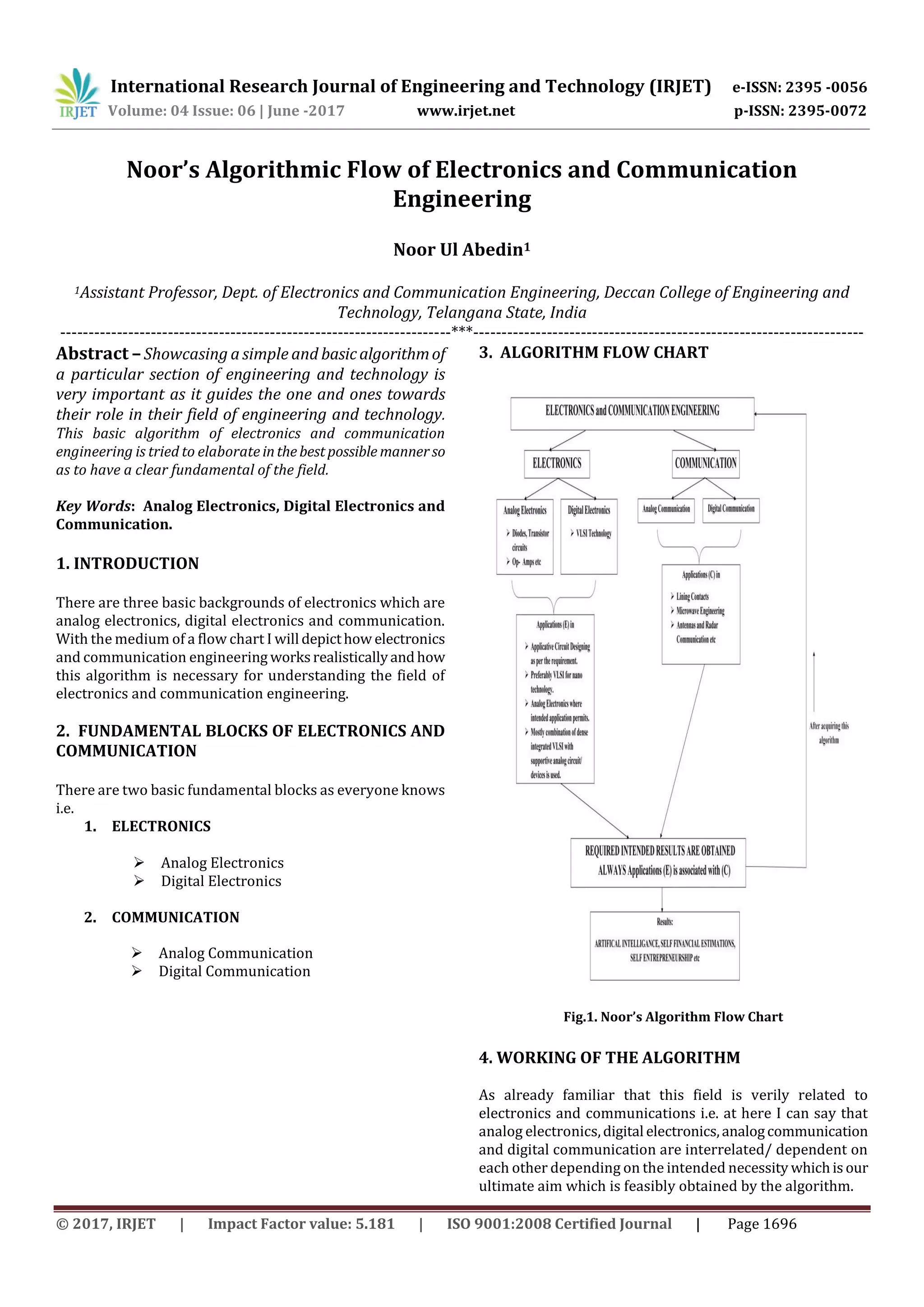
3. ALGORITHM FLOW CHART
Fig.1. Noor’s Algorithm Flow Chart
4. WORKING OF THE ALGORITHM
As already familiar that this field is verily related to
electronics and communications i.e. at here I can say that
analog electronics,digital electronics,analogcommunication
and digital communication are interrelated/ dependent on
each other depending on the intended necessity whichisour
ultimate aim which is feasibly obtained by the algorithm.
International Research Journal of Engineering and Technology (IRJET) e-ISSN: 2395 -0056
Volume: 04 Issue: 06 | June -2017 www.irjet.net p-ISSN: 2395-0072
© 2017, IRJET | Impact Factor value: 5.181 | ISO 9001:2008 Certified Journal | Page 1697
4.1. Analog and Digital Electronics
Preference to analog electronics is the basic fundamental
engineering step towards electronics and communicationas
its provides us an idea how basic circuit designing using
verily visible physical analog components is accomplished
further providing the basic background of understanding
op- amps and necessity of digital electronics.
Analog device and their circuits such as diode, transistors:
BJTs, FETs are majorly used in analog electronics as the key
analog elements supported byvarioussimpleandcompound
networks.
Major circuit works which required major analog device/
devices and their associatednetworksasstatedabovewould
be easily performed by using a single Op- amp IC, thus
reducing the amount number of analog devices, their
possible networks and also the size of the circuit.
No doubly Op- amp has eased the circuit designing butit was
limited to a certain extent, this extent was been able to
extended and bounded as per our needs with the help of
digital electronic leading to design dense integrated circuits
using CAD tools and ultimately leading to VLSI technology.
4.2. Analog and Digital Communication
Communication is the second major sector, when seeing a
communication system the two analog and digital
communication signals are commonly used together. As a
applicative system that processes a signal uses both the
signal converters the best elaborationisa DSPProcessorand
a TCP/ IP network.
The preference of going towards analog signalsistheregood
performance over longer distances and the on the other
hand use of digital signal makes it easier for the processorto
perform their functionalities.
Therefore in many of the systems we observetheuseofboth
analog and digital signals.
Fig.2. Data Communication System Model
4.3.ApplicationsofElectronics(E)andApplications
of Communication (C):
When the intended purpose fulfils with analog circuitry it
suits the best, when dense integration/ nano circuitry is
required we move onto digital circuitry and in majority of
the device we give preference to a circuitry which is digital
design with analog devices/ circuit. Similarly basedon these
the communication can be accomplished in many routes
such as lining and wireless. Microwave engineering,
Antennas and Radar are the major modes through which
high level is accomplished.
4.4. Result
When the topologies of analog and digital are verily
understood the engineer will have an exact result obtained
as per his desired application and purpose.
Engineering applications such as artificial intelligence, self-
financial estimation and self entrepreneurship and may
more can be easily framed and executed.
5. PRACTICAL COMPARISON
Illustrating with the help of a full adder,thefull addercanbe
implemented in by hardware selected ICs, in digital
electronics the same full adder can be implemented byusing
HDL.
The feasibility of digitally generatedfull adderismoreasthis
can be easily associated with anycomplexcircuitrywhere its
necessity is there and if not willingness to use can be easily
removed where as analyzing these particular aspects on
analog backgrounds becomes difficult and utilizes more
time.
Fig.3. Full Adder Logical Circuit Diagram
Table.1. Full Adder Truth Table
INPUTS OUTPUTS
A B CARRYINPUT SUM CARRYOUTPUT
0 0 0 0 0
0 0 1 1 0
0 1 0 1 0
International Research Journal of Engineering and Technology (IRJET) e-ISSN: 2395 -0056
Volume: 04 Issue: 06 | June -2017 www.irjet.net p-ISSN: 2395-0072
© 2017, IRJET | Impact Factor value: 5.181 | ISO 9001:2008 Certified Journal | Page 1698
0 1 1 0 1
1 0 0 1 0
1 0 1 0 1
1 1 0 0 1
1 1 1 1 1
Implementing a full adder on circuitboard we wouldrequire
IC 7408 for AND Gate, IC 7486 for EX - OR Gate and IC 7432
for OR Gate.
Using these ICs we are able to design a full adder on board
and verify its logic i.e. verifying its truth table.
The same results are easily obtained digitally with the help
of writing a Verilog HDL code for full Adder. Here full adder
is obtained by using two half adders h1 and h2 respectively.
Verilog HDL Description:
Module Program:
module halfadd (s, c, a, b);
input a,b;
output s,c;
assign s=a^b;
assign c=a&b;
endmodule
module fulladd (sum, carry, c, a, b);
input a, b, c;
output sum, carry;
wire w1,w2,w3;
halfadd h1(w1,w2,a,b);
halfadd h2(sum,w3,c,w1);
or (carry,w2,w3);
endmodule
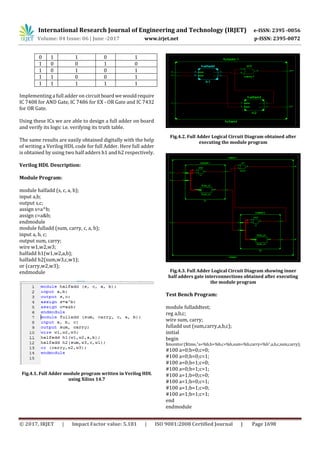
Fig.4.1. Full Adder module program written in Verilog HDL
using Xilinx 14.7
Fig.4.2. Full Adder Logical Circuit Diagram obtained after
executing the module program
Fig.4.3. Full Adder Logical Circuit Diagram showing inner
half adders gate interconnections obtained after executing
the module program
Test Bench Program:
module fulladdtest;
reg a,b,c;
wire sum, carry;
fulladd uut (sum,carry,a,b,c);
initial
begin
$monitor ($time,"a=%b,b=%b,c=%b,sum=%b,carry=%b",a,b,c,sum,carry);
#100 a=0;b=0;c=0;
#100 a=0;b=0;c=1;
#100 a=0;b=1;c=0;
#100 a=0;b=1;c=1;
#100 a=1;b=0;c=0;
#100 a=1;b=0;c=1;
#100 a=1;b=1;c=0;
#100 a=1;b=1;c=1;
end
endmodule
International Research Journal of Engineering and Technology (IRJET) e-ISSN: 2395 -0056
Volume: 04 Issue: 06 | June -2017 www.irjet.net p-ISSN: 2395-0072
© 2017, IRJET | Impact Factor value: 5.181 | ISO 9001:2008 Certified Journal | Page 1699
Fig.4.4. Full Adder test bench program written in Verilog
HDL using Xilinx 14.7
Fig.4.5. Timing diagram obtained after writing the test bench
showing the logical verification of the full adder
6. FUTURE SCOPE
Engineers and Engineering students can easily be able
design their own circuits and implement.Itwill becomevery
easier to showcase their engineering work as per the global
sections of electronics and communication engineering
7. CONCLUSION
The importance and use of analog, digital and their
combined effort is understood.
REFERENCES
[1]. Data and Computer Communication Networks by
William Stallings
[2]. Verilog HDL by Samir Palnitkar
[3]. A Verilog HDL Primer by J. Bhasker
[4]. Introduction to VLSI Circuits andSystemsbyJohnP.
Uyemura
[5]. VLSI Design by P Sahu
[6]. VLSI Design by M. Michael Vai
[7]. Digital Systems by Tocci & Widmer
[8]. Digital Design by Morris Mano
[9]. Digital Hardware Design by John B. Peatman
[10]. Antennas by John D Kraus, Ronald J Marhefka and
Ahmed S Khan
[11]. Antenna and Wave Propagation by K. D. Prasad
[12]. Antenna Theory by Constantine Balanis
[13]. Elements of Electromagnetics by Mattew N. O.
Sadiku
[14]. Fundamental of Electronic Circuits by Charles K.
Alexander and Mattew N. O. Sadiku
[15]. Electronic Devices and Circuits by Jacob Millman,
Christos C. Halkias and Satyarbrata Jit
[16]. Electronic Devices and Circuits by S. Salivahanan, N
Kumar and A Vallavaraj
[17]. Integrated Electronics by Jacob Millman, ChristosC.
Halkias and Chetan Parikh
[18]. Circuits and Networks by A Sudhakar and
Shyammohan S Palli
[19]. Engineering Circuit Analysis by W H Hayt,
J E Kemmerly and S M Durbin
[20]. Electronic Devices and Circuits by J B Gupta
BIOGRAPHY
Mr. Noor Ul Abedin is working as
an Assistant Professor in Dept. of
Electronics and Communication,
Deccan College of Engineering and
Technology. He’s field of interest
are Analog and Digital Electronics.
He has lectured and thought
variousengineeringsubjectswhich
include Anlaog Electronic Devices
& Circuits, VLSI Design, Networks
& Circuits, Antennas & Wave
Propagation, Electronic
Instrumentation, Automation in
Process Control, Power
Electronics, Digital Electronics &
Logic Design and LinearIntegrated
Circuits.

Noor’s Algorithmic Flow of Electronics and Communication Engineering

  • 1.
    International Research Journalof Engineering and Technology (IRJET) e-ISSN: 2395 -0056 Volume: 04 Issue: 06 | June -2017 www.irjet.net p-ISSN: 2395-0072 © 2017, IRJET | Impact Factor value: 5.181 | ISO 9001:2008 Certified Journal | Page 1696 Noor’s Algorithmic Flow of Electronics and Communication Engineering Noor Ul Abedin1 1Assistant Professor, Dept. of Electronics and Communication Engineering, Deccan College of Engineering and Technology, Telangana State, India ---------------------------------------------------------------------***--------------------------------------------------------------------- Abstract –Showcasing a simple and basicalgorithmof a particular section of engineering and technology is very important as it guides the one and ones towards their role in their field of engineering and technology. This basic algorithm of electronics and communication engineering is tried to elaborate inthebestpossible manner so as to have a clear fundamental of the field. Key Words: Analog Electronics, Digital Electronics and Communication. 1. INTRODUCTION There are three basic backgrounds of electronics which are analog electronics, digital electronics and communication. With the medium of a flow chart I will depicthow electronics and communication engineering worksrealisticallyandhow this algorithm is necessary for understanding the field of electronics and communication engineering. 2. FUNDAMENTAL BLOCKS OF ELECTRONICS AND COMMUNICATION There are two basic fundamental blocks as everyone knows i.e. 1. ELECTRONICS  Analog Electronics  Digital Electronics 2. COMMUNICATION  Analog Communication  Digital Communication 3. ALGORITHM FLOW CHART Fig.1. Noor’s Algorithm Flow Chart 4. WORKING OF THE ALGORITHM As already familiar that this field is verily related to electronics and communications i.e. at here I can say that analog electronics,digital electronics,analogcommunication and digital communication are interrelated/ dependent on each other depending on the intended necessity whichisour ultimate aim which is feasibly obtained by the algorithm.
  • 2.
    International Research Journalof Engineering and Technology (IRJET) e-ISSN: 2395 -0056 Volume: 04 Issue: 06 | June -2017 www.irjet.net p-ISSN: 2395-0072 © 2017, IRJET | Impact Factor value: 5.181 | ISO 9001:2008 Certified Journal | Page 1697 4.1. Analog and Digital Electronics Preference to analog electronics is the basic fundamental engineering step towards electronics and communicationas its provides us an idea how basic circuit designing using verily visible physical analog components is accomplished further providing the basic background of understanding op- amps and necessity of digital electronics. Analog device and their circuits such as diode, transistors: BJTs, FETs are majorly used in analog electronics as the key analog elements supported byvarioussimpleandcompound networks. Major circuit works which required major analog device/ devices and their associatednetworksasstatedabovewould be easily performed by using a single Op- amp IC, thus reducing the amount number of analog devices, their possible networks and also the size of the circuit. No doubly Op- amp has eased the circuit designing butit was limited to a certain extent, this extent was been able to extended and bounded as per our needs with the help of digital electronic leading to design dense integrated circuits using CAD tools and ultimately leading to VLSI technology. 4.2. Analog and Digital Communication Communication is the second major sector, when seeing a communication system the two analog and digital communication signals are commonly used together. As a applicative system that processes a signal uses both the signal converters the best elaborationisa DSPProcessorand a TCP/ IP network. The preference of going towards analog signalsistheregood performance over longer distances and the on the other hand use of digital signal makes it easier for the processorto perform their functionalities. Therefore in many of the systems we observetheuseofboth analog and digital signals. Fig.2. Data Communication System Model 4.3.ApplicationsofElectronics(E)andApplications of Communication (C): When the intended purpose fulfils with analog circuitry it suits the best, when dense integration/ nano circuitry is required we move onto digital circuitry and in majority of the device we give preference to a circuitry which is digital design with analog devices/ circuit. Similarly basedon these the communication can be accomplished in many routes such as lining and wireless. Microwave engineering, Antennas and Radar are the major modes through which high level is accomplished. 4.4. Result When the topologies of analog and digital are verily understood the engineer will have an exact result obtained as per his desired application and purpose. Engineering applications such as artificial intelligence, self- financial estimation and self entrepreneurship and may more can be easily framed and executed. 5. PRACTICAL COMPARISON Illustrating with the help of a full adder,thefull addercanbe implemented in by hardware selected ICs, in digital electronics the same full adder can be implemented byusing HDL. The feasibility of digitally generatedfull adderismoreasthis can be easily associated with anycomplexcircuitrywhere its necessity is there and if not willingness to use can be easily removed where as analyzing these particular aspects on analog backgrounds becomes difficult and utilizes more time. Fig.3. Full Adder Logical Circuit Diagram Table.1. Full Adder Truth Table INPUTS OUTPUTS A B CARRYINPUT SUM CARRYOUTPUT 0 0 0 0 0 0 0 1 1 0 0 1 0 1 0
  • 3.
    International Research Journalof Engineering and Technology (IRJET) e-ISSN: 2395 -0056 Volume: 04 Issue: 06 | June -2017 www.irjet.net p-ISSN: 2395-0072 © 2017, IRJET | Impact Factor value: 5.181 | ISO 9001:2008 Certified Journal | Page 1698 0 1 1 0 1 1 0 0 1 0 1 0 1 0 1 1 1 0 0 1 1 1 1 1 1 Implementing a full adder on circuitboard we wouldrequire IC 7408 for AND Gate, IC 7486 for EX - OR Gate and IC 7432 for OR Gate. Using these ICs we are able to design a full adder on board and verify its logic i.e. verifying its truth table. The same results are easily obtained digitally with the help of writing a Verilog HDL code for full Adder. Here full adder is obtained by using two half adders h1 and h2 respectively. Verilog HDL Description: Module Program: module halfadd (s, c, a, b); input a,b; output s,c; assign s=a^b; assign c=a&b; endmodule module fulladd (sum, carry, c, a, b); input a, b, c; output sum, carry; wire w1,w2,w3; halfadd h1(w1,w2,a,b); halfadd h2(sum,w3,c,w1); or (carry,w2,w3); endmodule Fig.4.1. Full Adder module program written in Verilog HDL using Xilinx 14.7 Fig.4.2. Full Adder Logical Circuit Diagram obtained after executing the module program Fig.4.3. Full Adder Logical Circuit Diagram showing inner half adders gate interconnections obtained after executing the module program Test Bench Program: module fulladdtest; reg a,b,c; wire sum, carry; fulladd uut (sum,carry,a,b,c); initial begin $monitor ($time,"a=%b,b=%b,c=%b,sum=%b,carry=%b",a,b,c,sum,carry); #100 a=0;b=0;c=0; #100 a=0;b=0;c=1; #100 a=0;b=1;c=0; #100 a=0;b=1;c=1; #100 a=1;b=0;c=0; #100 a=1;b=0;c=1; #100 a=1;b=1;c=0; #100 a=1;b=1;c=1; end endmodule
  • 4.
    International Research Journalof Engineering and Technology (IRJET) e-ISSN: 2395 -0056 Volume: 04 Issue: 06 | June -2017 www.irjet.net p-ISSN: 2395-0072 © 2017, IRJET | Impact Factor value: 5.181 | ISO 9001:2008 Certified Journal | Page 1699 Fig.4.4. Full Adder test bench program written in Verilog HDL using Xilinx 14.7 Fig.4.5. Timing diagram obtained after writing the test bench showing the logical verification of the full adder 6. FUTURE SCOPE Engineers and Engineering students can easily be able design their own circuits and implement.Itwill becomevery easier to showcase their engineering work as per the global sections of electronics and communication engineering 7. CONCLUSION The importance and use of analog, digital and their combined effort is understood. REFERENCES [1]. Data and Computer Communication Networks by William Stallings [2]. Verilog HDL by Samir Palnitkar [3]. A Verilog HDL Primer by J. Bhasker [4]. Introduction to VLSI Circuits andSystemsbyJohnP. Uyemura [5]. VLSI Design by P Sahu [6]. VLSI Design by M. Michael Vai [7]. Digital Systems by Tocci & Widmer [8]. Digital Design by Morris Mano [9]. Digital Hardware Design by John B. Peatman [10]. Antennas by John D Kraus, Ronald J Marhefka and Ahmed S Khan [11]. Antenna and Wave Propagation by K. D. Prasad [12]. Antenna Theory by Constantine Balanis [13]. Elements of Electromagnetics by Mattew N. O. Sadiku [14]. Fundamental of Electronic Circuits by Charles K. Alexander and Mattew N. O. Sadiku [15]. Electronic Devices and Circuits by Jacob Millman, Christos C. Halkias and Satyarbrata Jit [16]. Electronic Devices and Circuits by S. Salivahanan, N Kumar and A Vallavaraj [17]. Integrated Electronics by Jacob Millman, ChristosC. Halkias and Chetan Parikh [18]. Circuits and Networks by A Sudhakar and Shyammohan S Palli [19]. Engineering Circuit Analysis by W H Hayt, J E Kemmerly and S M Durbin [20]. Electronic Devices and Circuits by J B Gupta BIOGRAPHY Mr. Noor Ul Abedin is working as an Assistant Professor in Dept. of Electronics and Communication, Deccan College of Engineering and Technology. He’s field of interest are Analog and Digital Electronics. He has lectured and thought variousengineeringsubjectswhich include Anlaog Electronic Devices & Circuits, VLSI Design, Networks & Circuits, Antennas & Wave Propagation, Electronic Instrumentation, Automation in Process Control, Power Electronics, Digital Electronics & Logic Design and LinearIntegrated Circuits.