WEEK 5
PRESENTED BY GROUP 5:
• MIGUEL ABRAM AGNO
ADERIEYAN TIMOTHY DELA ROSA
ALFONSO AUREL LAPINORIA
MIGUEL JOSE MANCENIDO
LANCE JOSHUA RIVERA
PAUL JERICHO VALE
FORM AND CONTENT
Form and content are the basic components of any work of art. Their careful examination is an
important starting point in visual analysis. In some cases, the condition of a work, conservation,
and scientific tools may provide additional information. Form includes the elements of design,
which are arranged, based on principles of design, to create a composition
ELEMENTS OF DESIGN
Elements of design are the means employed by artists to express their ideas. They are critical to the
overall visual aspects and play a significant role in viewers’ response to art. They include
-line
-color
-space
-shapes
-light
-texture
-pattern
-time and motion
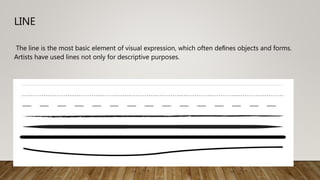
LINE
The line is the most basic element of visual expression, which often defines objects and forms.
Artists have used lines not only for descriptive purposes.
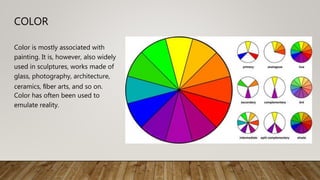
COLOR
Color is mostly associated with
painting. It is, however, also widely
used in sculptures, works made of
glass, photography, architecture,
ceramics, fiber arts, and so on.
Color has often been used to
emulate reality.
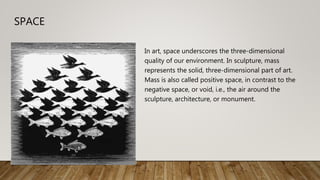
SPACE
In art, space underscores the three-dimensional
quality of our environment. In sculpture, mass
represents the solid, three-dimensional part of art.
Mass is also called positive space, in contrast to the
negative space, or void, i.e., the air around the
sculpture, architecture, or monument.
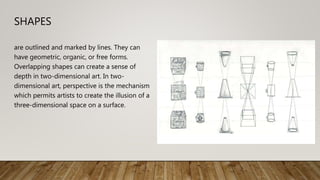
SHAPES
are outlined and marked by lines. They can
have geometric, organic, or free forms.
Overlapping shapes can create a sense of
depth in two-dimensional art. In two-
dimensional art, perspective is the mechanism
which permits artists to create the illusion of a
three-dimensional space on a surface.
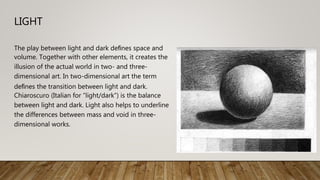
LIGHT
The play between light and dark defines space and
volume. Together with other elements, it creates the
illusion of the actual world in two- and three-
dimensional art. In two-dimensional art the term
defines the transition between light and dark.
Chiaroscuro (Italian for “light/dark”) is the balance
between light and dark. Light also helps to underline
the differences between mass and void in three-
dimensional works.
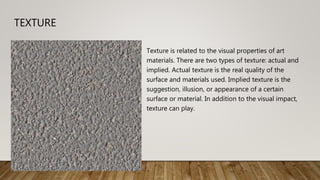
TEXTURE
Texture is related to the visual properties of art
materials. There are two types of texture: actual and
implied. Actual texture is the real quality of the
surface and materials used. Implied texture is the
suggestion, illusion, or appearance of a certain
surface or material. In addition to the visual impact,
texture can play.
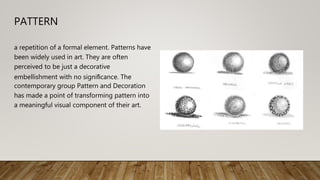
PATTERN
a repetition of a formal element. Patterns have
been widely used in art. They are often
perceived to be just a decorative
embellishment with no significance. The
contemporary group Pattern and Decoration
has made a point of transforming pattern into
a meaningful visual component of their art.
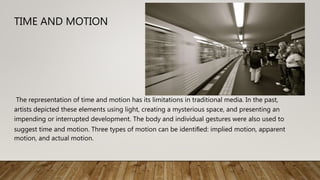
TIME AND MOTION
The representation of time and motion has its limitations in traditional media. In the past,
artists depicted these elements using light, creating a mysterious space, and presenting an
impending or interrupted development. The body and individual gestures were also used to
suggest time and motion. Three types of motion can be identified: implied motion, apparent
motion, and actual motion.
TIMELINE OF
GREEK
SCULPTURES AND
BUILDINGS
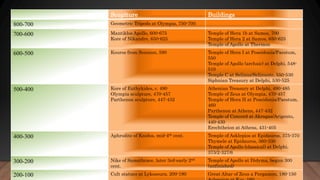
Scuplture Buildings
800-700 Geometric Tripods at Olympia, 750-700
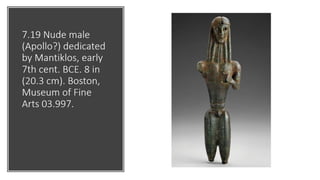
700-600 Mantiklos Apollo, 600-675
Kore of Nikandre, 650-625
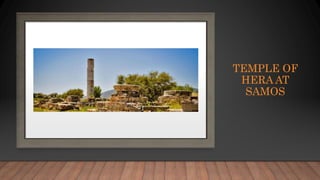
Temple of Hera 1b at Samos, 700
Temple of Hera 2 at Samos, 650-625
Temple of Apollo at Thermon
600-500 Kouros from Sounion, 590 Temple of Hera I at Poseidonia/Paestum,
550
Temple of Apollo (archaic) at Delphi, 548-
510
Temple C at Selinus/Selinunte, 550-530
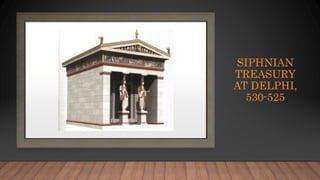
Siphnian Treasury at Delphi, 530-525
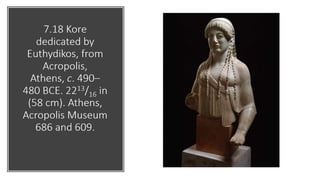
500-400 Kore of Euthykides, c. 490
Olympia sculpture, 470-457
Parthenon sculpture, 447-432
Athenian Treasury at Delphi, 490-485
Temple of Zeus at Olympia, 470-457
Temple of Hera II at Poseidonia/Paestum,
460
Parthenon at Athens, 447-432
Temple of Concord at Akragas/Arigento,
440-430
Erechtheion at Athens, 431-405
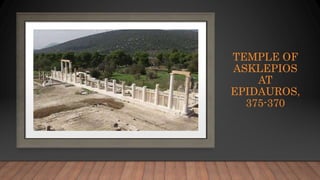
400-300 Aphrodite of Knidos, mid-4th cent. Temple of Asklepios at Epidauros, 375-370
Thymele at Epidauros, 360-330
Temple of Apollo (classical) at Delphi,
373/2-327/6
300-200 Nike of Samothrace, later 3rd-early 2nd
cent.
Temple of Apollo at Didyma, begun 300
(unfinished)
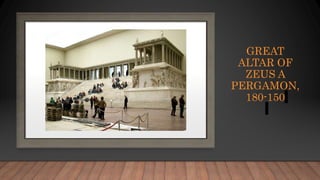
200-100 Cult statues at Lykosoura. 200-190 Great Altar of Zeus a Pergamon, 180-150
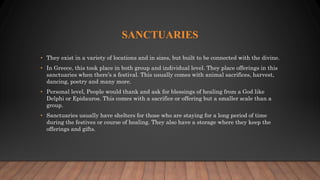
SANCTUARIES
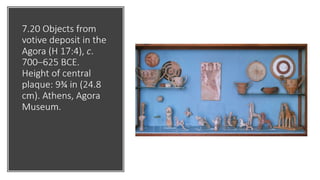
• They exist in a variety of locations and in sizes, but built to be connected with the divine.
• In Greece, this took place in both group and individual level. They place offerings in this
sanctuaries when there’s a festival. This usually comes with animal sacrifices, harvest,
dancing, poetry and many more.
• Personal level, People would thank and ask for blessings of healing from a God like
Delphi or Epidauros. This comes with a sacrifice or offering but a smaller scale than a
group.
• Sanctuaries usually have shelters for those who are staying for a long period of time
during the festives or course of healing. They also have a storage where they keep the
offerings and gifts.
SCULPTURES
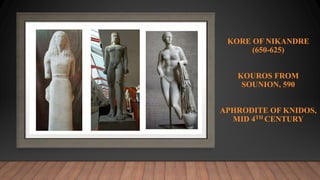
KORE OF NIKANDRE
(650-625)
KOUROS FROM
SOUNION, 590
APHRODITE OF KNIDOS,
MID 4TH CENTURY
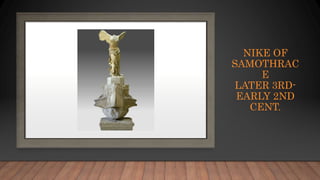
NIKE OF
SAMOTHRAC
E
LATER 3RD-
EARLY 2ND
CENT.
BUILDINGS
TEMPLE OF
HERA AT
SAMOS
SIPHNIAN
TREASURY
AT DELPHI,
530-525
TEMPLE OF
ASKLEPIOS
AT
EPIDAUROS,
375-370
GREAT
ALTAR OF
ZEUS A
PERGAMON,
180-150
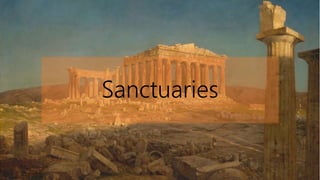
Sanctuaries
What are sanctuaries ?
• Sanctuaries exist in a variety of locations and sizes, but all can be
said to be places that are set apart from ordinary life in which
humans can connect with the divine.
• Most communal activities took place in the open air, so that
sanctuaries were generally defined precincts with paths for
circulation and open areas for gathering, as well as a collection of
support structures that additionally served as a stage setting for
the activities.
• In looking at a sanctuary, then, one must consider it both
diachronically, as it developed from one point in time to the next,
and synchronically, as a pastiche of works and buildings from
different periods that existed concurrently with each other.
Communal acts
• Processions
• Performances of choral songs or plays
• Sacrifices of animals or harvest followed by communal
feasting
• Dedications of gifts
• Competitions in both athletics and the arts, including music,
poetry, drama, and dance
Architectural aspect of the sanctuary
• The sanctuary or temenos is usually defined by walls or
boundary markers to distinguish the sacred space clearly.
• Entrances are limited and regulate the flow of traffic, which
will be set on pathways that provide an order to the visit or
ritual.
• The most essential ritual feature of the sanctuary is its altar,
where sacrifices take place outside before the assembled
participants.
Architectural aspect of the sanctuary
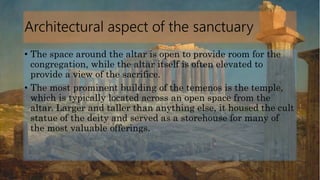
• The space around the altar is open to provide room for the
congregation, while the altar itself is often elevated to
provide a view of the sacrifice.
• The most prominent building of the temenos is the temple,
which is typically located across an open space from the
altar. Larger and taller than anything else, it housed the cult
statue of the deity and served as a storehouse for many of
the most valuable offerings.
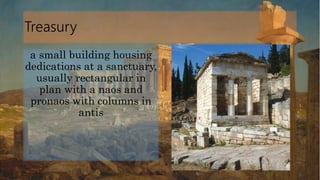
Treasury
a small building housing
dedications at a sanctuary,
usually rectangular in
plan with a naos and
pronaos with columns in
antis
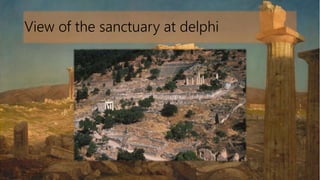
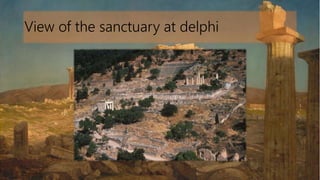
View of the sanctuary at delphi
Delphi
• According to mythology, Delphi was the center of the earth,
the omphalos, which was guarded by a serpent, Python, son
of Gaia. He was killed by Apollo, who took over the sanctuary
and, most important, its prophetic function.
• The priestess, called the Pythia, pronounced the oracles,
which frequently had an obtuse and hard-to-decipher quality
about them. These oracles were held as sacred by cities
throughout Greece, who often sent for a pronouncement from
the Pythia before a major undertaking such as war or
colonization. As a rural site that was not associated with a
specific major city, the sanctuary became Panhellenic.
Olympic games
• After a reorganization around 582 bce, quadrennial athletic
games took place midway between the Olympic Games.
Additional athletic contests were organized in the sixth
century at Isthmia and Nemea during the odd years between
the Olympic and Pythian games, and the sites together
constituted the four crown games of ancient Greece,
referencing the crowns of olive, laurel, or celery awarded at
each site.
View of the sanctuary at delphi
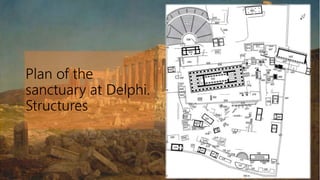
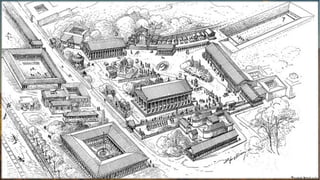
Plan of the
sanctuary at Delphi.
Structures
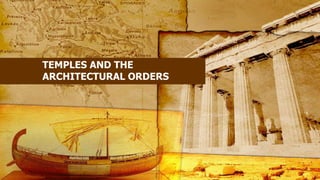
TEMPLES AND THE
ARCHITECTURAL ORDERS
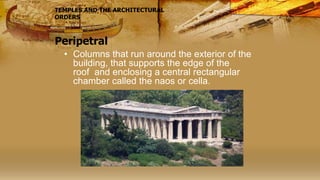
Peripetral
• Columns that run around the exterior of the
building, that supports the edge of the
roof and enclosing a central rectangular
chamber called the naos or cella.
TEMPLES AND THE ARCHITECTURAL
ORDERS
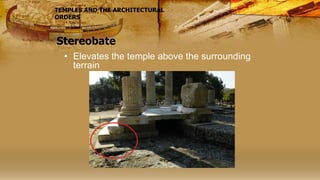
Stereobate
• Elevates the temple above the surrounding
terrain
TEMPLES AND THE ARCHITECTURAL
ORDERS
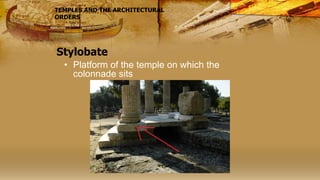
Stylobate
• Platform of the temple on which the
colonnade sits
TEMPLES AND THE ARCHITECTURAL
ORDERS
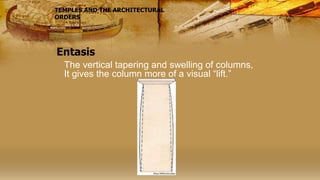
Entasis
The vertical tapering and swelling of columns,
It gives the column more of a visual “lift.”
TEMPLES AND THE ARCHITECTURAL
ORDERS
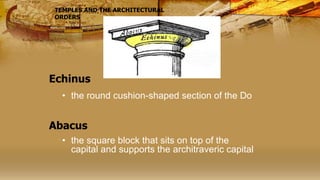
Echinus
• the round cushion-shaped section of the Do
• the square block that sits on top of the
capital and supports the architraveric capital
TEMPLES AND THE ARCHITECTURAL
ORDERS
Abacus
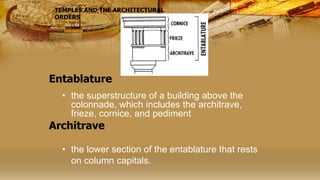
Entablature
• the superstructure of a building above the
colonnade, which includes the architrave,
frieze, cornice, and pediment
• the lower section of the entablature that rests
on column capitals.
TEMPLES AND THE ARCHITECTURAL
ORDERS
Architrave
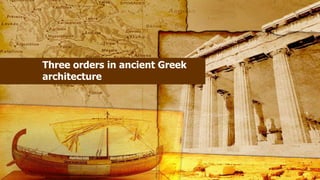
Three orders in ancient Greek
architecture
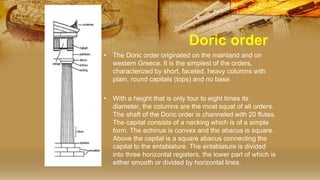
Doric order
• The Doric order originated on the mainland and on
western Greece. It is the simplest of the orders,
characterized by short, faceted, heavy columns with
plain, round capitals (tops) and no base.
• With a height that is only four to eight times its
diameter, the columns are the most squat of all orders.
The shaft of the Doric order is channeled with 20 flutes.
The capital consists of a necking which is of a simple
form. The echinus is convex and the abacus is square.
Above the capital is a square abacus connecting the
capital to the entablature. The entablature is divided
into three horizontal registers, the lower part of which is
either smooth or divided by horizontal lines.
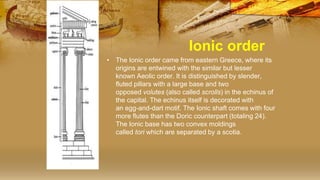
Ionic order
• The Ionic order came from eastern Greece, where its
origins are entwined with the similar but lesser
known Aeolic order. It is distinguished by slender,
fluted pillars with a large base and two
opposed volutes (also called scrolls) in the echinus of
the capital. The echinus itself is decorated with
an egg-and-dart motif. The Ionic shaft comes with four
more flutes than the Doric counterpart (totaling 24).
The Ionic base has two convex moldings
called tori which are separated by a scotia.
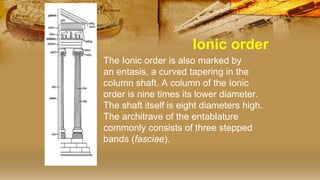
Ionic order
• The Ionic order is also marked by
an entasis, a curved tapering in the
column shaft. A column of the Ionic
order is nine times its lower diameter.
The shaft itself is eight diameters high.
The architrave of the entablature
commonly consists of three stepped
bands (fasciae).
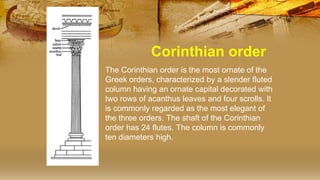
Corinthian order
• The Corinthian order is the most ornate of the
Greek orders, characterized by a slender fluted
column having an ornate capital decorated with
two rows of acanthus leaves and four scrolls. It
is commonly regarded as the most elegant of
the three orders. The shaft of the Corinthian
order has 24 flutes. The column is commonly
ten diameters high.
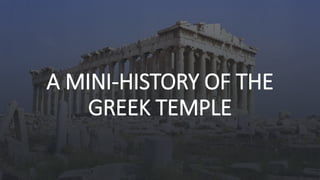
A MINI-HISTORY OF THE
GREEK TEMPLE
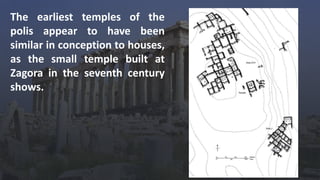
The earliest temples of the
polis appear to have been
similar in conception to houses,
as the small temple built at
Zagora in the seventh century
shows.
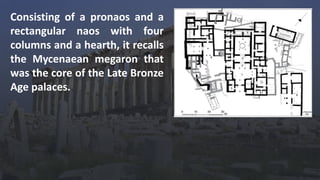
Consisting of a pronaos and a
rectangular naos with four
columns and a hearth, it recalls
the Mycenaean megaron that
was the core of the Late Bronze
Age palaces.
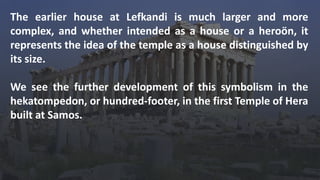
The earlier house at Lefkandi is much larger and more
complex, and whether intended as a house or a heroön, it
represents the idea of the temple as a house distinguished by
its size.
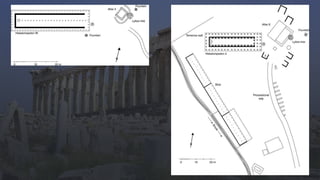
We see the further development of this symbolism in the
hekatompedon, or hundred-footer, in the first Temple of Hera
built at Samos.
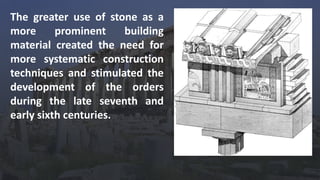
The greater use of stone as a
more prominent building
material created the need for
more systematic construction
techniques and stimulated the
development of the orders
during the late seventh and
early sixth centuries.
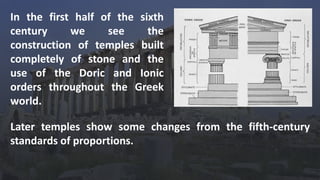
In the first half of the sixth
century we see the
construction of temples built
completely of stone and the
use of the Doric and Ionic
orders throughout the Greek
world.
Later temples show some changes from the fifth-century
standards of proportions.
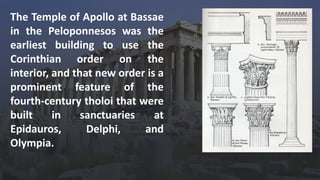
The Temple of Apollo at Bassae
in the Peloponnesos was the
earliest building to use the
Corinthian order on the
interior, and that new order is a
prominent feature of the
fourth-century tholoi that were
built in sanctuaries at
Epidauros, Delphi, and
Olympia.
Siting continues to be a major consideration and can be seen
in Hellenistic examples of temple architecture.
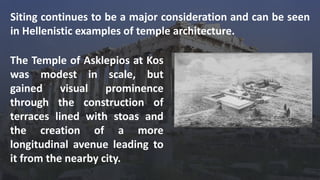
The Temple of Asklepios at Kos
was modest in scale, but
gained visual prominence
through the construction of
terraces lined with stoas and
the creation of a more
longitudinal avenue leading to
it from the nearby city.
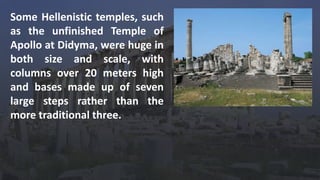
Some Hellenistic temples, such
as the unfinished Temple of
Apollo at Didyma, were huge in
both size and scale, with
columns over 20 meters high
and bases made up of seven
large steps rather than the
more traditional three.
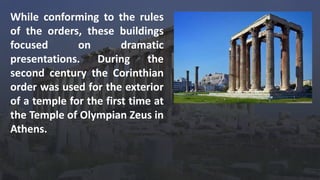
While conforming to the rules
of the orders, these buildings
focused on dramatic
presentations. During the
second century the Corinthian
order was used for the exterior
of a temple for the first time at
the Temple of Olympian Zeus in
Athens.
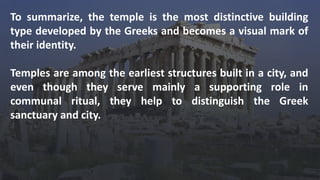
To summarize, the temple is the most distinctive building
type developed by the Greeks and becomes a visual mark of
their identity.
Temples are among the earliest structures built in a city, and
even though they serve mainly a supporting role in
communal ritual, they help to distinguish the Greek
sanctuary and city.
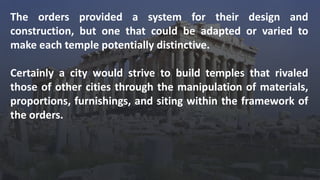
The orders provided a system for their design and
construction, but one that could be adapted or varied to
make each temple potentially distinctive.
Certainly a city would strive to build temples that rivaled
those of other cities through the manipulation of materials,
proportions, furnishings, and siting within the framework of
the orders.
Week 5 by group 5
Week 5 by group 5
Week 5 by group 5
Week 5 by group 5
Week 5 by group 5
Week 5 by group 5
Week 5 by group 5

Week 5 by group 5

  • 1.
    WEEK 5 PRESENTED BYGROUP 5: • MIGUEL ABRAM AGNO ADERIEYAN TIMOTHY DELA ROSA ALFONSO AUREL LAPINORIA MIGUEL JOSE MANCENIDO LANCE JOSHUA RIVERA PAUL JERICHO VALE
  • 2.
    FORM AND CONTENT Formand content are the basic components of any work of art. Their careful examination is an important starting point in visual analysis. In some cases, the condition of a work, conservation, and scientific tools may provide additional information. Form includes the elements of design, which are arranged, based on principles of design, to create a composition
  • 3.
    ELEMENTS OF DESIGN Elementsof design are the means employed by artists to express their ideas. They are critical to the overall visual aspects and play a significant role in viewers’ response to art. They include -line -color -space -shapes -light -texture -pattern -time and motion
  • 4.
    LINE The line isthe most basic element of visual expression, which often defines objects and forms. Artists have used lines not only for descriptive purposes.
  • 5.
    COLOR Color is mostlyassociated with painting. It is, however, also widely used in sculptures, works made of glass, photography, architecture, ceramics, fiber arts, and so on. Color has often been used to emulate reality.
  • 6.
    SPACE In art, spaceunderscores the three-dimensional quality of our environment. In sculpture, mass represents the solid, three-dimensional part of art. Mass is also called positive space, in contrast to the negative space, or void, i.e., the air around the sculpture, architecture, or monument.
  • 7.
    SHAPES are outlined andmarked by lines. They can have geometric, organic, or free forms. Overlapping shapes can create a sense of depth in two-dimensional art. In two- dimensional art, perspective is the mechanism which permits artists to create the illusion of a three-dimensional space on a surface.
  • 8.
    LIGHT The play betweenlight and dark defines space and volume. Together with other elements, it creates the illusion of the actual world in two- and three- dimensional art. In two-dimensional art the term defines the transition between light and dark. Chiaroscuro (Italian for “light/dark”) is the balance between light and dark. Light also helps to underline the differences between mass and void in three- dimensional works.
  • 9.
    TEXTURE Texture is relatedto the visual properties of art materials. There are two types of texture: actual and implied. Actual texture is the real quality of the surface and materials used. Implied texture is the suggestion, illusion, or appearance of a certain surface or material. In addition to the visual impact, texture can play.
  • 10.
    PATTERN a repetition ofa formal element. Patterns have been widely used in art. They are often perceived to be just a decorative embellishment with no significance. The contemporary group Pattern and Decoration has made a point of transforming pattern into a meaningful visual component of their art.
  • 11.
    TIME AND MOTION Therepresentation of time and motion has its limitations in traditional media. In the past, artists depicted these elements using light, creating a mysterious space, and presenting an impending or interrupted development. The body and individual gestures were also used to suggest time and motion. Three types of motion can be identified: implied motion, apparent motion, and actual motion.
  • 12.
  • 13.
    Scuplture Buildings 800-700 GeometricTripods at Olympia, 750-700 700-600 Mantiklos Apollo, 600-675 Kore of Nikandre, 650-625 Temple of Hera 1b at Samos, 700 Temple of Hera 2 at Samos, 650-625 Temple of Apollo at Thermon 600-500 Kouros from Sounion, 590 Temple of Hera I at Poseidonia/Paestum, 550 Temple of Apollo (archaic) at Delphi, 548- 510 Temple C at Selinus/Selinunte, 550-530 Siphnian Treasury at Delphi, 530-525 500-400 Kore of Euthykides, c. 490 Olympia sculpture, 470-457 Parthenon sculpture, 447-432 Athenian Treasury at Delphi, 490-485 Temple of Zeus at Olympia, 470-457 Temple of Hera II at Poseidonia/Paestum, 460 Parthenon at Athens, 447-432 Temple of Concord at Akragas/Arigento, 440-430 Erechtheion at Athens, 431-405 400-300 Aphrodite of Knidos, mid-4th cent. Temple of Asklepios at Epidauros, 375-370 Thymele at Epidauros, 360-330 Temple of Apollo (classical) at Delphi, 373/2-327/6 300-200 Nike of Samothrace, later 3rd-early 2nd cent. Temple of Apollo at Didyma, begun 300 (unfinished) 200-100 Cult statues at Lykosoura. 200-190 Great Altar of Zeus a Pergamon, 180-150
  • 14.
    SANCTUARIES • They existin a variety of locations and in sizes, but built to be connected with the divine. • In Greece, this took place in both group and individual level. They place offerings in this sanctuaries when there’s a festival. This usually comes with animal sacrifices, harvest, dancing, poetry and many more. • Personal level, People would thank and ask for blessings of healing from a God like Delphi or Epidauros. This comes with a sacrifice or offering but a smaller scale than a group. • Sanctuaries usually have shelters for those who are staying for a long period of time during the festives or course of healing. They also have a storage where they keep the offerings and gifts.
  • 15.
  • 16.
    KORE OF NIKANDRE (650-625) KOUROSFROM SOUNION, 590 APHRODITE OF KNIDOS, MID 4TH CENTURY
  • 17.
  • 18.
  • 19.
  • 20.
  • 21.
  • 22.
  • 23.
  • 24.
    What are sanctuaries? • Sanctuaries exist in a variety of locations and sizes, but all can be said to be places that are set apart from ordinary life in which humans can connect with the divine. • Most communal activities took place in the open air, so that sanctuaries were generally defined precincts with paths for circulation and open areas for gathering, as well as a collection of support structures that additionally served as a stage setting for the activities. • In looking at a sanctuary, then, one must consider it both diachronically, as it developed from one point in time to the next, and synchronically, as a pastiche of works and buildings from different periods that existed concurrently with each other.
  • 25.
    Communal acts • Processions •Performances of choral songs or plays • Sacrifices of animals or harvest followed by communal feasting • Dedications of gifts • Competitions in both athletics and the arts, including music, poetry, drama, and dance
  • 26.
    Architectural aspect ofthe sanctuary • The sanctuary or temenos is usually defined by walls or boundary markers to distinguish the sacred space clearly. • Entrances are limited and regulate the flow of traffic, which will be set on pathways that provide an order to the visit or ritual. • The most essential ritual feature of the sanctuary is its altar, where sacrifices take place outside before the assembled participants.
  • 27.
    Architectural aspect ofthe sanctuary • The space around the altar is open to provide room for the congregation, while the altar itself is often elevated to provide a view of the sacrifice. • The most prominent building of the temenos is the temple, which is typically located across an open space from the altar. Larger and taller than anything else, it housed the cult statue of the deity and served as a storehouse for many of the most valuable offerings.
  • 28.
    Treasury a small buildinghousing dedications at a sanctuary, usually rectangular in plan with a naos and pronaos with columns in antis
  • 29.
    View of thesanctuary at delphi
  • 30.
    Delphi • According tomythology, Delphi was the center of the earth, the omphalos, which was guarded by a serpent, Python, son of Gaia. He was killed by Apollo, who took over the sanctuary and, most important, its prophetic function. • The priestess, called the Pythia, pronounced the oracles, which frequently had an obtuse and hard-to-decipher quality about them. These oracles were held as sacred by cities throughout Greece, who often sent for a pronouncement from the Pythia before a major undertaking such as war or colonization. As a rural site that was not associated with a specific major city, the sanctuary became Panhellenic.
  • 31.
    Olympic games • Aftera reorganization around 582 bce, quadrennial athletic games took place midway between the Olympic Games. Additional athletic contests were organized in the sixth century at Isthmia and Nemea during the odd years between the Olympic and Pythian games, and the sites together constituted the four crown games of ancient Greece, referencing the crowns of olive, laurel, or celery awarded at each site.
  • 32.
    View of thesanctuary at delphi
  • 33.
    Plan of the sanctuaryat Delphi. Structures
  • 35.
  • 36.
    Peripetral • Columns thatrun around the exterior of the building, that supports the edge of the roof and enclosing a central rectangular chamber called the naos or cella. TEMPLES AND THE ARCHITECTURAL ORDERS
  • 37.
    Stereobate • Elevates thetemple above the surrounding terrain TEMPLES AND THE ARCHITECTURAL ORDERS
  • 38.
    Stylobate • Platform ofthe temple on which the colonnade sits TEMPLES AND THE ARCHITECTURAL ORDERS
  • 39.
    Entasis The vertical taperingand swelling of columns, It gives the column more of a visual “lift.” TEMPLES AND THE ARCHITECTURAL ORDERS
  • 40.
    Echinus • the roundcushion-shaped section of the Do • the square block that sits on top of the capital and supports the architraveric capital TEMPLES AND THE ARCHITECTURAL ORDERS Abacus
  • 41.
    Entablature • the superstructureof a building above the colonnade, which includes the architrave, frieze, cornice, and pediment • the lower section of the entablature that rests on column capitals. TEMPLES AND THE ARCHITECTURAL ORDERS Architrave
  • 42.
    Three orders inancient Greek architecture
  • 43.
    Doric order • TheDoric order originated on the mainland and on western Greece. It is the simplest of the orders, characterized by short, faceted, heavy columns with plain, round capitals (tops) and no base. • With a height that is only four to eight times its diameter, the columns are the most squat of all orders. The shaft of the Doric order is channeled with 20 flutes. The capital consists of a necking which is of a simple form. The echinus is convex and the abacus is square. Above the capital is a square abacus connecting the capital to the entablature. The entablature is divided into three horizontal registers, the lower part of which is either smooth or divided by horizontal lines.
  • 44.
    Ionic order • TheIonic order came from eastern Greece, where its origins are entwined with the similar but lesser known Aeolic order. It is distinguished by slender, fluted pillars with a large base and two opposed volutes (also called scrolls) in the echinus of the capital. The echinus itself is decorated with an egg-and-dart motif. The Ionic shaft comes with four more flutes than the Doric counterpart (totaling 24). The Ionic base has two convex moldings called tori which are separated by a scotia.
  • 45.
    Ionic order • TheIonic order is also marked by an entasis, a curved tapering in the column shaft. A column of the Ionic order is nine times its lower diameter. The shaft itself is eight diameters high. The architrave of the entablature commonly consists of three stepped bands (fasciae).
  • 46.
    Corinthian order • TheCorinthian order is the most ornate of the Greek orders, characterized by a slender fluted column having an ornate capital decorated with two rows of acanthus leaves and four scrolls. It is commonly regarded as the most elegant of the three orders. The shaft of the Corinthian order has 24 flutes. The column is commonly ten diameters high.
  • 47.
    A MINI-HISTORY OFTHE GREEK TEMPLE
  • 48.
    The earliest templesof the polis appear to have been similar in conception to houses, as the small temple built at Zagora in the seventh century shows.
  • 49.
    Consisting of apronaos and a rectangular naos with four columns and a hearth, it recalls the Mycenaean megaron that was the core of the Late Bronze Age palaces.
  • 50.
    The earlier houseat Lefkandi is much larger and more complex, and whether intended as a house or a heroön, it represents the idea of the temple as a house distinguished by its size. We see the further development of this symbolism in the hekatompedon, or hundred-footer, in the first Temple of Hera built at Samos.
  • 52.
    The greater useof stone as a more prominent building material created the need for more systematic construction techniques and stimulated the development of the orders during the late seventh and early sixth centuries.
  • 53.
    In the firsthalf of the sixth century we see the construction of temples built completely of stone and the use of the Doric and Ionic orders throughout the Greek world. Later temples show some changes from the fifth-century standards of proportions.
  • 54.
    The Temple ofApollo at Bassae in the Peloponnesos was the earliest building to use the Corinthian order on the interior, and that new order is a prominent feature of the fourth-century tholoi that were built in sanctuaries at Epidauros, Delphi, and Olympia.
  • 55.
    Siting continues tobe a major consideration and can be seen in Hellenistic examples of temple architecture. The Temple of Asklepios at Kos was modest in scale, but gained visual prominence through the construction of terraces lined with stoas and the creation of a more longitudinal avenue leading to it from the nearby city.
  • 56.
    Some Hellenistic temples,such as the unfinished Temple of Apollo at Didyma, were huge in both size and scale, with columns over 20 meters high and bases made up of seven large steps rather than the more traditional three.
  • 57.
    While conforming tothe rules of the orders, these buildings focused on dramatic presentations. During the second century the Corinthian order was used for the exterior of a temple for the first time at the Temple of Olympian Zeus in Athens.
  • 58.
    To summarize, thetemple is the most distinctive building type developed by the Greeks and becomes a visual mark of their identity. Temples are among the earliest structures built in a city, and even though they serve mainly a supporting role in communal ritual, they help to distinguish the Greek sanctuary and city.
  • 59.
    The orders provideda system for their design and construction, but one that could be adapted or varied to make each temple potentially distinctive. Certainly a city would strive to build temples that rivaled those of other cities through the manipulation of materials, proportions, furnishings, and siting within the framework of the orders.