Creating Powerful Learning
Experiences Through
Integration

Week #3: Synthesis of New Knowledge
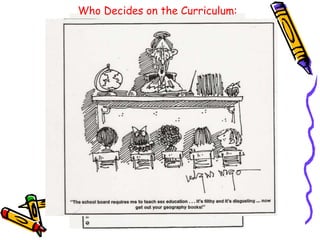
Who Decides on the Curriculum:
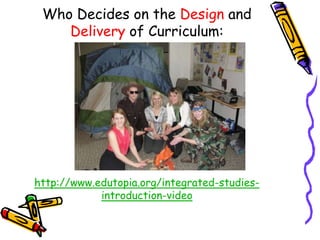
Who Decides on the Design and
Delivery of Curriculum:

http://www.edutopia.org/integrated-studiesintroduction-video
MAINSTREAM
by Yothu Yindi
Reflection in the water I see
Six pretty girls on my mind today
Yellow foam floating down the river
Voices I hear of Yolngu heroes
Go go go go living in the mainstream,
Go go go go under one dream
Monsoon clouds rolling over the ocean
Thunder and rain raging here tonight
Hear the sound of speargrass crying
Cross rivers and valleys on Yolngu land
Go go go go living in the mainstream,
Go go go go under one dream
Reflections in the water we see
Black and white living together
Sharing dreams of the red, black and gold
Living dreamtime now is the Yolngu way
Go go go go living in the mainstream,
Go go go go under one dream
We‟re living together, We‟re living together
We‟re learning together, We‟re living together
Yolngu Balanda
This is Australia
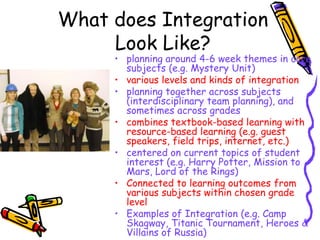
What does Integration
Look Like?

• planning around 4-6 week themes in core
subjects (e.g. Mystery Unit)
• various levels and kinds of integration
• planning together across subjects
(interdisciplinary team planning), and
sometimes across grades
• combines textbook-based learning with
resource-based learning (e.g. guest
speakers, field trips, internet, etc.)
• centered on current topics of student
interest (e.g. Harry Potter, Mission to
Mars, Lord of the Rings)
• Connected to learning outcomes from
various subjects within chosen grade
level
• Examples of Integration (e.g. Camp
Skagway, Titanic Tournament, Heroes &
Villains of Russia)
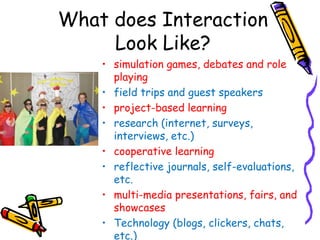
What does Interaction
Look Like?
• simulation games, debates and role
playing
• field trips and guest speakers
• project-based learning
• research (internet, surveys,
interviews, etc.)
• cooperative learning
• reflective journals, self-evaluations,
etc.
• multi-media presentations, fairs, and
showcases
• Technology (blogs, clickers, chats,
etc.)
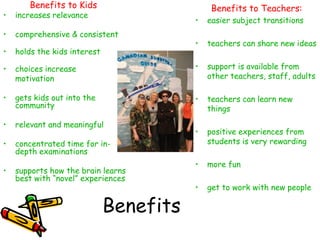
Benefits to Kids

Benefits to Teachers:

•

increases relevance

•

comprehensive & consistent

•

holds the kids interest

•

•

easier subject transitions

•

teachers can share new ideas

choices increase
motivation

•

support is available from
other teachers, staff, adults

•

gets kids out into the
community

•

teachers can learn new
things

•

relevant and meaningful

•

•

concentrated time for indepth examinations

positive experiences from
students is very rewarding

•

more fun

•

get to work with new people

•

supports how the brain learns
best with “novel” experiences

Benefits
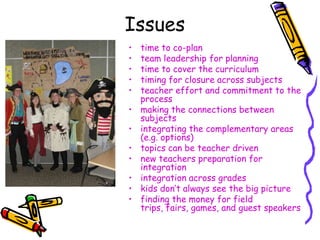
Issues
•
•
•
•
•
•
•
•
•
•
•
•

time to co-plan
team leadership for planning
time to cover the curriculum
timing for closure across subjects
teacher effort and commitment to the
process
making the connections between
subjects
integrating the complementary areas
(e.g. options)
topics can be teacher driven
new teachers preparation for
integration
integration across grades
kids don‟t always see the big picture
finding the money for field
trips, fairs, games, and guest speakers
Examples of Integration*
•

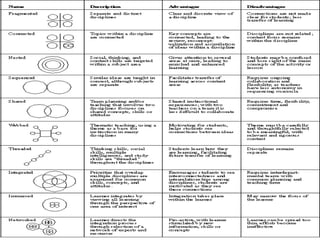
Parallel Disciplines Design

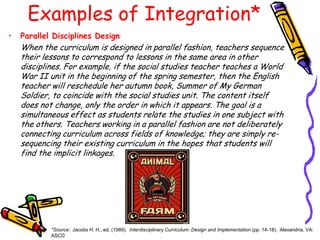
When the curriculum is designed in parallel fashion, teachers sequence
their lessons to correspond to lessons in the same area in other
disciplines. For example, if the social studies teacher teaches a World
War II unit in the beginning of the spring semester, then the English
teacher will reschedule her autumn book, Summer of My German
Soldier, to coincide with the social studies unit. The content itself
does not change, only the order in which it appears. The goal is a
simultaneous effect as students relate the studies in one subject with
the others. Teachers working in a parallel fashion are not deliberately
connecting curriculum across fields of knowledge; they are simply resequencing their existing curriculum in the hopes that students will
find the implicit linkages.

*Source: Jacobs H. H., ed. (1989). Interdisciplinary Curriculum: Design and Implementation (pp. 14-18). Alexandria, VA:
ASCD
Examples of Integration
•

Interdisciplinary Design
In this design, periodic units or courses of study deliberately bring
together the full range of disciplines in the school‟s curriculum:
language arts, math, social studies, and science, and the arts,
music, and physical education. The main point is that designers
attempt to use a full array of discipline-based perspectives. The
units are of specific duration: a few days, a few weeks, or a
semester. This option does not purport to replace the disciplinefield approach; rather, they are mutually supportive.
Examples of Integration
•

Multidisciplinary Design
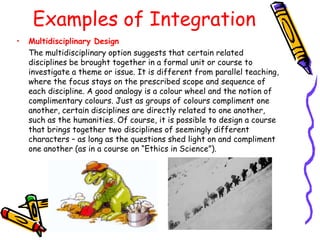
The multidisciplinary option suggests that certain related
disciplines be brought together in a formal unit or course to
investigate a theme or issue. It is different from parallel teaching,
where the focus stays on the prescribed scope and sequence of
each discipline. A good analogy is a colour wheel and the notion of
complimentary colours. Just as groups of colours compliment one
another, certain disciplines are directly related to one another,
such as the humanities. Of course, it is possible to design a course
that brings together two disciplines of seemingly different
characters – as long as the questions shed light on and compliment
one another (as in a course on “Ethics in Science”).
Examples of Integration
•

Integrated-Day Design (Single Grade, Whole School)
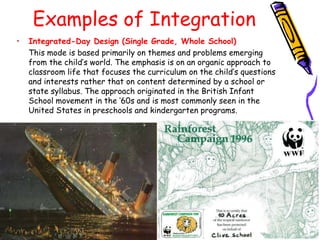
This mode is based primarily on themes and problems emerging
from the child‟s world. The emphasis is on an organic approach to
classroom life that focuses the curriculum on the child‟s questions
and interests rather that on content determined by a school or
state syllabus. The approach originated in the British Infant
School movement in the „60s and is most commonly seen in the
United States in preschools and kindergarten programs.
Examples of Integration
•

Field-Based Program
This approach is the most
extreme form of
interdisciplinary work. Students
live in the school environment and
create the curriculum out of
their day-to-day lives. Perhaps
A.S. Neil‟s Summerhill is the
most widely know example of
such an approach. Students who
are interested in the buildings on
campus might study architecture.
If there were a conflict between
students concerning ways to
behave in the school, they could
study rules of government. This
is a totally integrated program
because the student‟s life is
synonymous with school.
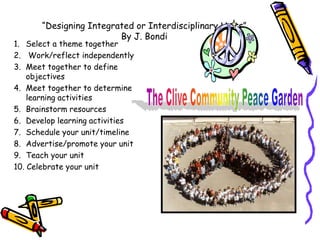
“Designing Integrated or Interdisciplinary Units”
By J. Bondi

1. Select a theme together
2. Work/reflect independently
3. Meet together to define
objectives
4. Meet together to determine
learning activities
5. Brainstorm resources
6. Develop learning activities
7. Schedule your unit/timeline
8. Advertise/promote your unit
9. Teach your unit
10. Celebrate your unit
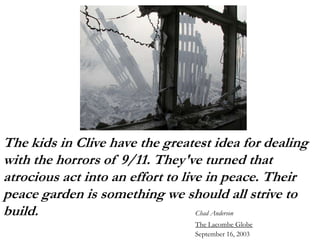
The kids in Clive have the greatest idea for dealing
with the horrors of 9/11. They've turned that
atrocious act into an effort to live in peace. Their
peace garden is something we should all strive to
build.
Chad Anderson
The Lacombe Globe
September 16, 2003
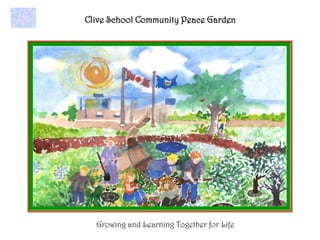
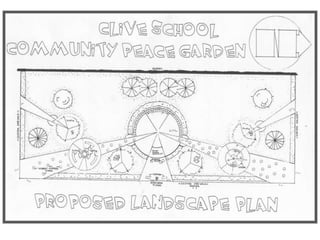
Clive School Community Peace Garden

Growing and Learning Together for Life
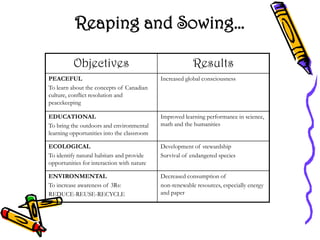
Reaping and Sowing…
Objectives

Results

PEACEFUL
To learn about the concepts of Canadian
culture, conflict resolution and
peacekeeping

Increased global consciousness

EDUCATIONAL
To bring the outdoors and environmental
learning opportunities into the classroom

Improved learning performance in science,
math and the humanities

ECOLOGICAL
To identify natural habitats and provide
opportunities for interaction with nature

Development of stewardship
Survival of endangered species

ENVIRONMENTAL
To increase awareness of 3Rs:
REDUCE-REUSE-RECYCLE

Decreased consumption of
non-renewable resources, especially energy
and paper
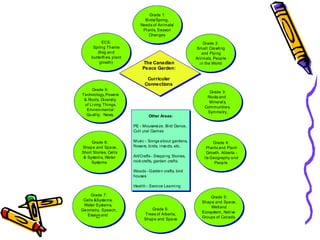
Grade 1:
Bi rds/Spring,
Need s of Ani mals/
Pl ants, Season
Chan ges
ECS:
Sprin g Th eme
(frog an d
butterfl i es, p lant
growth)

The Canadian
Peace Garden:

Grade 2:
Smal l Cra wli ng
and Flyi ng
Ani mals, Peop le
i n the World

Curricular
Connections
Grade 9:
Techno logy,Powe rs
& Roots, Diversity
of Li ving Thi ngs,
Envi ron mental
Qu ali ty, News,

Grade 3:
Rocks and
Mineral s,
Communitie s,
Symme try,
Other Areas:
PE - Mousersi ze, Bi rd Dance,
Cul t ural Games

Grade 8:
Shap e and Spa ce ,
Short Stories, Cel l s
& Systems, Wa ter
Syste ms

Musi c - Songs a bout gardens,
flowe rs, bi rds, i nse cts, etc.
Art/Crafts - Steppi ng Stones,
rock crafts, garden crafts

Grade 4:
Pl ants and Pla nt
Growth. Al berta i ts Geography a nd
Peop le

Woods - Garde n crafts, bird
houses
Heal th - Servi ce Lea rni ng
Grade 7:
Cel ls &Syste ms,
Water Systems,
Ge ometry, Speech,
Essays and

Grade 6:
Trees of Alberta,
Shap e and Spa ce

Grade 5:
Shap e and Spa ce ,
Wetl and
Ecosystem, Nati ve
Groups of Canada
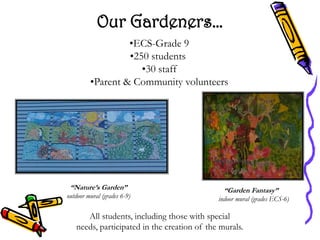
Our Gardeners…
•ECS-Grade 9
•250 students
•30 staff
•Parent & Community volunteers

“Nature’s Garden”
outdoor mural (grades 6-9)

“Garden Fantasy”
indoor mural (grades ECS-6)

All students, including those with special
needs, participated in the creation of the murals.
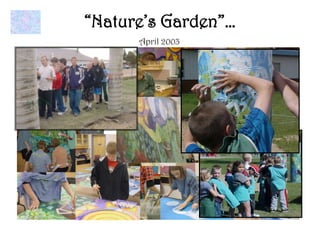
“Nature’s Garden”…
April 2003
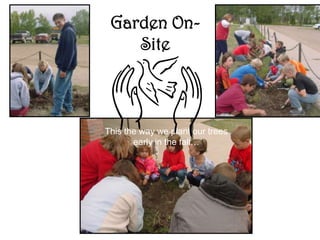
Garden OnSite

This the way we plant our trees
early in the fall…
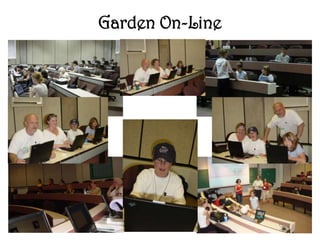
Garden On-Line
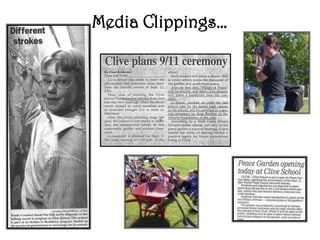
Media Clippings…
Creating Powerful Learning
Experiences Through
Integration
Week #3: Synthesis of New Knowledge

Week 3A: Powerful Learning Through Integration

  • 1.
    Creating Powerful Learning ExperiencesThrough Integration Week #3: Synthesis of New Knowledge
  • 2.
    Who Decides onthe Curriculum:
  • 3.
    Who Decides onthe Design and Delivery of Curriculum: http://www.edutopia.org/integrated-studiesintroduction-video
  • 4.
    MAINSTREAM by Yothu Yindi Reflectionin the water I see Six pretty girls on my mind today Yellow foam floating down the river Voices I hear of Yolngu heroes Go go go go living in the mainstream, Go go go go under one dream Monsoon clouds rolling over the ocean Thunder and rain raging here tonight Hear the sound of speargrass crying Cross rivers and valleys on Yolngu land Go go go go living in the mainstream, Go go go go under one dream Reflections in the water we see Black and white living together Sharing dreams of the red, black and gold Living dreamtime now is the Yolngu way Go go go go living in the mainstream, Go go go go under one dream We‟re living together, We‟re living together We‟re learning together, We‟re living together Yolngu Balanda This is Australia
  • 5.
    What does Integration LookLike? • planning around 4-6 week themes in core subjects (e.g. Mystery Unit) • various levels and kinds of integration • planning together across subjects (interdisciplinary team planning), and sometimes across grades • combines textbook-based learning with resource-based learning (e.g. guest speakers, field trips, internet, etc.) • centered on current topics of student interest (e.g. Harry Potter, Mission to Mars, Lord of the Rings) • Connected to learning outcomes from various subjects within chosen grade level • Examples of Integration (e.g. Camp Skagway, Titanic Tournament, Heroes & Villains of Russia)
  • 6.
    What does Interaction LookLike? • simulation games, debates and role playing • field trips and guest speakers • project-based learning • research (internet, surveys, interviews, etc.) • cooperative learning • reflective journals, self-evaluations, etc. • multi-media presentations, fairs, and showcases • Technology (blogs, clickers, chats, etc.)
  • 7.
    Benefits to Kids Benefitsto Teachers: • increases relevance • comprehensive & consistent • holds the kids interest • • easier subject transitions • teachers can share new ideas choices increase motivation • support is available from other teachers, staff, adults • gets kids out into the community • teachers can learn new things • relevant and meaningful • • concentrated time for indepth examinations positive experiences from students is very rewarding • more fun • get to work with new people • supports how the brain learns best with “novel” experiences Benefits
  • 8.
    Issues • • • • • • • • • • • • time to co-plan teamleadership for planning time to cover the curriculum timing for closure across subjects teacher effort and commitment to the process making the connections between subjects integrating the complementary areas (e.g. options) topics can be teacher driven new teachers preparation for integration integration across grades kids don‟t always see the big picture finding the money for field trips, fairs, games, and guest speakers
  • 9.
    Examples of Integration* • ParallelDisciplines Design When the curriculum is designed in parallel fashion, teachers sequence their lessons to correspond to lessons in the same area in other disciplines. For example, if the social studies teacher teaches a World War II unit in the beginning of the spring semester, then the English teacher will reschedule her autumn book, Summer of My German Soldier, to coincide with the social studies unit. The content itself does not change, only the order in which it appears. The goal is a simultaneous effect as students relate the studies in one subject with the others. Teachers working in a parallel fashion are not deliberately connecting curriculum across fields of knowledge; they are simply resequencing their existing curriculum in the hopes that students will find the implicit linkages. *Source: Jacobs H. H., ed. (1989). Interdisciplinary Curriculum: Design and Implementation (pp. 14-18). Alexandria, VA: ASCD
  • 10.
    Examples of Integration • InterdisciplinaryDesign In this design, periodic units or courses of study deliberately bring together the full range of disciplines in the school‟s curriculum: language arts, math, social studies, and science, and the arts, music, and physical education. The main point is that designers attempt to use a full array of discipline-based perspectives. The units are of specific duration: a few days, a few weeks, or a semester. This option does not purport to replace the disciplinefield approach; rather, they are mutually supportive.
  • 11.
    Examples of Integration • MultidisciplinaryDesign The multidisciplinary option suggests that certain related disciplines be brought together in a formal unit or course to investigate a theme or issue. It is different from parallel teaching, where the focus stays on the prescribed scope and sequence of each discipline. A good analogy is a colour wheel and the notion of complimentary colours. Just as groups of colours compliment one another, certain disciplines are directly related to one another, such as the humanities. Of course, it is possible to design a course that brings together two disciplines of seemingly different characters – as long as the questions shed light on and compliment one another (as in a course on “Ethics in Science”).
  • 12.
    Examples of Integration • Integrated-DayDesign (Single Grade, Whole School) This mode is based primarily on themes and problems emerging from the child‟s world. The emphasis is on an organic approach to classroom life that focuses the curriculum on the child‟s questions and interests rather that on content determined by a school or state syllabus. The approach originated in the British Infant School movement in the „60s and is most commonly seen in the United States in preschools and kindergarten programs.
  • 13.
    Examples of Integration • Field-BasedProgram This approach is the most extreme form of interdisciplinary work. Students live in the school environment and create the curriculum out of their day-to-day lives. Perhaps A.S. Neil‟s Summerhill is the most widely know example of such an approach. Students who are interested in the buildings on campus might study architecture. If there were a conflict between students concerning ways to behave in the school, they could study rules of government. This is a totally integrated program because the student‟s life is synonymous with school.
  • 15.
    “Designing Integrated orInterdisciplinary Units” By J. Bondi 1. Select a theme together 2. Work/reflect independently 3. Meet together to define objectives 4. Meet together to determine learning activities 5. Brainstorm resources 6. Develop learning activities 7. Schedule your unit/timeline 8. Advertise/promote your unit 9. Teach your unit 10. Celebrate your unit
  • 16.
    The kids inClive have the greatest idea for dealing with the horrors of 9/11. They've turned that atrocious act into an effort to live in peace. Their peace garden is something we should all strive to build. Chad Anderson The Lacombe Globe September 16, 2003
  • 17.
    Clive School CommunityPeace Garden Growing and Learning Together for Life
  • 18.
    Reaping and Sowing… Objectives Results PEACEFUL Tolearn about the concepts of Canadian culture, conflict resolution and peacekeeping Increased global consciousness EDUCATIONAL To bring the outdoors and environmental learning opportunities into the classroom Improved learning performance in science, math and the humanities ECOLOGICAL To identify natural habitats and provide opportunities for interaction with nature Development of stewardship Survival of endangered species ENVIRONMENTAL To increase awareness of 3Rs: REDUCE-REUSE-RECYCLE Decreased consumption of non-renewable resources, especially energy and paper
  • 20.
    Grade 1: Bi rds/Spring, Needs of Ani mals/ Pl ants, Season Chan ges ECS: Sprin g Th eme (frog an d butterfl i es, p lant growth) The Canadian Peace Garden: Grade 2: Smal l Cra wli ng and Flyi ng Ani mals, Peop le i n the World Curricular Connections Grade 9: Techno logy,Powe rs & Roots, Diversity of Li ving Thi ngs, Envi ron mental Qu ali ty, News, Grade 3: Rocks and Mineral s, Communitie s, Symme try, Other Areas: PE - Mousersi ze, Bi rd Dance, Cul t ural Games Grade 8: Shap e and Spa ce , Short Stories, Cel l s & Systems, Wa ter Syste ms Musi c - Songs a bout gardens, flowe rs, bi rds, i nse cts, etc. Art/Crafts - Steppi ng Stones, rock crafts, garden crafts Grade 4: Pl ants and Pla nt Growth. Al berta i ts Geography a nd Peop le Woods - Garde n crafts, bird houses Heal th - Servi ce Lea rni ng Grade 7: Cel ls &Syste ms, Water Systems, Ge ometry, Speech, Essays and Grade 6: Trees of Alberta, Shap e and Spa ce Grade 5: Shap e and Spa ce , Wetl and Ecosystem, Nati ve Groups of Canada
  • 21.
    Our Gardeners… •ECS-Grade 9 •250students •30 staff •Parent & Community volunteers “Nature’s Garden” outdoor mural (grades 6-9) “Garden Fantasy” indoor mural (grades ECS-6) All students, including those with special needs, participated in the creation of the murals.
  • 22.
  • 23.
    Garden OnSite This theway we plant our trees early in the fall…
  • 24.
  • 25.
  • 26.
    Creating Powerful Learning ExperiencesThrough Integration Week #3: Synthesis of New Knowledge