Comenius Regio
"City as a Learning Place -
Where Learning is An
Adventure"
Project meeting
ROMANIA
Bucharest
8-13 October 2012
Theoretical premises
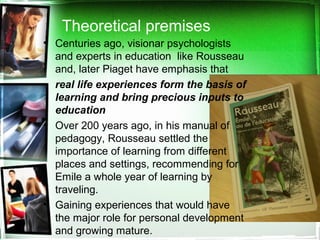
• Centuries ago, visionar psychologists
and experts in education like Rousseau
and, later Piaget have emphasis that
real life experiences form the basis of
learning and bring precious inputs to
education
• Over 200 years ago, in his manual of
pedagogy, Rousseau settled the
importance of learning from different
places and settings, recommending for
Emile a whole year of learning by
traveling.
• Gaining experiences that would have
the major role for personal development
and growing mature.
Up to present
• In our present Knowledge society, The European
Union stress upon the important role of involving
student in different and intercultral learning
experiences through placements in enterprises
and companies.
• The major role of working altogether end
experiencing new environments.
• Experiences may be planned to take place within
lessons in school class, school laboratory, as
well as in museums, parks or field trips.
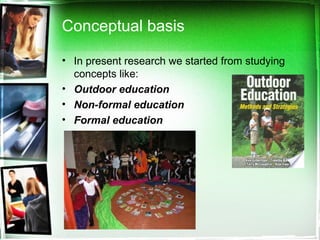
Conceptual basis
• In present research we started from studying
concepts like:
• Outdoor education
• Non-formal education
• Formal education
Outdoor education
• Starting from immemorial times, people was "trained"
to live in the world.
• For at least several million years, learning and
training was conducted in the outdoors and in
different unstructured places and ways.
• Through the last millennium the science of education
got a structure and methodology, education became
more structured.
• Outdoor education was the trend to return to
• Promoters of outdoor education, in theory were in
UK, and USA, and later Australia during the Second
World War (1943)
nature and experience
Studies upon the effectiveness of
outdoor education
• In 1983, Minda Borun published a research
related to: Planets and Pulleys: Studies of
Class Visits to Science Museums
• The University of Chicago published in 1998 In
The Elementary School Journal , a Quantitative
and qualitative study that assessed the effects
of an extracurricular science program on
students' interest and learning about biology.
• Emmett L. Wright realized an Analysis of the
effect of a museum experience on the
biology achievement of sixth-graders
published In Journal of Research in Science
Teaching, 2006
Outdoor education is by itself a powerful
teaching tool:
through “doing”, facing challenges, and
stepping outside students’ comfort zone,
assuming ownership, working as or with
leaders, learning process certainly takes on
a new dimension.
Outdoor education is an ideal catalyst for
learning about these notions.
(Anna Schmidt- USA 2006)
Conclusions of international studies
• After researching this domain, we could
conclude that there is a lack of research and a
relatively new trend that concernsit’s
effectiveness
• There might be a general conclusion of all
international research:
learning experiences that take place in a
different place that school class is more
susceptible to generate skills linked to the
neurological development and personal
development.
Formal activities in non-formal settings
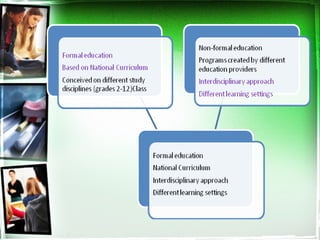
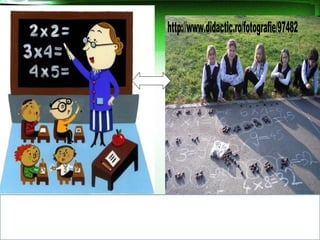
• Through this Regio project we proposed to create a
natural link between the structured types of
education related with different learning
environment end and experiences:
• Formal education
• Non-formal education
• The innovation that our project brings in, is :
to join strengths of formal education and
non-formal education, in order to overcome
their weaknesses
Non-formal education
• More experience and research is gained in the
field of non-formal education methodology at
international level.
• In Romania, this type of education was one of a
great interest and grew in the last period
UNESCO and European bodies contributed
through their politics and programs to it’s
flourishing.
• Most countries have Educational Management Information
Systems to monitor formal education, but only in rare cases
such systems exist for the non-formal sector.
• As a response to this challenge, UNESCO has developed an
easy-to-use methodology and database for creating a
Non-Formal Education Management Information System
(NFE-MIS).
The system:
• provides a practical and internationally applicable approach to NFE monitoring and evaluation,
adaptable to local contexts and information needs;
• enables countries to generate meaningful and reliable information and statistics on NFE which
can be used by policy-makers and planners for informed decision making, better planning and
delivery, monitoring and evaluation of NFE;
• aims at improving the co-ordination of programmes among NFE providers; and
• raises interest and encourages participation in NFE programmes.
Non-formal education
Methodology of Study
The research was European.
Commonly developed by Romanian-Bucharest
and Lithuanian- Prienai project teams:
• Discussing and common analyzing aspects of research
• Commonly conceiving the mythology of research
• Designing in Common of instruments of research-
questionnaire
• Selecting the similar scale of target group in both regions.
Participants in the questionnaire survey were teachers
involved in the Comenius Regio project "City as a place
of learning - where learning is an adventure”.
• The research was coordinated by the Teacher
Training Center of Bucharest Romania in
cooperation with The Municipality of Prienai-
educational department, Lithuania,
the international coordinators of Comenius Regio
project “City as a learning place - where learning
is an adventure” COM-11-PR-28-B-RO
• The research was realized between
December 2011- February 2012
in 5 schools from the two countries regions:
Bucharest- Romania and Prienai-Lithuania
Methodology of Study
Research target group
• A total number of 205 persons were
interviewed on a questionnaire base.
• 80 teaches of different subjects
• 125 students of 10-15 years old
1.School nr. 87 "M. Botez“
2.School nr. 112 “Titan”
3.“Eugen Lovinescu” High School
4.Silavotas basic school
5.Veiveriai Tomas Zilinskas gymnasium
Aim of research
• The is to set a scientific (even at small pilot
scale) background to our project and to identify
best ways, methods, strategies and places to
implement the proposed educational innovation:
 Teaching school lessons in non-formal
educational settings offered by the city
facilities
Bridging formal and non-formal
education by joining their strengths and
overcoming their weaknesses.
General hypothesis
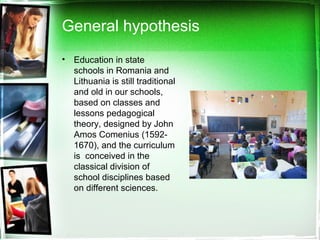
• Education in state
schools in Romania and
Lithuania is still traditional
and old in our schools,
based on classes and
lessons pedagogical
theory, designed by John
Amos Comenius (1592-
1670), and the curriculum
is conceived in the
classical division of
school disciplines based
on different sciences.
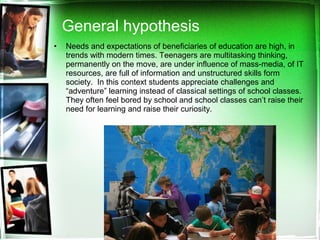
• Needs and expectations of beneficiaries of education are high, in
trends with modern times. Teenagers are multitasking thinking,
permanently on the move, are under influence of mass-media, of IT
resources, are full of information and unstructured skills form
society. In this context students appreciate challenges and
“adventure” learning instead of classical settings of school classes.
They often feel bored by school and school classes can’t raise their
need for learning and raise their curiosity.
General hypothesis
Survey idea
• Teachers perceived students needs and tend to
understand that some changes are needed in
their teaching in order to connect with students.
• Educators need to explore, research a system,
a methodology to raise curiosity and regain the
natural spirit of curiosity and adventure of
learning.
• The survey idea was to screen the current
situation regarding routine teaching settings
and possible innovative interventions.
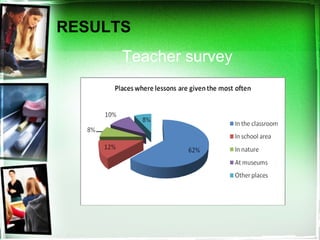
Teacher survey
RESULTS
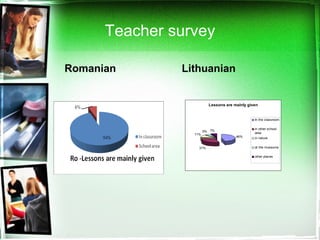
Romanian Lithuanian
Teacher survey
Lessons are mainly given
46%
31%
11%
5% 7%
In the classroom
in other school
area
in nature
at the museums
other places
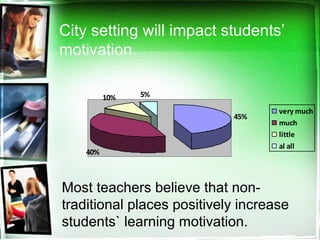
City setting will impact students’
motivation.
45%
40%
10% 5%
very much
much
little
al all
Most teachers believe that non-
traditional places positively increase
students` learning motivation.
Best place for organizing an effective lesson
for the subject that they teach
52
24
21
18
15
12
8
0
10
20
30
40
50
60
70
80
90
100
classroom
school area
nature
park
museum
church
library
trip
other
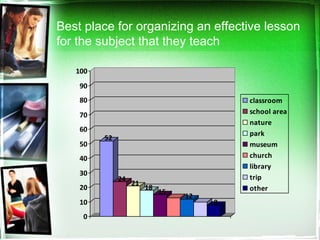
• In both countries, classroom is considered
the perfect place for an ideal lesson.
• Still, teachers are open to conceive good
lessons in nature and other places in the
city.
• Institutions in the city are also considered
as places suitable for organizing lessons in.
• The most popular non traditional places for
learning according to the hierarchy are
parks, museums and nature.
Best place for organizing an effective
lesson for the subject that they teach
SUBJECTS & PLACES
• The most subjects identified is English language,
biology, physics, primary school lessons, the
mother tongue language, art, history, religion,
music and biology
• Museum
• Church
• Park
• Factory
• Film/Theatre
• Opera
• Memorial houses
• Streets
• Library
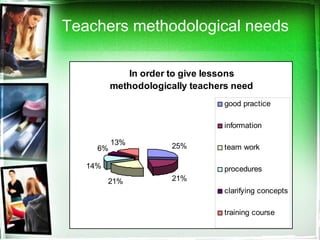
Teachers methodological needs
In order to give lessons
methodologically teachers need
25%
21%21%
14%
6%
13%
good practice
information
team work
procedures
clarifying concepts
training course
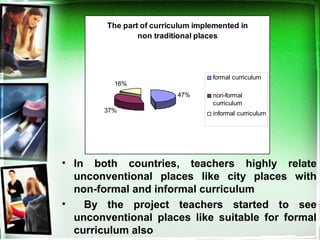
The part of curriculum implemented in
non traditional places
47%
37%
16%
formal curriculum
non-formal
curriculum
informal curriculum
• In both countries, teachers highly relate
unconventional places like city places with
non-formal and informal curriculum
• By the project teachers started to see
unconventional places like suitable for formal
curriculum also
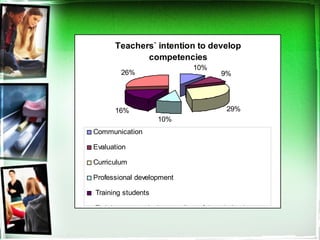
Teachers` intention to develop
competencies
10%
9%
29%
10%
16%
26%
Communication
Evaluation
Curriculum
Professional development
Training students
Training parents in the paradigm of the relation between
school
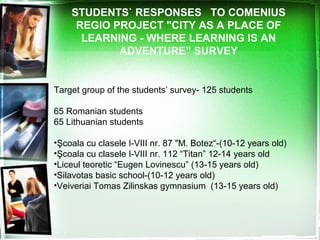
STUDENTS` RESPONSES TO COMENIUS
REGIO PROJECT "CITY AS A PLACE OF
LEARNING - WHERE LEARNING IS AN
ADVENTURE” SURVEY
Target group of the students’ survey- 125 students
65 Romanian students
65 Lithuanian students
•Şcoala cu clasele I-VIII nr. 87 "M. Botez“-(10-12 years old)
•Şcoala cu clasele I-VIII nr. 112 “Titan” 12-14 years old
•Liceul teoretic “Eugen Lovinescu” (13-15 years old)
•Silavotas basic school-(10-12 years old)
•Veiveriai Tomas Zilinskas gymnasium (13-15 years old)
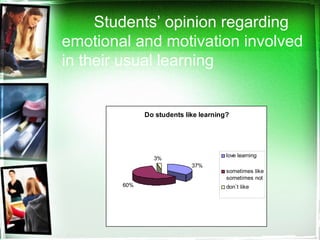
Do students like learning?
37%
60%
3%
love learning
sometimes like
sometimes not
don`t like
Students’ opinion regarding
emotional and motivation involved
in their usual learning
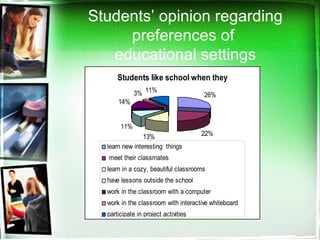
Students’ opinion regarding
preferences of
educational settings
Students like school when they
26%
22%13%
11%
14%
3% 11%
learn new interesting things
meet their classmates
learn in a cozy, beautiful classrooms
have lessons outside the school
work in the classroom with a computer
work in the classroom with interactive whiteboard
participate in project activities
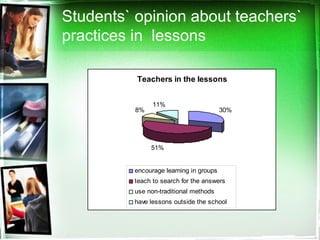
Students` opinion about teachers`
practices in lessons
Teachers in the lessons
30%
51%
8%
11%
encourage learning in groups
teach to search for the answers
use non-traditional methods
have lessons outside the school
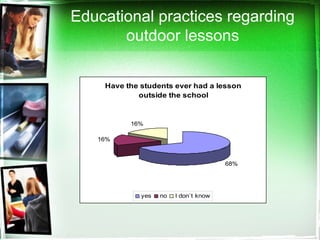
Educational practices regarding
outdoor lessons
Have the students ever had a lesson
outside the school
68%
16%
16%
yes no I don`t know
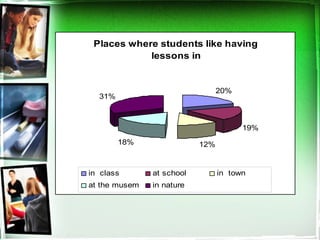
Places where students like having
lessons in
20%
19%
12%18%
31%
in class at school in town
at the musem in nature
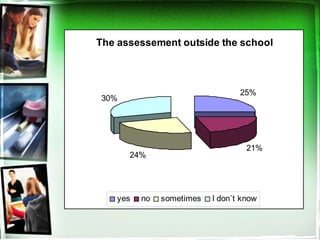
The assessement outside the school
25%
21%
24%
30%
yes no sometimes I don`t know
CONCLUSIONS
• Despite of significant differences between
Romania and Lithuania (national, geographical,
cultural, linguistically, social, historical),
educational practices and
opinions regarding them are
surprisingly much similar in the
two countries at present,
both on teachers group and
students group
• Both teachers and students in the two countries
agreed that it would be a plus under multiple
aspects to conceive and apply a methodology of
using unconventional places to teach normal
lessons for classes.
• Almost all subjects and lessons can be taught in
unconventional places if a rigorous methodology
and a good interdisciplinary planning is done
• Almost all subject teachers have such drafts of
lessons plans which they can give in
unconventional places
CONCLUSIONS
• The lessons, teachers give to their students, mainly take
place in the classrooms and in other school area. Only
some lessons are given in non traditional spaces.
• Most teachers believe that non traditional places
positively increase students` learning motivation.
• The most popular non traditional places for learning
according to the hierarchy are parks, museums and
nature.
• Most school subjects in non traditional places were
identified like: mother tongue language, communication,
(Lithuanian, Romanian) English language teachers,
primary class teachers and physics teachers.
• If teachers wish to organize such lessons,
methodologically, they would need good practice
examples, more information how to organize such
lessons and team work practice. Mostly non-formal
education plan is carried out in non traditional
educational places (at the museums, on the excursions).
• Learning in non conventional areas increases, enhance
quality and efficiency of students’ learning.
• In most cases teachers in order to be able to proceed professionally in
organizing lessons in the city, intends to improve curriculum, training
parents in the paradigm of the relation between school, and training
students` competencies.
• The majority students sometimes enjoy learning.
• Most students like school, where they discover new and interesting
things when they meet with classmates and learn in cozy, beautiful
classrooms.
• Some of the surveyed students like learning in non-traditional learning
spaces.
• The students state that teachers in the lessons mostly teach them to
search for the answers. They are encouraged to learn in groups too.
Some teachers give lessons outside the school.
• Students like lessons given in nature most of all.
• In lessons, which took place in non-traditional spaces, the students
remembered best local and national history facts, learned to know
nature, did some sport.
• Some of students state that teachers assess their activities in marks or
otherwise in lessons which are given outside the school. Part of
students do not know whether their activities are assessed.
• Most of the students would like to have lessons in nature, have trips, sports.
Simona Luca
Renata Pavlavičienė

Prezentare conferinta proiectomenius regio final simona luca

  • 1.
    Comenius Regio "City asa Learning Place - Where Learning is An Adventure" Project meeting ROMANIA Bucharest 8-13 October 2012
  • 2.
    Theoretical premises • Centuriesago, visionar psychologists and experts in education like Rousseau and, later Piaget have emphasis that real life experiences form the basis of learning and bring precious inputs to education • Over 200 years ago, in his manual of pedagogy, Rousseau settled the importance of learning from different places and settings, recommending for Emile a whole year of learning by traveling. • Gaining experiences that would have the major role for personal development and growing mature.
  • 3.
    Up to present •In our present Knowledge society, The European Union stress upon the important role of involving student in different and intercultral learning experiences through placements in enterprises and companies. • The major role of working altogether end experiencing new environments. • Experiences may be planned to take place within lessons in school class, school laboratory, as well as in museums, parks or field trips.
  • 4.
    Conceptual basis • Inpresent research we started from studying concepts like: • Outdoor education • Non-formal education • Formal education
  • 5.
    Outdoor education • Startingfrom immemorial times, people was "trained" to live in the world. • For at least several million years, learning and training was conducted in the outdoors and in different unstructured places and ways. • Through the last millennium the science of education got a structure and methodology, education became more structured. • Outdoor education was the trend to return to • Promoters of outdoor education, in theory were in UK, and USA, and later Australia during the Second World War (1943) nature and experience
  • 6.
    Studies upon theeffectiveness of outdoor education • In 1983, Minda Borun published a research related to: Planets and Pulleys: Studies of Class Visits to Science Museums • The University of Chicago published in 1998 In The Elementary School Journal , a Quantitative and qualitative study that assessed the effects of an extracurricular science program on students' interest and learning about biology. • Emmett L. Wright realized an Analysis of the effect of a museum experience on the biology achievement of sixth-graders published In Journal of Research in Science Teaching, 2006
  • 7.
    Outdoor education isby itself a powerful teaching tool: through “doing”, facing challenges, and stepping outside students’ comfort zone, assuming ownership, working as or with leaders, learning process certainly takes on a new dimension. Outdoor education is an ideal catalyst for learning about these notions. (Anna Schmidt- USA 2006)
  • 8.
    Conclusions of internationalstudies • After researching this domain, we could conclude that there is a lack of research and a relatively new trend that concernsit’s effectiveness • There might be a general conclusion of all international research: learning experiences that take place in a different place that school class is more susceptible to generate skills linked to the neurological development and personal development.
  • 9.
    Formal activities innon-formal settings • Through this Regio project we proposed to create a natural link between the structured types of education related with different learning environment end and experiences: • Formal education • Non-formal education • The innovation that our project brings in, is : to join strengths of formal education and non-formal education, in order to overcome their weaknesses
  • 12.
    Non-formal education • Moreexperience and research is gained in the field of non-formal education methodology at international level. • In Romania, this type of education was one of a great interest and grew in the last period UNESCO and European bodies contributed through their politics and programs to it’s flourishing.
  • 13.
    • Most countrieshave Educational Management Information Systems to monitor formal education, but only in rare cases such systems exist for the non-formal sector. • As a response to this challenge, UNESCO has developed an easy-to-use methodology and database for creating a Non-Formal Education Management Information System (NFE-MIS). The system: • provides a practical and internationally applicable approach to NFE monitoring and evaluation, adaptable to local contexts and information needs; • enables countries to generate meaningful and reliable information and statistics on NFE which can be used by policy-makers and planners for informed decision making, better planning and delivery, monitoring and evaluation of NFE; • aims at improving the co-ordination of programmes among NFE providers; and • raises interest and encourages participation in NFE programmes. Non-formal education
  • 14.
    Methodology of Study Theresearch was European. Commonly developed by Romanian-Bucharest and Lithuanian- Prienai project teams: • Discussing and common analyzing aspects of research • Commonly conceiving the mythology of research • Designing in Common of instruments of research- questionnaire • Selecting the similar scale of target group in both regions. Participants in the questionnaire survey were teachers involved in the Comenius Regio project "City as a place of learning - where learning is an adventure”.
  • 15.
    • The researchwas coordinated by the Teacher Training Center of Bucharest Romania in cooperation with The Municipality of Prienai- educational department, Lithuania, the international coordinators of Comenius Regio project “City as a learning place - where learning is an adventure” COM-11-PR-28-B-RO • The research was realized between December 2011- February 2012 in 5 schools from the two countries regions: Bucharest- Romania and Prienai-Lithuania Methodology of Study
  • 16.
    Research target group •A total number of 205 persons were interviewed on a questionnaire base. • 80 teaches of different subjects • 125 students of 10-15 years old 1.School nr. 87 "M. Botez“ 2.School nr. 112 “Titan” 3.“Eugen Lovinescu” High School 4.Silavotas basic school 5.Veiveriai Tomas Zilinskas gymnasium
  • 17.
    Aim of research •The is to set a scientific (even at small pilot scale) background to our project and to identify best ways, methods, strategies and places to implement the proposed educational innovation:  Teaching school lessons in non-formal educational settings offered by the city facilities Bridging formal and non-formal education by joining their strengths and overcoming their weaknesses.
  • 18.
    General hypothesis • Educationin state schools in Romania and Lithuania is still traditional and old in our schools, based on classes and lessons pedagogical theory, designed by John Amos Comenius (1592- 1670), and the curriculum is conceived in the classical division of school disciplines based on different sciences.
  • 19.
    • Needs andexpectations of beneficiaries of education are high, in trends with modern times. Teenagers are multitasking thinking, permanently on the move, are under influence of mass-media, of IT resources, are full of information and unstructured skills form society. In this context students appreciate challenges and “adventure” learning instead of classical settings of school classes. They often feel bored by school and school classes can’t raise their need for learning and raise their curiosity. General hypothesis
  • 20.
    Survey idea • Teachersperceived students needs and tend to understand that some changes are needed in their teaching in order to connect with students. • Educators need to explore, research a system, a methodology to raise curiosity and regain the natural spirit of curiosity and adventure of learning. • The survey idea was to screen the current situation regarding routine teaching settings and possible innovative interventions.
  • 21.
  • 22.
    Romanian Lithuanian Teacher survey Lessonsare mainly given 46% 31% 11% 5% 7% In the classroom in other school area in nature at the museums other places
  • 23.
    City setting willimpact students’ motivation. 45% 40% 10% 5% very much much little al all Most teachers believe that non- traditional places positively increase students` learning motivation.
  • 24.
    Best place fororganizing an effective lesson for the subject that they teach 52 24 21 18 15 12 8 0 10 20 30 40 50 60 70 80 90 100 classroom school area nature park museum church library trip other
  • 25.
    • In bothcountries, classroom is considered the perfect place for an ideal lesson. • Still, teachers are open to conceive good lessons in nature and other places in the city. • Institutions in the city are also considered as places suitable for organizing lessons in. • The most popular non traditional places for learning according to the hierarchy are parks, museums and nature. Best place for organizing an effective lesson for the subject that they teach
  • 26.
    SUBJECTS & PLACES •The most subjects identified is English language, biology, physics, primary school lessons, the mother tongue language, art, history, religion, music and biology • Museum • Church • Park • Factory • Film/Theatre • Opera • Memorial houses • Streets • Library
  • 27.
    Teachers methodological needs Inorder to give lessons methodologically teachers need 25% 21%21% 14% 6% 13% good practice information team work procedures clarifying concepts training course
  • 28.
    The part ofcurriculum implemented in non traditional places 47% 37% 16% formal curriculum non-formal curriculum informal curriculum • In both countries, teachers highly relate unconventional places like city places with non-formal and informal curriculum • By the project teachers started to see unconventional places like suitable for formal curriculum also
  • 29.
    Teachers` intention todevelop competencies 10% 9% 29% 10% 16% 26% Communication Evaluation Curriculum Professional development Training students Training parents in the paradigm of the relation between school
  • 30.
    STUDENTS` RESPONSES TOCOMENIUS REGIO PROJECT "CITY AS A PLACE OF LEARNING - WHERE LEARNING IS AN ADVENTURE” SURVEY Target group of the students’ survey- 125 students 65 Romanian students 65 Lithuanian students •Şcoala cu clasele I-VIII nr. 87 "M. Botez“-(10-12 years old) •Şcoala cu clasele I-VIII nr. 112 “Titan” 12-14 years old •Liceul teoretic “Eugen Lovinescu” (13-15 years old) •Silavotas basic school-(10-12 years old) •Veiveriai Tomas Zilinskas gymnasium (13-15 years old)
  • 31.
    Do students likelearning? 37% 60% 3% love learning sometimes like sometimes not don`t like Students’ opinion regarding emotional and motivation involved in their usual learning
  • 32.
    Students’ opinion regarding preferencesof educational settings Students like school when they 26% 22%13% 11% 14% 3% 11% learn new interesting things meet their classmates learn in a cozy, beautiful classrooms have lessons outside the school work in the classroom with a computer work in the classroom with interactive whiteboard participate in project activities
  • 33.
    Students` opinion aboutteachers` practices in lessons Teachers in the lessons 30% 51% 8% 11% encourage learning in groups teach to search for the answers use non-traditional methods have lessons outside the school
  • 34.
    Educational practices regarding outdoorlessons Have the students ever had a lesson outside the school 68% 16% 16% yes no I don`t know
  • 35.
    Places where studentslike having lessons in 20% 19% 12%18% 31% in class at school in town at the musem in nature
  • 36.
    The assessement outsidethe school 25% 21% 24% 30% yes no sometimes I don`t know
  • 37.
    CONCLUSIONS • Despite ofsignificant differences between Romania and Lithuania (national, geographical, cultural, linguistically, social, historical), educational practices and opinions regarding them are surprisingly much similar in the two countries at present, both on teachers group and students group
  • 38.
    • Both teachersand students in the two countries agreed that it would be a plus under multiple aspects to conceive and apply a methodology of using unconventional places to teach normal lessons for classes. • Almost all subjects and lessons can be taught in unconventional places if a rigorous methodology and a good interdisciplinary planning is done • Almost all subject teachers have such drafts of lessons plans which they can give in unconventional places CONCLUSIONS
  • 39.
    • The lessons,teachers give to their students, mainly take place in the classrooms and in other school area. Only some lessons are given in non traditional spaces. • Most teachers believe that non traditional places positively increase students` learning motivation. • The most popular non traditional places for learning according to the hierarchy are parks, museums and nature. • Most school subjects in non traditional places were identified like: mother tongue language, communication, (Lithuanian, Romanian) English language teachers, primary class teachers and physics teachers. • If teachers wish to organize such lessons, methodologically, they would need good practice examples, more information how to organize such lessons and team work practice. Mostly non-formal education plan is carried out in non traditional educational places (at the museums, on the excursions). • Learning in non conventional areas increases, enhance quality and efficiency of students’ learning.
  • 40.
    • In mostcases teachers in order to be able to proceed professionally in organizing lessons in the city, intends to improve curriculum, training parents in the paradigm of the relation between school, and training students` competencies. • The majority students sometimes enjoy learning. • Most students like school, where they discover new and interesting things when they meet with classmates and learn in cozy, beautiful classrooms. • Some of the surveyed students like learning in non-traditional learning spaces. • The students state that teachers in the lessons mostly teach them to search for the answers. They are encouraged to learn in groups too. Some teachers give lessons outside the school. • Students like lessons given in nature most of all. • In lessons, which took place in non-traditional spaces, the students remembered best local and national history facts, learned to know nature, did some sport. • Some of students state that teachers assess their activities in marks or otherwise in lessons which are given outside the school. Part of students do not know whether their activities are assessed. • Most of the students would like to have lessons in nature, have trips, sports.
  • 41.