Write as many facts as you know about
afghanistan or about living in a Muslim
                nation.
   W r i t i n g   J o u r n a l   C
Summary
Write a five sentence summary.

Look up 3 words that were new to you.

Connect the person’s challenges to you own.

Present.
I have a cat.
            I once had two cats.
        I used to fee my cats food.
    Tuna was my cats’ favorite food.
  Yet, my one cat’s second favorite was
   corn and I thought that was weird.
You know that nouns can be a person, a place, a
thing, or a thing. But, can you notice something
  that all nouns have in common-- a common
                       rule?
Noun Rule
•   A noun is a word that can be made plural and/or possesive

•   Singular: Cat, Horse   Singular Possessive: Cat’s, Horse’s

•   Plural: Cats, Horses    Plural Possessive: Cats’, Horses’

•   Remember to watch for nouns that do not follow these rules: Man, Men,
    Man’s, Men’s

•   Nouns are essential to all sentences, they provide the subject.
Noun Phrase
•   A noun phrase (NP) is a word or a group of words
    that function as a unit within a sentence.

•   A phrase always has a headword and this is the
    noun.

•   Nouns are signaled by the determiner

•   Common determiners include articles (a, an, the),
    Possessive nouns and pronouns (Camille’s, his), and
    demonstrative pronouns (this, that, those)
•   Let us add to the noun definition:A noun is a word
    that can be made plural and/or possessive, it
    occupies the headword position in a noun phrase,
    it is usually signaled by a determiner
•   Locate each noun phrases headword and determiner:

    •   The students rested after a long trip.

    •   Our new neighbors became our best friends.

    •   A huge crowd lined the streets for the parade.

    •   This new lasagna recipe feeds an enormous crowd.
Count vs. Noncount
       Nouns
 •   Knowing the difference between count and
     noncount nouns will help you do the following:
• Use the noun plural ending -s correctly
• Use the appropriate type of article: definite (the) or
  indefinite (a or an)
• Use words that express quantities, such as little,
  much, . . .
Count vs. Noncount


•   The main difference between count and noncount
    nouns is whether or not the things they refer to can
    be counted.
Count Nouns
 •   Count nouns refer to things that can be divided up
     into smaller units which are separate and distinct
     from one another. They usually refer to what can
     individually be seen or heard:
table
chair
word
remark
finger
Noncountthings that cannot be counted
                             Nouns
 •   Noncount nouns refer to
     because they are regarded as wholes which cannot be
     divided into parts. They often refer to abstractions and
     occasionally have a collective meaning:
anger
furniture
warmth
leisure
education
courage
progress
The Rules

•   The Rules


• Count nouns can be pluralized by adding a final -s to
  the nouns.
• Noncount nouns cannot be not pluralized at all.
Special Cases

•   Special Case: A special case is the use of the mass/
    count distinction for the purpose of classification.
    The nouns which function both ways mainly
    denote foods and beverages: food(s), drink(s),
    wine(s), bread(s), coffee(s), and fruit(s).
Describe a holiday that your family
celebrated. Is this celebrated in America?
How do you celebrate it? Why do you think
     people celebrate this holiday?
      W r i t i n g   J o u r n a l   B
Summary

Write a five sentence summary.

Look up 3 words that were new to you.

Does this sound like fun? Would you do this?
Why do you think people do this?
The last time I cooked was...
I arrived in America (when?)...
I studied English for (years?)...
Finish these sentences out loud!
Simple past tense
•   Use simple past tense to talk about something that
    happened in the past

•   You do this by using the past version of the main
    verb

•   What is a verb?

•   It is also, a word that can be used in present and
    past tenses, it has an s form and an ing form
Past Tense
•   in simple past the verb takes these endings: -d, -ed,
    -ied (baked, cooked, studied)

•   I visited, She visited,We visited: no matter who, the
    verb is the same

•   Time Markers (adverbs) are used: Yesterday, Today,
    This morning, ...for three years.

•   To make a past statement negative use

    •   did not + base form of verb
Practice
• Underline the simple past verb and then
  write it’s base form:
 • We arrived last Wednesday night. ____
 • Norma baked a cake. _____
 • The bus stopped at the corner. ______
 • We studied history this morning._____
Write one word you learned this week and
what it means. Write one thing you learned
 about Lance Armstrong. Write one thing
       about nouns that you learned.
     W r i t i n g J o u r n a l   1
                * M r . S
Find the missing words
1. Mother ___(Sing or Sang)___ to the baby.
2.Milk __(Flied or Flew)__ everywhere when
              the carton broke.
    3.I had__(an or a)__ apple for lunch.
4.Put __(them or those)__ boxes over there.
5.They __(can’t or didn’t)__ get to go to the
                    lake.
               Wa r m     U p
Which words have the /o/ sound in “go”?
       Goat So Drop Bone

Find the pattern and find the words that
              go together:
    Fork Spoon      Knife   Hammer

       Correct the Sentences:
      Will you came to my house

       I brush my tooth everyday
   Wa r m    u p   V e r s i o n   2 . 0
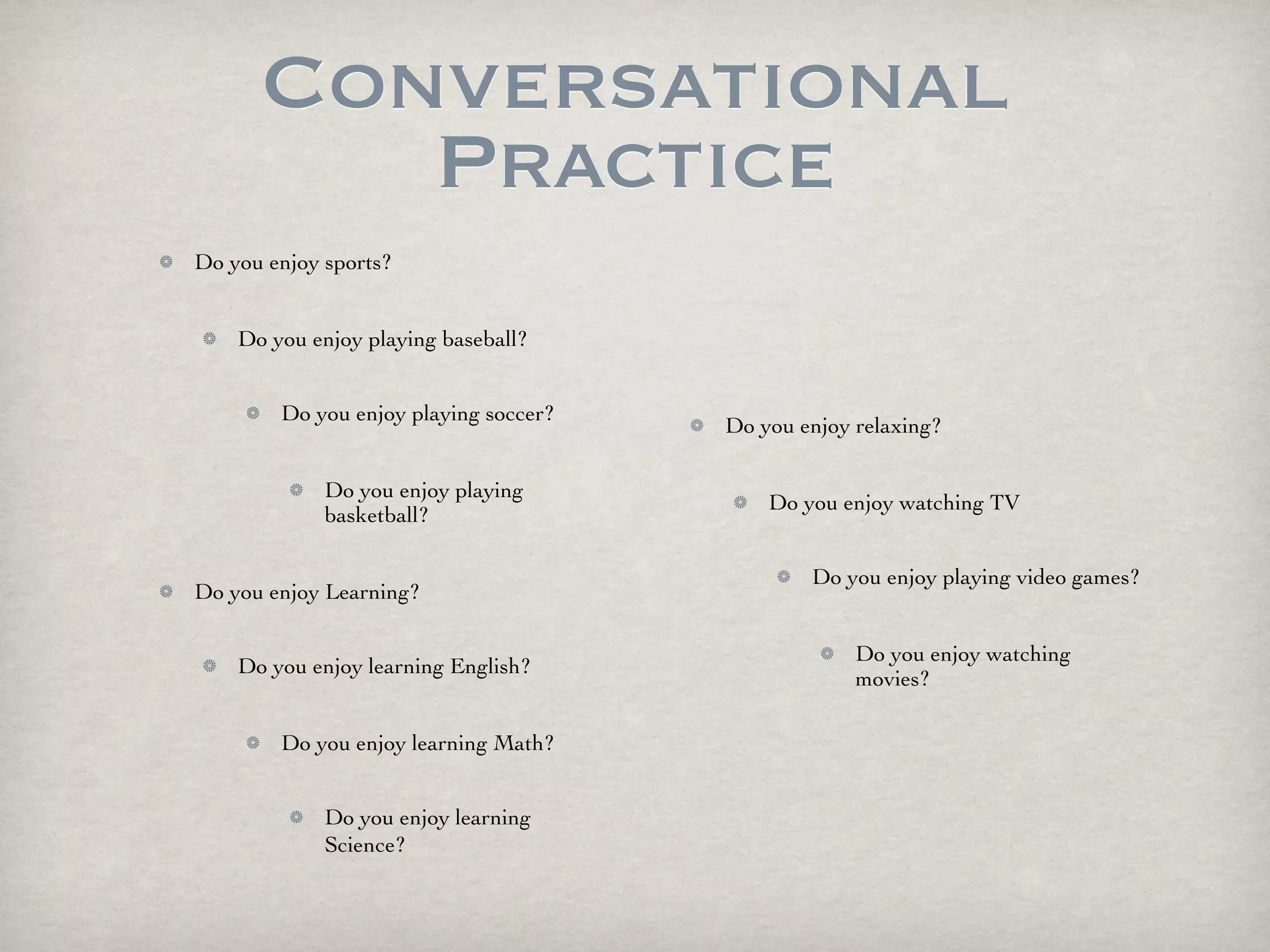
Conversational
         Practice
Do you enjoy sports?


    Do you enjoy playing baseball?


        Do you enjoy playing soccer?
                                       Do you enjoy relaxing?

             Do you enjoy playing
                                           Do you enjoy watching TV
             basketball?

                                               Do you enjoy playing video games?
Do you enjoy Learning?

                                                    Do you enjoy watching
    Do you enjoy learning English?
                                                    movies?

        Do you enjoy learning Math?


             Do you enjoy learning
             Science?
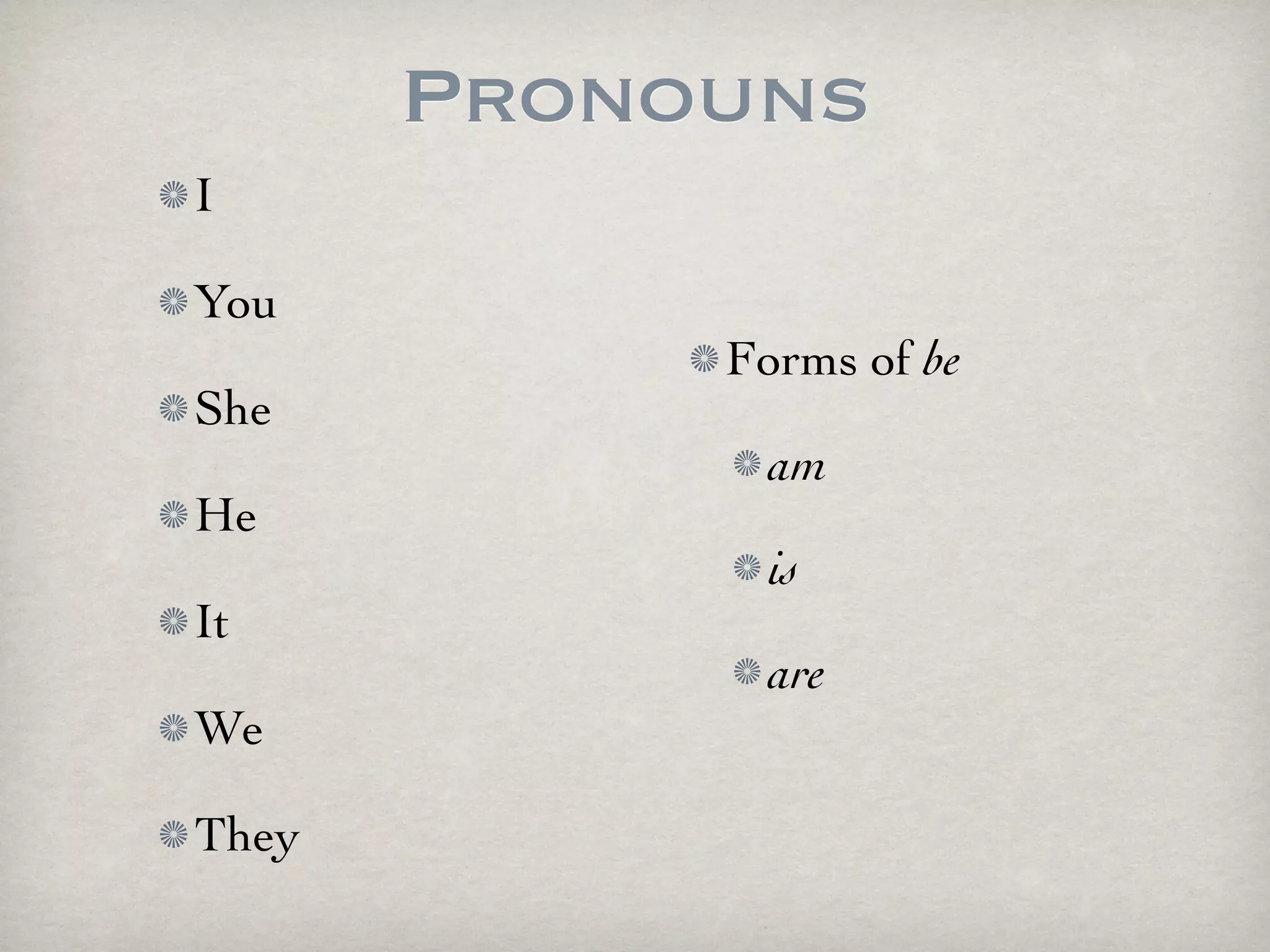
Pronouns
I

You
            Forms of be
She
              am
He
              is
It
              are
We

They
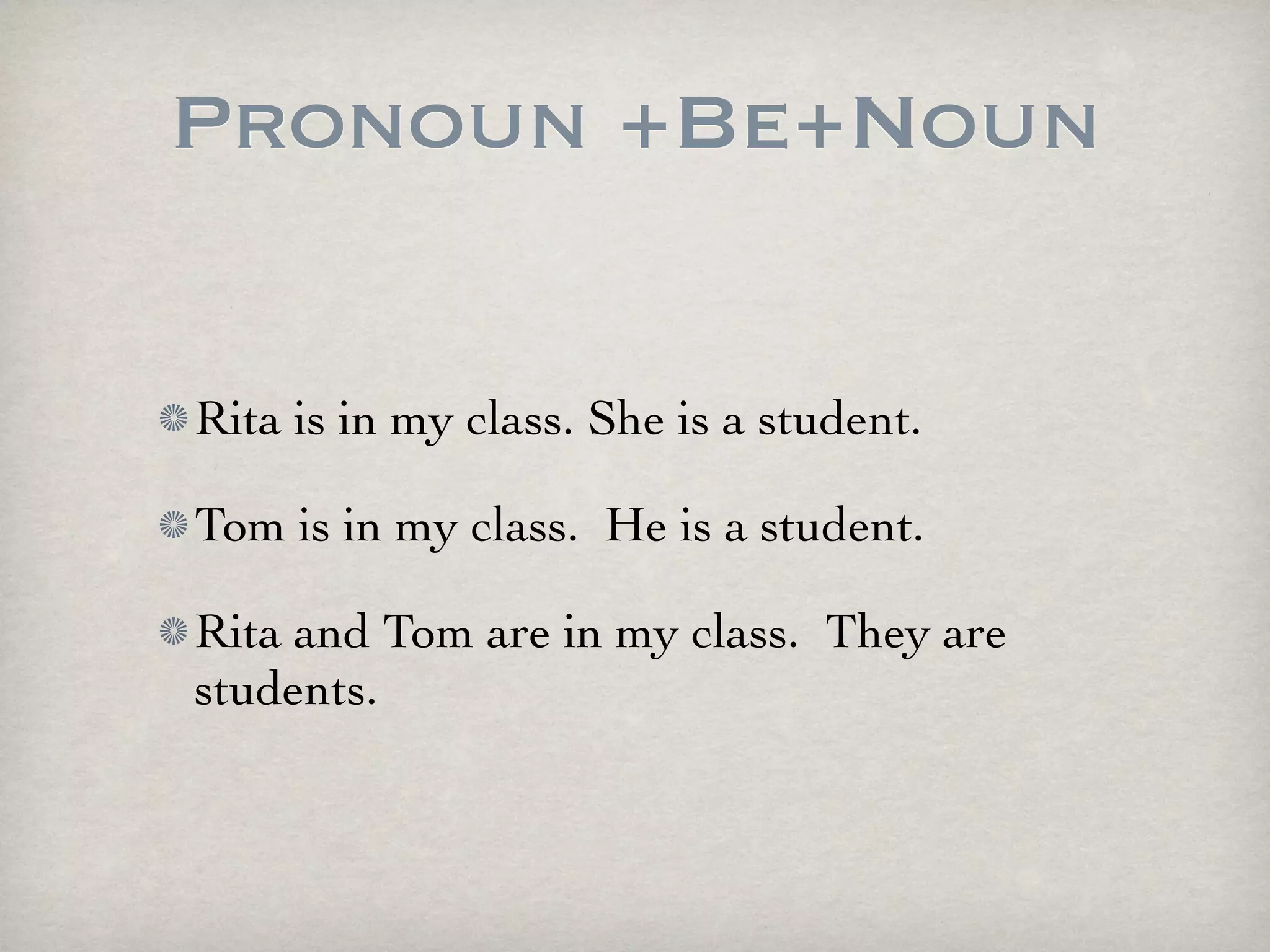
Pronoun +Be+Noun

Rita is in my class. She is a student.

Tom is in my class. He is a student.

Rita and Tom are in my class. They are
students.

Week 2 thurs

  • 1.
    Write as manyfacts as you know about afghanistan or about living in a Muslim nation. W r i t i n g J o u r n a l C
  • 2.
    Summary Write a fivesentence summary. Look up 3 words that were new to you. Connect the person’s challenges to you own. Present.
  • 3.
    I have acat. I once had two cats. I used to fee my cats food. Tuna was my cats’ favorite food. Yet, my one cat’s second favorite was corn and I thought that was weird. You know that nouns can be a person, a place, a thing, or a thing. But, can you notice something that all nouns have in common-- a common rule?
  • 4.
    Noun Rule • A noun is a word that can be made plural and/or possesive • Singular: Cat, Horse Singular Possessive: Cat’s, Horse’s • Plural: Cats, Horses Plural Possessive: Cats’, Horses’ • Remember to watch for nouns that do not follow these rules: Man, Men, Man’s, Men’s • Nouns are essential to all sentences, they provide the subject.
  • 5.
    Noun Phrase • A noun phrase (NP) is a word or a group of words that function as a unit within a sentence. • A phrase always has a headword and this is the noun. • Nouns are signaled by the determiner • Common determiners include articles (a, an, the), Possessive nouns and pronouns (Camille’s, his), and demonstrative pronouns (this, that, those)
  • 6.
    Let us add to the noun definition:A noun is a word that can be made plural and/or possessive, it occupies the headword position in a noun phrase, it is usually signaled by a determiner • Locate each noun phrases headword and determiner: • The students rested after a long trip. • Our new neighbors became our best friends. • A huge crowd lined the streets for the parade. • This new lasagna recipe feeds an enormous crowd.
  • 7.
    Count vs. Noncount Nouns • Knowing the difference between count and noncount nouns will help you do the following: • Use the noun plural ending -s correctly • Use the appropriate type of article: definite (the) or indefinite (a or an) • Use words that express quantities, such as little, much, . . .
  • 8.
    Count vs. Noncount • The main difference between count and noncount nouns is whether or not the things they refer to can be counted.
  • 9.
    Count Nouns • Count nouns refer to things that can be divided up into smaller units which are separate and distinct from one another. They usually refer to what can individually be seen or heard: table chair word remark finger
  • 10.
    Noncountthings that cannotbe counted Nouns • Noncount nouns refer to because they are regarded as wholes which cannot be divided into parts. They often refer to abstractions and occasionally have a collective meaning: anger furniture warmth leisure education courage progress
  • 11.
    The Rules • The Rules • Count nouns can be pluralized by adding a final -s to the nouns. • Noncount nouns cannot be not pluralized at all.
  • 12.
    Special Cases • Special Case: A special case is the use of the mass/ count distinction for the purpose of classification. The nouns which function both ways mainly denote foods and beverages: food(s), drink(s), wine(s), bread(s), coffee(s), and fruit(s).
  • 13.
    Describe a holidaythat your family celebrated. Is this celebrated in America? How do you celebrate it? Why do you think people celebrate this holiday? W r i t i n g J o u r n a l B
  • 14.
    Summary Write a fivesentence summary. Look up 3 words that were new to you. Does this sound like fun? Would you do this? Why do you think people do this?
  • 15.
    The last timeI cooked was... I arrived in America (when?)... I studied English for (years?)... Finish these sentences out loud!
  • 16.
    Simple past tense • Use simple past tense to talk about something that happened in the past • You do this by using the past version of the main verb • What is a verb? • It is also, a word that can be used in present and past tenses, it has an s form and an ing form
  • 17.
    Past Tense • in simple past the verb takes these endings: -d, -ed, -ied (baked, cooked, studied) • I visited, She visited,We visited: no matter who, the verb is the same • Time Markers (adverbs) are used: Yesterday, Today, This morning, ...for three years. • To make a past statement negative use • did not + base form of verb
  • 18.
    Practice • Underline thesimple past verb and then write it’s base form: • We arrived last Wednesday night. ____ • Norma baked a cake. _____ • The bus stopped at the corner. ______ • We studied history this morning._____
  • 19.
    Write one wordyou learned this week and what it means. Write one thing you learned about Lance Armstrong. Write one thing about nouns that you learned. W r i t i n g J o u r n a l 1 * M r . S
  • 20.
    Find the missingwords 1. Mother ___(Sing or Sang)___ to the baby. 2.Milk __(Flied or Flew)__ everywhere when the carton broke. 3.I had__(an or a)__ apple for lunch. 4.Put __(them or those)__ boxes over there. 5.They __(can’t or didn’t)__ get to go to the lake. Wa r m U p
  • 21.
    Which words havethe /o/ sound in “go”? Goat So Drop Bone Find the pattern and find the words that go together: Fork Spoon Knife Hammer Correct the Sentences: Will you came to my house I brush my tooth everyday Wa r m u p V e r s i o n 2 . 0
  • 22.
    Conversational Practice Do you enjoy sports? Do you enjoy playing baseball? Do you enjoy playing soccer? Do you enjoy relaxing? Do you enjoy playing Do you enjoy watching TV basketball? Do you enjoy playing video games? Do you enjoy Learning? Do you enjoy watching Do you enjoy learning English? movies? Do you enjoy learning Math? Do you enjoy learning Science?
  • 23.
    Pronouns I You Forms of be She am He is It are We They
  • 24.
    Pronoun +Be+Noun Rita isin my class. She is a student. Tom is in my class. He is a student. Rita and Tom are in my class. They are students.