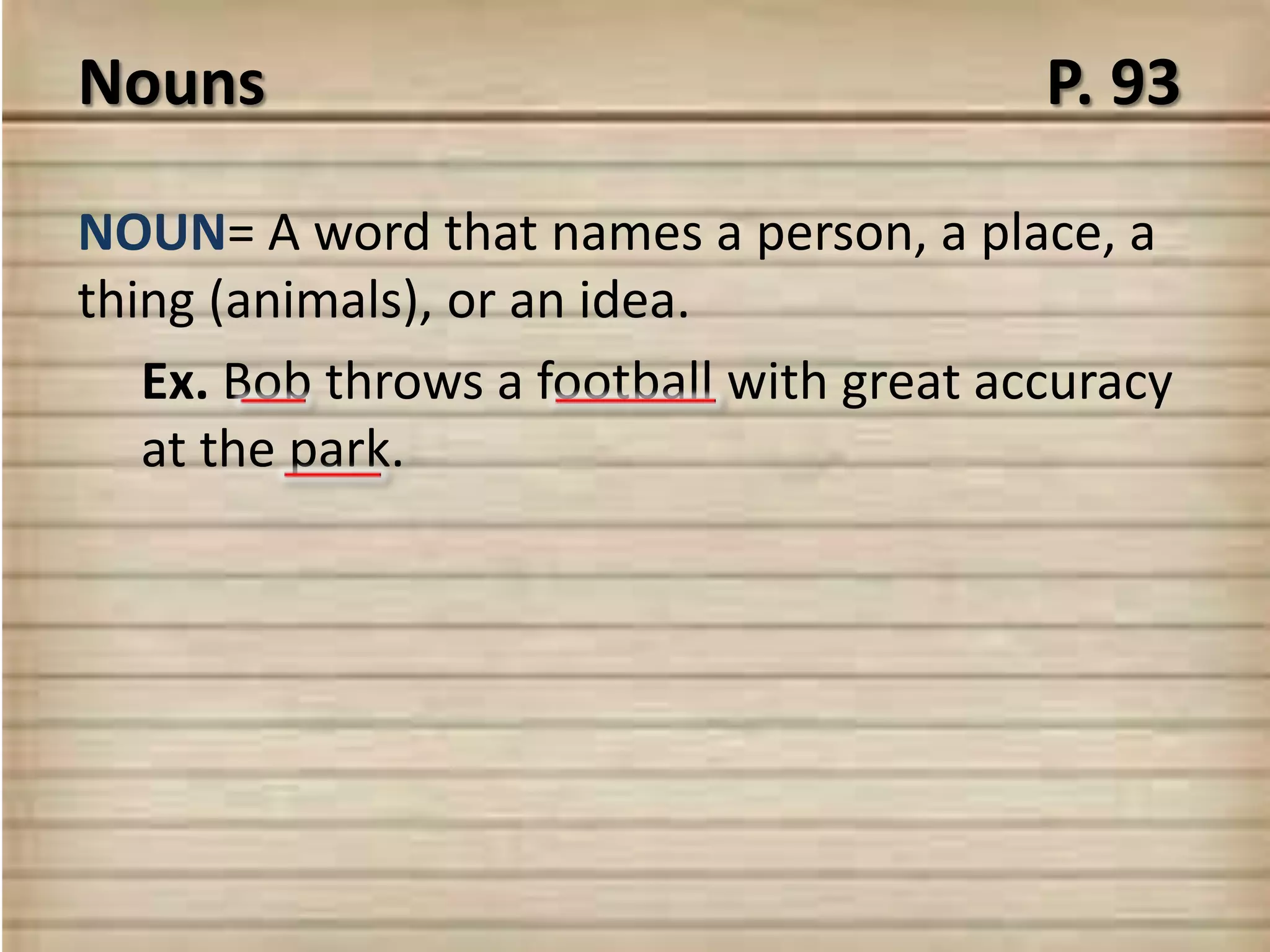
Nouns                                     P. 93

NOUN= A word that names a person, a place, a
thing (animals), or an idea.
   Ex. Bob throws a football with great accuracy
   at the park.
Practice: Write the following nouns under each category
  autonomy           Mexico    rosettes    hips
  responsibilities   hope      raggedy     shoes
  canteen            feet      goblet      Sally
  cumulus            nuns      poverty     mango
  Esperanza          sphinx    street      puberty
       People        Places     Things        Ideas
Types of Nouns
•   Singular
•   Plural
•   Compound
•   Concrete
•   Abstract
•   Common
•   Proper
•   Collective
•   Possessive
Singular and Plural Nouns                       P. 93
• SINGULAR NOUNS= name one person, place, thing, or idea.
• PLURAL NOUNS= name more than one
  person, place, thing, or idea.
   – for most nouns add -s
   – nouns ending in s, ch, sh, x, or z add –es
   – nouns ending in y preceded by a consonant, change y to
     i and add –es.
   – for nouns ending with f or fe, change the f to v and add –
     s or –es.
   – irregular plurals
   – nouns that do not change
Practice: Write the plural form of the following words


•    leaf- leaves                    •   letter ₋   letters
•    dish- dishes                    •   train ₋    trains
•    watch- watches                  •   creek ₋    creeks
•    fly- flies                      •   Glove ₋    Gloves
•    wolf- wolves                    •   chick ₋    chicks
•    responsibility-responsibilities •   leaf ₋     leaves
•    foot- feet                      •   shelf ₋    shelves
•    street- streets                 •   moose₋     moose
P. 95

Compound, Concrete, and Abstract Nouns

• COMPOUND= a noun made of two or more words.
   o open: gray fox, press secretary, line of sight
   o hyphenated: mother-in-law, tenth-grader
   o closed: folksinger, headlight, postmaster

• CONCRETE= names an object that occupies space or
  can be recognized by any of the senses

• ABSTRACT= names an idea, a quality, or a
  characteristic
Common and Proper Nouns                                 P. 96
COMMON= the general name of a person, place, thing, or idea
PROPER= the name of a particular person, place, thing, or idea
 Practice: Write a proper name for each common noun
       1. city             ____________________
       2. lake             ____________________
       3. day              ____________________
       4. athlete          ____________________
       5. restaurant       ____________________
       6. President        ____________________
       7. holiday          ____________________
       8. month            ____________________
       9. planet           ____________________
       10.actor            ____________________
Collective Nouns                                    P. 97
COLLECTIVE: singular in form but names a group
Practice: Identify each collective noun. Label it S if it’s
singular and P if it’s plural.
1. The decorating committee disagree about everything.
2. The couple in the film were Meg Ryan and Tom Hanks.
3. The mob is howling outside the gates of the embassy.
4. Ideally, a union represents all the workers.
5. Every night, the audience gives the play a standing
    ovation.
6. We like to harmonize at out house, and the family sing all
    the different parts.
7. In this story, an entire class decides to volunteer at a
    homeless shelter.
Possessive Nouns                                       P. 94
POSSESSIVE FORM: shows possession , ownership, or the
general relationship between two nouns.
• Add ’s (apostrophe s) to form the possessive of all singular
  nouns.
• When a plural noun ends with an s or z sound, the
  possessive may be formed by adding just an apostrophe.
EXAMPLE: the lids from the containers
            the containers’ lids
• Add apostrophe and –s to form the possessive of a plural
   noun that does not end in s.
Possessive Nouns
Practice: Write the possessive form.
 1. the benefits of the company        the company’s benefits

 2. the spoons belong to the ladies the ladies’ spoons

 3. the pay of the workers              The workers’ pay

 4. the music of Coldplay               Coldplay’s music

 5. the armies of Napoleon              Napoleon’s armies
Verbs                                        P.107-108
A word that expresses action or state of being and is
necessary to make a statement.
• Action Verbs
   o Transitive: followed by a direct object (answers the
      questions what or whom)
   o Intransitive: not followed by a direct object
--Thomas Morris, an Australian athlete, once skipped rope from
Melbourne to Adelaide, Australia.
--Manuel, the head chef of the finest restaurant in the hotel,
baked fourteen different kinds of cakes for the wedding
reception.
P.108-109
• Linking Verbs does not show action. Links the subject with
  a noun, pronoun, adjective. *Be in all its forms-
  am, is, are, was, were- is the most commonly used.
           Look             Remain           Seem             Became
           Stay             Grow             Appear           Sound
           Taste            Smell            Feel             turn

• EXAMPLE: The players are ready. The salad tastes good.
• Auxiliary Verbs accompanies the main verb may express
  time or emphasize meaning.
        Forms of be         Am, is, are, was, were, being, been
        Forms of have       Has, have, had, having
        Other auxiliaries   Can, could, do, does, did, may, might, shall, should,
                            Must, will, would
• EXAMPLE: We will need vegetables gardens.
           I should be leaving.
Adjectives                                     P.110-111
      A word that modifies a noun or a pronoun by limiting
its meaning. An adjective tells what kind, which one, how
many, or how much.
Examples: red barn
          interesting poem
          these ideas
*Possessive (my, our, your, his, her, its, and their) and
demonstrative (this, that, these, and those) pronouns and
possessive nouns (‘s) can also serve as adjectives when they
modify nouns.
Examples: my kitten [possessive adjective]
          those bicycles [demonstrative adj.]
          Lucy’s report. *possessive noun acting as adj.+
          leather shoes [noun acting as adj.]
P.112- 113

Adjectives                              P.110-111
Verbs can also serve as adjectives.
Examples: a spinning top
           some burned toast

The adjective can be in various position depending on
the word it modifies.
• How suspenseful this movie is!
• The movie is suspenseful.
• The movie, relentlessly suspenseful, ended
   suddenly.
P.112- 113

Adjectives                                      P.110-111


Practice: identify the adjective and the word it modifies
1. The shrew is a small, ferocious mammal.
2. Delicate white curtains hung at the tall windows of
   our old house.
3. Marcus was not paying close attention, and he fell
   through the cracked ice on the lake.
4. In the empty house, dried flowers hung on the faded
   yellow wall.
5. The flowers are amazingly beautiful in the bright sunlight.
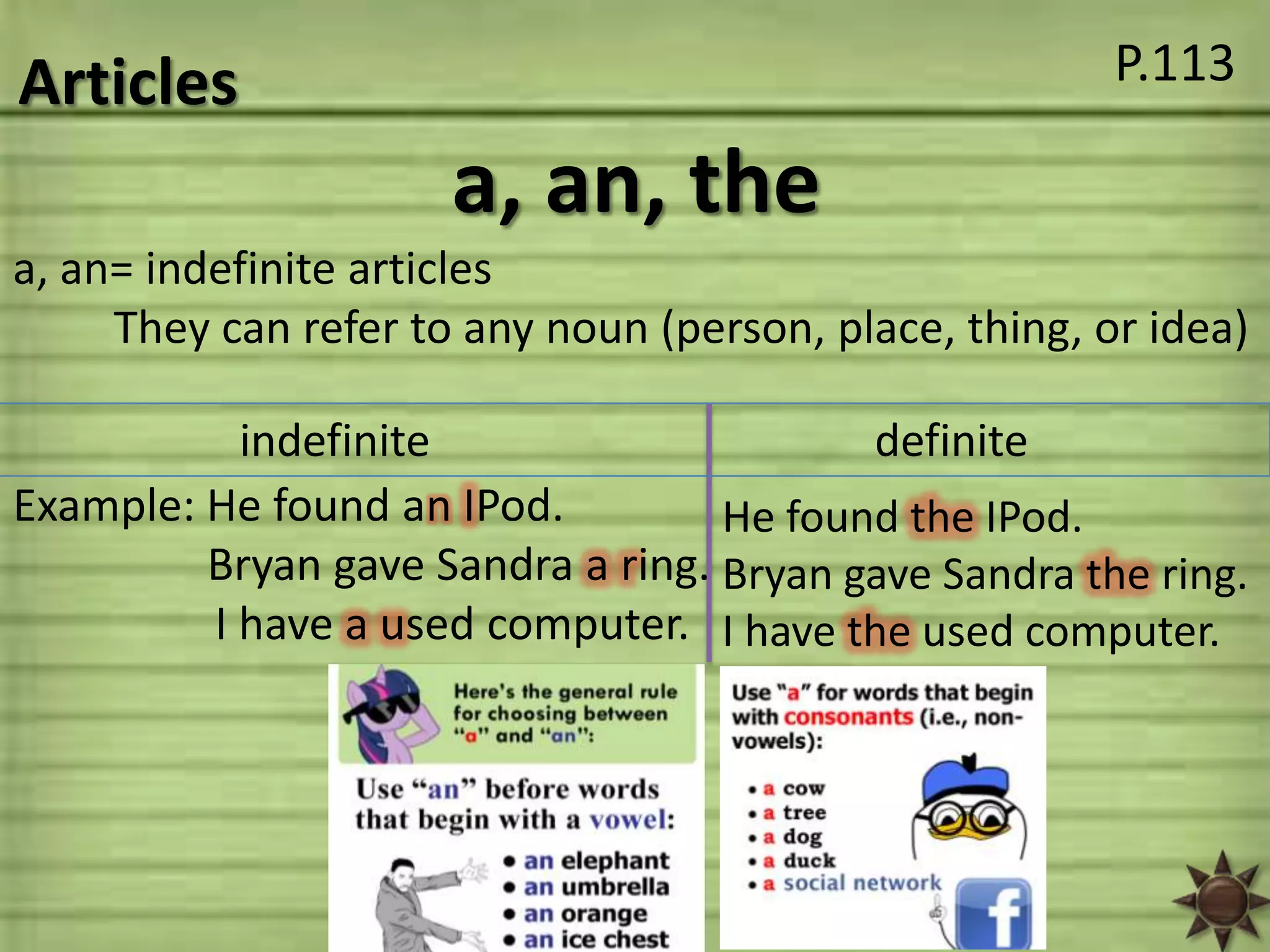
Articles                                                P.113

                      a, an, the
a, an= indefinite articles
     They can refer to any noun (person, place, thing, or idea)

           indefinite                     definite
Example: He found an IPod.         He found the IPod.
         Bryan gave Sandra a ring. Bryan gave Sandra the ring.
         I have a used computer. I have the used computer.

Nouns, Verbs, Adjectives, Articles

  • 1.
    Nouns P. 93 NOUN= A word that names a person, a place, a thing (animals), or an idea. Ex. Bob throws a football with great accuracy at the park.
  • 2.
    Practice: Write thefollowing nouns under each category autonomy Mexico rosettes hips responsibilities hope raggedy shoes canteen feet goblet Sally cumulus nuns poverty mango Esperanza sphinx street puberty People Places Things Ideas
  • 3.
    Types of Nouns • Singular • Plural • Compound • Concrete • Abstract • Common • Proper • Collective • Possessive
  • 4.
    Singular and PluralNouns P. 93 • SINGULAR NOUNS= name one person, place, thing, or idea. • PLURAL NOUNS= name more than one person, place, thing, or idea. – for most nouns add -s – nouns ending in s, ch, sh, x, or z add –es – nouns ending in y preceded by a consonant, change y to i and add –es. – for nouns ending with f or fe, change the f to v and add – s or –es. – irregular plurals – nouns that do not change
  • 5.
    Practice: Write theplural form of the following words • leaf- leaves • letter ₋ letters • dish- dishes • train ₋ trains • watch- watches • creek ₋ creeks • fly- flies • Glove ₋ Gloves • wolf- wolves • chick ₋ chicks • responsibility-responsibilities • leaf ₋ leaves • foot- feet • shelf ₋ shelves • street- streets • moose₋ moose
  • 6.
    P. 95 Compound, Concrete,and Abstract Nouns • COMPOUND= a noun made of two or more words. o open: gray fox, press secretary, line of sight o hyphenated: mother-in-law, tenth-grader o closed: folksinger, headlight, postmaster • CONCRETE= names an object that occupies space or can be recognized by any of the senses • ABSTRACT= names an idea, a quality, or a characteristic
  • 7.
    Common and ProperNouns P. 96 COMMON= the general name of a person, place, thing, or idea PROPER= the name of a particular person, place, thing, or idea Practice: Write a proper name for each common noun 1. city ____________________ 2. lake ____________________ 3. day ____________________ 4. athlete ____________________ 5. restaurant ____________________ 6. President ____________________ 7. holiday ____________________ 8. month ____________________ 9. planet ____________________ 10.actor ____________________
  • 8.
    Collective Nouns P. 97 COLLECTIVE: singular in form but names a group Practice: Identify each collective noun. Label it S if it’s singular and P if it’s plural. 1. The decorating committee disagree about everything. 2. The couple in the film were Meg Ryan and Tom Hanks. 3. The mob is howling outside the gates of the embassy. 4. Ideally, a union represents all the workers. 5. Every night, the audience gives the play a standing ovation. 6. We like to harmonize at out house, and the family sing all the different parts. 7. In this story, an entire class decides to volunteer at a homeless shelter.
  • 9.
    Possessive Nouns P. 94 POSSESSIVE FORM: shows possession , ownership, or the general relationship between two nouns. • Add ’s (apostrophe s) to form the possessive of all singular nouns. • When a plural noun ends with an s or z sound, the possessive may be formed by adding just an apostrophe. EXAMPLE: the lids from the containers the containers’ lids • Add apostrophe and –s to form the possessive of a plural noun that does not end in s.
  • 10.
    Possessive Nouns Practice: Writethe possessive form. 1. the benefits of the company the company’s benefits 2. the spoons belong to the ladies the ladies’ spoons 3. the pay of the workers The workers’ pay 4. the music of Coldplay Coldplay’s music 5. the armies of Napoleon Napoleon’s armies
  • 11.
    Verbs P.107-108 A word that expresses action or state of being and is necessary to make a statement. • Action Verbs o Transitive: followed by a direct object (answers the questions what or whom) o Intransitive: not followed by a direct object --Thomas Morris, an Australian athlete, once skipped rope from Melbourne to Adelaide, Australia. --Manuel, the head chef of the finest restaurant in the hotel, baked fourteen different kinds of cakes for the wedding reception.
  • 12.
    P.108-109 • Linking Verbsdoes not show action. Links the subject with a noun, pronoun, adjective. *Be in all its forms- am, is, are, was, were- is the most commonly used. Look Remain Seem Became Stay Grow Appear Sound Taste Smell Feel turn • EXAMPLE: The players are ready. The salad tastes good. • Auxiliary Verbs accompanies the main verb may express time or emphasize meaning. Forms of be Am, is, are, was, were, being, been Forms of have Has, have, had, having Other auxiliaries Can, could, do, does, did, may, might, shall, should, Must, will, would • EXAMPLE: We will need vegetables gardens. I should be leaving.
  • 13.
    Adjectives P.110-111 A word that modifies a noun or a pronoun by limiting its meaning. An adjective tells what kind, which one, how many, or how much. Examples: red barn interesting poem these ideas *Possessive (my, our, your, his, her, its, and their) and demonstrative (this, that, these, and those) pronouns and possessive nouns (‘s) can also serve as adjectives when they modify nouns. Examples: my kitten [possessive adjective] those bicycles [demonstrative adj.] Lucy’s report. *possessive noun acting as adj.+ leather shoes [noun acting as adj.]
  • 14.
    P.112- 113 Adjectives P.110-111 Verbs can also serve as adjectives. Examples: a spinning top some burned toast The adjective can be in various position depending on the word it modifies. • How suspenseful this movie is! • The movie is suspenseful. • The movie, relentlessly suspenseful, ended suddenly.
  • 15.
    P.112- 113 Adjectives P.110-111 Practice: identify the adjective and the word it modifies 1. The shrew is a small, ferocious mammal. 2. Delicate white curtains hung at the tall windows of our old house. 3. Marcus was not paying close attention, and he fell through the cracked ice on the lake. 4. In the empty house, dried flowers hung on the faded yellow wall. 5. The flowers are amazingly beautiful in the bright sunlight.
  • 16.
    Articles P.113 a, an, the a, an= indefinite articles They can refer to any noun (person, place, thing, or idea) indefinite definite Example: He found an IPod. He found the IPod. Bryan gave Sandra a ring. Bryan gave Sandra the ring. I have a used computer. I have the used computer.