ENGLISH 10
Week 1
At the end of this week, I
can:
■ Identify characteristics of useful information.
■ Identify different sources of information.
■ Identify whether the source is primary,
secondary, or tertiary source.
■ Extract useful information applying the
strategies discussed.
■ Create a comic strip that talks about current
issues.
Hello!
Characteristics of
good information
1.
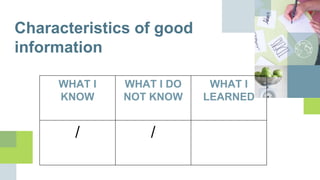
KWL Chart
Complete the table.
Characteristics of good
information
WHAT I
KNOW
WHAT I DO
NOT KNOW
WHAT I
LEARNED
/ /
2.
Are you updated?
Think of any current news about the
world. Write down 3 and be ready to
share it to the class.
3.
Can you tell
Choose one news from your list then
complete the checklist on the next
slide.
4.
Online News!
Search for an online news. Assess the
quality of the article based on the
criteria from the previous slide.
5.
Reflection
On a ¼ sheet of paper,
answer the question:
In getting information
from any media, what
factors or
characteristics should
you consider? Explain.
Week 1
(Day 2)
Hello!
Identify different
sources of
information.
How to get
information?
 Listening
 Reading
 Interviews
 Questioning
 Questionnaires
 Observation
Complete the
concept map by
writing sources of
information that
you know.
This is a slide title
SOURCES OF INFORMATION
News
Repor
t
Informativ
e Talks
Panel
Discussi
on
Speech
NEWS REPORT
■ These are found in newspapers,
televisions, or radios.
■ A news story is a journalistic, factual
presentation of news about current
events, typically one presented as a
narrative account.
https://www.youtube.com/watch?v=AjyG1CTll
70
NEWS REPORT
PUBLIC SPEECH
■ This is an oral presentation delivered
to an audience.
■ Public speaking is a process of
speaking to a group of people in a
structured, deliberate manner intended
to inform, influence, or entertain the
listeners.
PUBLIC SPEECH
INFORMATIVE TALKS
An informative speech
is one where the speaker
intends to educate their
audience on a specific
topic.
https://www.youtube.com/watch?v
=dfjVoAJrZKk&t=79s
INFORMATIVE TALKS
PANEL DISCUSSION
This is a situation in which a group of
people are gathered to discuss an issue,
often to provide feedback on something,
to brainstorm solutions to a problem or to
discuss an issue of public concern in
front of an audience.
https://www.youtube.com/watch?v=FKbu6YDqQP8&t=1s
PANEL DISCUSSION
… let’s
review
Give examples of sources of information.
Define news report.
Differentiate speech to informative
speech.
What is the purpose of panel discussion?
GROUP
ACTIVIT
Y
DIRECTIONS:
1. Form a circle with your
members.
2. Choose a card.
3. Complete the task in
the card within the time
given.
4. Be ready to present
your output.
Day 3 and 4
Sources
of
Information
Sources of Information
PRIMARY
SECONDARY
TERTIARY
PRIMARY sources
■These are authentic and have not been subjected
to evaluation or assessment.
■These report discoveries, sharing of information
and first-hand.
■These are information written at a certain time or
period of research.
■Definition of primary sources vary depending on
the contexts and/or disciplines.
PRIMARY sources
Examples:
speeches
video recordings
photographs
government records
newspaper/magazine portraying information
from eyewitnesses
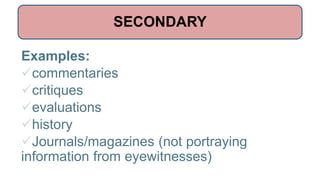
SECONDARY
■Sources Secondary sources provide
information, discussion and/or interpretation of
the evidence.
■These are usually evaluations of primary
sources.
■These are also information written by authors
who do not personally witness the event or
action.
Examples:
commentaries
critiques
evaluations
history
Journals/magazines (not portraying
information from eyewitnesses)
SECONDARY
TERTIARY
Tertiary sources serve as collection
of primary and secondary sources.
 publications that summarize and
digest the information in primary and
secondary sources to provide
background on a topic, idea, or event.
Examples:
bibliographies
directories
dictionary
almanac
abstracts
indexes
encyclopedias
databases
TERTIARY
Six essential
characteristics of
information sources
Six essential characteristics of
information sources
1. Accuracy. Information should be reliable, useful,
free from flaws and of high quality.
2. Completeness. Information should provide all
needed details. It should be able to answer the
wh– questions (what, who, when, where, why
and how).
3. Timeliness. Information should be up-to-date.
4. Consistency. Information should be consistent
for it to be considered accurate and useful.
5. Relevant. Information should suit the demand,
needs and interests of the readers.
6. Uniqueness. Information should be distinct.
Strategies to get information from reading
materials
1.Know what you're reading - and why.
2.Identify key information.
3.Increase your understanding.
4.Recall and review the text.
5.Control your reading environment.
WEEK 1
QUIZ
Review the concepts
above. We will have our
first quiz next meeting. 
WEEK 1
GROUP
OUTPU
T
DIRECTIONS:
1. Research about any current affairs.
2. Annotate or note details of the news.
3. Create a comic strip using the following guidelines:
 The setting and characters should be based on or about
your everyday life or conversations.
 The conversation should center on the news you have
chosen.
 The comics should be written in one oslo paper.
 Design and color your comics.
 All information or data you have taken from the news in the
“bubbles” should be highlighted or underlined.
 Write the sources of the data presented in the comics at the
bottom of the comics.
If you have
questions, do not
hesitate to ask in
our gc. 

Week 1.pptx