Types of
Listening
English Grade 10
Francis R. Malaquilla
Learning Objectives
The students should be able
to listen to audio materials
with an analytical ear.
Students should be able to
evaluate the accuracy and
validity of texts through
critical listening.
Students should be able to
apply analytical listening in
everyday situations.
01 02 03
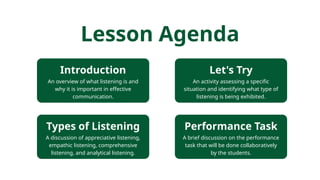
Lesson Agenda
Introduction
An overview of what listening is and
why it is important in effective
communication.
Let's Try
An activity assessing a specific
situation and identifying what type of
listening is being exhibited.
Types of Listening
A discussion of appreciative listening,
empathic listening, comprehensive
listening, and analytical listening.
Performance Task
A brief discussion on the performance
task that will be done collaboratively
by the students.
Introduction
Introduction
Introduction
Listening determines the success of
effective communication. Out of all
the four language macro skills,
listening attends to the majority of
communication. This simply means
that we listen most of the time
rather than speak.
Introduction
Without effective listening skills,
communication is easily
misinterpreted. As a result,
communication breaks down, and
the people involved in the
communication can easily become
frustrated or irritated.
Introduction
In this lesson, we will explore
the four types of listening so
that you will know what
listening skill should be used
in a particular situation.
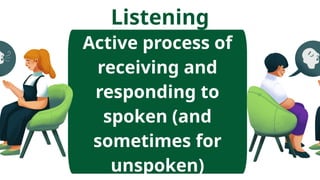
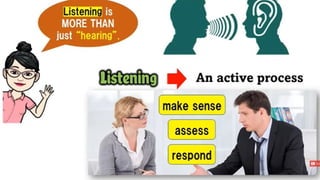
Active process of
receiving and
responding to
spoken (and
sometimes for
unspoken)
Listening
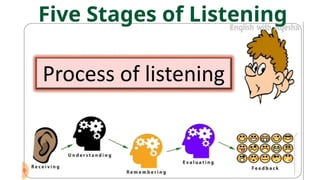
Five Stages of Listening
Appreciative Listening
Emphatic Listening
Comprehensive Listening
Analytical Listening
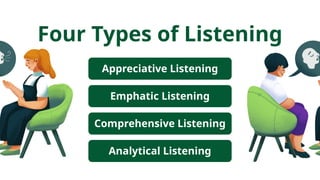
Four Types of Listening
Appreciative
Listening
Appreciative listening is a
type of listening in which
the person listening looks
for information that he or
she will appreciate and that
will help him or her meet
his or her needs and goals.
Appreciative
Listening
listening for pleasure and
enjoyment, as when we
listen to music, to a
comedy routine, or to an
entertaining speech
Appreciative
Listening
Examples
• listening to
music, poetry,
stories, or
speeches that
make you feel
Empathic Listening
Empathic listening is a dynamic and
compassionate process that requires more
than just hearing what someone says. By
taking the time to listen to them, you are
expressing that you care about them and
their views and feelings.
Empathic Listening
focuses on understanding and
identifying with a person’s situation,
feelings, or motives; there is an
attempt to understand what the other
person is feeling
Empathic Listening
listener does not necessarily agree or
feel the same way with the speaker
instead he/she understands the type
and intensity of feelings the speaker is
experiencing without judgement
Empathic Listening
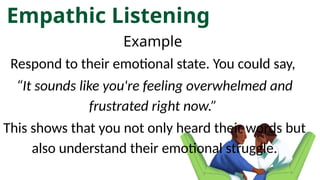
Example
Respond to their emotional state. You could say,
“It sounds like you're feeling overwhelmed and
frustrated right now.”
This shows that you not only heard their words but
also understand their emotional struggle.
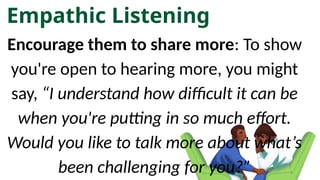
Empathic Listening
Encourage them to share more: To show
you're open to hearing more, you might
say, “I understand how difficult it can be
when you're putting in so much effort.
Would you like to talk more about what’s
been challenging for you?”
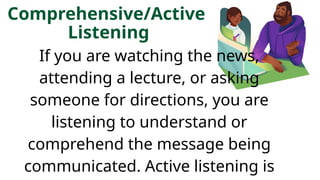
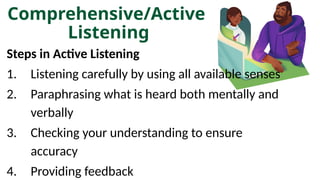
Comprehensive/Active
Listening
If you are watching the news,
attending a lecture, or asking
someone for directions, you are
listening to understand or
comprehend the message being
communicated. Active listening is
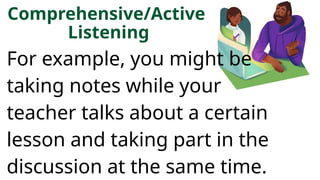
Comprehensive/Active
Listening
For example, you might be
taking notes while your
teacher talks about a certain
lesson and taking part in the
discussion at the same time.
Comprehensive/Active
Listening
Steps in Active Listening
1. Listening carefully by using all available senses
2. Paraphrasing what is heard both mentally and
verbally
3. Checking your understanding to ensure
accuracy
4. Providing feedback
Critical/
Analytical
Listening
listening to
evaluate a
message for
purposes of
accepting or
rejecting it
Critical/
Analytical
Listening
Example
Listen to the sales
pitch of a used-
car dealer or the
campaign speech
of a political
candidate
Critical/
Analytical
Listening
focuses on
evaluating
whether a
message is
logical and
reasonable.
Critical/
Analytical
Listening
asks you to make
judgements based on
your evaluation of the
speaker’s arguments -
challenges the
speaker’s message by
evaluating its accuracy
and meaningfulness,
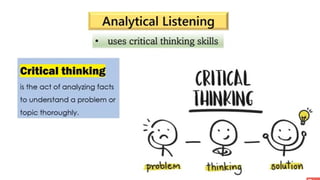
and utility -uses critical
thinking skills
Critical/
Analytical
Listening
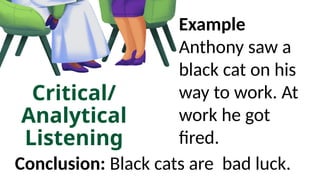
Example
Anthony saw a
black cat on his
way to work. At
work he got
fired.
Conclusion: Black cats are bad luck.
Analytical
Listening
The purpose of analytical listening is to evaluate
the message's content. As a critical listener, you
take in the entirety of the message, analyze it, and
evaluate what you have heard. Analytical listening
evaluates the relationship between ideas reflected
in the communication.
Thank you for
listening!