INFORMATIO
N FROM
VARIOUS
SOURCES
Lesson 1
Week 1
Overview
●This lesson deals with getting information from various sources in the
everyday life. Information, as available data everywhere, can be found in various
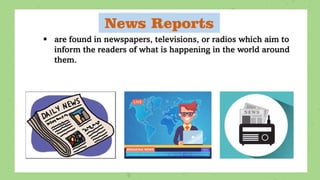
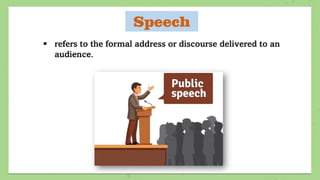
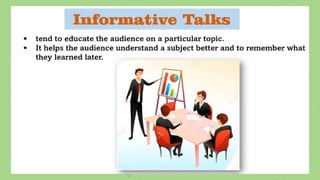
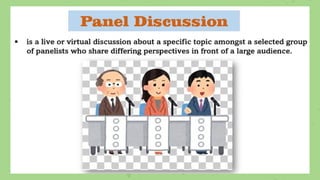
platforms and means such as news reports, speeches, informative talks and
panel discussion, among others. Getting information will basically expose you not
only in the pool of information but should also help you to identify which details
are factual or not. You are expected to identify certain details from different
sources and use them in various contexts.
Objectives
a. Differentiate various sources of
information;
c. Get information from different
text types that can be used in
everyday life through writing
and reading
b. Express the meaning of the
various sources of information
through self – introspection and
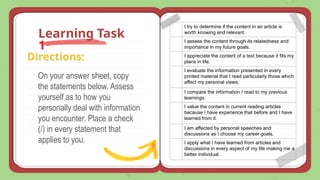
On your answer sheet, copy
the statements below. Assess
yourself as to how you
personally deal with information
you encounter. Place a check
(/) in every statement that
applies to you.
Learning Task
1
Directions:
I try to determine if the content in an article is
worth knowing and relevant.
I assess the content through its relatedness and
importance in my future goals.
I appreciate the content of a text because it fits my
plans in life.
I evaluate the information presented in every
printed material that I read particularly those which
affect my personal views.
I compare the information I read to my previous
learnings.
I value the content in current reading articles
because I have experience that before and I have
learned from it.
I am affected by personal speeches and
discussions as I choose my career goals.
I apply what I have learned from articles and
discussions in every aspect of my life making me a
better individual.
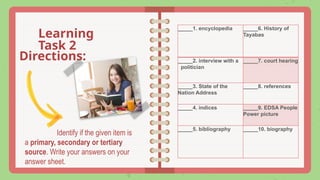
Identify if the given item is
a primary, secondary or tertiary
source. Write your answers on your
answer sheet.
Learning
Task 2
Directions:
_____1. encyclopedia _____6. History of
Tayabas
_____2. interview with a
politician
_____7. court hearing
_____3. State of the
Nation Address
_____8. references
_____4. indices _____9. EDSA People
Power picture
_____5. bibliography _____10. biography
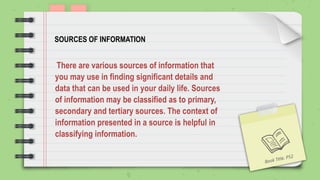
SOURCES OF INFORMATION
There are various sources of information that
you may use in finding significant details and
data that can be used in your daily life. Sources
of information may be classified as to primary,
secondary and tertiary sources. The context of
information presented in a source is helpful in
classifying information.
Book Title. P52
Definition
of Concepts
EXAMPLE
S
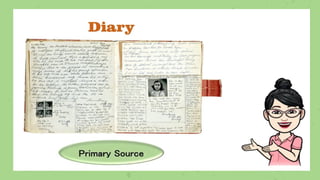
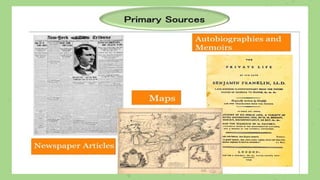
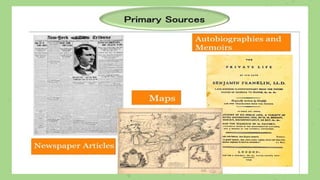
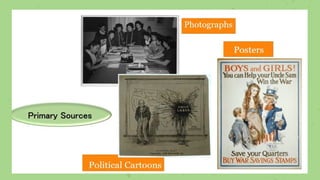
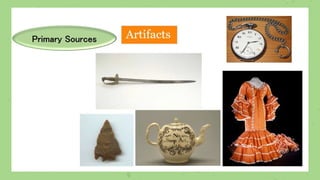
Primary Sources
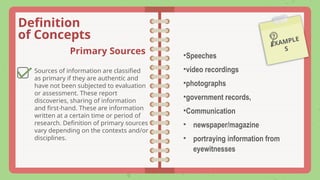
Sources of information are classified
as primary if they are authentic and
have not been subjected to evaluation
or assessment. These report
discoveries, sharing of information
and first-hand. These are information
written at a certain time or period of
research. Definition of primary sources
vary depending on the contexts and/or
disciplines.
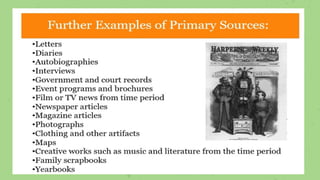
•Speeches
•video recordings
•photographs
•government records,
•Communication
• newspaper/magazine
• portraying information from
eyewitnesses
Definition
of Concepts
EXAMPLE
S
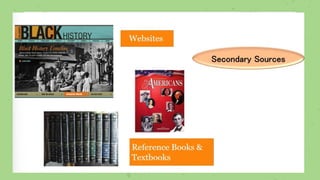
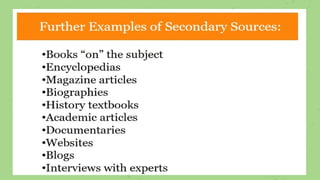
Secondary
Sources
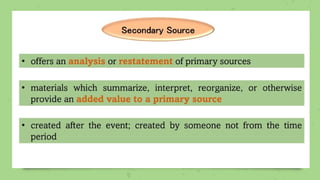
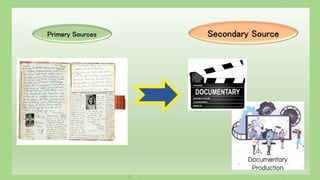
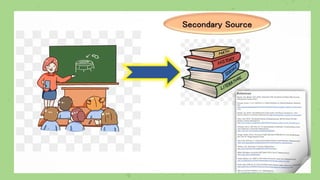
Secondary sources provide
information, discussion and/or
interpretation of the evidence. These
are usually evaluations of primary
sources. These are also information
written by authors who do not
personally witness the event or action.
Definition of secondary sources vary
depending on the contexts and/or
disciplines.
•commentaries
•critiques
•evaluations
•history
• Journals/magazines (not
portraying information from
eyewitnesses)
Definition
of Concepts
EXAMPLE
S
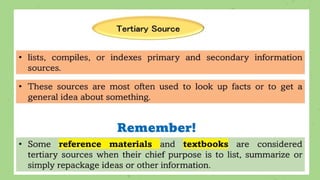
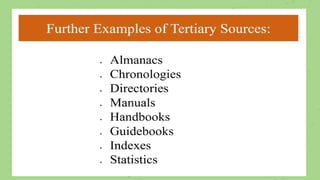
Tertiary Sources
Tertiary sources serve as collection of
primary and secondary sources.
• Bibliographies
• Directories
• Dictionary
• Almanac
• Abstracts
• indexes
• Encyclopedias
• databases
In using the information gathered whether they are primary,
secondary or tertiary sources, take note of these six (6)
characteristics that information should have.
1. Accuracy. Information should be reliable, useful, free from
flaws and of high quality.
2. Completeness. Information should provide all needed
details. It should be able to answer the wh– questions (what, who,
when, where, why and how).
3. Timeliness. Information should be up-to-date.
4. Consistency. Information should be consistent for it to be
considered accurate and useful.
5. Relevant. Information should suit the demand, needs and
interests of the readers.
6. Uniqueness. Information should be distinct.
Learning Task
3
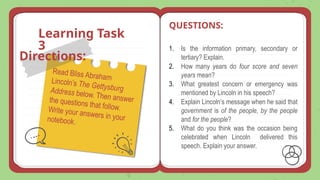
Read Bliss Abraham
Lincoln’s The Gettysburg
Address below. Then answer
the questions that follow.
Write your answers in your
notebook.
1. Is the information primary, secondary or
tertiary? Explain.
2. How many years do four score and seven
years mean?
3. What greatest concern or emergency was
mentioned by Lincoln in his speech?
4. Explain Lincoln’s message when he said that
government is of the people, by the people
and for the people?
5. What do you think was the occasion being
celebrated when Lincoln delivered this
speech. Explain your answer.
QUESTIONS:
Directions:
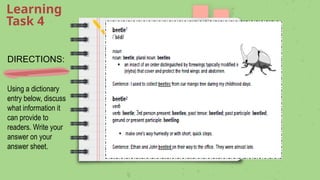
DIRECTIONS:
Learning
Task 4
Using a dictionary
entry below, discuss
what information it
can provide to
readers. Write your
answer on your
answer sheet.
Learning Task
6
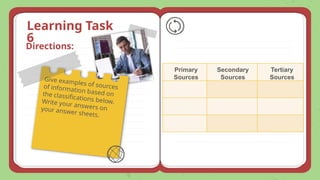
Give examples of sources
of information based on
the classifications below.
Write your answers on
your answer sheets.
Directions:
Primary
Sources
Secondary
Sources
Tertiary
Sources
Learning Task 7
Using the short article below. Provide
an analysis on what are the 3
significant information are provided in
the said article. Write your answer on
your answer sheet.
Directions:
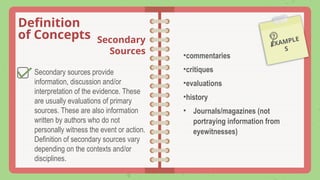
Louise J. Kaplan has rightly and very wisely remarked, “Adolescence represents an inner emotional
upheaval, a struggle between the eternal human wish to cling to the past and the equally powerful
wish to get on with the future.” They are just people trying to learn how to adjust among the adults;
they are quite perplexed, confused, and facing lots of dilemmas.
It is quite true that adolescence is the pivotal phase in any human’s development and growth. It is
crucial transitional period from childhood into adulthood. Crucial physical, emotional, mental, and
attitudinal changes take place in this period. This is the age of stress and aggression. This phase is the
phase of emotional turmoil in which an adolescent feels quite confused and vague about many issues
of life. One of the most conspicuous aspects of teenage is the clash of ideology between the
teenagers and grown-ups.
It has been found that most cases of teenage problems result from isolation, loneliness,
desperation, and lack of trust in parents, friends, and other family members. All these problems can
be minimized by understanding teenage problems and tackling them considerately. Teenagers are
exempted to react, but the elders must not react to their reactions as it might entice them to go astray
and take wrong decisions in stress and hysteria.
The parents, teachers, and other agencies that have the responsibilities to look after their healthy
growth and development must ensure they get healthy environment, training, and skills to be able to
cope successfully with the many complexities and stresses of this phase.

Q1W1 Information from Various Sources.pptx

  • 1.
  • 2.
    Overview ●This lesson dealswith getting information from various sources in the everyday life. Information, as available data everywhere, can be found in various platforms and means such as news reports, speeches, informative talks and panel discussion, among others. Getting information will basically expose you not only in the pool of information but should also help you to identify which details are factual or not. You are expected to identify certain details from different sources and use them in various contexts.
  • 3.
    Objectives a. Differentiate varioussources of information; c. Get information from different text types that can be used in everyday life through writing and reading b. Express the meaning of the various sources of information through self – introspection and
  • 4.
    On your answersheet, copy the statements below. Assess yourself as to how you personally deal with information you encounter. Place a check (/) in every statement that applies to you. Learning Task 1 Directions: I try to determine if the content in an article is worth knowing and relevant. I assess the content through its relatedness and importance in my future goals. I appreciate the content of a text because it fits my plans in life. I evaluate the information presented in every printed material that I read particularly those which affect my personal views. I compare the information I read to my previous learnings. I value the content in current reading articles because I have experience that before and I have learned from it. I am affected by personal speeches and discussions as I choose my career goals. I apply what I have learned from articles and discussions in every aspect of my life making me a better individual.
  • 33.
    Identify if thegiven item is a primary, secondary or tertiary source. Write your answers on your answer sheet. Learning Task 2 Directions: _____1. encyclopedia _____6. History of Tayabas _____2. interview with a politician _____7. court hearing _____3. State of the Nation Address _____8. references _____4. indices _____9. EDSA People Power picture _____5. bibliography _____10. biography
  • 34.
    SOURCES OF INFORMATION Thereare various sources of information that you may use in finding significant details and data that can be used in your daily life. Sources of information may be classified as to primary, secondary and tertiary sources. The context of information presented in a source is helpful in classifying information. Book Title. P52
  • 35.
    Definition of Concepts EXAMPLE S Primary Sources Sourcesof information are classified as primary if they are authentic and have not been subjected to evaluation or assessment. These report discoveries, sharing of information and first-hand. These are information written at a certain time or period of research. Definition of primary sources vary depending on the contexts and/or disciplines. •Speeches •video recordings •photographs •government records, •Communication • newspaper/magazine • portraying information from eyewitnesses
  • 36.
    Definition of Concepts EXAMPLE S Secondary Sources Secondary sourcesprovide information, discussion and/or interpretation of the evidence. These are usually evaluations of primary sources. These are also information written by authors who do not personally witness the event or action. Definition of secondary sources vary depending on the contexts and/or disciplines. •commentaries •critiques •evaluations •history • Journals/magazines (not portraying information from eyewitnesses)
  • 37.
    Definition of Concepts EXAMPLE S Tertiary Sources Tertiarysources serve as collection of primary and secondary sources. • Bibliographies • Directories • Dictionary • Almanac • Abstracts • indexes • Encyclopedias • databases
  • 38.
    In using theinformation gathered whether they are primary, secondary or tertiary sources, take note of these six (6) characteristics that information should have. 1. Accuracy. Information should be reliable, useful, free from flaws and of high quality. 2. Completeness. Information should provide all needed details. It should be able to answer the wh– questions (what, who, when, where, why and how). 3. Timeliness. Information should be up-to-date. 4. Consistency. Information should be consistent for it to be considered accurate and useful. 5. Relevant. Information should suit the demand, needs and interests of the readers. 6. Uniqueness. Information should be distinct.
  • 39.
    Learning Task 3 Read BlissAbraham Lincoln’s The Gettysburg Address below. Then answer the questions that follow. Write your answers in your notebook. 1. Is the information primary, secondary or tertiary? Explain. 2. How many years do four score and seven years mean? 3. What greatest concern or emergency was mentioned by Lincoln in his speech? 4. Explain Lincoln’s message when he said that government is of the people, by the people and for the people? 5. What do you think was the occasion being celebrated when Lincoln delivered this speech. Explain your answer. QUESTIONS: Directions:
  • 40.
    DIRECTIONS: Learning Task 4 Using adictionary entry below, discuss what information it can provide to readers. Write your answer on your answer sheet.
  • 41.
    Learning Task 6 Give examplesof sources of information based on the classifications below. Write your answers on your answer sheets. Directions: Primary Sources Secondary Sources Tertiary Sources
  • 42.
    Learning Task 7 Usingthe short article below. Provide an analysis on what are the 3 significant information are provided in the said article. Write your answer on your answer sheet. Directions:
  • 43.
    Louise J. Kaplanhas rightly and very wisely remarked, “Adolescence represents an inner emotional upheaval, a struggle between the eternal human wish to cling to the past and the equally powerful wish to get on with the future.” They are just people trying to learn how to adjust among the adults; they are quite perplexed, confused, and facing lots of dilemmas. It is quite true that adolescence is the pivotal phase in any human’s development and growth. It is crucial transitional period from childhood into adulthood. Crucial physical, emotional, mental, and attitudinal changes take place in this period. This is the age of stress and aggression. This phase is the phase of emotional turmoil in which an adolescent feels quite confused and vague about many issues of life. One of the most conspicuous aspects of teenage is the clash of ideology between the teenagers and grown-ups. It has been found that most cases of teenage problems result from isolation, loneliness, desperation, and lack of trust in parents, friends, and other family members. All these problems can be minimized by understanding teenage problems and tackling them considerately. Teenagers are exempted to react, but the elders must not react to their reactions as it might entice them to go astray and take wrong decisions in stress and hysteria. The parents, teachers, and other agencies that have the responsibilities to look after their healthy growth and development must ensure they get healthy environment, training, and skills to be able to cope successfully with the many complexities and stresses of this phase.

Editor's Notes

  • #5 Students like you can get information from various sources, such as news reports, speeches, informative talks and panel discussion. The information you get form different sources can be used in your everyday life.
  • #6 Students like you can get information from various sources, such as news reports, speeches, informative talks and panel discussion. The information you get form different sources can be used in your everyday life.
  • #7 Students like you can get information from various sources, such as news reports, speeches, informative talks and panel discussion. The information you get form different sources can be used in your everyday life.
  • #8 Students like you can get information from various sources, such as news reports, speeches, informative talks and panel discussion. The information you get form different sources can be used in your everyday life.
  • #9 Students like you can get information from various sources, such as news reports, speeches, informative talks and panel discussion. The information you get form different sources can be used in your everyday life.
  • #10 Students like you can get information from various sources, such as news reports, speeches, informative talks and panel discussion. The information you get form different sources can be used in your everyday life.
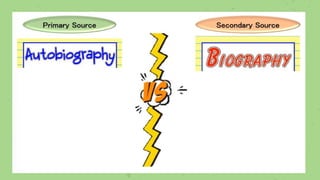
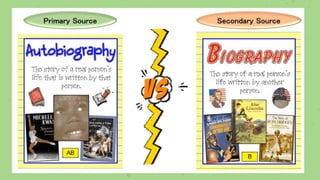
  • #35 A primary source is most often created during the time the events you are studying occurred, such as newspaper articles from the period, correspondence, diplomatic records, original research reports and notes, diaries etc. They may also include items created after the events occurred, but that recount them such as autobiographies and oral histories.
  • #36 Secondary Sources are accounts written after the fact with the benefit of hindsight. They are interpretations and evaluations of primary sources. Secondary sources are not evidence, but rather commentary on and discussion of evidence.
  • #37 A tertiary source presents summaries or condensed versions of materials, usually with references back to the primary and/or secondary sources.