PUBLIC POLICY
Jeffrey Lau Li Chun Hei Joshua
(52224761) (52224054)
LIN Pui Yuen Date of Presentation: 15-Nov-2010
Community College of City University
Division of Social Studies
Associate Degree of Social Science in Public Administration and Management
DSS 10004 Introduction to Social & Public Adminsitration
CONTENT
1. Introduction of Public Policy
2. The Science of ‘Muddling Through’
3. The Seven Deadly Sins of Policy Analysts
PUBLIC POLICY
• Definition
 Course of action by officials
 Regulatory measures, laws, funding priorities
 Not only to the end, decision-making and analysis as well
 Includes constitutions, legislativeacts, and judicial decisions
THE SCIENCE OF MUDDLING THROUGH
 Charles E. Lindblom
 2 ways to formulate policy
 Rational-Comprehensive (Root) (全面分析)
 Successive Limited Comparison (Branch) (見步行步)
 Root vs. Branch
 Illustrate with examples
 Formulate policy with respect to inflation (通漲)
 Discussion of the ‘best’ method (Decision making)
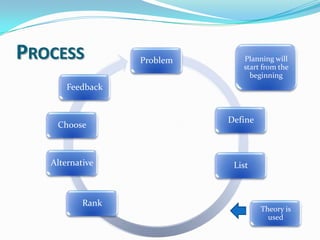
Problem
Define
Alternative List
Rank
Choose
Feedback
Planning will
start from the
beginning
Theory is
used
PROCESS
 List all related values (e.g. full employment)
 Rate all possible outcomes
 Require a huge inquiry and calculations into values (深入了
解)
 Calculate all benefits, costs, efficiency
 Outline all possible policy alternatives
 Undertake systematic comparison of alternatives
RATIONAL-COMPREHENSIVE (ROOT)
 Consider any theory available
 Inflation
 Theory of prices
 Consideration is comprehensive
 Strict central control (中央控制) or free market (自由市場)
 Depends on which method fits the situation the best
 Make the choice
Objective
Outline
Combine
Step-by-step
Problem
PROCESS
Base on
History
Continue
with
Previous
SUCCESSIVE LIMITED COMPARISON (BRANCH)
 Set simple objectives without conscious thought
(可以缺乏深思熟慮)
 E.g. Maintain price level
 Maybe affected by other goals
 E.g. Full employment
 Ignore due to not in consideration
 Not even related possible values or outcomes
SUCCESSIVE LIMITED COMPARISON (BRANCH)
 Outline and compare a few related policy alternatives
 Combine policies with objectives or values
E.g.
1. Higherprice stabilityand higherrisk of unemployment
or
2. Less price stability and lower risk of unemployment
 No theory is applied
 Depends on the record of past experience
 Small policy step by step (少步進行)
SUCCESSIVE LIMITED COMPARISON (BRANCH)
ROOT VS. BRANCH
 Root
 More mechanical process
 Choose means (過程) that best satisfied goals
 All means and Values are clarified and ranked
ROOT VS. BRANCH
 Branch
 Partially achieve their goals
 Repeat the sequence endlessly
 Improve accuracy of prediction
Root vs. branch
Rational – Comprehensive (Root) Successive Limited Comparison
(Branch)
All values or objectives are classified Values and objectives are selected
By means-end analysis, policy is
formulated
Limited means-end analysis as means
and ends are not distinct
“Good” policy depends on whether it
can be proved as the most appropriate
means to accomplish desire ends
Even different analysis is made,
evidences always agree with the policy.
But it does not agree that the means is
appropriate to complete an agreed
objective
Root vs Branch
Rational – Comprehensive (Root) Successive Limited Comparison
(Branch)
Analysis is comprehensive(全面),
considering every important related
factors
Analysis is limited
(I) Possible outcomes are ignored
(II) Potential alternative policies are
neglected
(III)Important effected values are
neglected
Theory is often heavily relied upon Succession of comparisons are reduced
and does not rely on theory
When problem exists, the planning has
to start again form the beginning
Little changes to improve the policy,
repeat step by step
DECISION-MAKING
 Complex problems
 First method is not possible
 No intellectual capacities (知識空間) &
sources of information
 Time and money are limited
 Only introduce in literatures (文學研習)
 Focus on research, theory, analysis
 Can only be applied on simple problems
 Few variables & values (少變數)
DECISION-MAKING
 Second method preferred
 May have disadvantages
 Not long-range
 Make changes only when problem happened
 Ignore some other excellent policies
 Administrators become lazy or less discovery of a new
method
DECISION-MAKING
 Wildly used
 Superior to decision-making
 Very familiar to the method
 More skills
 Be aware of the time to extend or restrict
DECISION-MAKING
 Improve the policy advance
 A start for studying what is good advice
 Channeled
 Distant
 Late
 Superficial
 Topical
 Capricious
 Apolitical
CHANNELED
 Get into a rut (墨守成規)
 Change of circumstances
 Because of bureaucratic routine
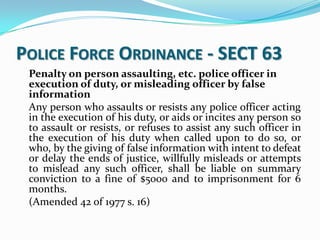
POLICE FORCE ORDINANCE - SECT 63
Penalty on person assaulting, etc. police officer in
execution of duty, or misleading officer by false
information
Any person who assaults or resists any police officer acting
in the execution of his duty, or aids or incites any person so
to assault or resists, or refuses to assist any such officer in
the execution of his duty when called upon to do so, or
who, by the giving of false information with intent to defeat
or delay the ends of justice, willfully misleads or attempts
to mislead any such officer, shall be liable on summary
conviction to a fine of $5000 and to imprisonment for 6
months.
(Amended 42 of 1977 s. 16)
警隊條例 - SECT 63
對執行職責的警務人員襲擊等或以虛假資料誤導警務
人員的罰則
任何人襲擊或抗拒執行職責的警務人員,或協助或煽
惑任何人如此襲擊或抗拒,或在被要求協助該執行職
責的人員時拒絕協助,或意圖妨礙或拖延達到公正的
目的而提供虛假資料,以蓄意誤導或企圖誤導警務人
員,循簡易程序定罪後,可處罰款$5000及監禁6個
月。
(由1977年第42號第16條修訂)
OFFENCES AGAINST THE PERSON ORDINANCE -SECT36
Assault with intent to commit offence, or on police
officer, etc.
Any person who-
(a) assaults any person with intent to commit an arrestable
offence; or
(b) assaults, resists, or willfully obstructs any police officer in the
due execution of his duty or any person acting in aid of such
officer; or
(c) assaults any person with intent to resist or prevent the lawful
apprehension or detainer of himself or of any other person for
any offence, shall be guilty of an offence triable either summarily
or upon indictment, and shall be liable to imprisonment for 2
years.
(Amended 30 of 1911 ss. 2 & 5; 51 of 1911 s. 2; 22 of 1950 s. 3; 50 of
1991 s. 4) [cf. 1861 c.100 s.38 U.K.]
意圖犯罪而襲擊或襲警等
任何人:
(a) 意圖犯可逮捕的罪行而襲擊他人;或
(b) 襲擊、抗拒或故意阻撓在正當執行職務的任何警務人
員或在協助該警務人員的人;或
(c) 意圖抗拒或防止自已或其他人由於任何罪行受到合法拘
捕或扣留而襲擊他人,
即屬犯可循簡易或公訴程序審訊的罪行,可處監禁2年。
由1911年第30號第2及5條修訂; 由1911年第51號第2條修訂;
由1950年第22號第3條修訂; 由1991年第50號第4條修訂
[比照 1861 c. 100 s. 38 U.K.]
侵害人身罪條例 - SECT 36
DISTANT
 Based on ignorance
 Foreign policy may have different background
 May not be applicable in different places
 Use general solutions for specific conditions
LATE
 The policy will be Wasted
 Late because of data collection
 Balance between accuracy and on time
SUPERFICIAL
 Too quick
 Do not have enough preparation
 Not understand the problem deeply
TOPICAL
 Crisis may affect our Routine
 Ignore less visible issues
 Not assumed crisis proportions
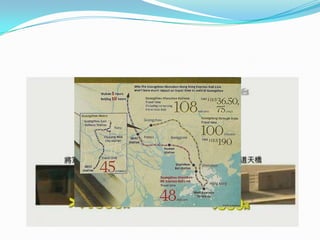
 泰國於2008年11月發生了泰國人民民主聯盟在首都曼
谷素萬那普國際機場舉行反政府集會,素萬那普國際
機場被迫關閉。近千香港遊客滯留當地,香港政府遲
遲沒有派遣包機接走民眾。由於鄰近的中國、台灣及
澳門等已早早派遣包機接走人民,令香港人感到十分
無助。
CAPRICIOUS
 Refuse to change
 Things are gel (停止改變)
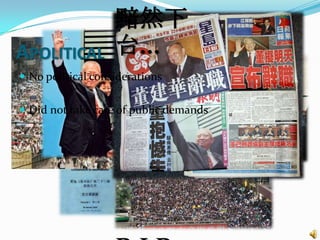
APOLITICAL
 No political considerations
 Did not take care of public demands
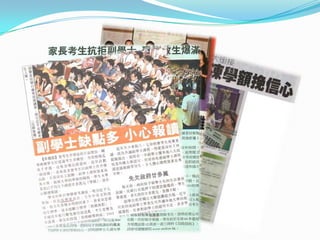
黯然下
台...
QUESTION & ANSWER SECTION
1. Are there any other method to formulate a policy?
(other than root and branch)
2. Do you have any example of good advice?
REFERENCE
 Hong Kong Ordinances. (2010). HKLII. Retrieved
November 12, 2010, from
http://www.hklii.hk/hk/legis/en/ord/index.shtml.
 港府研包機接回港人. (2008). Ming Pao. Retrieved
November 12, 2010, from
http://life.mingpao.com/cfm/dailynews3b.cfm?File=
20081128/nalta/tak2.txt.
 Shafritz, Jay M., Albert C. Hyde (ed.) (1992) Classics
of Public Administration, 3rd ed., Pacific
Grove, California : Brooks/Cole Publishing
THE END

Week 12 - Public Policy

  • 1.
    PUBLIC POLICY Jeffrey LauLi Chun Hei Joshua (52224761) (52224054) LIN Pui Yuen Date of Presentation: 15-Nov-2010 Community College of City University Division of Social Studies Associate Degree of Social Science in Public Administration and Management DSS 10004 Introduction to Social & Public Adminsitration
  • 2.
    CONTENT 1. Introduction ofPublic Policy 2. The Science of ‘Muddling Through’ 3. The Seven Deadly Sins of Policy Analysts
  • 3.
    PUBLIC POLICY • Definition Course of action by officials  Regulatory measures, laws, funding priorities  Not only to the end, decision-making and analysis as well  Includes constitutions, legislativeacts, and judicial decisions
  • 4.
    THE SCIENCE OFMUDDLING THROUGH  Charles E. Lindblom  2 ways to formulate policy  Rational-Comprehensive (Root) (全面分析)  Successive Limited Comparison (Branch) (見步行步)  Root vs. Branch  Illustrate with examples  Formulate policy with respect to inflation (通漲)  Discussion of the ‘best’ method (Decision making)
  • 6.
  • 7.
     List allrelated values (e.g. full employment)  Rate all possible outcomes  Require a huge inquiry and calculations into values (深入了 解)  Calculate all benefits, costs, efficiency  Outline all possible policy alternatives  Undertake systematic comparison of alternatives RATIONAL-COMPREHENSIVE (ROOT)
  • 8.
    RATIONAL-COMPREHENSIVE (ROOT)  Considerany theory available  Inflation  Theory of prices  Consideration is comprehensive  Strict central control (中央控制) or free market (自由市場)  Depends on which method fits the situation the best  Make the choice
  • 10.
  • 11.
    SUCCESSIVE LIMITED COMPARISON(BRANCH)  Set simple objectives without conscious thought (可以缺乏深思熟慮)  E.g. Maintain price level  Maybe affected by other goals  E.g. Full employment  Ignore due to not in consideration  Not even related possible values or outcomes
  • 12.
    SUCCESSIVE LIMITED COMPARISON(BRANCH)  Outline and compare a few related policy alternatives  Combine policies with objectives or values E.g. 1. Higherprice stabilityand higherrisk of unemployment or 2. Less price stability and lower risk of unemployment
  • 13.
     No theoryis applied  Depends on the record of past experience  Small policy step by step (少步進行) SUCCESSIVE LIMITED COMPARISON (BRANCH)
  • 15.
    ROOT VS. BRANCH Root  More mechanical process  Choose means (過程) that best satisfied goals  All means and Values are clarified and ranked
  • 16.
    ROOT VS. BRANCH Branch  Partially achieve their goals  Repeat the sequence endlessly  Improve accuracy of prediction
  • 17.
    Root vs. branch Rational– Comprehensive (Root) Successive Limited Comparison (Branch) All values or objectives are classified Values and objectives are selected By means-end analysis, policy is formulated Limited means-end analysis as means and ends are not distinct “Good” policy depends on whether it can be proved as the most appropriate means to accomplish desire ends Even different analysis is made, evidences always agree with the policy. But it does not agree that the means is appropriate to complete an agreed objective
  • 18.
    Root vs Branch Rational– Comprehensive (Root) Successive Limited Comparison (Branch) Analysis is comprehensive(全面), considering every important related factors Analysis is limited (I) Possible outcomes are ignored (II) Potential alternative policies are neglected (III)Important effected values are neglected Theory is often heavily relied upon Succession of comparisons are reduced and does not rely on theory When problem exists, the planning has to start again form the beginning Little changes to improve the policy, repeat step by step
  • 20.
    DECISION-MAKING  Complex problems First method is not possible  No intellectual capacities (知識空間) & sources of information  Time and money are limited
  • 21.
     Only introducein literatures (文學研習)  Focus on research, theory, analysis  Can only be applied on simple problems  Few variables & values (少變數) DECISION-MAKING
  • 22.
     Second methodpreferred  May have disadvantages  Not long-range  Make changes only when problem happened  Ignore some other excellent policies  Administrators become lazy or less discovery of a new method DECISION-MAKING
  • 23.
     Wildly used Superior to decision-making  Very familiar to the method  More skills  Be aware of the time to extend or restrict DECISION-MAKING
  • 25.
     Improve thepolicy advance  A start for studying what is good advice
  • 26.
     Channeled  Distant Late  Superficial  Topical  Capricious  Apolitical
  • 29.
    CHANNELED  Get intoa rut (墨守成規)  Change of circumstances  Because of bureaucratic routine
  • 30.
    POLICE FORCE ORDINANCE- SECT 63 Penalty on person assaulting, etc. police officer in execution of duty, or misleading officer by false information Any person who assaults or resists any police officer acting in the execution of his duty, or aids or incites any person so to assault or resists, or refuses to assist any such officer in the execution of his duty when called upon to do so, or who, by the giving of false information with intent to defeat or delay the ends of justice, willfully misleads or attempts to mislead any such officer, shall be liable on summary conviction to a fine of $5000 and to imprisonment for 6 months. (Amended 42 of 1977 s. 16)
  • 31.
    警隊條例 - SECT63 對執行職責的警務人員襲擊等或以虛假資料誤導警務 人員的罰則 任何人襲擊或抗拒執行職責的警務人員,或協助或煽 惑任何人如此襲擊或抗拒,或在被要求協助該執行職 責的人員時拒絕協助,或意圖妨礙或拖延達到公正的 目的而提供虛假資料,以蓄意誤導或企圖誤導警務人 員,循簡易程序定罪後,可處罰款$5000及監禁6個 月。 (由1977年第42號第16條修訂)
  • 32.
    OFFENCES AGAINST THEPERSON ORDINANCE -SECT36 Assault with intent to commit offence, or on police officer, etc. Any person who- (a) assaults any person with intent to commit an arrestable offence; or (b) assaults, resists, or willfully obstructs any police officer in the due execution of his duty or any person acting in aid of such officer; or (c) assaults any person with intent to resist or prevent the lawful apprehension or detainer of himself or of any other person for any offence, shall be guilty of an offence triable either summarily or upon indictment, and shall be liable to imprisonment for 2 years. (Amended 30 of 1911 ss. 2 & 5; 51 of 1911 s. 2; 22 of 1950 s. 3; 50 of 1991 s. 4) [cf. 1861 c.100 s.38 U.K.]
  • 33.
    意圖犯罪而襲擊或襲警等 任何人: (a) 意圖犯可逮捕的罪行而襲擊他人;或 (b) 襲擊、抗拒或故意阻撓在正當執行職務的任何警務人 員或在協助該警務人員的人;或 (c)意圖抗拒或防止自已或其他人由於任何罪行受到合法拘 捕或扣留而襲擊他人, 即屬犯可循簡易或公訴程序審訊的罪行,可處監禁2年。 由1911年第30號第2及5條修訂; 由1911年第51號第2條修訂; 由1950年第22號第3條修訂; 由1991年第50號第4條修訂 [比照 1861 c. 100 s. 38 U.K.] 侵害人身罪條例 - SECT 36
  • 36.
    DISTANT  Based onignorance  Foreign policy may have different background  May not be applicable in different places  Use general solutions for specific conditions
  • 40.
    LATE  The policywill be Wasted  Late because of data collection  Balance between accuracy and on time
  • 44.
    SUPERFICIAL  Too quick Do not have enough preparation  Not understand the problem deeply
  • 48.
    TOPICAL  Crisis mayaffect our Routine  Ignore less visible issues  Not assumed crisis proportions
  • 49.
  • 52.
    CAPRICIOUS  Refuse tochange  Things are gel (停止改變)
  • 56.
    APOLITICAL  No politicalconsiderations  Did not take care of public demands 黯然下 台...
  • 57.
    QUESTION & ANSWERSECTION 1. Are there any other method to formulate a policy? (other than root and branch) 2. Do you have any example of good advice?
  • 58.
    REFERENCE  Hong KongOrdinances. (2010). HKLII. Retrieved November 12, 2010, from http://www.hklii.hk/hk/legis/en/ord/index.shtml.  港府研包機接回港人. (2008). Ming Pao. Retrieved November 12, 2010, from http://life.mingpao.com/cfm/dailynews3b.cfm?File= 20081128/nalta/tak2.txt.  Shafritz, Jay M., Albert C. Hyde (ed.) (1992) Classics of Public Administration, 3rd ed., Pacific Grove, California : Brooks/Cole Publishing
  • 59.