Social and behavioral Pharmacy

     The Concept of Social
          Pharmacy
          WEEK 1
What is Social Pharmacy?
• Traditionally, chemistry, biochemistry, physics and physiology
  form Pharmacy’s core knowledge base.
• Knowledge of medications and their effects is the basis of the
  pharmacists’ professional expertise.
• Practicing pharmacy, however, is carried out among human
  beings, the persons referred to as customers or patients or
  users. They, in turn, are connected with one another in
  families, organizations and health systems in countries and
  cultures around the world.


                                                               2
                            Your footer here
Thus, when trying to explain, understand or change
pharmacy practice, the natural sciences simply do not
provide adequate tools or perspectives.
They need to be supplemented with knowledge from the
disciplines that deal with people and systems, i.e., the
humanistic and social sciences.
And this is where Social Pharmacy comes into the picture.
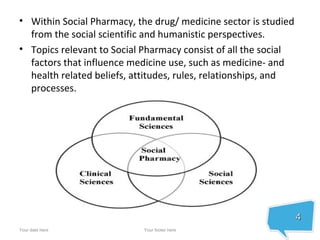
• Within Social Pharmacy, the drug/ medicine sector is studied
  from the social scientific and humanistic perspectives.
• Topics relevant to Social Pharmacy consist of all the social
  factors that influence medicine use, such as medicine- and
  health related beliefs, attitudes, rules, relationships, and
  processes.


                                                                 4
Your date here              Your footer here
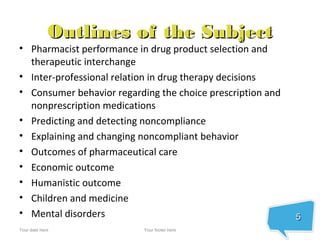
Outlines of the Subject
• Pharmacist performance in drug product selection and
  therapeutic interchange
• Inter-professional relation in drug therapy decisions
• Consumer behavior regarding the choice prescription and
  nonprescription medications
• Predicting and detecting noncompliance
• Explaining and changing noncompliant behavior
• Outcomes of pharmaceutical care
• Economic outcome
• Humanistic outcome
• Children and medicine
• Mental disorders                                          5
Your date here             Your footer here
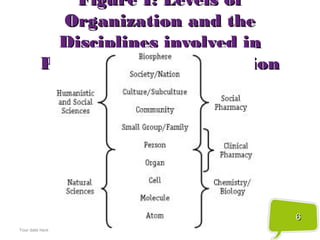
Figure I: Levels of
            Organization and the
           Disciplines involved in
          Pharmaceutical Education


                                       6
Your date here      Your footer here
Figure I: Levels of
            Organization and the
           Disciplines involved in
          Pharmaceutical Education


                                       6
Your date here      Your footer here

Week 1 introduction

  • 1.
    Social and behavioralPharmacy The Concept of Social Pharmacy WEEK 1
  • 2.
    What is SocialPharmacy? • Traditionally, chemistry, biochemistry, physics and physiology form Pharmacy’s core knowledge base. • Knowledge of medications and their effects is the basis of the pharmacists’ professional expertise. • Practicing pharmacy, however, is carried out among human beings, the persons referred to as customers or patients or users. They, in turn, are connected with one another in families, organizations and health systems in countries and cultures around the world. 2 Your footer here
  • 3.
    Thus, when tryingto explain, understand or change pharmacy practice, the natural sciences simply do not provide adequate tools or perspectives. They need to be supplemented with knowledge from the disciplines that deal with people and systems, i.e., the humanistic and social sciences. And this is where Social Pharmacy comes into the picture.
  • 4.
    • Within SocialPharmacy, the drug/ medicine sector is studied from the social scientific and humanistic perspectives. • Topics relevant to Social Pharmacy consist of all the social factors that influence medicine use, such as medicine- and health related beliefs, attitudes, rules, relationships, and processes. 4 Your date here Your footer here
  • 5.
    Outlines of theSubject • Pharmacist performance in drug product selection and therapeutic interchange • Inter-professional relation in drug therapy decisions • Consumer behavior regarding the choice prescription and nonprescription medications • Predicting and detecting noncompliance • Explaining and changing noncompliant behavior • Outcomes of pharmaceutical care • Economic outcome • Humanistic outcome • Children and medicine • Mental disorders 5 Your date here Your footer here
  • 6.
    Figure I: Levelsof Organization and the Disciplines involved in Pharmaceutical Education 6 Your date here Your footer here
  • 7.
    Figure I: Levelsof Organization and the Disciplines involved in Pharmaceutical Education 6 Your date here Your footer here