IIT RTC Conference Summary 
Illinois Institute of Technology 
Real Time Communication Conference 
The missing link between 
telecoms research and the 
industry
Highlights 
• Henning Schulzrinne CTO of the FCC 
• WebRTC developer, for a WebRTC developer by Peter Thatcher of Google 
• Ben Klang from MojoLingo’s great taxonomy for RTC services 
• Todd Carothers from CounterPath on Real-Time Communications (RTC) 
Clients—Present and Future Roadmap 
• Scott Scheuber from US Cellular on The Things of Business 
• Alan Johnston from Avaya on WebRTC Security and Privacy 
• Ed Elkin from ALU presentation the network benefits of VoLTE 
• Quan Choi from US Cellular on VoLTE benefits 
• Robin Raymond from HookFlash 
o Future of the Cloud with P2P (Peer-to-Peer) RTC (Real-Time Communication) 
o Delivering Real-Time Communications with Mobile 
o ORTC API Update
Henning Schulzrinne CTO of the FCC 
I’m waiting on his slides. But the most insight came in the discussion after 
his presentation on the “3GPP 'self-inflicted problem' of too much signaling” 
and on software having to be responsible for its impact of others (e.g. poorly 
written software hijacked in denial of service attacks) which he thinks will 
change with a few class action law suits. 
His presentation focused on IoT, he was frank that beyond M2M the cases 
are weak at the moment. He used the towel dispenser example which is 
weak. He also raise the social angle that with IoT many jobs lost are at the 
low end of the income range, which he questioned as a society can we afford. 
He was also unsure if IoT interop standards can be achieved to deliver on 
the big IoT vision, quoting X.10 as an example. My view is just like in the 
lack of interop beyond basic video across home entertainment equipment. 
The value of keeping customers in silos (no matter how small) far out 
weighs the benefit of interop. Apple being the archetype. 
Overall an inspiring multi-domain discussion with a good dose of social 
awareness thrown in J
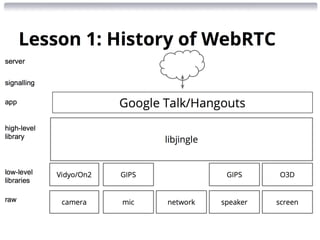
This presentation has a nice review of how developers see WebRTC, and that 
we’re not simple enough yet for most developers.
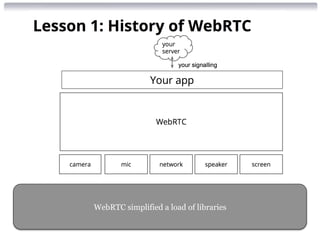
WebRTC simplified a load of libraries
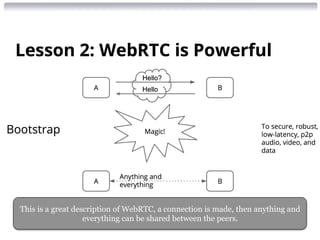
This is a great description of WebRTC, a connection is made, then anything and 
everything can be shared between the peers.
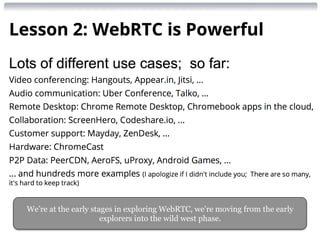
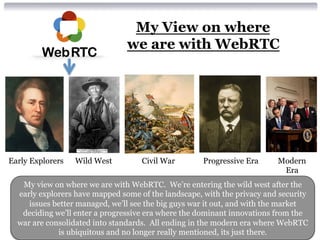
We’re at the early stages in exploring WebRTC, we’re moving from the early 
explorers into the wild west phase.
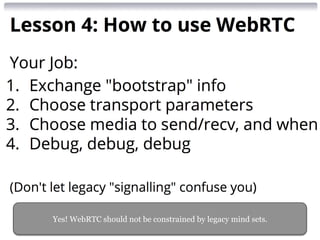
Yes! WebRTC should not be constrained by legacy mind sets.
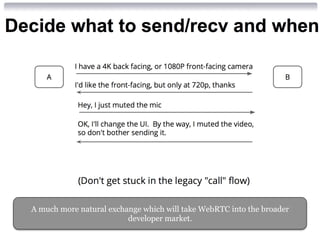
A much more natural exchange which will take WebRTC into the broader 
developer market.
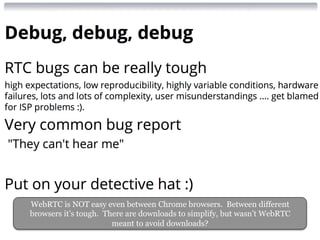
WebRTC is NOT easy even between Chrome browsers. Between different 
browsers it’s tough. There are downloads to simplify, but wasn’t WebRTC 
meant to avoid downloads?
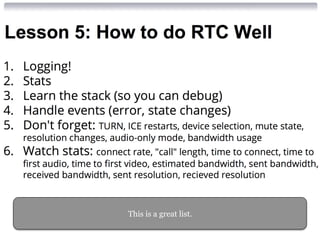
This is a great list.
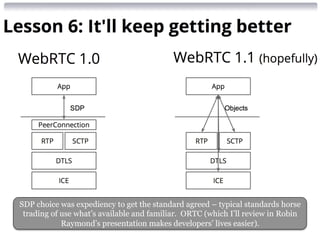
SDP choice was expediency to get the standard agreed – typical standards horse 
trading of use what’s available and familiar. ORTC (which I’ll review in Robin 
Raymond’s presentation makes developers’ lives easier).
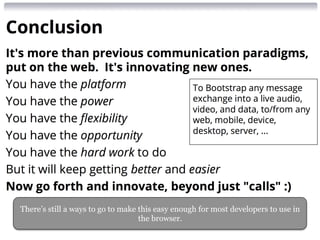
There’s still a ways to go to make this easy enough for most developers to use in 
the browser.
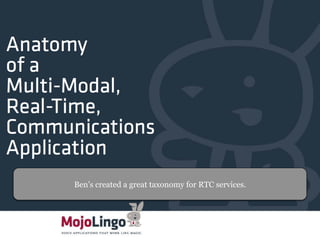
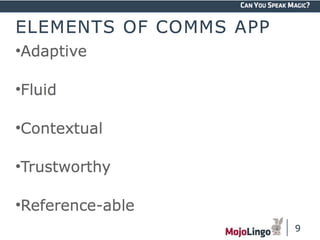
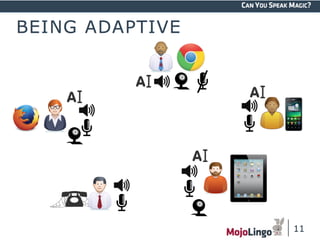
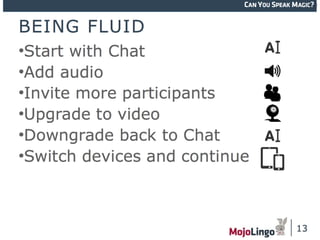
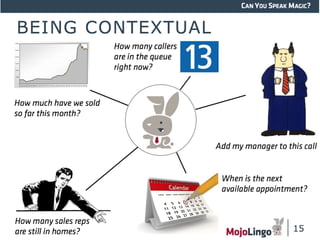
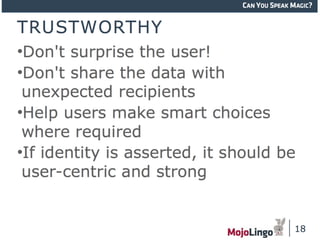
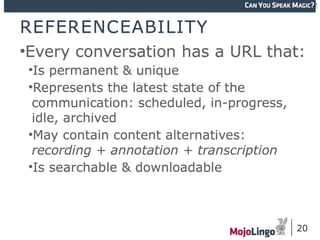
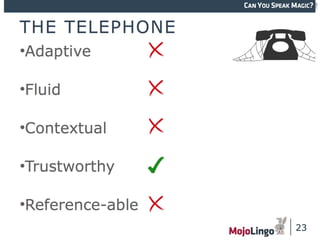
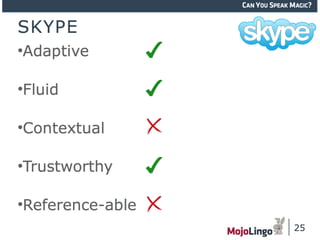
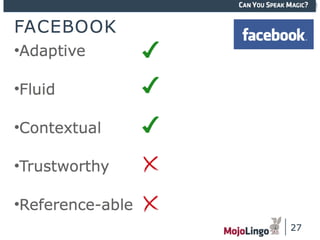
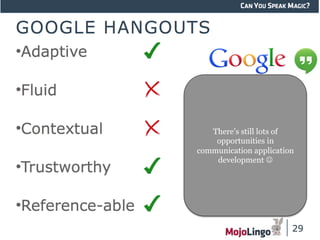
Ben’s created a great taxonomy for RTC services.
There’s still lots of 
opportunities in 
communication application 
development J
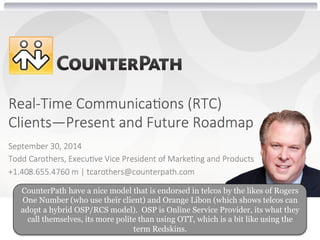
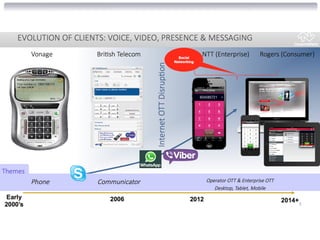
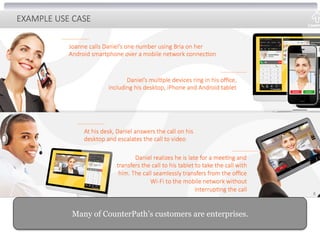
CounterPath have a nice model that is endorsed in telcos by the likes of Rogers 
One Number (who use their client) and Orange Libon (which shows telcos can 
adopt a hybrid OSP/RCS model). OSP is Online Service Provider, its what they 
call themselves, its more polite than using OTT, which is a bit like using the 
term Redskins.
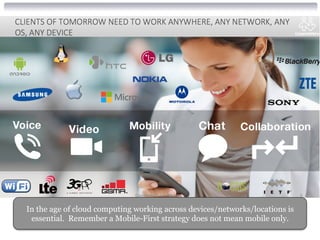
In the age of cloud computing working across devices/networks/locations is 
essential. Remember a Mobile-First strategy does not mean mobile only.
Many of CounterPath’s customers are enterprises.
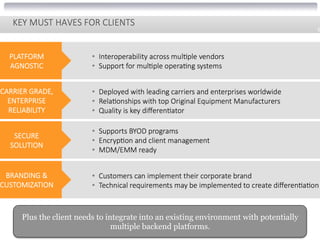
Plus the client needs to integrate into an existing environment with potentially 
multiple backend platforms.
US Cellular game a number of presentation at the event, which was great to see such 
active and insightful telco contributions to the event.
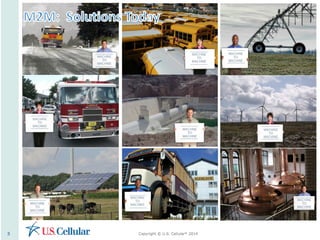
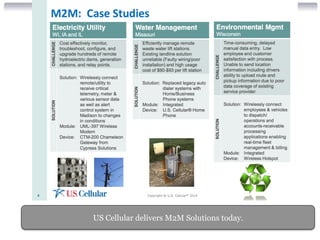
US Cellular delivers M2M Solutions today.
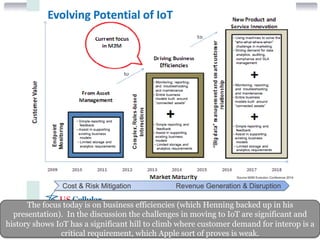
The focus today is on business efficiencies (which Henning backed up in his 
presentation). In the discussion the challenges in moving to IoT are significant and 
history shows IoT has a significant hill to climb where customer demand for interop is a 
critical requirement, which Apple sort of proves is weak.
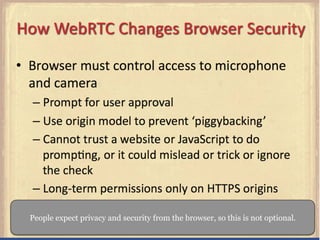
Security and Privacy will become critical barriers to WebRTC being used in 
many mainstream applications.
People expect privacy and security from the browser, so this is not optional.
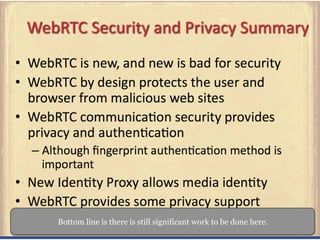
Bottom line is there is still significant work to be done here.
My View on where 
we are with WebRTC 
Early Explorers Wild West Civil War Progressive Era Modern 
Era 
My view on where we are with WebRTC. We’re entering the wild west after the 
early explorers have mapped some of the landscape, with the privacy and security 
issues better managed, we’ll see the big guys war it out, and with the market 
deciding we’ll enter a progressive era where the dominant innovations from the 
war are consolidated into standards. All ending in the modern era where WebRTC 
is ubiquitous and no longer really mentioned, its just there.
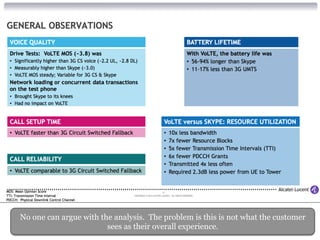
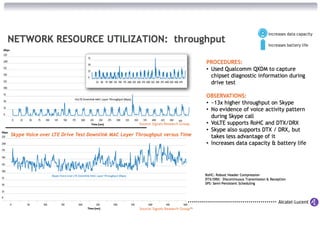
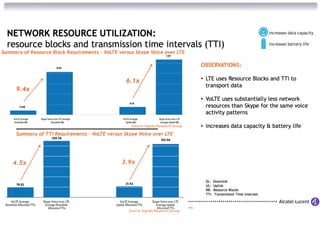
ALU gave a nice presentation on the network benefits of VoLTE
No one can argue with the analysis. The problem is this is not what the customer 
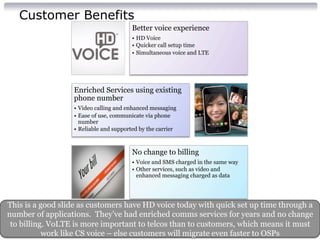
sees as their overall experience.
Customer Benefits 
Better voice experience 
• HD Voice 
• Quicker call setup time 
• Simultaneous voice and LTE 
Enriched Services using existing 
phone number 
• Video calling and enhanced messaging 
• Ease of use, communicate via phone 
number 
• Reliable and supported by the carrier 
No change to billing 
• Voice and SMS charged in the same way 
• Other services, such as video and 
enhanced messaging charged as data 
This is a good slide as customers have HD voice today with quick set up time through a 
number of applications. They’ve had enriched comms services for years and no change 
to billing. VoLTE is more important to telcos than to customers, which means it must 
work like CS voice – else customers will migrate even faster to OSPs
WebRTC, Mobility, Cloud, and More... 
IIT REAL-TIME COMMUNICATIONS 
Conference & Expo Sept 30 - Oct 2, 2014 Chicago 
Future of the Cloud with P2P 
(Peer-to-Peer) RTC (Real-Time 
Communication) 
Presented by Robin Raymond [http://about.me/robinraymond] 
Chief Architect 
Hookflash.com / OpenPeer.org 
Robin gave several nice presentations, I review a couple here, first on Cloud and 
2014-09-30 9:30am WEST: Alumni Lounge 
RTC
PSTN into the Cloud 
PSTN is becoming increasingly virtualized into 
the cloud... 
PSTN into the Cloud
Phone Numbers will become Cloud Identities 
The cloud will be a place to create, call and 
dispose of phone numbers at will. 
This will ironically push usage away from PSTN. 
PSTN into the Cloud
PSTN Telemarketers and Fraud 
The introduction of VoIP has made mass dialing every PSTN 
number cheap. 
This has been made worse by: 
● Cloud robo dialers (calls 1000s of people at once) 
● Cloud "natural language" artificial intelligence dialers 
● Fraudsters using workers from anywhere on the planet 
with the cheapest labour costs to place VoIP calls 
● Caller-ID spoofing 
I gave up on a fixed landline years ago, so I’m fortunate not to face this. 
PSTN into the Cloud
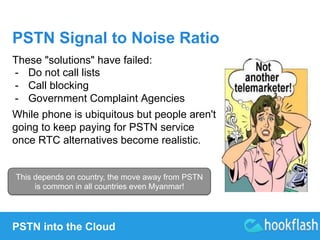
PSTN Signal to Noise Ratio 
These "solutions" have failed: 
- Do not call lists 
- Call blocking 
- Government Complaint Agencies 
While phone is ubiquitous but people aren't 
going to keep paying for PSTN service 
once RTC alternatives become realistic. 
This depends on country, the move away from PSTN 
is common in all countries even Myanmar! 
PSTN into the Cloud
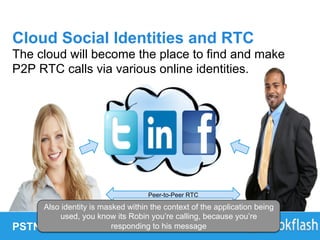
Cloud Social Identities and RTC 
The cloud will become the place to find and make 
P2P RTC calls via various online identities. 
PSTN into the Cloud 
Peer-to-Peer RTC 
Also identity is masked within the context of the application being 
used, you know its Robin you’re calling, because you’re 
responding to his message
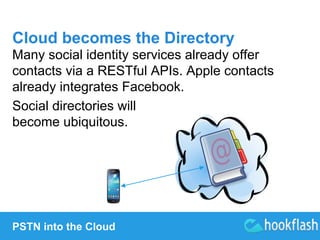
Cloud becomes the Directory 
Many social identity services already offer 
contacts via a RESTful APIs. Apple contacts 
already integrates Facebook. 
Social directories will 
become ubiquitous. 
PSTN into the Cloud
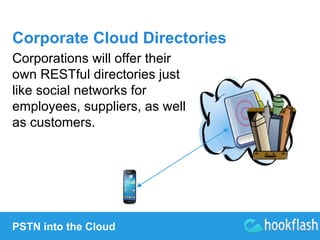
Corporate Cloud Directories 
Corporations will offer their 
own RESTful directories just 
like social networks for 
employees, suppliers, as well 
as customers. 
PSTN into the Cloud
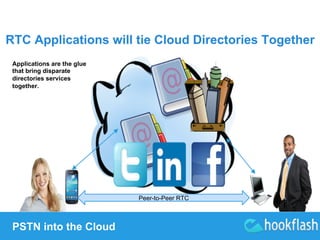
RTC Applications will tie Cloud Directories Together 
PSTN into the Cloud 
Peer-to-Peer RTC 
Applications are the glue 
that bring disparate 
directories services 
together.
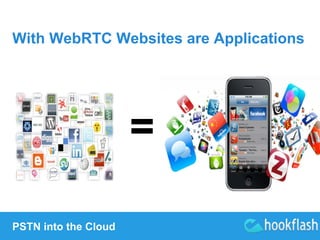
With WebRTC Websites are Applications 
PSTN into the Cloud 
=
What RTC Interactions can be Serviced better 
by the Cloud? 
● Connecting with specialized skills or expert consultations 
● Geographically dispersed employees, customers, or supply 
chains 
● Human social interaction 
● Customer inquiries / outreach 
● Medical supportive care 
● Distanced education / training 
● Collaborative work environments 
● Gaming and entertainment 
● Connectivity with travelling and mobile workforce 
● Vertical niches (e.g. financial, insurance, manufacturing, 
energy) 
Future P2P RTC Cloud Use Cases
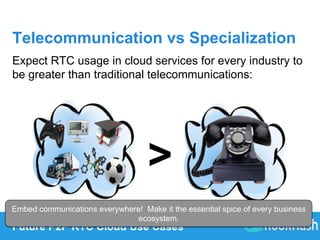
Telecommunication vs Specialization 
Expect RTC usage in cloud services for every industry to 
be greater than traditional telecommunications: 
> 
Embed communications everywhere! Make it the essential spice of every business 
ecosystem. 
Future P2P RTC Cloud Use Cases
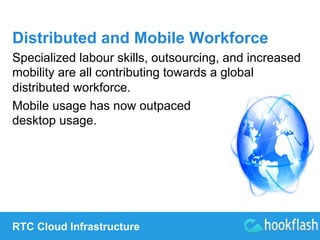
Distributed and Mobile Workforce 
Specialized labour skills, outsourcing, and increased 
mobility are all contributing towards a global 
distributed workforce. 
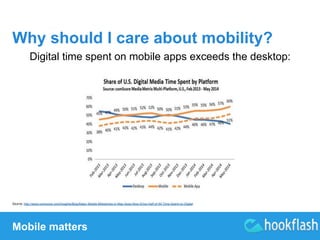
Mobile usage has now outpaced 
desktop usage. 
RTC Cloud Infrastructure
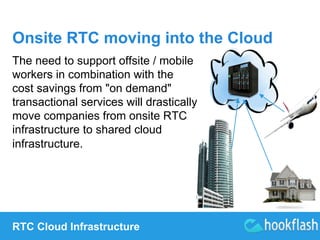
Onsite RTC moving into the Cloud 
The need to support offsite / mobile 
workers in combination with the 
cost savings from "on demand" 
transactional services will drastically 
move companies from onsite RTC 
infrastructure to shared cloud 
infrastructure. 
RTC Cloud Infrastructure
Only the Cloud can Service the World 
The world of RTC is global, distributed, and mobile. 
The distribution and mobility of customers, suppliers, 
and employees demand a new type of RTC 
infrastructure than the era of old. 
RTC Cloud Infrastructure
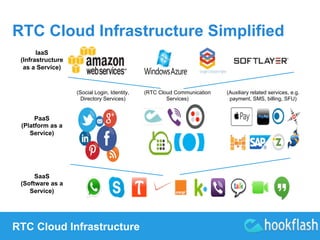
RTC Cloud Infrastructure Simplified 
IaaS 
(Infrastructure 
as a Service) 
PaaS 
(Platform as a 
Service) 
(Social Login, Identity, 
Directory Services) 
RTC Cloud Infrastructure 
(RTC Cloud Communication 
Services) 
(Auxiliary related services, e.g. 
payment, SMS, billing, SFU) 
SaaS 
(Software as a 
Service)
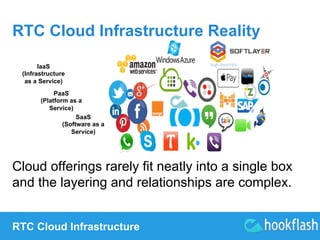
RTC Cloud Infrastructure Reality 
IaaS 
(Infrastructure 
as a Service) 
PaaS 
(Platform as a 
Service) 
SaaS 
(Software as a 
Service) 
Cloud offerings rarely fit neatly into a single box 
and the layering and relationships are complex. 
RTC Cloud Infrastructure
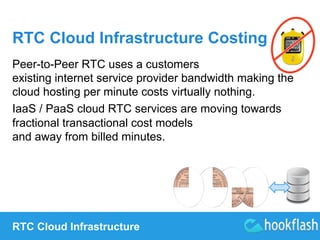
RTC Cloud Infrastructure Costing 
Peer-to-Peer RTC uses a customers 
existing internet service provider bandwidth making the 
cloud hosting per minute costs virtually nothing. 
IaaS / PaaS cloud RTC services are moving towards 
fractional transactional cost models 
and away from billed minutes. 
RTC Cloud Infrastructure
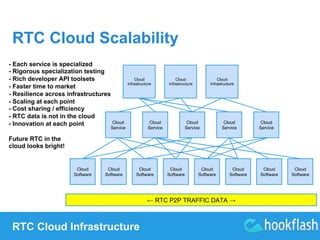
RTC Cloud Scalability 
Cloud 
Software 
Cloud 
Service 
Cloud 
Infrastructure 
RTC Cloud Infrastructure 
Cloud 
Service 
Cloud 
Service 
Cloud 
Service 
Cloud 
Service 
Cloud 
Infrastructure 
Cloud 
Infrastructure 
Cloud 
Software 
Cloud 
Software 
Cloud 
Software 
Cloud 
Software 
Cloud 
Software 
Cloud 
Software 
Cloud 
Software 
- Each service is specialized 
- Rigorous specialization testing 
- Rich developer API toolsets 
- Faster time to market 
- Resilience across infrastructures 
- Scaling at each point 
- Cost sharing / efficiency 
- RTC data is not in the cloud 
- Innovation at each point 
Future RTC in the 
cloud looks bright! 
← RTC P2P TRAFFIC DATA →
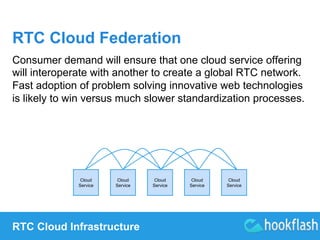
RTC Cloud Federation 
Consumer demand will ensure that one cloud service offering 
will interoperate with another to create a global RTC network. 
Fast adoption of problem solving innovative web technologies 
is likely to win versus much slower standardization processes. 
Cloud 
Service 
Cloud 
Service 
RTC Cloud Infrastructure 
Cloud 
Service 
Cloud 
Service 
Cloud 
Service
Cloud RTC Trends 
● Global RTC needs are pushing cloud solutions 
● On-demand transactional shared cloud services 
● Mobile and distributed workforces and customer interaction 
● Cloud identity and social sign-on 
● Efficiencies, reduce costs, expanded service capabilities, 
increased scalability will be born out of the cloud 
● Innovation and adoption of new technologies will drive 
federation faster than standardization 
RTC Cloud Infrastructure
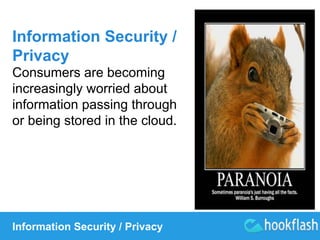
Information Security / 
Privacy 
Consumers are becoming 
increasingly worried about 
information passing through 
or being stored in the cloud. 
Information Security / Privacy
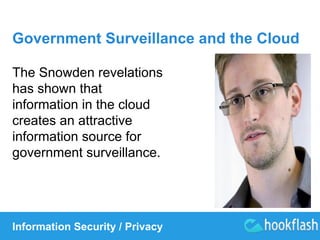
Government Surveillance and the Cloud 
The Snowden revelations 
has shown that 
information in the cloud 
creates an attractive 
information source for 
government surveillance. 
Information Security / Privacy
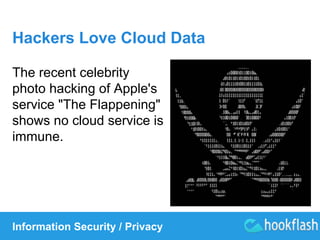
Hackers Love Cloud Data 
The recent celebrity 
photo hacking of Apple's 
service "The Flappening" 
shows no cloud service is 
immune. 
Information Security / Privacy
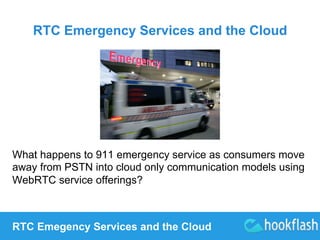
RTC Emergency Services and the Cloud 
What happens to 911 emergency service as consumers move 
away from PSTN into cloud only communication models using 
WebRTC service offerings? 
RTC Emegency Services and the Cloud
911 per Subscriber Fees 
Imagine if every WebRTC website was required by law to offer 
911 emergency services using today's 911 subscriber fee 
models. 
There would be no WebRTC. 
Per subscriber fees for 911 would be prohibitively expensive 
for most sites and consumers will be repeatedly billed. 
RTC Emegency Services and the Cloud
911 in the Future Cloud 
911 service will need to be unbundled from the strict ties to the PSTN. 
Possible models: 
● Direct consumer 911 SaaS (Software as a Service) offerings 
● Bundled 911 SaaS offerings with consumer/business Internet packages 
● Transactional based 911 PaaS (Platform as a Service) providers to integrate 
911 services (with associated APIs) 
Bottom line: 911 subscriber models need to change to become part of WebRTC. 
The good news is that it is changing. 
RTC Emegency Services and the Cloud
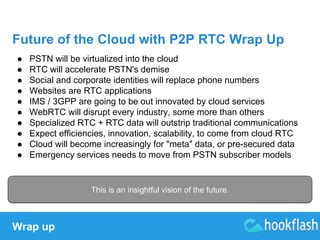
Future of the Cloud with P2P RTC Wrap Up 
● PSTN will be virtualized into the cloud 
● RTC will accelerate PSTN's demise 
● Social and corporate identities will replace phone numbers 
● Websites are RTC applications 
● IMS / 3GPP are going to be out innovated by cloud services 
● WebRTC will disrupt every industry, some more than others 
● Specialized RTC + RTC data will outstrip traditional communications 
● Expect efficiencies, innovation, scalability, to come from cloud RTC 
● Cloud will become increasingly for "meta" data, or pre-secured data 
● Emergency services needs to move from PSTN subscriber models 
Wrap up 
This is an insightful vision of the future.
WebRTC, Mobility, Cloud, and More... 
IIT REAL-TIME COMMUNICATIONS 
Conference & Expo Sept 30 - Oct 2, 2014 Chicago 
Delivering Real-Time 
Communications with Mobile 
Presented by Robin Raymond [http://about.me/robinraymond] 
Chief Architect 
Hookflash.com / OpenPeer.org 
2014-10-01 9:00am WEST: Alumni Lounge
Why should I care about mobility? 
Digital time spent on mobile apps exceeds the desktop: 
Source: http://www.comscore.com/Insights/Blog/Major-Mobile-Milestones-in-May-Apps-Now-Drive-Half-of-All-Time-Spent-on-Digital 
Mobile matters
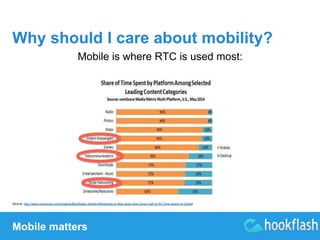
Why should I care about mobility? 
Mobile is where RTC is used most: 
Source: http://www.comscore.com/Insights/Blog/Major-Mobile-Milestones-in-May-Apps-Now-Drive-Half-of-All-Time-Spent-on-Digital 
Mobile matters
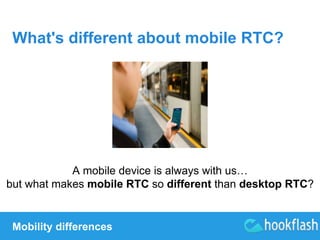
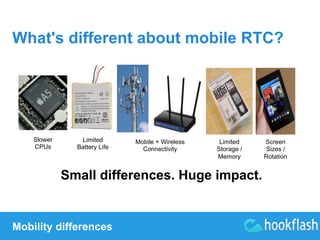
What's different about mobile RTC? 
A mobile device is always with us… 
but what makes mobile RTC so different than desktop RTC? 
Mobility differences
What's different about mobile RTC? 
Slower 
CPUs 
Limited 
Battery Life 
Mobility differences 
Mobile + Wireless 
Connectivity 
Limited 
Storage / 
Memory 
Small differences. Huge impact. 
Screen 
Sizes / 
Rotation
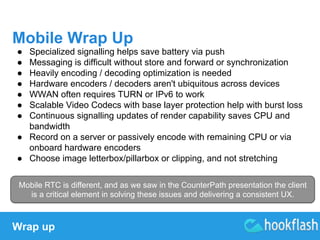
Mobile Wrap Up 
● Specialized signalling helps save battery via push 
● Messaging is difficult without store and forward or synchronization 
● Heavily encoding / decoding optimization is needed 
● Hardware encoders / decoders aren't ubiquitous across devices 
● WWAN often requires TURN or IPv6 to work 
● Scalable Video Codecs with base layer protection help with burst loss 
● Continuous signalling updates of render capability saves CPU and 
bandwidth 
● Record on a server or passively encode with remaining CPU or via 
onboard hardware encoders 
● Choose image letterbox/pillarbox or clipping, and not stretching 
Mobile RTC is different, and as we saw in the CounterPath presentation the client 
is a critical element in solving these issues and delivering a consistent UX. 
Wrap up
ORTC API Update 
IIT RTC Conference Chicago 9/2014 
It will be in WebRTC 1.1 – it’s the standards guys they love to squabble.
What is ORTC? 
A W3C Community Group to design an-object 
based API for RTC (ORTC == Object RTC) 
The hope is to merge the work of the CG into 
the WebRTC WG as WebRTC 1.1.
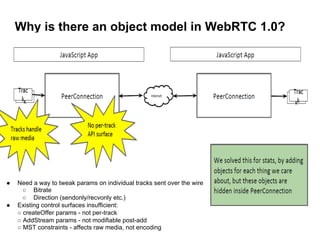
Why is there an object model in WebRTC 1.0? 
● Need a way to tweak params on individual tracks sent over the wire 
○ Bitrate 
○ Direction (sendonly/recvonly etc.) 
● Existing control surfaces insufficient: 
○ createOffer params - not per-track 
○ AddStream params - not modifiable post-add 
○ MST constraints - affects raw media, not encoding
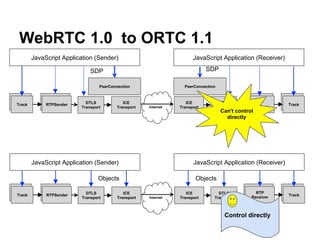
WebRTC 1.0 to ORTC 1.1 
JavaScript Application (Sender) JavaScript Application (Receiver) 
PeerConnection 
RTPSender 
PeerConnection 
TTraracckk RTPSender DTLS 
Transport 
ICE 
Transport Internet 
ICE 
Transport 
DTLS 
Transport 
RTP 
RecReTivPe r 
Receiver 
TTraracckk 
JavaScript Application (Sender) JavaScript Application (Receiver) 
TTraracckk RTPSender 
RTPSender DTLS 
Transport 
ICE 
Transport Internet 
DTLS 
Transport 
RTP 
RecReTivPe r 
Receiver 
TTraracckk 
SDP SDP 
Objects Objects 
ICE 
Transport 
Can't control 
directly 
Control directly
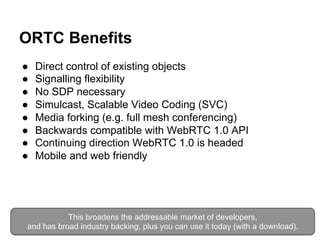
ORTC Benefits 
● Direct control of existing objects 
● Signalling flexibility 
● No SDP necessary 
● Simulcast, Scalable Video Coding (SVC) 
● Media forking (e.g. full mesh conferencing) 
● Backwards compatible with WebRTC 1.0 API 
● Continuing direction WebRTC 1.0 is headed 
● Mobile and web friendly 
This broadens the addressable market of developers, 
and has broad industry backing, plus you can use it today (with a download).
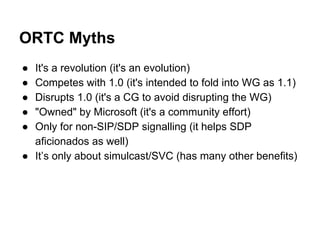
ORTC Myths 
● It's a revolution (it's an evolution) 
● Competes with 1.0 (it's intended to fold into WG as 1.1) 
● Disrupts 1.0 (it's a CG to avoid disrupting the WG) 
● "Owned" by Microsoft (it's a community effort) 
● Only for non-SIP/SDP signalling (it helps SDP 
aficionados as well) 
● It’s only about simulcast/SVC (has many other benefits)

IIT RTC Conference 2014 summary

  • 1.
    IIT RTC ConferenceSummary Illinois Institute of Technology Real Time Communication Conference The missing link between telecoms research and the industry
  • 2.
    Highlights • HenningSchulzrinne CTO of the FCC • WebRTC developer, for a WebRTC developer by Peter Thatcher of Google • Ben Klang from MojoLingo’s great taxonomy for RTC services • Todd Carothers from CounterPath on Real-Time Communications (RTC) Clients—Present and Future Roadmap • Scott Scheuber from US Cellular on The Things of Business • Alan Johnston from Avaya on WebRTC Security and Privacy • Ed Elkin from ALU presentation the network benefits of VoLTE • Quan Choi from US Cellular on VoLTE benefits • Robin Raymond from HookFlash o Future of the Cloud with P2P (Peer-to-Peer) RTC (Real-Time Communication) o Delivering Real-Time Communications with Mobile o ORTC API Update
  • 3.
    Henning Schulzrinne CTOof the FCC I’m waiting on his slides. But the most insight came in the discussion after his presentation on the “3GPP 'self-inflicted problem' of too much signaling” and on software having to be responsible for its impact of others (e.g. poorly written software hijacked in denial of service attacks) which he thinks will change with a few class action law suits. His presentation focused on IoT, he was frank that beyond M2M the cases are weak at the moment. He used the towel dispenser example which is weak. He also raise the social angle that with IoT many jobs lost are at the low end of the income range, which he questioned as a society can we afford. He was also unsure if IoT interop standards can be achieved to deliver on the big IoT vision, quoting X.10 as an example. My view is just like in the lack of interop beyond basic video across home entertainment equipment. The value of keeping customers in silos (no matter how small) far out weighs the benefit of interop. Apple being the archetype. Overall an inspiring multi-domain discussion with a good dose of social awareness thrown in J
  • 4.
    This presentation hasa nice review of how developers see WebRTC, and that we’re not simple enough yet for most developers.
  • 6.
    WebRTC simplified aload of libraries
  • 7.
    This is agreat description of WebRTC, a connection is made, then anything and everything can be shared between the peers.
  • 8.
    We’re at theearly stages in exploring WebRTC, we’re moving from the early explorers into the wild west phase.
  • 9.
    Yes! WebRTC shouldnot be constrained by legacy mind sets.
  • 10.
    A much morenatural exchange which will take WebRTC into the broader developer market.
  • 11.
    WebRTC is NOTeasy even between Chrome browsers. Between different browsers it’s tough. There are downloads to simplify, but wasn’t WebRTC meant to avoid downloads?
  • 12.
    This is agreat list.
  • 13.
    SDP choice wasexpediency to get the standard agreed – typical standards horse trading of use what’s available and familiar. ORTC (which I’ll review in Robin Raymond’s presentation makes developers’ lives easier).
  • 14.
    There’s still aways to go to make this easy enough for most developers to use in the browser.
  • 15.
    Ben’s created agreat taxonomy for RTC services.
  • 25.
    There’s still lotsof opportunities in communication application development J
  • 26.
    CounterPath have anice model that is endorsed in telcos by the likes of Rogers One Number (who use their client) and Orange Libon (which shows telcos can adopt a hybrid OSP/RCS model). OSP is Online Service Provider, its what they call themselves, its more polite than using OTT, which is a bit like using the term Redskins.
  • 28.
    In the ageof cloud computing working across devices/networks/locations is essential. Remember a Mobile-First strategy does not mean mobile only.
  • 29.
    Many of CounterPath’scustomers are enterprises.
  • 30.
    Plus the clientneeds to integrate into an existing environment with potentially multiple backend platforms.
  • 33.
    US Cellular gamea number of presentation at the event, which was great to see such active and insightful telco contributions to the event.
  • 35.
    US Cellular deliversM2M Solutions today.
  • 36.
    The focus todayis on business efficiencies (which Henning backed up in his presentation). In the discussion the challenges in moving to IoT are significant and history shows IoT has a significant hill to climb where customer demand for interop is a critical requirement, which Apple sort of proves is weak.
  • 37.
    Security and Privacywill become critical barriers to WebRTC being used in many mainstream applications.
  • 39.
    People expect privacyand security from the browser, so this is not optional.
  • 41.
    Bottom line isthere is still significant work to be done here.
  • 42.
    My View onwhere we are with WebRTC Early Explorers Wild West Civil War Progressive Era Modern Era My view on where we are with WebRTC. We’re entering the wild west after the early explorers have mapped some of the landscape, with the privacy and security issues better managed, we’ll see the big guys war it out, and with the market deciding we’ll enter a progressive era where the dominant innovations from the war are consolidated into standards. All ending in the modern era where WebRTC is ubiquitous and no longer really mentioned, its just there.
  • 43.
    ALU gave anice presentation on the network benefits of VoLTE
  • 44.
    No one canargue with the analysis. The problem is this is not what the customer sees as their overall experience.
  • 47.
    Customer Benefits Bettervoice experience • HD Voice • Quicker call setup time • Simultaneous voice and LTE Enriched Services using existing phone number • Video calling and enhanced messaging • Ease of use, communicate via phone number • Reliable and supported by the carrier No change to billing • Voice and SMS charged in the same way • Other services, such as video and enhanced messaging charged as data This is a good slide as customers have HD voice today with quick set up time through a number of applications. They’ve had enriched comms services for years and no change to billing. VoLTE is more important to telcos than to customers, which means it must work like CS voice – else customers will migrate even faster to OSPs
  • 48.
    WebRTC, Mobility, Cloud,and More... IIT REAL-TIME COMMUNICATIONS Conference & Expo Sept 30 - Oct 2, 2014 Chicago Future of the Cloud with P2P (Peer-to-Peer) RTC (Real-Time Communication) Presented by Robin Raymond [http://about.me/robinraymond] Chief Architect Hookflash.com / OpenPeer.org Robin gave several nice presentations, I review a couple here, first on Cloud and 2014-09-30 9:30am WEST: Alumni Lounge RTC
  • 49.
    PSTN into theCloud PSTN is becoming increasingly virtualized into the cloud... PSTN into the Cloud
  • 50.
    Phone Numbers willbecome Cloud Identities The cloud will be a place to create, call and dispose of phone numbers at will. This will ironically push usage away from PSTN. PSTN into the Cloud
  • 51.
    PSTN Telemarketers andFraud The introduction of VoIP has made mass dialing every PSTN number cheap. This has been made worse by: ● Cloud robo dialers (calls 1000s of people at once) ● Cloud "natural language" artificial intelligence dialers ● Fraudsters using workers from anywhere on the planet with the cheapest labour costs to place VoIP calls ● Caller-ID spoofing I gave up on a fixed landline years ago, so I’m fortunate not to face this. PSTN into the Cloud
  • 52.
    PSTN Signal toNoise Ratio These "solutions" have failed: - Do not call lists - Call blocking - Government Complaint Agencies While phone is ubiquitous but people aren't going to keep paying for PSTN service once RTC alternatives become realistic. This depends on country, the move away from PSTN is common in all countries even Myanmar! PSTN into the Cloud
  • 53.
    Cloud Social Identitiesand RTC The cloud will become the place to find and make P2P RTC calls via various online identities. PSTN into the Cloud Peer-to-Peer RTC Also identity is masked within the context of the application being used, you know its Robin you’re calling, because you’re responding to his message
  • 54.
    Cloud becomes theDirectory Many social identity services already offer contacts via a RESTful APIs. Apple contacts already integrates Facebook. Social directories will become ubiquitous. PSTN into the Cloud
  • 55.
    Corporate Cloud Directories Corporations will offer their own RESTful directories just like social networks for employees, suppliers, as well as customers. PSTN into the Cloud
  • 56.
    RTC Applications willtie Cloud Directories Together PSTN into the Cloud Peer-to-Peer RTC Applications are the glue that bring disparate directories services together.
  • 57.
    With WebRTC Websitesare Applications PSTN into the Cloud =
  • 58.
    What RTC Interactionscan be Serviced better by the Cloud? ● Connecting with specialized skills or expert consultations ● Geographically dispersed employees, customers, or supply chains ● Human social interaction ● Customer inquiries / outreach ● Medical supportive care ● Distanced education / training ● Collaborative work environments ● Gaming and entertainment ● Connectivity with travelling and mobile workforce ● Vertical niches (e.g. financial, insurance, manufacturing, energy) Future P2P RTC Cloud Use Cases
  • 59.
    Telecommunication vs Specialization Expect RTC usage in cloud services for every industry to be greater than traditional telecommunications: > Embed communications everywhere! Make it the essential spice of every business ecosystem. Future P2P RTC Cloud Use Cases
  • 60.
    Distributed and MobileWorkforce Specialized labour skills, outsourcing, and increased mobility are all contributing towards a global distributed workforce. Mobile usage has now outpaced desktop usage. RTC Cloud Infrastructure
  • 61.
    Onsite RTC movinginto the Cloud The need to support offsite / mobile workers in combination with the cost savings from "on demand" transactional services will drastically move companies from onsite RTC infrastructure to shared cloud infrastructure. RTC Cloud Infrastructure
  • 62.
    Only the Cloudcan Service the World The world of RTC is global, distributed, and mobile. The distribution and mobility of customers, suppliers, and employees demand a new type of RTC infrastructure than the era of old. RTC Cloud Infrastructure
  • 63.
    RTC Cloud InfrastructureSimplified IaaS (Infrastructure as a Service) PaaS (Platform as a Service) (Social Login, Identity, Directory Services) RTC Cloud Infrastructure (RTC Cloud Communication Services) (Auxiliary related services, e.g. payment, SMS, billing, SFU) SaaS (Software as a Service)
  • 64.
    RTC Cloud InfrastructureReality IaaS (Infrastructure as a Service) PaaS (Platform as a Service) SaaS (Software as a Service) Cloud offerings rarely fit neatly into a single box and the layering and relationships are complex. RTC Cloud Infrastructure
  • 65.
    RTC Cloud InfrastructureCosting Peer-to-Peer RTC uses a customers existing internet service provider bandwidth making the cloud hosting per minute costs virtually nothing. IaaS / PaaS cloud RTC services are moving towards fractional transactional cost models and away from billed minutes. RTC Cloud Infrastructure
  • 66.
    RTC Cloud Scalability Cloud Software Cloud Service Cloud Infrastructure RTC Cloud Infrastructure Cloud Service Cloud Service Cloud Service Cloud Service Cloud Infrastructure Cloud Infrastructure Cloud Software Cloud Software Cloud Software Cloud Software Cloud Software Cloud Software Cloud Software - Each service is specialized - Rigorous specialization testing - Rich developer API toolsets - Faster time to market - Resilience across infrastructures - Scaling at each point - Cost sharing / efficiency - RTC data is not in the cloud - Innovation at each point Future RTC in the cloud looks bright! ← RTC P2P TRAFFIC DATA →
  • 67.
    RTC Cloud Federation Consumer demand will ensure that one cloud service offering will interoperate with another to create a global RTC network. Fast adoption of problem solving innovative web technologies is likely to win versus much slower standardization processes. Cloud Service Cloud Service RTC Cloud Infrastructure Cloud Service Cloud Service Cloud Service
  • 68.
    Cloud RTC Trends ● Global RTC needs are pushing cloud solutions ● On-demand transactional shared cloud services ● Mobile and distributed workforces and customer interaction ● Cloud identity and social sign-on ● Efficiencies, reduce costs, expanded service capabilities, increased scalability will be born out of the cloud ● Innovation and adoption of new technologies will drive federation faster than standardization RTC Cloud Infrastructure
  • 69.
    Information Security / Privacy Consumers are becoming increasingly worried about information passing through or being stored in the cloud. Information Security / Privacy
  • 70.
    Government Surveillance andthe Cloud The Snowden revelations has shown that information in the cloud creates an attractive information source for government surveillance. Information Security / Privacy
  • 71.
    Hackers Love CloudData The recent celebrity photo hacking of Apple's service "The Flappening" shows no cloud service is immune. Information Security / Privacy
  • 72.
    RTC Emergency Servicesand the Cloud What happens to 911 emergency service as consumers move away from PSTN into cloud only communication models using WebRTC service offerings? RTC Emegency Services and the Cloud
  • 73.
    911 per SubscriberFees Imagine if every WebRTC website was required by law to offer 911 emergency services using today's 911 subscriber fee models. There would be no WebRTC. Per subscriber fees for 911 would be prohibitively expensive for most sites and consumers will be repeatedly billed. RTC Emegency Services and the Cloud
  • 74.
    911 in theFuture Cloud 911 service will need to be unbundled from the strict ties to the PSTN. Possible models: ● Direct consumer 911 SaaS (Software as a Service) offerings ● Bundled 911 SaaS offerings with consumer/business Internet packages ● Transactional based 911 PaaS (Platform as a Service) providers to integrate 911 services (with associated APIs) Bottom line: 911 subscriber models need to change to become part of WebRTC. The good news is that it is changing. RTC Emegency Services and the Cloud
  • 75.
    Future of theCloud with P2P RTC Wrap Up ● PSTN will be virtualized into the cloud ● RTC will accelerate PSTN's demise ● Social and corporate identities will replace phone numbers ● Websites are RTC applications ● IMS / 3GPP are going to be out innovated by cloud services ● WebRTC will disrupt every industry, some more than others ● Specialized RTC + RTC data will outstrip traditional communications ● Expect efficiencies, innovation, scalability, to come from cloud RTC ● Cloud will become increasingly for "meta" data, or pre-secured data ● Emergency services needs to move from PSTN subscriber models Wrap up This is an insightful vision of the future.
  • 76.
    WebRTC, Mobility, Cloud,and More... IIT REAL-TIME COMMUNICATIONS Conference & Expo Sept 30 - Oct 2, 2014 Chicago Delivering Real-Time Communications with Mobile Presented by Robin Raymond [http://about.me/robinraymond] Chief Architect Hookflash.com / OpenPeer.org 2014-10-01 9:00am WEST: Alumni Lounge
  • 77.
    Why should Icare about mobility? Digital time spent on mobile apps exceeds the desktop: Source: http://www.comscore.com/Insights/Blog/Major-Mobile-Milestones-in-May-Apps-Now-Drive-Half-of-All-Time-Spent-on-Digital Mobile matters
  • 78.
    Why should Icare about mobility? Mobile is where RTC is used most: Source: http://www.comscore.com/Insights/Blog/Major-Mobile-Milestones-in-May-Apps-Now-Drive-Half-of-All-Time-Spent-on-Digital Mobile matters
  • 79.
    What's different aboutmobile RTC? A mobile device is always with us… but what makes mobile RTC so different than desktop RTC? Mobility differences
  • 80.
    What's different aboutmobile RTC? Slower CPUs Limited Battery Life Mobility differences Mobile + Wireless Connectivity Limited Storage / Memory Small differences. Huge impact. Screen Sizes / Rotation
  • 81.
    Mobile Wrap Up ● Specialized signalling helps save battery via push ● Messaging is difficult without store and forward or synchronization ● Heavily encoding / decoding optimization is needed ● Hardware encoders / decoders aren't ubiquitous across devices ● WWAN often requires TURN or IPv6 to work ● Scalable Video Codecs with base layer protection help with burst loss ● Continuous signalling updates of render capability saves CPU and bandwidth ● Record on a server or passively encode with remaining CPU or via onboard hardware encoders ● Choose image letterbox/pillarbox or clipping, and not stretching Mobile RTC is different, and as we saw in the CounterPath presentation the client is a critical element in solving these issues and delivering a consistent UX. Wrap up
  • 82.
    ORTC API Update IIT RTC Conference Chicago 9/2014 It will be in WebRTC 1.1 – it’s the standards guys they love to squabble.
  • 83.
    What is ORTC? A W3C Community Group to design an-object based API for RTC (ORTC == Object RTC) The hope is to merge the work of the CG into the WebRTC WG as WebRTC 1.1.
  • 84.
    Why is therean object model in WebRTC 1.0? ● Need a way to tweak params on individual tracks sent over the wire ○ Bitrate ○ Direction (sendonly/recvonly etc.) ● Existing control surfaces insufficient: ○ createOffer params - not per-track ○ AddStream params - not modifiable post-add ○ MST constraints - affects raw media, not encoding
  • 85.
    WebRTC 1.0 toORTC 1.1 JavaScript Application (Sender) JavaScript Application (Receiver) PeerConnection RTPSender PeerConnection TTraracckk RTPSender DTLS Transport ICE Transport Internet ICE Transport DTLS Transport RTP RecReTivPe r Receiver TTraracckk JavaScript Application (Sender) JavaScript Application (Receiver) TTraracckk RTPSender RTPSender DTLS Transport ICE Transport Internet DTLS Transport RTP RecReTivPe r Receiver TTraracckk SDP SDP Objects Objects ICE Transport Can't control directly Control directly
  • 86.
    ORTC Benefits ●Direct control of existing objects ● Signalling flexibility ● No SDP necessary ● Simulcast, Scalable Video Coding (SVC) ● Media forking (e.g. full mesh conferencing) ● Backwards compatible with WebRTC 1.0 API ● Continuing direction WebRTC 1.0 is headed ● Mobile and web friendly This broadens the addressable market of developers, and has broad industry backing, plus you can use it today (with a download).
  • 87.
    ORTC Myths ●It's a revolution (it's an evolution) ● Competes with 1.0 (it's intended to fold into WG as 1.1) ● Disrupts 1.0 (it's a CG to avoid disrupting the WG) ● "Owned" by Microsoft (it's a community effort) ● Only for non-SIP/SDP signalling (it helps SDP aficionados as well) ● It’s only about simulcast/SVC (has many other benefits)