WebRTC beyond
Audio and Video
Silvia Pfeiffer
Coviu
WebRTC Summit, 4th Nov
8:30am – 9:05am
A bit about me
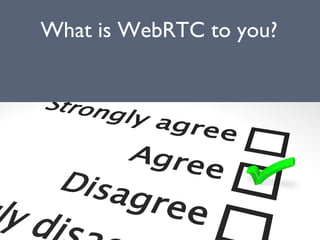
What is WebRTC to you?
1. An SDK to develop voice and video mobile applications?
2. A means to include the browser in your unified
communications solution?
3. An extension-free way to re-write your video conferencing
application?
4. An opportunity for adding video/audio communications to
your Web application?
5. A new Web API that Web developers need help with?
Is it …
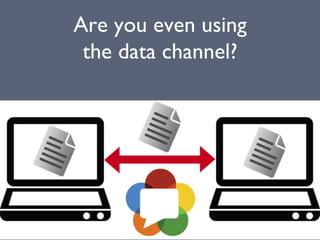
Are you even using
the data channel?
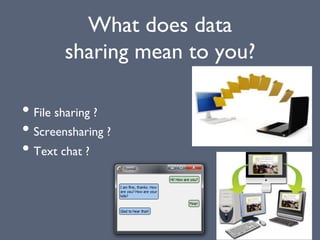
What does data
sharing mean to you?
• File sharing ?
• Screensharing ?
• Text chat ?
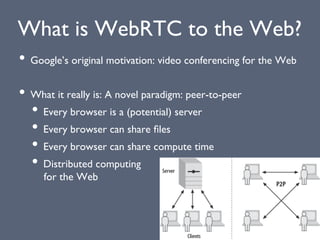
What is WebRTC to the Web?
• Google’s original motivation: video conferencing for the Web
• What it really is: A novel paradigm: peer-to-peer
• Every browser is a (potential) server
• Every browser can share files
• Every browser can share compute time
• Distributed computing
for the Web
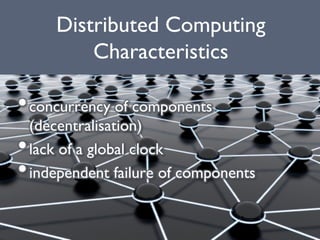
Distributed Computing
Characteristics
• concurrency of components
(decentralisation)
• lack of a global clock
• independent failure of components
Decentralisation
• Decentralisation of data
• No central storage, efficiency
• High availability
• Privacy of data
• Scalability
• Decentralisation of computing
• Parallel computing
• Scalability
• Decentralisation of communication channels
• Publish – Subscribe
Challenges of Peer-to-Peer
• Decentralisation of data
• No central storage: search is more difficult
• Potential for lower availability
• Decentralisation of computing
• Parallel computing complexity
• Coherence
• Decentralisation of communication
channels
• Not scalable
P2P Applications
of WebRTC
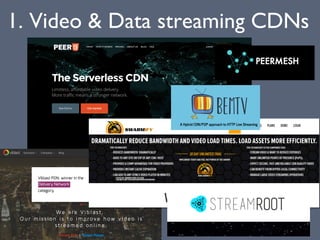
1. Video & Data streaming CDNs
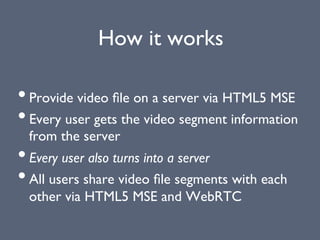
How it works
• Provide video file on a server via HTML5 MSE
• Every user gets the video segment information
from the server
• Every user also turns into a server
• All users share video file segments with each
other via HTML5 MSE and WebRTC
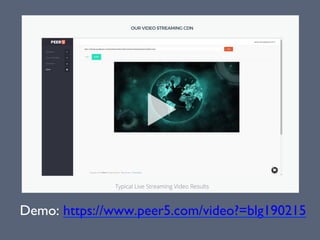
Demo: https://www.peer5.com/video?=blg190215
P2P CDN goals
• Low-latency downloads
• Fast discovery: rely on server
• Robustness towards peak usage
• Less server infrastructure
• Less bandwidth use for publisher
Challenges for P2P CDN
approaches
Video consumer may object to
• Uncontrolled use of upstream bandwidth
QoS for video consumer may degrade
• Limited by upload speed of others
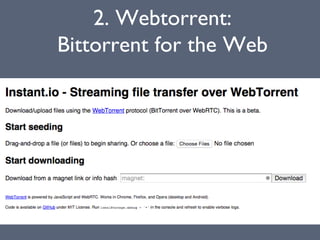
2. Webtorrent:
Bittorrent for the Web
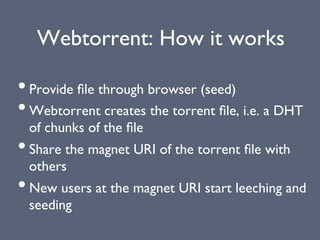
Webtorrent: How it works
• Provide file through browser (seed)
• Webtorrent creates the torrent file, i.e. a DHT
of chunks of the file
• Share the magnet URI of the torrent file with
others
• New users at the magnet URI start leeching and
seeding
Web/Bittorrent goals
• No servers / pure P2P
• Sharing economy
• Parallel download instead of server
limits
• Avoid server infrastructure
• Minimal bandwidth use for publisher
Challenges for Webtorrent
approaches
• User may object to uncontrolled use of upstream
bandwidth (leads to freeriders)
• Need to leave browser open to continue seeding
• Distribution relies on a large number of participants
• Latency through distributed nodes
• Limited security – only publicly available content
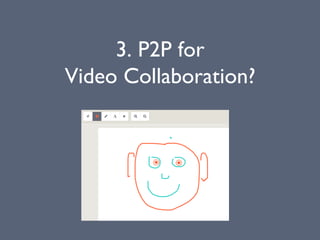
3. P2P for
Video Collaboration?
Traditional collaboration
• Edit token serialises annotations between
endpoints
• Server keeps track of changes and holds ground
truth
• Token request and release introduces
• Document locking
• Taking turns
• Unresponsive UX
• Limited scalability
Properties of P2P Collaboration
• Collaborate on annotations in parallel
• Unsynchronised clocks
• Reliable communication is not guaranteed
• Participants drop out and return, new ones join
• Eventually everyone needs to see the same state
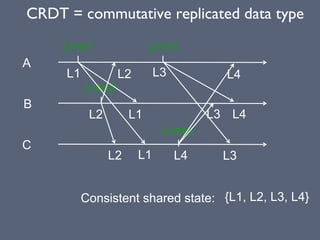
How to achieve consistency
• The order per endpoint matters: monotonically
increasing system state
• Broadcast state update to everyone else (gossip
protocol)
• The result between peers is commutative
A
B
C
Consistent shared state:
Line1
{L1, L2, L3, L4}
Line3
Line2
Line4
L1
L2
L2
L1
L1
L2 L3 L4
L3 L4
L4 L3
CRDT = commutative replicated data type
A
B
C
Line1 Line3
Line2
Line4
L1
L2
L2
L1
L1
L2 L3 L4
L3 L4
L4 L3
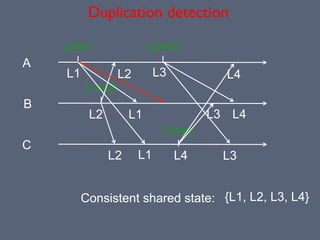
Duplication detection
Consistent shared state: {L1, L2, L3, L4}
A
B
C
Line1 Line3
Line2
Line4
L1
L2
L2
L1
L1
L2 L3 L4
L3 L4
L4 L1
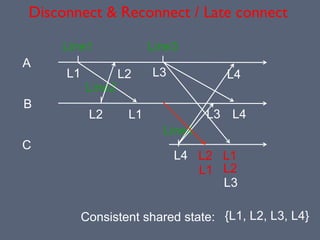
Disconnect & Reconnect / Late connect
L2
L3
Consistent shared state: {L1, L2, L3, L4}
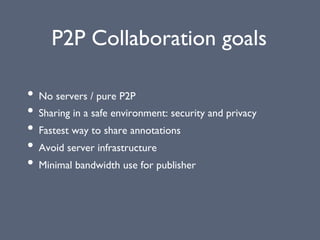
P2P Collaboration goals
• No servers / pure P2P
• Sharing in a safe environment: security and privacy
• Fastest way to share annotations
• Avoid server infrastructure
• Minimal bandwidth use for publisher
Summary
• P2P is a new paradigm on the Web:
• File sharing
• Richer collaboration
• Advantages are clear:
• Security & Privacy
• Speed in parallelisation
• Server-less introduces scalability
• Challenges:
• Concurrency complexity
• Network fault tolerance
Silvia Pfeiffer
Coviu
silvia@coviu.com
@CoviuApp
@silviapfeiffer

WebRTC beyond Audio and Video

  • 1.
    WebRTC beyond Audio andVideo Silvia Pfeiffer Coviu WebRTC Summit, 4th Nov 8:30am – 9:05am
  • 2.
  • 3.
  • 4.
    1. An SDK todevelop voice and video mobile applications? 2. A means to include the browser in your unified communications solution? 3. An extension-free way to re-write your video conferencing application? 4. An opportunity for adding video/audio communications to your Web application? 5. A new Web API that Web developers need help with? Is it …
  • 5.
    Are you evenusing the data channel?
  • 6.
    What does data sharingmean to you? • File sharing ? • Screensharing ? • Text chat ?
  • 8.
    What is WebRTCto the Web? • Google’s original motivation: video conferencing for the Web • What it really is: A novel paradigm: peer-to-peer • Every browser is a (potential) server • Every browser can share files • Every browser can share compute time • Distributed computing for the Web
  • 9.
    Distributed Computing Characteristics • concurrency ofcomponents (decentralisation) • lack of a global clock • independent failure of components
  • 10.
    Decentralisation • Decentralisation of data • Nocentral storage, efficiency • High availability • Privacy of data • Scalability • Decentralisation of computing • Parallel computing • Scalability • Decentralisation of communication channels • Publish – Subscribe
  • 11.
    Challenges of Peer-to-Peer • Decentralisationof data • No central storage: search is more difficult • Potential for lower availability • Decentralisation of computing • Parallel computing complexity • Coherence • Decentralisation of communication channels • Not scalable
  • 12.
  • 13.
    1. Video &Data streaming CDNs
  • 14.
    How it works • Providevideo file on a server via HTML5 MSE • Every user gets the video segment information from the server • Every user also turns into a server • All users share video file segments with each other via HTML5 MSE and WebRTC
  • 15.
  • 16.
    P2P CDN goals • Low-latencydownloads • Fast discovery: rely on server • Robustness towards peak usage • Less server infrastructure • Less bandwidth use for publisher
  • 17.
    Challenges for P2PCDN approaches Video consumer may object to • Uncontrolled use of upstream bandwidth QoS for video consumer may degrade • Limited by upload speed of others
  • 18.
  • 19.
    Webtorrent: How itworks • Provide file through browser (seed) • Webtorrent creates the torrent file, i.e. a DHT of chunks of the file • Share the magnet URI of the torrent file with others • New users at the magnet URI start leeching and seeding
  • 20.
    Web/Bittorrent goals • No servers/ pure P2P • Sharing economy • Parallel download instead of server limits • Avoid server infrastructure • Minimal bandwidth use for publisher
  • 21.
    Challenges for Webtorrent approaches • Usermay object to uncontrolled use of upstream bandwidth (leads to freeriders) • Need to leave browser open to continue seeding • Distribution relies on a large number of participants • Latency through distributed nodes • Limited security – only publicly available content
  • 22.
    3. P2P for VideoCollaboration?
  • 23.
    Traditional collaboration • Edit tokenserialises annotations between endpoints • Server keeps track of changes and holds ground truth • Token request and release introduces • Document locking • Taking turns • Unresponsive UX • Limited scalability
  • 24.
    Properties of P2PCollaboration • Collaborate on annotations in parallel • Unsynchronised clocks • Reliable communication is not guaranteed • Participants drop out and return, new ones join • Eventually everyone needs to see the same state
  • 25.
    How to achieveconsistency • The order per endpoint matters: monotonically increasing system state • Broadcast state update to everyone else (gossip protocol) • The result between peers is commutative
  • 26.
    A B C Consistent shared state: Line1 {L1,L2, L3, L4} Line3 Line2 Line4 L1 L2 L2 L1 L1 L2 L3 L4 L3 L4 L4 L3 CRDT = commutative replicated data type
  • 27.
    A B C Line1 Line3 Line2 Line4 L1 L2 L2 L1 L1 L2 L3L4 L3 L4 L4 L3 Duplication detection Consistent shared state: {L1, L2, L3, L4}
  • 28.
    A B C Line1 Line3 Line2 Line4 L1 L2 L2 L1 L1 L2 L3L4 L3 L4 L4 L1 Disconnect & Reconnect / Late connect L2 L3 Consistent shared state: {L1, L2, L3, L4}
  • 29.
    P2P Collaboration goals • Noservers / pure P2P • Sharing in a safe environment: security and privacy • Fastest way to share annotations • Avoid server infrastructure • Minimal bandwidth use for publisher
  • 30.
    Summary • P2P is anew paradigm on the Web: • File sharing • Richer collaboration • Advantages are clear: • Security & Privacy • Speed in parallelisation • Server-less introduces scalability • Challenges: • Concurrency complexity • Network fault tolerance
  • 31.