

2
Problem statement:
I inherited a MongoDB database server with
60 collections and 100 or so indexes.
The business users are complaining about
slow report completion times.
What can I do to improve performance ?
3
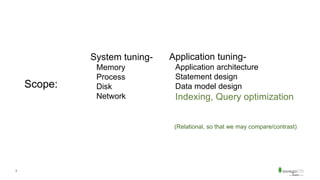
Scope:
System tuning-
Memory
Process
Disk
Network
Application tuning-
Application architecture
Statement design
Data model design
Indexing, Query optimization
(Relational, so that we may compare/contrast)
4
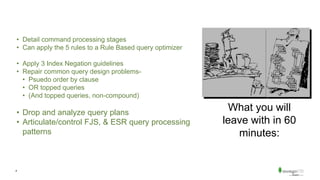
What you will
leave with in 60
minutes:
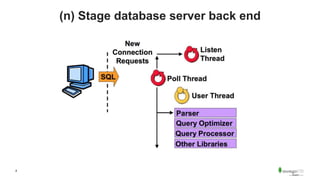
• Detail command processing stages
• Can apply the 5 rules to a Rule Based query optimizer
• Apply 3 Index Negation guidelines
• Repair common query design problems-
• Psuedo order by clause
• OR topped queries
• (And topped queries, non-compound)
• Drop and analyze query plans
• Articulate/control FJS, & ESR query processing
patterns
5
Queries 1 & 2:
SELECT * FROM phonebook
WHERE lastName LIKE “?son”;
SELECT * FROM phonebook
WHERE firstName = “Jennifer”;
6
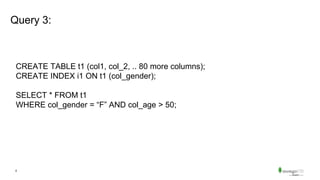
Query 3:
CREATE TABLE t1 (col1, col_2, .. 80 more columns);
CREATE INDEX i1 ON t1 (col_gender);
SELECT * FROM t1
WHERE col_gender = “F” AND col_age > 50;
7
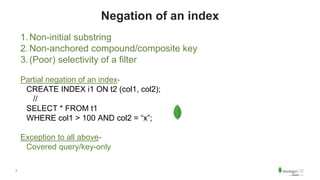
Negation of an index
1.Non-initial substring
2.Non-anchored compound/composite key
3.(Poor) selectivity of a filter
Partial negation of an index-
CREATE INDEX i1 ON t2 (col1, col2);
//
SELECT * FROM t1
WHERE col1 > 100 AND col2 = “x”;
Exception to all above-
Covered query/key-only
8
(n) Stage database server back end
9
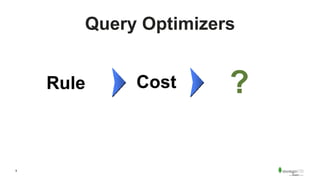
Query Optimizers
Rule Cost ?
10
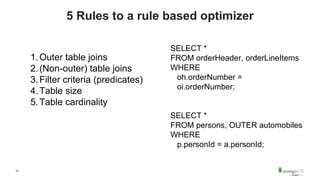
5 Rules to a rule based optimizer
1.Outer table joins
2.(Non-outer) table joins
3.Filter criteria (predicates)
4.Table size
5.Table cardinality
SELECT *
FROM orderHeader, orderLineItems
WHERE
oh.orderNumber =
oi.orderNumber;
SELECT *
FROM persons, OUTER automobiles
WHERE
p.personId = a.personId;
11
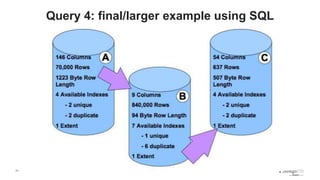
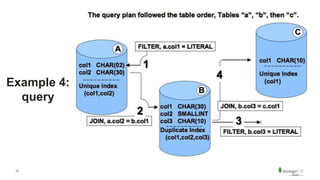
Query 4: final/larger example using SQL
12
Example 4:
query
13
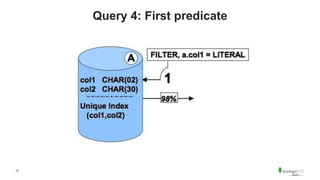
Query 4: First predicate
14
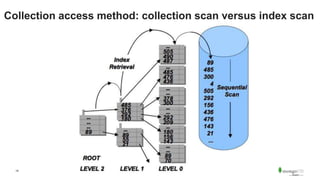
Collection access method: collection scan versus index scan
15
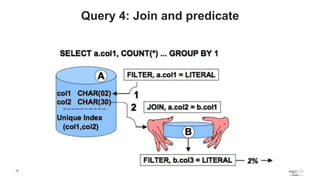
Query 4: Join and predicate
16
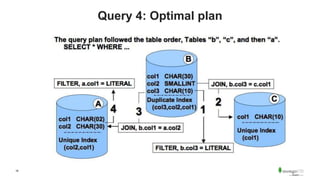
Query 4: Optimal plan
17
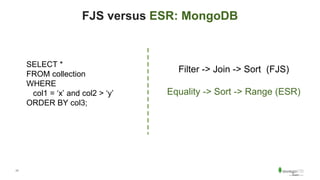
FJS versus ESR: MongoDB
SELECT *
FROM collection
WHERE
col1 = ‘x’ and col2 > ‘y’
ORDER BY col3;
Filter -> Join -> Sort (FJS)
Equality -> Sort -> Range (ESR)
18
Problem statement:
I inherited a MongoDB database server with
60 collections and 100 or so indexes.
The business users are complaining about
slow report completion times.
What can I do to improve performance ?
19
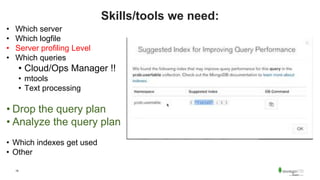
Skills/tools we need:
• Which server
• Which logfile
• Server profiling Level
• Which queries
• Cloud/Ops Manager !!
• mtools
• Text processing
• Drop the query plan
• Analyze the query plan
• Which indexes get used
• Other
20
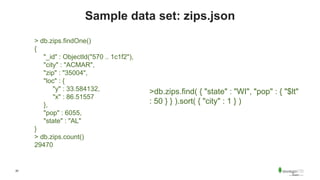
Sample data set: zips.json
> db.zips.findOne()
{
"_id" : ObjectId("570 .. 1c1f2"),
"city" : "ACMAR",
"zip" : "35004",
"loc" : {
"y" : 33.584132,
"x" : 86.51557
},
"pop" : 6055,
"state" : "AL"
}
> db.zips.count()
29470
>db.zips.find( { "state" : "WI", "pop" : { "$lt"
: 50 } } ).sort( { "city" : 1 } )
21
Query 5: Dumping the query plan
db.zips.find( { "state" : "WI",
"pop" : { "$lt" : 50 } } ).sort(
{ "city" : 1 }
).explain("executionStats")
"winningPlan" : {
"stage" : "SORT", "sortPattern" : { "city" : 1 },
"inputStage" : {
"stage" : "COLLSCAN",
"filter" : {
"$and" : [ "state" : { "$eq" : "WI" "pop" : { "$lt" : 50
"rejectedPlans" : [ ]
"executionStats" : {
"nReturned" : 4,
"executionTimeMillis" : 16,
"totalKeysExamined" : 0,
"totalDocsExamined" : 29470,
22
Query 5: get indexes
> db.zips.getIndexes()
[ {
"v" : 1, "key" : { "_id" : 1 },
"name" : "_id_",
"ns" : "test_db.zips"
} ]
db.zips.createIndex( { "state" : 1 , "pop" : 1 } )
23
Query 5: attempt 2
winningPlan" : {
"stage" : "SORT", "sortPattern" : { "city" : 1 },
"inputStage" : {
"stage" : "FETCH",
"inputStage" : {
"stage" : "IXSCAN",
"keyPattern" : { "state" : 1, "pop" : 1 },
"indexBounds" : {
"state" : [ "["WI", "WI"]" ],
"pop" : [ "[-inf.0, 50.0)" ]
"executionStats" : {
"nReturned" : 4,
"executionTimeMillis" : 1,
"totalKeysExamined" : 4,
"totalDocsExamined" : 4,
24
Query 5:
attempt 3
db.zips.createIndex( { "state" : 1 , "city" : 1 , "pop" : 1 } )
"winningPlan" : {
"stage" : "SORT", "sortPattern" : { "city" : 1
"inputStage" : {
"stage" : "FETCH",
"inputStage" : {
"stage" : "IXSCAN",
"keyPattern" : { "state" : 1, "pop" : 1
"rejectedPlans" : [
"stage" : "FETCH",
"inputStage" : {
"stage" : "IXSCAN",
"keyPattern" : { "state" : 1, "city" : 1, "pop" : 1 },
"indexBounds" : {
"state" : [ "["WI", "WI"]" ],
"city" : [ "[MinKey, MaxKey]" ],
"pop" : [ "[-inf.0, 50.0)" ]
25
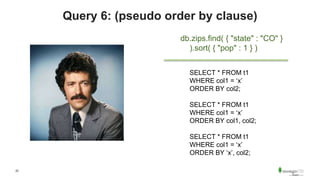
Query 6: (pseudo order by clause)
db.zips.find( { "state" : "CO" }
).sort( { "pop" : 1 } )
SELECT * FROM t1
WHERE col1 = ‘x’
ORDER BY col2;
SELECT * FROM t1
WHERE col1 = ‘x’
ORDER BY col1, col2;
SELECT * FROM t1
WHERE col1 = ‘x’
ORDER BY ‘x’, col2;
26
Query 6: query plan
"stage" : "FETCH",
"inputStage" : {
"stage" : "IXSCAN",
"keyPattern" : { "state" : 1, "city" : 1, "pop" : 1 },
"indexBounds" : {
"state" : [ "["CO", "CO"]" ],
"city" : [ "[MinKey, MaxKey]" ],
"pop" : [ "[MinKey, MaxKey]" ]
"executionStats" : {
"nReturned" : 416,
"executionTimeMillis" : 1,
"totalKeysExamined" : 416,
"totalDocsExamined" : 416,
"winningPlan" : {
"stage" : "FETCH",
"inputStage" : {
"stage" : "IXSCAN",
"keyPattern" : { "state" : 1, "pop" : 1 },
"indexBounds" : {
"state" : [ "["CO", "CO"]" ],
"pop" : [ "[MinKey, MaxKey]" ]
"rejectedPlans" : [
"stage" : "SORT",
"sortPattern" : { "pop" : 1 },
"inputStage" : {
27
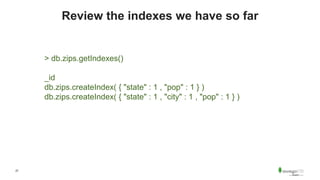
Review the indexes we have so far
> db.zips.getIndexes()
_id
db.zips.createIndex( { "state" : 1 , "pop" : 1 } )
db.zips.createIndex( { "state" : 1 , "city" : 1 , "pop" : 1 } )
28
Query 7: OR topped query
db.zips.find( { "$or" : [ { "state" : "UT" }, { "pop" : 2 } ] } )
"winningPlan" : {
"inputStage" : {
"stage" : "COLLSCAN",
"filter" : {
"$or" : [
"pop" : { "$eq" : 2 }
"state" : { "$eq" : "UT" }
"rejectedPlans" : [ ]
"executionStats" : {
"nReturned" : 215,
"executionTimeMillis" : 22,
"totalKeysExamined" : 0,
"totalDocsExamined" : 29470,
SELECT * FROM t1
WHERE
order_date = TODAY
OR
ship_weight < 10;
29
Query 7: solution
"stage" : "IXSCAN",
"keyPattern" : { "pop" : 1 },
"indexBounds" : {
"pop" : [ "[2.0, 2.0]" ]
"rejectedPlans" : [ ]
"executionStats" : {
"nReturned" : 215,
"executionTimeMillis" : 2,
"totalKeysExamined" : 215,
"totalDocsExamined" : 215,
db.zips.createIndex( { "pop" : 1 } )
"winningPlan" : {
"inputStage" : {
"stage" : "FETCH",
"inputStage" : {
"stage" : "OR",
"inputStages" : [
"stage" : "IXSCAN",
"keyPattern" : { "state" : 1, "pop" : 1 },
"indexBounds" : {
"state" : [ "["UT", "UT"]" ],
"pop" : [ "[MinKey, MaxKey]" ]
30
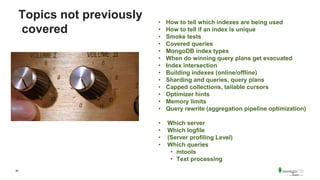
Topics not previously
covered
• How to tell which indexes are being used
• How to tell if an index is unique
• Smoke tests
• Covered queries
• MongoDB index types
• When do winning query plans get evacuated
• Index intersection
• Building indexes (online/offline)
• Sharding and queries, query plans
• Capped collections, tailable cursors
• Optimizer hints
• Memory limits
• Query rewrite (aggregation pipeline optimization)
• Which server
• Which logfile
• (Server profiling Level)
• Which queries
• mtools
• Text processing
31
Resources:
• The parent to this preso,
https://github.com/farrell0/MongoDB-Developers-Notebook
• An excellent query primer (110 pages)
http://www.redbooks.ibm.com/abstracts/sg247138.html?Open
(Chapters 10 and 11.)
• University.MongoDB.com
• https://www.mongodb.com/consulting-test#performance_evaluation
• zips.json
http://media.mongodb.org/zips.json
• Call Dave Lutz, at home, .. .. On Sunday (early)
(512)555/1212
32
Backup Slides
How to tell which indexes are being used
db.zips.aggregate( [ { "$indexStats" : {} } ] ).pretty()
{ "name" : "pop_1",
"key" : { "pop" : 1 },
"host" : "rhhost00.grid:27017",
"accesses" : {
"ops" : NumberLong(15),
"since" : ISODate("2016-04-19T07:13:44.546Z") } }
{ "name" : "state_1_city_1_pop_1",
"key" : { "state" : 1, "city" : 1, "pop" : 1 },
"host" : "rhhost00.grid:27017",
"accesses" : {
"ops" : NumberLong(0),
"since" : ISODate("2016-04-19T06:49:11.765Z") } }
How to tell if an index is unique
db.t1.createIndex( { "k1" : 1 },
{ "unique" : true })
{
"createdCollectionAutomatically" : true,
"numIndexesBefore" : 1,
"numIndexesAfter" : 2,
"ok" : 1
}
> db.t1.getIndexes()
[ { "v" : 1,
"key" : { "_id" : 1 },
"name" : "_id_",
"ns" : "test_db.t1“ },
{ "v" : 1,
"unique" : true,
"key" : { "k1" : 1 },
"name" : "k1_1",
"ns" : "test_db.t1“ }
]
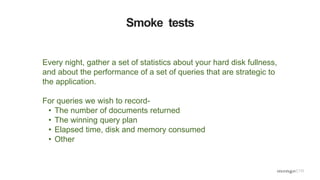
Smoke tests
Every night, gather a set of statistics about your hard disk fullness,
and about the performance of a set of queries that are strategic to
the application.
For queries we wish to record-
• The number of documents returned
• The winning query plan
• Elapsed time, disk and memory consumed
• Other
Covered queries
> db.zips.find( { "pop" : { "$lt" : 200 } },
{ "_id" : 0, "pop" : 1 } ).sort(
{ "pop" : -1 } ).explain()
"winningPlan" : {
"stage" : "PROJECTION",
"transformBy" : {
"_id" : 0,
"pop" : 1 },
"inputStage" : {
"stage" : "IXSCAN",
"keyPattern" : { "pop" : 1 },
"indexBounds" : {
"pop" : [ "(200.0, -inf.0]" ]
"rejectedPlans" : [ ]
}
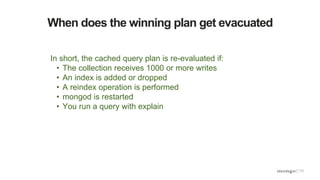
When does the winning plan get evacuated
In short, the cached query plan is re-evaluated if:
• The collection receives 1000 or more writes
• An index is added or dropped
• A reindex operation is performed
• mongod is restarted
• You run a query with explain
Index intersection
db.zips.find( { "$or" : [ { "state" : "UT" }, { "pop" : 2 } ] } )
db.zips.find( { "city" : "EAST TROY", "zip" : 53120 } )
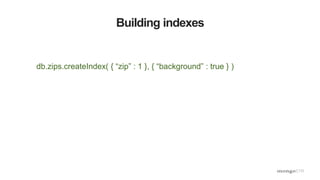
Building indexes
db.zips.createIndex( { “zip” : 1 }, { “background” : true } )
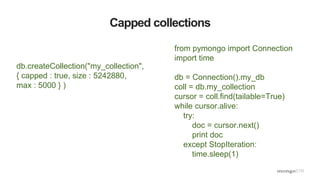
Capped collections
db.createCollection("my_collection",
{ capped : true, size : 5242880,
max : 5000 } )
from pymongo import Connection
import time
db = Connection().my_db
coll = db.my_collection
cursor = coll.find(tailable=True)
while cursor.alive:
try:
doc = cursor.next()
print doc
except StopIteration:
time.sleep(1)
Memory limits: 32 MB, 100 MB
"executionStages" : {
"stage" : "SORT",
"nReturned" : 1,
"executionTimeMillisEstimate" : 60,
…
"sortPattern" : { "City" : 1 },
"memUsage" : 120,
"memLimit" : 33554432,
db.zips.aggregate([
{ "$group" :
{ "_id" : "$state",
//
"totalPop" : { "$sum" : "$pop" },
"cityCount" : { "$sum" : 1 }
}
} ,
{ "$sort" : { "_id" : 1 } }
],
{ "allowDiskUse" : true }
)
42
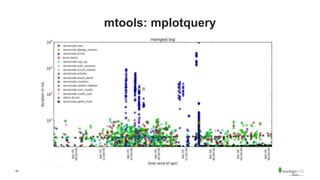
mtools: mplotquery
43
But first:
Y/N I have more than 24 months
experience with SQL
Y/N I have more than 6 months
experience with MongoDB
Y/N I have dropped a MongoDB
explain plan, understood it,
made changes, and was happy
Y/N Puppies scare me
44
Two more examples: Queries 8 and 9
find() aggregate()
• optimizer hints
• $lookup()
45
Query 8: automatic query rewrite
> db.zips.aggregate(
... [
... { "$sort" :
... { "state" : 1 }
... },
... {
... "$match" :
... { "state" : { "$gt" : "M" } }
... }
... ],
... { "explain" : true } )
46
Query 8: Explain plan
"stages" : [
"$cursor" : {
"sort" : { "state" : 1 },
"winningPlan" : {
"stage" : "FETCH",
"inputStage" : {
"stage" : "IXSCAN",
"indexName" : "state_1_city_1",
"indexBounds" : {
"state" : [ "("M", {})" ],
"city" : [ "[MinKey, MaxKey]" ]
"rejectedPlans" : [ ]
47
Query 9: Optimizer hints
> db.zips.find( { "city" : "EAST TROY" }).hint(
{ "zip" : 1} ).explain("executionStats")
"winningPlan" : {
"stage" : "FETCH",
"filter" : { "city" : { "$eq" : "EAST TROY" } },
"inputStage" : {
"stage" : "IXSCAN", "keyPattern" : { "zip" : 1 },
"indexBounds" : { "zip" : [ "[MinKey, MaxKey]" ] }
"rejectedPlans" : [ ]
"executionStats" : {
"nReturned" : 1,
"executionTimeMillis" : 28,
"totalKeysExamined" : 29470,
"totalDocsExamined" : 29470,

Webinar: Index Tuning and Evaluation

  • 2.
    2 Problem statement: I inheriteda MongoDB database server with 60 collections and 100 or so indexes. The business users are complaining about slow report completion times. What can I do to improve performance ?
  • 3.
    3 Scope: System tuning- Memory Process Disk Network Application tuning- Applicationarchitecture Statement design Data model design Indexing, Query optimization (Relational, so that we may compare/contrast)
  • 4.
    4 What you will leavewith in 60 minutes: • Detail command processing stages • Can apply the 5 rules to a Rule Based query optimizer • Apply 3 Index Negation guidelines • Repair common query design problems- • Psuedo order by clause • OR topped queries • (And topped queries, non-compound) • Drop and analyze query plans • Articulate/control FJS, & ESR query processing patterns
  • 5.
    5 Queries 1 &2: SELECT * FROM phonebook WHERE lastName LIKE “?son”; SELECT * FROM phonebook WHERE firstName = “Jennifer”;
  • 6.
    6 Query 3: CREATE TABLEt1 (col1, col_2, .. 80 more columns); CREATE INDEX i1 ON t1 (col_gender); SELECT * FROM t1 WHERE col_gender = “F” AND col_age > 50;
  • 7.
    7 Negation of anindex 1.Non-initial substring 2.Non-anchored compound/composite key 3.(Poor) selectivity of a filter Partial negation of an index- CREATE INDEX i1 ON t2 (col1, col2); // SELECT * FROM t1 WHERE col1 > 100 AND col2 = “x”; Exception to all above- Covered query/key-only
  • 8.
    8 (n) Stage databaseserver back end
  • 9.
  • 10.
    10 5 Rules toa rule based optimizer 1.Outer table joins 2.(Non-outer) table joins 3.Filter criteria (predicates) 4.Table size 5.Table cardinality SELECT * FROM orderHeader, orderLineItems WHERE oh.orderNumber = oi.orderNumber; SELECT * FROM persons, OUTER automobiles WHERE p.personId = a.personId;
  • 11.
    11 Query 4: final/largerexample using SQL
  • 12.
  • 13.
  • 14.
    14 Collection access method:collection scan versus index scan
  • 15.
    15 Query 4: Joinand predicate
  • 16.
  • 17.
    17 FJS versus ESR:MongoDB SELECT * FROM collection WHERE col1 = ‘x’ and col2 > ‘y’ ORDER BY col3; Filter -> Join -> Sort (FJS) Equality -> Sort -> Range (ESR)
  • 18.
    18 Problem statement: I inheriteda MongoDB database server with 60 collections and 100 or so indexes. The business users are complaining about slow report completion times. What can I do to improve performance ?
  • 19.
    19 Skills/tools we need: •Which server • Which logfile • Server profiling Level • Which queries • Cloud/Ops Manager !! • mtools • Text processing • Drop the query plan • Analyze the query plan • Which indexes get used • Other
  • 20.
    20 Sample data set:zips.json > db.zips.findOne() { "_id" : ObjectId("570 .. 1c1f2"), "city" : "ACMAR", "zip" : "35004", "loc" : { "y" : 33.584132, "x" : 86.51557 }, "pop" : 6055, "state" : "AL" } > db.zips.count() 29470 >db.zips.find( { "state" : "WI", "pop" : { "$lt" : 50 } } ).sort( { "city" : 1 } )
  • 21.
    21 Query 5: Dumpingthe query plan db.zips.find( { "state" : "WI", "pop" : { "$lt" : 50 } } ).sort( { "city" : 1 } ).explain("executionStats") "winningPlan" : { "stage" : "SORT", "sortPattern" : { "city" : 1 }, "inputStage" : { "stage" : "COLLSCAN", "filter" : { "$and" : [ "state" : { "$eq" : "WI" "pop" : { "$lt" : 50 "rejectedPlans" : [ ] "executionStats" : { "nReturned" : 4, "executionTimeMillis" : 16, "totalKeysExamined" : 0, "totalDocsExamined" : 29470,
  • 22.
    22 Query 5: getindexes > db.zips.getIndexes() [ { "v" : 1, "key" : { "_id" : 1 }, "name" : "_id_", "ns" : "test_db.zips" } ] db.zips.createIndex( { "state" : 1 , "pop" : 1 } )
  • 23.
    23 Query 5: attempt2 winningPlan" : { "stage" : "SORT", "sortPattern" : { "city" : 1 }, "inputStage" : { "stage" : "FETCH", "inputStage" : { "stage" : "IXSCAN", "keyPattern" : { "state" : 1, "pop" : 1 }, "indexBounds" : { "state" : [ "["WI", "WI"]" ], "pop" : [ "[-inf.0, 50.0)" ] "executionStats" : { "nReturned" : 4, "executionTimeMillis" : 1, "totalKeysExamined" : 4, "totalDocsExamined" : 4,
  • 24.
    24 Query 5: attempt 3 db.zips.createIndex({ "state" : 1 , "city" : 1 , "pop" : 1 } ) "winningPlan" : { "stage" : "SORT", "sortPattern" : { "city" : 1 "inputStage" : { "stage" : "FETCH", "inputStage" : { "stage" : "IXSCAN", "keyPattern" : { "state" : 1, "pop" : 1 "rejectedPlans" : [ "stage" : "FETCH", "inputStage" : { "stage" : "IXSCAN", "keyPattern" : { "state" : 1, "city" : 1, "pop" : 1 }, "indexBounds" : { "state" : [ "["WI", "WI"]" ], "city" : [ "[MinKey, MaxKey]" ], "pop" : [ "[-inf.0, 50.0)" ]
  • 25.
    25 Query 6: (pseudoorder by clause) db.zips.find( { "state" : "CO" } ).sort( { "pop" : 1 } ) SELECT * FROM t1 WHERE col1 = ‘x’ ORDER BY col2; SELECT * FROM t1 WHERE col1 = ‘x’ ORDER BY col1, col2; SELECT * FROM t1 WHERE col1 = ‘x’ ORDER BY ‘x’, col2;
  • 26.
    26 Query 6: queryplan "stage" : "FETCH", "inputStage" : { "stage" : "IXSCAN", "keyPattern" : { "state" : 1, "city" : 1, "pop" : 1 }, "indexBounds" : { "state" : [ "["CO", "CO"]" ], "city" : [ "[MinKey, MaxKey]" ], "pop" : [ "[MinKey, MaxKey]" ] "executionStats" : { "nReturned" : 416, "executionTimeMillis" : 1, "totalKeysExamined" : 416, "totalDocsExamined" : 416, "winningPlan" : { "stage" : "FETCH", "inputStage" : { "stage" : "IXSCAN", "keyPattern" : { "state" : 1, "pop" : 1 }, "indexBounds" : { "state" : [ "["CO", "CO"]" ], "pop" : [ "[MinKey, MaxKey]" ] "rejectedPlans" : [ "stage" : "SORT", "sortPattern" : { "pop" : 1 }, "inputStage" : {
  • 27.
    27 Review the indexeswe have so far > db.zips.getIndexes() _id db.zips.createIndex( { "state" : 1 , "pop" : 1 } ) db.zips.createIndex( { "state" : 1 , "city" : 1 , "pop" : 1 } )
  • 28.
    28 Query 7: ORtopped query db.zips.find( { "$or" : [ { "state" : "UT" }, { "pop" : 2 } ] } ) "winningPlan" : { "inputStage" : { "stage" : "COLLSCAN", "filter" : { "$or" : [ "pop" : { "$eq" : 2 } "state" : { "$eq" : "UT" } "rejectedPlans" : [ ] "executionStats" : { "nReturned" : 215, "executionTimeMillis" : 22, "totalKeysExamined" : 0, "totalDocsExamined" : 29470, SELECT * FROM t1 WHERE order_date = TODAY OR ship_weight < 10;
  • 29.
    29 Query 7: solution "stage": "IXSCAN", "keyPattern" : { "pop" : 1 }, "indexBounds" : { "pop" : [ "[2.0, 2.0]" ] "rejectedPlans" : [ ] "executionStats" : { "nReturned" : 215, "executionTimeMillis" : 2, "totalKeysExamined" : 215, "totalDocsExamined" : 215, db.zips.createIndex( { "pop" : 1 } ) "winningPlan" : { "inputStage" : { "stage" : "FETCH", "inputStage" : { "stage" : "OR", "inputStages" : [ "stage" : "IXSCAN", "keyPattern" : { "state" : 1, "pop" : 1 }, "indexBounds" : { "state" : [ "["UT", "UT"]" ], "pop" : [ "[MinKey, MaxKey]" ]
  • 30.
    30 Topics not previously covered •How to tell which indexes are being used • How to tell if an index is unique • Smoke tests • Covered queries • MongoDB index types • When do winning query plans get evacuated • Index intersection • Building indexes (online/offline) • Sharding and queries, query plans • Capped collections, tailable cursors • Optimizer hints • Memory limits • Query rewrite (aggregation pipeline optimization) • Which server • Which logfile • (Server profiling Level) • Which queries • mtools • Text processing
  • 31.
    31 Resources: • The parentto this preso, https://github.com/farrell0/MongoDB-Developers-Notebook • An excellent query primer (110 pages) http://www.redbooks.ibm.com/abstracts/sg247138.html?Open (Chapters 10 and 11.) • University.MongoDB.com • https://www.mongodb.com/consulting-test#performance_evaluation • zips.json http://media.mongodb.org/zips.json • Call Dave Lutz, at home, .. .. On Sunday (early) (512)555/1212
  • 32.
  • 33.
    How to tellwhich indexes are being used db.zips.aggregate( [ { "$indexStats" : {} } ] ).pretty() { "name" : "pop_1", "key" : { "pop" : 1 }, "host" : "rhhost00.grid:27017", "accesses" : { "ops" : NumberLong(15), "since" : ISODate("2016-04-19T07:13:44.546Z") } } { "name" : "state_1_city_1_pop_1", "key" : { "state" : 1, "city" : 1, "pop" : 1 }, "host" : "rhhost00.grid:27017", "accesses" : { "ops" : NumberLong(0), "since" : ISODate("2016-04-19T06:49:11.765Z") } }
  • 34.
    How to tellif an index is unique db.t1.createIndex( { "k1" : 1 }, { "unique" : true }) { "createdCollectionAutomatically" : true, "numIndexesBefore" : 1, "numIndexesAfter" : 2, "ok" : 1 } > db.t1.getIndexes() [ { "v" : 1, "key" : { "_id" : 1 }, "name" : "_id_", "ns" : "test_db.t1“ }, { "v" : 1, "unique" : true, "key" : { "k1" : 1 }, "name" : "k1_1", "ns" : "test_db.t1“ } ]
  • 35.
    Smoke tests Every night,gather a set of statistics about your hard disk fullness, and about the performance of a set of queries that are strategic to the application. For queries we wish to record- • The number of documents returned • The winning query plan • Elapsed time, disk and memory consumed • Other
  • 36.
    Covered queries > db.zips.find({ "pop" : { "$lt" : 200 } }, { "_id" : 0, "pop" : 1 } ).sort( { "pop" : -1 } ).explain() "winningPlan" : { "stage" : "PROJECTION", "transformBy" : { "_id" : 0, "pop" : 1 }, "inputStage" : { "stage" : "IXSCAN", "keyPattern" : { "pop" : 1 }, "indexBounds" : { "pop" : [ "(200.0, -inf.0]" ] "rejectedPlans" : [ ] }
  • 37.
    When does thewinning plan get evacuated In short, the cached query plan is re-evaluated if: • The collection receives 1000 or more writes • An index is added or dropped • A reindex operation is performed • mongod is restarted • You run a query with explain
  • 38.
    Index intersection db.zips.find( {"$or" : [ { "state" : "UT" }, { "pop" : 2 } ] } ) db.zips.find( { "city" : "EAST TROY", "zip" : 53120 } )
  • 39.
    Building indexes db.zips.createIndex( {“zip” : 1 }, { “background” : true } )
  • 40.
    Capped collections db.createCollection("my_collection", { capped: true, size : 5242880, max : 5000 } ) from pymongo import Connection import time db = Connection().my_db coll = db.my_collection cursor = coll.find(tailable=True) while cursor.alive: try: doc = cursor.next() print doc except StopIteration: time.sleep(1)
  • 41.
    Memory limits: 32MB, 100 MB "executionStages" : { "stage" : "SORT", "nReturned" : 1, "executionTimeMillisEstimate" : 60, … "sortPattern" : { "City" : 1 }, "memUsage" : 120, "memLimit" : 33554432, db.zips.aggregate([ { "$group" : { "_id" : "$state", // "totalPop" : { "$sum" : "$pop" }, "cityCount" : { "$sum" : 1 } } } , { "$sort" : { "_id" : 1 } } ], { "allowDiskUse" : true } )
  • 42.
  • 43.
    43 But first: Y/N Ihave more than 24 months experience with SQL Y/N I have more than 6 months experience with MongoDB Y/N I have dropped a MongoDB explain plan, understood it, made changes, and was happy Y/N Puppies scare me
  • 44.
    44 Two more examples:Queries 8 and 9 find() aggregate() • optimizer hints • $lookup()
  • 45.
    45 Query 8: automaticquery rewrite > db.zips.aggregate( ... [ ... { "$sort" : ... { "state" : 1 } ... }, ... { ... "$match" : ... { "state" : { "$gt" : "M" } } ... } ... ], ... { "explain" : true } )
  • 46.
    46 Query 8: Explainplan "stages" : [ "$cursor" : { "sort" : { "state" : 1 }, "winningPlan" : { "stage" : "FETCH", "inputStage" : { "stage" : "IXSCAN", "indexName" : "state_1_city_1", "indexBounds" : { "state" : [ "("M", {})" ], "city" : [ "[MinKey, MaxKey]" ] "rejectedPlans" : [ ]
  • 47.
    47 Query 9: Optimizerhints > db.zips.find( { "city" : "EAST TROY" }).hint( { "zip" : 1} ).explain("executionStats") "winningPlan" : { "stage" : "FETCH", "filter" : { "city" : { "$eq" : "EAST TROY" } }, "inputStage" : { "stage" : "IXSCAN", "keyPattern" : { "zip" : 1 }, "indexBounds" : { "zip" : [ "[MinKey, MaxKey]" ] } "rejectedPlans" : [ ] "executionStats" : { "nReturned" : 1, "executionTimeMillis" : 28, "totalKeysExamined" : 29470, "totalDocsExamined" : 29470,