KantanMT Partner Webinar
“Machine Translation: Managing Translation Memories
for Engineering and Automotive Translation”
16 June 2016
Christian Taube
Matrix Communications GmbH
Technical Lead
christian.taube@matrix-ag.com
About me and my company
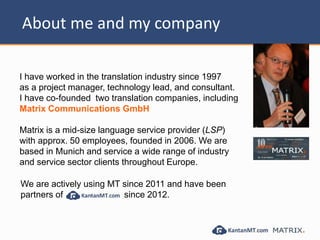
I have worked in the translation industry since 1997
as a project manager, technology lead, and consultant.
I have co-founded two translation companies, including
Matrix Communications GmbH
Matrix is a mid-size language service provider (LSP)
with approx. 50 employees, founded in 2006. We are
based in Munich and service a wide range of industry
and service sector clients throughout Europe.
We are actively using MT since 2011 and have been
partners of since 2012.
Machine translation today
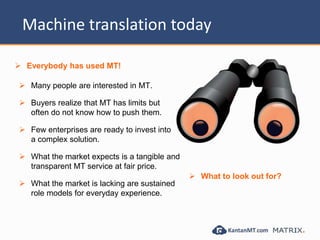
 Many people are interested in MT.
 Buyers realize that MT has limits but
often do not know how to push them.
 Few enterprises are ready to invest into
a complex solution.
 What the market expects is a tangible and
transparent MT service at fair price.
 What the market is lacking are sustained
role models for everyday experience.
 Everybody has used MT!
 What to look out for?
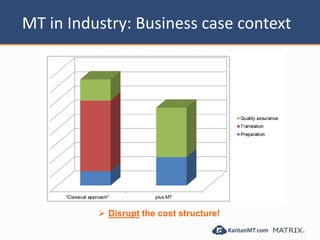
MT in Industry: Business case
context
 Disrupt the cost structure!
Where do we see potential for MT?
Productivity aid when translating texts in organizations that have...
• ... some level of control over authoring guidelines
• ... a high degree of in-domain specificity
• ... well-documented terminology
• ... a well-established translation memory process
We find that this potential can be realized in, for example...
• Technical documentation (of many sorts)
• User documentation
• Financial reporting
• Catalogue texts
MT case study
 Customer: Engineering company with world-wide presence and
a wide variety of high-tech products and service solutions
 Content: Service documentation
 Language pairs: German  English, Spanish, French, Italian,
Dutch, Danish, Norwegian, Chinese (Simplified) – further pairs
currently in planning
 Translation platform: Trados Studio
 Implementation: TM + output,
post-editors can work in their usual environment
 Productivity: Productivity improves significantly per language
Case study: Building MT engines in
KantanMT
 We use customer-specific translation memories as
input (no other, less customer-specific corpora,
although that is an option that Kantan has).
 We use customer-specific terminology and make sure
this is actually in the TMs
 We edit our „raw“ TM input for the MT purpose.
 Preparatory steps in clean-up before training may include:
 Elimination of non-aligned segments, empty segments, segments that are too short/too
long on either side, etc.
 Normalization of capitalized words, acronyms, etc.
 Certain linguistic checks (consistency), terminological checks.
 TMX input size ranges from 100,000 to > 700,000 segments.
 Our smallest engine was built on 150,000 words (!) – Specificity works!
 Automated post-editing rules (PEX) are constantly optimized and extended.
Case study: Success factors and
benefits
Success factors we have identified:
• Manage expectations on all sides.
• Identify suitable text types.
• Work with authors to optimize source.
• Invest in your TMs. Use suitable tools to maintain them.
• Train post-editors. Translators can be post-editors!
• Don‘t be afraid of ending up in dead ends. Reverse, and try again.
Benefits gained:
• Turnaround times significantly reduced (translator throughput)
• Significant cost reductions
• Final workflow retains the same high quality standard
Summary: Benefits of cooperation
 Fully automated system training:
 One-click system customization
 Automatic data pre-processing and cleansing (Kantan Gentry)
 Fully automated translation step:
 Automated pre- and post-processing of files we upload
 PEX rules to aid translation
 Quality assessment of engines:
 KantanWatch
 Gap Analysis
 Reject Report
 No maintenance and infrastructure
Q & A
Thank you!
@KantanMT info@kantanmt.com
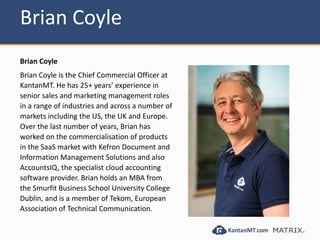
Brian Coyle
Brian Coyle
Brian Coyle is the Chief Commercial Officer at
KantanMT. He has 25+ years’ experience in
senior sales and marketing management roles
in a range of industries and across a number of
markets including the US, the UK and Europe.
Over the last number of years, Brian has
worked on the commercialisation of products
in the SaaS market with Kefron Document and
Information Management Solutions and also
AccountsIQ, the specialist cloud accounting
software provider. Brian holds an MBA from
the Smurfit Business School University College
Dublin, and is a member of Tekom, European
Association of Technical Communication.
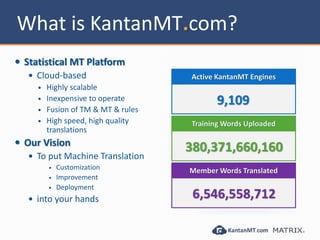
What is KantanMT.com?
 Statistical MT Platform
 Cloud-based
 Highly scalable
 Inexpensive to operate
 Fusion of TM & MT & rules
 High speed, high quality
translations
 Our Vision
 To put Machine Translation
 Customization
 Improvement
 Deployment
 into your hands
Active KantanMT Engines
9,109
Training Words Uploaded
380,371,660,160
Member Words Translated
6,546,558,712
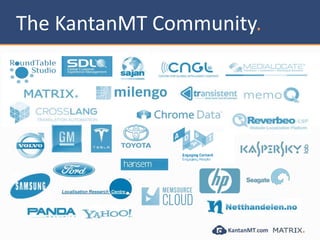
The KantanMT Community.
Case Study #1
@KantanMT info@kantanmt.com
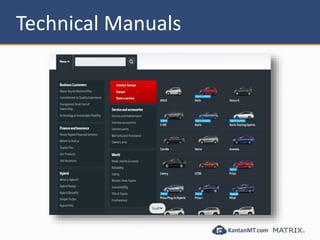
Technical Manuals
Technical Manuals
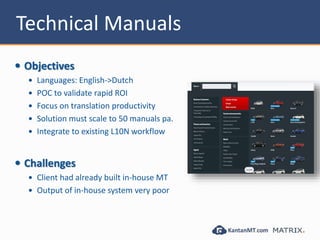
 Objectives
 Languages: English->Dutch
 POC to validate rapid ROI
 Focus on translation productivity
 Solution must scale to 50 manuals pa.
 Integrate to existing L10N workflow
 Challenges
 Client had already built in-house MT
 Output of in-house system very poor
Technical Manuals
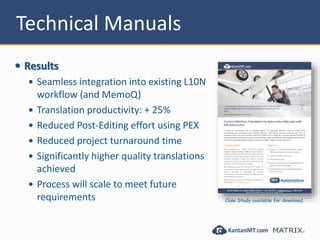
 Results
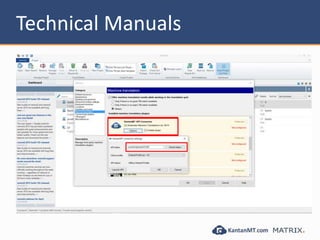
 Seamless integration into existing L10N
workflow (and MemoQ)
 Translation productivity: + 25%
 Reduced Post-Editing effort using PEX
 Reduced project turnaround time
 Significantly higher quality translations
achieved
 Process will scale to meet future
requirements Case Study available for download.
Technical Manuals
Case Study #2
@KantanMT info@kantanmt.com
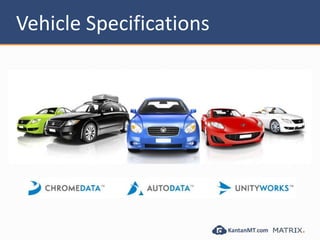
Vehicle Specifications
 Objectives
 Vehicle descriptions service
 6,000 websites & 17,000 dealerships
 Languages: English->Spanish &
Canadian French
 Focus on translation productivity &
speed
 Challenges
 Client had own internal L1ON platform
 Self-developed, customised CAT tool
Vehicle Specifications
 Results
 Seamless integration into existing
L10N workflow using KantanAPI
 Translation productivity: + 70%
 Reduced Post-Editing effort using
PEX
 Reduced project turnaround time
 Reduced project costs
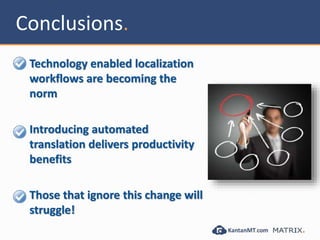
Conclusions.
Technology enabled localization
workflows are becoming the
norm
Introducing automated
translation delivers productivity
benefits
Those that ignore this change will
struggle!
@KantanMT info@kantanmt.com

Webinar automotive and engineering content 16.06.16

  • 2.
    KantanMT Partner Webinar “MachineTranslation: Managing Translation Memories for Engineering and Automotive Translation” 16 June 2016 Christian Taube Matrix Communications GmbH Technical Lead christian.taube@matrix-ag.com
  • 3.
    About me andmy company I have worked in the translation industry since 1997 as a project manager, technology lead, and consultant. I have co-founded two translation companies, including Matrix Communications GmbH Matrix is a mid-size language service provider (LSP) with approx. 50 employees, founded in 2006. We are based in Munich and service a wide range of industry and service sector clients throughout Europe. We are actively using MT since 2011 and have been partners of since 2012.
  • 4.
    Machine translation today Many people are interested in MT.  Buyers realize that MT has limits but often do not know how to push them.  Few enterprises are ready to invest into a complex solution.  What the market expects is a tangible and transparent MT service at fair price.  What the market is lacking are sustained role models for everyday experience.  Everybody has used MT!  What to look out for?
  • 5.
    MT in Industry:Business case context  Disrupt the cost structure!
  • 6.
    Where do wesee potential for MT? Productivity aid when translating texts in organizations that have... • ... some level of control over authoring guidelines • ... a high degree of in-domain specificity • ... well-documented terminology • ... a well-established translation memory process We find that this potential can be realized in, for example... • Technical documentation (of many sorts) • User documentation • Financial reporting • Catalogue texts
  • 7.
    MT case study Customer: Engineering company with world-wide presence and a wide variety of high-tech products and service solutions  Content: Service documentation  Language pairs: German  English, Spanish, French, Italian, Dutch, Danish, Norwegian, Chinese (Simplified) – further pairs currently in planning  Translation platform: Trados Studio  Implementation: TM + output, post-editors can work in their usual environment  Productivity: Productivity improves significantly per language
  • 8.
    Case study: BuildingMT engines in KantanMT  We use customer-specific translation memories as input (no other, less customer-specific corpora, although that is an option that Kantan has).  We use customer-specific terminology and make sure this is actually in the TMs  We edit our „raw“ TM input for the MT purpose.  Preparatory steps in clean-up before training may include:  Elimination of non-aligned segments, empty segments, segments that are too short/too long on either side, etc.  Normalization of capitalized words, acronyms, etc.  Certain linguistic checks (consistency), terminological checks.  TMX input size ranges from 100,000 to > 700,000 segments.  Our smallest engine was built on 150,000 words (!) – Specificity works!  Automated post-editing rules (PEX) are constantly optimized and extended.
  • 9.
    Case study: Successfactors and benefits Success factors we have identified: • Manage expectations on all sides. • Identify suitable text types. • Work with authors to optimize source. • Invest in your TMs. Use suitable tools to maintain them. • Train post-editors. Translators can be post-editors! • Don‘t be afraid of ending up in dead ends. Reverse, and try again. Benefits gained: • Turnaround times significantly reduced (translator throughput) • Significant cost reductions • Final workflow retains the same high quality standard
  • 10.
    Summary: Benefits ofcooperation  Fully automated system training:  One-click system customization  Automatic data pre-processing and cleansing (Kantan Gentry)  Fully automated translation step:  Automated pre- and post-processing of files we upload  PEX rules to aid translation  Quality assessment of engines:  KantanWatch  Gap Analysis  Reject Report  No maintenance and infrastructure
  • 11.
  • 12.
  • 13.
  • 14.
    Brian Coyle Brian Coyle BrianCoyle is the Chief Commercial Officer at KantanMT. He has 25+ years’ experience in senior sales and marketing management roles in a range of industries and across a number of markets including the US, the UK and Europe. Over the last number of years, Brian has worked on the commercialisation of products in the SaaS market with Kefron Document and Information Management Solutions and also AccountsIQ, the specialist cloud accounting software provider. Brian holds an MBA from the Smurfit Business School University College Dublin, and is a member of Tekom, European Association of Technical Communication.
  • 15.
    What is KantanMT.com? Statistical MT Platform  Cloud-based  Highly scalable  Inexpensive to operate  Fusion of TM & MT & rules  High speed, high quality translations  Our Vision  To put Machine Translation  Customization  Improvement  Deployment  into your hands Active KantanMT Engines 9,109 Training Words Uploaded 380,371,660,160 Member Words Translated 6,546,558,712
  • 16.
  • 17.
    Case Study #1 @KantanMTinfo@kantanmt.com
  • 18.
  • 19.
    Technical Manuals  Objectives Languages: English->Dutch  POC to validate rapid ROI  Focus on translation productivity  Solution must scale to 50 manuals pa.  Integrate to existing L10N workflow  Challenges  Client had already built in-house MT  Output of in-house system very poor
  • 20.
    Technical Manuals  Results Seamless integration into existing L10N workflow (and MemoQ)  Translation productivity: + 25%  Reduced Post-Editing effort using PEX  Reduced project turnaround time  Significantly higher quality translations achieved  Process will scale to meet future requirements Case Study available for download.
  • 21.
  • 22.
    Case Study #2 @KantanMTinfo@kantanmt.com
  • 23.
  • 24.
    Vehicle Specifications  Objectives Vehicle descriptions service  6,000 websites & 17,000 dealerships  Languages: English->Spanish & Canadian French  Focus on translation productivity & speed  Challenges  Client had own internal L1ON platform  Self-developed, customised CAT tool
  • 25.
    Vehicle Specifications  Results Seamless integration into existing L10N workflow using KantanAPI  Translation productivity: + 70%  Reduced Post-Editing effort using PEX  Reduced project turnaround time  Reduced project costs
  • 26.
    Conclusions. Technology enabled localization workflowsare becoming the norm Introducing automated translation delivers productivity benefits Those that ignore this change will struggle!
  • 27.