Web 2.0/Social Media in Medicine Author: Ves Dimov, MD  Allergy and Immunology Fellow, Creighton University, Division of Allergy & Immunology,  Member of the New England Journal of Medicine Advisory Board for Students and Residents, Former Clinical Assistant Professor of Medicine, Cleveland Clinic and Case Western Reserve University Last updated: 04/22/2009
About Us   (me) Any reputable website has  “About Us” section
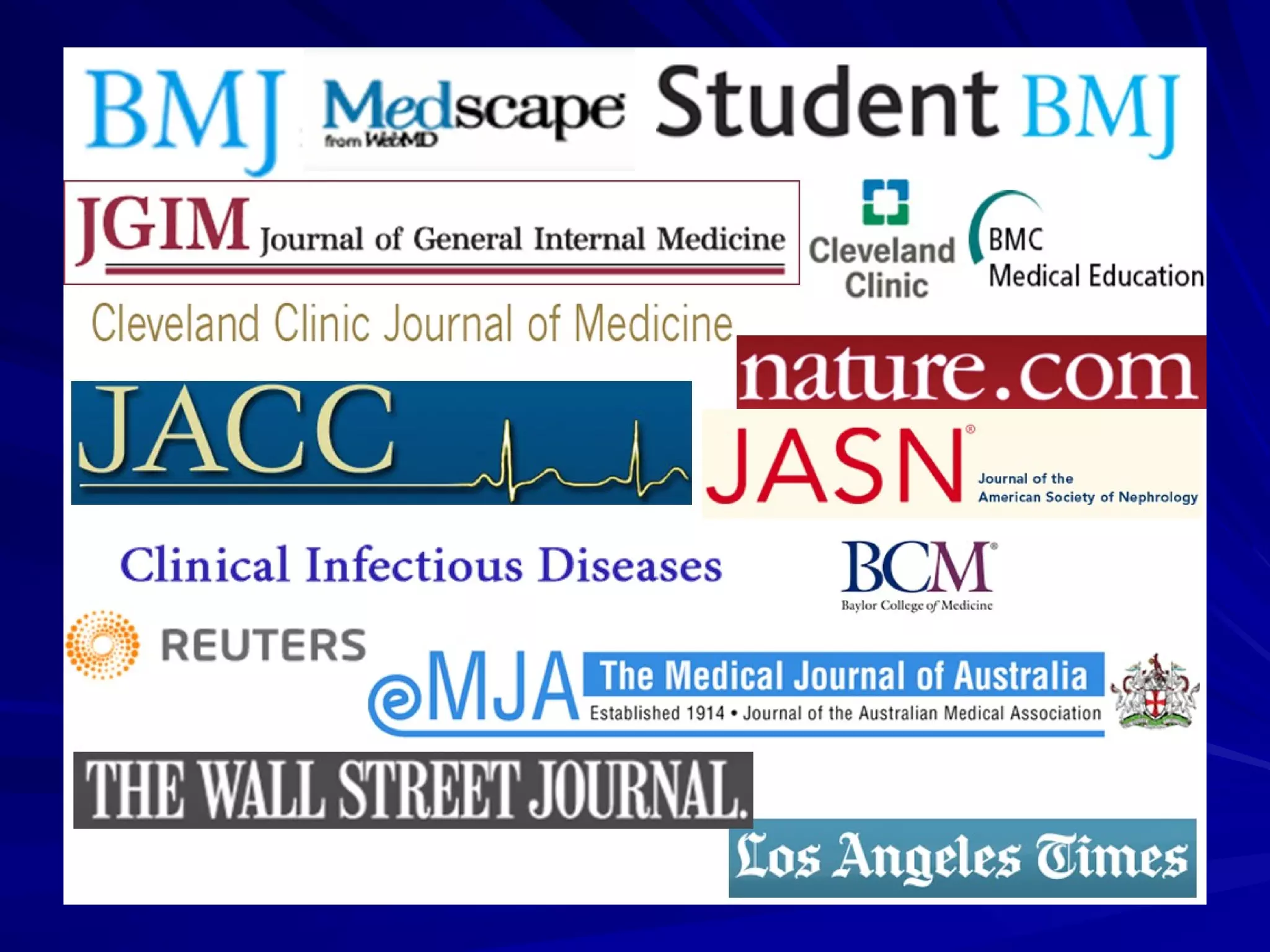
Who are you to talk to me about Web 2.0 and websites?  I have made 9 educational websites: for Cleveland Clinic, University of Miami, Case Western Reserve University and personal They have been featured multiple times in BMJ, Medscape, peer reviewed journals Abstracts presented at multiple national and international scientific meetings
 
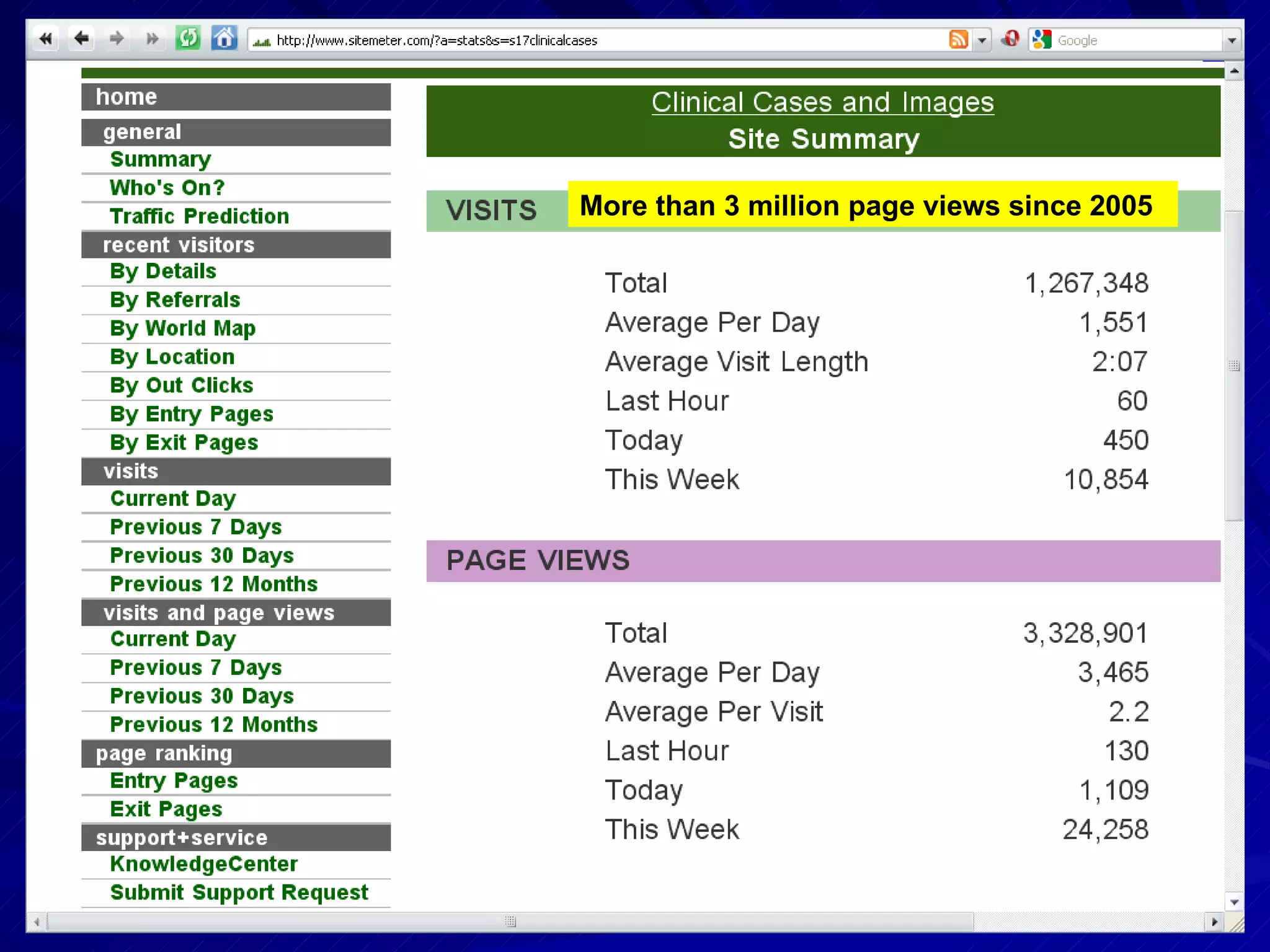
How many people visit your website? Three million page views since 2005. It feels as if you have written a book and somebody reads 3,000 pages of it… every day 1.3 million visitors from all over the world, probably a larger readership than many journals Google loves quality content
Web 2.0/Social Media in  Medicine
What is  Web 2.0 ? The web world has changed before our eyes
What is Web 2.0? Web 2.0 is a collection of (mostly) free web services You can’t buy Web 2.0 at the store but you can use it today
Web 1.0  vs.  Web 2.0 Web 1.0 users follow links to content Web 2.0  users  comment, edit and create  content It is  user-created  content. For the user, by the user
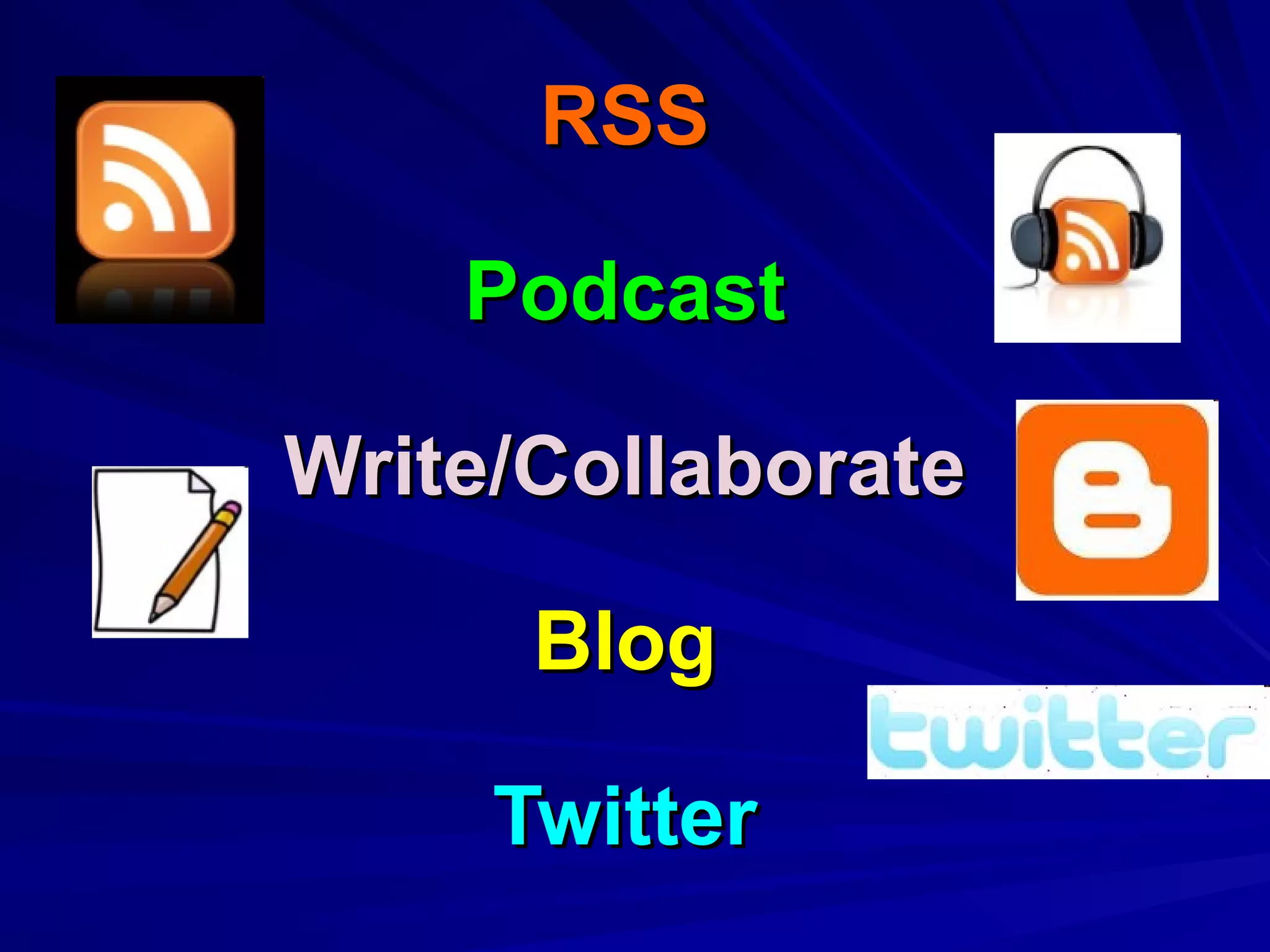
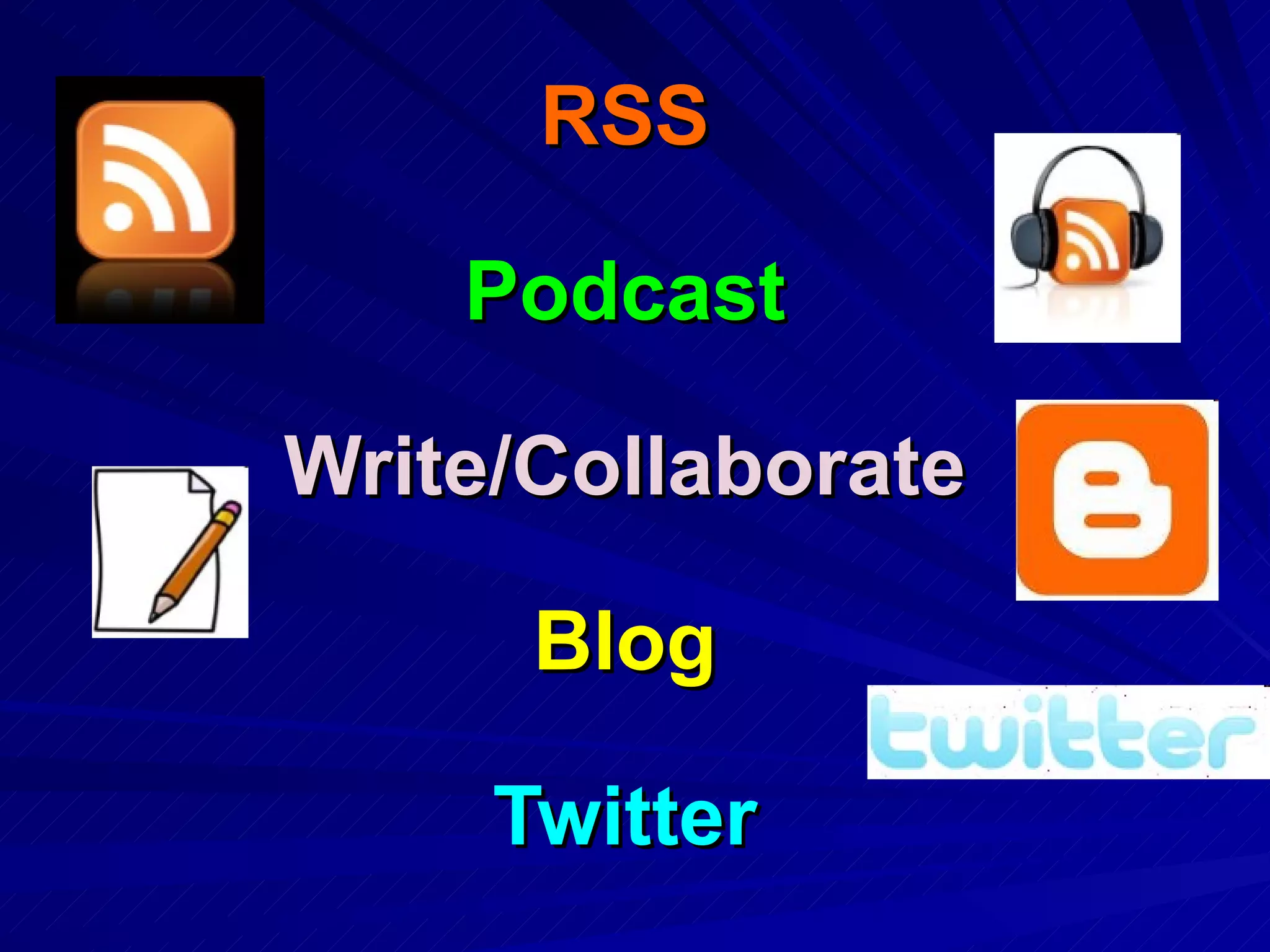
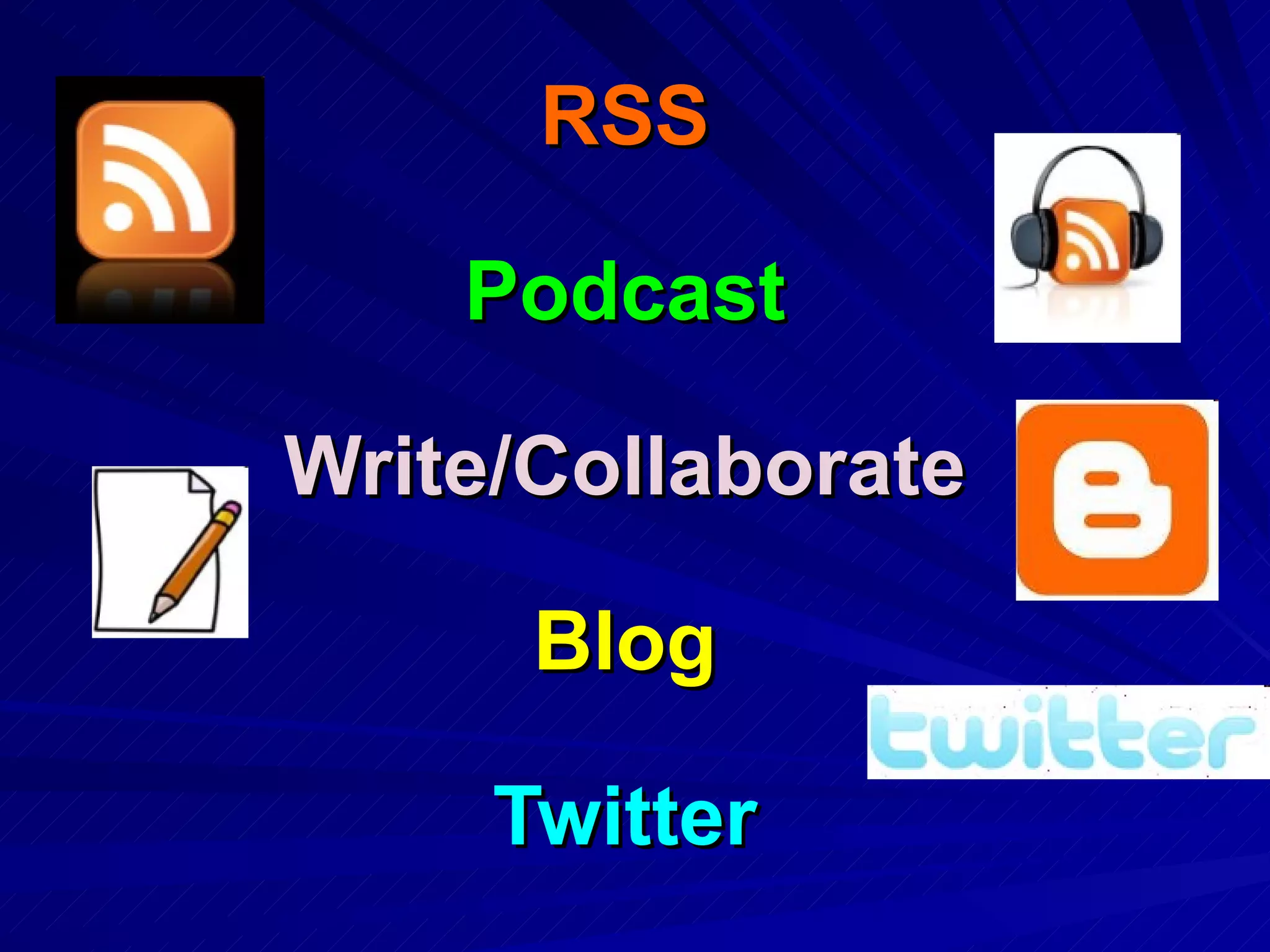
RSS Podcast Write/Collaborate Blog Twitter Social network - Facebook
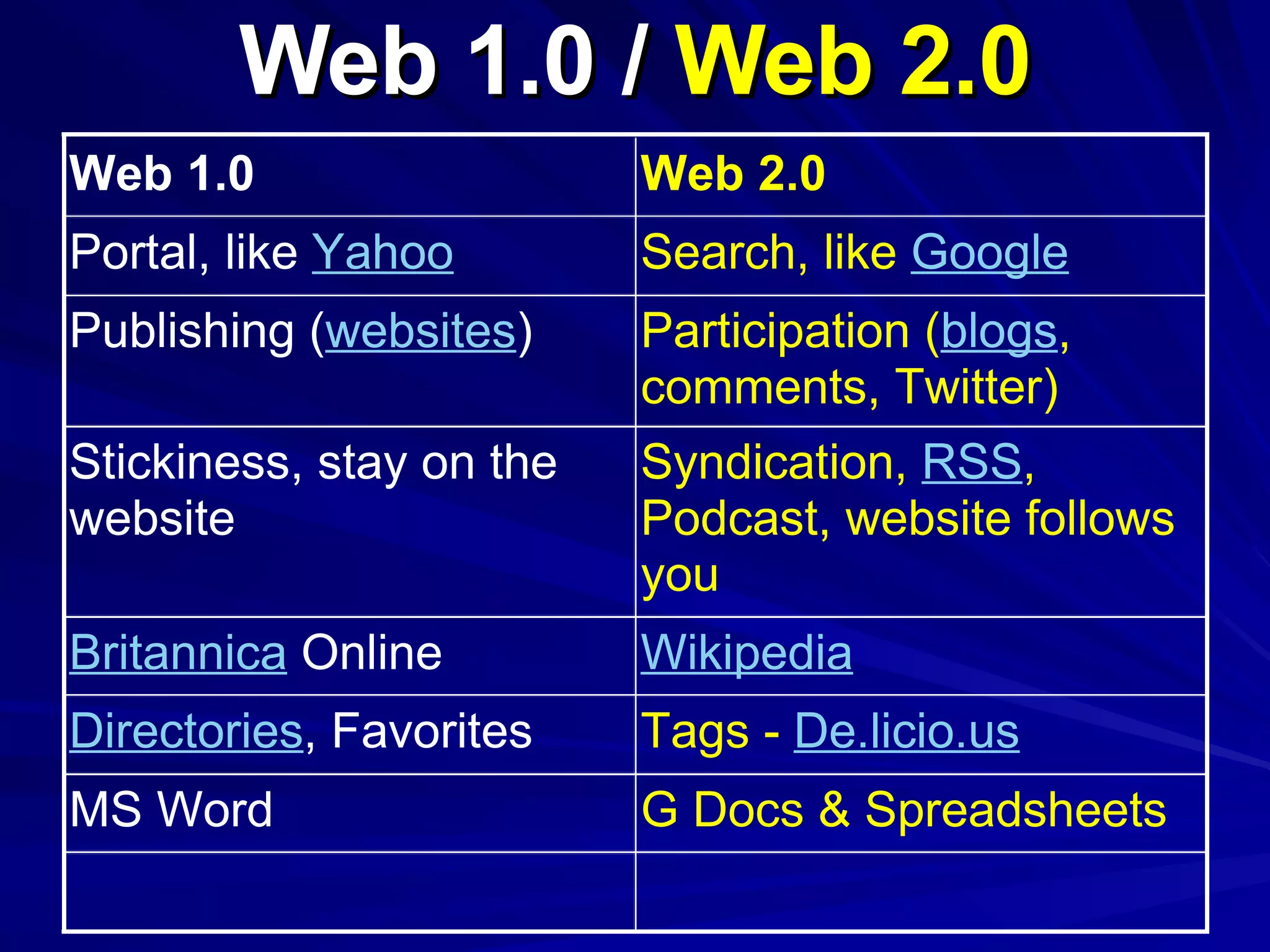
Web 1.0 /  Web 2.0 G Docs & Spreadsheets MS Word Tags -  De.licio.us Directories , Favorites  Wikipedia Britannica  Online  Syndication,  RSS , Podcast, website follows you Stickiness, stay on the website  Participation ( blogs , comments, Twitter) Publishing ( websites )  Search, like  Google Portal, like  Yahoo Web 2.0 Web 1.0 
Why should I care about Web 2.0?
Where is my place in all that? Everybody is busy Web 2.0 saves time by helping you get exactly the information you are interested in Blogs and Twitter let you create content and share it with others – this is content created FOR the user BY the user
How can I use Web 2.0?
RSS Podcast Write/Collaborate Blog Twitter Social network - Facebook
RSS
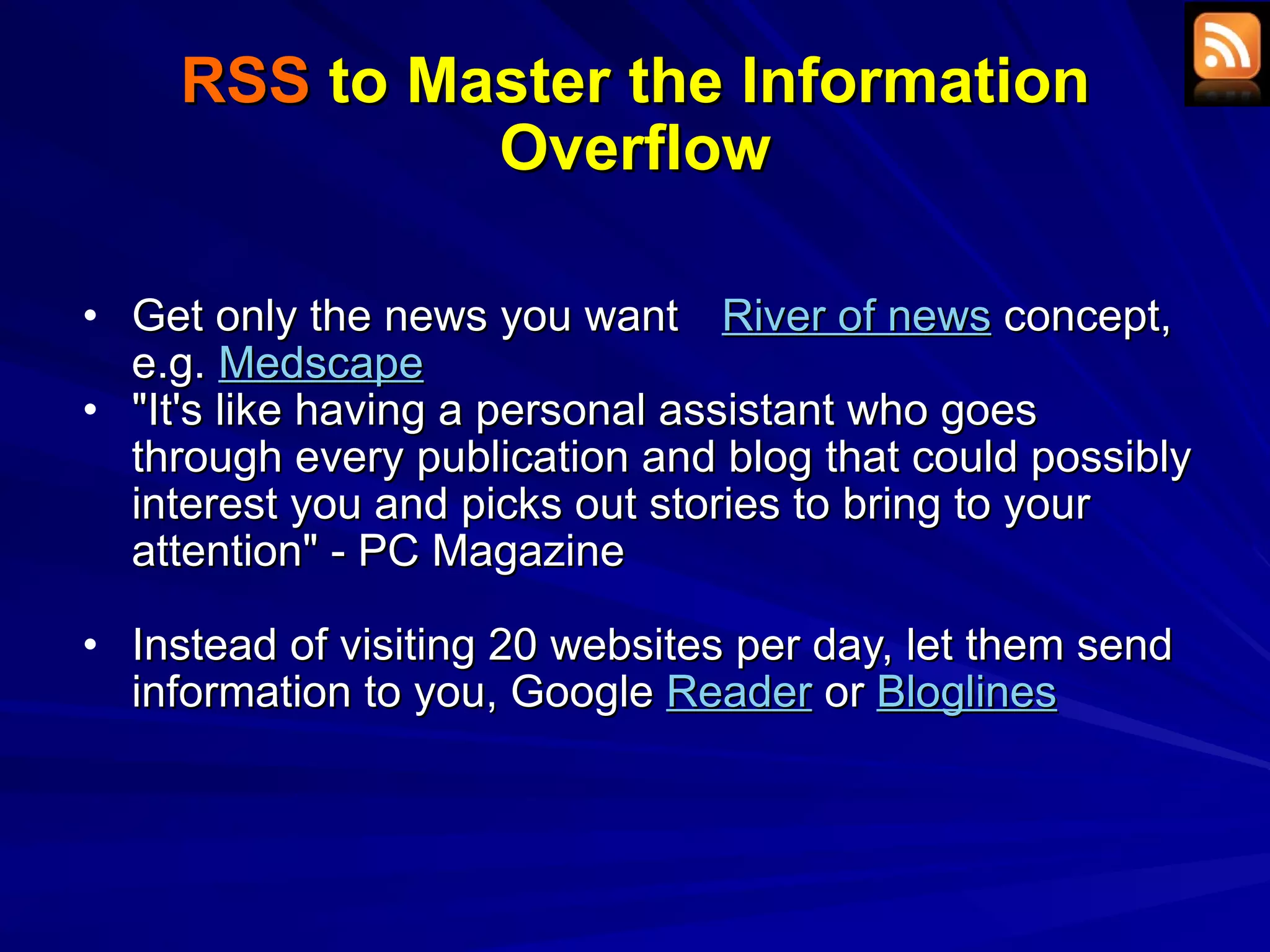
What is  RSS ? RSS  =  R eally  S imple  S yndication A hybrid between a personal assistant and your “inbox for the web”
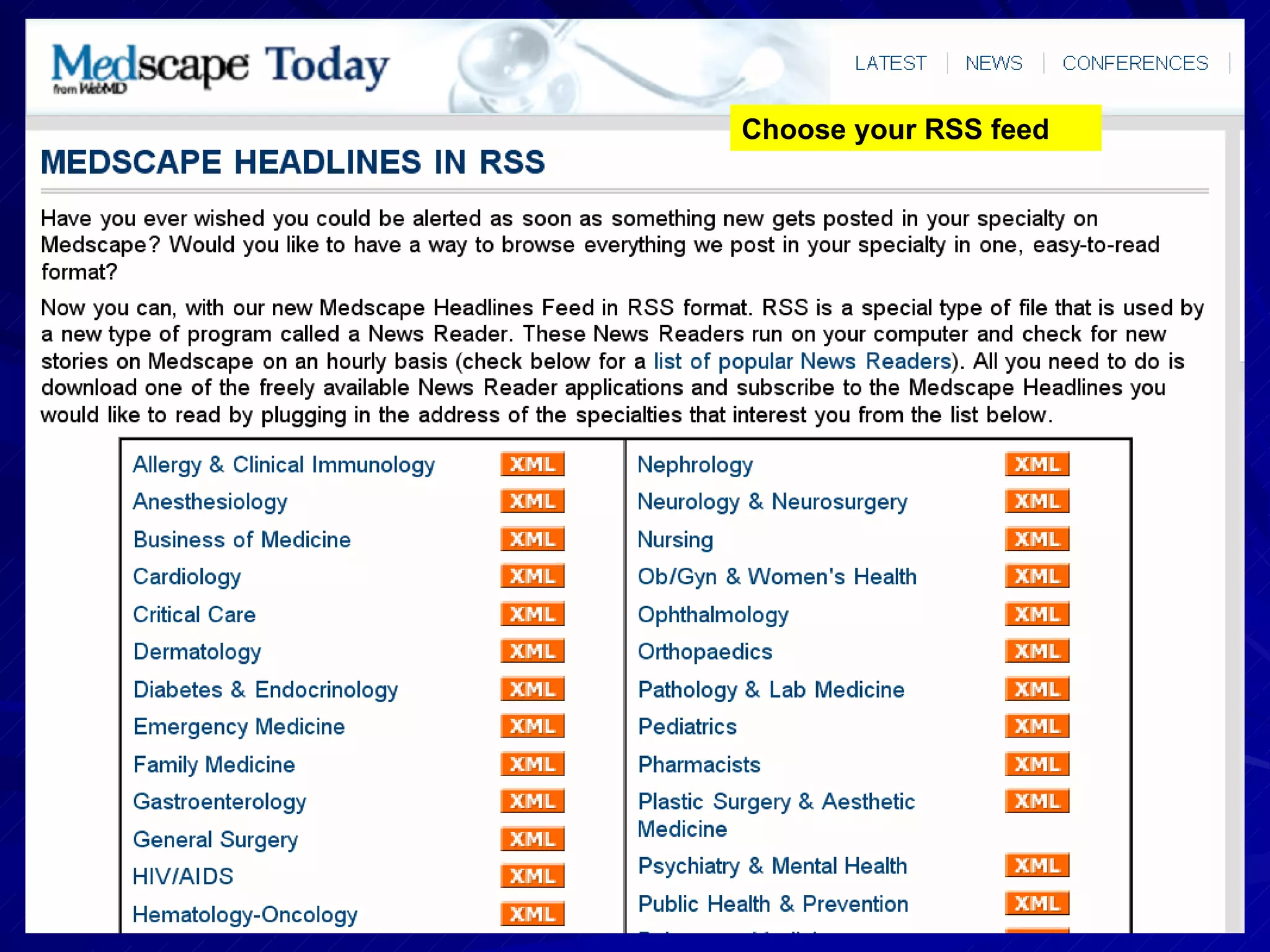
RSS  to Master the Information Overflow Get only the news you want  River of news  concept, e.g.  Medscape "It's like having a personal assistant who goes through every publication and blog that could possibly interest you and picks out stories to bring to your attention" - PC Magazine Instead of visiting 20 websites per day, let them send information to you, Google  Reader  or  Bloglines
Choose your RSS feed
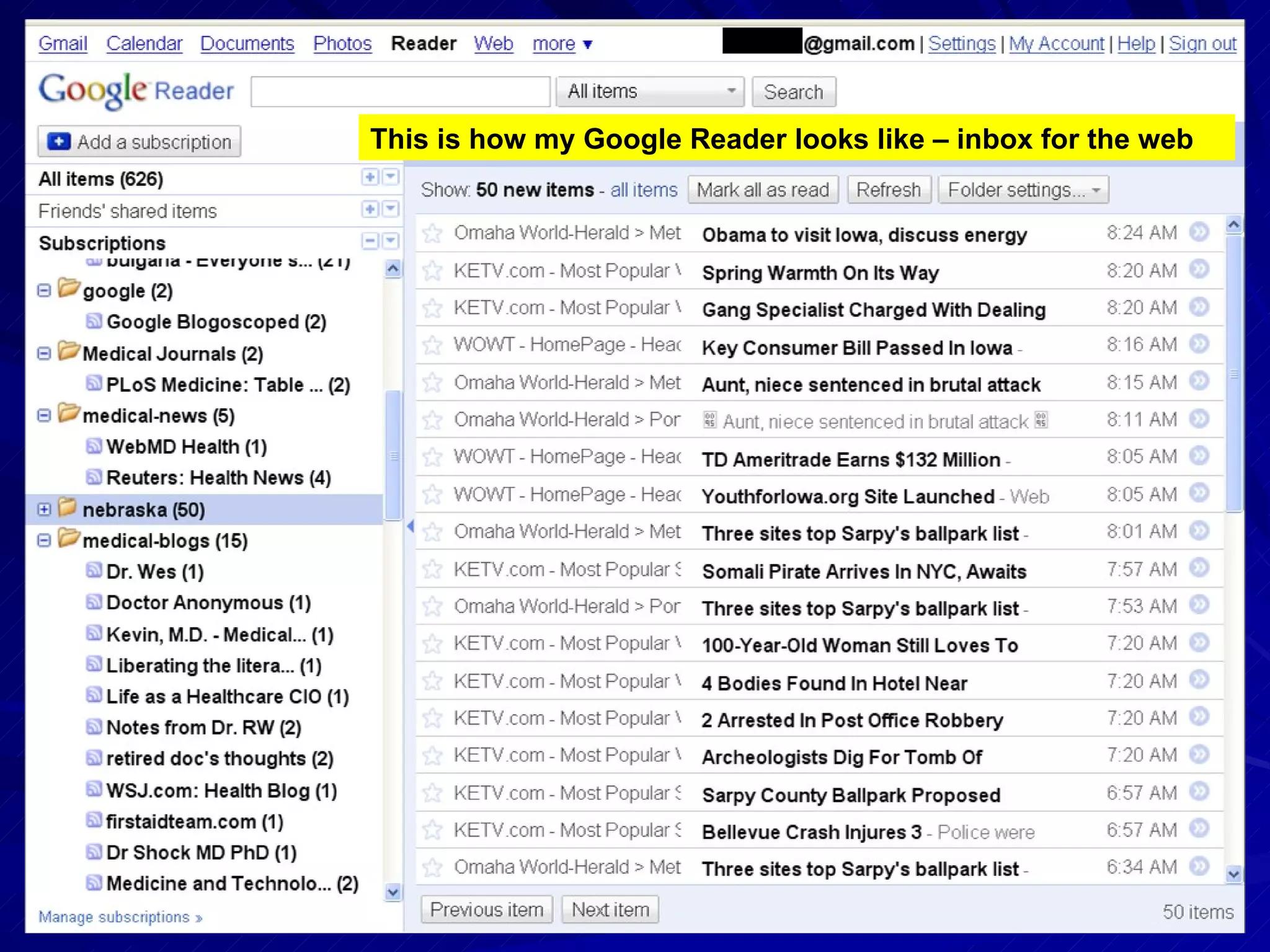
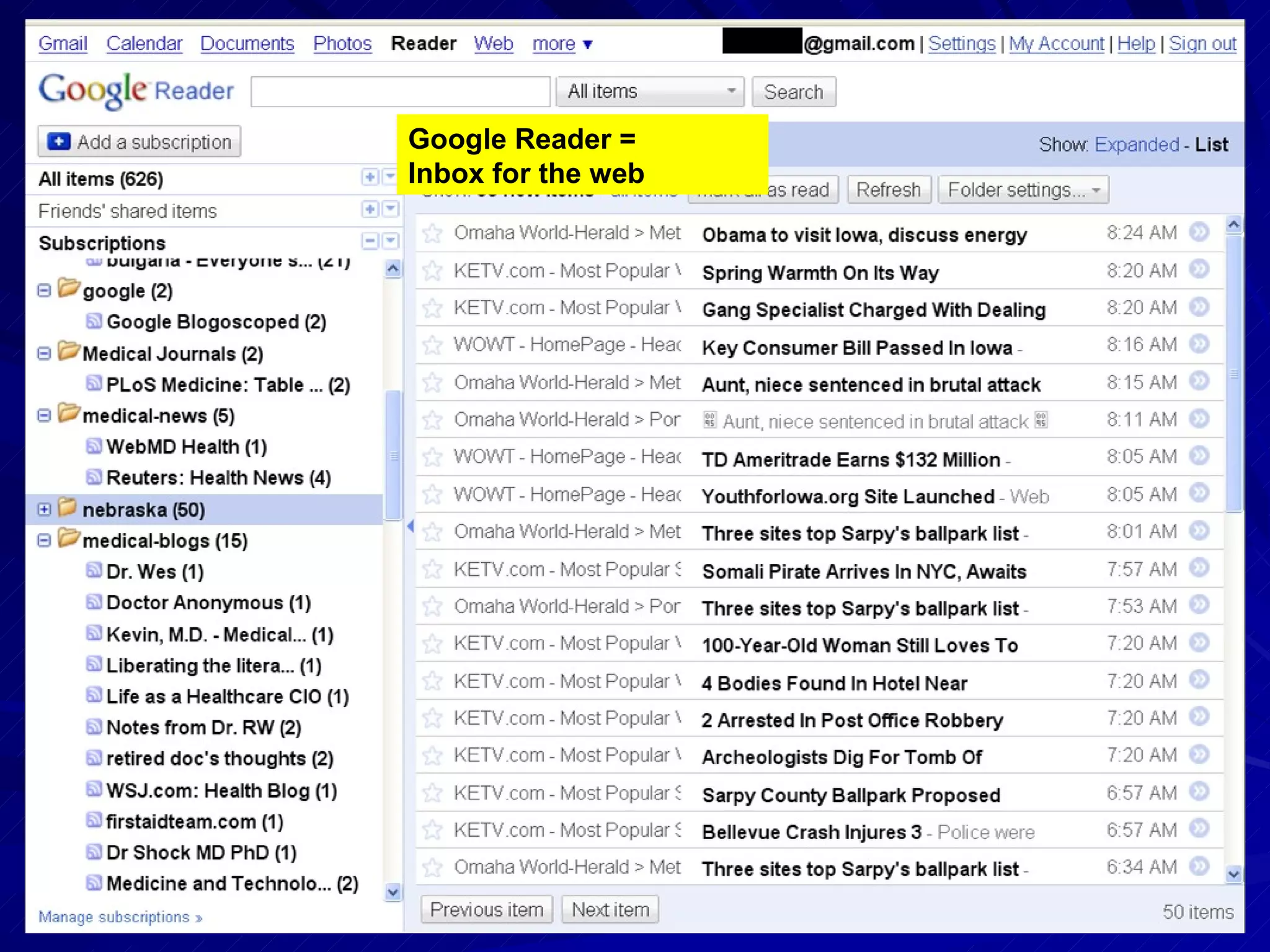
This is how my Google Reader looks like – inbox for the web
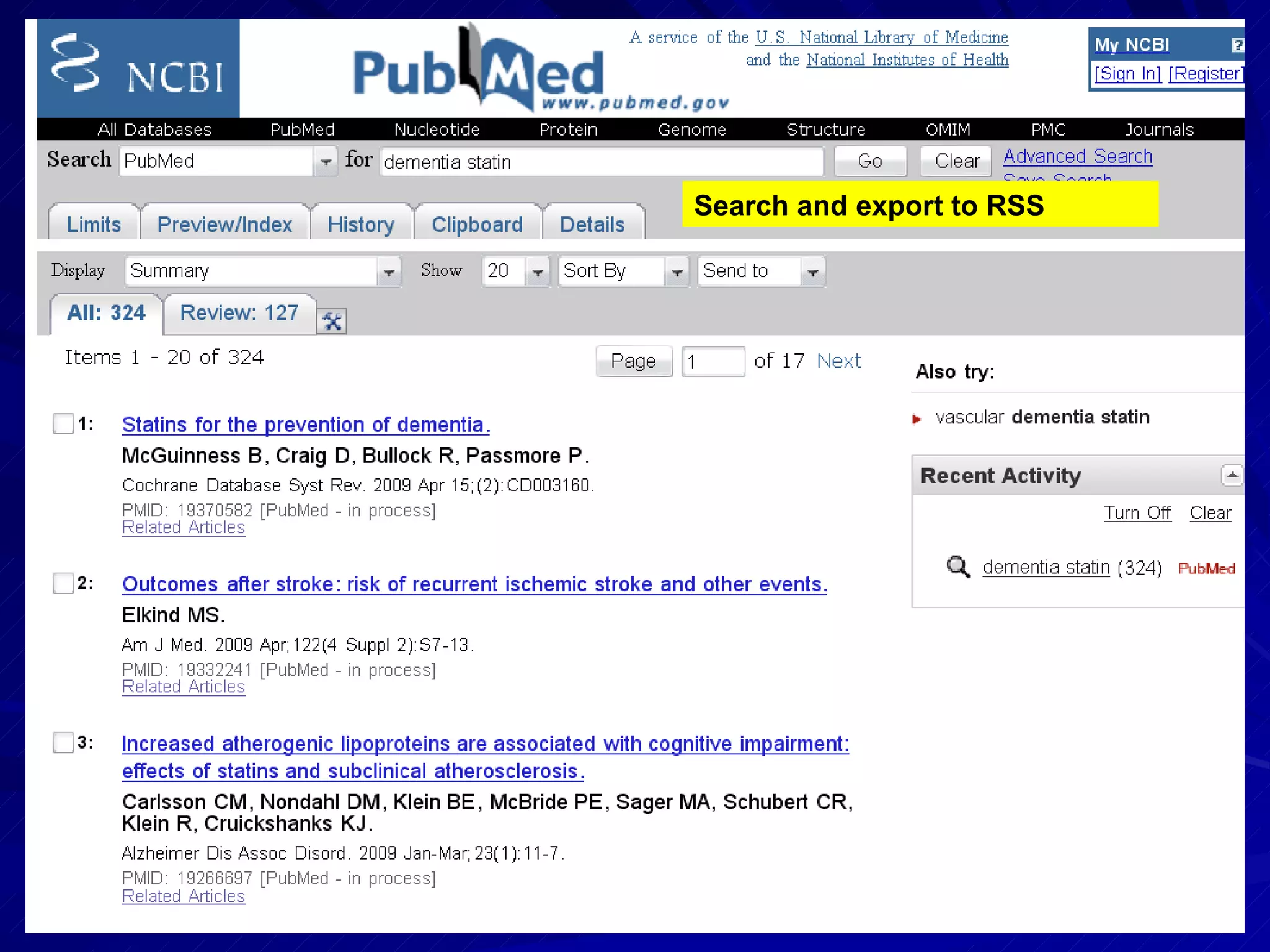
RSS S ubscribe to specific searches on  Pubmed  (e.g. statins and dementia), or any search engine and collect them in one place S ubscribe to the  major medical journals  RSS feeds
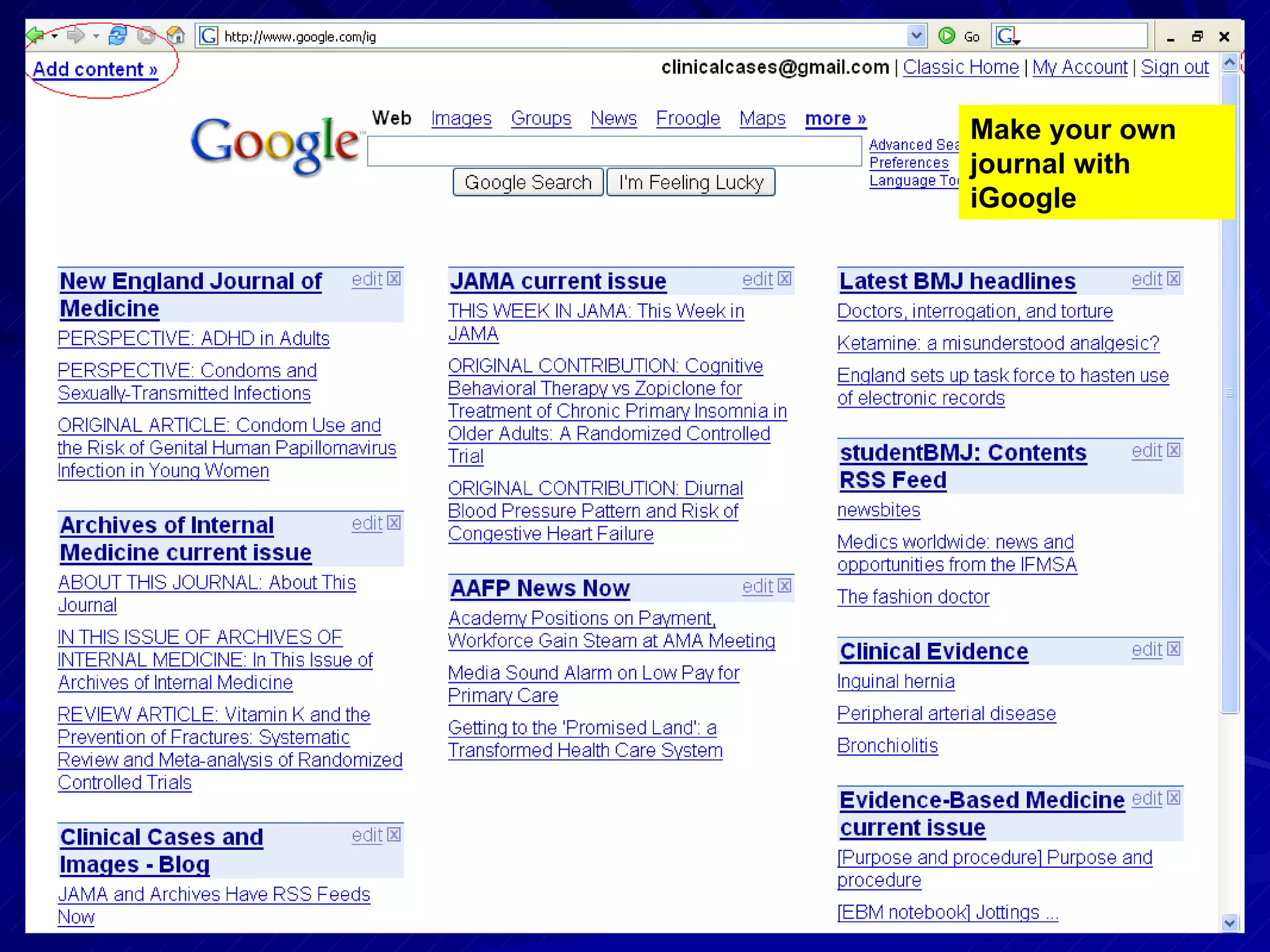
Make your own “medical journal” Combine RSS feeds from the journals you read into one easy-to-scan page Use iGoogle or other aggregators
Make your own journal with iGoogle
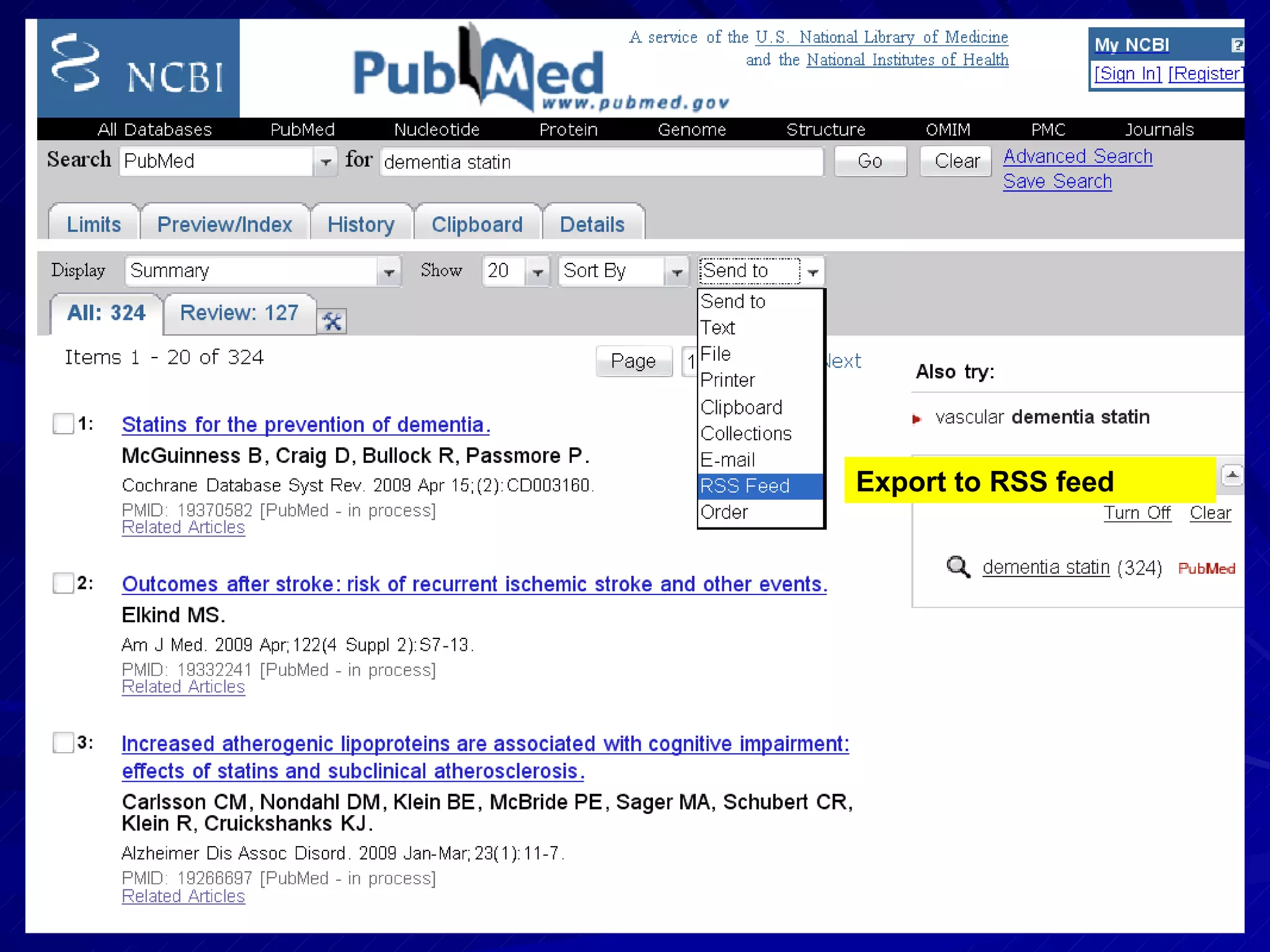
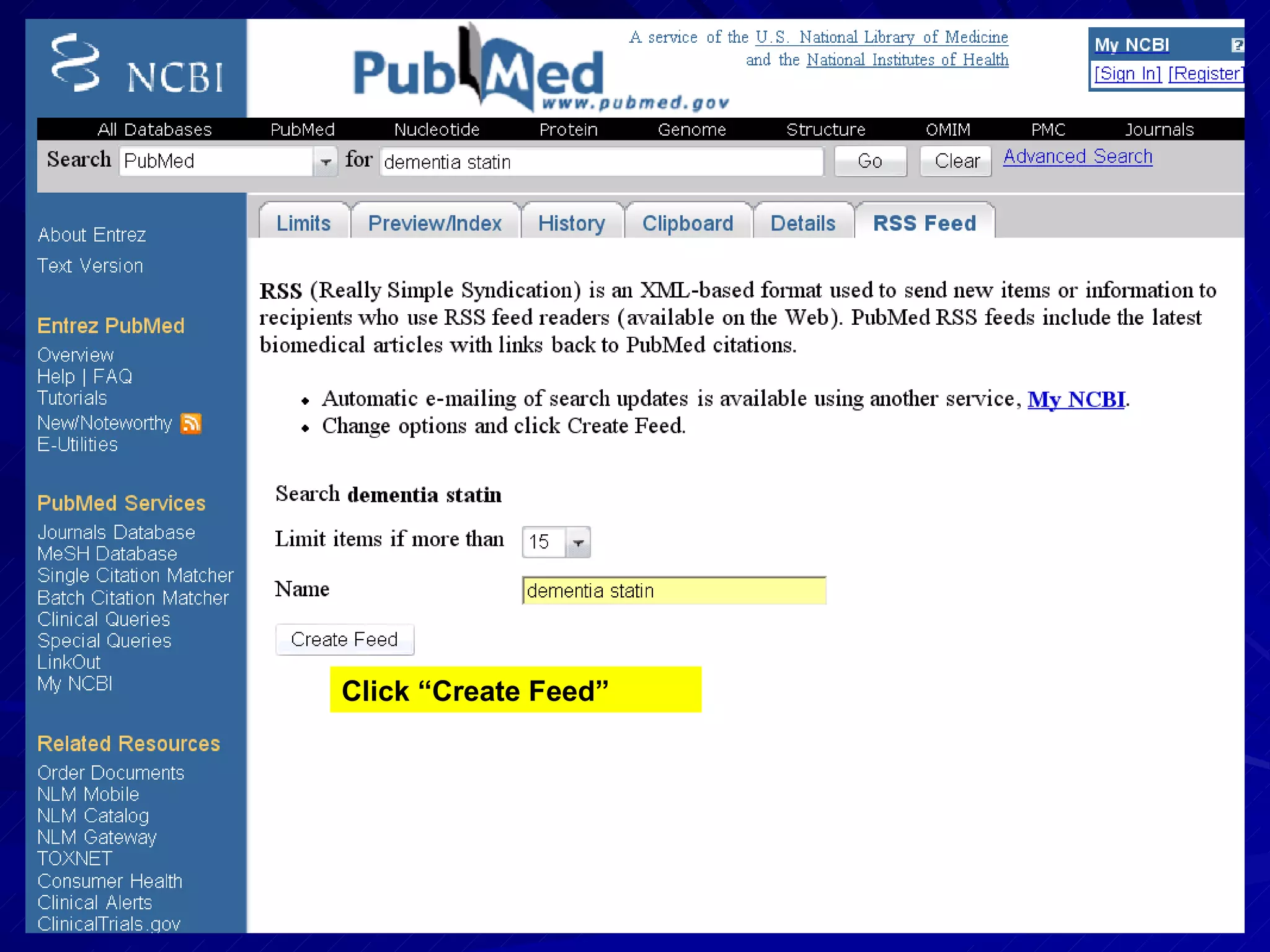
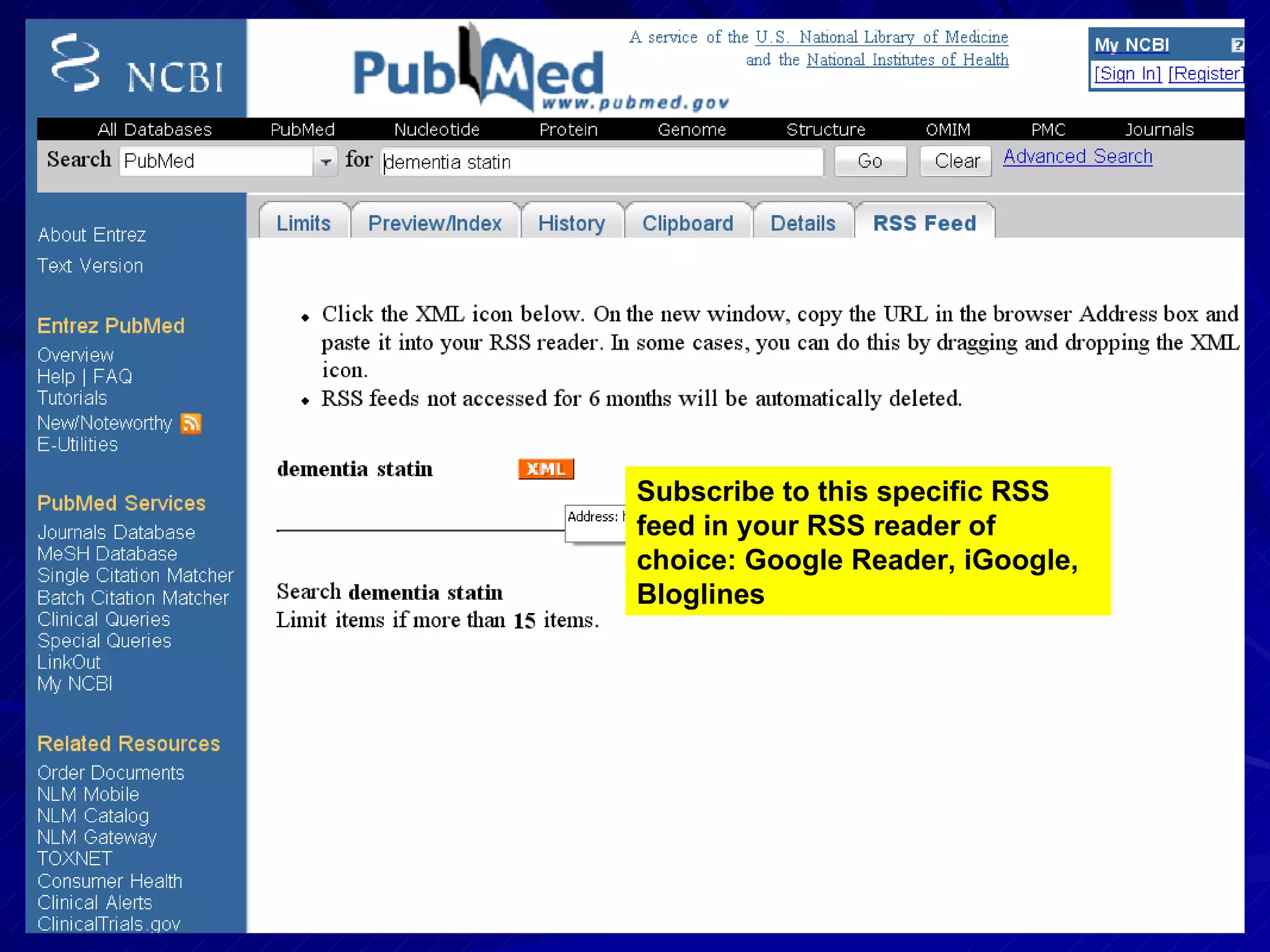
PubMed and RSS Why and how to do use it?
Search and export to RSS
Export to RSS feed
Click “Create Feed”
Subscribe to this specific RSS feed in your RSS reader of choice: Google Reader, iGoogle, Bloglines
RSS = Inbox for the Web RSS  is like you email “inbox for the web” Collects all the information you need in one place I rarely visit websites anymore despite following more than 350 sites a day RSS  reader is the central point
Google Reader =  Inbox for the web
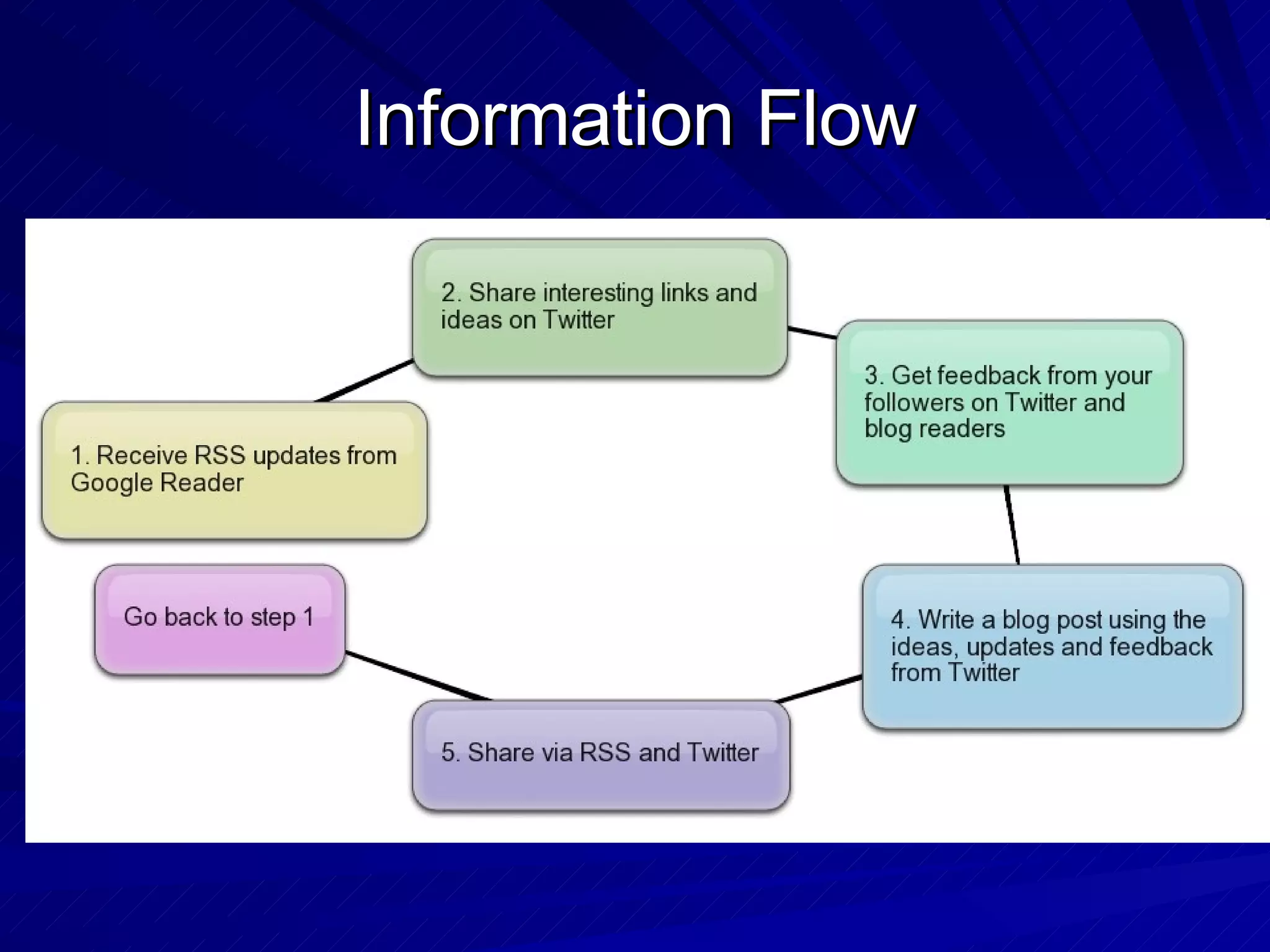
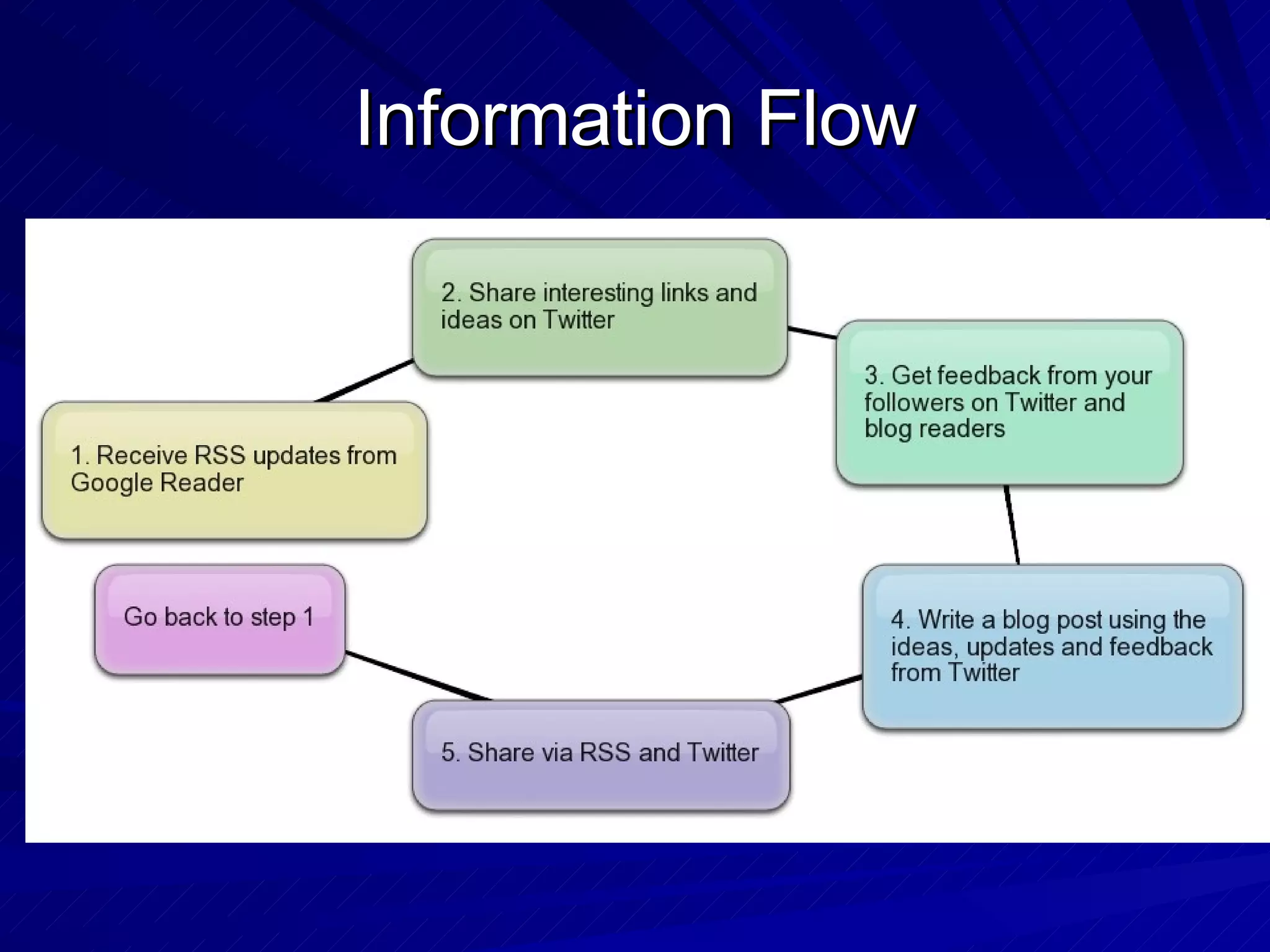
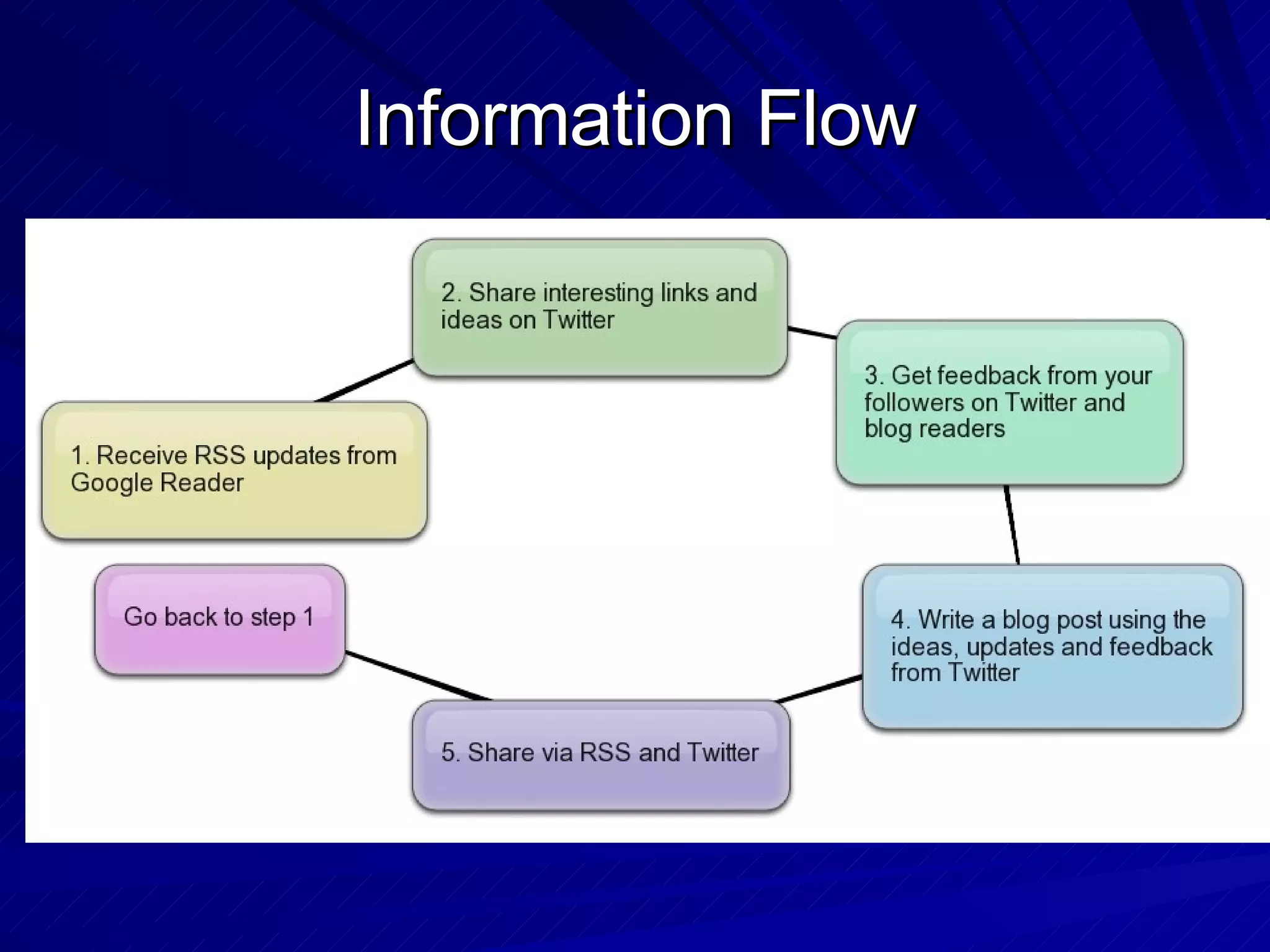
Information Flow
RSS Podcast Write/Collaborate Blog Twitter Social network - Facebook
Podcast
What is a podcast? Podcast  =  po rtable broad cast  (audio file) i Phone/iPod  file It’s portable, you can take it with you whenever you go
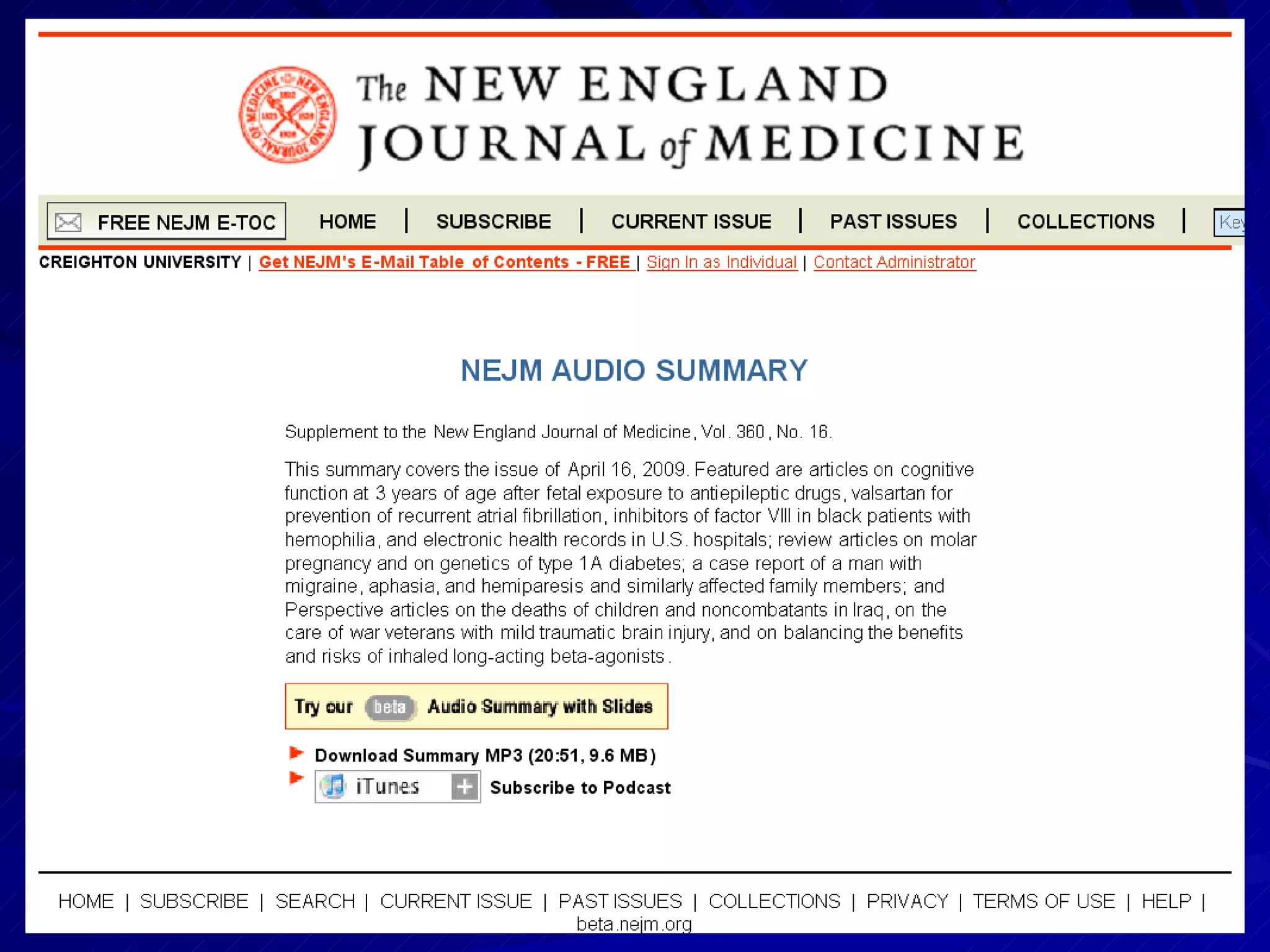
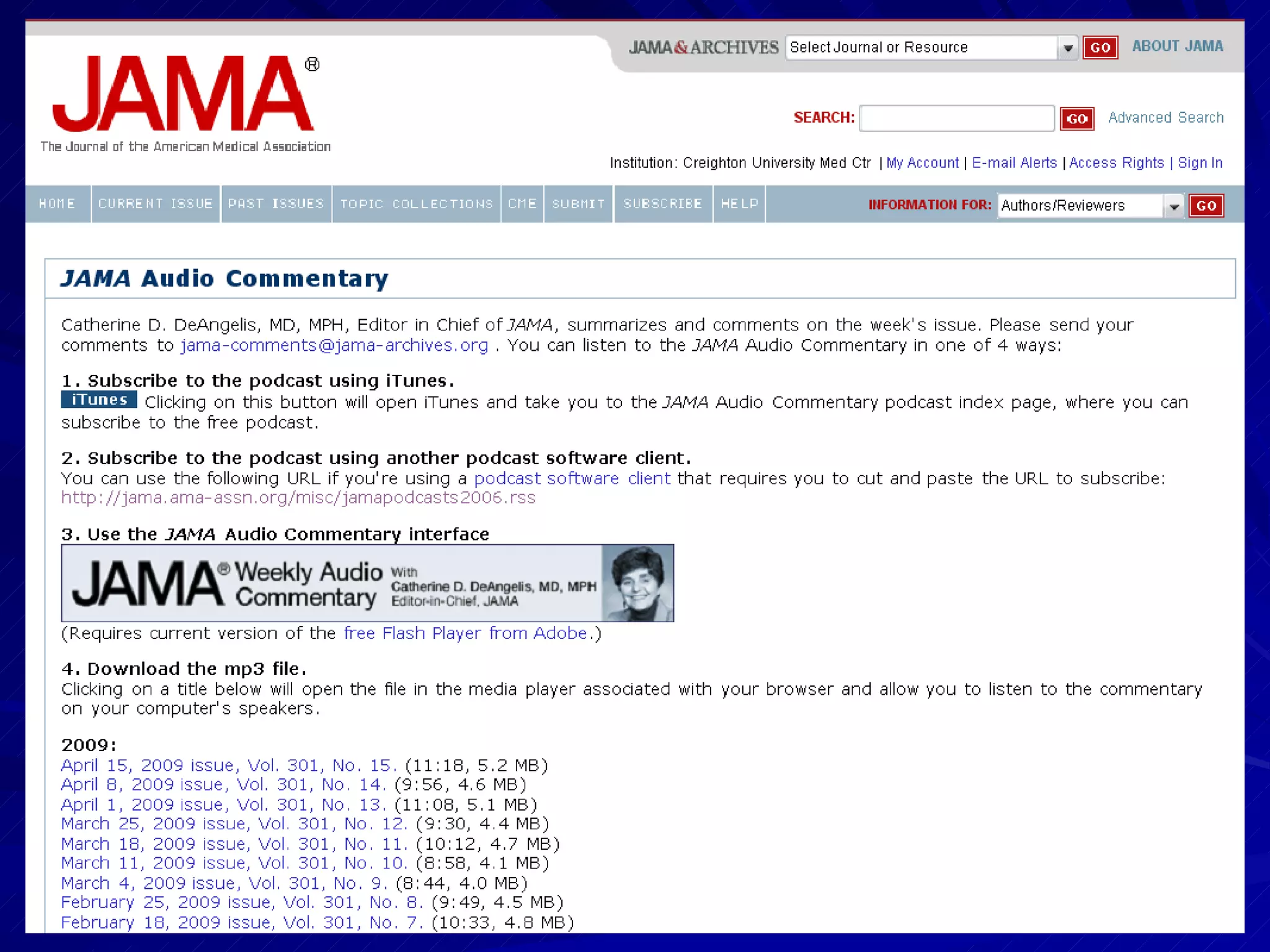
Podcast Podcast is a downloadable audio file. You can subscribe via  RSS Most major journals feature weekly  audio summary  of contents You can listen when you commute to work or exercise Make CME portable by using  text-to-speech
 
 
Videocast Same as podcast but with video Video lectures in your area of interest are available from iTubes
Top 5 Medical Podcasts ACC Conversations with Experts Johns Hopkins Medicine JAMA Audio Commentary NEJM This Week The Lancet
How to listen to podcasts? P P  odcast P  ortable audio P  C P  od, iPhone/iPod and iTunes
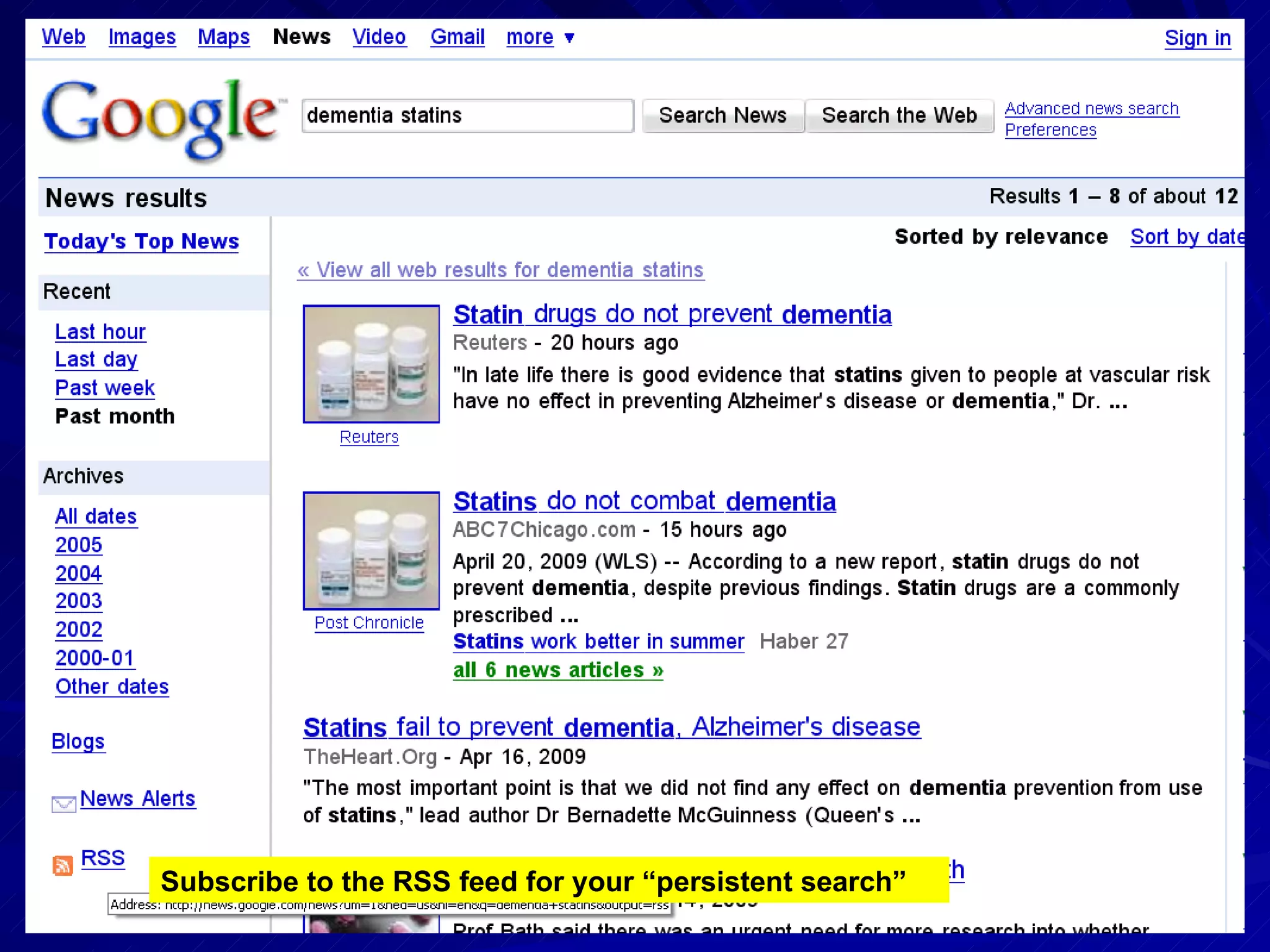
Persistent Search Set up a search query Get updated  any time something new is published about your search term
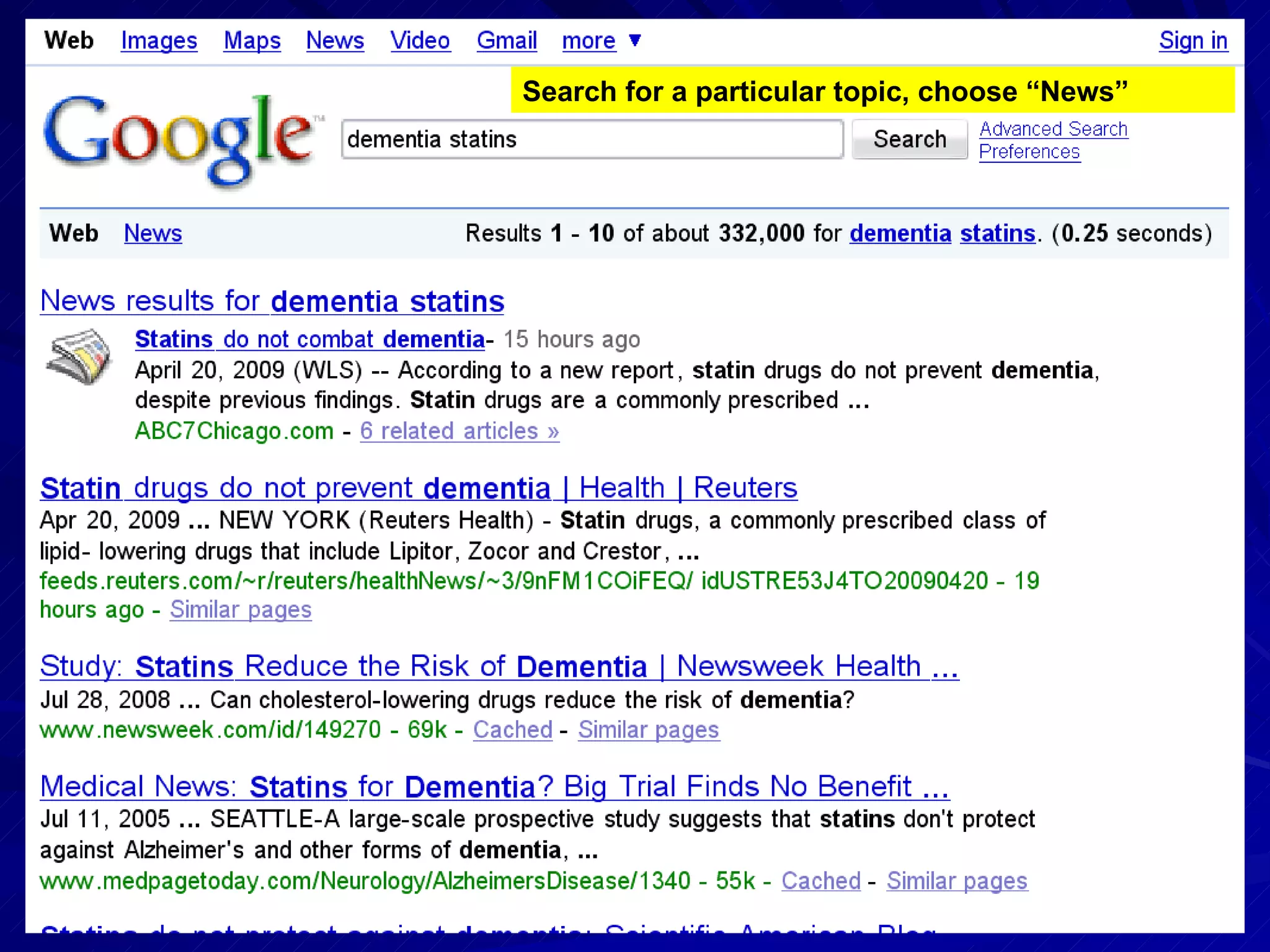
Search for a particular topic, choose “News”
Subscribe to the RSS feed for your “persistent search”
RSS Podcast Write/Collaborate Blog Twitter Social network - Facebook
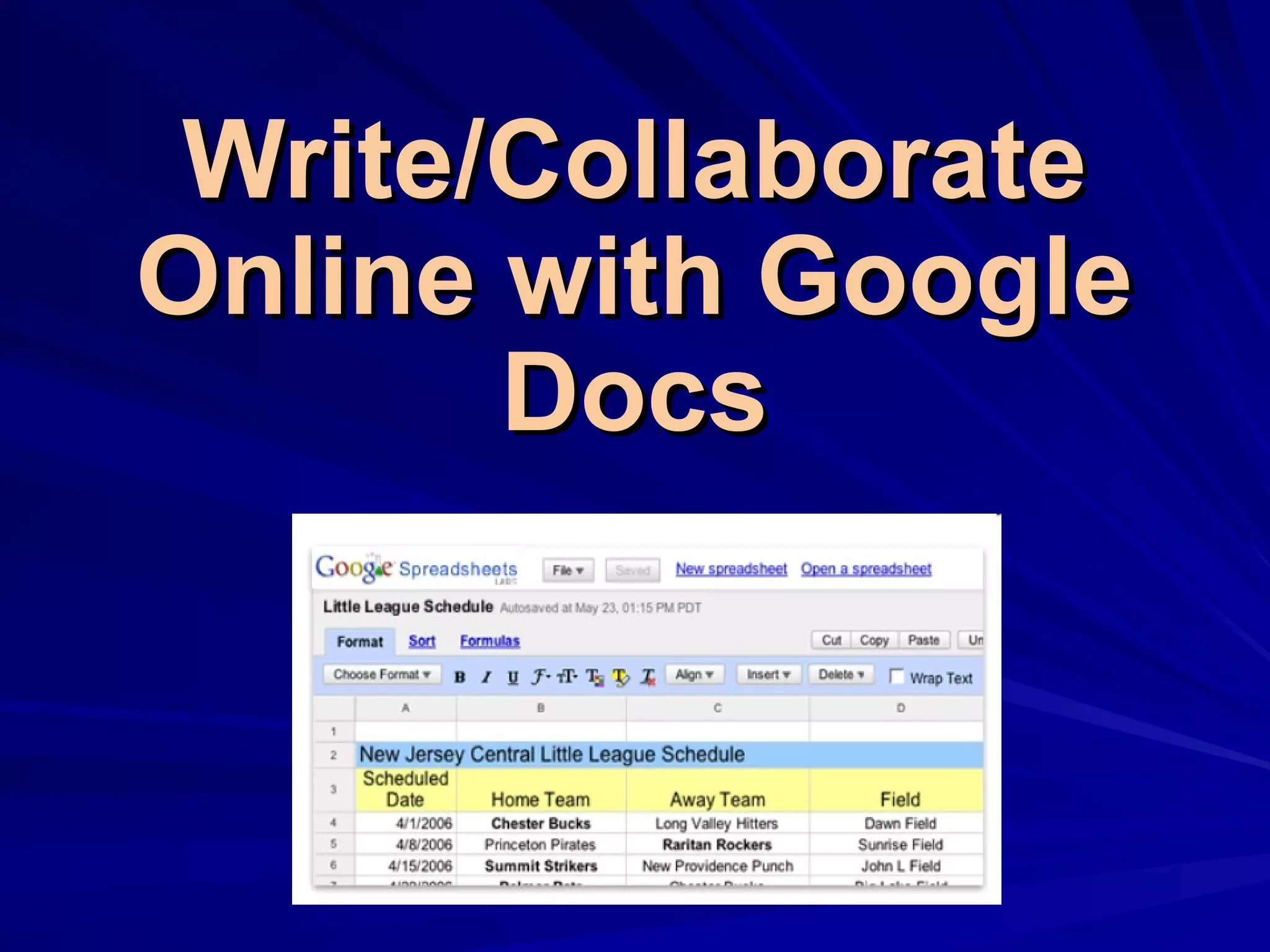
Write/Collaborate Online with Google Docs
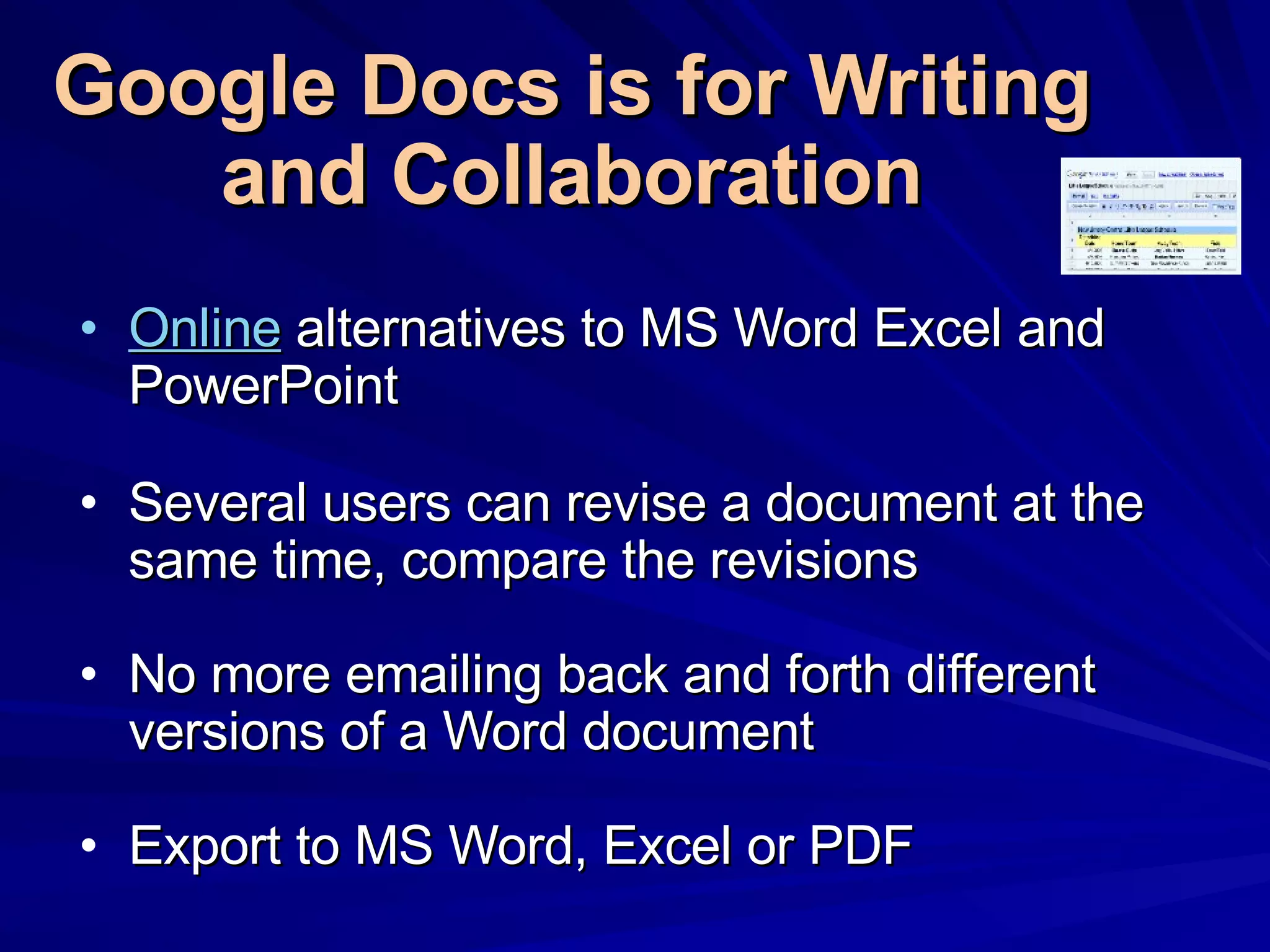
Google Docs   is for Writing and Collaboration Online  alternatives to MS Word Excel and PowerPoint  Several users can revise a document at the same time, compare the revisions No more emailing back and forth different versions of a Word document Export to MS Word, Excel or PDF
RSS Podcast Write/Collaborate Blog Twitter Social network - Facebook
Blog
What is a blog? Blog  = Web log Easy-to-make website
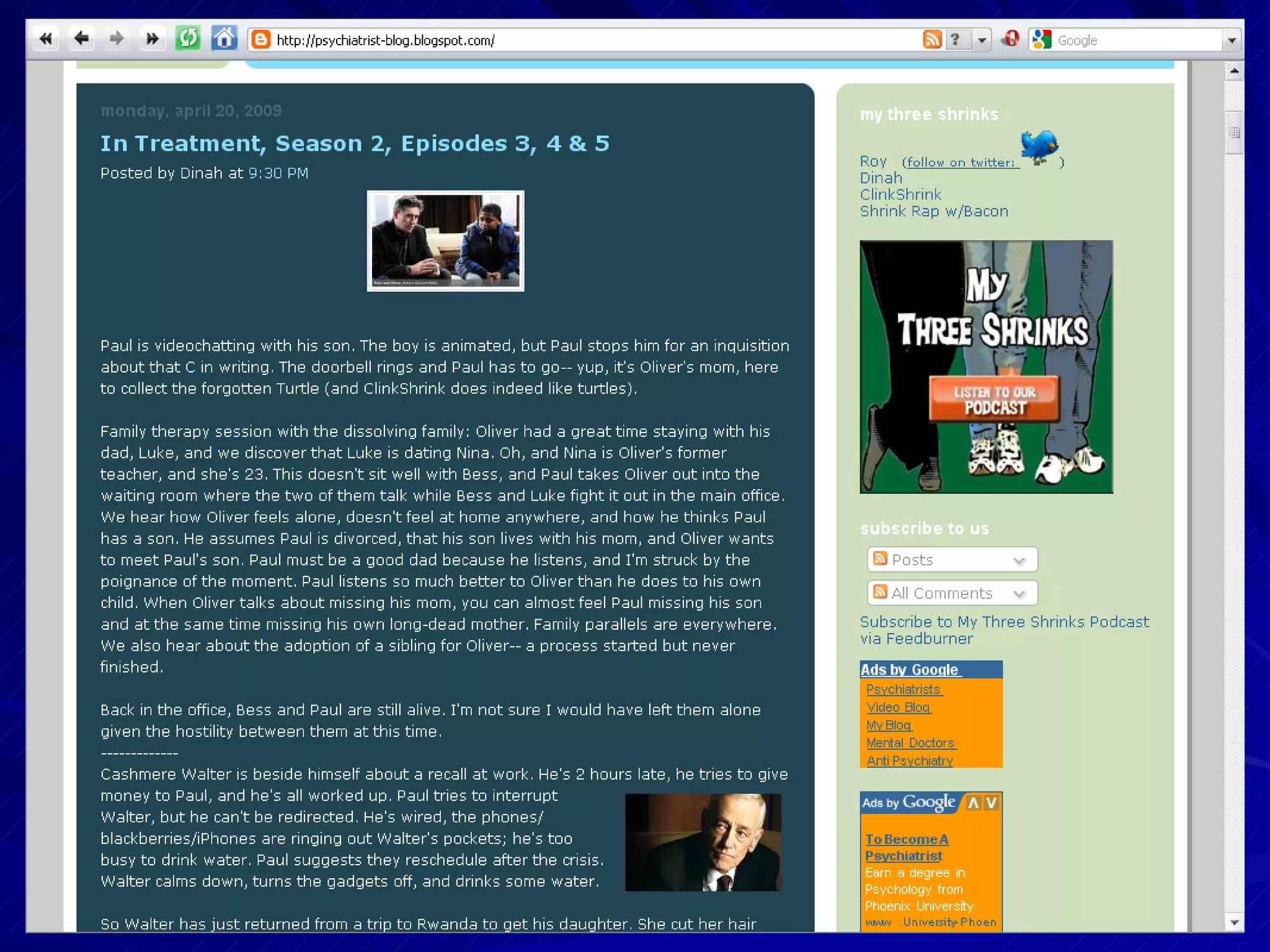
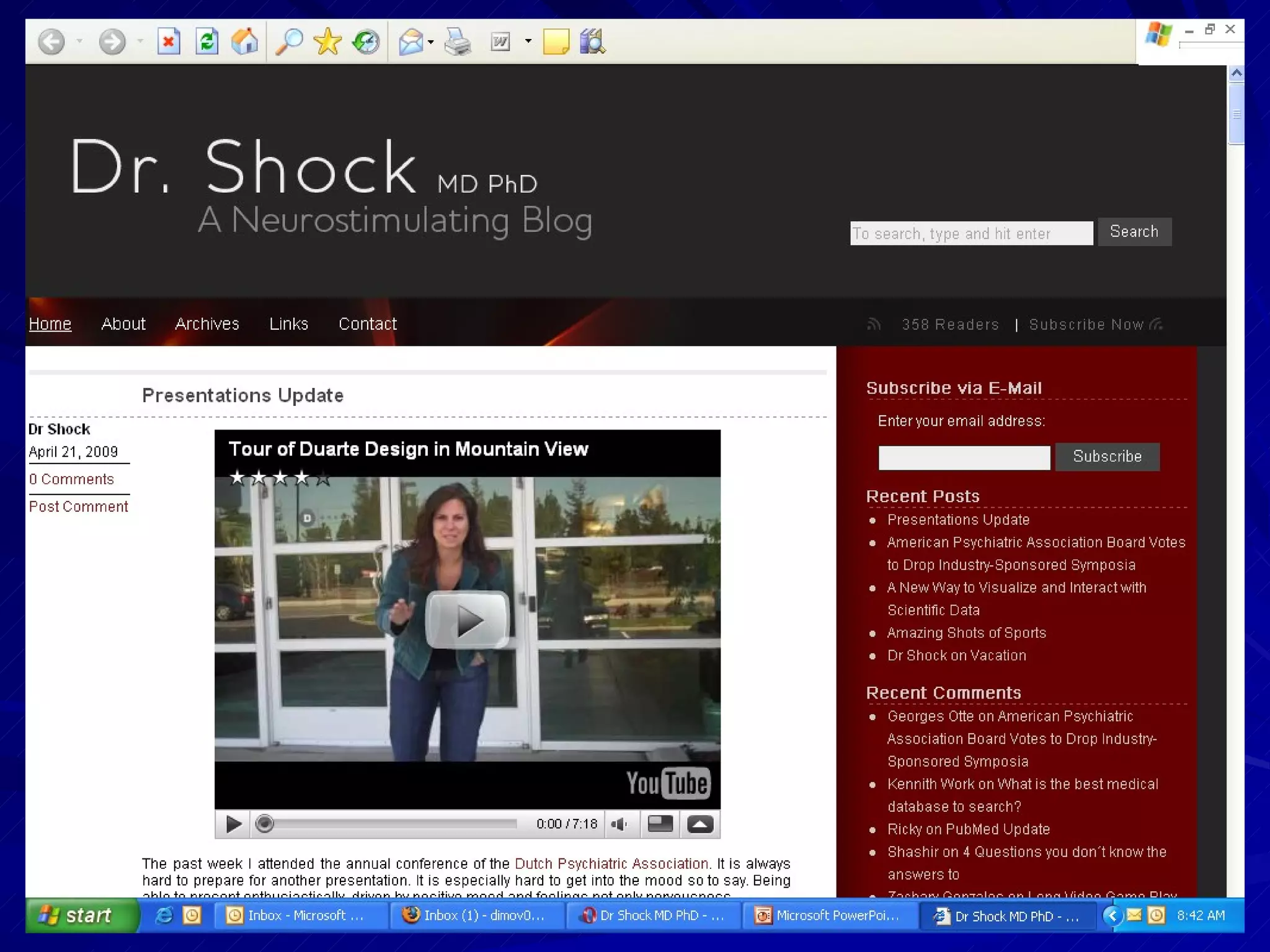
Find bloggers in your specialty For example: Psychiatry Shrink Rap - http://psychiatrist-blog.blogspot.com Dr. Shock -  http://www.shockmd.com Why am I Still Here? -  http://tinyshrink.blogspot.com PsychCentral - http://psychcentral.com/blog Dr. Sanity - http://drsanity.blogspot.com/
 
 
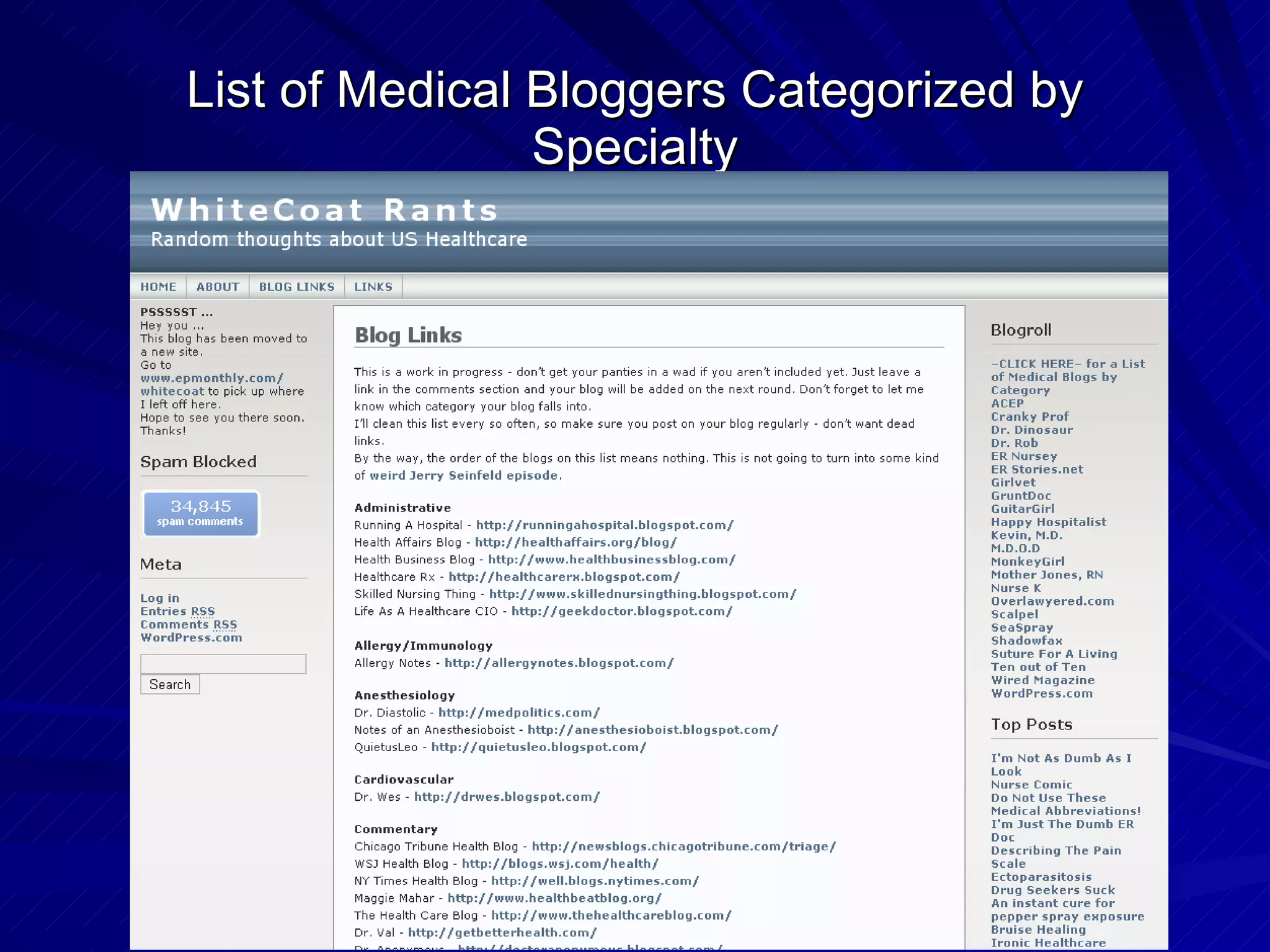
List of Medical Bloggers Categorized by Specialty
How to start a blog Web 2.0 = Give the power back to the user It’s not difficult at all Creating a website is as easy as opening an email account Maintaining a website is even easier
How easy? Google’s  Blogger  claims that it takes 5 minutes to start a website The NY Times gave it a try and it took them 4 minutes
How can I make a website? Google  Blogger.com   WordPress.com
What about those bloggers? Blogging can’t be serious, right? Right They may not be serious but they get millions of visitors
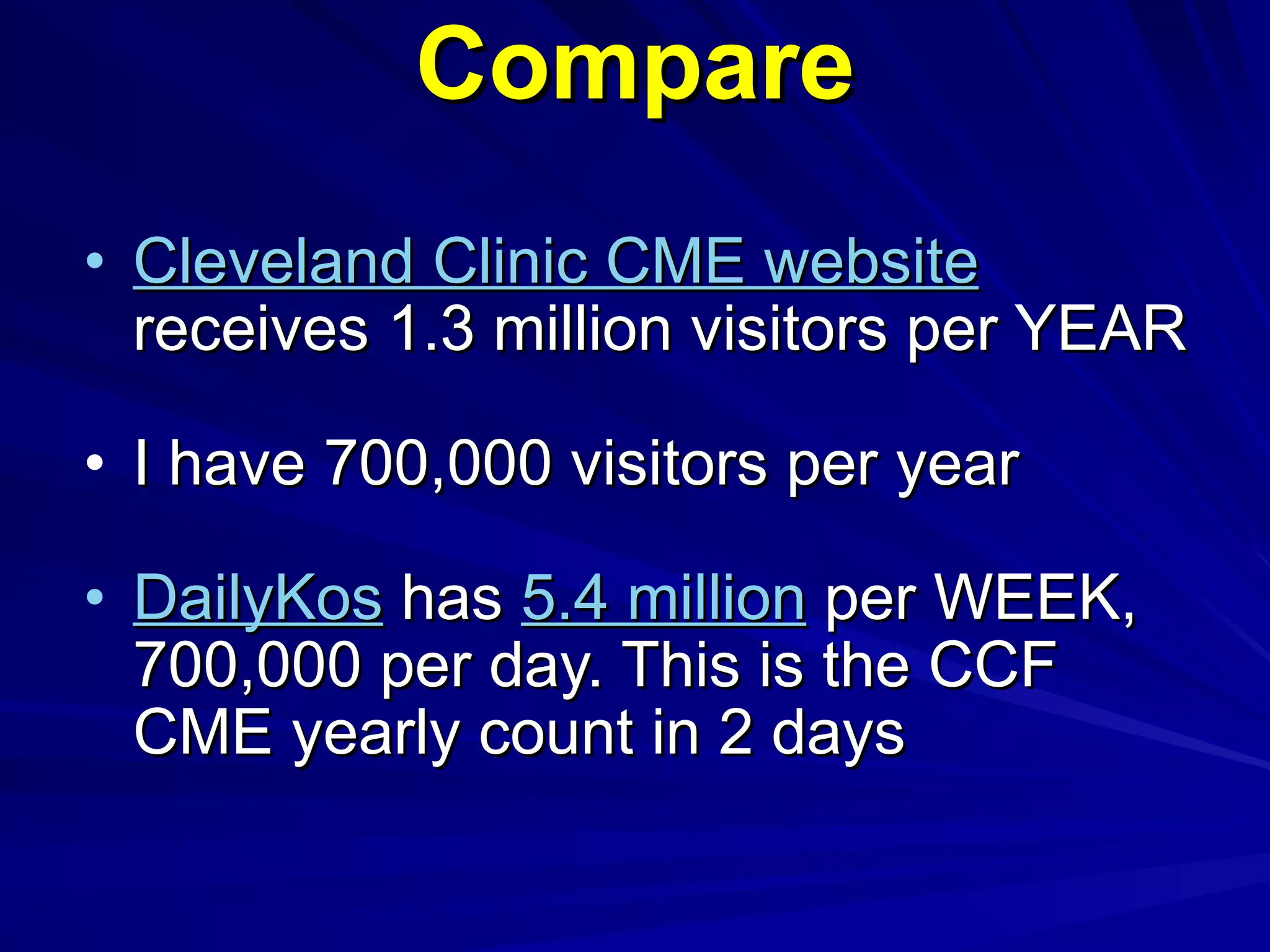
Compare Cleveland Clinic CME website  receives 1.3 million visitors per YEAR I have 700,000 visitors per year DailyKos  has  5.4 million  per WEEK, 700,000 per day. This is the CCF CME yearly count in 2 days
More than 3 million page views since 2005
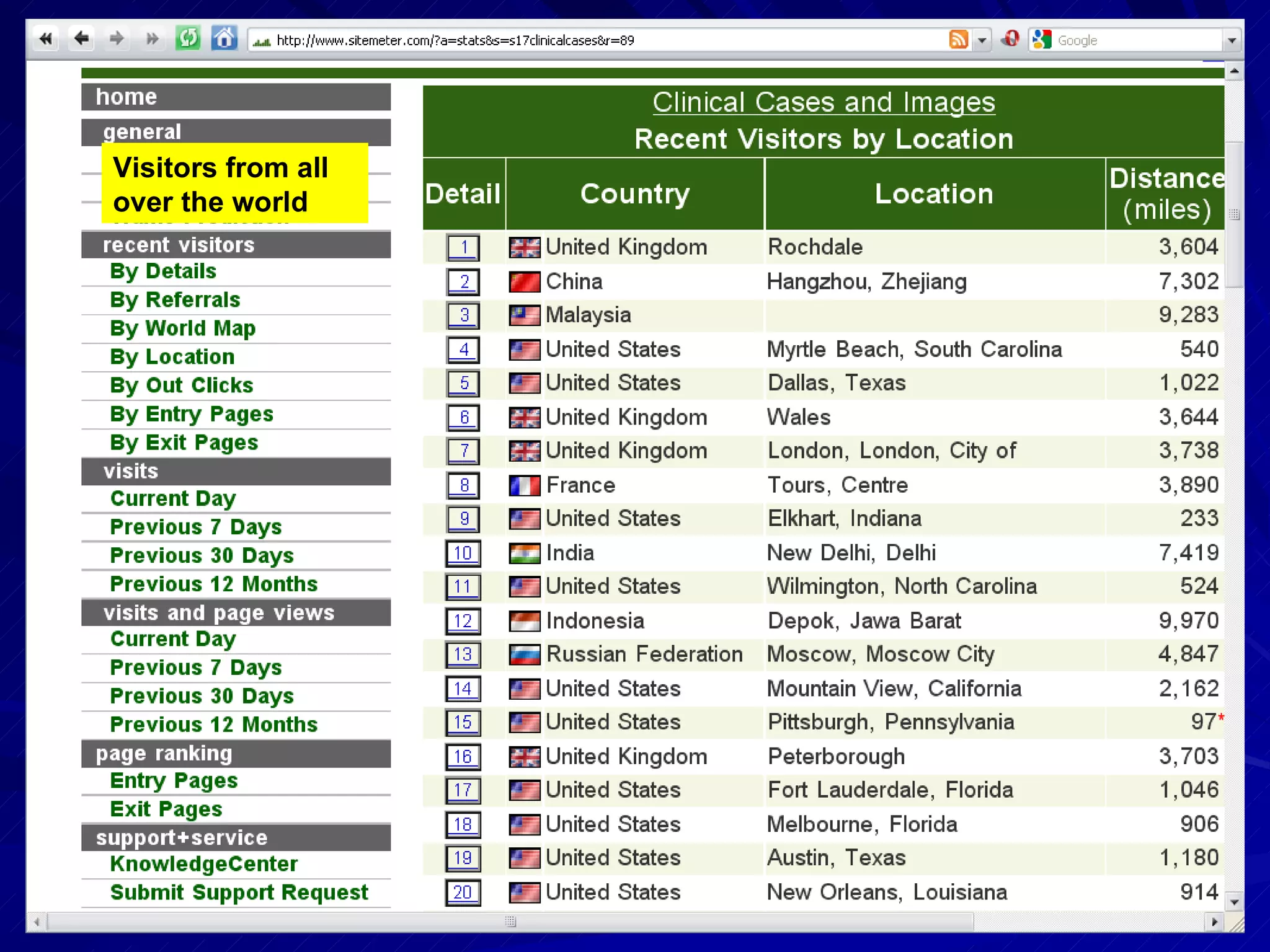
Visitors from all over the world
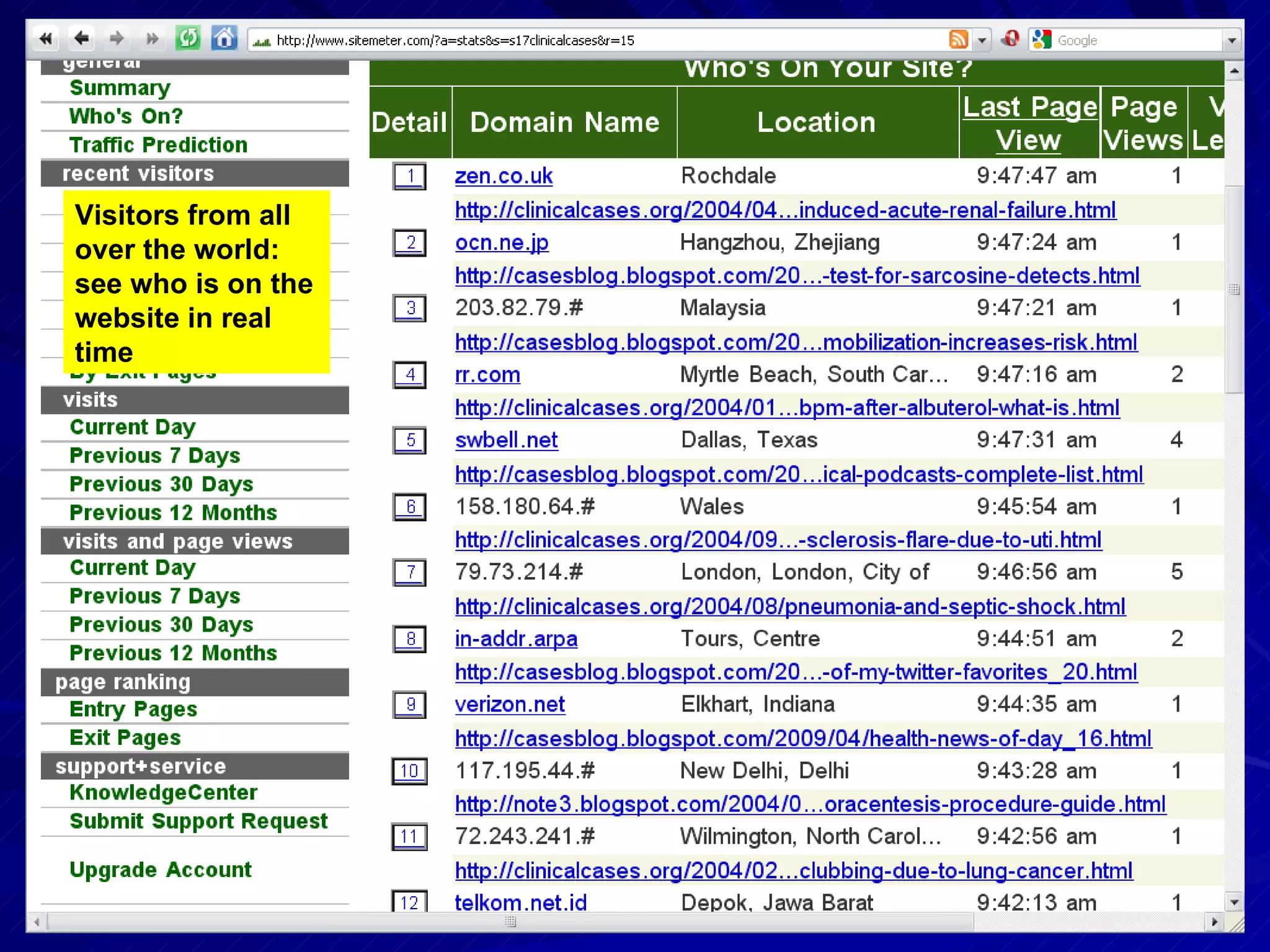
Visitors from all over the world: see who is on the website in real time
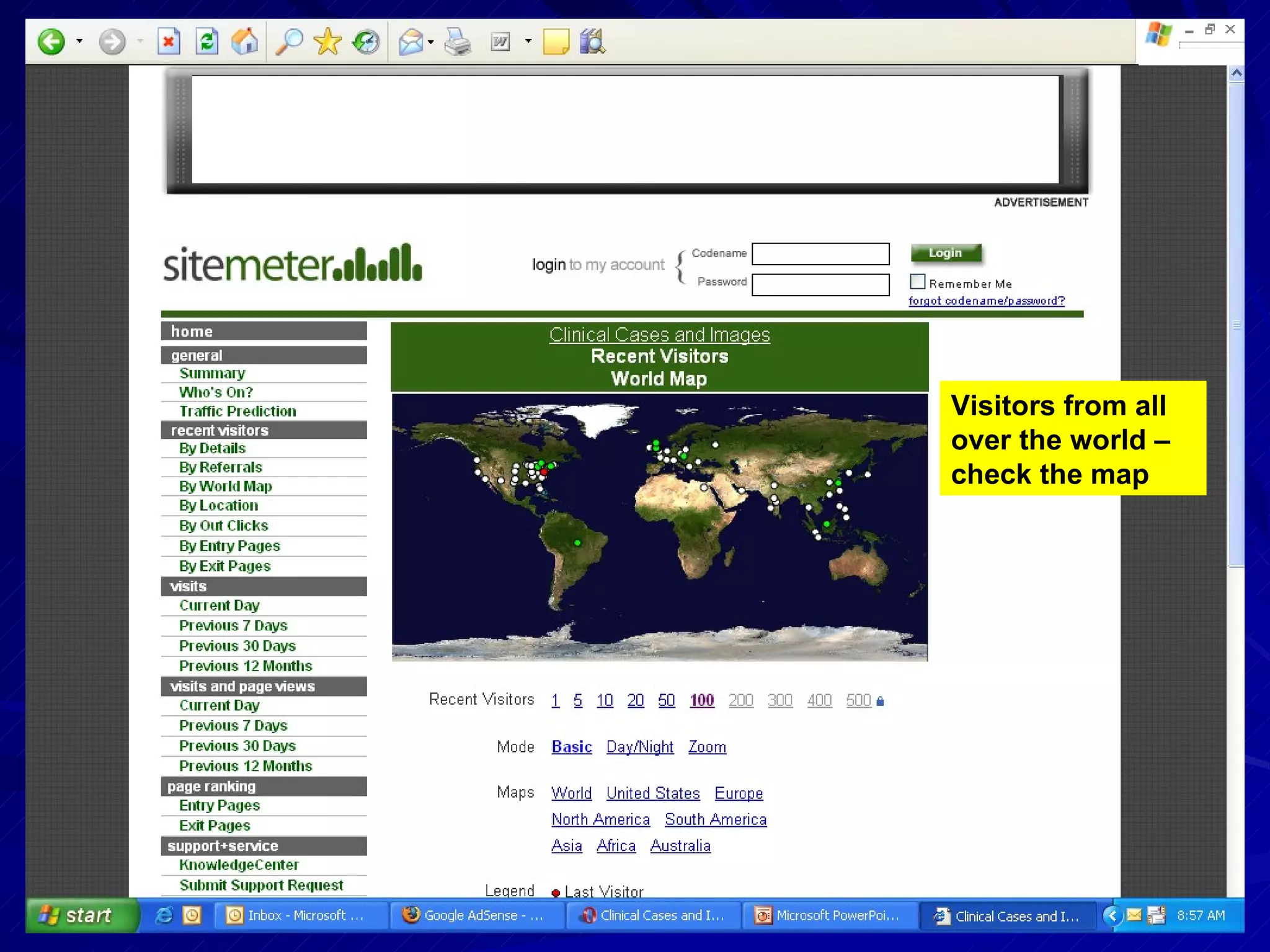
Visitors from all over the world – check the map
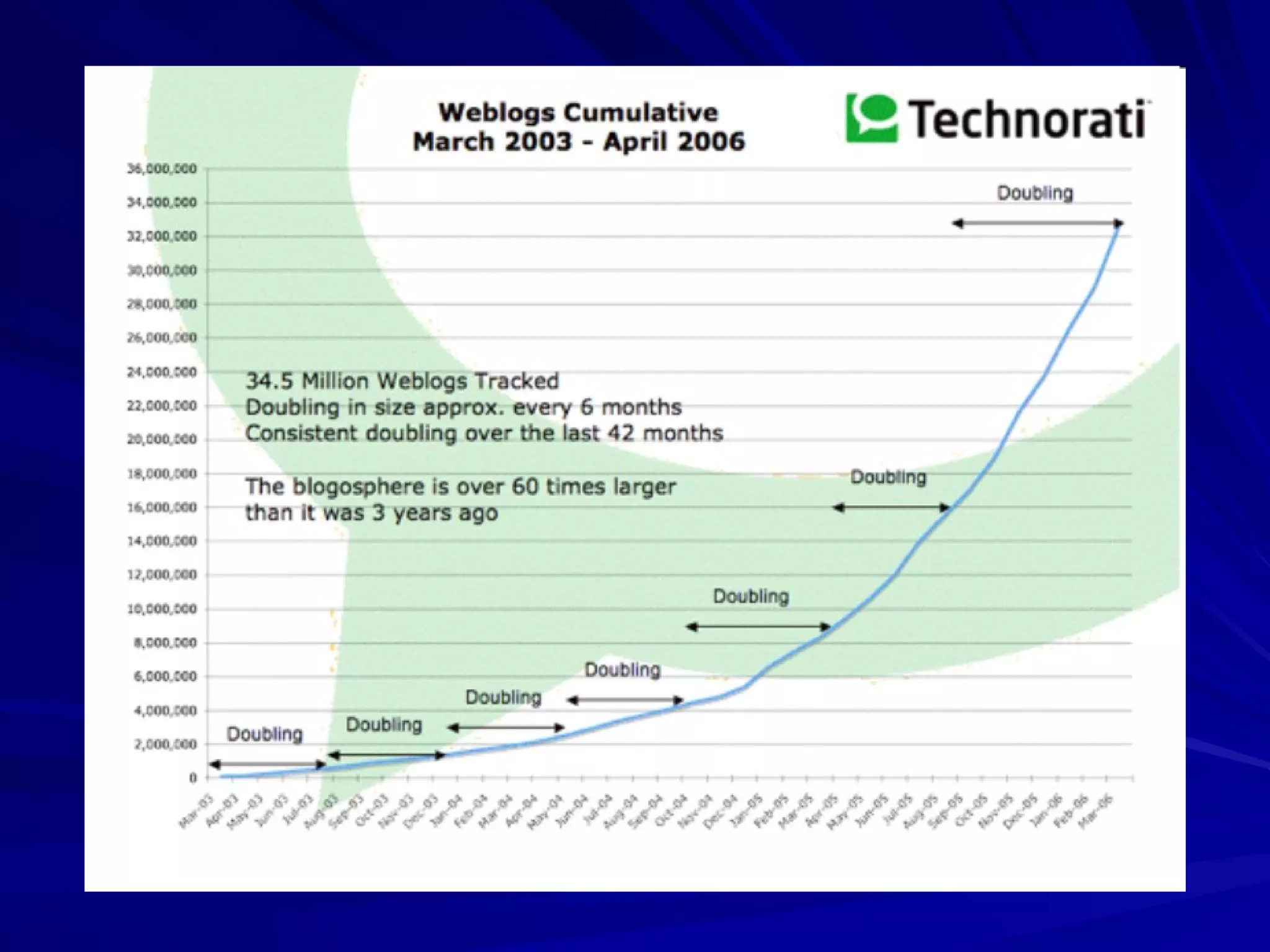
Blogosphere The collection of blogs on the Internet is called blogosphere and is doubling in size every 5 months A new blog is created every second
 
More and more people see the world through “Google eyes”
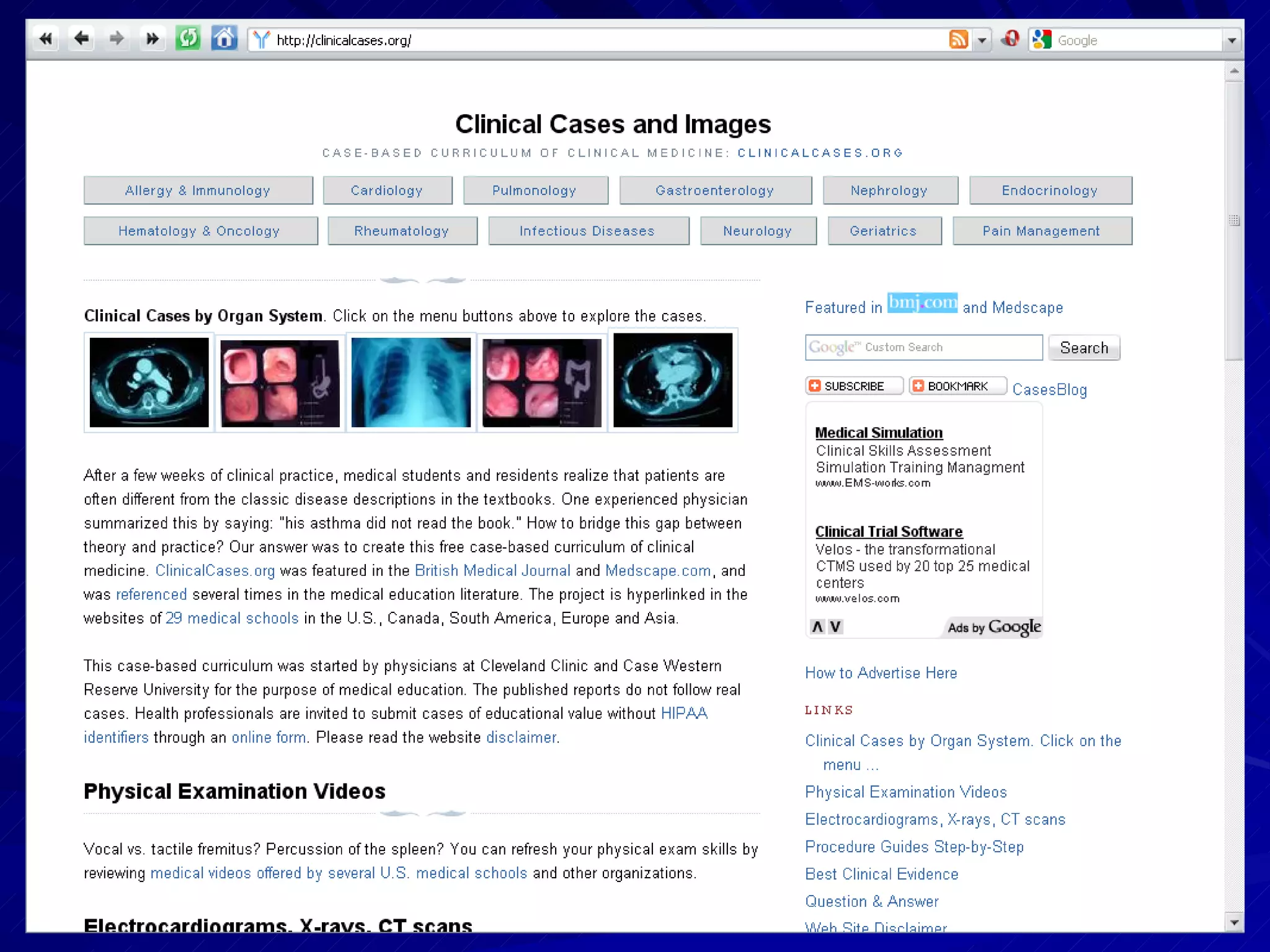
An Example of Web 2.0
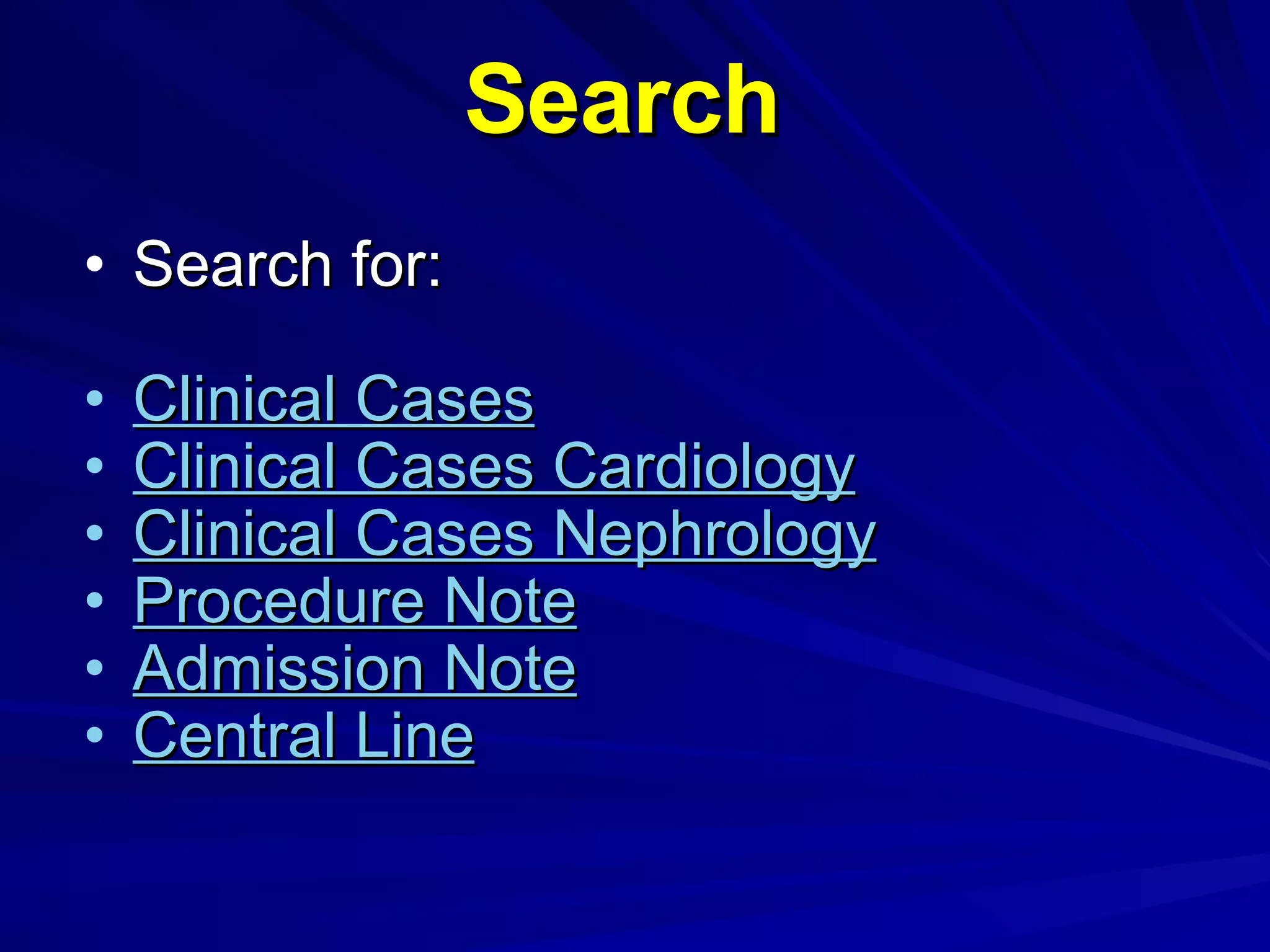
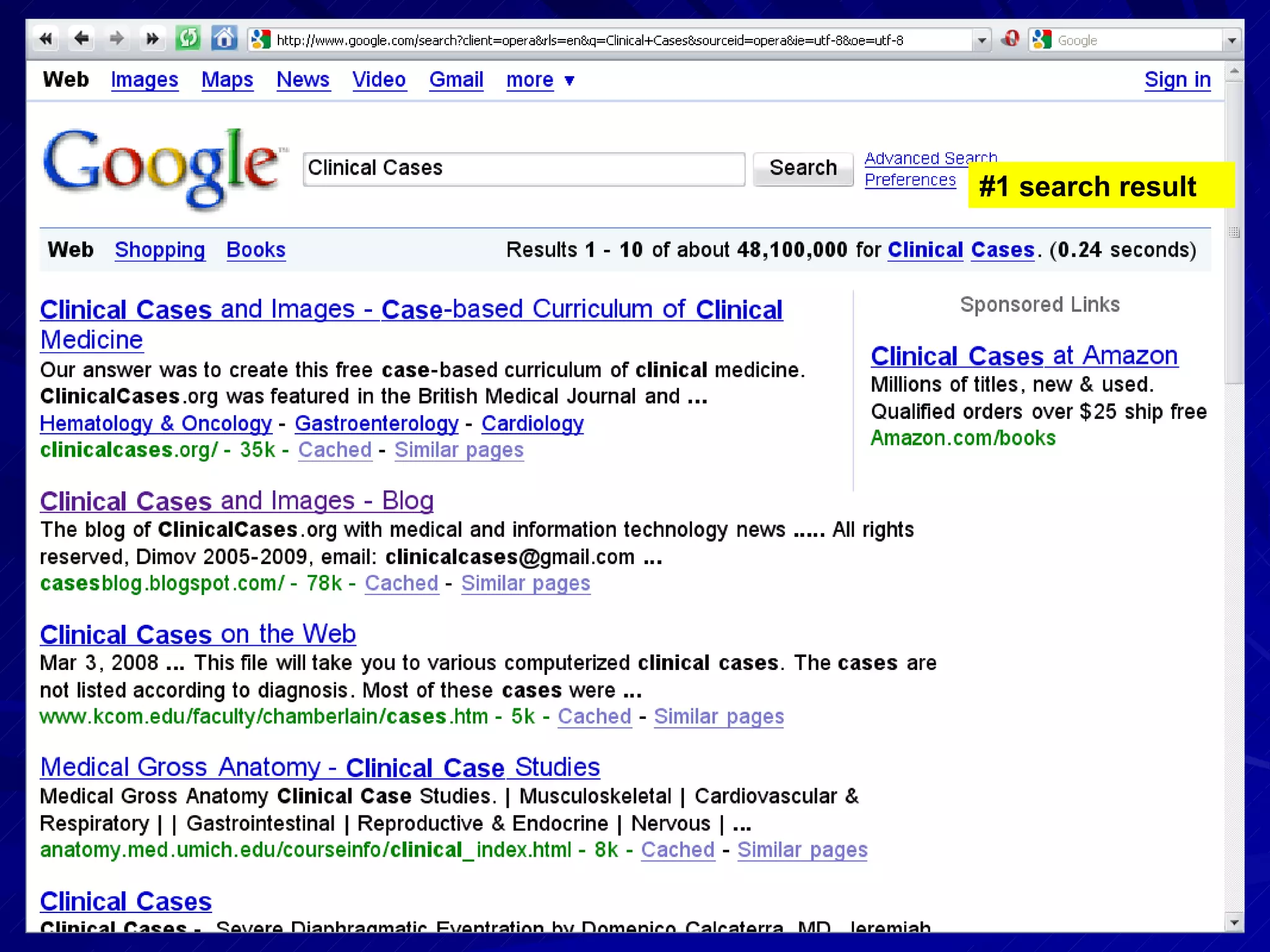
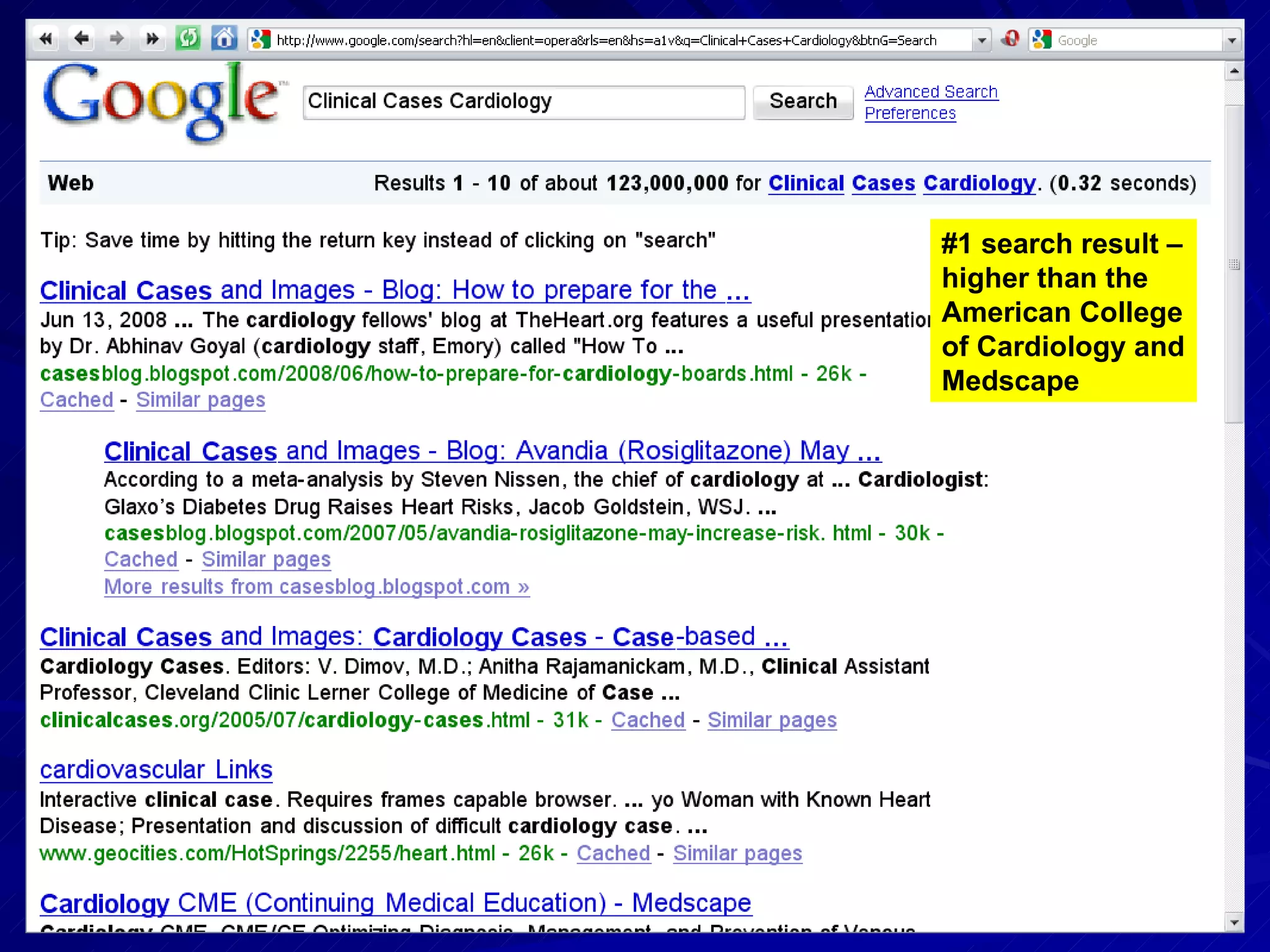
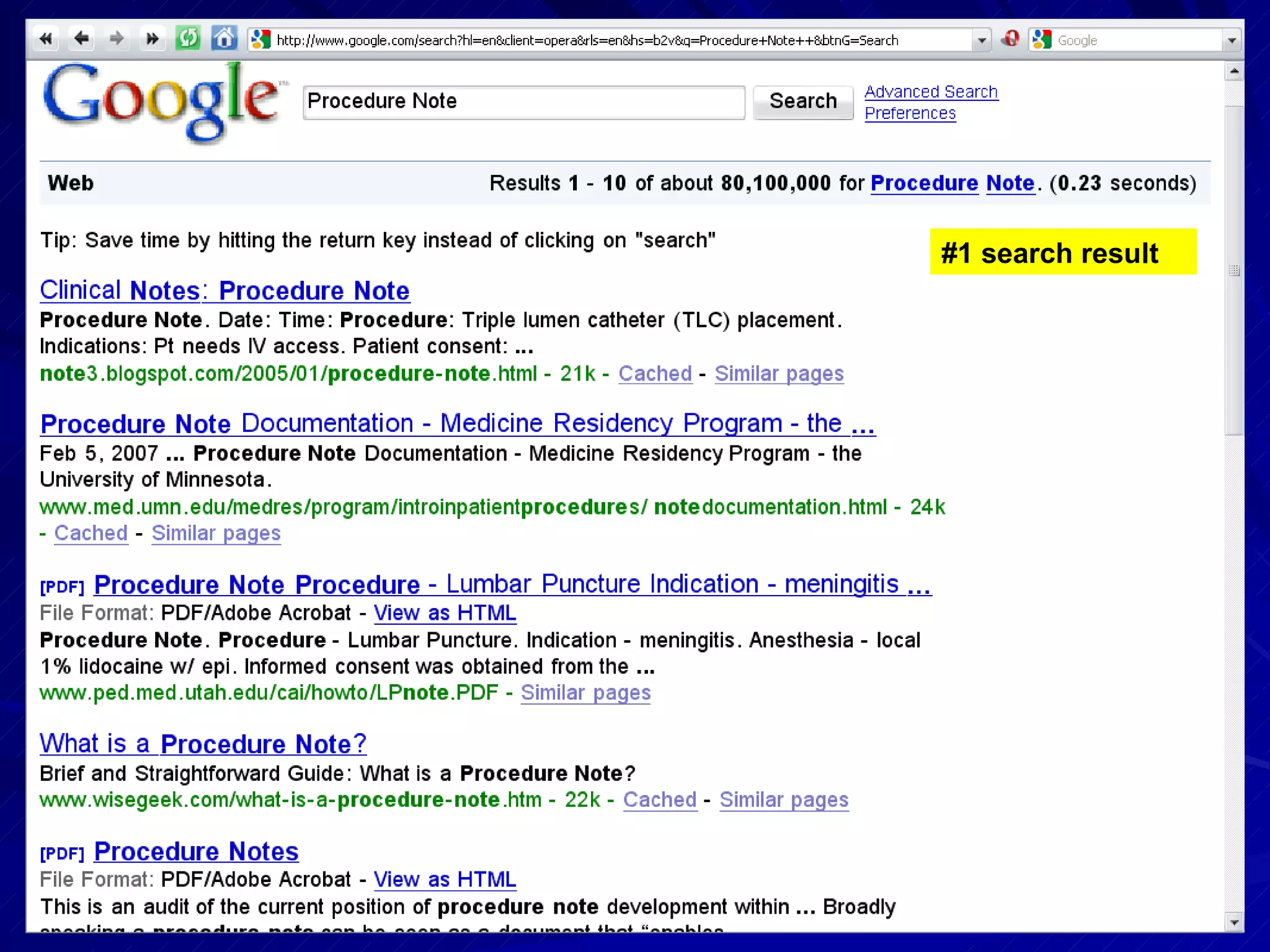
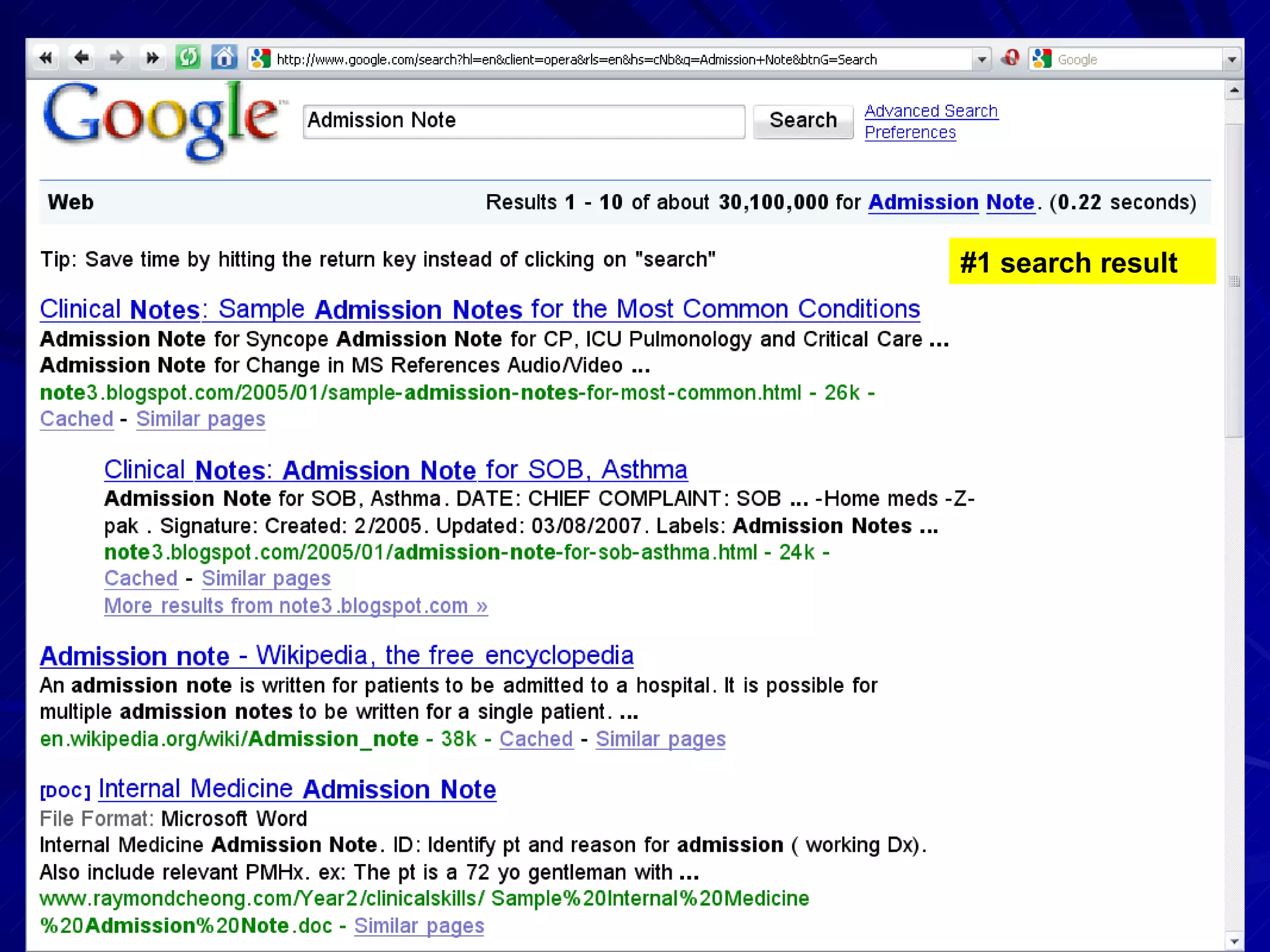
Search  Search for: Clinical Cases Clinical Cases Cardiology Clinical Cases Nephrology Procedure Note Admission Note Central Line
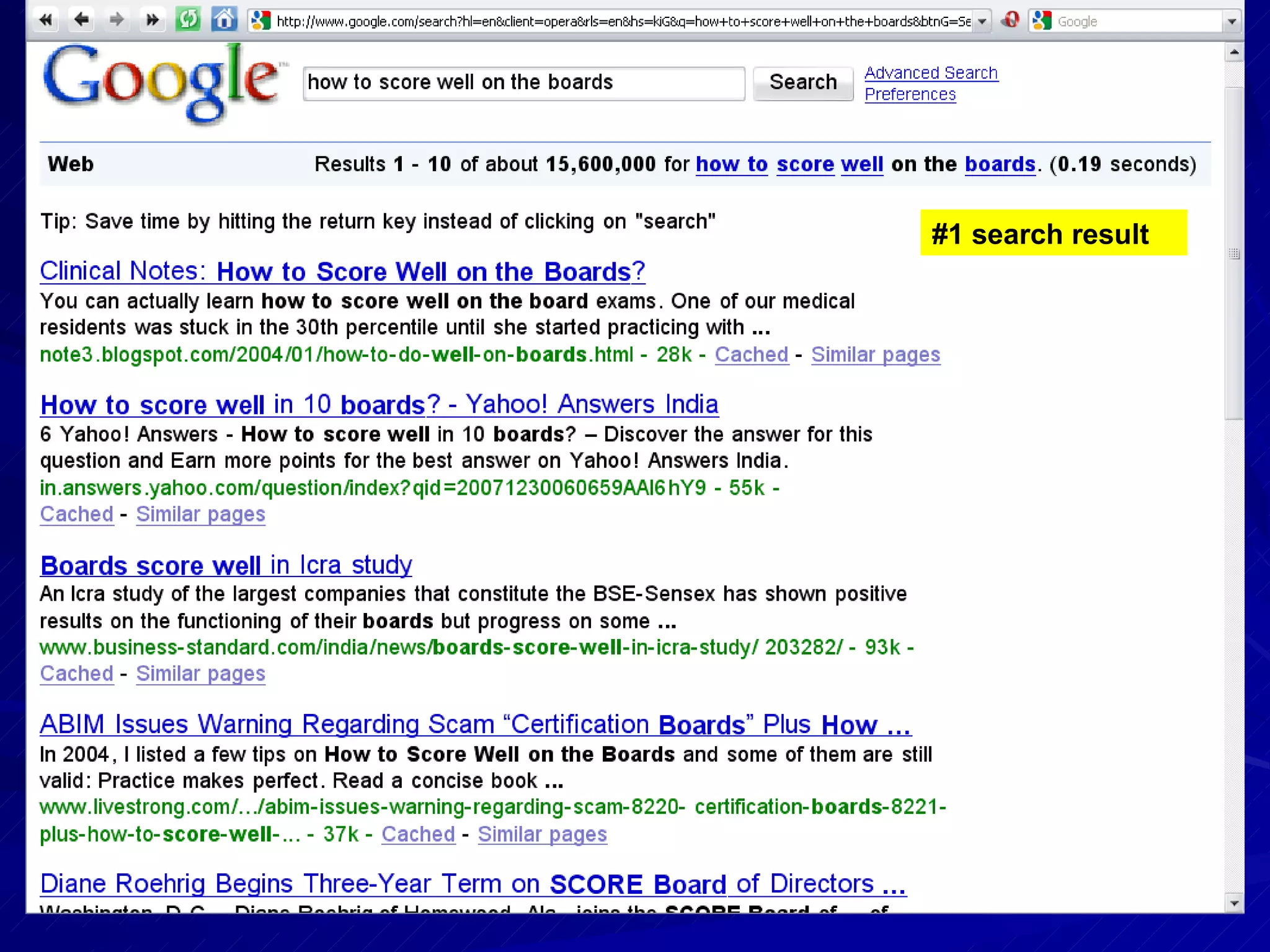
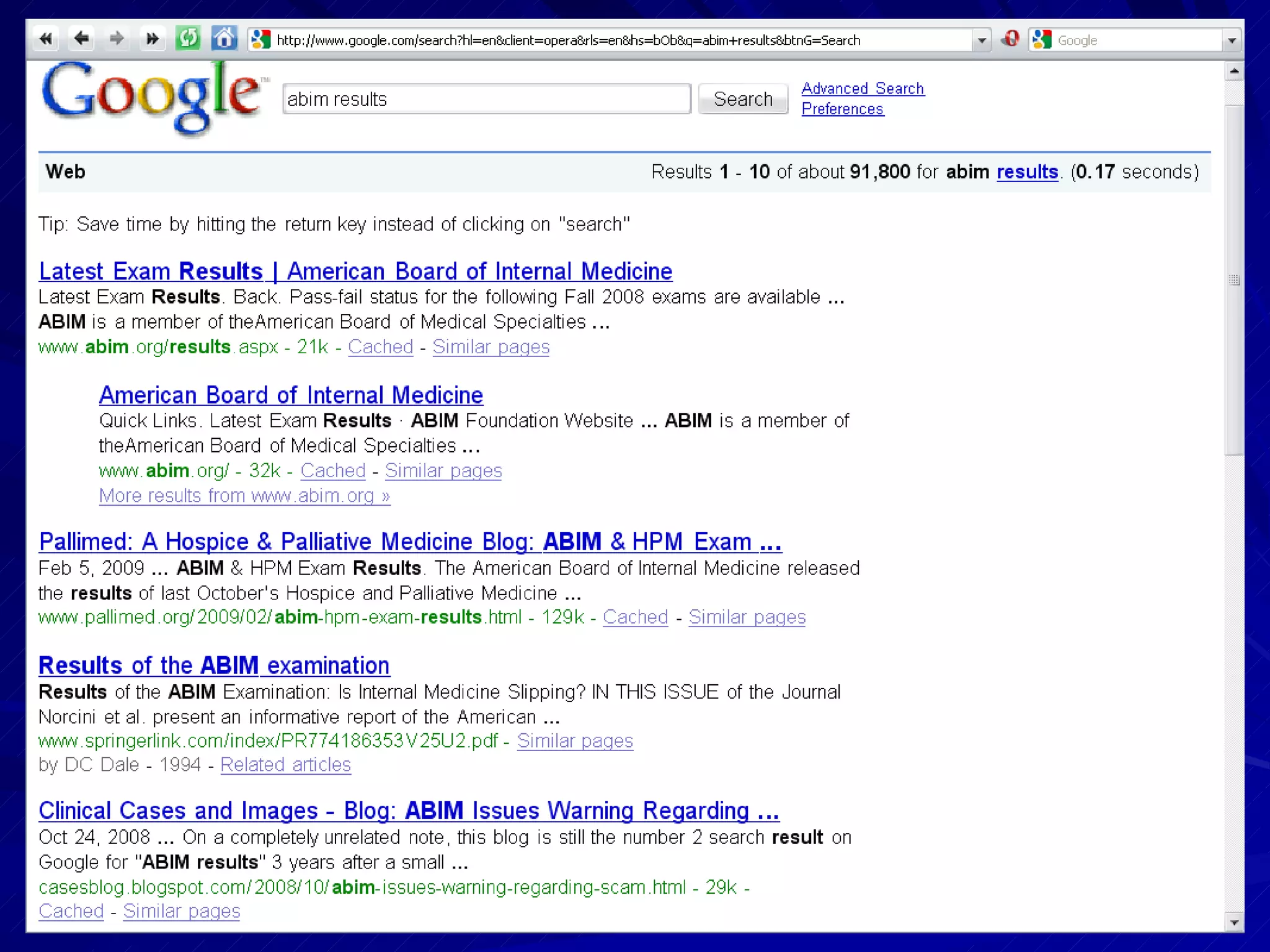
#1 search result
#1 search result – higher than the American College of Cardiology and Medscape
#1 search result
#1 search result
#1 search result
#1 search result
 
ClinicalCases.org A  website  based on the Google blog platform It is NOT a blog This is a small example of Web 2.0 See the visitors  statistics
 
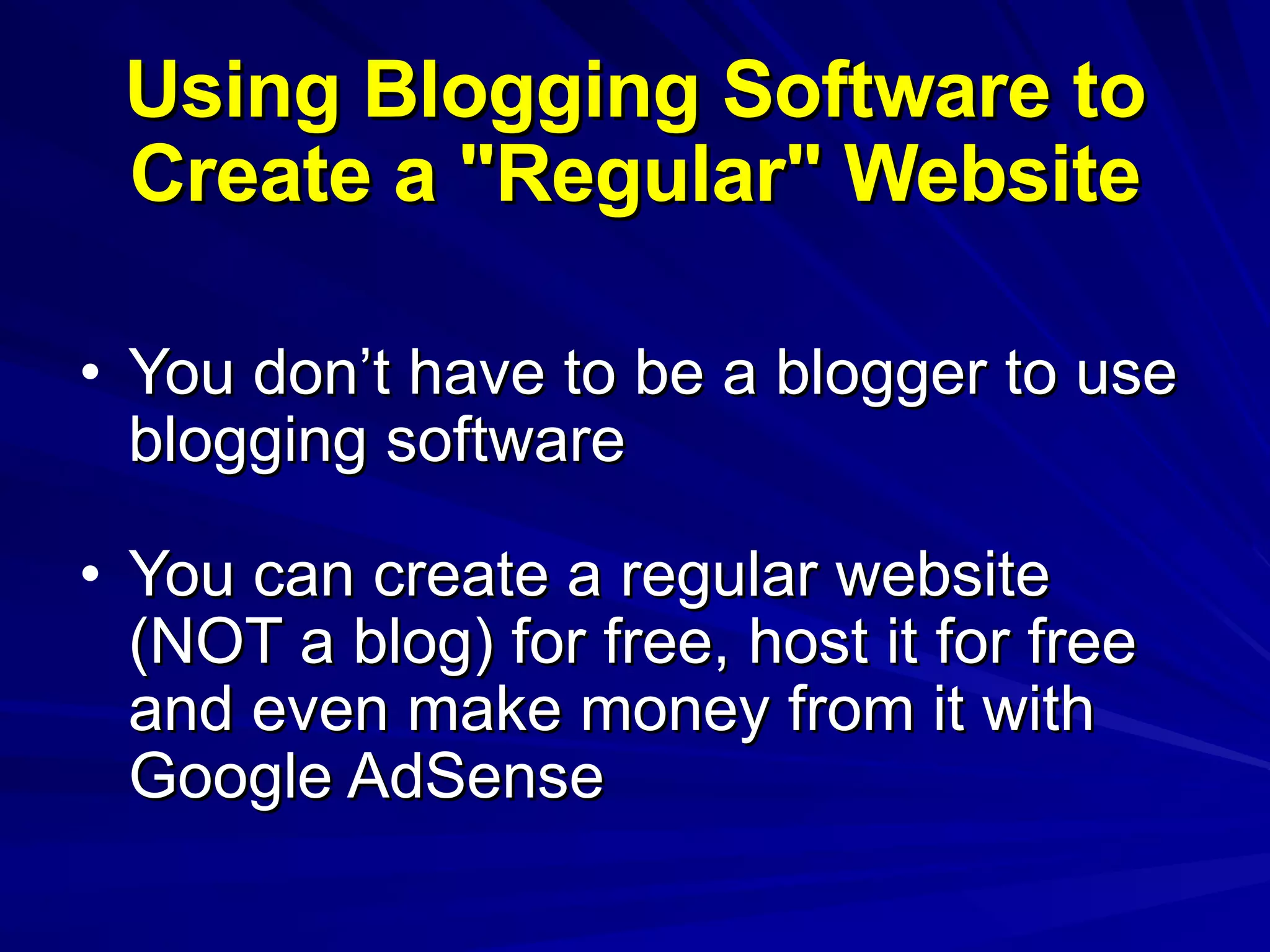
Using Blogging Software to Create a "Regular" Website You don’t have to be a blogger to use blogging software You can create a regular website (NOT a blog) for free, host it for free and even make money from it with Google AdSense
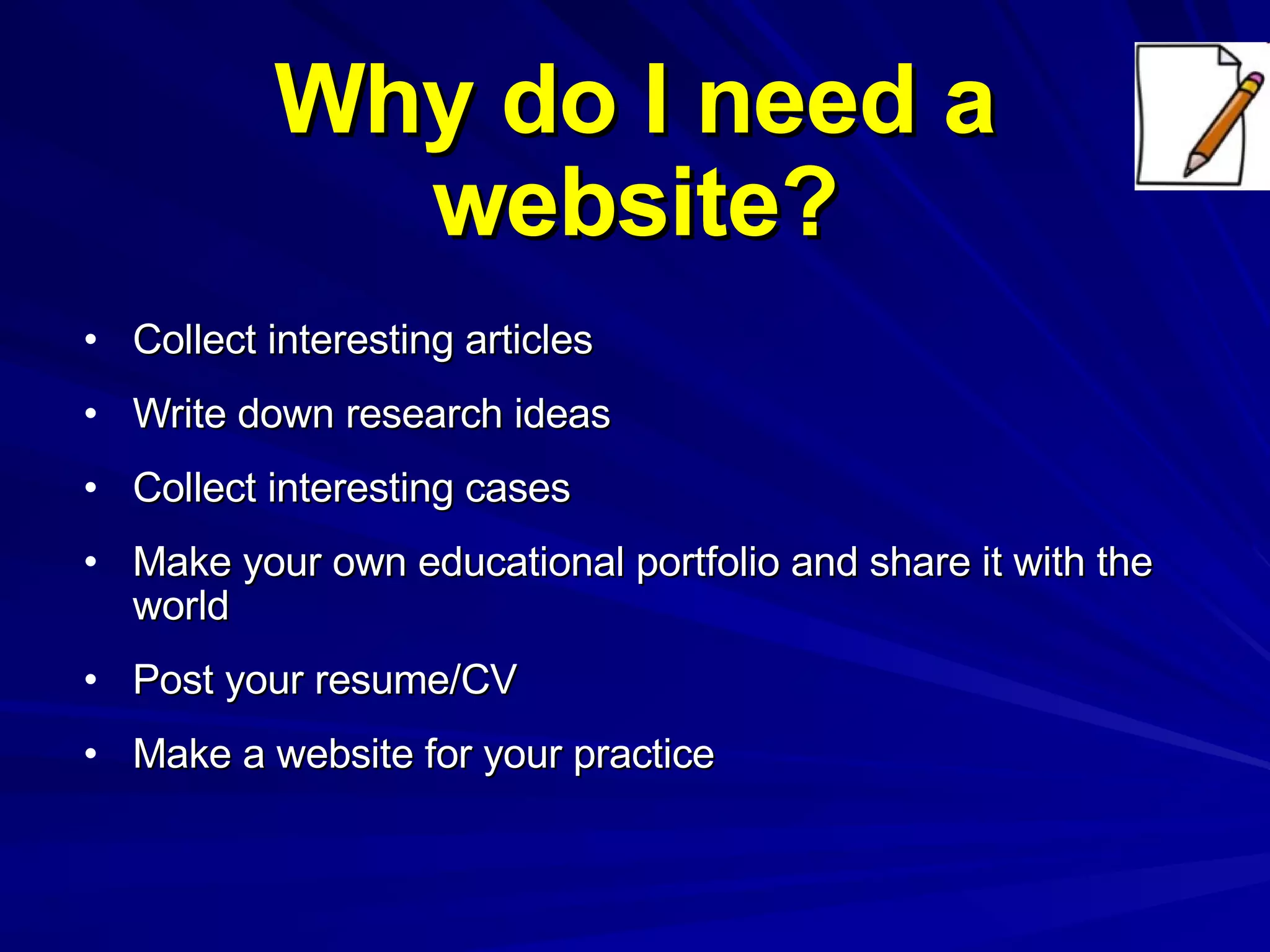
Why do I need a website? Collect interesting articles Write down research ideas Collect interesting cases Make your own educational portfolio and share it with the world Post your resume/CV Make a website for your practice
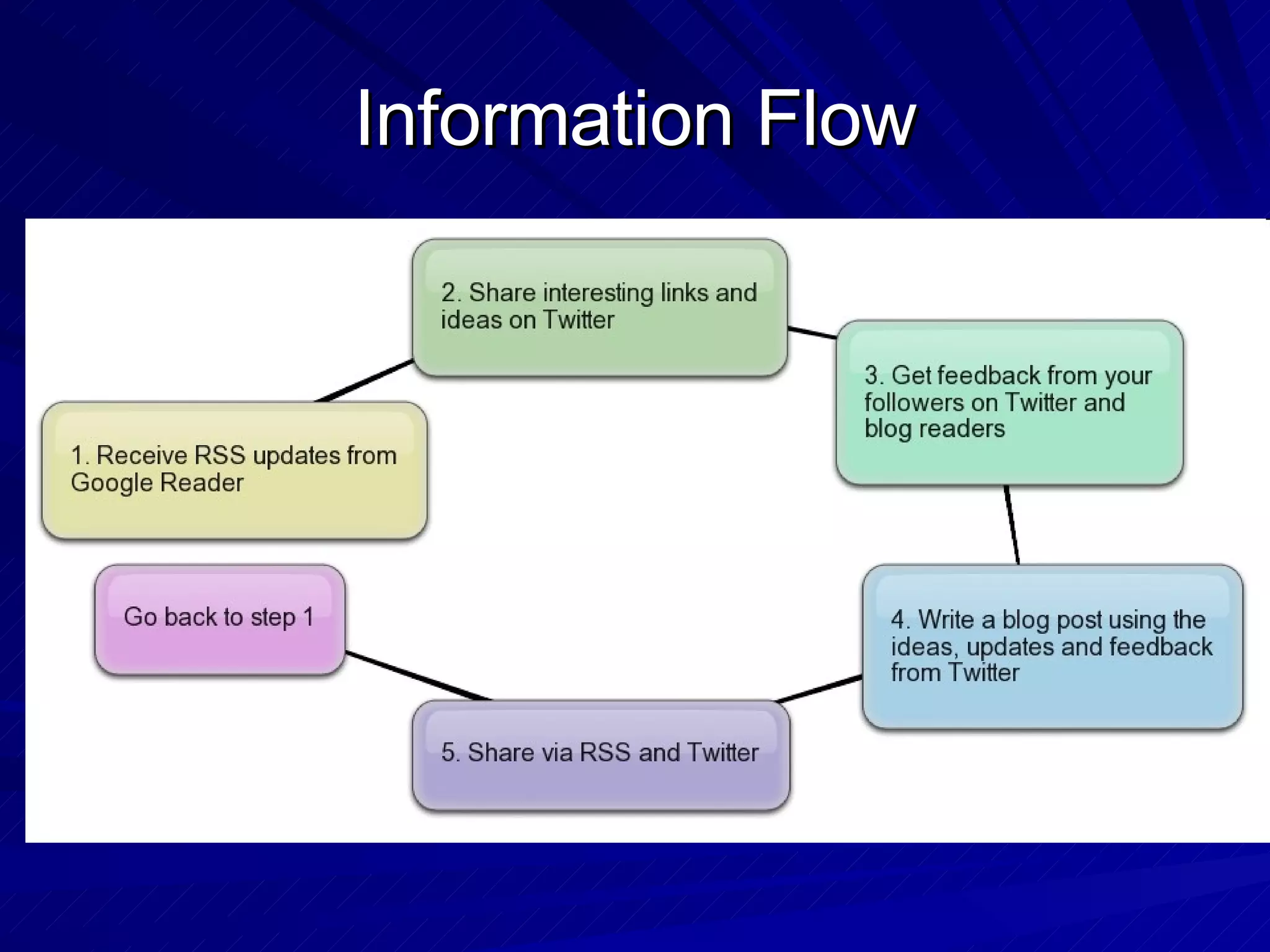
Information Flow
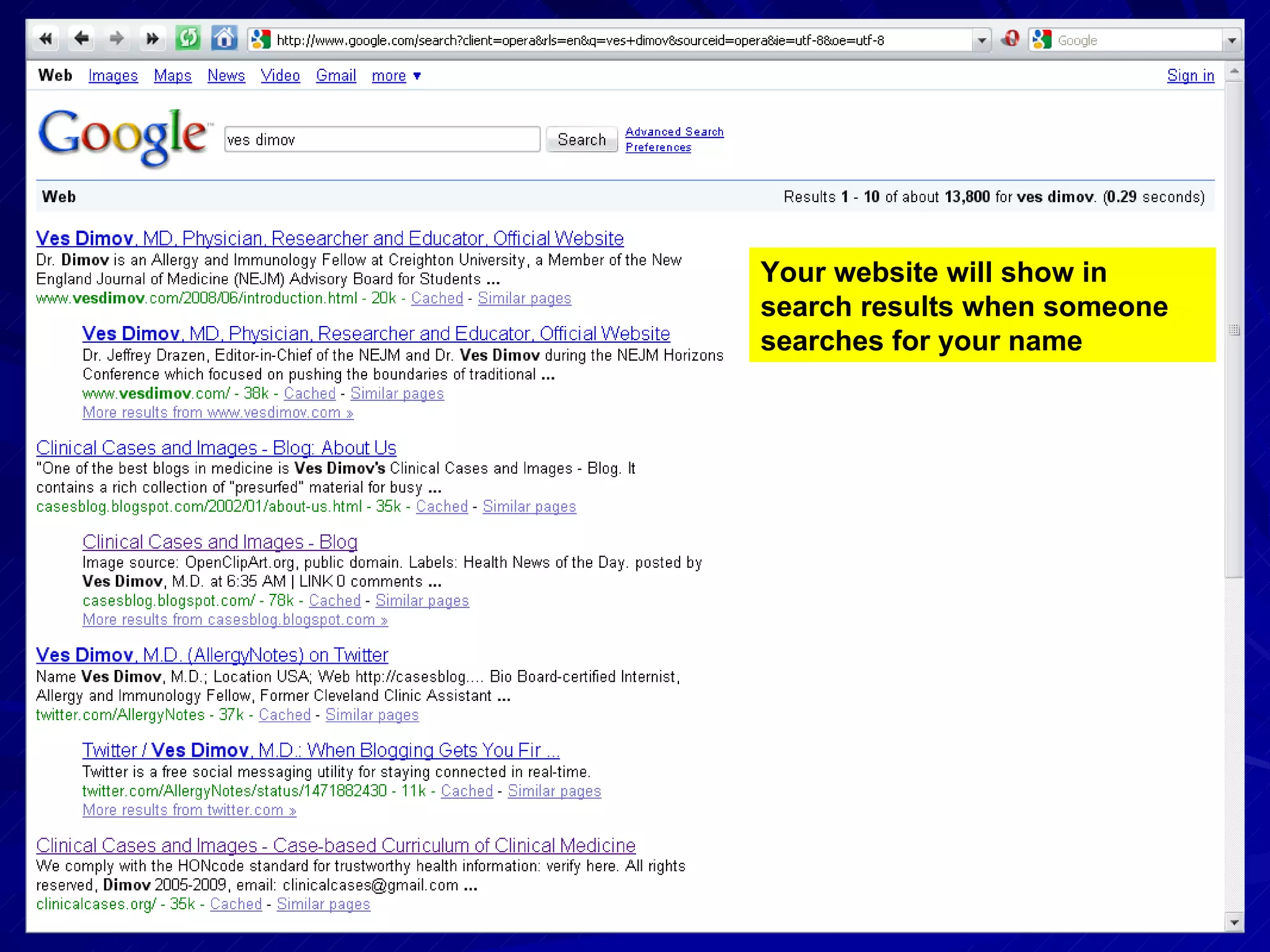
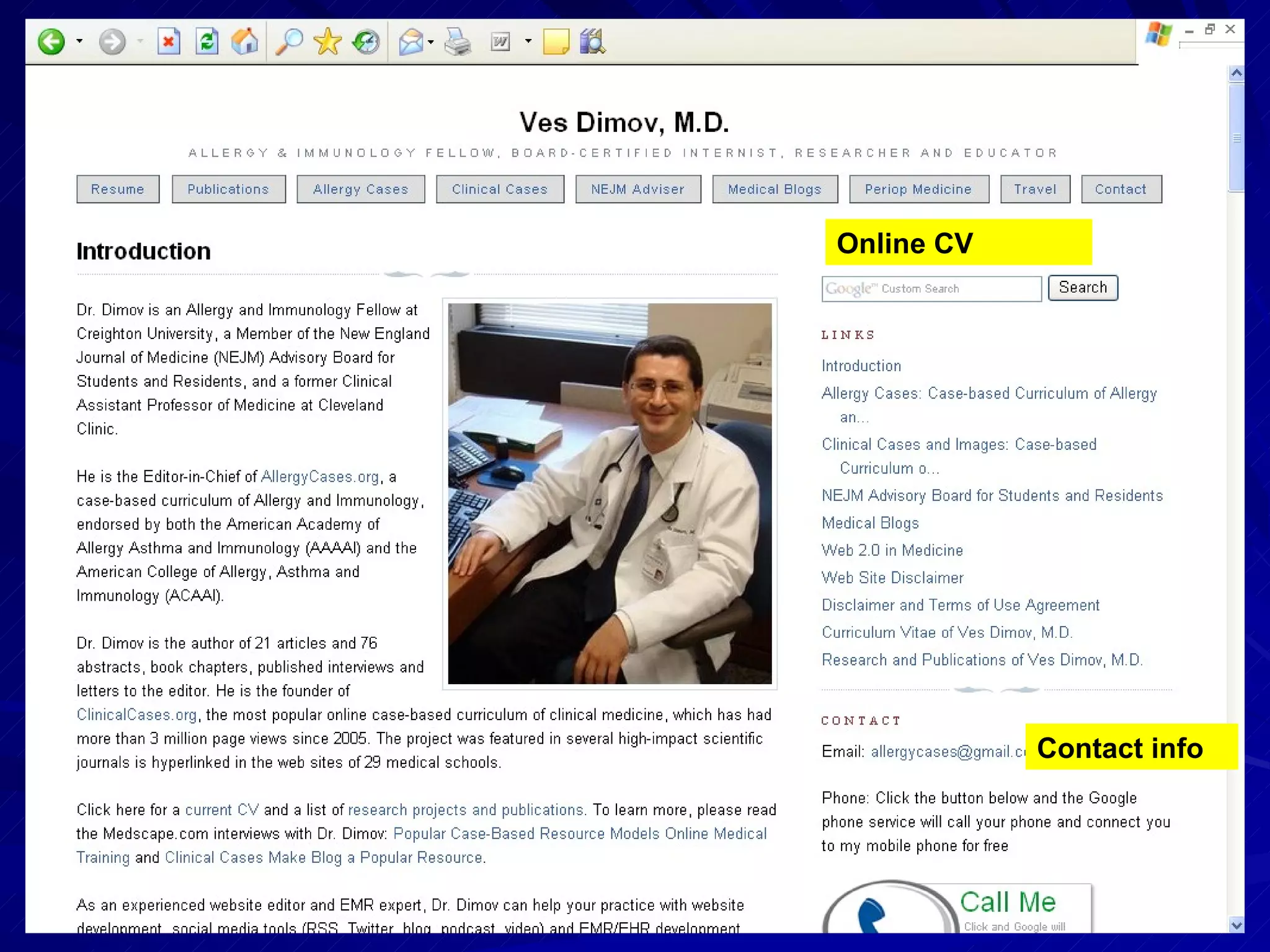
Make yourself Google-able Patients will Google you Your employers will Google you Your colleagues will Google you Your future spouse will Google you What will they find?
Example
Your website will show in search results when someone searches for your name
Online CV Contact info
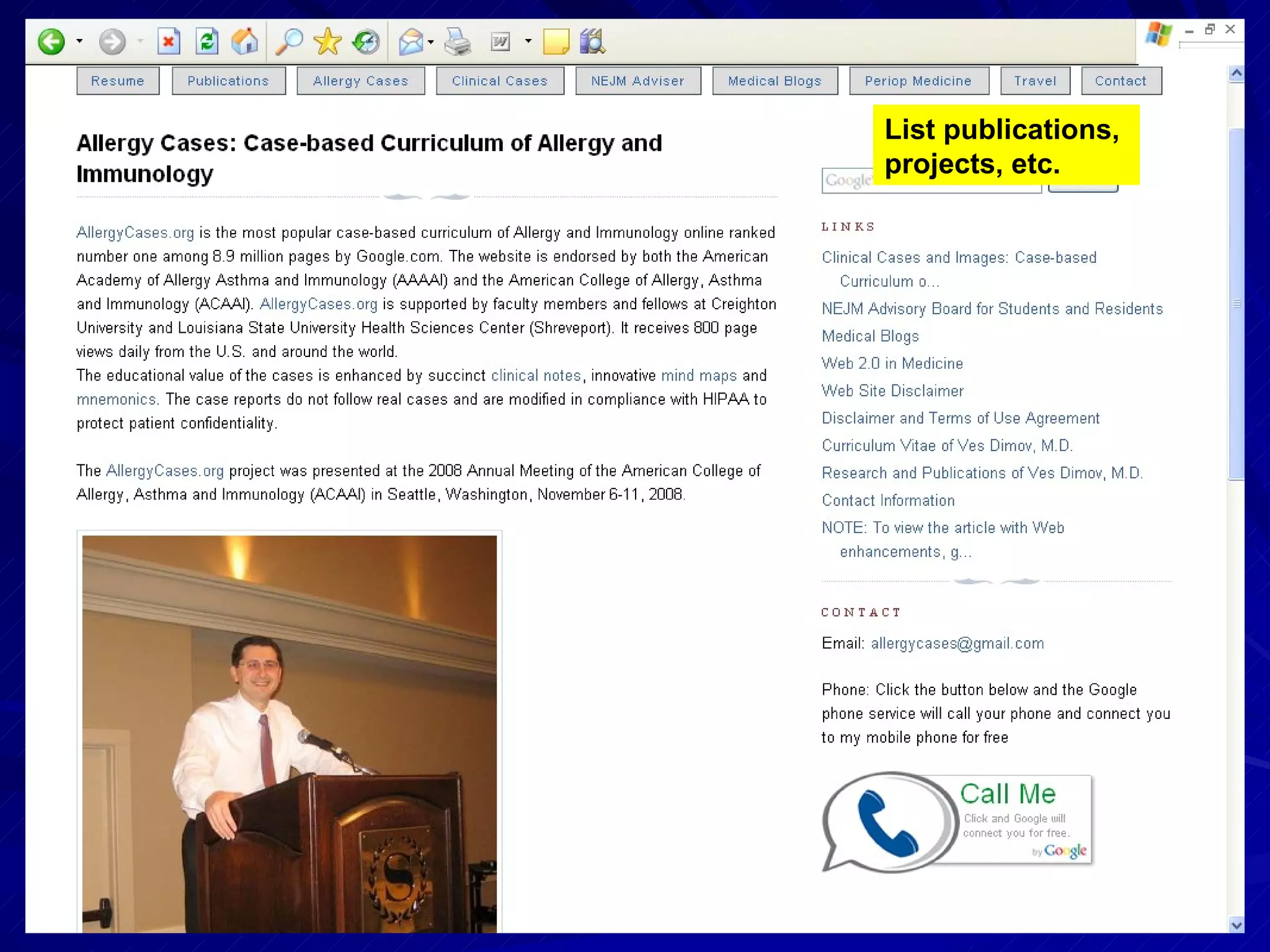
List publications, projects, etc.
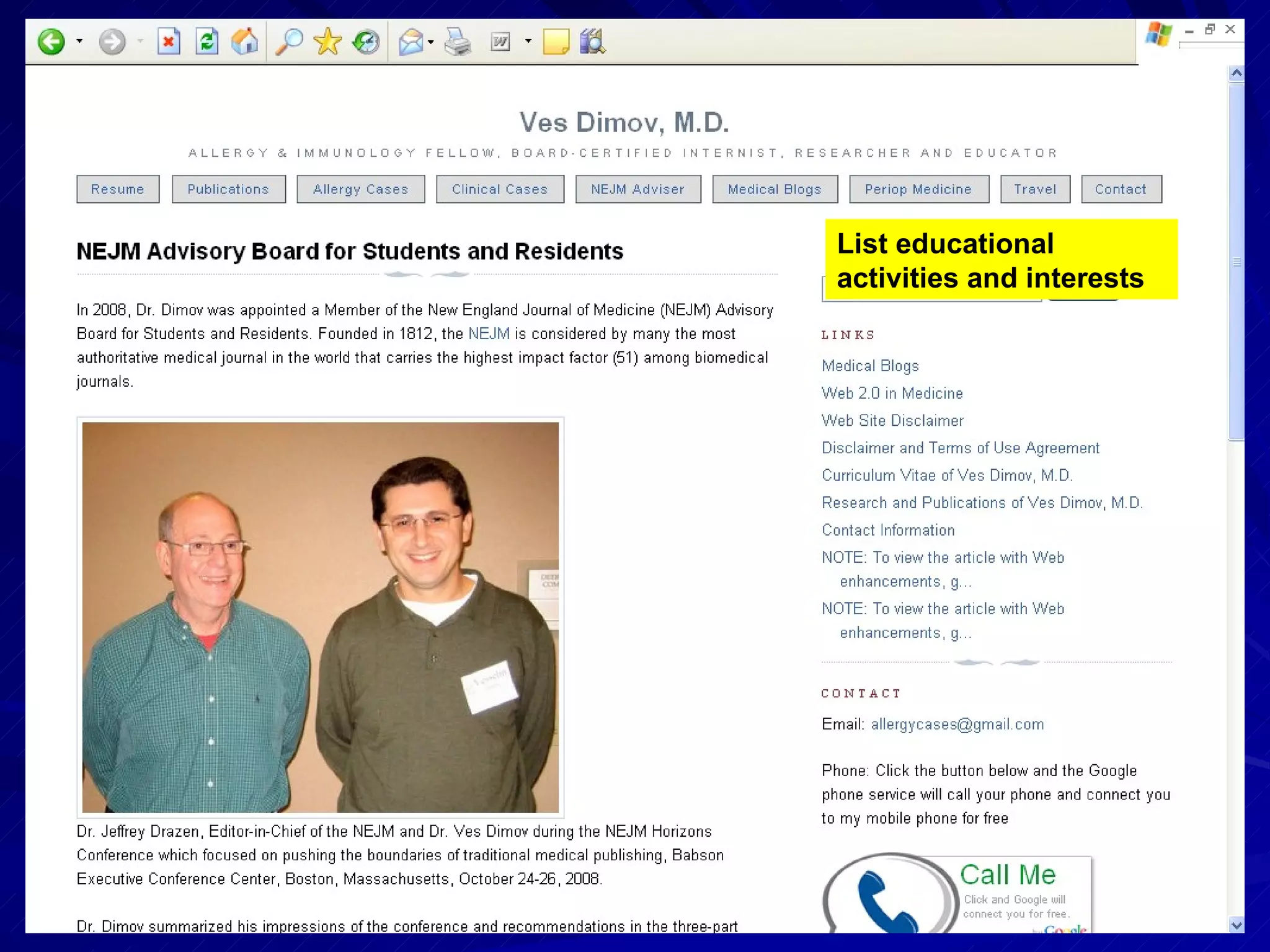
List educational activities and interests
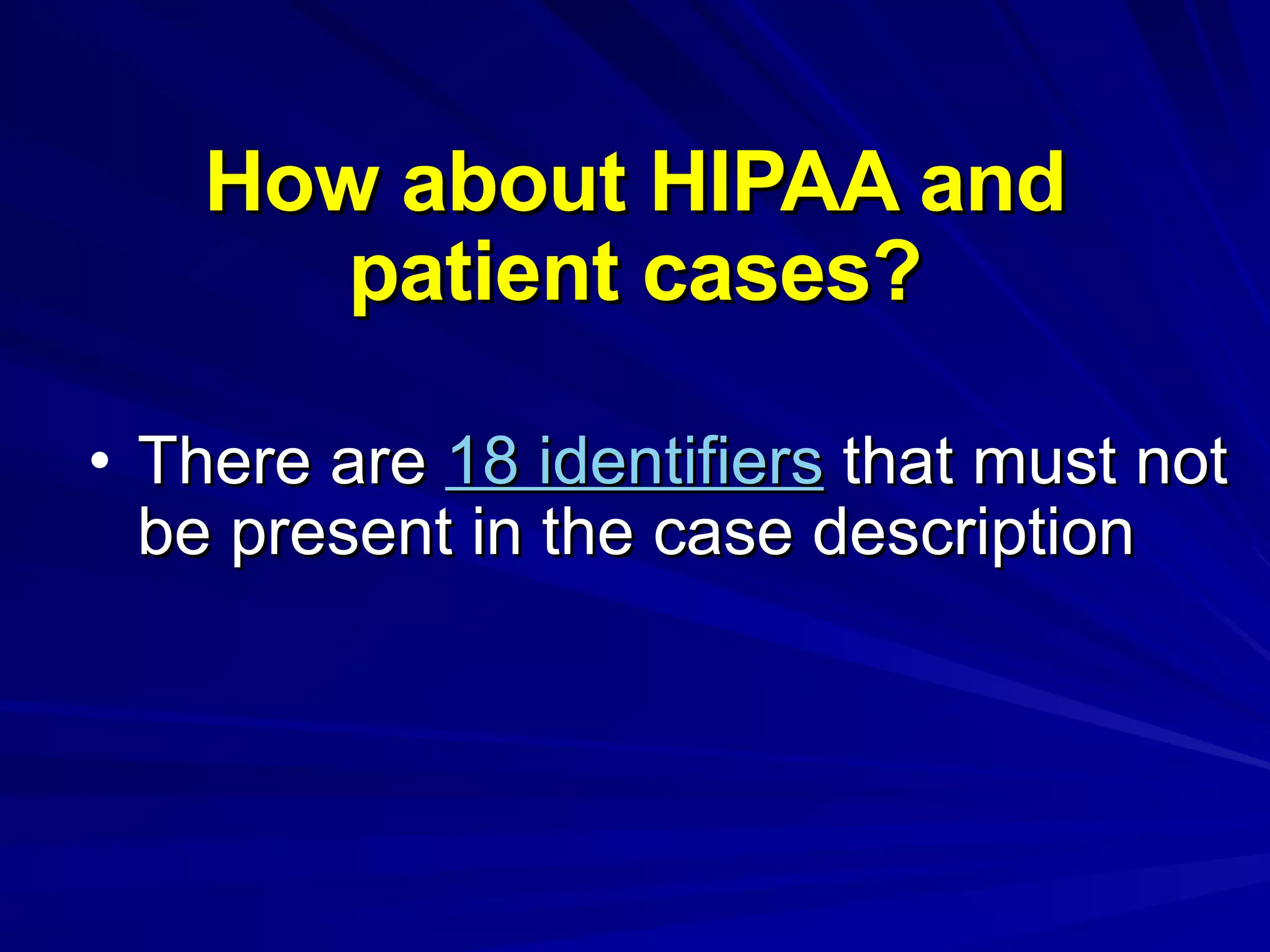
How about HIPAA and patient cases? There are  18 identifiers  that must not be present in the case description
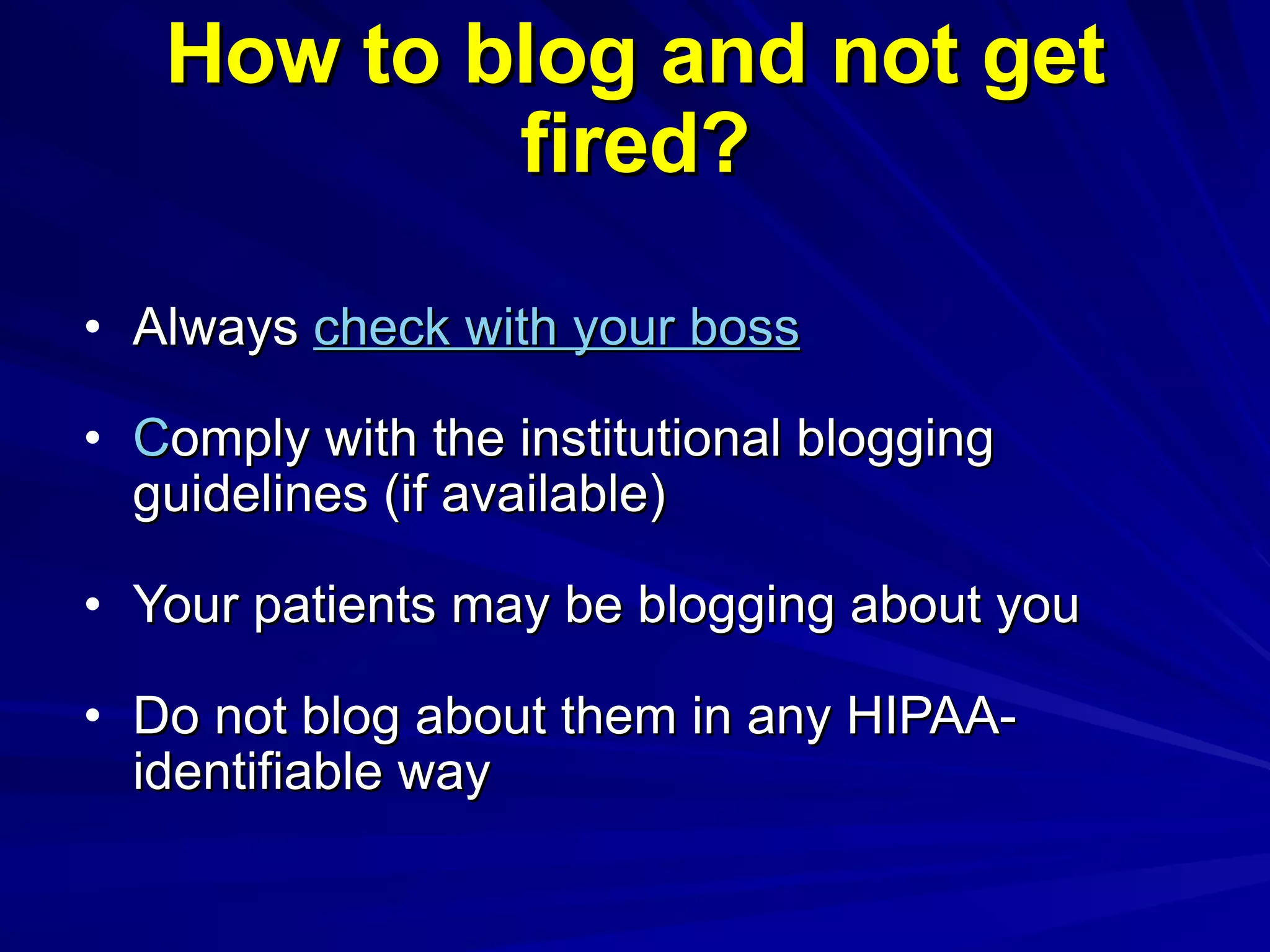
How to blog and not get fired? Always  check with your boss C omply with the institutional blogging guidelines (if available) Your patients may be blogging about you Do not blog about them in any HIPAA-identifiable way
RSS Podcast Write/Collaborate Blog Twitter Social network - Facebook
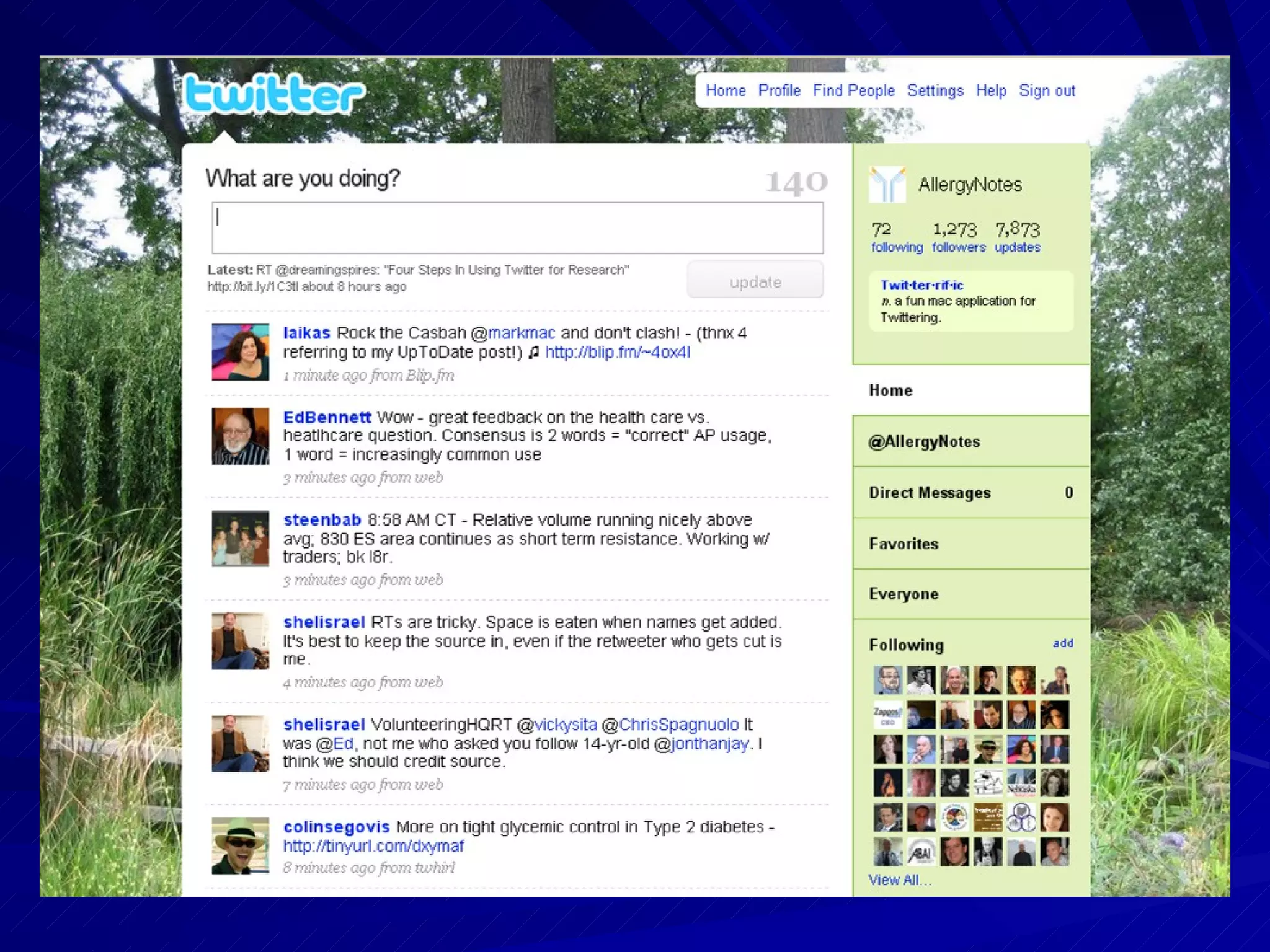
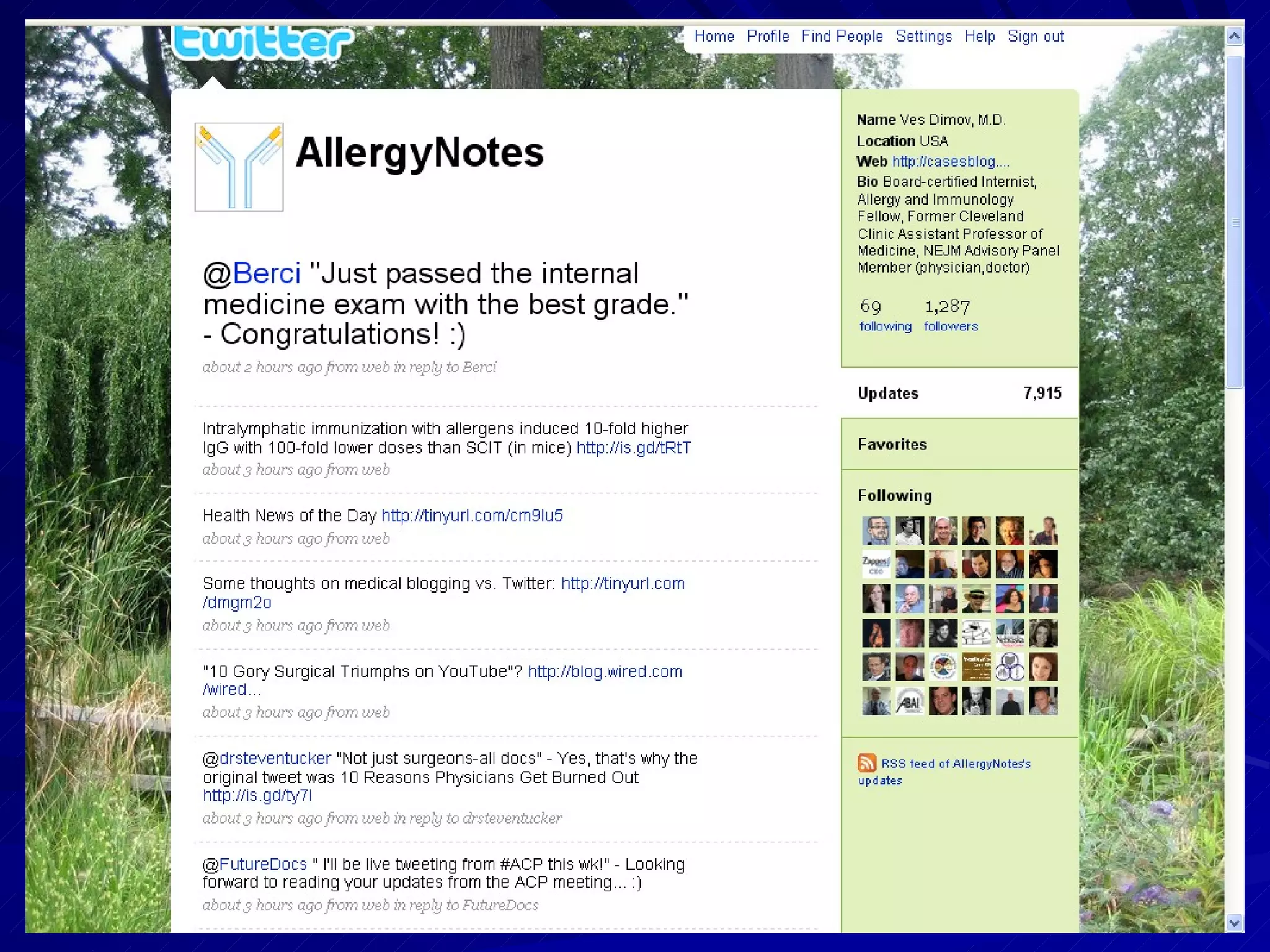
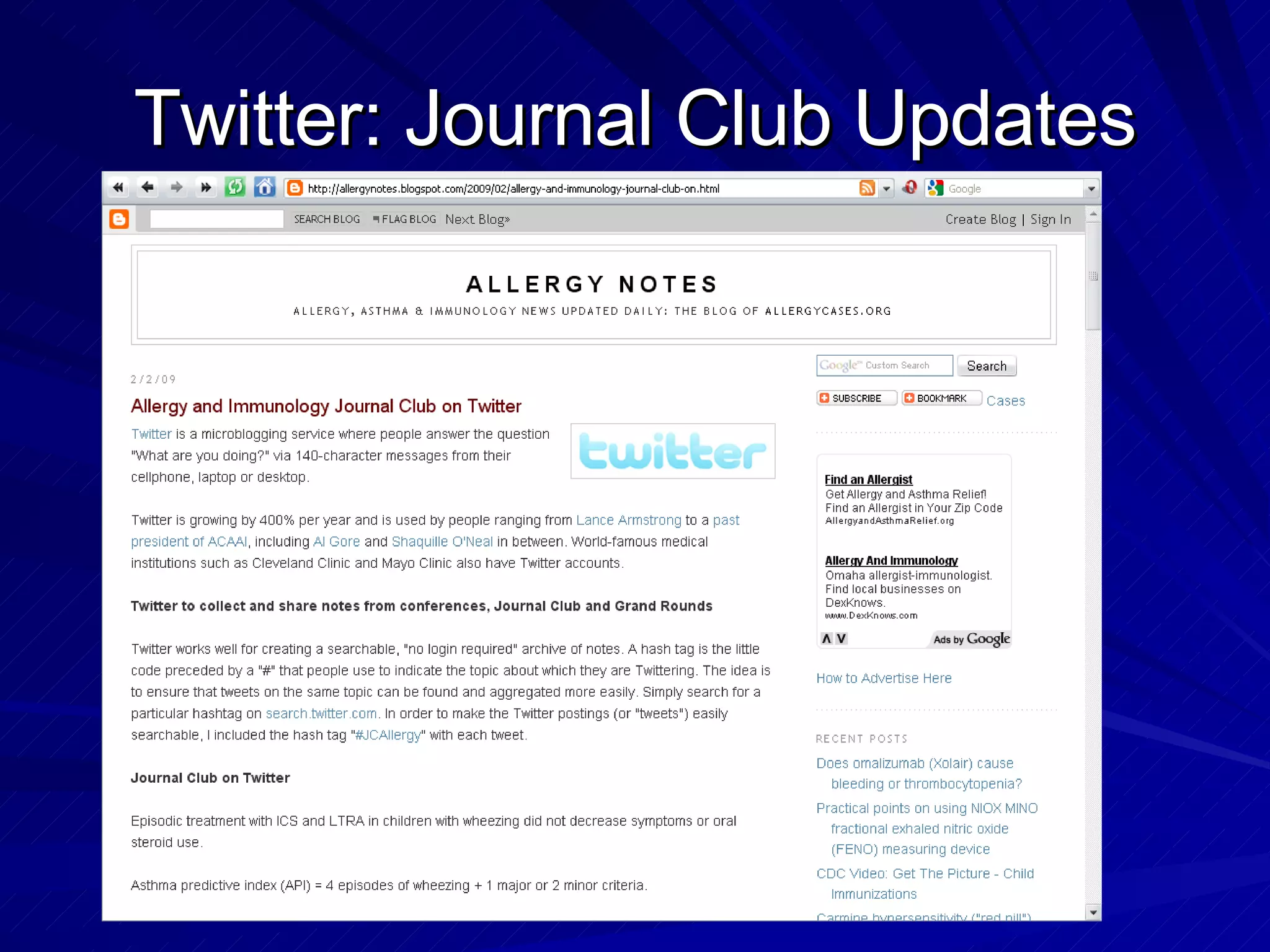
Twitter is a microblogging service where people answer the question "What are you doing?" via 140-character messages from their cellphone, laptop or desktop You can select the messages (called "tweets") that you find useful, amusing, or both Micro-blogging on Twitter is easy, fun and can be very useful and educational if you follow/subscribe to interesting people
Information Flow
 
 
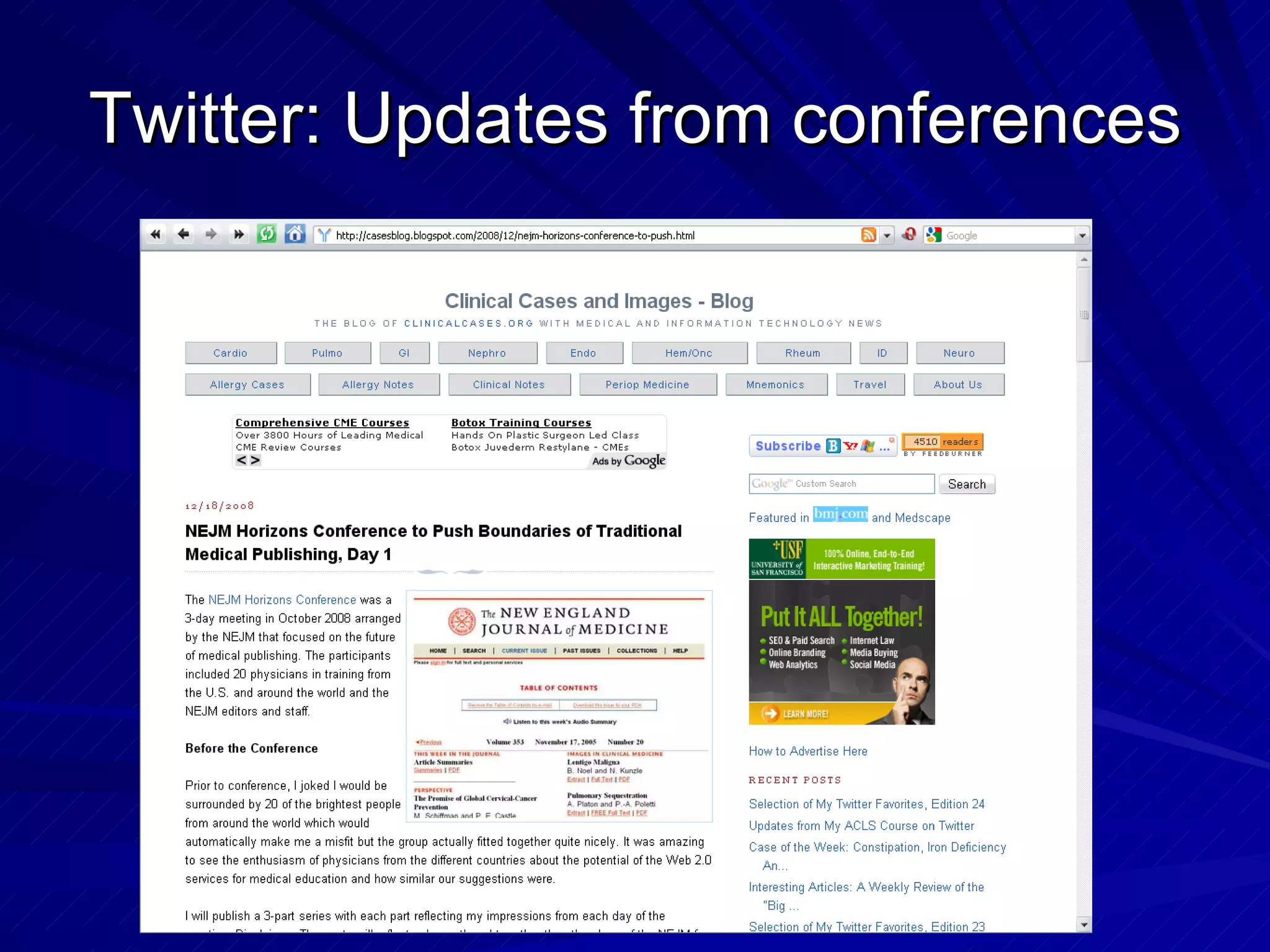
Twitter: Updates from conferences
 
Twitter: Journal Club Updates
Twitter: Health News Updates
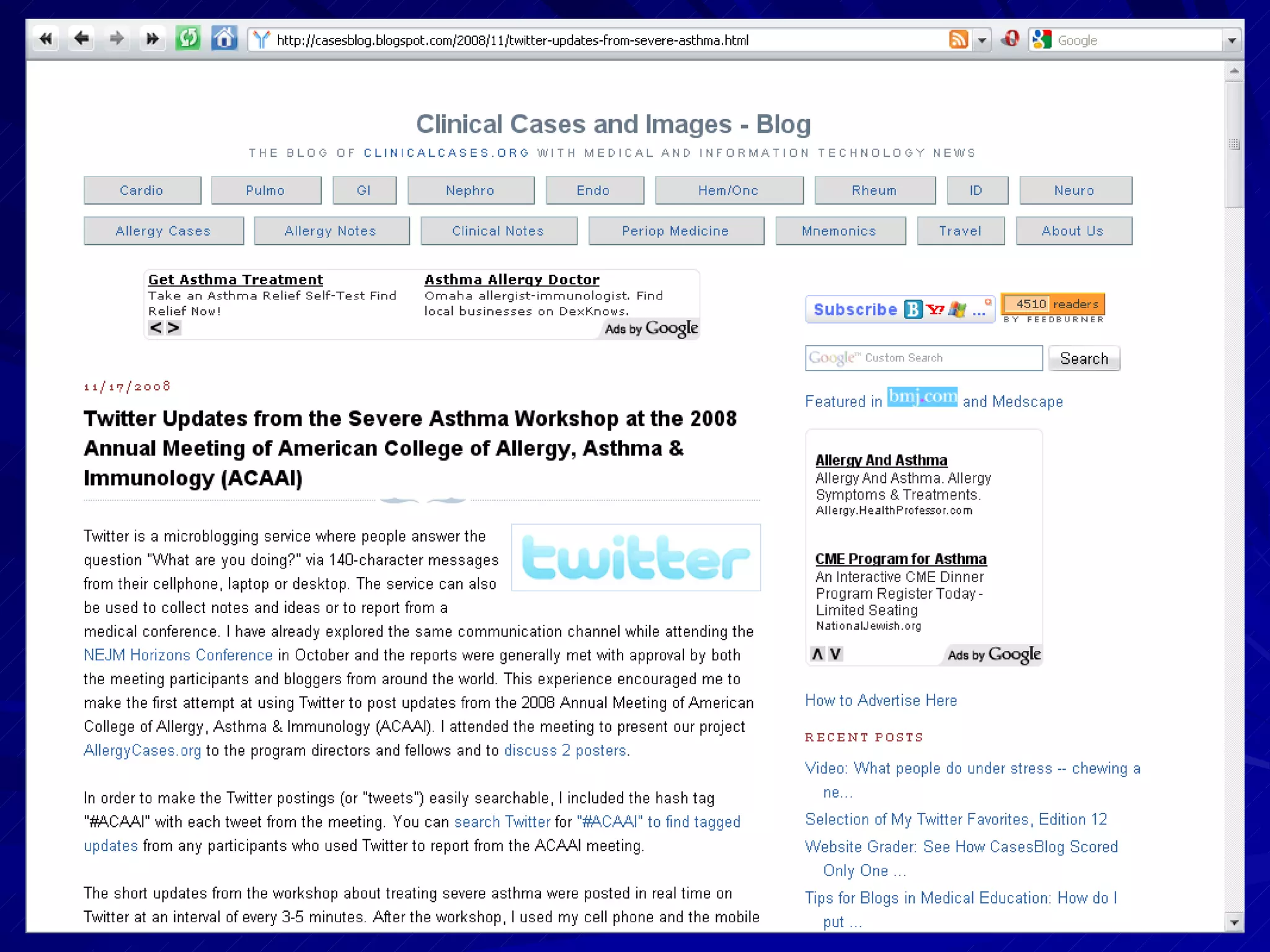
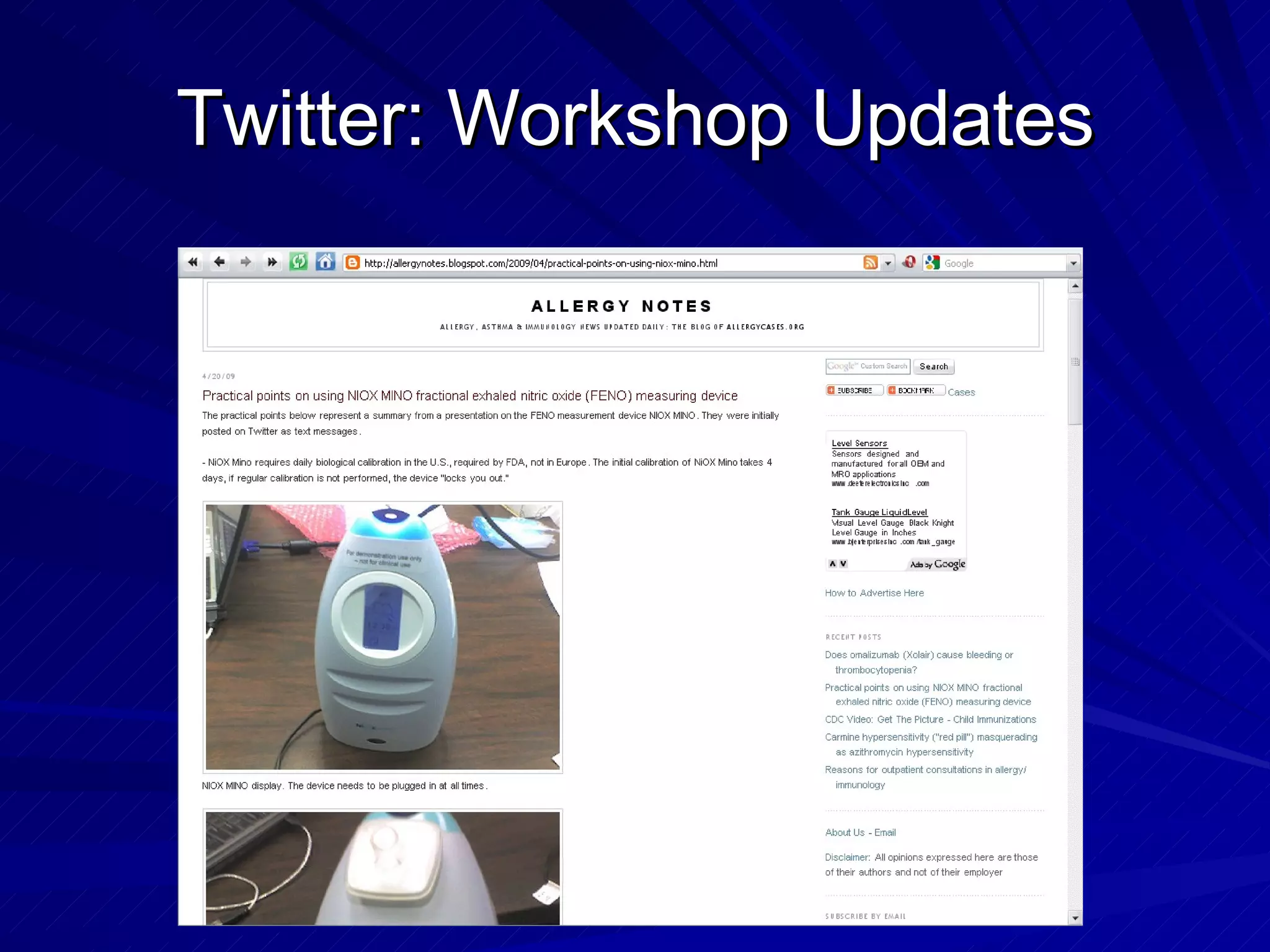
Twitter: Workshop Updates
Twitter It only takes a cell phone Easy to do Microblog Follow/followers
Information Flow
Summary Web 2.0 offers a great opportunity. We should use it to: Benefit our patients Stay updated Share knowledge with medical professional all over the world Take research collaboration to the next level Career advancement
Questions? Please email clinicalcases@gmail.com

Web2 0 in Medicine - 2009 Update

  • 1.
    Web 2.0/Social Mediain Medicine Author: Ves Dimov, MD Allergy and Immunology Fellow, Creighton University, Division of Allergy & Immunology, Member of the New England Journal of Medicine Advisory Board for Students and Residents, Former Clinical Assistant Professor of Medicine, Cleveland Clinic and Case Western Reserve University Last updated: 04/22/2009
  • 2.
    About Us (me) Any reputable website has “About Us” section
  • 3.
    Who are youto talk to me about Web 2.0 and websites? I have made 9 educational websites: for Cleveland Clinic, University of Miami, Case Western Reserve University and personal They have been featured multiple times in BMJ, Medscape, peer reviewed journals Abstracts presented at multiple national and international scientific meetings
  • 4.
  • 5.
    How many peoplevisit your website? Three million page views since 2005. It feels as if you have written a book and somebody reads 3,000 pages of it… every day 1.3 million visitors from all over the world, probably a larger readership than many journals Google loves quality content
  • 6.
  • 7.
    What is Web 2.0 ? The web world has changed before our eyes
  • 8.
    What is Web2.0? Web 2.0 is a collection of (mostly) free web services You can’t buy Web 2.0 at the store but you can use it today
  • 9.
    Web 1.0 vs. Web 2.0 Web 1.0 users follow links to content Web 2.0 users comment, edit and create content It is user-created content. For the user, by the user
  • 10.
    RSS Podcast Write/CollaborateBlog Twitter Social network - Facebook
  • 11.
    Web 1.0 / Web 2.0 G Docs & Spreadsheets MS Word Tags - De.licio.us Directories , Favorites  Wikipedia Britannica Online  Syndication, RSS , Podcast, website follows you Stickiness, stay on the website  Participation ( blogs , comments, Twitter) Publishing ( websites )  Search, like Google Portal, like Yahoo Web 2.0 Web 1.0 
  • 12.
    Why should Icare about Web 2.0?
  • 13.
    Where is myplace in all that? Everybody is busy Web 2.0 saves time by helping you get exactly the information you are interested in Blogs and Twitter let you create content and share it with others – this is content created FOR the user BY the user
  • 14.
    How can Iuse Web 2.0?
  • 15.
    RSS Podcast Write/CollaborateBlog Twitter Social network - Facebook
  • 16.
  • 17.
    What is RSS ? RSS = R eally S imple S yndication A hybrid between a personal assistant and your “inbox for the web”
  • 18.
    RSS toMaster the Information Overflow Get only the news you want  River of news concept, e.g. Medscape "It's like having a personal assistant who goes through every publication and blog that could possibly interest you and picks out stories to bring to your attention" - PC Magazine Instead of visiting 20 websites per day, let them send information to you, Google Reader  or Bloglines
  • 19.
  • 20.
    This is howmy Google Reader looks like – inbox for the web
  • 21.
    RSS S ubscribeto specific searches on Pubmed (e.g. statins and dementia), or any search engine and collect them in one place S ubscribe to the major medical journals RSS feeds
  • 22.
    Make your own“medical journal” Combine RSS feeds from the journals you read into one easy-to-scan page Use iGoogle or other aggregators
  • 23.
    Make your ownjournal with iGoogle
  • 24.
    PubMed and RSSWhy and how to do use it?
  • 25.
  • 26.
  • 27.
  • 28.
    Subscribe to thisspecific RSS feed in your RSS reader of choice: Google Reader, iGoogle, Bloglines
  • 29.
    RSS = Inboxfor the Web RSS is like you email “inbox for the web” Collects all the information you need in one place I rarely visit websites anymore despite following more than 350 sites a day RSS reader is the central point
  • 30.
    Google Reader = Inbox for the web
  • 31.
  • 32.
    RSS Podcast Write/CollaborateBlog Twitter Social network - Facebook
  • 33.
  • 34.
    What is apodcast? Podcast = po rtable broad cast (audio file) i Phone/iPod file It’s portable, you can take it with you whenever you go
  • 35.
    Podcast Podcast isa downloadable audio file. You can subscribe via RSS Most major journals feature weekly audio summary of contents You can listen when you commute to work or exercise Make CME portable by using text-to-speech
  • 36.
  • 37.
  • 38.
    Videocast Same aspodcast but with video Video lectures in your area of interest are available from iTubes
  • 39.
    Top 5 MedicalPodcasts ACC Conversations with Experts Johns Hopkins Medicine JAMA Audio Commentary NEJM This Week The Lancet
  • 40.
    How to listento podcasts? P P odcast P ortable audio P C P od, iPhone/iPod and iTunes
  • 41.
    Persistent Search Setup a search query Get updated any time something new is published about your search term
  • 42.
    Search for aparticular topic, choose “News”
  • 43.
    Subscribe to theRSS feed for your “persistent search”
  • 44.
    RSS Podcast Write/CollaborateBlog Twitter Social network - Facebook
  • 45.
  • 46.
    Google Docs is for Writing and Collaboration Online alternatives to MS Word Excel and PowerPoint Several users can revise a document at the same time, compare the revisions No more emailing back and forth different versions of a Word document Export to MS Word, Excel or PDF
  • 47.
    RSS Podcast Write/CollaborateBlog Twitter Social network - Facebook
  • 48.
  • 49.
    What is ablog? Blog = Web log Easy-to-make website
  • 50.
    Find bloggers inyour specialty For example: Psychiatry Shrink Rap - http://psychiatrist-blog.blogspot.com Dr. Shock - http://www.shockmd.com Why am I Still Here? - http://tinyshrink.blogspot.com PsychCentral - http://psychcentral.com/blog Dr. Sanity - http://drsanity.blogspot.com/
  • 51.
  • 52.
  • 53.
    List of MedicalBloggers Categorized by Specialty
  • 54.
    How to starta blog Web 2.0 = Give the power back to the user It’s not difficult at all Creating a website is as easy as opening an email account Maintaining a website is even easier
  • 55.
    How easy? Google’s Blogger claims that it takes 5 minutes to start a website The NY Times gave it a try and it took them 4 minutes
  • 56.
    How can Imake a website? Google Blogger.com WordPress.com
  • 57.
    What about thosebloggers? Blogging can’t be serious, right? Right They may not be serious but they get millions of visitors
  • 58.
    Compare Cleveland ClinicCME website receives 1.3 million visitors per YEAR I have 700,000 visitors per year DailyKos has 5.4 million per WEEK, 700,000 per day. This is the CCF CME yearly count in 2 days
  • 59.
    More than 3million page views since 2005
  • 60.
    Visitors from allover the world
  • 61.
    Visitors from allover the world: see who is on the website in real time
  • 62.
    Visitors from allover the world – check the map
  • 63.
    Blogosphere The collectionof blogs on the Internet is called blogosphere and is doubling in size every 5 months A new blog is created every second
  • 64.
  • 65.
    More and morepeople see the world through “Google eyes”
  • 66.
  • 67.
    Search Searchfor: Clinical Cases Clinical Cases Cardiology Clinical Cases Nephrology Procedure Note Admission Note Central Line
  • 68.
  • 69.
    #1 search result– higher than the American College of Cardiology and Medscape
  • 70.
  • 71.
  • 72.
  • 73.
  • 74.
  • 75.
    ClinicalCases.org A website based on the Google blog platform It is NOT a blog This is a small example of Web 2.0 See the visitors statistics
  • 76.
  • 77.
    Using Blogging Softwareto Create a "Regular" Website You don’t have to be a blogger to use blogging software You can create a regular website (NOT a blog) for free, host it for free and even make money from it with Google AdSense
  • 78.
    Why do Ineed a website? Collect interesting articles Write down research ideas Collect interesting cases Make your own educational portfolio and share it with the world Post your resume/CV Make a website for your practice
  • 79.
  • 80.
    Make yourself Google-ablePatients will Google you Your employers will Google you Your colleagues will Google you Your future spouse will Google you What will they find?
  • 81.
  • 82.
    Your website willshow in search results when someone searches for your name
  • 83.
  • 84.
  • 85.
  • 86.
    How about HIPAAand patient cases? There are 18 identifiers that must not be present in the case description
  • 87.
    How to blogand not get fired? Always check with your boss C omply with the institutional blogging guidelines (if available) Your patients may be blogging about you Do not blog about them in any HIPAA-identifiable way
  • 88.
    RSS Podcast Write/CollaborateBlog Twitter Social network - Facebook
  • 89.
    Twitter is amicroblogging service where people answer the question "What are you doing?" via 140-character messages from their cellphone, laptop or desktop You can select the messages (called "tweets") that you find useful, amusing, or both Micro-blogging on Twitter is easy, fun and can be very useful and educational if you follow/subscribe to interesting people
  • 90.
  • 91.
  • 92.
  • 93.
  • 94.
  • 95.
  • 96.
  • 97.
  • 98.
    Twitter It onlytakes a cell phone Easy to do Microblog Follow/followers
  • 99.
  • 100.
    Summary Web 2.0offers a great opportunity. We should use it to: Benefit our patients Stay updated Share knowledge with medical professional all over the world Take research collaboration to the next level Career advancement
  • 101.
    Questions? Please emailclinicalcases@gmail.com