WEANING IN INFANTS….. !!!
BY DR RIZWAN AHMED
ASSISTANT PROFESSOR
DEPARTMENT OF PEDIATRICS
NKP SIMS NAGPUR
COMPLEMENTARY
FEEDING
• DEFINITION –
– Complementary feeding is defined as the systematic
process of introduction of suitable food at the right time in
addition to mothers milk in order to provide needed
nutrients to thebaby
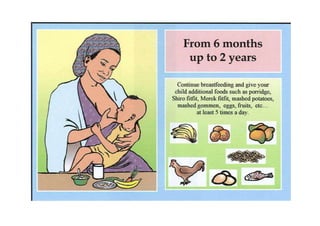
‐ The giving of foods to infants starting at six months, in
addition to breastmilk.
‐ NOT sufficient as on their own as a diet
‐ Should NOT displacebreastmilk
WHAT IS COMPLEMENTARY
FEEDING?
TIME OF COMPLEMENTARY FEEDING OR
WEANING
• Baby is biologically ready to accept semisolids by 4‐6 months
of age
• By 4 months of age intestinal amylase matures and the gut
becomes ready to accept cereals and pulses(legumes)
• Breast milk increases till 6 months of age and it plateaus off
WHY START AT SIX
MONTHS?
• Infant’s intestinal tracts develops immunologically with
defence mechanisms to protect the infant from foreign
proteins.
• The infant’s ability to digest and absorb proteins, fats, and
carbohydrates, other than those in breast milk increases
rapidly.
• The infant’s kidneys develop the ability to excrete the waste
products from foods with a high renal solute load, such as
meat.
• The infant develops the neuromuscular mechanisms needed
for recognizing and accepting a spoon, masticating,
swallowing non liquid foods, and appreciating variation in the
taste and colour offoods.
What are the risks of starting complementary
feeding too early or too late?
• Reduce breast milk production orintake
• Contribute to increased rates of infant mortality and
morbidity.
• Increase the risk of mother becoming pregnant.
• Interfere with ironabsorption
• Reject foods when they are introduced at a later age
• Consume an inadequate variety & amount of food to meet
their nutritional needs.
CONTINUATION OF BREAST
FEEDING
• Breast milk should continue to be the main food of the baby
even when weaning isstarted
• Breast milk should continue as long as feasible ,preferably till
2 years ofage
• This is important as the first 2 years is a period of rapid brain
growth and breast milk contains factors essential for brain
growth anddevelopment
COMPLEMENTARY
FOODS
• Complementary foods can be home made or instant foods
• It is better to start with mono cereals, followed by multi
cereals and cereals‐ pulsecombination
• Cereal like rice is best choice to start as it is gluten free and
easily digestable.
• Cereal pulse combination is better due to fortification of
amino acids as cereals generally lack lysine and pulses lack
methionine.
• The advantage of homemade weaning cereals is that they are
economical, easily available, culturally accepted and closer to
family food andversatile.
• Addition of jaggery for calories and minerals, milk for protein
and oil for calories can make homemade food more nutrient
denser
FAMILY POT
FEEDING
• The acceptance of food from family food should be a part of
mixed feeding regime
• A new food should be introduced in the morning session and
only one item should be introduced at a time
• Around 6 months of age :cereal based porridge( ragi ,suji ,
rice) enriched with jaggery /sugar ,oil /ghee and animalmilk
can be started
• 6‐9 MONTHS :
– Introduce mashed items from the family pot enriched with
jaggery /sugar & oil/ghee
– Mashed rice with pulses ,mashed tubers & vegetables
soups, mashed fruits can be given 4‐5 times a day in
addition to breastmilk
• 9‐12 M0NTHS :
– Introduce soft food that can be chewed.
– By 1 year of age baby should be taking everything cooked
at home. This is called family pot feeding.
– 1 year old child should eat half of what the mother eats
BRIDGING THE CALORIE AND OTHER
NUITRIENT GAP
• The calorie gap can be bridged by using oil/ghee & sugar &
selecting high density food item that will not swell much on
cooking. Ex: egg,potato
• Cereals, pulse combinations, roots & tubers, green leafy
vegetables, seasonal fruits, milk products given to the baby
will bridge the nutrientgap.
• Soaking and malting of grains will increase digestibility and
vitamin content.
13
• Sprouting or germinationwill enhance vitamin content and
make it amylase rich food (ARF) and will decrease bulk on
cooking.
• Fermentation enhances vitamin C anddigestibility
e.g Curd /yogurt.
• The once a day introduction of instant food could be a way of
balancing nutrient gap and one step solution to prevent
malnutrition
DEVELOPING READINESS FOR
FAMILY FOODS
• It is very essential to introduce varied textures and taste throughout
complementary feedingperiod.
• It is essential to advice the mother to differentiate the texture through
the preparation and cookingmethods.
• Introducing new tastes with addition of vegetables ,fruits will expose the
baby to healthy eatingpractices
PREPARATION AND STORAGE OF
WEANING FOODS
• Hand washing with soap and water should be practiced
before cooking andfeeding
• The food stuffs should be freshly prepared
• Precooked ready to mix cereal‐pulse combinations can be
prepared and stored in air tight containers
WEANING OR COMPLEMENTARY
BRIDGE AND SAFETY NET TO
PREVENT MALNUTRITION
• Most of the children fall into pit of malnutrition during the
weaning and post weaningphase
• Jelliffe has suggested a ‘three plank protein bridge’to prevent
PEM.
• Three planks include
1. Continued breastfeeding
2. Introducing vegetableprotein
3. Animal protein
• So safety net is needed beneath the bridge
• This includes utilization of supplementary feeding
programmes as in ICDS, which ensures extra 300 kcal/day
• Those who cant avail this facility should arrange extra feeding
either in play school in form of group eating or at home using
akshayapatra
• Responsive feeding like mother child interaction
during feeding has positiveimpact
WEANING OR COMPLEMENTARY FEEDING
BRIDGE
FEEDING OF
CHILDREN
1) TODDLERS (1‐3 YEARS OFAGE)
• Toddler needs more than half the food that the mother
eats
• Eating while playing, group eating and eating from
special vessel ‘akshayapatra’into which pieces of food
stuff added on,may be adopted
2) PRESCHOOL CHILDREN (3‐6 YEARS )
• A preschool children child should eat half the quantity of food
that the fathereats.
• Group eating and supplementary feeding from the ICDS
anganwadis should me made available to them in addition to
family pot feeding.
3) SCHOOL GOINGCHILDREN
• They should eat three fourth of food that the father eats
• They should take balanced diet and should not miss meals especially
breakfast ,which is brain’sfood.
4) FEEDING DURING ANDAFTER ILLNESS
• Breast feeding and feeding of easily digestible soft food items
should be continued during illness every 2 – 3 hours.
• After the illness give an extra meal for 1‐2 weeks to regain the lost
weight
• GROWTH AND DEVELOPMENTMONITORING
• Frequent weighing and recording on the growth chart are
desirable
• A flat curve or downward curve should be of concern and
appropriate intervention should beinitiated
TEN COMMANDMENTS IN
NUTRITION
1. Be baby friendly and initiate breast feeding soon after birth
2. Practice exclusive demand feeding during the first 4‐6
months ofage
3. Continue breast feeding till 2 years of age, the period of
rapid brain growth andmyelination
4. Build the weaning or complementary bridge at the age of 4‐
6 months
5. Slowly switch over to pot feeding and baby should take
everything cooked at home by one year of age
6.Make a safety net for the young child in the form of
supplementary feeding, group eating or akshayapatra
concept
7. Ensure balanced diet that includes all various food items
and nutrients
8. Ensure extra nutrition during special physiological needs
like illness, adolescence, pregnancy,lactation
9 .Ensure micro nutrients and anti oxidants by including green
leafy vegetables, fruits etc.Also utilize micro nutrient
supplementation programmes like vitamin A, iron, folic
acid, iodine etc.
10. Ensure quality of survival and overall development by
non‐nutritional interventions like socioeconomic
advancement, standards of sanitaion ,immunisation,
periodic dewormimg, tender lovingcare(TLC)
ESPHAGAN (EUROPEAN SOCIETY FOR PAEDIATRIC
GASTROENETEROLOGY ,HEPATOOGY , AND
NUTRITION ) AND WHO RECOMMENDATIONS
1. Introducing weaning foods around 6 months of age and
giving follow on formula in a quantity of not less than 500ml
daily along with complementaryfeeds
2. It has recommended that introduction of gluten be avoided
in select families andcommunities
3. Avoiding foods that may contain high amount of nitrates
during earlymonths
4. Delaying the introduction of highly allergic foods ,such as egg
white and seafish
S
TYPES OF COMMERCIAL WEANING
PREPARATION
• STANDARD CEREALS OR PROCESSEDCEREAL
BASED COMPEMENTARYFOOD
– Commonly called as weaning food or supplementary food
based on cereal/pulses, millets, nuts and edible oil seeds
processed to low moisture content and so fragmented to
permit dilution with water ,milk or other suitable medium.
• COMPLETE CEREALS OR MIK –CEREAL BASED
COMPLEMENTARY FOOD
– These foods are based on milk, cereal, millets, nuts and
edible oil seeds processed to low moisture content and so
fragmented as to permit dilution with water
• PULPY WEANING FOODS
– These are high quality pulp of selected single or
combination of fruit and vegetable pulps packed in
suitable containers.
– These are not available inIndia
• FOLOW ON /FOLLOW‐UPFORMULAS
– Is a food intended for use as a liquid part of the weaning
diet for the infant from the 6th Month onwards till 2 years
of age
• Follow – on formulas should continue to provide about 40%
of the infants energy intake, with about 500 ml to be
consumed everyday
– PROTIEN
• Protein used is of good quality. From sources suchas
milk, eggs andfish
– CALCIUM
• Follow on formulas should contain at least 90 mg of
calcium per 100kcal (50‐140mg/100 kcal)
• FAT
– Fat content of follow –on formula should be higher than
3.3gm /100kcal and it should provide at least 35% of total
energy in theformula
– Linoleic acid content should be between 300 mg and
1200mg /100kcal.
FEATURES OF HOMEMADE
PREPARATIONS AND
COMMERCIAL PREPARATIONS
Thank
You

WEANING.pptx

  • 1.
    WEANING IN INFANTS…..!!! BY DR RIZWAN AHMED ASSISTANT PROFESSOR DEPARTMENT OF PEDIATRICS NKP SIMS NAGPUR
  • 2.
    COMPLEMENTARY FEEDING • DEFINITION – –Complementary feeding is defined as the systematic process of introduction of suitable food at the right time in addition to mothers milk in order to provide needed nutrients to thebaby
  • 4.
    ‐ The givingof foods to infants starting at six months, in addition to breastmilk. ‐ NOT sufficient as on their own as a diet ‐ Should NOT displacebreastmilk WHAT IS COMPLEMENTARY FEEDING?
  • 5.
    TIME OF COMPLEMENTARYFEEDING OR WEANING • Baby is biologically ready to accept semisolids by 4‐6 months of age • By 4 months of age intestinal amylase matures and the gut becomes ready to accept cereals and pulses(legumes) • Breast milk increases till 6 months of age and it plateaus off
  • 6.
    WHY START ATSIX MONTHS? • Infant’s intestinal tracts develops immunologically with defence mechanisms to protect the infant from foreign proteins. • The infant’s ability to digest and absorb proteins, fats, and carbohydrates, other than those in breast milk increases rapidly. • The infant’s kidneys develop the ability to excrete the waste products from foods with a high renal solute load, such as meat. • The infant develops the neuromuscular mechanisms needed for recognizing and accepting a spoon, masticating, swallowing non liquid foods, and appreciating variation in the taste and colour offoods.
  • 7.
    What are therisks of starting complementary feeding too early or too late? • Reduce breast milk production orintake • Contribute to increased rates of infant mortality and morbidity. • Increase the risk of mother becoming pregnant. • Interfere with ironabsorption • Reject foods when they are introduced at a later age • Consume an inadequate variety & amount of food to meet their nutritional needs.
  • 8.
    CONTINUATION OF BREAST FEEDING •Breast milk should continue to be the main food of the baby even when weaning isstarted • Breast milk should continue as long as feasible ,preferably till 2 years ofage • This is important as the first 2 years is a period of rapid brain growth and breast milk contains factors essential for brain growth anddevelopment
  • 9.
    COMPLEMENTARY FOODS • Complementary foodscan be home made or instant foods • It is better to start with mono cereals, followed by multi cereals and cereals‐ pulsecombination • Cereal like rice is best choice to start as it is gluten free and easily digestable. • Cereal pulse combination is better due to fortification of amino acids as cereals generally lack lysine and pulses lack methionine.
  • 10.
    • The advantageof homemade weaning cereals is that they are economical, easily available, culturally accepted and closer to family food andversatile. • Addition of jaggery for calories and minerals, milk for protein and oil for calories can make homemade food more nutrient denser
  • 11.
    FAMILY POT FEEDING • Theacceptance of food from family food should be a part of mixed feeding regime • A new food should be introduced in the morning session and only one item should be introduced at a time • Around 6 months of age :cereal based porridge( ragi ,suji , rice) enriched with jaggery /sugar ,oil /ghee and animalmilk can be started
  • 12.
    • 6‐9 MONTHS: – Introduce mashed items from the family pot enriched with jaggery /sugar & oil/ghee – Mashed rice with pulses ,mashed tubers & vegetables soups, mashed fruits can be given 4‐5 times a day in addition to breastmilk • 9‐12 M0NTHS : – Introduce soft food that can be chewed. – By 1 year of age baby should be taking everything cooked at home. This is called family pot feeding. – 1 year old child should eat half of what the mother eats
  • 13.
    BRIDGING THE CALORIEAND OTHER NUITRIENT GAP • The calorie gap can be bridged by using oil/ghee & sugar & selecting high density food item that will not swell much on cooking. Ex: egg,potato • Cereals, pulse combinations, roots & tubers, green leafy vegetables, seasonal fruits, milk products given to the baby will bridge the nutrientgap. • Soaking and malting of grains will increase digestibility and vitamin content. 13
  • 14.
    • Sprouting orgerminationwill enhance vitamin content and make it amylase rich food (ARF) and will decrease bulk on cooking. • Fermentation enhances vitamin C anddigestibility e.g Curd /yogurt. • The once a day introduction of instant food could be a way of balancing nutrient gap and one step solution to prevent malnutrition
  • 15.
    DEVELOPING READINESS FOR FAMILYFOODS • It is very essential to introduce varied textures and taste throughout complementary feedingperiod. • It is essential to advice the mother to differentiate the texture through the preparation and cookingmethods. • Introducing new tastes with addition of vegetables ,fruits will expose the baby to healthy eatingpractices
  • 16.
    PREPARATION AND STORAGEOF WEANING FOODS • Hand washing with soap and water should be practiced before cooking andfeeding • The food stuffs should be freshly prepared • Precooked ready to mix cereal‐pulse combinations can be prepared and stored in air tight containers
  • 17.
    WEANING OR COMPLEMENTARY BRIDGEAND SAFETY NET TO PREVENT MALNUTRITION • Most of the children fall into pit of malnutrition during the weaning and post weaningphase • Jelliffe has suggested a ‘three plank protein bridge’to prevent PEM. • Three planks include 1. Continued breastfeeding 2. Introducing vegetableprotein 3. Animal protein
  • 18.
    • So safetynet is needed beneath the bridge • This includes utilization of supplementary feeding programmes as in ICDS, which ensures extra 300 kcal/day • Those who cant avail this facility should arrange extra feeding either in play school in form of group eating or at home using akshayapatra • Responsive feeding like mother child interaction during feeding has positiveimpact
  • 19.
  • 20.
    FEEDING OF CHILDREN 1) TODDLERS(1‐3 YEARS OFAGE) • Toddler needs more than half the food that the mother eats • Eating while playing, group eating and eating from special vessel ‘akshayapatra’into which pieces of food stuff added on,may be adopted
  • 21.
    2) PRESCHOOL CHILDREN(3‐6 YEARS ) • A preschool children child should eat half the quantity of food that the fathereats. • Group eating and supplementary feeding from the ICDS anganwadis should me made available to them in addition to family pot feeding.
  • 22.
    3) SCHOOL GOINGCHILDREN •They should eat three fourth of food that the father eats • They should take balanced diet and should not miss meals especially breakfast ,which is brain’sfood. 4) FEEDING DURING ANDAFTER ILLNESS • Breast feeding and feeding of easily digestible soft food items should be continued during illness every 2 – 3 hours. • After the illness give an extra meal for 1‐2 weeks to regain the lost weight
  • 23.
    • GROWTH ANDDEVELOPMENTMONITORING • Frequent weighing and recording on the growth chart are desirable • A flat curve or downward curve should be of concern and appropriate intervention should beinitiated
  • 24.
    TEN COMMANDMENTS IN NUTRITION 1.Be baby friendly and initiate breast feeding soon after birth 2. Practice exclusive demand feeding during the first 4‐6 months ofage 3. Continue breast feeding till 2 years of age, the period of rapid brain growth andmyelination 4. Build the weaning or complementary bridge at the age of 4‐ 6 months 5. Slowly switch over to pot feeding and baby should take everything cooked at home by one year of age
  • 25.
    6.Make a safetynet for the young child in the form of supplementary feeding, group eating or akshayapatra concept 7. Ensure balanced diet that includes all various food items and nutrients 8. Ensure extra nutrition during special physiological needs like illness, adolescence, pregnancy,lactation 9 .Ensure micro nutrients and anti oxidants by including green leafy vegetables, fruits etc.Also utilize micro nutrient supplementation programmes like vitamin A, iron, folic acid, iodine etc. 10. Ensure quality of survival and overall development by non‐nutritional interventions like socioeconomic advancement, standards of sanitaion ,immunisation, periodic dewormimg, tender lovingcare(TLC)
  • 26.
    ESPHAGAN (EUROPEAN SOCIETYFOR PAEDIATRIC GASTROENETEROLOGY ,HEPATOOGY , AND NUTRITION ) AND WHO RECOMMENDATIONS 1. Introducing weaning foods around 6 months of age and giving follow on formula in a quantity of not less than 500ml daily along with complementaryfeeds 2. It has recommended that introduction of gluten be avoided in select families andcommunities 3. Avoiding foods that may contain high amount of nitrates during earlymonths 4. Delaying the introduction of highly allergic foods ,such as egg white and seafish
  • 27.
    S TYPES OF COMMERCIALWEANING PREPARATION • STANDARD CEREALS OR PROCESSEDCEREAL BASED COMPEMENTARYFOOD – Commonly called as weaning food or supplementary food based on cereal/pulses, millets, nuts and edible oil seeds processed to low moisture content and so fragmented to permit dilution with water ,milk or other suitable medium.
  • 28.
    • COMPLETE CEREALSOR MIK –CEREAL BASED COMPLEMENTARY FOOD – These foods are based on milk, cereal, millets, nuts and edible oil seeds processed to low moisture content and so fragmented as to permit dilution with water
  • 29.
    • PULPY WEANINGFOODS – These are high quality pulp of selected single or combination of fruit and vegetable pulps packed in suitable containers. – These are not available inIndia • FOLOW ON /FOLLOW‐UPFORMULAS – Is a food intended for use as a liquid part of the weaning diet for the infant from the 6th Month onwards till 2 years of age
  • 30.
    • Follow –on formulas should continue to provide about 40% of the infants energy intake, with about 500 ml to be consumed everyday – PROTIEN • Protein used is of good quality. From sources suchas milk, eggs andfish – CALCIUM • Follow on formulas should contain at least 90 mg of calcium per 100kcal (50‐140mg/100 kcal)
  • 31.
    • FAT – Fatcontent of follow –on formula should be higher than 3.3gm /100kcal and it should provide at least 35% of total energy in theformula – Linoleic acid content should be between 300 mg and 1200mg /100kcal.
  • 32.
    FEATURES OF HOMEMADE PREPARATIONSAND COMMERCIAL PREPARATIONS
  • 33.