MDG: CSO Meeting
11 August 2013
KZN REPORT
1. Proposed CSOs to form part of the MDG process
(Based on views and interactions)
2
There is a rich diversity of civil society
organisations in KZN with the potential to
contribute meaningfully to MDG processes
and reporting:
• 104 large networked civil society orgs
categorised by goal and forwarded to
province and national Stats SA
• Elicited opinion from 9 large, networked
orgs – cutting across 8 MDGs
• Commitment to participate in future
national and provincial level meetings
from all 9 organisations
1. Proposed CSOs to form part of the MDG process
(Based on views and interactions)
3
KZN Orgs present today:
• info4africa
• Religions for Peace (WCRP)
• Centre for AIDS Programme of Research
in South Africa (CAPRISA)
• Diakonia
KZN Orgs Committed to Future
Participation:
• Child Welfare South Africa (CWSA)
• Children’s Rights Centre (CRC)
• Wildlands Conservation Trust
• KZN Provincial Social Welfare Forum
• Families South Africa (FAMSA)
Thoughts from KZN CSOs
• Info4africa
• Religions for Peace (WCRP)
• CAPRISA
• MATCH
• Diakonia
• Wildlands Conservation Trust
• Community Grants Programme, PEPFAR
4
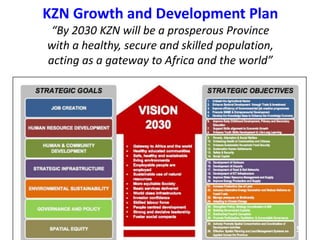
KZN Growth and Development Plan
“By 2030 KZN will be a prosperous Province
with a healthy, secure and skilled population,
acting as a gateway to Africa and the world”
5
1: Eradicate Extreme Poverty & Hunger
• Job Creation – KZN needs 2,1 mil new jobs by 2030
• Requires grown in KZN economy by 4% p.a.
– Currently quarterly grown negative (1,8% / 2,1%)
– Govt solution is 18 strategic infrastructure projects hoping to
create millions of jobs whilst providing infrastructure and
building the economy
– 15 in KZN including the Dig Out Port & Logistics and Industrial
Corridor between KZN, FS and GT
• KZN prov budget allocates R13 billion in dev projects
• Housing – since 2009 KZN has produced 85 733 new
housing units and upgraded 6386 units
• Electricity - now available to 76,68% of homes
• Operation Sakuma Sakhe coordinated response to poverty
6
1: Eradicate Extreme Poverty & Hunger
7
Diakonia Council of Churches & Religions for Peace have
for years worked in socio-economic development and
currently support a variety of self-help programmes.
Wildlands Conservation Trust has a pro-poor focus –
enabling green entrepreneurs instead of job creation and
dependency on govt grants
• involving women- and child-headed households in rural
and per-urban areas in large scale recycling operations
• R20 million in funding by govt has been channeled to
communities in the form of barter goods for trees and
waste and as wages for temporary labour.
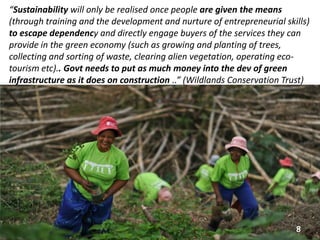
“Sustainability will only be realised once people are given the means
(through training and the development and nurture of entrepreneurial skills)
to escape dependency and directly engage buyers of the services they can
provide in the green economy (such as growing and planting of trees,
collecting and sorting of waste, clearing alien vegetation, operating eco-
tourism etc).. Govt needs to put as much money into the dev of green
infrastructure as it does on construction ..” (Wildlands Conservation Trust)
8
2: Achieve Universal Primary Education
Education
• 95,2% if 5 year olds in KZN in School
• ECD is a firm priority of KZN but more 0 to 4 year olds need to receive ECD
9
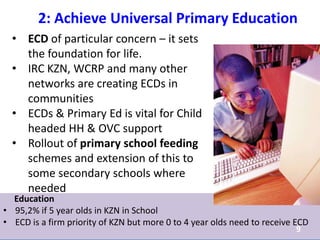
• ECD of particular concern – it sets
the foundation for life.
• IRC KZN, WCRP and many other
networks are creating ECDs in
communities
• ECDs & Primary Ed is vital for Child
headed HH & OVC support
• Rollout of primary school feeding
schemes and extension of this to
some secondary schools where
needed
3: Promote Gender Equality & Empower Women
• In KZN one in 4 women experiences sexual violence
• 28% of all KZN school girls experience sexual violence
• School children in the Religions for Peace / info4africa Youth
Peace Forum report purposefully wearing tight cycling shorts
under their uniforms to make rape more difficult
• Significant training & dialogue creation has been done in Human
Rights for All and GBV by the religious sector since 2002
• SA Women of Faith Network – bringing women together and
focus on the girl child in all countries
• OTP actively targets social dev and women’s empowerment
projects through Zimele Developing Community Self-Reliance –
small business development with a focus on community
development
10
11
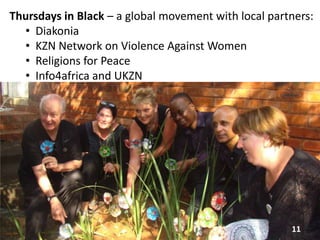
Thursdays in Black – a global movement with local partners:
• Diakonia
• KZN Network on Violence Against Women
• Religions for Peace
• Info4africa and UKZN
4: Reduce Child Mortality
• Info4africa
12
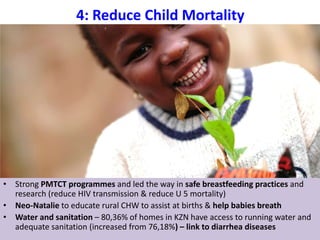
• Strong PMTCT programmes and led the way in safe breastfeeding practices and
research (reduce HIV transmission & reduce U 5 mortality)
• Neo-Natalie to educate rural CHW to assist at births & help babies breath
• Water and sanitation – 80,36% of homes in KZN have access to running water and
adequate sanitation (increased from 76,18%) – link to diarrhea diseases
5: Improve Maternal Health
"Every 90 seconds, a woman dies of complications related to
pregnancy and childbirth” (ACRL)
• KZN took the lead in the launch and roll out of CARMMA – save mother
save the child
• We have some of the best pediatricians and child health specialists in
KZN working in partnership with the Municipalities and Province on
PMTCT, Infant feeding policies and health systems strengthening
– MATCH; ZoeLife; Islamic Medical Association
– Department of Paediatrics, UKZN
– Medical Research Council
– CAPRISA
• Partnerships with CSOs to create birthing kits; bring knowledge of “Neo-
Natalie” and other innovations from abroad
13
6: Combat HIV/AIDS, Malaria & other Diseases
• HIV/AIDS
– downturn in HIV prevalence rates in KZN from 39,5% in 2009 to 37,4% in 2012.
– Age group 15 to 24 is pleasing with prevalence decreased to 25,5% (in 2009: 31%)
14
• KZN is leading testing for TB and HIV
• K-RITH is one of the most advanced TB HIV research labs in
the world driving innovation in the control of these diseases
• CAPRISA drives innovative breakthroughs in Microbicides &
integrated TB HIV treatment research and practice
• PEPFAR sees “country ownership as a fundamental element of
progress towards more sustainable management of the
HIV/AIDS response in partner countries”
• PEPFAR says “KZN also at forefront of fight against Malaria and
we have seen great strides towards that” – estuary spraying
• We need to beware the shifting focus – are we preparing??
15
7: Ensure Environmental Sustainability
16
Wildlands Conservation Trust says KZN is at the forefront of
environmental conservation
• Provincially, OTP leads a partnership with Wildlands
Conservation Trust called the Integrated Greening
Programme. This is a pilot in development of the green
economy, working at the interface between community (rural
and urban) development and environmental conservation
• At municipal level, eThekwini is actively addressing climate
change and risk mitigation, at the same time answering the
pressures of population growth and unsustainable
development.
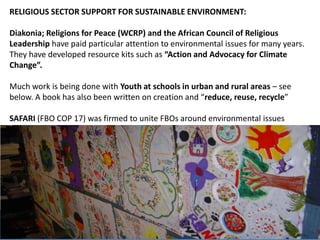
RELIGIOUS SECTOR SUPPORT FOR SUSTAINABLE ENVIRONMENT:
Diakonia; Religions for Peace (WCRP) and the African Council of Religious
Leadership have paid particular attention to environmental issues for many years.
They have developed resource kits such as “Action and Advocacy for Climate
Change”.
Much work is being done with Youth at schools in urban and rural areas – see
below. A book has also been written on creation and “reduce, reuse, recycle”
SAFARI (FBO COP 17) was firmed to unite FBOs around environmental issues
17
18
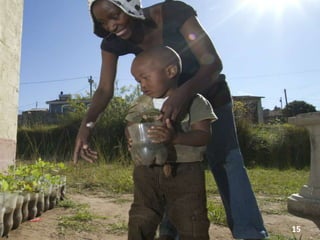
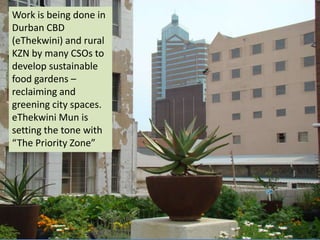
Work is being done in
Durban CBD
(eThekwini) and rural
KZN by many CSOs to
develop sustainable
food gardens –
reclaiming and
greening city spaces.
eThekwini Mun is
setting the tone with
“The Priority Zone”
8: Develop a Global Partnership for Development
• Holding COP17 in Durban helped to turn the
focus to environmental issues in KZN
– We have seen a marked increase in urban food
gardens and support for indigenous plants,
eradication of alien vegetation (esp along our
waterways)
– We have more RDP houses with solar water geysers
• Rising fuel costs and shrinking economic activity
is hurting KZNs ability to reach MDGs
• More people are growing their own food as a
solution to high food costs
19
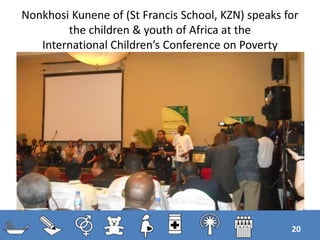
Nonkhosi Kunene of (St Francis School, KZN) speaks for
the children & youth of Africa at the
International Children’s Conference on Poverty
20
21
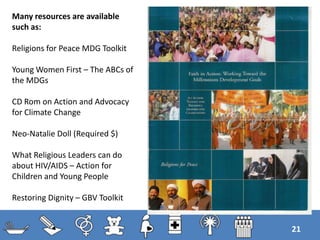
Many resources are available
such as:
Religions for Peace MDG Toolkit
Young Women First – The ABCs of
the MDGs
CD Rom on Action and Advocacy
for Climate Change
Neo-Natalie Doll (Required $)
What Religious Leaders can do
about HIV/AIDS – Action for
Children and Young People
Restoring Dignity – GBV Toolkit

WCRP Forum | March 2013 | Presentation 1

  • 1.
    MDG: CSO Meeting 11August 2013 KZN REPORT
  • 2.
    1. Proposed CSOsto form part of the MDG process (Based on views and interactions) 2 There is a rich diversity of civil society organisations in KZN with the potential to contribute meaningfully to MDG processes and reporting: • 104 large networked civil society orgs categorised by goal and forwarded to province and national Stats SA • Elicited opinion from 9 large, networked orgs – cutting across 8 MDGs • Commitment to participate in future national and provincial level meetings from all 9 organisations
  • 3.
    1. Proposed CSOsto form part of the MDG process (Based on views and interactions) 3 KZN Orgs present today: • info4africa • Religions for Peace (WCRP) • Centre for AIDS Programme of Research in South Africa (CAPRISA) • Diakonia KZN Orgs Committed to Future Participation: • Child Welfare South Africa (CWSA) • Children’s Rights Centre (CRC) • Wildlands Conservation Trust • KZN Provincial Social Welfare Forum • Families South Africa (FAMSA)
  • 4.
    Thoughts from KZNCSOs • Info4africa • Religions for Peace (WCRP) • CAPRISA • MATCH • Diakonia • Wildlands Conservation Trust • Community Grants Programme, PEPFAR 4
  • 5.
    KZN Growth andDevelopment Plan “By 2030 KZN will be a prosperous Province with a healthy, secure and skilled population, acting as a gateway to Africa and the world” 5
  • 6.
    1: Eradicate ExtremePoverty & Hunger • Job Creation – KZN needs 2,1 mil new jobs by 2030 • Requires grown in KZN economy by 4% p.a. – Currently quarterly grown negative (1,8% / 2,1%) – Govt solution is 18 strategic infrastructure projects hoping to create millions of jobs whilst providing infrastructure and building the economy – 15 in KZN including the Dig Out Port & Logistics and Industrial Corridor between KZN, FS and GT • KZN prov budget allocates R13 billion in dev projects • Housing – since 2009 KZN has produced 85 733 new housing units and upgraded 6386 units • Electricity - now available to 76,68% of homes • Operation Sakuma Sakhe coordinated response to poverty 6
  • 7.
    1: Eradicate ExtremePoverty & Hunger 7 Diakonia Council of Churches & Religions for Peace have for years worked in socio-economic development and currently support a variety of self-help programmes. Wildlands Conservation Trust has a pro-poor focus – enabling green entrepreneurs instead of job creation and dependency on govt grants • involving women- and child-headed households in rural and per-urban areas in large scale recycling operations • R20 million in funding by govt has been channeled to communities in the form of barter goods for trees and waste and as wages for temporary labour.
  • 8.
    “Sustainability will onlybe realised once people are given the means (through training and the development and nurture of entrepreneurial skills) to escape dependency and directly engage buyers of the services they can provide in the green economy (such as growing and planting of trees, collecting and sorting of waste, clearing alien vegetation, operating eco- tourism etc).. Govt needs to put as much money into the dev of green infrastructure as it does on construction ..” (Wildlands Conservation Trust) 8
  • 9.
    2: Achieve UniversalPrimary Education Education • 95,2% if 5 year olds in KZN in School • ECD is a firm priority of KZN but more 0 to 4 year olds need to receive ECD 9 • ECD of particular concern – it sets the foundation for life. • IRC KZN, WCRP and many other networks are creating ECDs in communities • ECDs & Primary Ed is vital for Child headed HH & OVC support • Rollout of primary school feeding schemes and extension of this to some secondary schools where needed
  • 10.
    3: Promote GenderEquality & Empower Women • In KZN one in 4 women experiences sexual violence • 28% of all KZN school girls experience sexual violence • School children in the Religions for Peace / info4africa Youth Peace Forum report purposefully wearing tight cycling shorts under their uniforms to make rape more difficult • Significant training & dialogue creation has been done in Human Rights for All and GBV by the religious sector since 2002 • SA Women of Faith Network – bringing women together and focus on the girl child in all countries • OTP actively targets social dev and women’s empowerment projects through Zimele Developing Community Self-Reliance – small business development with a focus on community development 10
  • 11.
    11 Thursdays in Black– a global movement with local partners: • Diakonia • KZN Network on Violence Against Women • Religions for Peace • Info4africa and UKZN
  • 12.
    4: Reduce ChildMortality • Info4africa 12 • Strong PMTCT programmes and led the way in safe breastfeeding practices and research (reduce HIV transmission & reduce U 5 mortality) • Neo-Natalie to educate rural CHW to assist at births & help babies breath • Water and sanitation – 80,36% of homes in KZN have access to running water and adequate sanitation (increased from 76,18%) – link to diarrhea diseases
  • 13.
    5: Improve MaternalHealth "Every 90 seconds, a woman dies of complications related to pregnancy and childbirth” (ACRL) • KZN took the lead in the launch and roll out of CARMMA – save mother save the child • We have some of the best pediatricians and child health specialists in KZN working in partnership with the Municipalities and Province on PMTCT, Infant feeding policies and health systems strengthening – MATCH; ZoeLife; Islamic Medical Association – Department of Paediatrics, UKZN – Medical Research Council – CAPRISA • Partnerships with CSOs to create birthing kits; bring knowledge of “Neo- Natalie” and other innovations from abroad 13
  • 14.
    6: Combat HIV/AIDS,Malaria & other Diseases • HIV/AIDS – downturn in HIV prevalence rates in KZN from 39,5% in 2009 to 37,4% in 2012. – Age group 15 to 24 is pleasing with prevalence decreased to 25,5% (in 2009: 31%) 14 • KZN is leading testing for TB and HIV • K-RITH is one of the most advanced TB HIV research labs in the world driving innovation in the control of these diseases • CAPRISA drives innovative breakthroughs in Microbicides & integrated TB HIV treatment research and practice • PEPFAR sees “country ownership as a fundamental element of progress towards more sustainable management of the HIV/AIDS response in partner countries” • PEPFAR says “KZN also at forefront of fight against Malaria and we have seen great strides towards that” – estuary spraying • We need to beware the shifting focus – are we preparing??
  • 15.
  • 16.
    7: Ensure EnvironmentalSustainability 16 Wildlands Conservation Trust says KZN is at the forefront of environmental conservation • Provincially, OTP leads a partnership with Wildlands Conservation Trust called the Integrated Greening Programme. This is a pilot in development of the green economy, working at the interface between community (rural and urban) development and environmental conservation • At municipal level, eThekwini is actively addressing climate change and risk mitigation, at the same time answering the pressures of population growth and unsustainable development.
  • 17.
    RELIGIOUS SECTOR SUPPORTFOR SUSTAINABLE ENVIRONMENT: Diakonia; Religions for Peace (WCRP) and the African Council of Religious Leadership have paid particular attention to environmental issues for many years. They have developed resource kits such as “Action and Advocacy for Climate Change”. Much work is being done with Youth at schools in urban and rural areas – see below. A book has also been written on creation and “reduce, reuse, recycle” SAFARI (FBO COP 17) was firmed to unite FBOs around environmental issues 17
  • 18.
    18 Work is beingdone in Durban CBD (eThekwini) and rural KZN by many CSOs to develop sustainable food gardens – reclaiming and greening city spaces. eThekwini Mun is setting the tone with “The Priority Zone”
  • 19.
    8: Develop aGlobal Partnership for Development • Holding COP17 in Durban helped to turn the focus to environmental issues in KZN – We have seen a marked increase in urban food gardens and support for indigenous plants, eradication of alien vegetation (esp along our waterways) – We have more RDP houses with solar water geysers • Rising fuel costs and shrinking economic activity is hurting KZNs ability to reach MDGs • More people are growing their own food as a solution to high food costs 19
  • 20.
    Nonkhosi Kunene of(St Francis School, KZN) speaks for the children & youth of Africa at the International Children’s Conference on Poverty 20
  • 21.
    21 Many resources areavailable such as: Religions for Peace MDG Toolkit Young Women First – The ABCs of the MDGs CD Rom on Action and Advocacy for Climate Change Neo-Natalie Doll (Required $) What Religious Leaders can do about HIV/AIDS – Action for Children and Young People Restoring Dignity – GBV Toolkit