CLASSIFICATION OF 
WORKING CAPITAL 
PRESENTED BY: 
ALEENA CHACKOCHAN 
MACFAST
WORKING CAPITAL 
Working Capital refers to that part of the firm’s 
capital, which is required for financing short-term or 
current assets such as cash marketable securities, debtors 
and inventories. Funds thus, invested in current assets 
keep revolving fast and are constantly converted into cash 
and this cash flow out again in exchange for other current 
assets. Working Capital is also known as revolving or 
circulating capital or short-term capital.
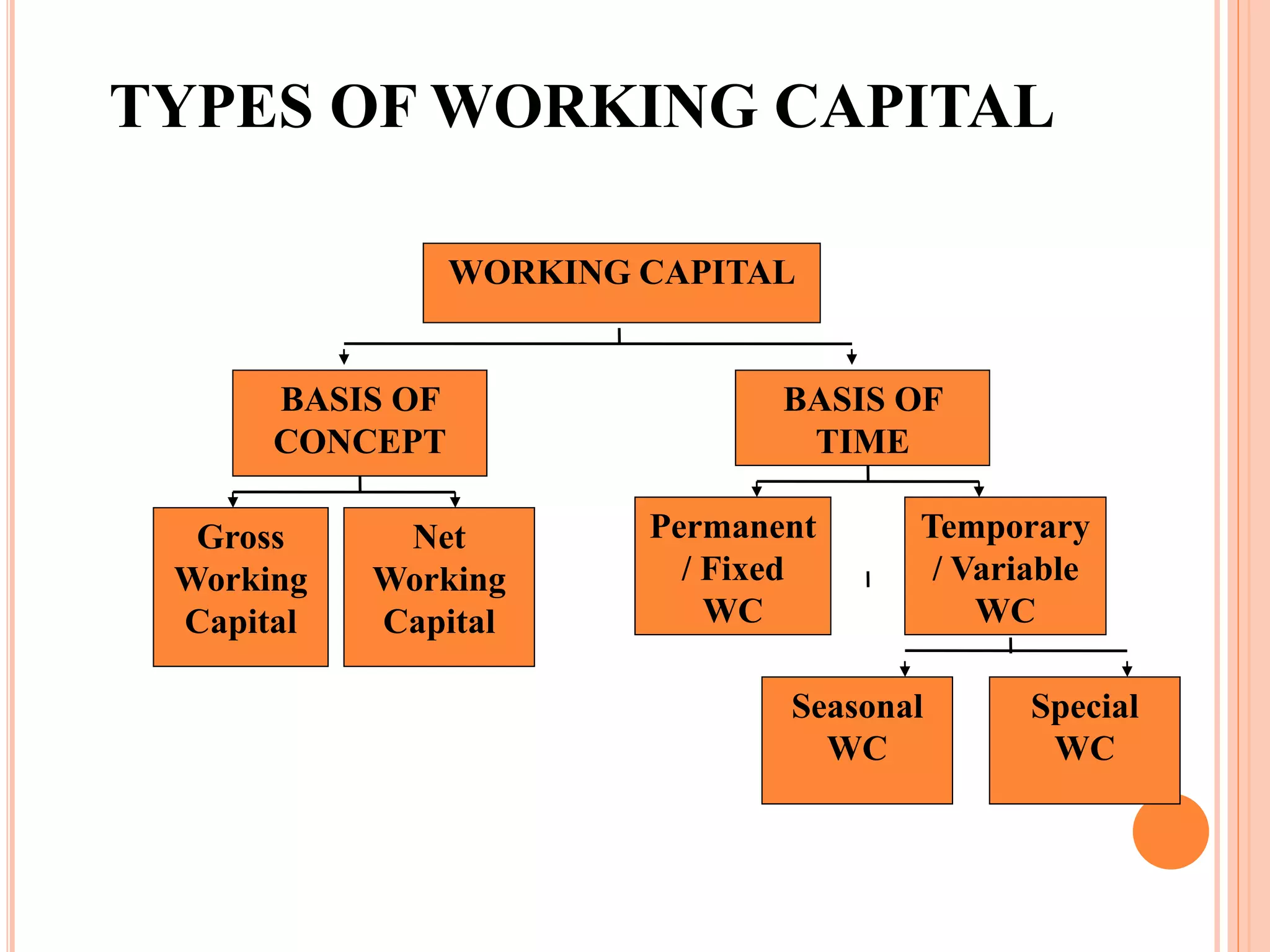
TYPES OF WORKING CAPITAL 
WORKING CAPITAL 
BASIS OF 
CONCEPT 
BASIS OF 
TIME 
Gross 
Working 
Capital 
Net 
Working 
Capital 
Permanent 
/ Fixed 
WC 
Temporary 
/ Variable 
WC 
Special 
WC 
Seasonal 
WC
GROSS WORKING CAPITAL 
Gross working capital require that a firm have 
adequate investment in current assets and proper 
management of theses asset. 
It should be neither excessive nor inadequate asset. 
If there are surplus funds they should be immediately 
invested, and if the funds become low and the 
requirement is greater the financial manager should be 
able to get the required finance so that the commitments of 
the firm can be made short notice.
NET WORKING CAPITAL 
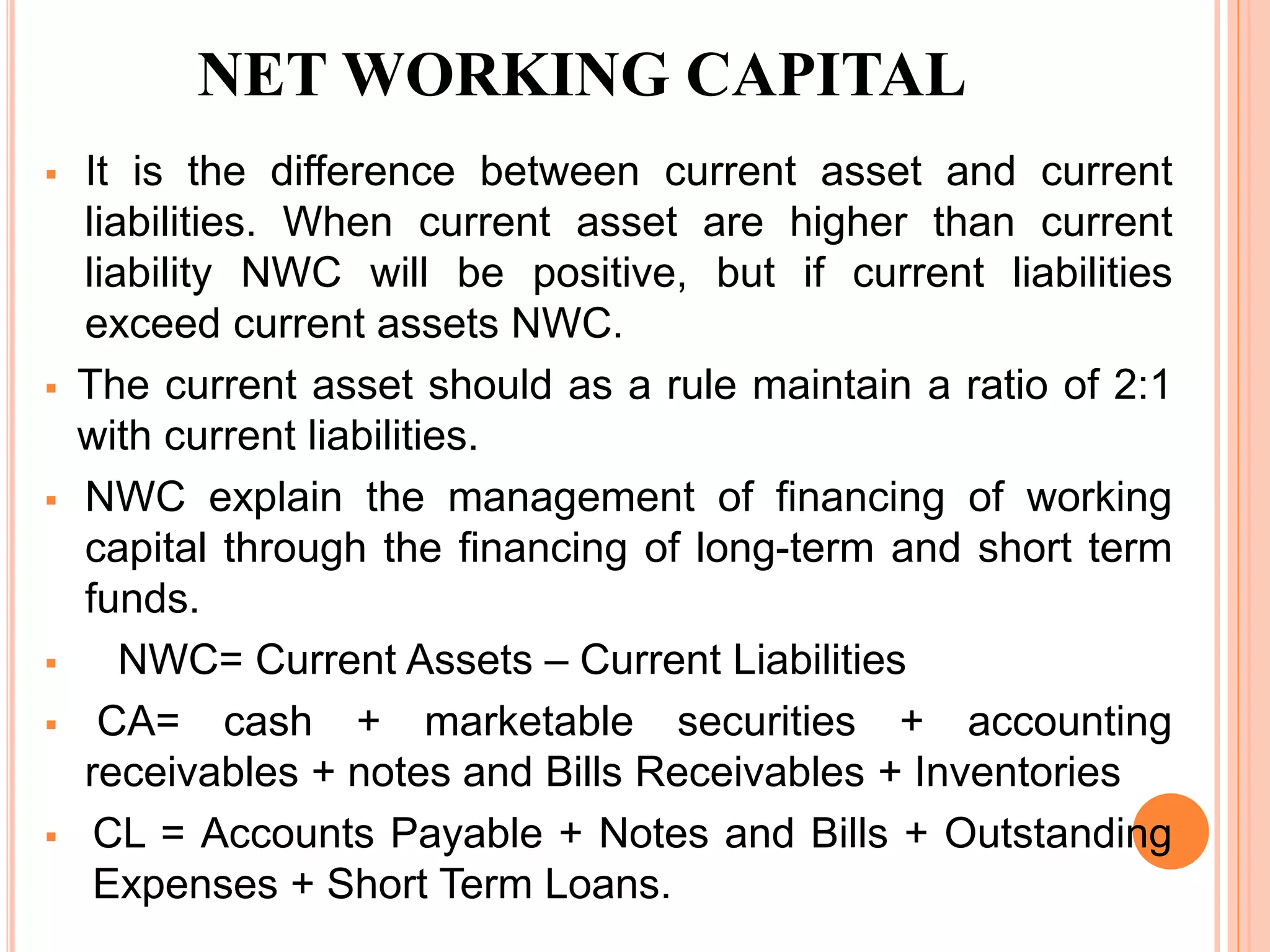
 It is the difference between current asset and current 
liabilities. When current asset are higher than current 
liability NWC will be positive, but if current liabilities 
exceed current assets NWC. 
 The current asset should as a rule maintain a ratio of 2:1 
with current liabilities. 
 NWC explain the management of financing of working 
capital through the financing of long-term and short term 
funds. 
 NWC= Current Assets – Current Liabilities 
 CA= cash + marketable securities + accounting 
receivables + notes and Bills Receivables + Inventories 
 CL = Accounts Payable + Notes and Bills + Outstanding 
Expenses + Short Term Loans.
DIFFERENCE BETWEEN NET WORKING 
CAPITAL AND GROSS WORKING CAPITAL 
Net Working Capital Gross Working Capital 
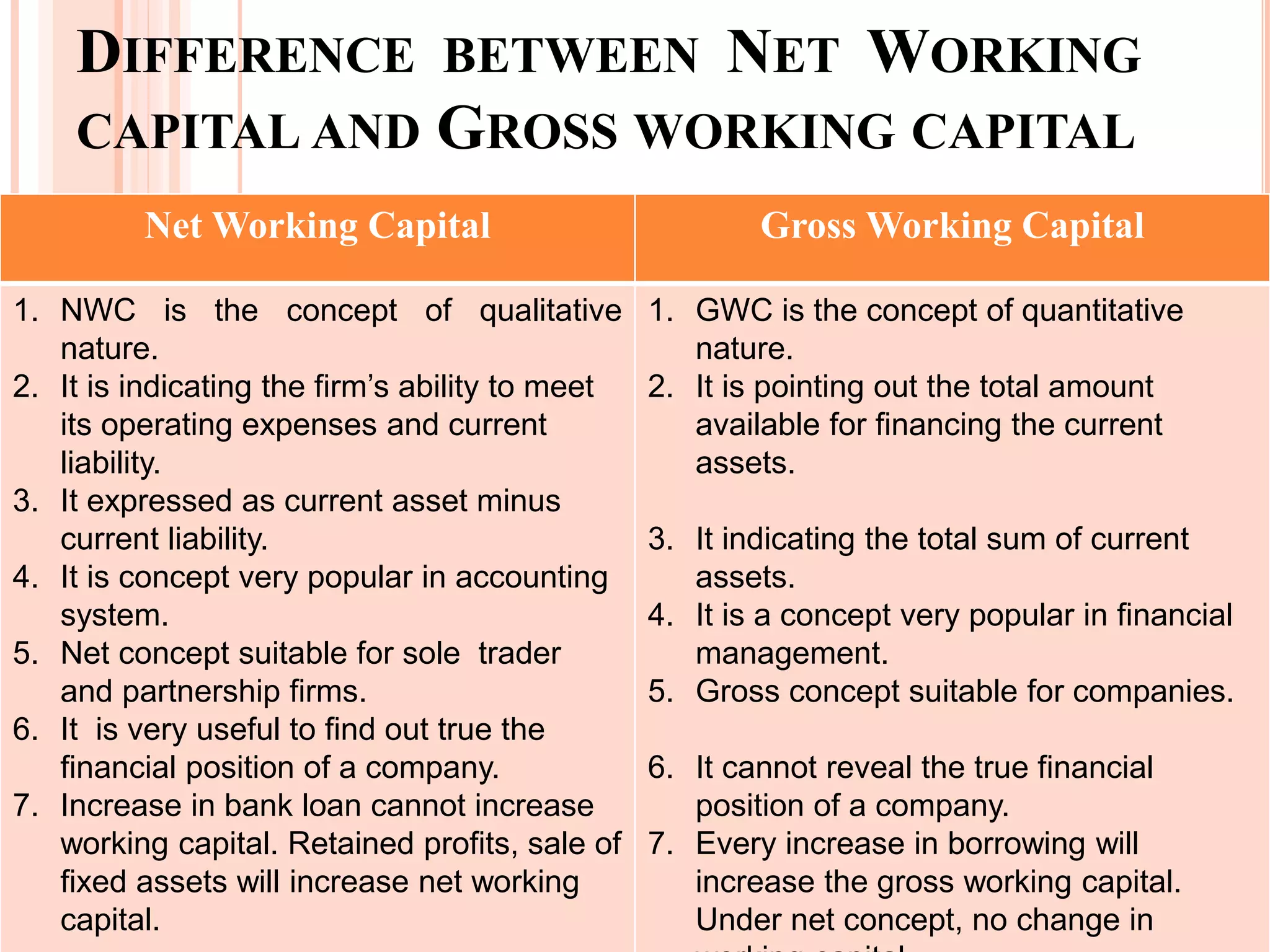
1. NWC is the concept of qualitative 
nature. 
2. It is indicating the firm’s ability to meet 
its operating expenses and current 
liability. 
3. It expressed as current asset minus 
current liability. 
4. It is concept very popular in accounting 
system. 
5. Net concept suitable for sole trader 
and partnership firms. 
6. It is very useful to find out true the 
financial position of a company. 
7. Increase in bank loan cannot increase 
working capital. Retained profits, sale of 
fixed assets will increase net working 
capital. 
1. GWC is the concept of quantitative 
nature. 
2. It is pointing out the total amount 
available for financing the current 
assets. 
3. It indicating the total sum of current 
assets. 
4. It is a concept very popular in financial 
management. 
5. Gross concept suitable for companies. 
6. It cannot reveal the true financial 
position of a company. 
7. Every increase in borrowing will 
increase the gross working capital. 
Under net concept, no change in 
working capital.
PERMANENT OR REGULAR 
WORKING CAPITAL 
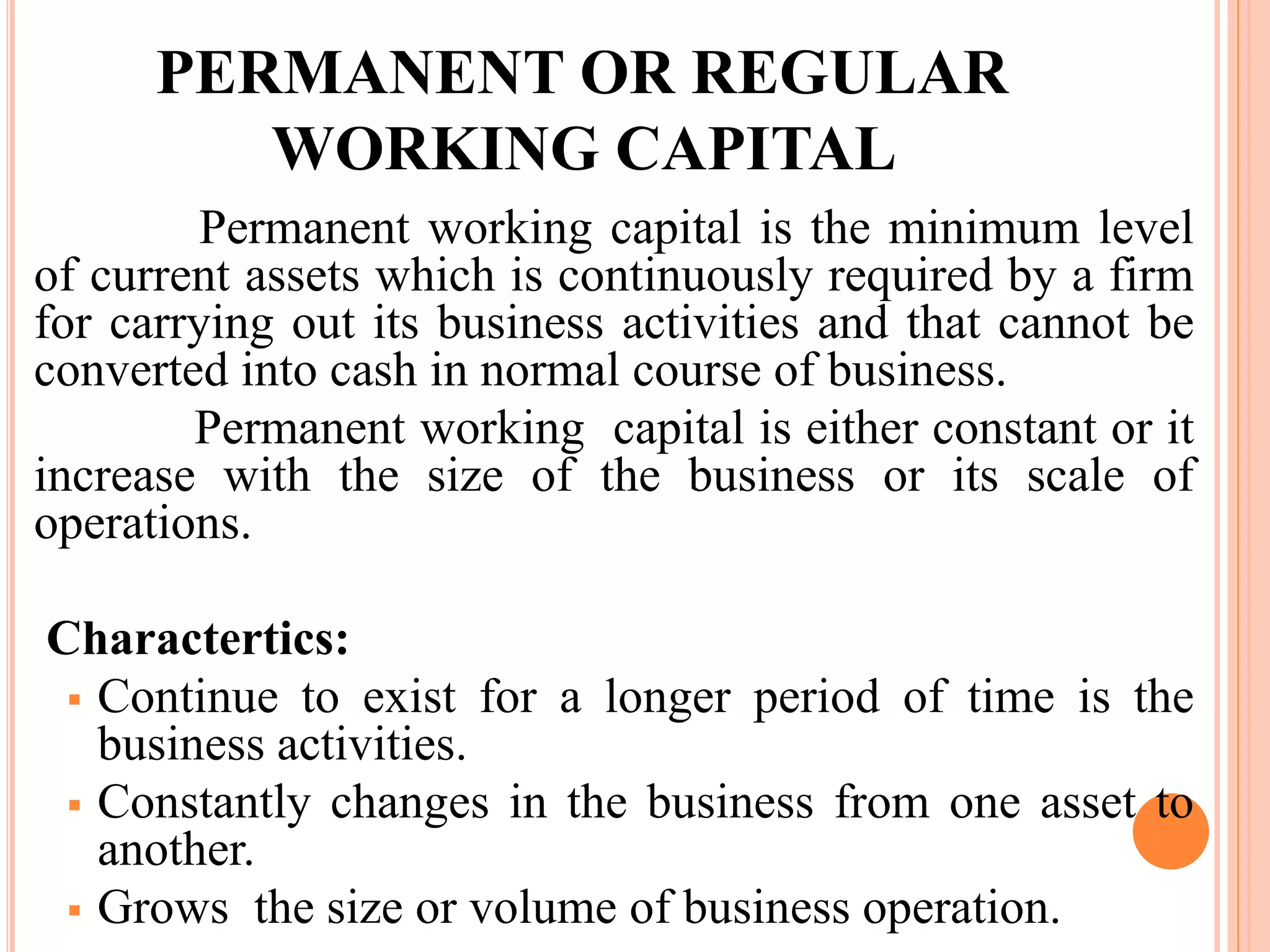
Permanent working capital is the minimum level 
of current assets which is continuously required by a firm 
for carrying out its business activities and that cannot be 
converted into cash in normal course of business. 
Permanent working capital is either constant or it 
increase with the size of the business or its scale of 
operations. 
Charactertics: 
 Continue to exist for a longer period of time is the 
business activities. 
 Constantly changes in the business from one asset to 
another. 
 Grows the size or volume of business operation.
TEMPORARY OR VARIABLE 
WORKING CAPITAL 
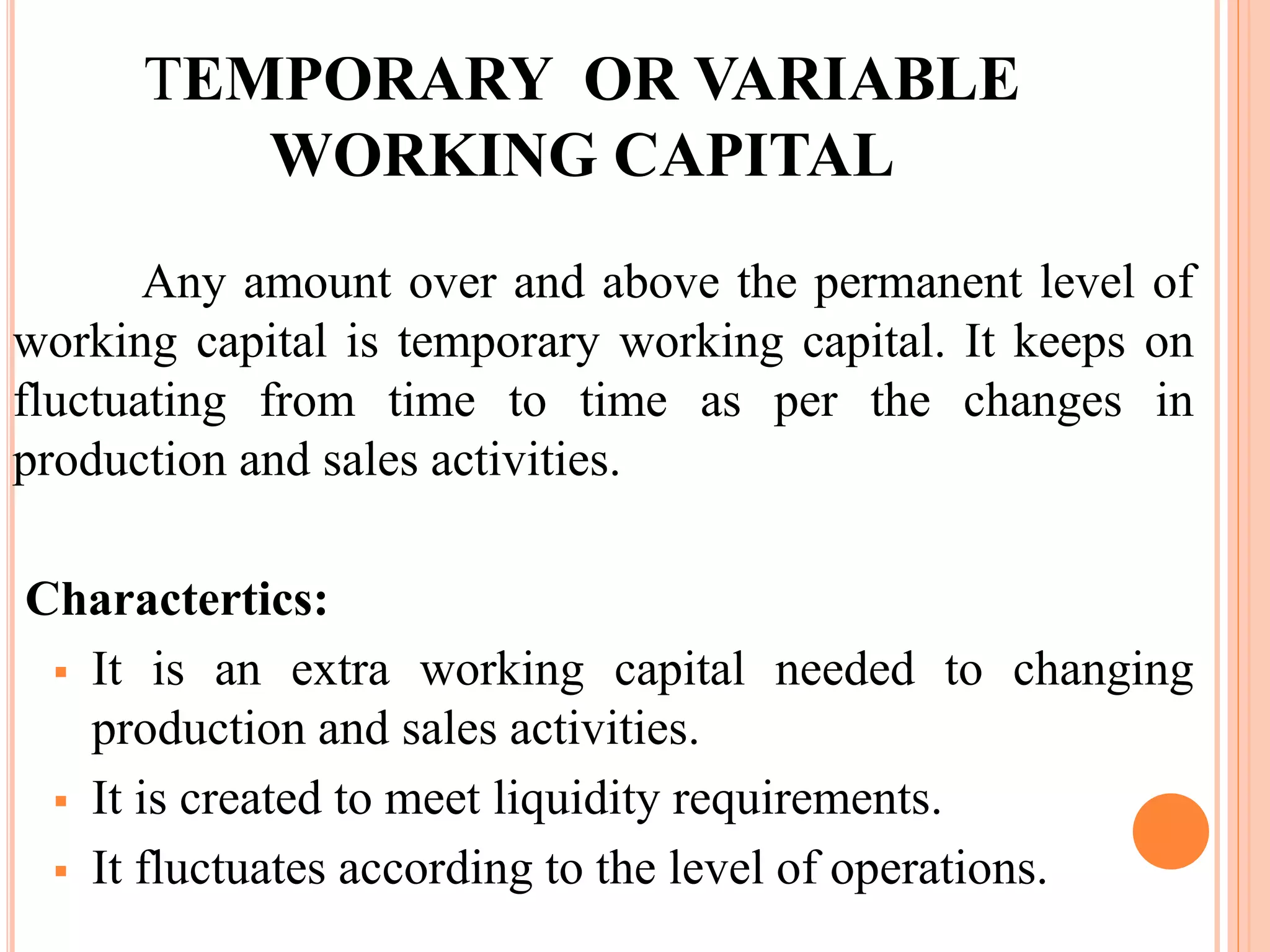
Any amount over and above the permanent level of 
working capital is temporary working capital. It keeps on 
fluctuating from time to time as per the changes in 
production and sales activities. 
Charactertics: 
 It is an extra working capital needed to changing 
production and sales activities. 
 It is created to meet liquidity requirements. 
 It fluctuates according to the level of operations.
 Temporary working capital is fluctuating during the 
operating period. 
 It is needed for shorter period. 
Two types of temporary working capital 
• Seasonal working capital. 
• Specific working capital.
SEASONAL WORKING CAPITAL 
The capital required to meet the seasonal 
demands of the enterprise is called seasonal working 
capital. 
For example, a manufacture of woolen textiles, 
refrigerators or coolers may need extra funds to carry on 
production and to accumulate stock before the sales 
operations. 
Seasonal working capital being of short-term 
nature, it has to be financed from short-term sources like 
bank loan etc.
SPECIFIC WORKING CAPITAL 
Specific working capital is that part of working 
capital which is required to meet unforeseen contingencies 
like slump, strike, flood, war etc. 
Additional working capital is to be arranged to 
meet special exigencies such as launching of extensive 
marketing campaign, purchase of goods for stock in view 
of future increase in price etc.
THANK YOU

Wcm

  • 1.
    CLASSIFICATION OF WORKINGCAPITAL PRESENTED BY: ALEENA CHACKOCHAN MACFAST
  • 2.
    WORKING CAPITAL WorkingCapital refers to that part of the firm’s capital, which is required for financing short-term or current assets such as cash marketable securities, debtors and inventories. Funds thus, invested in current assets keep revolving fast and are constantly converted into cash and this cash flow out again in exchange for other current assets. Working Capital is also known as revolving or circulating capital or short-term capital.
  • 3.
    TYPES OF WORKINGCAPITAL WORKING CAPITAL BASIS OF CONCEPT BASIS OF TIME Gross Working Capital Net Working Capital Permanent / Fixed WC Temporary / Variable WC Special WC Seasonal WC
  • 4.
    GROSS WORKING CAPITAL Gross working capital require that a firm have adequate investment in current assets and proper management of theses asset. It should be neither excessive nor inadequate asset. If there are surplus funds they should be immediately invested, and if the funds become low and the requirement is greater the financial manager should be able to get the required finance so that the commitments of the firm can be made short notice.
  • 5.
    NET WORKING CAPITAL  It is the difference between current asset and current liabilities. When current asset are higher than current liability NWC will be positive, but if current liabilities exceed current assets NWC.  The current asset should as a rule maintain a ratio of 2:1 with current liabilities.  NWC explain the management of financing of working capital through the financing of long-term and short term funds.  NWC= Current Assets – Current Liabilities  CA= cash + marketable securities + accounting receivables + notes and Bills Receivables + Inventories  CL = Accounts Payable + Notes and Bills + Outstanding Expenses + Short Term Loans.
  • 6.
    DIFFERENCE BETWEEN NETWORKING CAPITAL AND GROSS WORKING CAPITAL Net Working Capital Gross Working Capital 1. NWC is the concept of qualitative nature. 2. It is indicating the firm’s ability to meet its operating expenses and current liability. 3. It expressed as current asset minus current liability. 4. It is concept very popular in accounting system. 5. Net concept suitable for sole trader and partnership firms. 6. It is very useful to find out true the financial position of a company. 7. Increase in bank loan cannot increase working capital. Retained profits, sale of fixed assets will increase net working capital. 1. GWC is the concept of quantitative nature. 2. It is pointing out the total amount available for financing the current assets. 3. It indicating the total sum of current assets. 4. It is a concept very popular in financial management. 5. Gross concept suitable for companies. 6. It cannot reveal the true financial position of a company. 7. Every increase in borrowing will increase the gross working capital. Under net concept, no change in working capital.
  • 7.
    PERMANENT OR REGULAR WORKING CAPITAL Permanent working capital is the minimum level of current assets which is continuously required by a firm for carrying out its business activities and that cannot be converted into cash in normal course of business. Permanent working capital is either constant or it increase with the size of the business or its scale of operations. Charactertics:  Continue to exist for a longer period of time is the business activities.  Constantly changes in the business from one asset to another.  Grows the size or volume of business operation.
  • 8.
    TEMPORARY OR VARIABLE WORKING CAPITAL Any amount over and above the permanent level of working capital is temporary working capital. It keeps on fluctuating from time to time as per the changes in production and sales activities. Charactertics:  It is an extra working capital needed to changing production and sales activities.  It is created to meet liquidity requirements.  It fluctuates according to the level of operations.
  • 9.
     Temporary workingcapital is fluctuating during the operating period.  It is needed for shorter period. Two types of temporary working capital • Seasonal working capital. • Specific working capital.
  • 10.
    SEASONAL WORKING CAPITAL The capital required to meet the seasonal demands of the enterprise is called seasonal working capital. For example, a manufacture of woolen textiles, refrigerators or coolers may need extra funds to carry on production and to accumulate stock before the sales operations. Seasonal working capital being of short-term nature, it has to be financed from short-term sources like bank loan etc.
  • 11.
    SPECIFIC WORKING CAPITAL Specific working capital is that part of working capital which is required to meet unforeseen contingencies like slump, strike, flood, war etc. Additional working capital is to be arranged to meet special exigencies such as launching of extensive marketing campaign, purchase of goods for stock in view of future increase in price etc.
  • 12.