Ways to Raise Your Child's
Emotional Intelligence
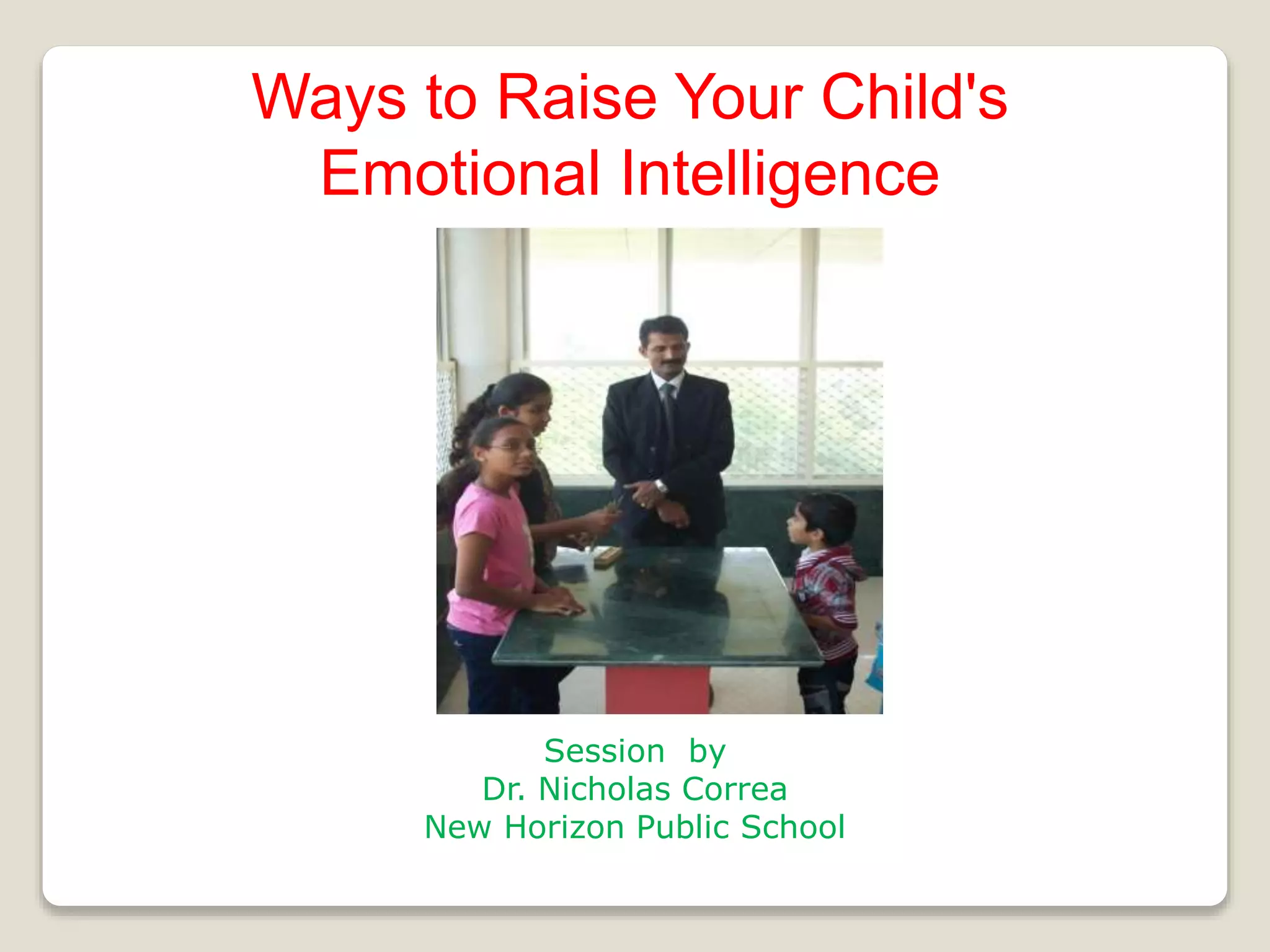
Session by
Dr. Nicholas Correa
New Horizon Public School
Research on defiant children shows that they tend to lack
something called emotional intelligence (EQ).
A lack of emotional intelligence is basically a lack of
emotional maturity.
Daniel Goleman popularized the concept of emotional
intelligence, which involves our ability to understand, use,
regulate, and manage our emotions as key determinants
of our life success and happiness.
Emotional intelligence appears to be a key predictor of
children's ability to make suitable peer relationships,
get along at home, develop a well-balanced outlook on
life, and to reach their academic potential at school.
The term encompasses the following five
characteristics and abilities:
1.Self-awareness- knowing your emotions, recognizing
feelings as they occur, and discriminating between them
2. Mood management- handling feelings so they're relevant to
the current situation and you react appropriately
3. Self-motivation- "gathering up" your feelings and directing
yourself toward a goal, despite self-doubt, inertia, and
impulsiveness
4. Empathy- recognizing feelings in others and tuning into their
verbal and nonverbal cues
5. Managing relationships- handling interpersonal interaction,
conflict resolution, and negotiations
Chances are your defiant child has lower than normal levels
of emotional intelligence, which is a big reason why life is so
difficult for him.
In short, your child's lower EQ limits his or her ability to use
two key coping skills: calming down and solving problems.
Therefore, many of the things your child "chooses" not to do
(e.g., be more self-aware, considerate of others, and control
his impulses) may actually be things he can't do.
The more you understand your child's emotional immaturity
and limitations, the more you can begin to work around them
rather than clash with them.
Here’s three ways to help your child
learn to be more emotionally intelligent:
Coach him to realize when he is stressed – The first step to
reducing stress is recognizing what stress feels like.
Share how your body feels when you are under stress and
ask your child or teen what goes on for them. You could also
share the quote by Sir William Osler: “Our bodies weep the
tears our eyes refuse to shed.” You could ask questions such
as, “How does your body feel when you’re stressed? Are your
muscles or stomach tight or sore?
Are your hands clenched? Is your breath shallow? Teach your
child how being aware of your physical response to stress will
help regulate tension when it occurs.
Help your child Identify her stress response –
Everyone reacts differently to stress. If your child tends
to become angry or agitated under stress, she will
respond best to stress relief activities that quiet her
down.
If she tends to become depressed or withdrawn, she will
respond best to stress relief activities that are
stimulating. If she tends to freeze—speeding up in some
ways while slowing down in others—she’ll need stress
relief activities such as giving a pet affection and
attention that provides both comfort and stimulation.
Encourage your child or teen to discover the stress-
busting techniques that work for him – The best way to
reduce stress quickly is by engaging one or more of your
senses: sight, sound, smell, taste, and touch.
Each person responds differently to sensory input, so you
need to find things that are soothing and/or energizing to
you. For example, if your child is visual person he can
relieve stress by surrounding himself with uplifting images.
If he responds more to sound, you may find a wind chime, a
favoorite piece of music, or the sound of a water fountain
helps to quickly reduce his stress levels.

Ways to raise your child's E,Q

  • 1.
    Ways to RaiseYour Child's Emotional Intelligence Session by Dr. Nicholas Correa New Horizon Public School
  • 2.
    Research on defiantchildren shows that they tend to lack something called emotional intelligence (EQ). A lack of emotional intelligence is basically a lack of emotional maturity. Daniel Goleman popularized the concept of emotional intelligence, which involves our ability to understand, use, regulate, and manage our emotions as key determinants of our life success and happiness.
  • 3.
    Emotional intelligence appearsto be a key predictor of children's ability to make suitable peer relationships, get along at home, develop a well-balanced outlook on life, and to reach their academic potential at school. The term encompasses the following five characteristics and abilities:
  • 4.
    1.Self-awareness- knowing youremotions, recognizing feelings as they occur, and discriminating between them 2. Mood management- handling feelings so they're relevant to the current situation and you react appropriately 3. Self-motivation- "gathering up" your feelings and directing yourself toward a goal, despite self-doubt, inertia, and impulsiveness 4. Empathy- recognizing feelings in others and tuning into their verbal and nonverbal cues 5. Managing relationships- handling interpersonal interaction, conflict resolution, and negotiations
  • 5.
    Chances are yourdefiant child has lower than normal levels of emotional intelligence, which is a big reason why life is so difficult for him. In short, your child's lower EQ limits his or her ability to use two key coping skills: calming down and solving problems. Therefore, many of the things your child "chooses" not to do (e.g., be more self-aware, considerate of others, and control his impulses) may actually be things he can't do. The more you understand your child's emotional immaturity and limitations, the more you can begin to work around them rather than clash with them.
  • 6.
    Here’s three waysto help your child learn to be more emotionally intelligent:
  • 7.
    Coach him torealize when he is stressed – The first step to reducing stress is recognizing what stress feels like. Share how your body feels when you are under stress and ask your child or teen what goes on for them. You could also share the quote by Sir William Osler: “Our bodies weep the tears our eyes refuse to shed.” You could ask questions such as, “How does your body feel when you’re stressed? Are your muscles or stomach tight or sore? Are your hands clenched? Is your breath shallow? Teach your child how being aware of your physical response to stress will help regulate tension when it occurs.
  • 8.
    Help your childIdentify her stress response – Everyone reacts differently to stress. If your child tends to become angry or agitated under stress, she will respond best to stress relief activities that quiet her down. If she tends to become depressed or withdrawn, she will respond best to stress relief activities that are stimulating. If she tends to freeze—speeding up in some ways while slowing down in others—she’ll need stress relief activities such as giving a pet affection and attention that provides both comfort and stimulation.
  • 9.
    Encourage your childor teen to discover the stress- busting techniques that work for him – The best way to reduce stress quickly is by engaging one or more of your senses: sight, sound, smell, taste, and touch. Each person responds differently to sensory input, so you need to find things that are soothing and/or energizing to you. For example, if your child is visual person he can relieve stress by surrounding himself with uplifting images. If he responds more to sound, you may find a wind chime, a favoorite piece of music, or the sound of a water fountain helps to quickly reduce his stress levels.