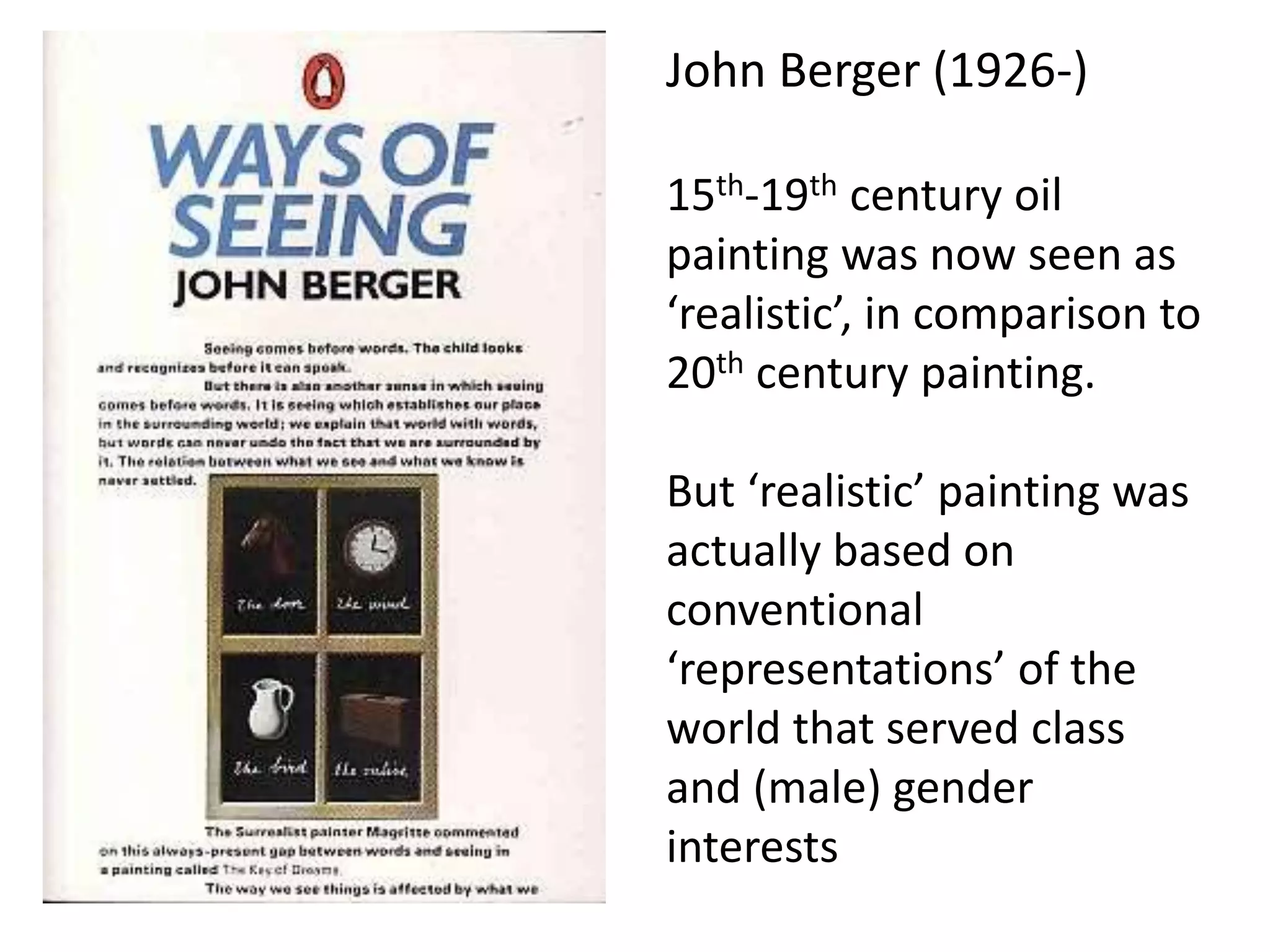
Ways of seeing:
The individual and the social in applied
linguistics research methodologies
PLL 2
Individuals in Context
Jyväskalä, 22-24 August 2016
Phil Benson – Macquarie University, Department of Linguistics
Three eras of Applied Linguistics
the invisible learner
learner-centredness
person-centredness
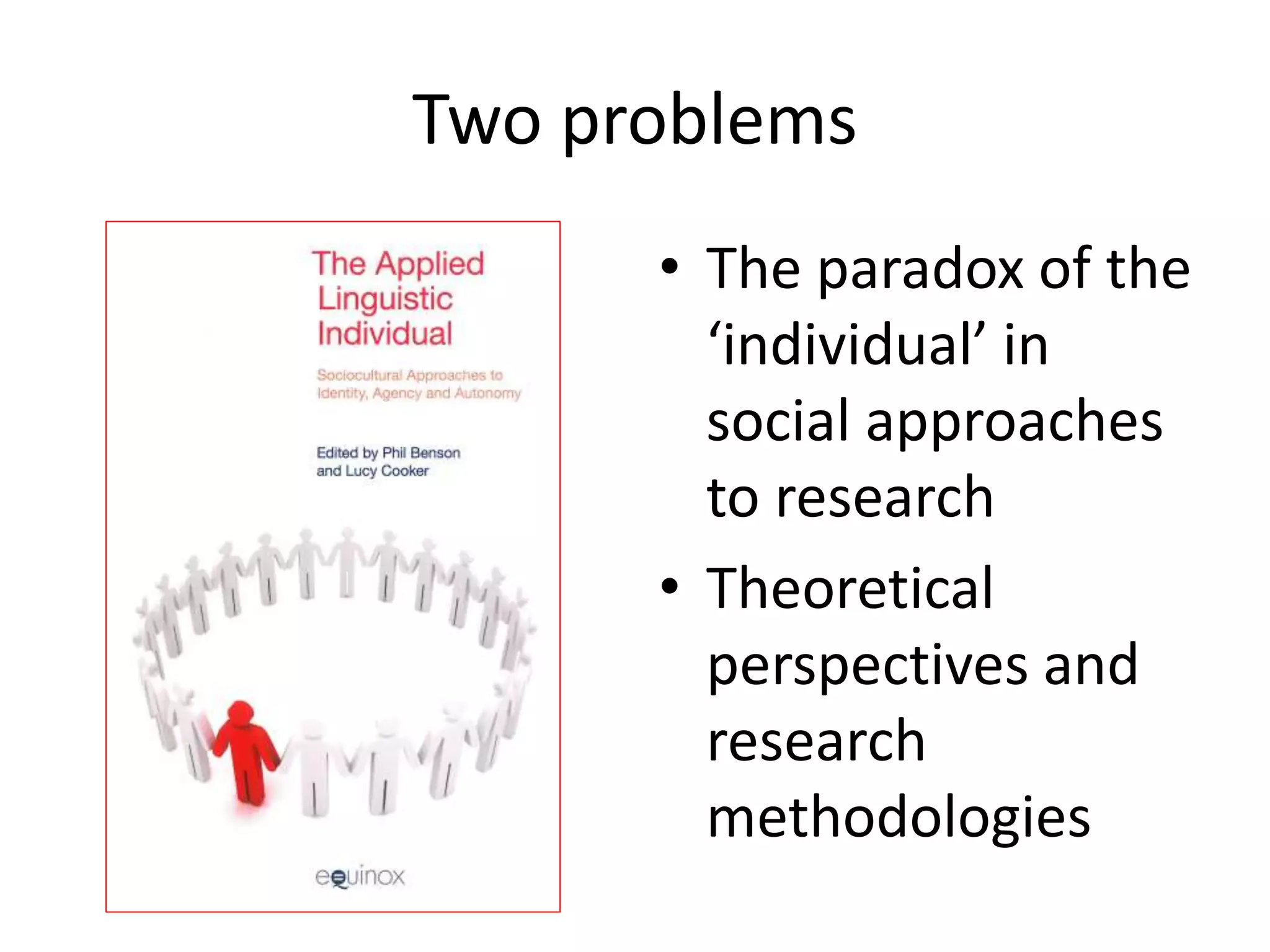
Two problems
• The paradox of the
‘individual’ in
social approaches
to research
• Theoretical
perspectives and
research
methodologies
John Berger (1926-)
15th-19th century oil
painting was now seen as
‘realistic’, in comparison to
20th century painting.
But ‘realistic’ painting was
actually based on
conventional
‘representations’ of the
world that served class
and (male) gender
interests
A way of seeing the world
“…a way of seeing the
world, which was
ultimately determined by
new attitudes to property
and exchange, found its
visual expression in the oil
painting, and could not
have found it in any other
visual art form.”
Berger (1972: 87)
Seeing comes before words…
“Seeing comes before
words…. But there is another
sense in which seeing comes
before words. It is seeing
which establishes our place in
the surrounding world; we
explain that world with words,
but words can never undo the
fact that we are surrounded
by it.”
Berger (1972: 7)
Two problems
• The paradox of the
‘individual’ in
social approaches
to research
• Theoretical
perspectives and
research
methodologies
Otto Jespersen (1860-1943)
• Danish linguist, specialized
in English Grammar
• How to teach a foreign
language, first published
1904
• Reprinted many times, this
printing 1963
• Highly influential guide for
foreign language teachers
based on structural
linguistics
The era of ‘the invisible learner’
• Applied linguistics = application of
linguistics
• Focus on problems of classroom teaching
• Anecdotal classroom research
• Research = linguistics research
(+psycholinguistics, sociolinguistics)
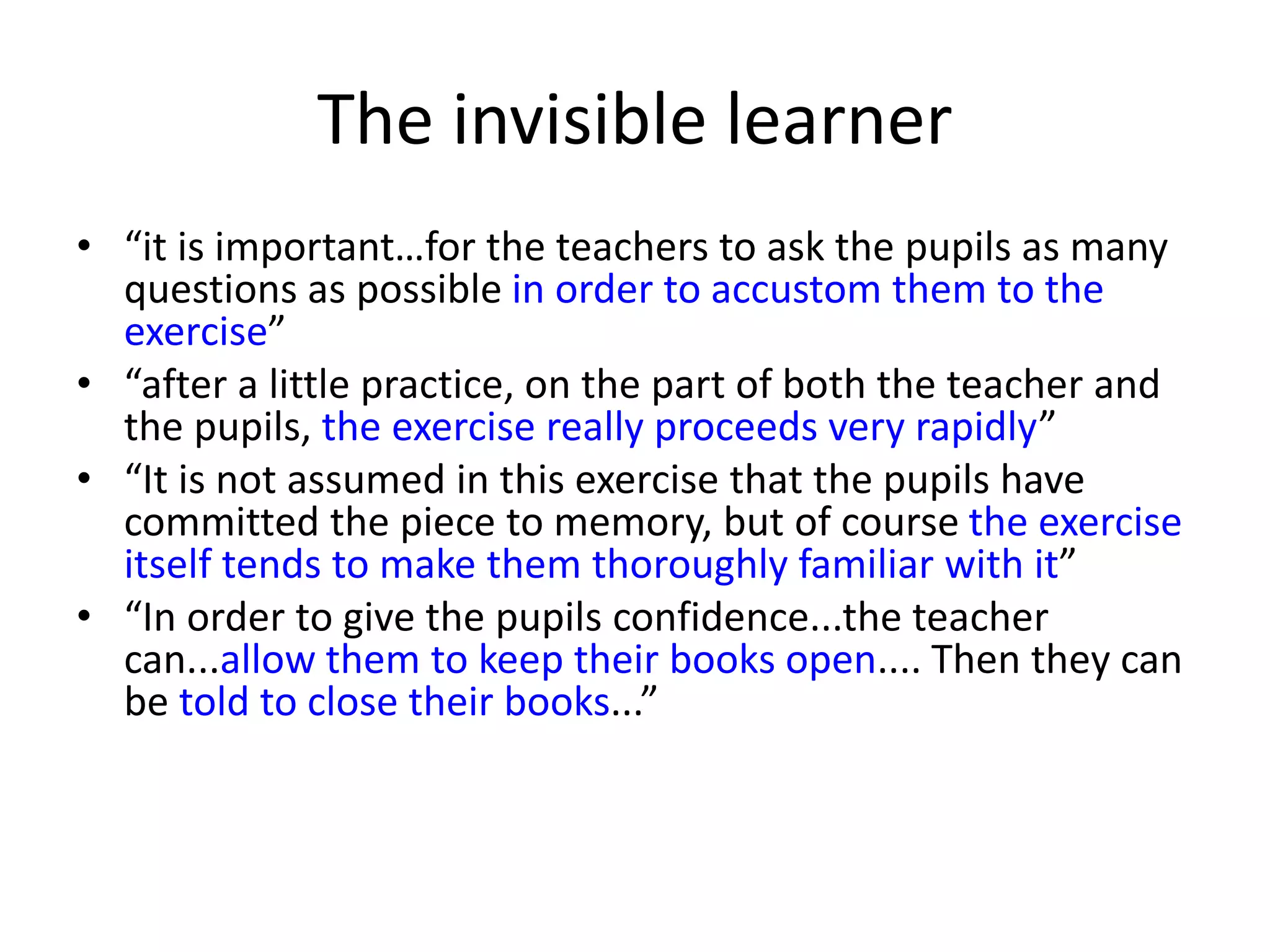
The invisible learner
• “it is important…for the teachers to ask the pupils as many
questions as possible in order to accustom them to the
exercise”
• “after a little practice, on the part of both the teacher and
the pupils, the exercise really proceeds very rapidly”
• “It is not assumed in this exercise that the pupils have
committed the piece to memory, but of course the exercise
itself tends to make them thoroughly familiar with it”
• “In order to give the pupils confidence...the teacher
can...allow them to keep their books open.... Then they can
be told to close their books...”
The learner centred era
(1970s-1990s)
• Intense focus on the language learner
• SLA and the language learning process
• New concepts:
– Language learning strategies
– Learning styles, preferences, beliefs
– Language learning motivation
– Learner autonomy
– Needs analysis
– Learner training / development
– Learner-centredness
Visibility and learner-centredness
• Learner-centredness “grew out of the recognition
that language learners were diverse” (Wenden 2002:
32)
– Diversity of learners (+ adults)
– Diversity of teaching and learning situations
– Diversity of purposes
• Learners became objects of intense scrutiny in
research
• ‘Scientific methods constructed ‘the learner’ as an
abstraction - and diversity in terms of combinations
of psychological and sociological variables
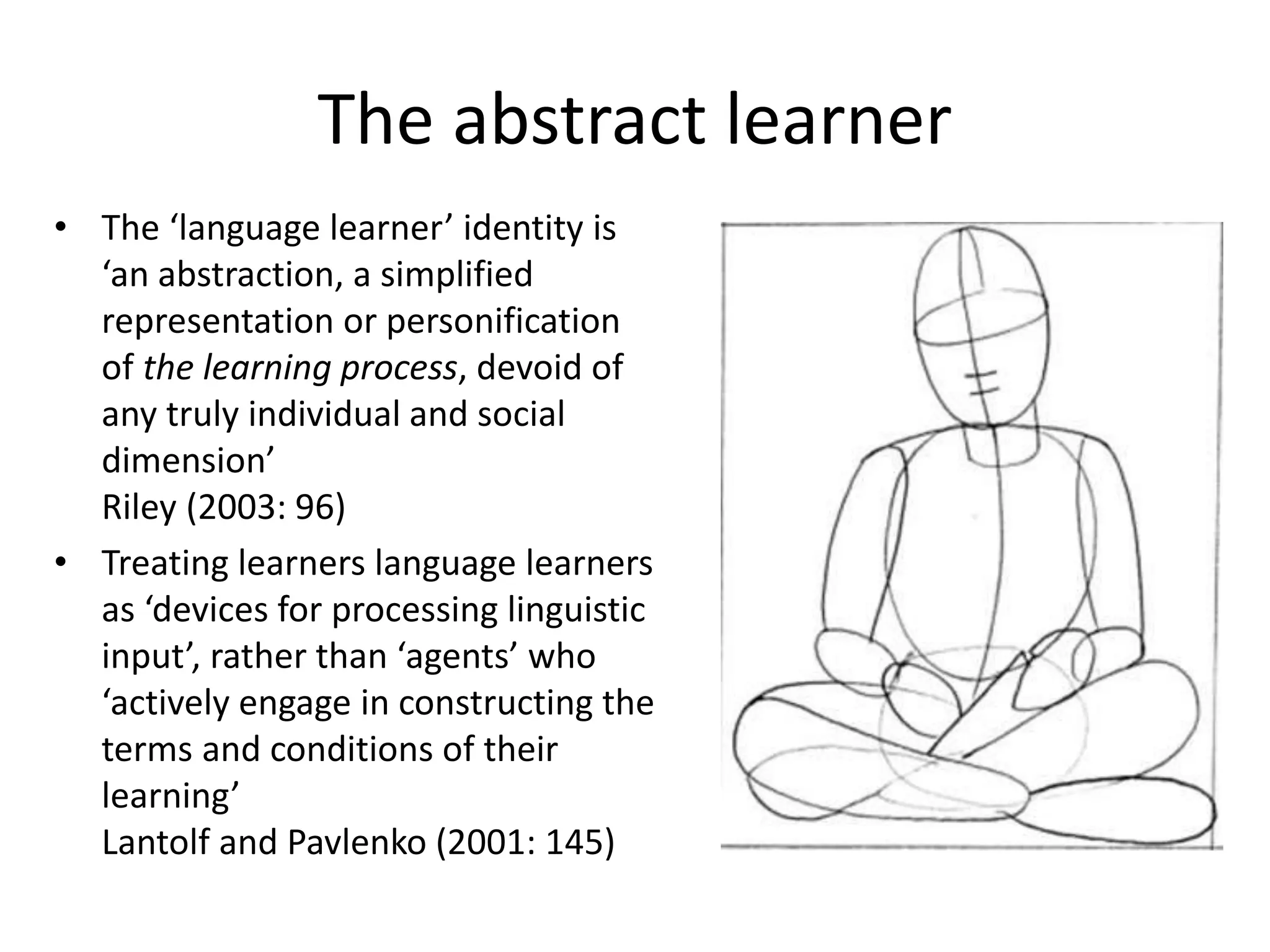
The abstract learner
• The ‘language learner’ identity is
‘an abstraction, a simplified
representation or personification
of the learning process, devoid of
any truly individual and social
dimension’
Riley (2003: 96)
• Treating learners language learners
as ‘devices for processing linguistic
input’, rather than ‘agents’ who
‘actively engage in constructing the
terms and conditions of their
learning’
Lantolf and Pavlenko (2001: 145)
Person-centredness (2000-??)
• The ‘social turn’
– Language socialization
– Vygotskyan / Sociocultural theory
– Situated learning /Communities of practice
– Social realism
– Identity theories
– Complex Systems Theory
– Ecology of language learning
The social turn as person-centredness
• Critique of abstraction and universalism (cast as
‘individualism’)
• Critique of social determinism (the learner as a
combination of variables)
• Alternating focus on social contexts/processes
and individual agency
• ‘Agency’ corresponds to the growing visibility of
‘the person’ in qualitative research
• ‘Motivating the person, not the learner’
(Ushioda 2011)
Visibility and person-centredness
• Individual / multiple case study
• Ethnographic
• Narrative / Autoethnography
• Visual
• Interactional
• Microgenetic
• Timescales…
Learner-centred -> Person-centred
New ways of seeing?
• “[T]he learning and acquisition of languages
are seen as deeply embedded in intricate
social interactional encounters and practices
in which learners participate, often carrying
the baggage of highly personal backgrounds,
complex motivations, anxieties and desires.
These practices are, in turn, part of wide social
processes and networks that underlie them in
a variety of ways.” (De Fina, 2015: 271)
New ways of seeing?
• “[T]he learning and acquisition of languages
are seen as deeply embedded in intricate
social interactional encounters and practices
in which learners participate, often carrying
the baggage of highly personal backgrounds,
complex motivations, anxieties and desires.
These practices are, in turn, part of wide social
processes and networks that underlie them in
a variety of ways.” (De Fina, 2015: 271)
Ethnography vs. Narrative
Questions?
• Are we over the critique of ‘individualism’ and
the need to use to use ‘social’ in every
sentence?
• Theory and methodology: Which is the
chicken and which is the egg?
• Is anything new? Does anything ever go away?

Ways of seeing

  • 1.
    Ways of seeing: Theindividual and the social in applied linguistics research methodologies PLL 2 Individuals in Context Jyväskalä, 22-24 August 2016 Phil Benson – Macquarie University, Department of Linguistics
  • 2.
    Three eras ofApplied Linguistics the invisible learner learner-centredness person-centredness
  • 3.
    Two problems • Theparadox of the ‘individual’ in social approaches to research • Theoretical perspectives and research methodologies
  • 4.
    John Berger (1926-) 15th-19thcentury oil painting was now seen as ‘realistic’, in comparison to 20th century painting. But ‘realistic’ painting was actually based on conventional ‘representations’ of the world that served class and (male) gender interests
  • 5.
    A way ofseeing the world “…a way of seeing the world, which was ultimately determined by new attitudes to property and exchange, found its visual expression in the oil painting, and could not have found it in any other visual art form.” Berger (1972: 87)
  • 6.
    Seeing comes beforewords… “Seeing comes before words…. But there is another sense in which seeing comes before words. It is seeing which establishes our place in the surrounding world; we explain that world with words, but words can never undo the fact that we are surrounded by it.” Berger (1972: 7)
  • 7.
    Two problems • Theparadox of the ‘individual’ in social approaches to research • Theoretical perspectives and research methodologies
  • 9.
    Otto Jespersen (1860-1943) •Danish linguist, specialized in English Grammar • How to teach a foreign language, first published 1904 • Reprinted many times, this printing 1963 • Highly influential guide for foreign language teachers based on structural linguistics
  • 11.
    The era of‘the invisible learner’ • Applied linguistics = application of linguistics • Focus on problems of classroom teaching • Anecdotal classroom research • Research = linguistics research (+psycholinguistics, sociolinguistics)
  • 12.
    The invisible learner •“it is important…for the teachers to ask the pupils as many questions as possible in order to accustom them to the exercise” • “after a little practice, on the part of both the teacher and the pupils, the exercise really proceeds very rapidly” • “It is not assumed in this exercise that the pupils have committed the piece to memory, but of course the exercise itself tends to make them thoroughly familiar with it” • “In order to give the pupils confidence...the teacher can...allow them to keep their books open.... Then they can be told to close their books...”
  • 13.
    The learner centredera (1970s-1990s) • Intense focus on the language learner • SLA and the language learning process • New concepts: – Language learning strategies – Learning styles, preferences, beliefs – Language learning motivation – Learner autonomy – Needs analysis – Learner training / development – Learner-centredness
  • 14.
    Visibility and learner-centredness •Learner-centredness “grew out of the recognition that language learners were diverse” (Wenden 2002: 32) – Diversity of learners (+ adults) – Diversity of teaching and learning situations – Diversity of purposes • Learners became objects of intense scrutiny in research • ‘Scientific methods constructed ‘the learner’ as an abstraction - and diversity in terms of combinations of psychological and sociological variables
  • 15.
    The abstract learner •The ‘language learner’ identity is ‘an abstraction, a simplified representation or personification of the learning process, devoid of any truly individual and social dimension’ Riley (2003: 96) • Treating learners language learners as ‘devices for processing linguistic input’, rather than ‘agents’ who ‘actively engage in constructing the terms and conditions of their learning’ Lantolf and Pavlenko (2001: 145)
  • 16.
    Person-centredness (2000-??) • The‘social turn’ – Language socialization – Vygotskyan / Sociocultural theory – Situated learning /Communities of practice – Social realism – Identity theories – Complex Systems Theory – Ecology of language learning
  • 17.
    The social turnas person-centredness • Critique of abstraction and universalism (cast as ‘individualism’) • Critique of social determinism (the learner as a combination of variables) • Alternating focus on social contexts/processes and individual agency • ‘Agency’ corresponds to the growing visibility of ‘the person’ in qualitative research • ‘Motivating the person, not the learner’ (Ushioda 2011)
  • 18.
    Visibility and person-centredness •Individual / multiple case study • Ethnographic • Narrative / Autoethnography • Visual • Interactional • Microgenetic • Timescales…
  • 19.
  • 20.
    New ways ofseeing? • “[T]he learning and acquisition of languages are seen as deeply embedded in intricate social interactional encounters and practices in which learners participate, often carrying the baggage of highly personal backgrounds, complex motivations, anxieties and desires. These practices are, in turn, part of wide social processes and networks that underlie them in a variety of ways.” (De Fina, 2015: 271)
  • 21.
    New ways ofseeing? • “[T]he learning and acquisition of languages are seen as deeply embedded in intricate social interactional encounters and practices in which learners participate, often carrying the baggage of highly personal backgrounds, complex motivations, anxieties and desires. These practices are, in turn, part of wide social processes and networks that underlie them in a variety of ways.” (De Fina, 2015: 271)
  • 22.
  • 23.
  • 24.
    Questions? • Are weover the critique of ‘individualism’ and the need to use to use ‘social’ in every sentence? • Theory and methodology: Which is the chicken and which is the egg? • Is anything new? Does anything ever go away?

Editor's Notes

  • #3 I am going to talk about three eras in Applied Linguistics The era of the invisible learner (up to the 1970s) The learner-centred era (1970s-1990s) The person-centred era (2000s up to today) I will do this mainly as a way of trying to make sense of some features of the transition from learner-centredness to person-centredness that we are going through at the present time. This has been called ‘the social turn’, but it could also be called ‘the individual turn’ or possibly be called the ‘qualitative’ turn. I am going to say that it is mainly a turn from a focus on ‘the learner’ towards a focus on ‘the language learning person’. The ‘person’ is a word that is increasingly being used in this context by others.
  • #4 I want to use this idea of ‘person-centredness’ to focus on what I see as two important issues in the transitions we are going through at the present time 1. A paradox of the status of the ‘individual’ in social approaches to research. These approaches are ‘anti-individualist’, but often focus on individuals in research 2. What is the relationship between social approaches (essentially epistemological) and their preferred research methodologies (which are mainly qualitative and often involve individual case studies).
  • #5 The phrase ‘ways of seeing’ in the title of the presentation is taken from the title of a book by John Berger, published in 1972 John Berger is a British Marxist art critic, who was greatly influenced by Walter Benjamin. The book is based on a four-part BBC TV series (you can watch it on YouTube). It was highly influential at the time (and perhaps even now). Berger’s argument is…
  • #6 This was Berger’s main argument
  • #7 You may have noticed this quote on the cover of the book. It sums up the way that I am using the idea of ways of seeing… In Applied Linguistics, we use words to articulate concepts and theories, we don’t use visual images. But we use words metaphorically and visually... I am looking at the three eras as ways of seeing language learners (1) From not seeing them at all, to (2) seeing them as ‘learners’, to (3) seeing ‘learners’ as ‘people’. (And note how difficult it is to see ‘who’ we are seeing, without using a word that imposes a particular way of seeing upon them)
  • #8 I want to use this idea of ‘ways of seeing’ language learners to cast light on these problems. To see them as problems of ‘ways of seeing’…
  • #9 The era of the invisible learner. Let’s take a look at this book
  • #10 This is Otto Jesperson and his book
  • #11 Take at look at this page – what do you notice?
  • #12 Jesperson’s book represents the era of the invisible learner before the 1970s, and the rise of Second Language Acquisition reseacrch, and these are some of its characteristics
  • #13 Why do I call this the era of ‘the invisible learner”? Looking back at the page from Jesperson’s book, this is an unusual page because he doesn’t usually mention learners at all. Notice that on this page that he (1) calls them ‘pupils’ and (2) represents them as passive recipients of teaching. Also notice that although he mentions the learners – he is not talking about LEARNING
  • #14 SLA = Second language acquisition The learner-centred era began in the 1970s and is associated with the origins of SLA research in the early 1970s, and learner-centredness and autonomy in Europe and Australia The new theoretical concepts that emerged all referred explicitly to learners and learning. ‘The learner’ and the ‘the language learning process’ became very widely used phrases.
  • #16 These are two examples of critiques of learner-centredness Riley – the learner as an ‘abstraction’ Lantolf and Pavlenko – the learner as a ‘processing device’ and an early example of a person-centred approach that was emerging among some researchers in the 1990s – “treating language learners as people”
  • #17 The ‘social turn’ has led to a flowering of interest in a range of theories and approaches What they have in common is the idea that learning is a social process
  • #18 These are four characteristics of the social turn – which point to the view that it is really a turn towards ‘person-centredness’
  • #19 These are the preferred research methods in socially oriented research How much is this turn towards person-centredness related to the increased visibility of individual learners in qualitative research? An ‘epistemological lens’ (Maggie Kubyanova)
  • #20 The picture of the learner is being filled in, enriched by qualitative research
  • #22 New ways of talking about language learning that highlight this enriched ‘way of seeing’ the learner