The ‘geographies’ of YouTube:
Language and cultural identity
 negotiations in virtual space

          Phil Benson
YouTube
‘Founded in February 2005, YouTube allows
billions of people to discover, watch and share
originally-created videos. YouTube provides a
forum for people to connect, inform, and
inspire others across the globe and acts as a
distribution platform for original content
creators and advertisers large and small.’
YouTube – global/local
• global in terms of the ‘universal’ structure of
  the YouTube page – replicability
• local in terms of specific content of specific
  pages
     • how is the locality of a YouTube page
       produced?
     • what part does interculturality play in the
       geographies of YouTube?
East Asian popular culture
• East and Southeast Asia – geographically widespread
  (Japan to Indonesia) – culturally and linguistically
  diverse
• Evidence of uneven and sporadic transnational flows
  of popular culture (pop music, film, TV drama)
  (Iwabuchi, 2002; Chua, 2004)
• Linguistic strategies in popular and problematization
  of ethnic and gender identities (Benson, in press;
  Jung, 2002)
YouTube comments
• Study of YouTube comments on videos of Easy Breezy (Utada
  Hikaru) and Sexy, Naughty, Bitchy (Tata Young)
• By (a) singing in English and (b) projecting sexually assertive
  identities in their videos, Utada and Young provoke discussion
  of language, ethnic and gender identities:
   – Do Asian singers have the right to sing in English?
   – Are Asian singers who sing in English really ‘Asian’?
   – Is it okay for Asian female singers to be so ‘cool with their
      sexuality’?
                                                   [Benson, in press]
YouTube comments on Easy Breezy
• Why is she singing english?
• “You’re easy breezy and I’m Japaneze”???? Oh hel
  no. Asian card REVOKED!!!!!!!
• I liked her japanese songs (lyric and melody wise) but
  her american album just sucked. Japanesy? wtf. I was
  embarassed to play this song in front of people...
  She’s half-assedly trying to look sexy here and its not
  working... obviously. urgh too much make up. better
  luck next time.
Comments section as
                 ‘virtual region’
• Comments create a space for negotiation of identity in East Asian
  popular music across a virtual region that encompasses East Asia
  and its diasporas.
• It is significant that the discussion takes place in English, because it
  could not take place on the same scale in, for example, Thai or
  Japanese.
• As the videos are viewed on YouTube, virtual representations of
  their market emerge, which become actual spaces for negotiation
  of identities that match the scale of the market itself.
• The kinds of comments that might be made face-to-face to a friend
  in a specific location are opened up for public view and negotiation
  on a regional scale.
Invoking context
         Conversation Analysis
• an interaction is made up of sequenced
  utterances and unfolds over time
• the ongoing interaction constitutes the
  primary context for each utterance
• the context of the interaction is invoked by
  the participants as the interaction proceeds
Invoking context
              the YouTube page
• The YouTube page is a structured site for multimodal
  interaction
• The page defines a limit to a single site of interaction
• The interaction unfolds over time (e.g., owner posts
  video, user views alter statistics, comments are
  added, themes evolve, etc.)
• A ‘cultural geography’ is invoked – the locality of the
  page is produced
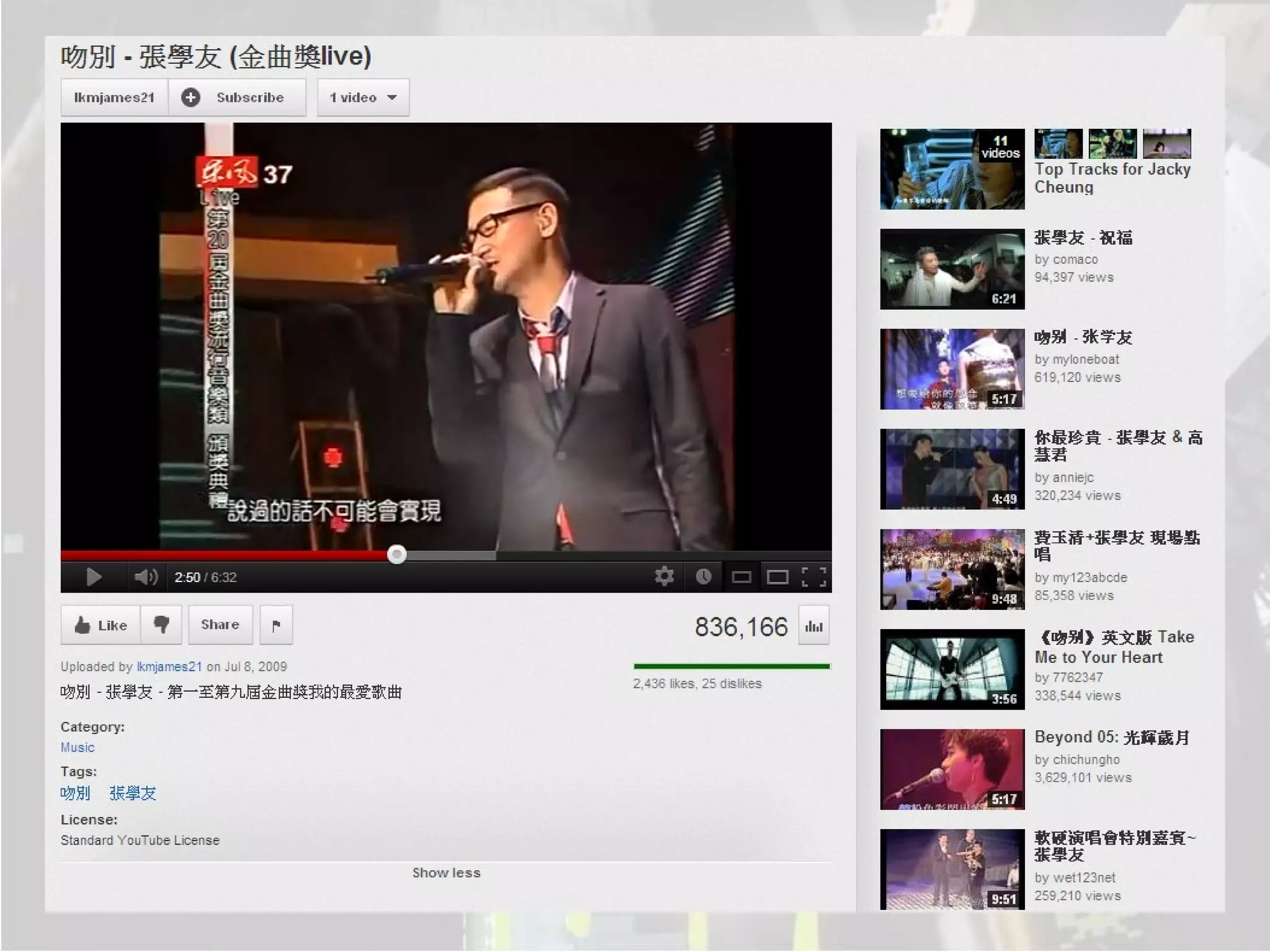
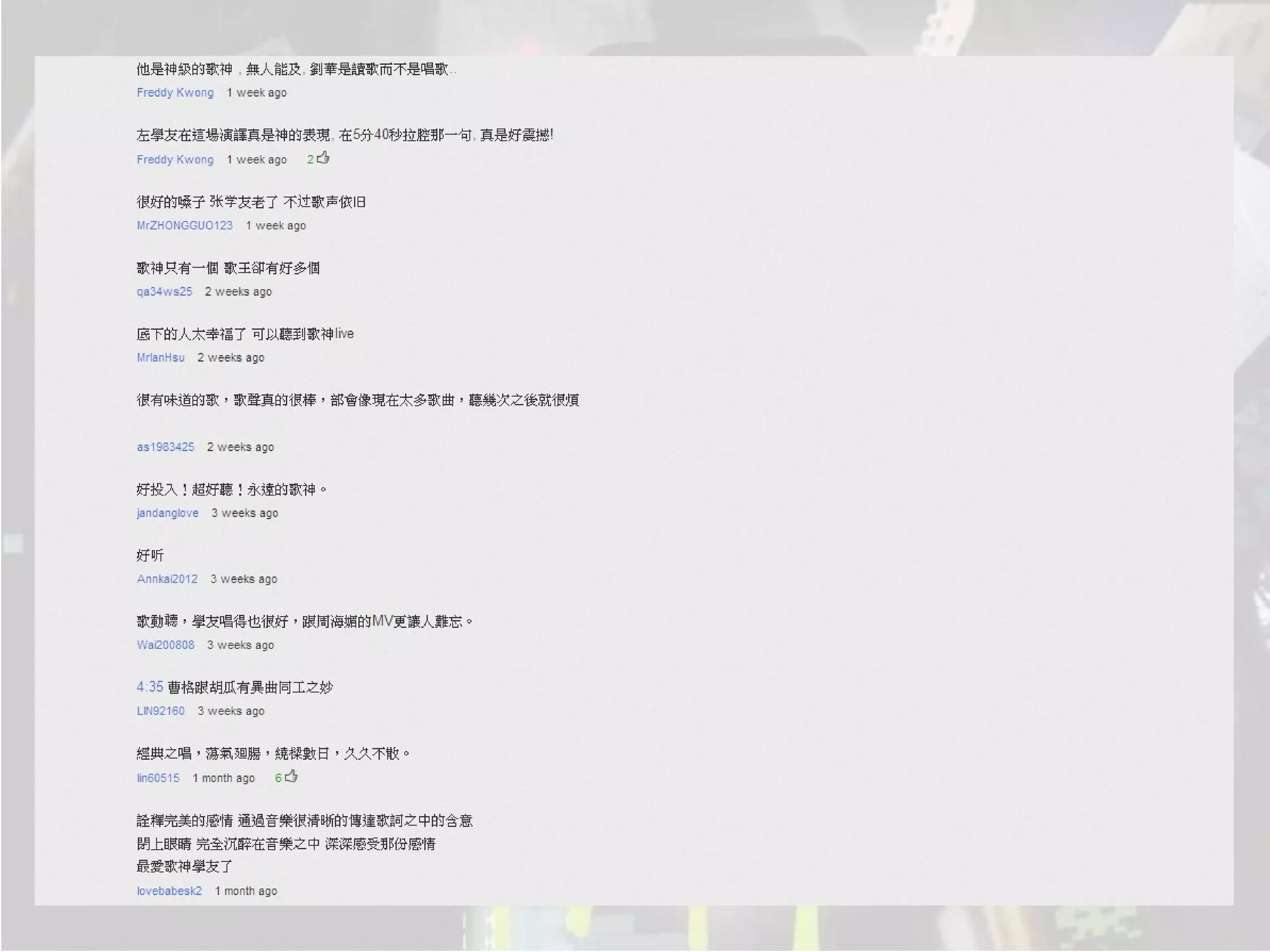
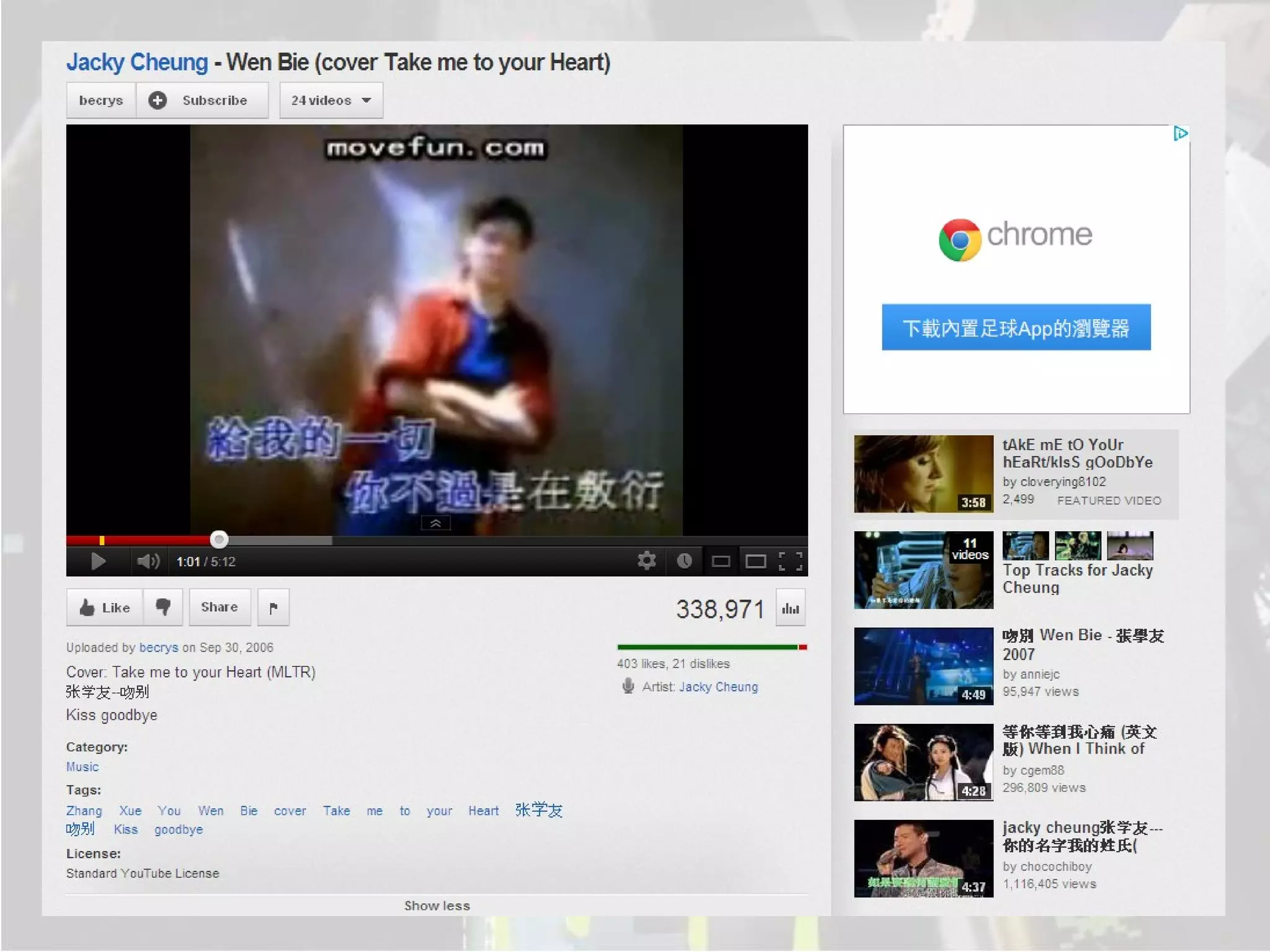
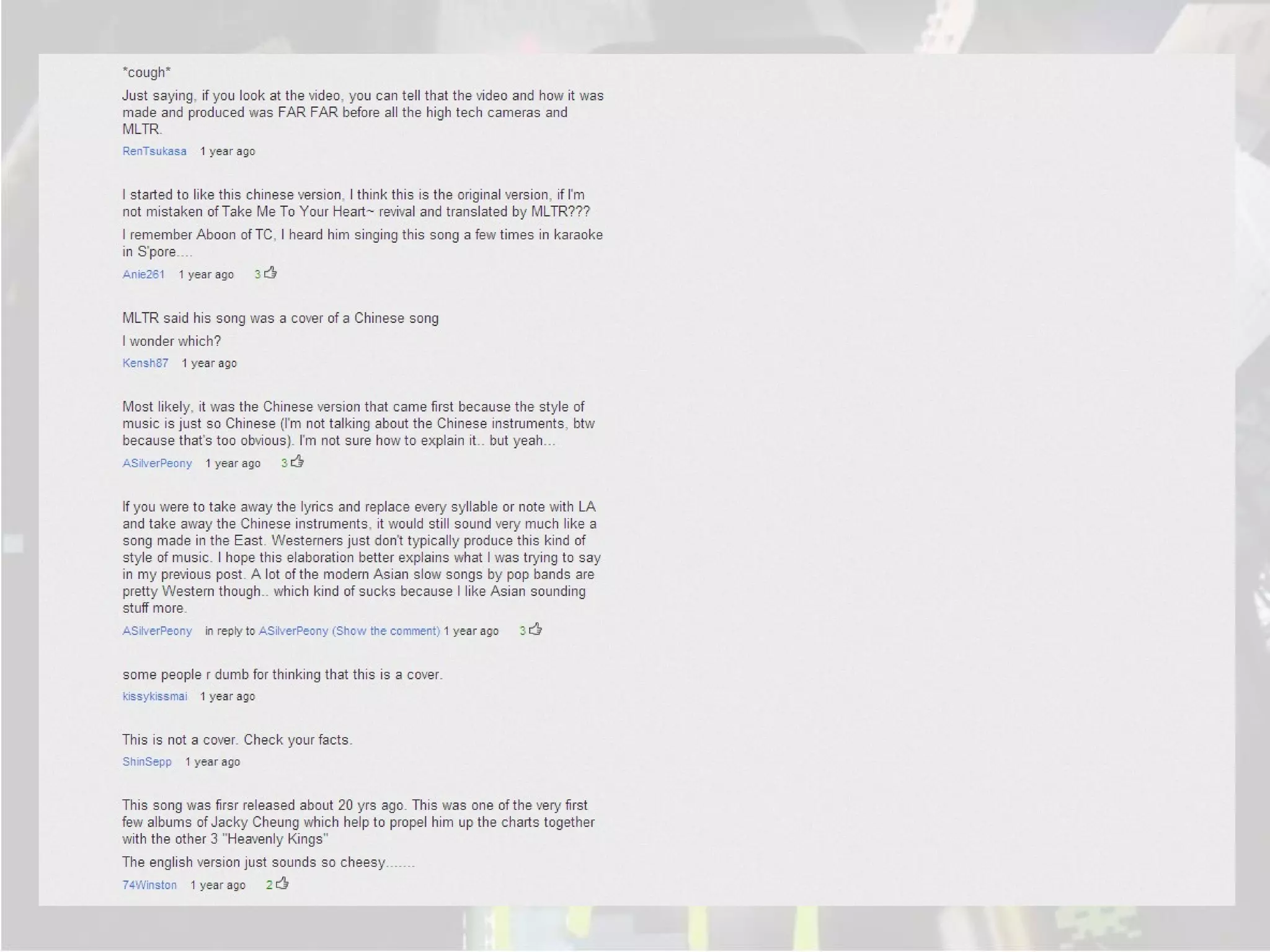
Jacky Cheung 吻別 / Wen Bie

• http://www.youtube.com/watch?v=GW24kXpT1sI
• http://www.youtube.com/watch?v=ec3tb_7rnH4
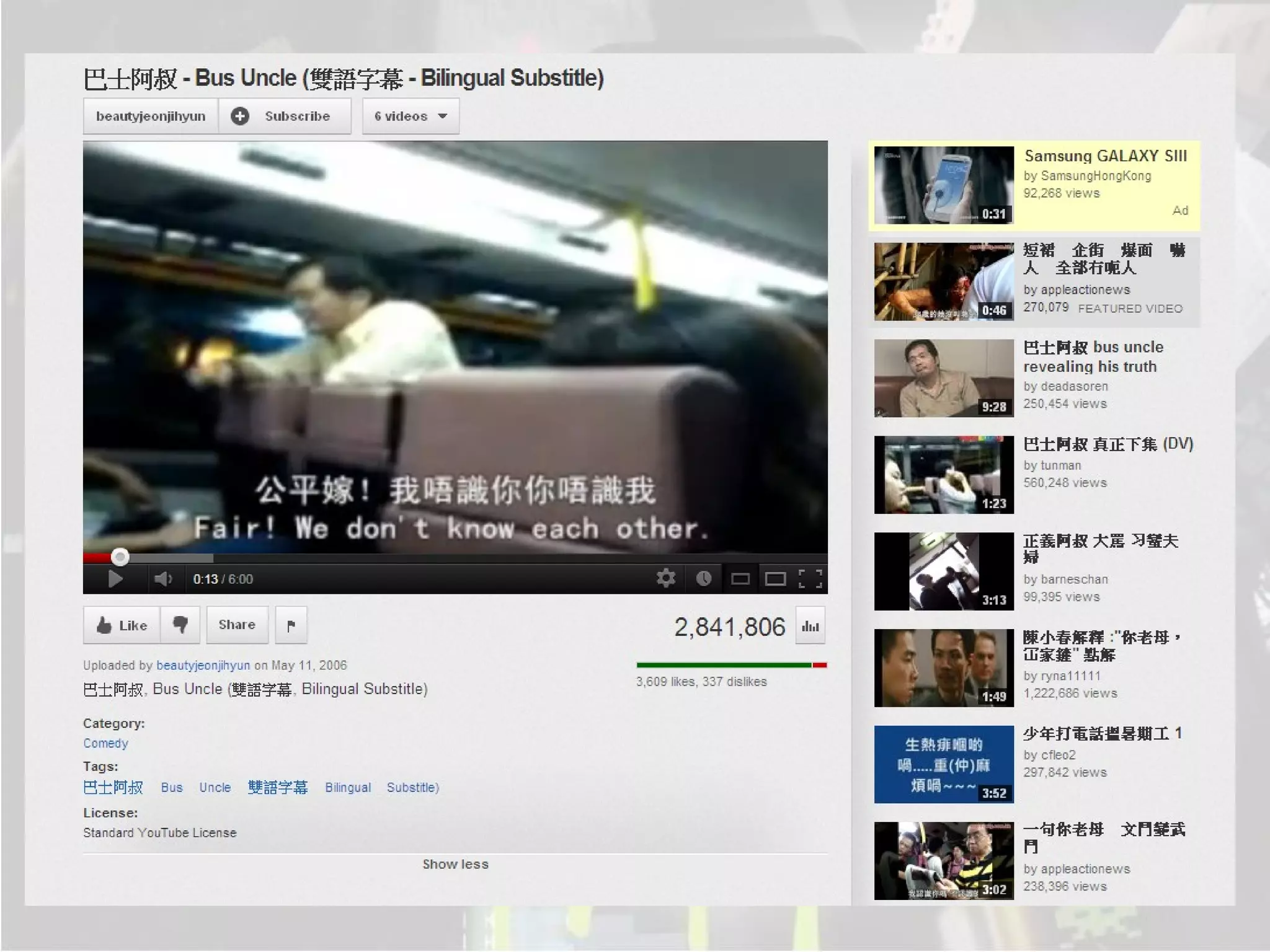
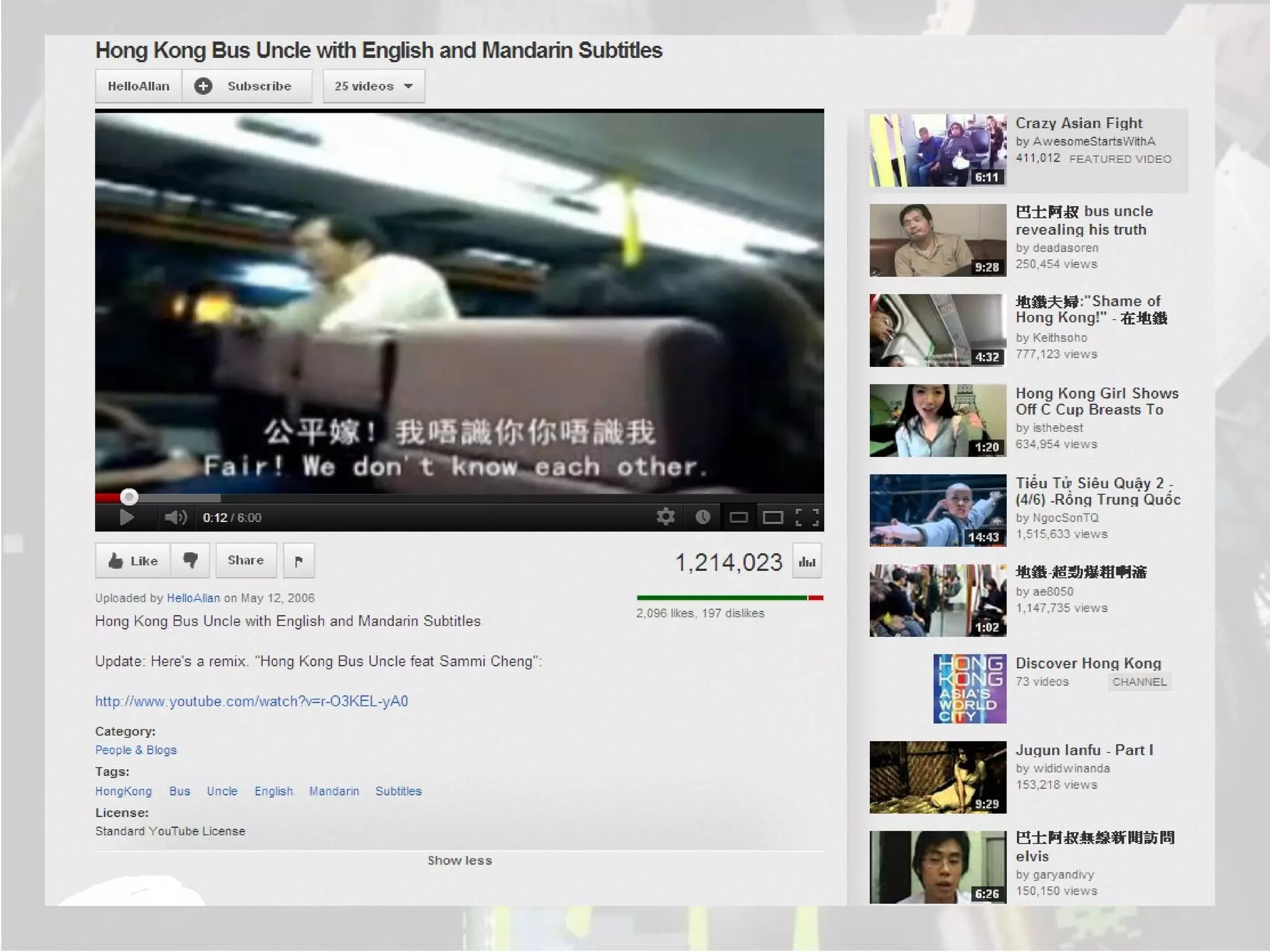
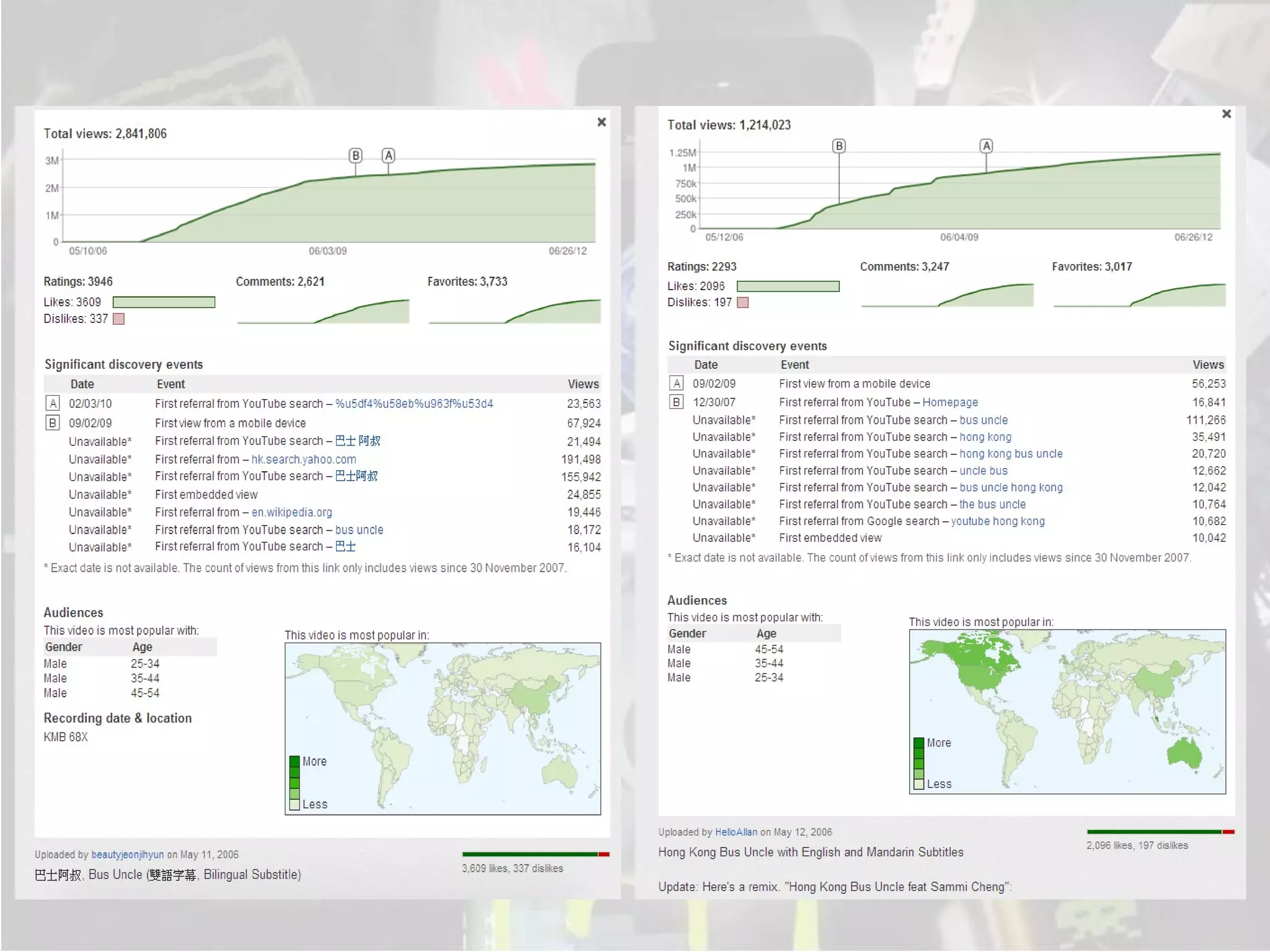
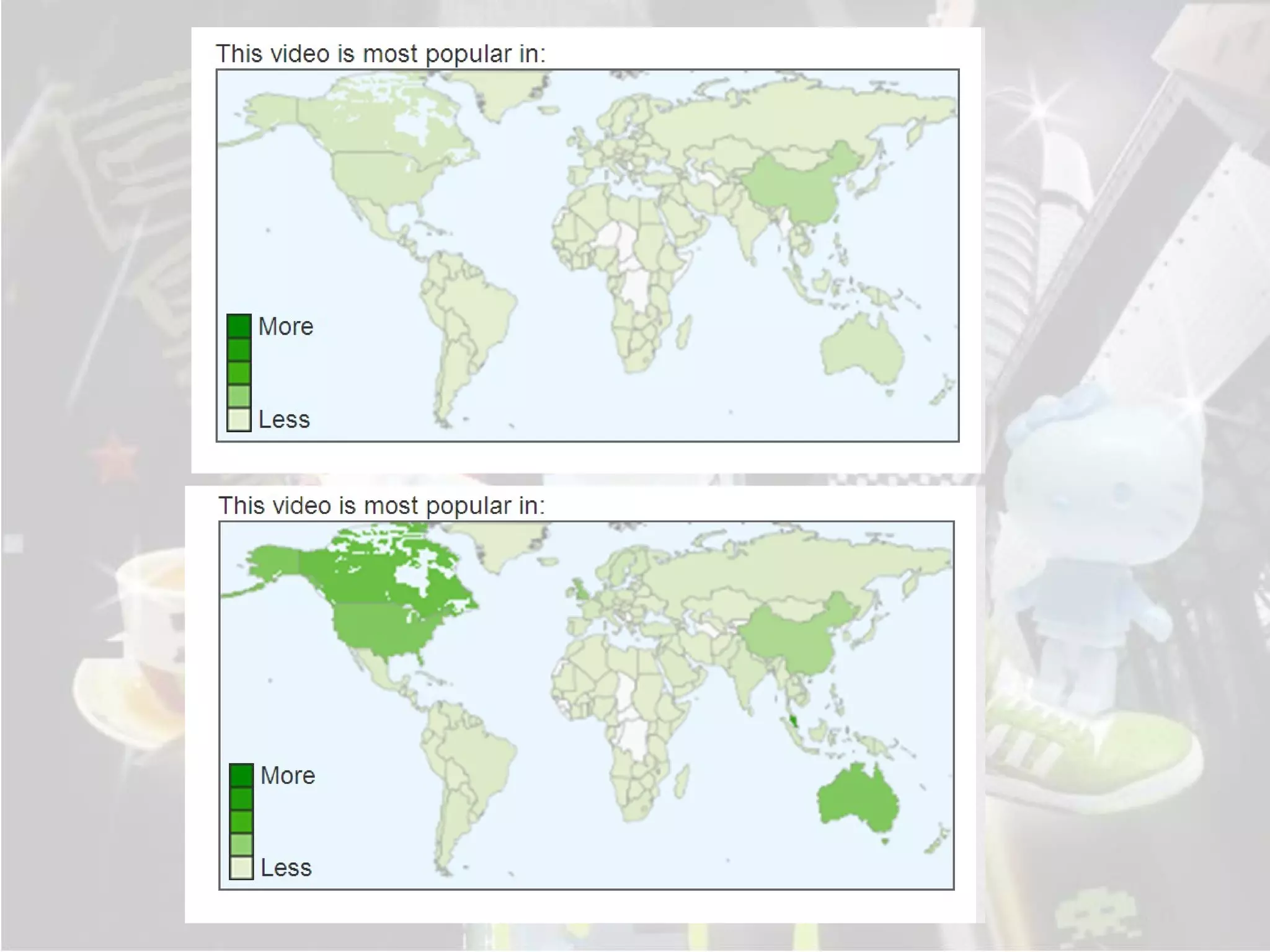
Bus uncle
• http://www.youtube.com/watch?v=RSHziqJWYcM
• http://www.youtube.com/watch?v=EsYRQkmVifg
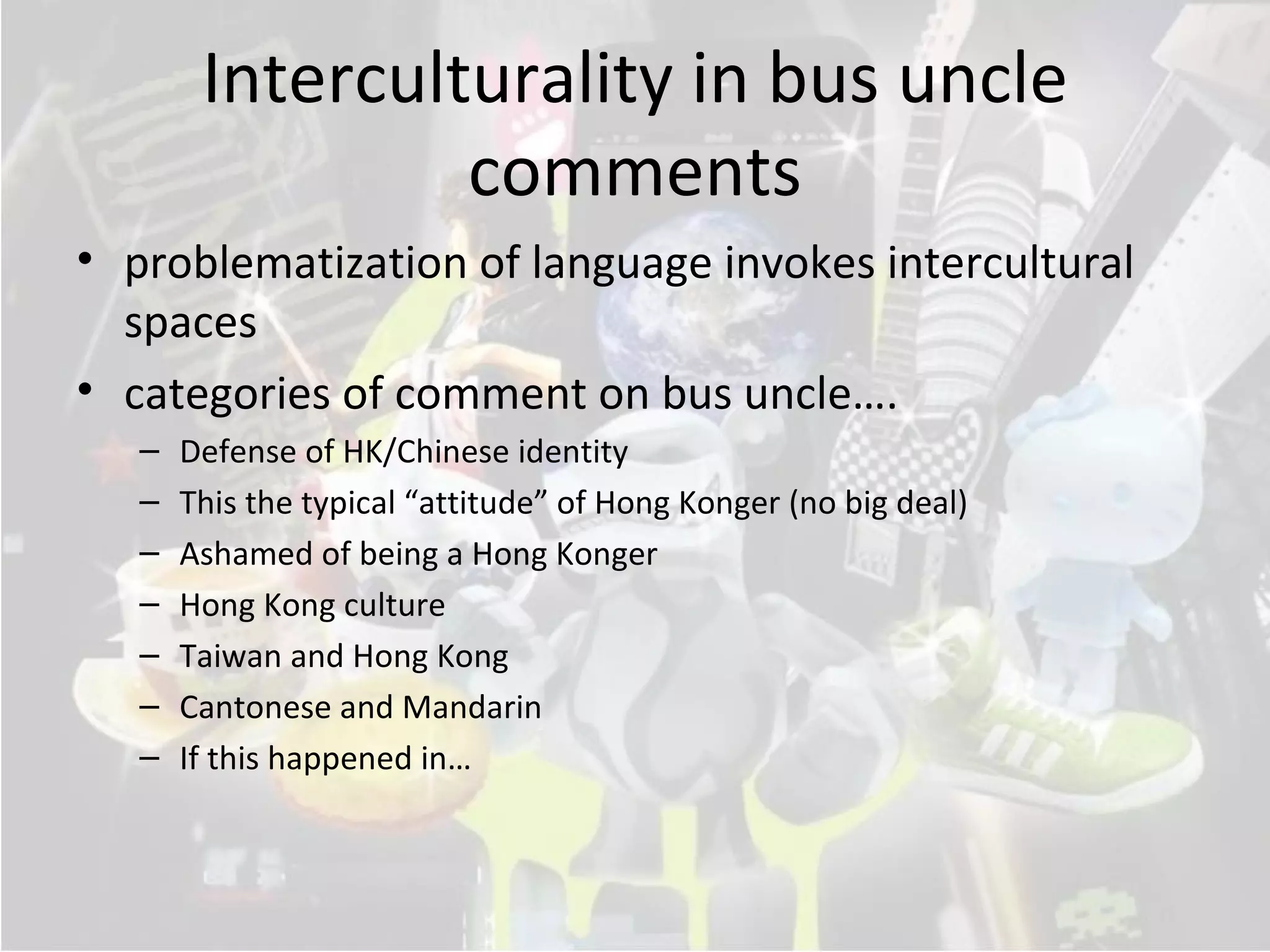
Interculturality in bus uncle
                 comments
• problematization of language invokes intercultural
  spaces
• categories of comment on bus uncle….
   –   Defense of HK/Chinese identity
   –   This the typical “attitude” of Hong Konger (no big deal)
   –   Ashamed of being a Hong Konger
   –   Hong Kong culture
   –   Taiwan and Hong Kong
   –   Cantonese and Mandarin
   –   If this happened in…
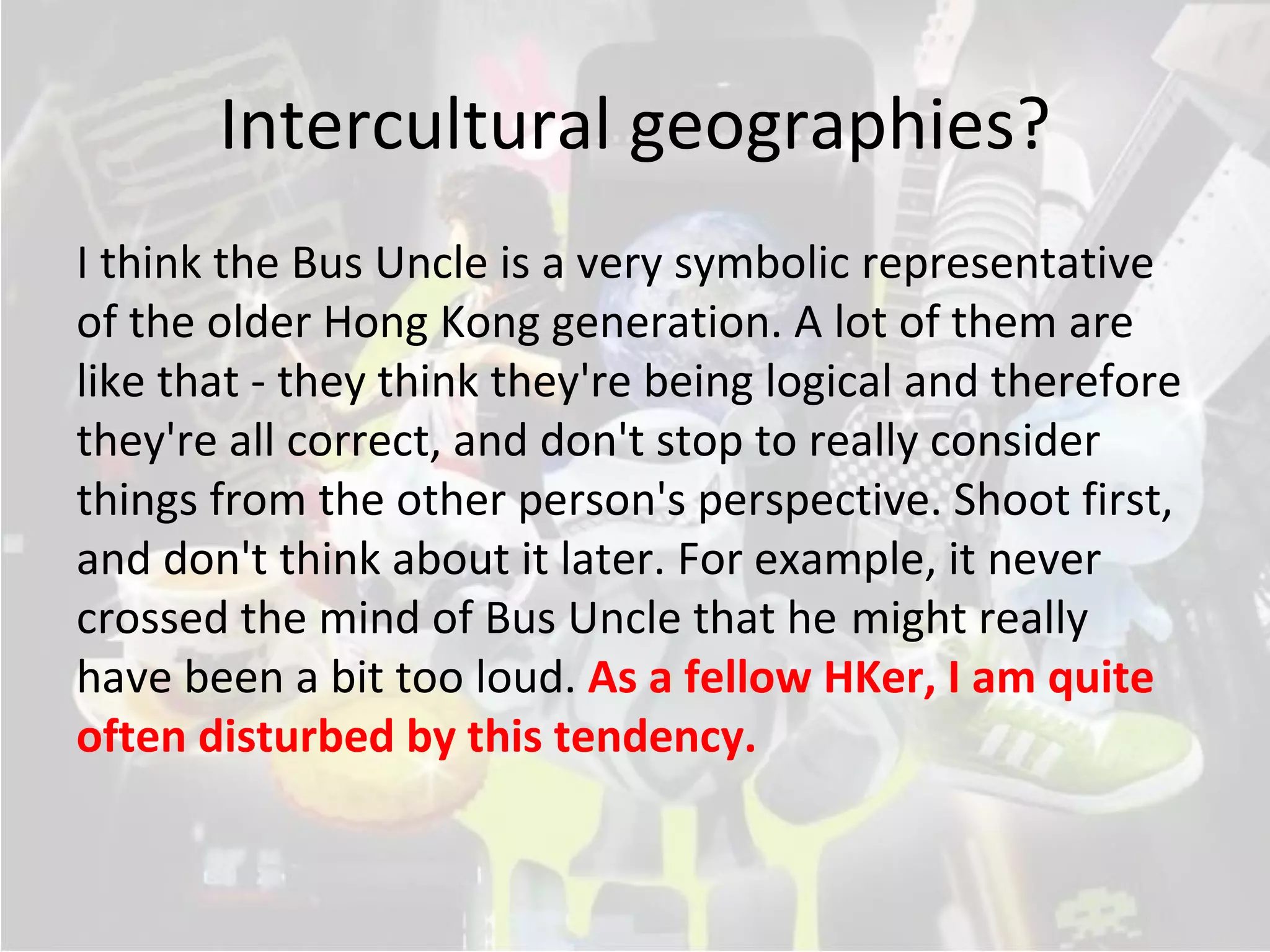
Intercultural geographies?
I think the Bus Uncle is a very symbolic representative
of the older Hong Kong generation. A lot of them are
like that - they think they're being logical and therefore
they're all correct, and don't stop to really consider
things from the other person's perspective. Shoot first,
and don't think about it later. For example, it never
crossed the mind of Bus Uncle that he might really
have been a bit too loud. As a fellow HKer, I am quite
often disturbed by this tendency.
Intercultural geographies?
goddammit...this is why i am ashamed to be chinese.
even though i'm halfway around the world in SF,
they're are just more and more of these loud mouthed
bastards that crowd the bus
lol in Singapore will not be so easy for u to shout and
scream... Bus uncle...either u will end up in hospital or
Police station..
This is why I don't take public transportation.
Happens all the time in Seattle.  .
what a shame... this video pops right up on the
top when you type "hong kong" in youtube
Methodogical challenges
•   meaning of comments
•   locations and identifications
•   avoiding cherry-picking
•   moving beyond anecdote
references
Benson, P. (in press). English and identity in East Asian popular music.
   Popular Music
Chu, D. (2009). Collective behavior in YouTube: A case study of ‘Bus
   Uncle’ online videos. Asian Journal of Communication, 19(3),
   337-353.
Chua, Beng Huat (2004). Conceptualizing an East Asian popular
   culture. Inter-Asia Cultural Studies, 5(2), 200-221.
Iwabuchi. Koichi (2002). Recentering globalization: Popular culture and
   Japanese transnationalism. Durham and London: Duke University
   Press.
Jung, E-Y (2010). Playing the race and sexuality cards in the
   transnational pop game: Korean videos for the US market. Journal
   of Popular Music Studies, 22 (2), 219-236.

The 'geographies' of YouTube

  • 1.
    The ‘geographies’ ofYouTube: Language and cultural identity negotiations in virtual space Phil Benson
  • 2.
    YouTube ‘Founded in February2005, YouTube allows billions of people to discover, watch and share originally-created videos. YouTube provides a forum for people to connect, inform, and inspire others across the globe and acts as a distribution platform for original content creators and advertisers large and small.’
  • 3.
    YouTube – global/local •global in terms of the ‘universal’ structure of the YouTube page – replicability • local in terms of specific content of specific pages • how is the locality of a YouTube page produced? • what part does interculturality play in the geographies of YouTube?
  • 4.
    East Asian popularculture • East and Southeast Asia – geographically widespread (Japan to Indonesia) – culturally and linguistically diverse • Evidence of uneven and sporadic transnational flows of popular culture (pop music, film, TV drama) (Iwabuchi, 2002; Chua, 2004) • Linguistic strategies in popular and problematization of ethnic and gender identities (Benson, in press; Jung, 2002)
  • 5.
    YouTube comments • Studyof YouTube comments on videos of Easy Breezy (Utada Hikaru) and Sexy, Naughty, Bitchy (Tata Young) • By (a) singing in English and (b) projecting sexually assertive identities in their videos, Utada and Young provoke discussion of language, ethnic and gender identities: – Do Asian singers have the right to sing in English? – Are Asian singers who sing in English really ‘Asian’? – Is it okay for Asian female singers to be so ‘cool with their sexuality’? [Benson, in press]
  • 7.
    YouTube comments onEasy Breezy • Why is she singing english? • “You’re easy breezy and I’m Japaneze”???? Oh hel no. Asian card REVOKED!!!!!!! • I liked her japanese songs (lyric and melody wise) but her american album just sucked. Japanesy? wtf. I was embarassed to play this song in front of people... She’s half-assedly trying to look sexy here and its not working... obviously. urgh too much make up. better luck next time.
  • 8.
    Comments section as ‘virtual region’ • Comments create a space for negotiation of identity in East Asian popular music across a virtual region that encompasses East Asia and its diasporas. • It is significant that the discussion takes place in English, because it could not take place on the same scale in, for example, Thai or Japanese. • As the videos are viewed on YouTube, virtual representations of their market emerge, which become actual spaces for negotiation of identities that match the scale of the market itself. • The kinds of comments that might be made face-to-face to a friend in a specific location are opened up for public view and negotiation on a regional scale.
  • 9.
    Invoking context Conversation Analysis • an interaction is made up of sequenced utterances and unfolds over time • the ongoing interaction constitutes the primary context for each utterance • the context of the interaction is invoked by the participants as the interaction proceeds
  • 10.
    Invoking context the YouTube page • The YouTube page is a structured site for multimodal interaction • The page defines a limit to a single site of interaction • The interaction unfolds over time (e.g., owner posts video, user views alter statistics, comments are added, themes evolve, etc.) • A ‘cultural geography’ is invoked – the locality of the page is produced
  • 11.
    Jacky Cheung 吻別/ Wen Bie • http://www.youtube.com/watch?v=GW24kXpT1sI • http://www.youtube.com/watch?v=ec3tb_7rnH4
  • 16.
    Bus uncle • http://www.youtube.com/watch?v=RSHziqJWYcM •http://www.youtube.com/watch?v=EsYRQkmVifg
  • 21.
    Interculturality in busuncle comments • problematization of language invokes intercultural spaces • categories of comment on bus uncle…. – Defense of HK/Chinese identity – This the typical “attitude” of Hong Konger (no big deal) – Ashamed of being a Hong Konger – Hong Kong culture – Taiwan and Hong Kong – Cantonese and Mandarin – If this happened in…
  • 22.
    Intercultural geographies? I thinkthe Bus Uncle is a very symbolic representative of the older Hong Kong generation. A lot of them are like that - they think they're being logical and therefore they're all correct, and don't stop to really consider things from the other person's perspective. Shoot first, and don't think about it later. For example, it never crossed the mind of Bus Uncle that he might really have been a bit too loud. As a fellow HKer, I am quite often disturbed by this tendency.
  • 23.
    Intercultural geographies? goddammit...this iswhy i am ashamed to be chinese. even though i'm halfway around the world in SF, they're are just more and more of these loud mouthed bastards that crowd the bus lol in Singapore will not be so easy for u to shout and scream... Bus uncle...either u will end up in hospital or Police station.. This is why I don't take public transportation. Happens all the time in Seattle. .
  • 24.
    what a shame...this video pops right up on the top when you type "hong kong" in youtube
  • 25.
    Methodogical challenges • meaning of comments • locations and identifications • avoiding cherry-picking • moving beyond anecdote
  • 26.
    references Benson, P. (inpress). English and identity in East Asian popular music. Popular Music Chu, D. (2009). Collective behavior in YouTube: A case study of ‘Bus Uncle’ online videos. Asian Journal of Communication, 19(3), 337-353. Chua, Beng Huat (2004). Conceptualizing an East Asian popular culture. Inter-Asia Cultural Studies, 5(2), 200-221. Iwabuchi. Koichi (2002). Recentering globalization: Popular culture and Japanese transnationalism. Durham and London: Duke University Press. Jung, E-Y (2010). Playing the race and sexuality cards in the transnational pop game: Korean videos for the US market. Journal of Popular Music Studies, 22 (2), 219-236.