Prince2 – The useful bits…
Objective…
• Quick intro to Prince2 and how key
elements were adopted at Salford
• Present a simple structured approach to
organising a project based on the ideas
behind Prince2
Running order…
• What is Prince2
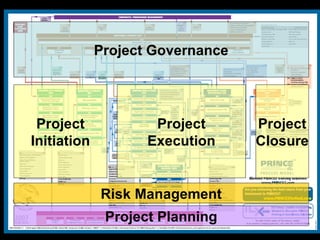
• The Prince2 process map
• A simple structured approach to projects
What is Prince2…
• Prince2™ is an established method for project management. It covers the
management, organization and the control of projects of all shapes and
sizes.
• The methodology itself defines a process based approach to project
management, with inputs, outputs and objectives clearly identified.
• It also details a stage by stage approach, ensuring that progress can be
properly monitored.
• Under Prince2, the whole project is driven by the business requirements,
and managers are encouraged to make the process inclusive, often
including suppliers and customers.
• The intention is that projects should be properly controlled and defined,
but with flexibility and good communication.
What is Prince2…
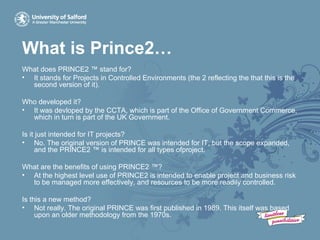
What does PRINCE2 ™ stand for?
• It stands for Projects in Controlled Environments (the 2 reflecting the that this is the
second version of it).
Who developed it?
• It was devloped by the CCTA, which is part of the Office of Government Commerce,
which in turn is part of the UK Government.
Is it just intended for IT projects?
• No. The original version of PRINCE was intended for IT, but the scope expanded,
and the PRINCE2 ™ is intended for all types ofproject.
What are the benefits of using PRINCE2 ™?
• At the highest level use of PRINCE2 is intended to enable project and business risk
to be managed more effectively, and resources to be more readily controlled.
Is this a new method?
• Not really. The original PRINCE was first published in 1989. This itself was based
upon an older methodology from the 1970s.
It’s process based…
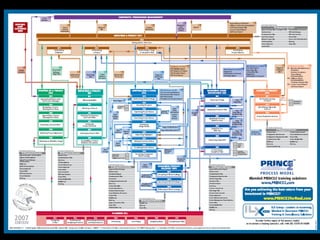
• A collection of processes that together
make up the complete prince2 process
model, example processes groups
include:
– Initiating a project
– Controlling a stage
– Directing a project
– And many more 
Prince2 – Typical responses 
• Do I need to understand all that!
• You must be joking
• It won’t work here
• It’s IT gone mad 
• How do we simplify it and make it useful?
Project Governance
Project
Initiation
Project
Execution
Project
Closure
Project Planning
Risk Management
Structured approach…
• All project management methodologies
are based on having a structured
approach
• Intermediate decision and check points
• So adopt a structured approach – but
keep it simple and appropriate for you 
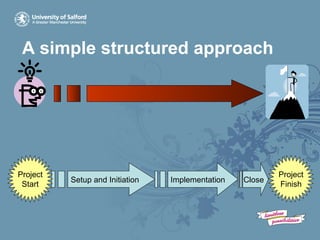
A simple structured approach
Setup and Initiation Implementation Close
Project
Finish
Project
Start
Stage 1 – Setup and Initiation
• Important for projects of any size
– What the project will deliver and why these are
important
– What the resource requirements to deliver are
(R&R's)
– What the plan and milestones are
– What the risks are and how these will be managed
– What are the assumptions and dependencies
– What are the control mechanisms (reporting and
governance)
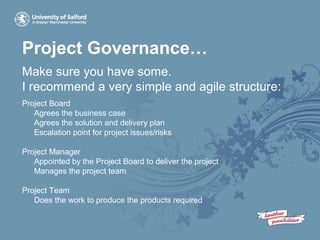
Project Governance…
Make sure you have some.
I recommend a very simple and agile structure:
Project Board
Agrees the business case
Agrees the solution and delivery plan
Escalation point for project issues/risks
Project Manager
Appointed by the Project Board to deliver the project
Manages the project team
Project Team
Does the work to produce the products required
Establish a risk log…
• Start a risk log straight away
– Include
• Risks
• Assumptions
• Issues
• Dependencies
• Maintain it, review it, add to it
• Involve the most appropriate people, get
people working for and with you 
Monitor progress…
• Have a plan
– all tasks/products that need to be completed
– How long each task/product will take and when they will
complete
– The order they need to be done in
– Who will do them
– Any dependencies that exist between tasks
• How do I use it?
– Record when tasks are completing and compare to when they
should be
– If they are late, your project will probably be late
Project plans…
• Use what suits you and the complexity of
the project…
– Gant Chart – MS Project
– Simple List – Excel, Word etc…
• Get it agreed
Ensure controlled end to projects…
• Unfortunately an often undervalued
phase of projects
• Ensures:
– Proper assessment of a projects successes and
shortcomings
– Lessons to be learnt for future projects
– All elements have been completed that allow the
project to be completed
– Any follow up actions required outside the project
are captured, agreed and owned.
Communications…
• Effective communication can mean the
difference between project success and
failure
• Think carefully throughout the project
about what you should be
communicating, to who, in what form and
when, throughout the project – Have a
comms plan!
Final thoughts…
• Prince2 isn’t magic and won’t guarantee
success
• Use the bits that help you
• Start small 
• Seek out people in similar positions –
mutual support and advice
Any questions?
Email: p.waters@salford.ac.uk

Waterspm2

  • 1.
    Prince2 – Theuseful bits…
  • 2.
    Objective… • Quick introto Prince2 and how key elements were adopted at Salford • Present a simple structured approach to organising a project based on the ideas behind Prince2
  • 3.
    Running order… • Whatis Prince2 • The Prince2 process map • A simple structured approach to projects
  • 4.
    What is Prince2… •Prince2™ is an established method for project management. It covers the management, organization and the control of projects of all shapes and sizes. • The methodology itself defines a process based approach to project management, with inputs, outputs and objectives clearly identified. • It also details a stage by stage approach, ensuring that progress can be properly monitored. • Under Prince2, the whole project is driven by the business requirements, and managers are encouraged to make the process inclusive, often including suppliers and customers. • The intention is that projects should be properly controlled and defined, but with flexibility and good communication.
  • 5.
    What is Prince2… Whatdoes PRINCE2 ™ stand for? • It stands for Projects in Controlled Environments (the 2 reflecting the that this is the second version of it). Who developed it? • It was devloped by the CCTA, which is part of the Office of Government Commerce, which in turn is part of the UK Government. Is it just intended for IT projects? • No. The original version of PRINCE was intended for IT, but the scope expanded, and the PRINCE2 ™ is intended for all types ofproject. What are the benefits of using PRINCE2 ™? • At the highest level use of PRINCE2 is intended to enable project and business risk to be managed more effectively, and resources to be more readily controlled. Is this a new method? • Not really. The original PRINCE was first published in 1989. This itself was based upon an older methodology from the 1970s.
  • 6.
    It’s process based… •A collection of processes that together make up the complete prince2 process model, example processes groups include: – Initiating a project – Controlling a stage – Directing a project – And many more 
  • 8.
    Prince2 – Typicalresponses  • Do I need to understand all that! • You must be joking • It won’t work here • It’s IT gone mad  • How do we simplify it and make it useful?
  • 9.
  • 10.
    Structured approach… • Allproject management methodologies are based on having a structured approach • Intermediate decision and check points • So adopt a structured approach – but keep it simple and appropriate for you 
  • 11.
    A simple structuredapproach Setup and Initiation Implementation Close Project Finish Project Start
  • 12.
    Stage 1 –Setup and Initiation • Important for projects of any size – What the project will deliver and why these are important – What the resource requirements to deliver are (R&R's) – What the plan and milestones are – What the risks are and how these will be managed – What are the assumptions and dependencies – What are the control mechanisms (reporting and governance)
  • 13.
    Project Governance… Make sureyou have some. I recommend a very simple and agile structure: Project Board Agrees the business case Agrees the solution and delivery plan Escalation point for project issues/risks Project Manager Appointed by the Project Board to deliver the project Manages the project team Project Team Does the work to produce the products required
  • 14.
    Establish a risklog… • Start a risk log straight away – Include • Risks • Assumptions • Issues • Dependencies • Maintain it, review it, add to it • Involve the most appropriate people, get people working for and with you 
  • 15.
    Monitor progress… • Havea plan – all tasks/products that need to be completed – How long each task/product will take and when they will complete – The order they need to be done in – Who will do them – Any dependencies that exist between tasks • How do I use it? – Record when tasks are completing and compare to when they should be – If they are late, your project will probably be late
  • 16.
    Project plans… • Usewhat suits you and the complexity of the project… – Gant Chart – MS Project – Simple List – Excel, Word etc… • Get it agreed
  • 17.
    Ensure controlled endto projects… • Unfortunately an often undervalued phase of projects • Ensures: – Proper assessment of a projects successes and shortcomings – Lessons to be learnt for future projects – All elements have been completed that allow the project to be completed – Any follow up actions required outside the project are captured, agreed and owned.
  • 18.
    Communications… • Effective communicationcan mean the difference between project success and failure • Think carefully throughout the project about what you should be communicating, to who, in what form and when, throughout the project – Have a comms plan!
  • 19.
    Final thoughts… • Prince2isn’t magic and won’t guarantee success • Use the bits that help you • Start small  • Seek out people in similar positions – mutual support and advice
  • 20.