INTRODUCTION
Transportation is the movement of human, animal and goods from
one location to another.
Mode of transportation includes air, rail, road, water cable, pipeline
and space.
Human’s first means involved walking, running and swimming.
This Presentation include the following:
1) Transportation of Water
2) Evolution / Timeline of water transportation
3) Advantages and Dis-advantages
4) The contribution of Water Transportation to the development of
SDG’s
WATER TRANSPORTATION
Transport which move on water is called WATER
TRANSPORTATION
Water Transportation is the intentional movement of water
over a long distances
Water Transportation is the cheapest and oldest mode of
transport
It has played a very significant role in bringing different
part of the world closer and is indispensable to foreign
trade
HISTORY
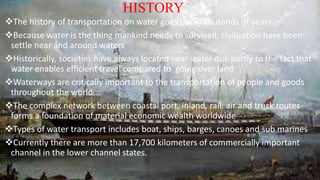
The history of transportation on water goes back thousands of years
Because water is the thing mankind needs to survived, civilization have been
settle near and around waters
Historically, societies have always located near water due partly to the fact that
water enables efficient travel compared to going over land
Waterways are critically important to the transportation of people and goods
throughout the world
The complex network between coastal port, inland, rail, air and truck routes
forms a foundation of material economic wealth worldwide
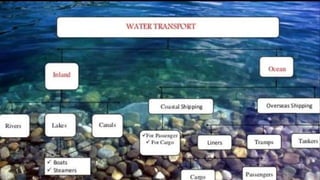
Types of water transport includes boat, ships, barges, canoes and sub marines
Currently there are more than 17,700 kilometers of commercially important
channel in the lower channel states.
EVOLUTION OF
WATER
TRANSPORTATION
TIMELINE
Many thousands of years ago, a raft made by tying
several logs with creepers was the first kind water
transport that a person could steer which obsolete
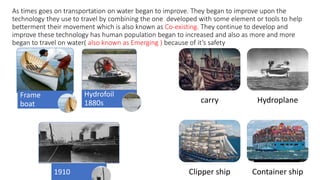
As times goes on transportation on water began to improve. They began to improve upon the
technology they use to travel by combining the one developed with some element or tools to help
betterment their movement which is also known as Co-existing. They continue to develop and
improve these technology has human population began to increased and also as more and more
began to travel on water( also known as Emerging ) because of it’s safety
Frame
boat
Hydrofoil
1880s
1910
carry Hydroplane
Clipper ship Container ship
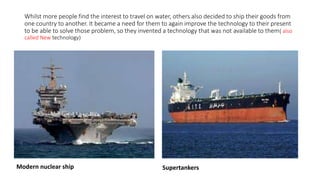
Whilst more people find the interest to travel on water, others also decided to ship their goods from
one country to another. It became a need for them to again improve the technology to their present
to be able to solve those problem, so they invented a technology that was not available to them( also
called New technology)
Modern nuclear ship Supertankers
Advantages & Disadvantages
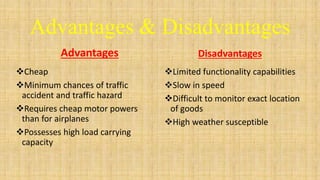
Advantages
Cheap
Minimum chances of traffic
accident and traffic hazard
Requires cheap motor powers
than for airplanes
Possesses high load carrying
capacity
Disadvantages
Limited functionality capabilities
Slow in speed
Difficult to monitor exact location
of goods
High weather susceptible
Water Transportation to the Contribution
of SDG’s.
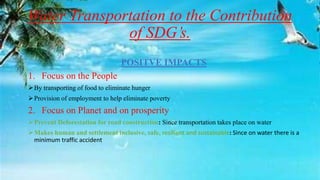
POSITVE IMPACTS
1. Focus on the People
By transporting of food to eliminate hunger
Provision of employment to help eliminate poverty
2. Focus on Planet and on prosperity
Prevent Deforestation for road construction: Since transportation takes place on water
Makes human and settlement inclusive, safe, resilient and sustainable: Since on water there is a
minimum traffic accident
NEGATIVE IMPACTS
Destruction of life in the aquatic habitats
Release of carbon dioxide
Transporting on water sometimes makes
water unsafe to drink
Accident is very critical
REFERENCING
GROUP 18
NAMES
1) Boansi Kyeremateng Collins
INDEX NUMBERS
1. UEB3509820
WATER TRANSPORTATION.pptx

WATER TRANSPORTATION.pptx

  • 2.
    INTRODUCTION Transportation is themovement of human, animal and goods from one location to another. Mode of transportation includes air, rail, road, water cable, pipeline and space. Human’s first means involved walking, running and swimming. This Presentation include the following: 1) Transportation of Water 2) Evolution / Timeline of water transportation 3) Advantages and Dis-advantages 4) The contribution of Water Transportation to the development of SDG’s
  • 3.
    WATER TRANSPORTATION Transport whichmove on water is called WATER TRANSPORTATION Water Transportation is the intentional movement of water over a long distances Water Transportation is the cheapest and oldest mode of transport It has played a very significant role in bringing different part of the world closer and is indispensable to foreign trade
  • 4.
    HISTORY The history oftransportation on water goes back thousands of years Because water is the thing mankind needs to survived, civilization have been settle near and around waters Historically, societies have always located near water due partly to the fact that water enables efficient travel compared to going over land Waterways are critically important to the transportation of people and goods throughout the world The complex network between coastal port, inland, rail, air and truck routes forms a foundation of material economic wealth worldwide Types of water transport includes boat, ships, barges, canoes and sub marines Currently there are more than 17,700 kilometers of commercially important channel in the lower channel states.
  • 6.
  • 7.
    Many thousands ofyears ago, a raft made by tying several logs with creepers was the first kind water transport that a person could steer which obsolete
  • 8.
    As times goeson transportation on water began to improve. They began to improve upon the technology they use to travel by combining the one developed with some element or tools to help betterment their movement which is also known as Co-existing. They continue to develop and improve these technology has human population began to increased and also as more and more began to travel on water( also known as Emerging ) because of it’s safety Frame boat Hydrofoil 1880s 1910 carry Hydroplane Clipper ship Container ship
  • 9.
    Whilst more peoplefind the interest to travel on water, others also decided to ship their goods from one country to another. It became a need for them to again improve the technology to their present to be able to solve those problem, so they invented a technology that was not available to them( also called New technology) Modern nuclear ship Supertankers
  • 10.
    Advantages & Disadvantages Advantages Cheap Minimumchances of traffic accident and traffic hazard Requires cheap motor powers than for airplanes Possesses high load carrying capacity Disadvantages Limited functionality capabilities Slow in speed Difficult to monitor exact location of goods High weather susceptible
  • 11.
    Water Transportation tothe Contribution of SDG’s. POSITVE IMPACTS 1. Focus on the People By transporting of food to eliminate hunger Provision of employment to help eliminate poverty 2. Focus on Planet and on prosperity Prevent Deforestation for road construction: Since transportation takes place on water Makes human and settlement inclusive, safe, resilient and sustainable: Since on water there is a minimum traffic accident
  • 12.
    NEGATIVE IMPACTS Destruction oflife in the aquatic habitats Release of carbon dioxide Transporting on water sometimes makes water unsafe to drink Accident is very critical
  • 13.
  • 14.
    GROUP 18 NAMES 1) BoansiKyeremateng Collins INDEX NUMBERS 1. UEB3509820