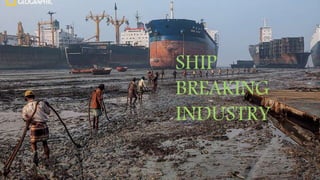
SHIP
BREAKING
INDUSTRY
Presented To- Prof.
Presented By- Ayan Alam(161014038)
-
-
-
2
Overview
Ship Breaking in
Developed &
Developing Countries
Ship Breaking in
Bangladesh
Some Ship Breaking
Yards
Introduction
Global Ship Breaking
Industry
History of Ship
Breaking
Bangladesh Environmental Lawyers Association
3
Introduction
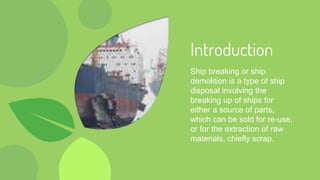
Ship breaking or ship
demolition is a type of ship
disposal involving the
breaking up of ships for
either a source of parts,
which can be sold for re-use,
or for the extraction of raw
materials, chiefly scrap.
Ship Breaking | National Geo-Graphic Documentary
5
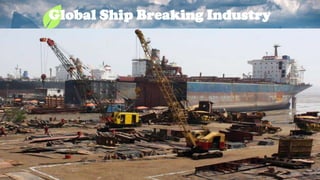
Global Ship Breaking Industry
6
“
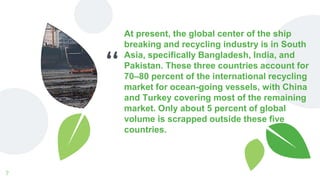
At present, the global center of the ship
breaking and recycling industry is in South
Asia, specifically Bangladesh, India, and
Pakistan. These three countries account for
70–80 percent of the international recycling
market for ocean-going vessels, with China
and Turkey covering most of the remaining
market. Only about 5 percent of global
volume is scrapped outside these five
countries.
7
History Of Ship breaking
The navy vessel HMS Temeraire had her
masts, stores and guns removed and her
crew paid off. She was sold by Dutch
auction on 16 August 1838 to John
Beatson, a shipbreaker based
at Rotherhithe for £5,530. In 1880,
Denny Brothers of Dumbarton used
scrap maritime steel in their shipbuilding.
Many other nations began to purchase
British ships for scrap by the late 19th
century, including Germany, Italy, the
Netherlands and Japan. The Italian
industry started in 1892, and the
Japanese after an 1896 law had been
passed to subsidise native shipbuilding.8
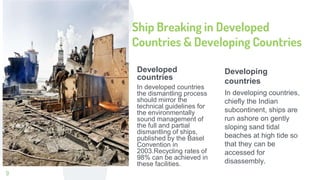
Developed
countries
In developed countries
the dismantling process
should mirror the
technical guidelines for
the environmentally
sound management of
the full and partial
dismantling of ships,
published by the Basel
Convention in
2003.Recycling rates of
98% can be achieved in
these facilities.
Ship Breaking in Developed
Countries & Developing Countries
Developing
countries
In developing countries,
chiefly the Indian
subcontinent, ships are
run ashore on gently
sloping sand tidal
beaches at high tide so
that they can be
accessed for
disassembly.
9
Some Ship Breaking Yards
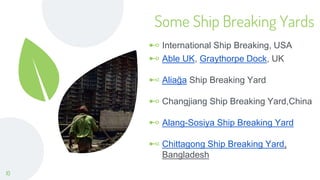
⊷ International Ship Breaking, USA
⊷ Able UK, Graythorpe Dock, UK
⊷ Aliağa Ship Breaking Yard
⊷ Changjiang Ship Breaking Yard,China
⊷ Alang-Sosiya Ship Breaking Yard
⊷ Chittagong Ship Breaking Yard,
Bangladesh
10
Place your screenshot here
11
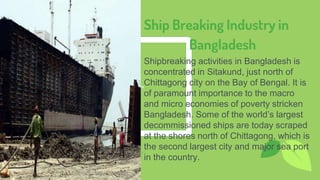
Ship Breaking Industry in
Bangladesh
Shipbreaking activities in Bangladesh is
concentrated in Sitakund, just north of
Chittagong city on the Bay of Bengal. It is
of paramount importance to the macro
and micro economies of poverty stricken
Bangladesh. Some of the world’s largest
decommissioned ships are today scraped
at the shores north of Chittagong, which is
the second largest city and major sea port
in the country.
.
Benefits from Ship
breaking
1. Production of
steel
2. In some ways it
can be considered a
“green industry”.
3. It generates large
amounts of revenue
for various
Government
authorities through
the payment of
taxes.
4. Employment.
Worker Rights
Violation
1. Limited or no
access to treatment,
emergency services
and compensation
when a worker is
injured or killed on the
job.
2. Less than minimum
wages.
3. Use of child labor.
4. Extensive working
hours with no right to
overtime, sick or
annual leave.
5. Lack of job
security: no work no
pay.
6. No right to join or
form a trade union.
Environmental
Pollution
1. Persistent
Organic
Pollutants
2. Asbestos
3. Heavy metals
4. Oil pollution
5. Impact of
shipbreaking on
physiochemical
properties of
seawater
6. Impact of
shipbreaking on
biodiversity
12
Environmental Risks
In recent years, ship breaking has
become an issue of environmental
concern beyond the health of the
yard workers. Many ship breaking
yards operate in developing nations
with lax or no environmental law,
enabling large quantities of highly
toxic materials to escape into the
general environment and causing
serious health problems among
ship breakers, the local population,
and wildlife. Environmental
campaign groups such
as Greenpeace have made the
issue a high priority for their
activities.
13
BELABangladesh Environmental Lawyers Association
Bangladesh Environmental Lawyers Association, or BELA, is a
nonprofit legal organization established in 1992 to assist efforts to
protect the environment.
14
15
Thanks!Thank You All For Your Attention
Do You Have Any QUESTIONS?

Ship breaking industry

  • 1.
  • 2.
    Presented To- Prof. PresentedBy- Ayan Alam(161014038) - - - 2
  • 3.
    Overview Ship Breaking in Developed& Developing Countries Ship Breaking in Bangladesh Some Ship Breaking Yards Introduction Global Ship Breaking Industry History of Ship Breaking Bangladesh Environmental Lawyers Association 3
  • 4.
    Introduction Ship breaking orship demolition is a type of ship disposal involving the breaking up of ships for either a source of parts, which can be sold for re-use, or for the extraction of raw materials, chiefly scrap.
  • 5.
    Ship Breaking |National Geo-Graphic Documentary 5
  • 6.
  • 7.
    “ At present, theglobal center of the ship breaking and recycling industry is in South Asia, specifically Bangladesh, India, and Pakistan. These three countries account for 70–80 percent of the international recycling market for ocean-going vessels, with China and Turkey covering most of the remaining market. Only about 5 percent of global volume is scrapped outside these five countries. 7
  • 8.
    History Of Shipbreaking The navy vessel HMS Temeraire had her masts, stores and guns removed and her crew paid off. She was sold by Dutch auction on 16 August 1838 to John Beatson, a shipbreaker based at Rotherhithe for £5,530. In 1880, Denny Brothers of Dumbarton used scrap maritime steel in their shipbuilding. Many other nations began to purchase British ships for scrap by the late 19th century, including Germany, Italy, the Netherlands and Japan. The Italian industry started in 1892, and the Japanese after an 1896 law had been passed to subsidise native shipbuilding.8
  • 9.
    Developed countries In developed countries thedismantling process should mirror the technical guidelines for the environmentally sound management of the full and partial dismantling of ships, published by the Basel Convention in 2003.Recycling rates of 98% can be achieved in these facilities. Ship Breaking in Developed Countries & Developing Countries Developing countries In developing countries, chiefly the Indian subcontinent, ships are run ashore on gently sloping sand tidal beaches at high tide so that they can be accessed for disassembly. 9
  • 10.
    Some Ship BreakingYards ⊷ International Ship Breaking, USA ⊷ Able UK, Graythorpe Dock, UK ⊷ Aliağa Ship Breaking Yard ⊷ Changjiang Ship Breaking Yard,China ⊷ Alang-Sosiya Ship Breaking Yard ⊷ Chittagong Ship Breaking Yard, Bangladesh 10
  • 11.
    Place your screenshothere 11 Ship Breaking Industry in Bangladesh Shipbreaking activities in Bangladesh is concentrated in Sitakund, just north of Chittagong city on the Bay of Bengal. It is of paramount importance to the macro and micro economies of poverty stricken Bangladesh. Some of the world’s largest decommissioned ships are today scraped at the shores north of Chittagong, which is the second largest city and major sea port in the country.
  • 12.
    . Benefits from Ship breaking 1.Production of steel 2. In some ways it can be considered a “green industry”. 3. It generates large amounts of revenue for various Government authorities through the payment of taxes. 4. Employment. Worker Rights Violation 1. Limited or no access to treatment, emergency services and compensation when a worker is injured or killed on the job. 2. Less than minimum wages. 3. Use of child labor. 4. Extensive working hours with no right to overtime, sick or annual leave. 5. Lack of job security: no work no pay. 6. No right to join or form a trade union. Environmental Pollution 1. Persistent Organic Pollutants 2. Asbestos 3. Heavy metals 4. Oil pollution 5. Impact of shipbreaking on physiochemical properties of seawater 6. Impact of shipbreaking on biodiversity 12
  • 13.
    Environmental Risks In recentyears, ship breaking has become an issue of environmental concern beyond the health of the yard workers. Many ship breaking yards operate in developing nations with lax or no environmental law, enabling large quantities of highly toxic materials to escape into the general environment and causing serious health problems among ship breakers, the local population, and wildlife. Environmental campaign groups such as Greenpeace have made the issue a high priority for their activities. 13
  • 14.
    BELABangladesh Environmental LawyersAssociation Bangladesh Environmental Lawyers Association, or BELA, is a nonprofit legal organization established in 1992 to assist efforts to protect the environment. 14
  • 15.
    15 Thanks!Thank You AllFor Your Attention Do You Have Any QUESTIONS?