Practical Engineering
I hear and I forget. I see and I remember. I do and I
                             understand. - Confucius


                             Ashwith Jerome Rego
                             ashwith@ieee.org
                             http://ashwith.wordpress.com
What is it?
•   College lab experiments - not the way you're
    doing it now.
•   Smaller experiments - because the labs
    cannot cover everything.
•   Projects - That's why you're here today.
•   Exploring beyond the syllabus
•   Teaching is the best way to learn
Why should you care?
•   Improves your Résumé (That's what everyone really
    cares about isn't it? ;-))
•   Get a feel of how R&D works.
•   What did Confucius say again?
•   Strengthens understanding - Interviews will be a piece
    of cake!
•   Bragging rights! :-)
•   Syllabus becomes more interesting.
•   Marks aren't everything. Projects really show what you
    know.
•   That's how things get discovered or invented
•   The most important reason - It's fun!
What's important?
•   Know the theory first - know it well.
•   Try to create something small from what
    you've just learned.
•   Build up from here.
•   DO NOT COPY! Work hard, struggle, design
    it yourself. It feels great in the end!
•   Share what you create. Teaching is the best
    way to learn.
•   Keep it Simple. Have Fun.
The Fun part: Projects
•   Do your homework. Study the required material. Do a
    thorough literature survey.
•   Plan a schedule (with your mentor). Set deadlines and
    stick to them.
•   Document your work from the beginning.
•   Work hard. "Pick a formula and substitute" doesn't
    always work. Get your hands dirty. That's how we had
    fun as kids :-)
•   Be independent. If you don't get it right do everything
    you can to figure it out yourself. Your mentor should be
    your last resort.
•   Regular updates - Keep your mentor informed.
Where do I start?
•   If you want to build circuits, learn to solder.
    It's easy, takes a few minutes to learn and
    only a day or two to master.
•   If you're going to code, learn to do it right.
•   Your college lab. Don't complain. It's much
    better than you think.
•   Simulation tools.
•   Cheap boards and equipment.
•   Contests, tech fests.
•   Workshops.
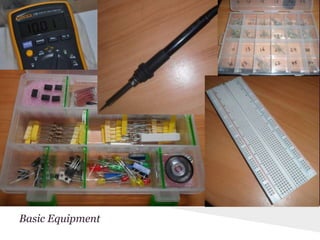
Basic Equipment
•   Multimeter x 2
•   Soldering Iron
•   Breadboards
•   General Purpose PCBs
•   Basic components: assorted resistors,
    capacitors, op-amps, transistors, wires (or
    any analog starter kit), sensors, motors.
•   Batteries: 12V, 9V, 5V.
Basic Equipment
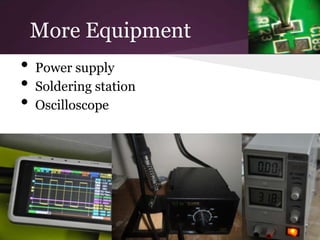
More Equipment
•   Power supply
•   Soldering station
•   Oscilloscope
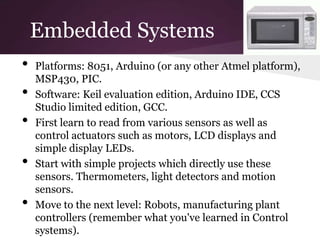
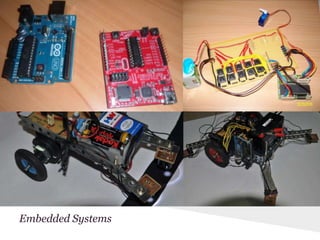
Embedded Systems
•   Platforms: 8051, Arduino (or any other Atmel platform),
    MSP430, PIC.
•   Software: Keil evaluation edition, Arduino IDE, CCS
    Studio limited edition, GCC.
•   First learn to read from various sensors as well as
    control actuators such as motors, LCD displays and
    simple display LEDs.
•   Start with simple projects which directly use these
    sensors. Thermometers, light detectors and motion
    sensors.
•   Move to the next level: Robots, manufacturing plant
    controllers (remember what you've learned in Control
    systems).
Embedded Systems
Analog Design
•   Be thorough with the theory first. Analog
    circuits, signals and systems, controls
    systems are important subjects.
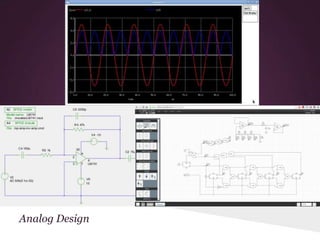
•   Simulation tools:
    o   gEDA: http://www.gpleda.org/
    o   Online Tools: https://www.circuitlab.com/
•   Design on paper. Verify with simulation.
    Then go ahead and build.
Analog Design
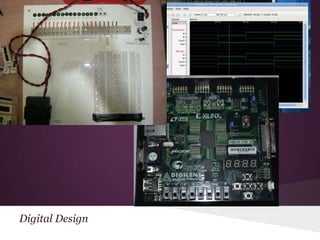
Digital Design
•   Platforms: Discrete ICs, PLDs, FPGAs.
•   Pick either Verilog or VHDL.
•   Design + Verification. Very few know the
    latter.
•   Understand the entire workflow - from
    architecture specification to synthesis.
•   Automation using Scripts. Perl, Shell
    Scripting.
•   OVM, UVM and SystemVerilog, SystemC.
Digital Design
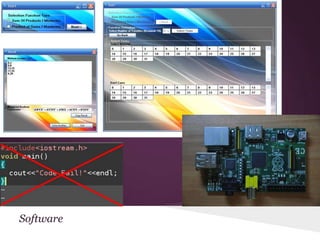
Software
•   Get familiar with any *nix environment. Then slowly
    become an expert.
•   Concentrate more on how to design and think about a
    program. Languages are secondary.
•   Learn to write fast efficient programs (Algorithm
    design/selection). Not everyone has a fast multi-core
    CPU with a lot of RAM.
•   Coding style and standards compliance is important.
•   Raspberry Pi: http://www.raspberrypi.org/
    Gertboard
•   Android/iOS/Windows Mobile/Java.
Software
Free Resources
•   Fedora Electronic Lab (GNU/Linux)
•   Scilab, Octave
•   Maxima, Sagemath
•   Libraries: LAPACK, OpenCV, NumPy, SciPy
•   Online Courses
    o   edX: https://www.edx.org/
    o   Coursera: https://www.coursera.org/
    o   Udacity: http://www.udacity.com/
•   Use the right books!
•   Use the right software!
Sharing is caring
•   Blogs and websites:
    o   Ashwith http://ashwith.wordpress.com/
    o   Flip flop http://msuraj.wordpress.com/
    o   Infinity Redefined
        http://msharmavikram.wordpress.com/
•   Workshops
•   Online Forums
•   Remember: Teaching is the best way to
    learn! (I won't repeat that again :-))
•   Résumé boost.
Rewind...
•   Always start small.
•   Understand why things work.
•   Plan thoroughly. Break everything into manageable bits.
•   Be patient. Projects are hard and it takes time. That's how
    the industry is as well.
•   Learn because you want to and you like it.
•   If it's not fun it's not worth it. Find out what really is your
    passion.
•   Share what you learn.
•   Open-hardware, Free and Open Source Software (FOSS).
•   Protecting your work - licenses.
•   Learning never stops after college!
Any questions?


Don't be shy!
Thank You!


This is the part where you clap ;-)

Practical engineering

  • 1.
    Practical Engineering I hearand I forget. I see and I remember. I do and I understand. - Confucius Ashwith Jerome Rego ashwith@ieee.org http://ashwith.wordpress.com
  • 2.
    What is it? • College lab experiments - not the way you're doing it now. • Smaller experiments - because the labs cannot cover everything. • Projects - That's why you're here today. • Exploring beyond the syllabus • Teaching is the best way to learn
  • 3.
    Why should youcare? • Improves your Résumé (That's what everyone really cares about isn't it? ;-)) • Get a feel of how R&D works. • What did Confucius say again? • Strengthens understanding - Interviews will be a piece of cake! • Bragging rights! :-) • Syllabus becomes more interesting. • Marks aren't everything. Projects really show what you know. • That's how things get discovered or invented • The most important reason - It's fun!
  • 4.
    What's important? • Know the theory first - know it well. • Try to create something small from what you've just learned. • Build up from here. • DO NOT COPY! Work hard, struggle, design it yourself. It feels great in the end! • Share what you create. Teaching is the best way to learn. • Keep it Simple. Have Fun.
  • 6.
    The Fun part:Projects • Do your homework. Study the required material. Do a thorough literature survey. • Plan a schedule (with your mentor). Set deadlines and stick to them. • Document your work from the beginning. • Work hard. "Pick a formula and substitute" doesn't always work. Get your hands dirty. That's how we had fun as kids :-) • Be independent. If you don't get it right do everything you can to figure it out yourself. Your mentor should be your last resort. • Regular updates - Keep your mentor informed.
  • 7.
    Where do Istart? • If you want to build circuits, learn to solder. It's easy, takes a few minutes to learn and only a day or two to master. • If you're going to code, learn to do it right. • Your college lab. Don't complain. It's much better than you think. • Simulation tools. • Cheap boards and equipment. • Contests, tech fests. • Workshops.
  • 8.
    Basic Equipment • Multimeter x 2 • Soldering Iron • Breadboards • General Purpose PCBs • Basic components: assorted resistors, capacitors, op-amps, transistors, wires (or any analog starter kit), sensors, motors. • Batteries: 12V, 9V, 5V.
  • 9.
  • 10.
    More Equipment • Power supply • Soldering station • Oscilloscope
  • 11.
    Embedded Systems • Platforms: 8051, Arduino (or any other Atmel platform), MSP430, PIC. • Software: Keil evaluation edition, Arduino IDE, CCS Studio limited edition, GCC. • First learn to read from various sensors as well as control actuators such as motors, LCD displays and simple display LEDs. • Start with simple projects which directly use these sensors. Thermometers, light detectors and motion sensors. • Move to the next level: Robots, manufacturing plant controllers (remember what you've learned in Control systems).
  • 12.
  • 13.
    Analog Design • Be thorough with the theory first. Analog circuits, signals and systems, controls systems are important subjects. • Simulation tools: o gEDA: http://www.gpleda.org/ o Online Tools: https://www.circuitlab.com/ • Design on paper. Verify with simulation. Then go ahead and build.
  • 14.
  • 15.
    Digital Design • Platforms: Discrete ICs, PLDs, FPGAs. • Pick either Verilog or VHDL. • Design + Verification. Very few know the latter. • Understand the entire workflow - from architecture specification to synthesis. • Automation using Scripts. Perl, Shell Scripting. • OVM, UVM and SystemVerilog, SystemC.
  • 16.
  • 17.
    Software • Get familiar with any *nix environment. Then slowly become an expert. • Concentrate more on how to design and think about a program. Languages are secondary. • Learn to write fast efficient programs (Algorithm design/selection). Not everyone has a fast multi-core CPU with a lot of RAM. • Coding style and standards compliance is important. • Raspberry Pi: http://www.raspberrypi.org/ Gertboard • Android/iOS/Windows Mobile/Java.
  • 18.
  • 19.
    Free Resources • Fedora Electronic Lab (GNU/Linux) • Scilab, Octave • Maxima, Sagemath • Libraries: LAPACK, OpenCV, NumPy, SciPy • Online Courses o edX: https://www.edx.org/ o Coursera: https://www.coursera.org/ o Udacity: http://www.udacity.com/ • Use the right books! • Use the right software!
  • 20.
    Sharing is caring • Blogs and websites: o Ashwith http://ashwith.wordpress.com/ o Flip flop http://msuraj.wordpress.com/ o Infinity Redefined http://msharmavikram.wordpress.com/ • Workshops • Online Forums • Remember: Teaching is the best way to learn! (I won't repeat that again :-)) • Résumé boost.
  • 21.
    Rewind... • Always start small. • Understand why things work. • Plan thoroughly. Break everything into manageable bits. • Be patient. Projects are hard and it takes time. That's how the industry is as well. • Learn because you want to and you like it. • If it's not fun it's not worth it. Find out what really is your passion. • Share what you learn. • Open-hardware, Free and Open Source Software (FOSS). • Protecting your work - licenses. • Learning never stops after college!
  • 22.
  • 23.
    Thank You! This isthe part where you clap ;-)