WATER AND ITS ROL
IN BIOLOGY
Polar bond
Hydrogen bond
The extraordinary qualities of water emerge in large part from
the hydrogen bonding that organizes water molecules into a
higher level of structural order.
Cohesive behavior
Related to cohesion is surface
tension, a measure of how
difficult it is to stretch or break
the surface of a liquid. The hy-
drogen bonds in water give it
an unusually high surface
tension.
Water has a high specific heat: Heat is absorbed
when hydrogen bonds break and is released when
hydrogen bonds form. This helps keep temperatures
relatively steady, within limits that permit life.
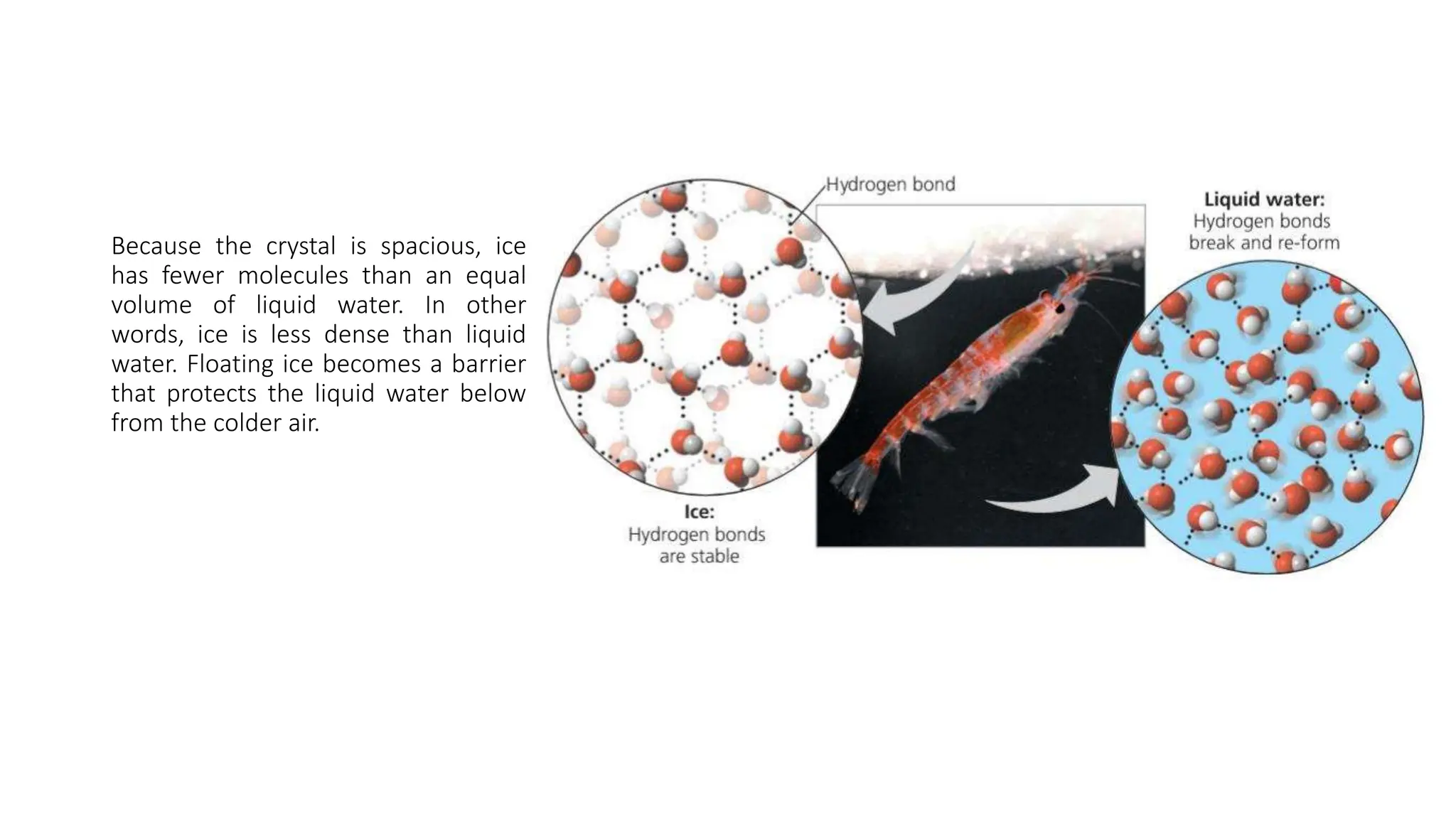
Because the crystal is spacious, ice
has fewer molecules than an equal
volume of liquid water. In other
words, ice is less dense than liquid
water. Floating ice becomes a barrier
that protects the liquid water below
from the colder air.
Versatility as a solvent.
Occasionally, a hydrogen atom participating in a hydrogen bond
between two water molecules shifts from one molecule to the
other.
A buffer is a substance that minimizes changes in the concentrations of H+ and
OH− in a solution.
It does so by accepting hydrogen ions from the solution when they are in
excess and donating hydrogen ions to the solution when they have been
depleted.
References
• Biology in Focus. Second Edition. Lisa A. Hurry [et al], (2013).
“Chemistry and cells”p. 19-34. Pearson Education.

Water in biology .........................

  • 1.
    WATER AND ITSROL IN BIOLOGY
  • 3.
  • 4.
  • 5.
    The extraordinary qualitiesof water emerge in large part from the hydrogen bonding that organizes water molecules into a higher level of structural order.
  • 6.
  • 7.
    Related to cohesionis surface tension, a measure of how difficult it is to stretch or break the surface of a liquid. The hy- drogen bonds in water give it an unusually high surface tension.
  • 8.
    Water has ahigh specific heat: Heat is absorbed when hydrogen bonds break and is released when hydrogen bonds form. This helps keep temperatures relatively steady, within limits that permit life.
  • 9.
    Because the crystalis spacious, ice has fewer molecules than an equal volume of liquid water. In other words, ice is less dense than liquid water. Floating ice becomes a barrier that protects the liquid water below from the colder air.
  • 10.
  • 12.
    Occasionally, a hydrogenatom participating in a hydrogen bond between two water molecules shifts from one molecule to the other.
  • 14.
    A buffer isa substance that minimizes changes in the concentrations of H+ and OH− in a solution. It does so by accepting hydrogen ions from the solution when they are in excess and donating hydrogen ions to the solution when they have been depleted.
  • 16.
    References • Biology inFocus. Second Edition. Lisa A. Hurry [et al], (2013). “Chemistry and cells”p. 19-34. Pearson Education.

Editor's Notes

  • #2 All organisms are made mostly of water and live in an envi- ronment dominated by water. Most cells are surrounded by water, and cells themselves are about 70–95% water. Water is an exceptional substance with many extraordinary qualities. We can trace water’s unique behavior to the structure and interactions of its molecules.
  • #3 The number of electrons required to complete an atom’s valence shell generally determines how many covalent bonds that atom will form.
  • #4 In some cases, two atoms are unequal in their attraction for valence electrons.
  • #5 This noncovalent attraction between a hydrogen and an electronegative atom is called a hydrogen bond. In living cells, the electronegative partners are usually oxygen or nitrogen atoms.
  • #7 Evaporation from leaves pulls water upward from the roots through water-conducting cells. Because of the properties of cohesion and adhesion, the tallest trees can transport water more than 100 m upward
  • #8  making it behave as though it were coated with an invisible film. You can observe the surface tension of water by slightly over- filling a drinking glass; the water will stand above the rim. The spider in Figure 2.18 takes advantage of the surface tension of water to walk across a pond without breaking the surface.
  • #9  A large body of water can absorb and store a huge amount of heat from the sun in the daytime and during sum- mer while warming up only a few degrees. At night and during winter, the gradually cooling water can warm the air. This is the reason coastal areas generally have milder climates than inland regions Evaporative cooling is based on water’s high heat of vaporization. The evaporative loss of the most energetic water molecules cools a surface.
  • #12 Human lysozyme is a protein found in tears and saliva that has antibacterial action. This model shows the lysozyme molecule (purple) in an aqueous environment. Ionic and polar regions on the protein’s surface attract water molecules.
  • #13 The water mol- ecule that lost a proton is now a hydroxide ion (OH−), which has a charge of 1–. The proton binds to the other water mol- ecule, making that molecule a hydronium ion (H3O+).