PHARM D 1STYEAR
MEDICINAL BIOCHEMISTRY
1.3
WATER, ELECTROLYTE
Dr Rina Das
Associate Professor
MM College of Pharmacy,
MM(DU), Mullana
Balance – a state of equilibrium –
substances are maintained in the
right amounts and in the right
place in the body
Water Balance
•Osmosis is the primary method of water movement
into and out of body fluid compartments.
•Osmosis is the net movement of water molecules
through a selectively permeable membrane from an
area of high water concentration to an area of lower
water concentration.
•The concentration of solutes determines
the direction of water movement.
•Most solutes in the body are electrolytes
– inorganic compounds which dissociate
into ions in solution.
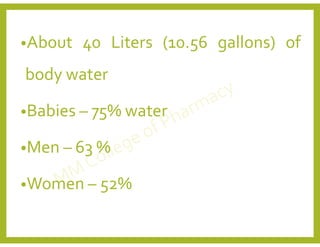
•About 40 Liters (10.56 gallons) of
body water
•Babies – 75% water
•Men – 63 %
•Women – 52%
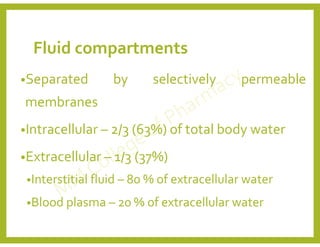
Fluid compartments
•Separated by selectively permeable
membranes
•Intracellular – 2/3 (63%) of total body water
•Extracellular – 1/3 (37%)
•Interstitial fluid – 80 % of extracellular water
•Blood plasma – 20 % of extracellular water
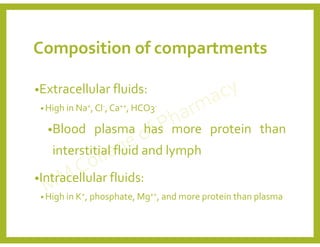
Composition of compartments
•Extracellular fluids:
• High in Na+, Cl-, Ca++, HCO3-
•Blood plasma has more protein than
interstitial fluid and lymph
•Intracellular fluids:
• High in K+, phosphate, Mg++, and more protein than plasma

water and electrolytes

  • 1.
    PHARM D 1STYEAR MEDICINALBIOCHEMISTRY 1.3 WATER, ELECTROLYTE Dr Rina Das Associate Professor MM College of Pharmacy, MM(DU), Mullana
  • 2.
    Balance – astate of equilibrium – substances are maintained in the right amounts and in the right place in the body
  • 3.
    Water Balance •Osmosis isthe primary method of water movement into and out of body fluid compartments. •Osmosis is the net movement of water molecules through a selectively permeable membrane from an area of high water concentration to an area of lower water concentration.
  • 4.
    •The concentration ofsolutes determines the direction of water movement. •Most solutes in the body are electrolytes – inorganic compounds which dissociate into ions in solution.
  • 5.
    •About 40 Liters(10.56 gallons) of body water •Babies – 75% water •Men – 63 % •Women – 52%
  • 6.
    Fluid compartments •Separated byselectively permeable membranes •Intracellular – 2/3 (63%) of total body water •Extracellular – 1/3 (37%) •Interstitial fluid – 80 % of extracellular water •Blood plasma – 20 % of extracellular water
  • 7.
    Composition of compartments •Extracellularfluids: • High in Na+, Cl-, Ca++, HCO3- •Blood plasma has more protein than interstitial fluid and lymph •Intracellular fluids: • High in K+, phosphate, Mg++, and more protein than plasma