Introduction to Enzymes
Dr Rina Das Mehta
Professor
MM College of Pharmacy, MM(DU)
Introduction
 Enzymes act as catalysts and increase the rate
of chemical reactions. They are usually
proteins in nature.
 They bind to a substrate and form a complex.
They are substrate specific.
 This complex lowers the activation energy in
the reaction:
 without the enzyme becoming consumed
 and without changing the equilibrium of the reaction.
 A product is produced at the end of the
reaction and released from the active site of
enzyme.
 Enzyme catalyzed reactions are essential to
physiologic functions, such as:
 the hydration of carbon dioxide,
 nerve conduction,
 nutrient degradation,
 muscle contraction
 and energy use.
 Found in all body tissue, enzymes frequently
appear in the serum following cellular injury
or, sometimes, in smaller amounts, from
degraded cells.
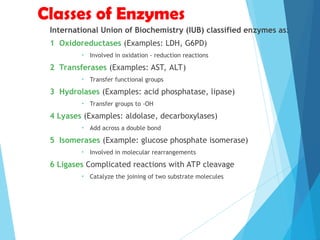
Classes of Enzymes
International Union of Biochemistry (IUB) classified enzymes as:
1 Oxidoreductases (Examples: LDH, G6PD)
• Involved in oxidation - reduction reactions
2 Transferases (Examples: AST, ALT)
• Transfer functional groups
3 Hydrolases (Examples: acid phosphatase, lipase)
• Transfer groups to -OH
4 Lyases (Examples: aldolase, decarboxylases)
• Add across a double bond
5 Isomerases (Example: glucose phosphate isomerase)
• Involved in molecular rearrangements
6 Ligases Complicated reactions with ATP cleavage
• Catalyze the joining of two substrate molecules

Introduction to Enzymes and classification .ppt

  • 1.
    Introduction to Enzymes DrRina Das Mehta Professor MM College of Pharmacy, MM(DU)
  • 2.
    Introduction  Enzymes actas catalysts and increase the rate of chemical reactions. They are usually proteins in nature.  They bind to a substrate and form a complex. They are substrate specific.  This complex lowers the activation energy in the reaction:  without the enzyme becoming consumed  and without changing the equilibrium of the reaction.  A product is produced at the end of the reaction and released from the active site of enzyme.
  • 3.
     Enzyme catalyzedreactions are essential to physiologic functions, such as:  the hydration of carbon dioxide,  nerve conduction,  nutrient degradation,  muscle contraction  and energy use.  Found in all body tissue, enzymes frequently appear in the serum following cellular injury or, sometimes, in smaller amounts, from degraded cells.
  • 4.
    Classes of Enzymes InternationalUnion of Biochemistry (IUB) classified enzymes as: 1 Oxidoreductases (Examples: LDH, G6PD) • Involved in oxidation - reduction reactions 2 Transferases (Examples: AST, ALT) • Transfer functional groups 3 Hydrolases (Examples: acid phosphatase, lipase) • Transfer groups to -OH 4 Lyases (Examples: aldolase, decarboxylases) • Add across a double bond 5 Isomerases (Example: glucose phosphate isomerase) • Involved in molecular rearrangements 6 Ligases Complicated reactions with ATP cleavage • Catalyze the joining of two substrate molecules