The activated sludge process treats wastewater by mixing it with oxygen and microorganisms in tanks. This allows microbes to break down organic matter, producing new cells, carbon dioxide, and water. The microbes are then removed from the treated water through settling. Oxidation ponds and ditches also use microbes and oxygen to treat wastewater, but do so in large, shallow ponds or ditches, utilizing sunlight, algae, and bacteria to purify the water over longer detention times. Both processes effectively reduce organic matter, but ponds require more land and can have odor issues while ditches are more compact and energy efficient.
Introduces the activated sludge process for wastewater treatment, mixing raw sewage with air/oxygen, utilizing bacteria for organic matter breakdown. Describes sludge handling and aeration.
Highlights benefits such as reduced undesired sludge, lengthy emptying intervals, reliability, simplicity, and lower costs.
Discusses drawbacks including high initial costs, need for skilled operation, continuous energy use, and potential sludge discharge issues.
Describes oxidation ponds for wastewater treatment, emphasizing algae-bacteria interactions for organic waste breakdown and oxygen release.
Lists advantages such as significant biological oxygen demand reduction, simplicity, low labor, and cost-effectiveness.
Outlines disadvantages like land requirement, maintenance challenges, potential odors, and groundwater contamination risks.
Explains oxidation ditch process using long solids retention times, aerators for mixing, simultaneous nitrification and denitrification, and dual reactor function.
Details benefits including reliability, shock load resistance, reduced sludge production, and lower energy costs.
Mentions challenges like higher suspended solids concentrations and larger land area requirements.
Contrasts the two systems on factors like land usage, treatment methods, and detention times.
WHAT IS ACTIVATEDSLUDGE PROCESS-
• The activated sludge process is an integral process used to treat
wastewater. Air or oxygen is blown into raw sewage. It is most
effective for large volumes of water. Wastewater is mixed and
aerated in a special tank. This step in the process occurs by pumping
air or oxygen into the activated sludge tank or using surface aerators.
The process oxidizes organic matters in the wastewater, producing
new cells, carbon dioxide, and water. The sludge particles can then
be removed through the process of gravity settling.
2.
WORKING OF ACTIVATEDSLUDGE PROCESS-
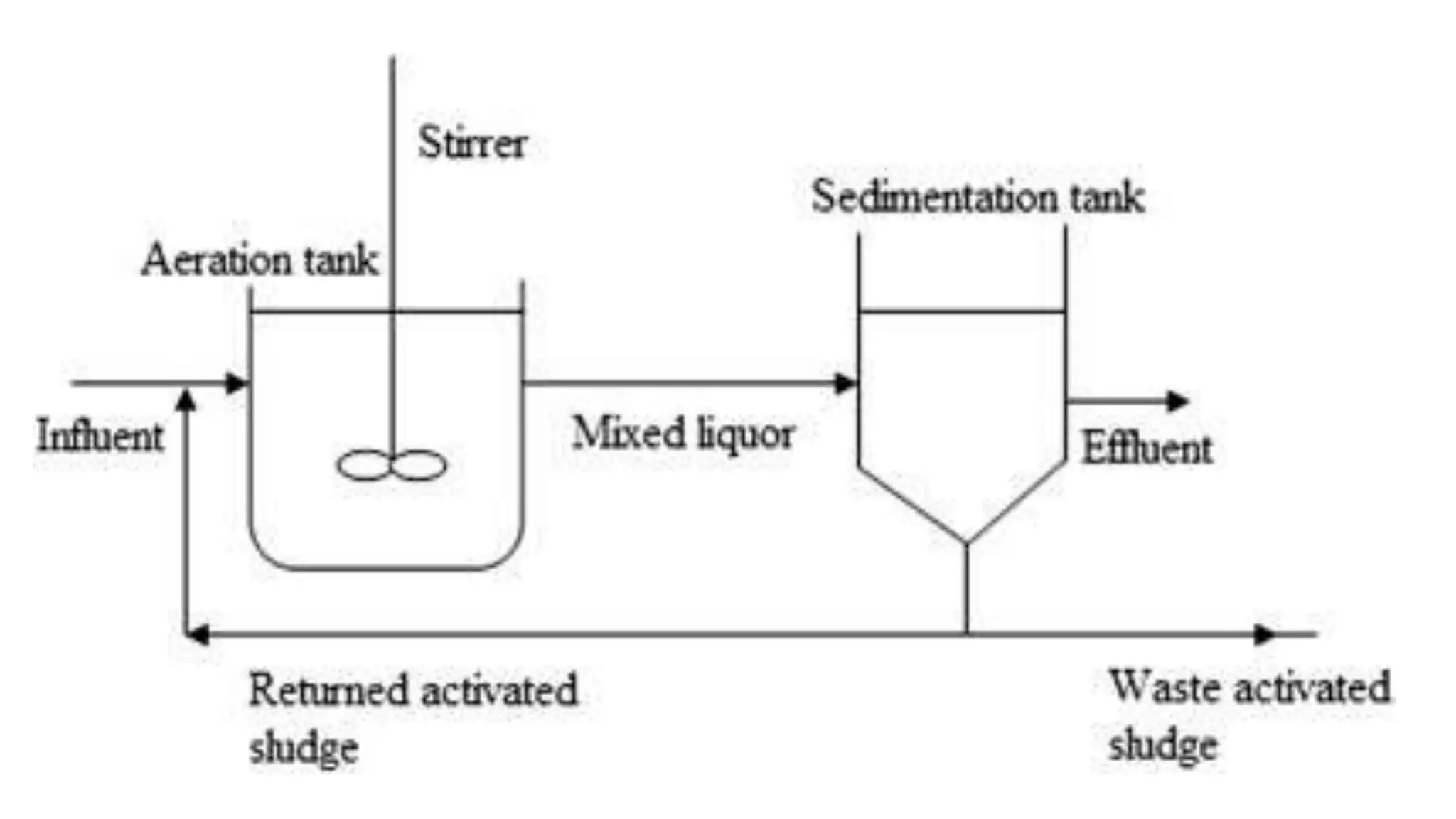
• The activated sludge process in the treatment of wastewater
involves blowing oxygen or air into raw, unsettled sewage. This
process smashes the solids. The sewage is bubbled, and sewage
liquor is discharged into an activated sludge chamber. Live bacteria
settle to the bottom of the tank and dead bacteria float to the top.
Clean water is discharged into a soakaway or watercourse while the
live bacteria return to the digestion chamber.
• The sludge is considered activated because the particles are
actively swarming with beneficial bacteria that digest the sewage.
• Detailed procedure is as follows-
3.
• Oxidize theorganic solids.
• Promote coagulation and flocculation and convert dissolved, colloid
and suspended solids into settle able solids. In practice the
following operations are carried out in an activated - sludge
process.
• The sewage is given treatment in the primary sedimentation tank.
The detention time is kept as short as 1-1/2 hours.
• The settled sewage form the Primary Sedimentation Tank is the
mixed with the required quantity of activated-sludge in the aeration
tank. The mixture of activated-sludge and wastewater in the
aeration tank is called ‘mixed liquor or mixed liquor suspended
solids MLSS or MLVSS mixed liquor volatile suspended solids’.
4.
• The MixedLiquor Suspended Solids is aerated for 6-8 hours in the
aeration tank, called the hydraulic detention time according to the
degree of purification. About 8m3 of air is provided from each m3 of
waste-water treated. The volumes of sludge returned to the
aeration basin is typically 20 to 30% of waste water flow air supply
8-10 m3 of sewage
• The aerated Mixed Liquor Suspended Solids resulting in the
formation of flock particles, ranging in size from 50 to 200pm.which
is then removed in the secondary sedimentation tank by gravity
settling, leeching a relatively clear liquid as the treated effluent.
Typically greater than 99% of suspend solids can be removed in the
clarification step.
5.
• Most ofthe settled sludge is returned to the aeration tank (and is
called return sludge) to maintain the high population of microbes
that permits rapid breakdown of the organic compounds. Because
more activated-sludge is produced tan is desirable in the process,
some of the return sludge is diverted or wasted to the sludge
handling system for treatment and disposal.
6.
ADVANTAGES OF ACTIVATEDSLUDGE PROCESS-
• The amount of undesired sludge is reduced.
• The sewage treatment plants re-seed themselves with beneficial
bacteria.
• The activated sludge treatment process allows the emptying
intervals to be longer.
• The process is very reliable.
• The process is more simple.
• Costs are reduced.
• The process can be odorless.
7.
DISADVANTAGES OF ACTIVATEDSLUDGE PROCESS-
• There are initial high capital and operating costs that may deter
some facilities from utilizing this method.
• Experts are required to design and construct the activated sludge
system.
• Skilled personnel must operate and maintain the treatment of
activated sludge.
• Electricity must be continuously used, increasing wastewater
treatment energy consumption.
• Parts and materials may not be available on a local level.
• Sludge and effluent might require further treatment or appropriate
discharge.
9.
Oxidation Pond-
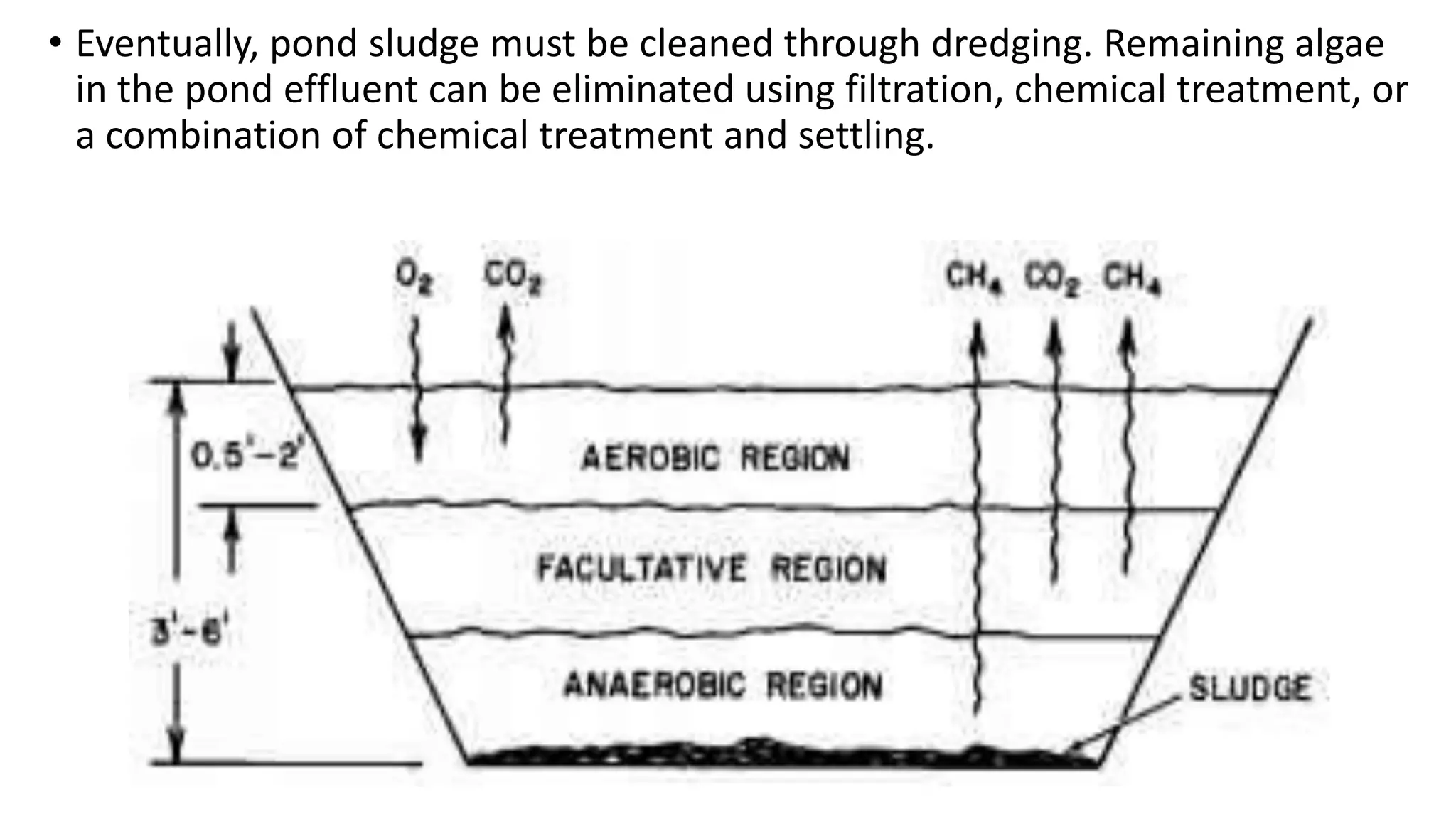
• Oxidationponds, also known as lagoons or stabilisation ponds, are
huge, shallow ponds meant to remediate wastewater by allowing
sunshine, bacteria, and algae to interact.
• Algae utilise solar energy, carbon dioxide, and inorganic substances
produced by bacteria in water to grow.
• During photosynthesis, algae release the oxygen required by
aerobic microorganisms.
• Occasionally, mechanical aerators are built to provide even more
oxygen, hence reducing the required pond size.
10.
• Eventually, pondsludge must be cleaned through dredging. Remaining algae
in the pond effluent can be eliminated using filtration, chemical treatment, or
a combination of chemical treatment and settling.
11.
Working Mechanism ofWaste Treatment-
• First, the bacteria present in the oxidation pond will oxidise the
home and industrial sewage’s organic waste. This results in the
release of carbon dioxide, water, and ammonia by bacteria.
• The algal development occurs when sunshine is present. It utilises
the inorganic wastes produced by the breakdown of organic matter
and releases oxygen.
• Based on the two mechanisms described above, it is evident that
algae and bacteria fulfil one other’s needs. The bacteria oxidise the
biodegradable organics with the oxygen generated by the algae.
The bacterial oxidation of organic waste produces carbon dioxide.
Eventually, algae use carbon dioxide to reduce inorganic wastes
such as nitrogen, phosphorus, etc.
12.
• As oxidationand reduction reactions occur simultaneously, an
oxidation pond is also referred to as a “Redox pond.” The oxidation
pond’s sludge can be used as fertiliser in irrigation processes.
13.
Advantages of OxidationPond-
• The stabilisation pond naturally reduces the biological oxygen
demand by as much as 90 percent.
• It is a straightforward procedure or requires no complicated
equipment.
• In tropical regions, oxidation ponds are a viable and efficient way
for treating home and commercial wastewater.
• The maintenance of a stabilising pond does not need a great deal of
labour.
• It is a cost-effective technology for treating wastewater from small,
isolated facilities.
14.
Disadvantages of OxidationPond-
• The creation of a stabilisation pond necessitates additional land
space.
• The upkeep is fairly complicated.
• If not properly maintained, it might emit an offensive odour and
attract mosquitoes during the procedure.
• There is a possibility of effluent seepage into the ground water,
which can lead to ground water contamination.
15.
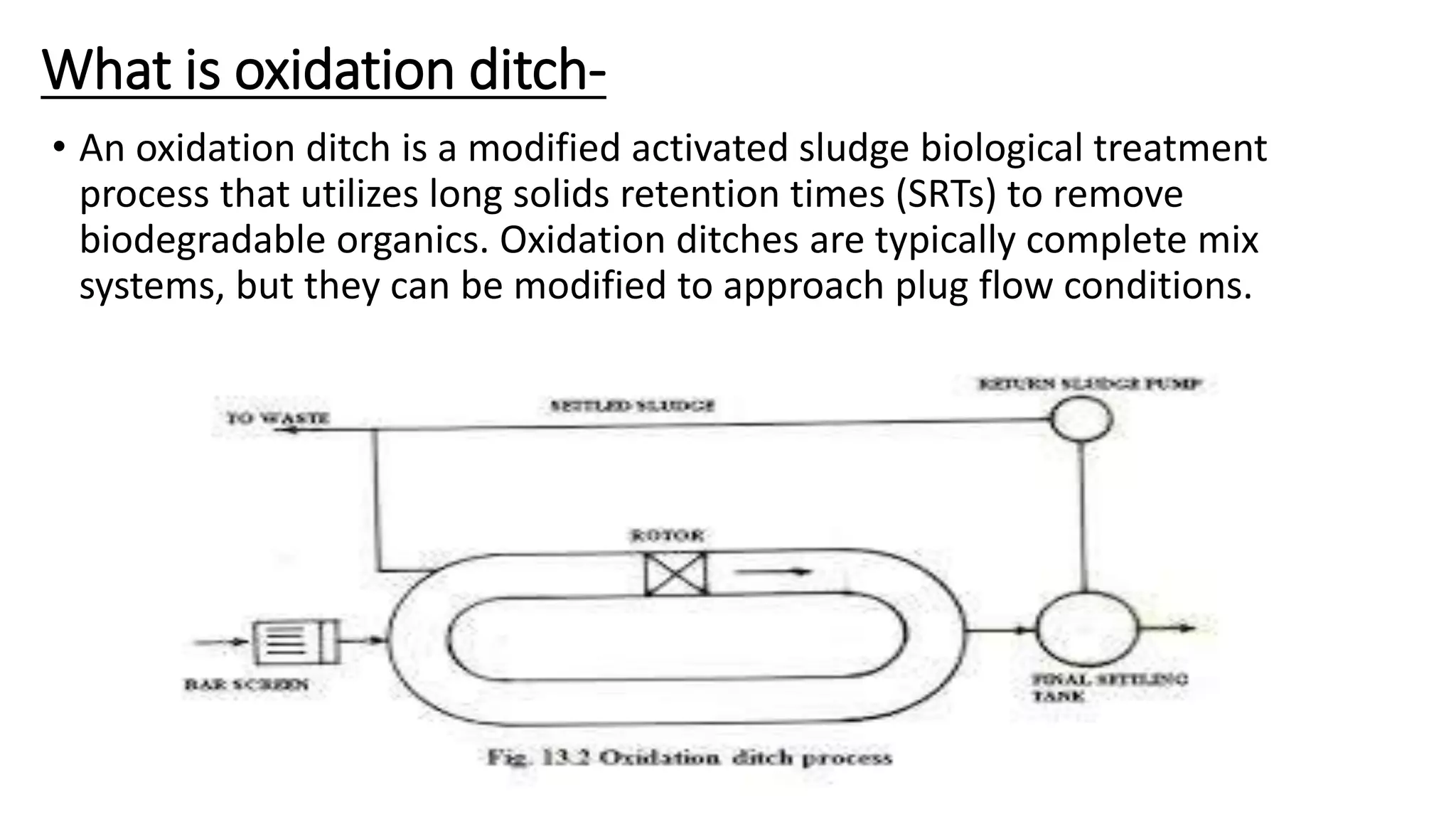
What is oxidationditch-
• An oxidation ditch is a modified activated sludge biological treatment
process that utilizes long solids retention times (SRTs) to remove
biodegradable organics. Oxidation ditches are typically complete mix
systems, but they can be modified to approach plug flow conditions.
16.
Working Of OxidationDitch-
Surface aerators, such as brush rotors, discaerators, draft tube
aerators, or fine bubblediffusers are used to circulate the mixed
liquor.The mixing process entrains oxygen into the mixedliquor to
foster microbial growth and the motivevelocity ensures contact of
microorganisms with theincoming wastewater. The aeration
sharplyincreases the dissolved oxygen (DO) concentrationbut
decreases as biomass uptake oxygen as themixed liquor travels
through the ditch. Solids aremaintained in suspension as the mixed
liquorcirculates around the ditch. If design SRTs areselected for
nitrification, a high degree ofnitrification will occur. Oxidation ditch
effluent isusually settled in a separate secondary clarifier.
Ananaerobic tank may be added prior to theditchtoenhance
biological phosphorus removal.
17.
An oxidation ditchmay also be operated to achievepartial
denitrification. One of the most commondesign modifications for
enhanced nitrogen removalis known as the Modified Ludzack-
Ettinger (MLE)process. In this process, illustrated in Figure 2, an
anoxic tank is added upstream of the ditch alongwith mixed liquor
recirculation from the aerobic zone to the tank to achieve higher
levels of denitrification. In the aerobic basin, autotrophicbacteria
(nitrifiers) convert ammonia-nitrogen to nitrite-nitrogen and then to
nitrate-nitrogen. In theanoxic zone, heterotrophic bacteria convert
nitratenitrogen to nitrogen gas which is released to the atmosphere.
Some mixed liquor from the aerobic basin is recirculated to the
anoxic zone to provide a mixed liquor with a high-concentration of
nitratenitrogen to the anoxic zone.
18.
Several manufacturers havedeveloped modifications to the oxidation
ditch design to remove nutrients in conditions cycled or phased
between the anoxic and aerobic states. While the mechanics of
operation differ by manufacturer, in general, the process consists of
two separate aeration basins, the first anoxic and the second aerobic.
Wastewater and return activated sludge (RAS) are introduced into
the first reactor which operates under anoxic conditions. Mixed
liquor then flows into the second reactor operating under aerobic
conditions. The process is then reversed and the second reactor
begins to operate under anoxic conditions
19.
Advantages of OxidationDitch-
• This process is reliable over other biological treatment processes owing to a
constant water level and continuous discharge;
• Resilient to the impact of shock load or hydraulic surge due to long
hydraulic retention time and complete mixing;
• Production of less sludge than other biological treatment processes. Only
15% of original BOD ends up as sludge;
• Energy efficient operations results in reduced energy costs.
20.
Disdvantages of OxidationDitch-
• Suspended solids concentrations of wastewater are relatively higher;
• Requires a larger land area, limiting the feasibility of oxidation ditches in
urban, suburban, or other areas where land acquisition costs are relatively
high.
21.
Difference Between Oxidationpond and Oxidation Ditch
Oxidation pond Oxidation Ditch
1.It consist of a shallow pond of depth
about 1m to 1.5m
1.It consists of a long continuous
channel usually oval in plan
2.Sewage is treated with the help of
bacteria and algae
2.Sewage is treated by activated
sludge process
3.More land is required 3.Less land is required
4.Detention time is 10 to 15 days 4.Detention time is 12 to 15 hours.









![Waste water treatment.pptx [autosaved]](https://cdn.slidesharecdn.com/ss_thumbnails/wastewatertreatment-161217102029-thumbnail.jpg?width=640&height=640&fit=bounds)


