Warrants in ESOP
Transactions
James G. Steiker
This article describes how warrants are used as part of the financing structure of leveraged ESOP transactions and discusses key corporate finance
and federal tax considerations in structuring ESOP financing arrangements
involving warrants.

W

arrants are often used in employee stock ownership plan
(ESOP) transactions to provide an enhanced return to investors and/or debt holders who provide a portion of the
ESOP company’s debt capital. A warrant is a financial instrument
that gives the holder a right to purchase issuer stock at a specified
price at a future date or during a future period. Warrants are identical
in financial structure and effect to stock options (in fact, a warrant
is a form of stock option), and the term “warrant” applies to an
option granted to a holder by an issuer to purchase another issuer
security, like common stock, preferred stock, notes, or bonds. This
article describes some common uses for and effects of warrants in
ESOP transactions.

Warrants and Corporate Finance
All companies consist of invested capital. The invested capital may
be equity owned by shareholders or debt held by lenders or investors.
Traditional corporate finance structures for invested capital form
a pyramid of returns and related risk, as shown in the simplified
diagram in figure 1.
At one end, common equity has both the greatest risk and greatest
potential return, while at the other end, senior secured debt has the
lowest risk and the lowest return. Preferred stock and subordinated
debt, both of which capture a slice of company cash flow ahead of
James Steiker is the chairman and CEO of SES Advisors, Inc., an ESOP advisory
firm, and the founding partner in the related law firm, Steiker, Fischer, Edwards
& Greenapple, P.C. He has more than 20 years of experience as a legal and
financial advisor in ESOP and other employee ownership matters.
Reprinted from the Journal of Employee Ownership Law and Finance, vol.
20, no. 2 (spring 2008). Copyright © 2008 by SES Advisors and the National
Center for Employee Ownership (NCEO). All rights reserved.
108	

The Journal of Employee Ownership Law and Finance, Vol. 20/2

Figure 1

the common equity holders but behind the senior debt lenders or
investors, have return and risk somewhere between senior debt and
common stock. Many middle-market companies are capitalized
exclusively with senior debt and common stock.
There are many studies, indexes, and reports that measure
expected returns for investors at each level of the pyramid. These
expected returns are greatly affected by general economic conditions,
specific financial market circumstances, and industry- and companyspecific concerns and risks. Broadly speaking, equity investors in
privately held middle-market companies look for total returns between 15% and 30%, preferred stockholders and subordinated debt
providers look for total returns between 10% and 18%, and senior
debt lenders look for returns based on prevailing short-term rates
expressed as a margin over LIBOR with senior debt interest rates
that, as of early 2008, generally range from 4.5% to 6.5%. There are
more specific forms of capital investment with mixed return/risk
attributes at each level in this pyramid (including, for example,
multiple classes of common stock or second-lien loans).
The manner in which investors achieve their expected returns
also varies greatly. Common equity investors may achieve small
pieces of their expected returns through dividends or distributions
but often expect to realize their returns as a capital gain through
sale of the common stock. By contrast, senior debt lenders and
investors usually expect monthly or quarterly payments of interest
as their return on investment. Preferred stock and subordinated
debt investors often expect to achieve their returns in part through
Warrants in ESOP Transactions	

109

current payment of interest and/or dividends and in part through
sale or redemption of the underlying investment. Few companies
can afford to pay a 10% to 18% current cash return on preferred
stock or subordinated debt. Warrants are often the tool of choice
to provide a subordinated debt investor with additional deferred
returns to augment a lower cash interest payment.
Subordinated debt instruments commonly provide a regular
cash interest payment of between 8% and 12% under current (early
2008) market conditions. There are typically warrants attached to
the subordinated debt instrument that are projected, at the time of
exercise, to provide enough additional return so that the overall
investment provides an appropriate rate of return to the subordinated debt investor.

Warrants and ESOP Transaction Financing
Many ESOP transactions are intended to create a 100% ESOP-owned
S corporation. In an S corporation, corporate income is attributed
to the shareholders for tax purposes. An ESOP is a tax-exempt trust
that does not pay federal income taxes on attributed income from
employer S corporation stock. A tax-free for-profit entity without
any tax-driven need to distribute income to shareholders creates
the unique potential for a highly leveraged finance structure to
facilitate the purchase or redemption of larger blocks of company
stock from non-ESOP sellers.
Companies generally prefer to accomplish leveraged ESOP
transactions through relatively inexpensive senior debt. However,
using senior debt alone is often not possible in highly leveraged
transactions designed to result in 100% ESOP ownership. Subordinated debt may be required. Selling shareholders often hold this
subordinated debt, and the subordinated debt instrument is often
structured to address the particular needs and concerns of the selling
shareholder. Third-party investors may also provide subordinated
debt to fund an ESOP transaction. While this article generally describes subordinated debt in ESOP transactions as seller financing,
the descriptions below apply equally to third-party investors who
might provide subordinated debt.
Subordinated debt is generally issued by a company as an “investment unit” consisting of the interest-paying note with a separate warrant instrument. An ESOP cannot issue a warrant directly,
110	

The Journal of Employee Ownership Law and Finance, Vol. 20/2

so seller-financed leveraged ESOP transactions using this form of
investment unit must use the company as a direct participant in
the ESOP financing. These transactions can be done with both S
corporations and C corporations, as described below.
S Corporation ESOP Transactions
S corporation ESOP transactions involving subordinated debt are
often structured in part or in whole as redemptions rather than direct
ESOP purchases of shares from shareholders. There are three main
reasons for this. First, the deferral of capital gains taxes permitted by
Section 1042 of the Internal Revenue Code (the “Code”) for the sale
of shares directly to an ESOP is not available to an S corporation
shareholder. The shareholder is therefore indifferent as to whether
the shares are purchased directly by the ESOP or redeemed by the
company. In either case, the proceeds are subject to capital gains
taxes. Second, if the company is to become an effectively tax-free
100% ESOP-owned S corporation, the company will not be using
tax deductions relating to payments of the principal and interest of
the third-party ESOP loan or for contributions to the ESOP. Finally,
redemptions may create less fiduciary risk for the ESOP trustee
because the trustee does not participate directly in a high-dollar
purchase of company shares in reliance on a regulated exemption
from ERISA prohibited transaction rules.
There are other considerations beyond the scope of this article
to determine whether an S corporation should redeem shares from
non-ESOP shareholders or fund a direct ESOP purchase of shares,
including benefit funding levels, the ability of newer and younger
employees to receive additional shares, and repurchase obligation
planning concerns. Many transactions mix a redemption component
with an ESOP direct purchase component.
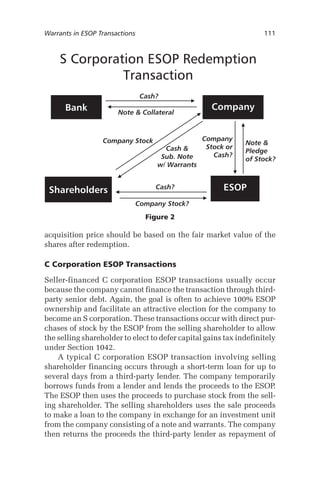
A typical redemption transaction to create 100% ESOP ownership is illustrated in figure 2. In this transaction, the company is
redeeming all or a portion of the outstanding shares of the company
from shareholders. The ESOP is becoming the 100% shareholder
either by purchasing some shares directly from the individual
shareholders or by purchasing newly issued shares from the company. If the shares are acquired from the individual shareholders,
the purchase price should be identical to the redemption price. If
the shares are newly issued shares acquired from the company, the
Warrants in ESOP Transactions	

111

Figure 2

acquisition price should be based on the fair market value of the
shares after redemption.
C Corporation ESOP Transactions
Seller-financed C corporation ESOP transactions usually occur
because the company cannot finance the transaction through thirdparty senior debt. Again, the goal is often to achieve 100% ESOP
ownership and facilitate an attractive election for the company to
become an S corporation. These transactions occur with direct purchases of stock by the ESOP from the selling shareholder to allow
the selling shareholder to elect to defer capital gains tax indefinitely
under Section 1042.
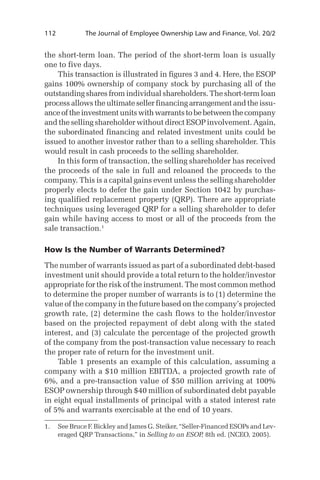
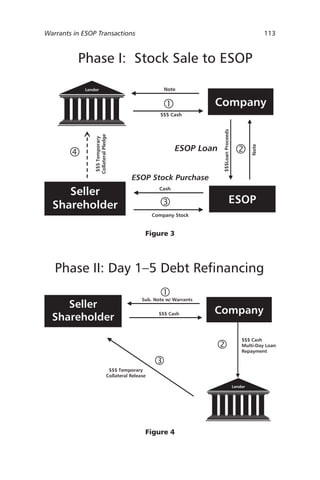
A typical C corporation ESOP transaction involving selling
shareholder financing occurs through a short-term loan for up to
several days from a third-party lender. The company temporarily
borrows funds from a lender and lends the proceeds to the ESOP.
The ESOP then uses the proceeds to purchase stock from the selling shareholder. The selling shareholders uses the sale proceeds
to make a loan to the company in exchange for an investment unit
from the company consisting of a note and warrants. The company
then returns the proceeds the third-party lender as repayment of
112	

The Journal of Employee Ownership Law and Finance, Vol. 20/2

the short-term loan. The period of the short-term loan is usually
one to five days.
This transaction is illustrated in figures 3 and 4. Here, the ESOP
gains 100% ownership of company stock by purchasing all of the
outstanding shares from individual shareholders. The short-term loan
process allows the ultimate seller financing arrangement and the issuance of the investment units with warrants to be between the company
and the selling shareholder without direct ESOP involvement. Again,
the subordinated financing and related investment units could be
issued to another investor rather than to a selling shareholder. This
would result in cash proceeds to the selling shareholder.
In this form of transaction, the selling shareholder has received
the proceeds of the sale in full and reloaned the proceeds to the
company. This is a capital gains event unless the selling shareholder
properly elects to defer the gain under Section 1042 by purchasing qualified replacement property (QRP). There are appropriate
techniques using leveraged QRP for a selling shareholder to defer
gain while having access to most or all of the proceeds from the
sale transaction.
How Is the Number of Warrants Determined?
The number of warrants issued as part of a subordinated debt-based
investment unit should provide a total return to the holder/investor
appropriate for the risk of the instrument. The most common method
to determine the proper number of warrants is to (1) determine the
value of the company in the future based on the company’s projected
growth rate, (2) determine the cash flows to the holder/investor
based on the projected repayment of debt along with the stated
interest, and (3) calculate the percentage of the projected growth
of the company from the post-transaction value necessary to reach
the proper rate of return for the investment unit.
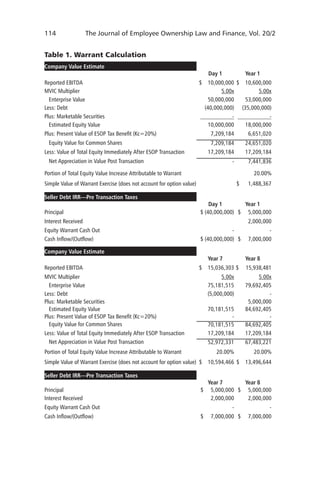
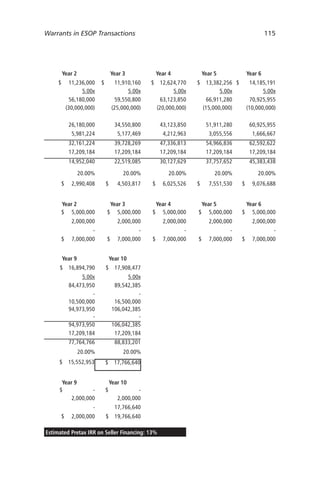
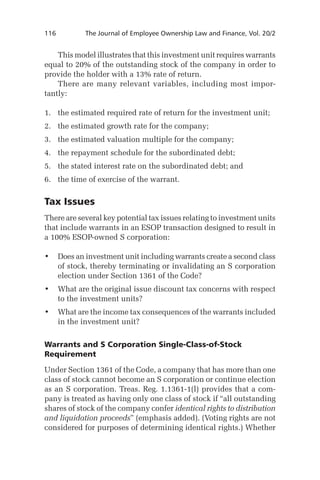
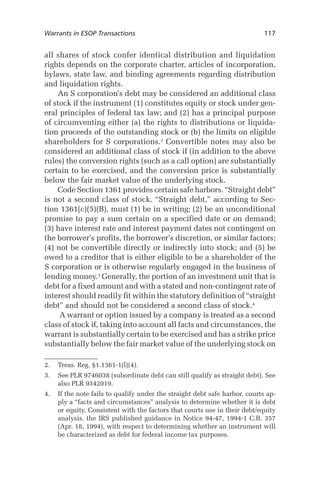
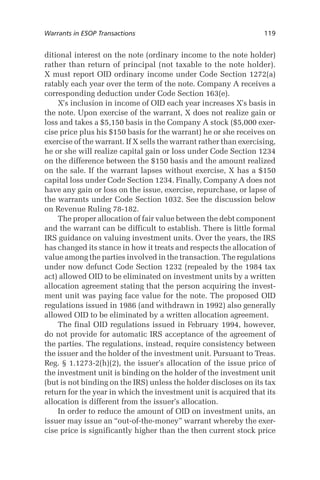
Table 1 presents an example of this calculation, assuming a
company with a $10 million EBITDA, a projected growth rate of
6%, and a pre-transaction value of $50 million arriving at 100%
ESOP ownership through $40 million of subordinated debt payable
in eight equal installments of principal with a stated interest rate
of 5% and warrants exercisable at the end of 10 years.
.	 See Bruce F. Bickley and James G. Steiker, “Seller-Financed ESOPs and Leveraged QRP Transactions,” in Selling to an ESOP, 8th ed. (NCEO, 2005).
Warrants in ESOP Transactions	

113

Figure 3

Figure 4
114	

The Journal of Employee Ownership Law and Finance, Vol. 20/2

Table 1. Warrant Calculation
Company Value Estimate
Reported EBITDA
MVIC Multiplier
Enterprise Value
Less: Debt
Plus: Marketable Securities
Estimated Equity Value

Day 1

Year 1

$ 10,000,000 $ 10,600,000
5.00x
5.00x
50,000,000
53,000,000
(40,000,000) (35,000,000)
10,000,000
18,000,000

Plus: Present Value of ESOP Tax Benefit (Kc=20%)

7,209,184

24,651,020
17,209,184

-

Less: Value of Total Equity Immediately After ESOP Transaction

6,651,020

7,209,184
17,209,184

Equity Value for Common Shares

7,441,836

Net Appreciation in Value Post Transaction
Portion of Total Equity Value Increase Attributable to Warrant

20.00%

Simple Value of Warrant Exercise (does not account for option value)
Seller Debt IRR—Pre Transaction Taxes
Principal

$

Day 1
Year 1
$ (40,000,000) $ 5,000,000

Interest Received
Equity Warrant Cash Out
Cash Inflow/(Outflow)

2,000,000
$ (40,000,000) $

Company Value Estimate
Reported EBITDA

1,488,367

Year 7

Year 8

$ 15,036,303 $

MVIC Multiplier
Enterprise Value
Less: Debt
Plus: Marketable Securities
Estimated Equity Value
Plus: Present Value of ESOP Tax Benefit (Kc=20%)
Equity Value for Common Shares

7,000,000

5.00x
75,181,515
(5,000,000)

15,938,481

70,181,515
70,181,515
17,209,184
52,972,331

Portion of Total Equity Value Increase Attributable to Warrant

67,483,221

20.00%

Less: Value of Total Equity Immediately After ESOP Transaction
Net Appreciation in Value Post Transaction

5.00x
79,692,405
5,000,000
84,692,405
84,692,405
17,209,184
20.00%

Simple Value of Warrant Exercise (does not account for option value) $ 10,594,466 $ 13,496,644
Seller Debt IRR—Pre Transaction Taxes
Principal
Interest Received

$

Equity Warrant Cash Out
Cash Inflow/(Outflow)

Year 7
Year 8
5,000,000 $ 5,000,000
2,000,000
2,000,000
-

$

7,000,000 $

7,000,000
Warrants in ESOP Transactions	

Year 2
$

115

Year 3

11,236,000
5.00x
56,180,000
(30,000,000)

$

Year 4

11,910,160
5.00x
59,550,800
(25,000,000)

$ 12,624,770
5.00x
63,123,850
(20,000,000)

26,180,000

34,550,800

5,981,224

5,177,469

32,161,224
17,209,184
14,952,040

Year 6
14,185,191
5.00x
70,925,955
(10,000,000)

43,123,850

51,911,280

60,925,955

4,212,963

3,055,556

1,666,667

39,728,269
17,209,184

47,336,813
17,209,184

54,966,836
17,209,184

62,592,622
17,209,184

22,519,085

20.00%
$

Year 5
$ 13,382,256 $
5.00x
66,911,280
(15,000,000)

30,127,629

37,757,652

45,383,438

20.00%

20.00%

20.00%

20.00%

2,990,408

$

4,503,817

$

6,025,526

$

7,551,530

$

9,076,688

Year 2
$ 5,000,000

$

Year 3
5,000,000

$

Year 4
5,000,000

$

Year 5
5,000,000

$

Year 6
5,000,000

2,000,000
$

2,000,000

2,000,000

2,000,000

7,000,000

7,000,000

7,000,000

7,000,000

$

Year 9

$

Year 10

$ 16,894,790

$ 17,908,477

5.00x
84,473,950
10,500,000
94,973,950
94,973,950
17,209,184

5.00x
89,542,385
16,500,000
106,042,385
106,042,385
17,209,184

77,764,766

88,833,201

20.00%

20.00%

$ 15,552,953

$ 17,766,640

Year 9
$
2,000,000

$

Year 10
2,000,000

$

17,766,640

2,000,000

$ 19,766,640

Estimated Pretax IRR on Seller Financing: 13%

$

2,000,000
$

7,000,000
116	

The Journal of Employee Ownership Law and Finance, Vol. 20/2

This model illustrates that this investment unit requires warrants
equal to 20% of the outstanding stock of the company in order to
provide the holder with a 13% rate of return.
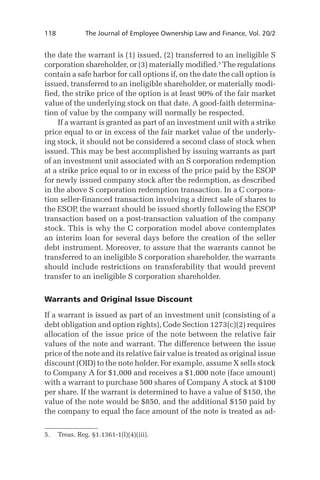
There are many relevant variables, including most importantly:
1.	 the estimated required rate of return for the investment unit;
2.	 the estimated growth rate for the company;
3.	 the estimated valuation multiple for the company;
4.	 the repayment schedule for the subordinated debt;
5.	 the stated interest rate on the subordinated debt; and
6.	 the time of exercise of the warrant.

Tax Issues
There are several key potential tax issues relating to investment units
that include warrants in an ESOP transaction designed to result in
a 100% ESOP-owned S corporation:
•	 Does an investment unit including warrants create a second class
of stock, thereby terminating or invalidating an S corporation
election under Section 1361 of the Code?
•	 What are the original issue discount tax concerns with respect
to the investment units?
•	 What are the income tax consequences of the warrants included
in the investment unit?
Warrants and S Corporation Single-Class-of-Stock
Requirement
Under Section 1361 of the Code, a company that has more than one
class of stock cannot become an S corporation or continue election
as an S corporation. Treas. Reg. 1.1361-1(l) provides that a company is treated as having only one class of stock if “all outstanding
shares of stock of the company confer identical rights to distribution
and liquidation proceeds” (emphasis added). (Voting rights are not
considered for purposes of determining identical rights.) Whether
Warrants in ESOP Transactions	

117

all shares of stock confer identical distribution and liquidation
rights depends on the corporate charter, articles of incorporation,
bylaws, state law, and binding agreements regarding distribution
and liquidation rights.
An S corporation’s debt may be considered an additional class
of stock if the instrument (1) constitutes equity or stock under general principles of federal tax law; and (2) has a principal purpose
of circumventing either (a) the rights to distributions or liquidation proceeds of the outstanding stock or (b) the limits on eligible
shareholders for S corporations. Convertible notes may also be
considered an additional class of stock if (in addition to the above
rules) the conversion rights (such as a call option) are substantially
certain to be exercised, and the conversion price is substantially
below the fair market value of the underlying stock.
Code Section 1361 provides certain safe harbors. “Straight debt”
is not a second class of stock. “Straight debt,” according to Section 1361(c)(5)(B), must (1) be in writing; (2) be an unconditional
promise to pay a sum certain on a specified date or on demand;
(3) have interest rate and interest payment dates not contingent on
the borrower’s profits, the borrower’s discretion, or similar factors;
(4) not be convertible directly or indirectly into stock; and (5) be
owed to a creditor that is either eligible to be a shareholder of the
S corporation or is otherwise regularly engaged in the business of
lending money. Generally, the portion of an investment unit that is
debt for a fixed amount and with a stated and non-contingent rate of
interest should readily fit within the statutory definition of “straight
debt” and should not be considered a second class of stock.
A warrant or option issued by a company is treated as a second
class of stock if, taking into account all facts and circumstances, the
warrant is substantially certain to be exercised and has a strike price
substantially below the fair market value of the underlying stock on
.	 Treas. Reg. §1.1361-1(l)(4).
.	 See PLR 9746038 (subordinate debt can still qualify as straight debt). See
also PLR 9342019.
.	 If the note fails to qualify under the straight debt safe harbor, courts apply a “facts and circumstances” analysis to determine whether it is debt
or equity. Consistent with the factors that courts use in their debt/equity
analysis, the IRS published guidance in Notice 94-47, 1994-1 C.B. 357
(Apr. 18, 1994), with respect to determining whether an instrument will
be characterized as debt for federal income tax purposes.
118	

The Journal of Employee Ownership Law and Finance, Vol. 20/2

the date the warrant is (1) issued, (2) transferred to an ineligible S
corporation shareholder, or (3) materially modified. The regulations
contain a safe harbor for call options if, on the date the call option is
issued, transferred to an ineligible shareholder, or materially modified, the strike price of the option is at least 90% of the fair market
value of the underlying stock on that date. A good-faith determination of value by the company will normally be respected.
If a warrant is granted as part of an investment unit with a strike
price equal to or in excess of the fair market value of the underlying stock, it should not be considered a second class of stock when
issued. This may be best accomplished by issuing warrants as part
of an investment unit associated with an S corporation redemption
at a strike price equal to or in excess of the price paid by the ESOP
for newly issued company stock after the redemption, as described
in the above S corporation redemption transaction. In a C corporation seller-financed transaction involving a direct sale of shares to
the ESOP, the warrant should be issued shortly following the ESOP
transaction based on a post-transaction valuation of the company
stock. This is why the C corporation model above contemplates
an interim loan for several days before the creation of the seller
debt instrument. Moreover, to assure that the warrants cannot be
transferred to an ineligible S corporation shareholder, the warrants
should include restrictions on transferability that would prevent
transfer to an ineligible S corporation shareholder.
Warrants and Original Issue Discount
If a warrant is issued as part of an investment unit (consisting of a
debt obligation and option rights), Code Section 1273(c)(2) requires
allocation of the issue price of the note between the relative fair
values of the note and warrant. The difference between the issue
price of the note and its relative fair value is treated as original issue
discount (OID) to the note holder. For example, assume X sells stock
to Company A for $1,000 and receives a $1,000 note (face amount)
with a warrant to purchase 500 shares of Company A stock at $100
per share. If the warrant is determined to have a value of $150, the
value of the note would be $850, and the additional $150 paid by
the company to equal the face amount of the note is treated as ad.	 Treas. Reg. §1.1361-1(l)(4)(iii).
Warrants in ESOP Transactions	

119

ditional interest on the note (ordinary income to the note holder)
rather than return of principal (not taxable to the note holder).
X must report OID ordinary income under Code Section 1272(a)
ratably each year over the term of the note. Company A receives a
corresponding deduction under Code Section 163(e).
X’s inclusion in income of OID each year increases X’s basis in
the note. Upon exercise of the warrant, X does not realize gain or
loss and takes a $5,150 basis in the Company A stock ($5,000 exercise price plus his $150 basis for the warrant) he or she receives on
exercise of the warrant. If X sells the warrant rather than exercising,
he or she will realize capital gain or loss under Code Section 1234
on the difference between the $150 basis and the amount realized
on the sale. If the warrant lapses without exercise, X has a $150
capital loss under Code Section 1234. Finally, Company A does not
have any gain or loss on the issue, exercise, repurchase, or lapse of
the warrants under Code Section 1032. See the discussion below
on Revenue Ruling 78-182.
The proper allocation of fair value between the debt component
and the warrant can be difficult to establish. There is little formal
IRS guidance on valuing investment units. Over the years, the IRS
has changed its stance in how it treats and respects the allocation of
value among the parties involved in the transaction. The regulations
under now defunct Code Section 1232 (repealed by the 1984 tax
act) allowed OID to be eliminated on investment units by a written
allocation agreement stating that the person acquiring the investment unit was paying face value for the note. The proposed OID
regulations issued in 1986 (and withdrawn in 1992) also generally
allowed OID to be eliminated by a written allocation agreement.
The final OID regulations issued in February 1994, however,
do not provide for automatic IRS acceptance of the agreement of
the parties. The regulations, instead, require consistency between
the issuer and the holder of the investment unit. Pursuant to Treas.
Reg. § 1.1273-2(h)(2), the issuer’s allocation of the issue price of
the investment unit is binding on the holder of the investment unit
(but is not binding on the IRS) unless the holder discloses on its tax
return for the year in which the investment unit is acquired that its
allocation is different from the issuer’s allocation.
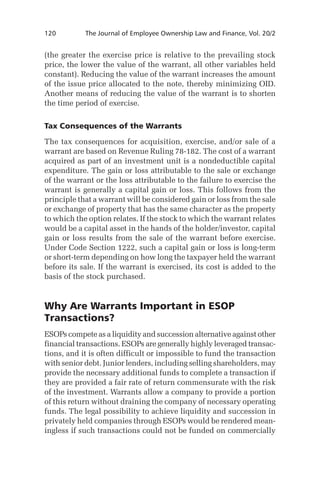
In order to reduce the amount of OID on investment units, an
issuer may issue an “out-of-the-money” warrant whereby the exercise price is significantly higher than the then current stock price
120	

The Journal of Employee Ownership Law and Finance, Vol. 20/2

(the greater the exercise price is relative to the prevailing stock
price, the lower the value of the warrant, all other variables held
constant). Reducing the value of the warrant increases the amount
of the issue price allocated to the note, thereby minimizing OID.
Another means of reducing the value of the warrant is to shorten
the time period of exercise.
Tax Consequences of the Warrants
The tax consequences for acquisition, exercise, and/or sale of a
warrant are based on Revenue Ruling 78-182. The cost of a warrant
acquired as part of an investment unit is a nondeductible capital
expenditure. The gain or loss attributable to the sale or exchange
of the warrant or the loss attributable to the failure to exercise the
warrant is generally a capital gain or loss. This follows from the
principle that a warrant will be considered gain or loss from the sale
or exchange of property that has the same character as the property
to which the option relates. If the stock to which the warrant relates
would be a capital asset in the hands of the holder/investor, capital
gain or loss results from the sale of the warrant before exercise.
Under Code Section 1222, such a capital gain or loss is long-term
or short-term depending on how long the taxpayer held the warrant
before its sale. If the warrant is exercised, its cost is added to the
basis of the stock purchased.

Why Are Warrants Important in ESOP
Transactions?
ESOPs compete as a liquidity and succession alternative against other
financial transactions. ESOPs are generally highly leveraged transactions, and it is often difficult or impossible to fund the transaction
with senior debt. Junior lenders, including selling shareholders, may
provide the necessary additional funds to complete a transaction if
they are provided a fair rate of return commensurate with the risk
of the investment. Warrants allow a company to provide a portion
of this return without draining the company of necessary operating
funds. The legal possibility to achieve liquidity and succession in
privately held companies through ESOPs would be rendered meaningless if such transactions could not be funded on commercially
Warrants in ESOP Transactions	

121

reasonable terms. Warrants issued in connection with subordinated
debt are a critical tool to allow ESOPs to compete on a level playing
field in financing buyouts of privately held companies.
122	

The Journal of Employee Ownership Law and Finance, Vol. 20/2

Subscription Information
This article is reprinted from the Journal of Employee Ownership
Law and Finance, which is published quarterly by the National
Center for Employee Ownership (NCEO). Subscription costs are
as follows. There are no shipping charges for NCEO membership
or Journal subscriptions; however, shipping charges are added to
orders for individual back issues or books (see the order form on
the following page).
		
NCEO members	 Nonmembers
Subscriptions
One-year subscription. ................ $	 75	
.
$	 00
1
	 Outside the U.S.. .................... $	 85	
.
$	 10
1
Two-year subscription. ................ $	 40	
.
1
$	 80
1
	 Outside the U.S.. .................... $	 50	
.
1
$	 90
1
Back Issues
Single issues................................. $	 25	

$	 35

	 An introductory NCEO membership is $90 for one year ($100
outside the U.S.) and includes (1) the bimonthly newsletter, Employee
Ownership Report; (2) access to the members-only area of the NCEO’s
Web site; (3) free live Webinars on ESOP-related topics; (4) substantial discounts on publications and events produced by the NCEO
(including this journal); and (5) the right to telephone or email the
NCEO for answers to questions regarding employee ownership.

Ordering, Address Changes, and Claims
To join the NCEO, subscribe to the Journal, or receive more information, call (510) 208-1300; fax your order to the NCEO at (510) 2729510; mail your order to the NCEO at 1736 Franklin St., 8th Floor,
Oakland, CA 94612; or visit our Web site at www.nceo.org, which
features a wide array of information about the NCEO and employee
ownership as well as secure online credit card ordering.
	 Address changes should be sent to the address above or by email to customerservice@nceo.org.
	 Any claims for missing issues must be filed within 45 days of
the time the Journal issue in question was shipped to subscribers.
Warrants in ESOP Transactions	

123

Order Form
To order, fill out this form and mail it with your credit card information or check to the NCEO at 1736 Franklin St., 8th Flr., Oakland,
CA 94612; fax it with your credit card information to the NCEO at
510-272-9510; telephone us at 510-208-1300 with your credit card
in hand; or order securely online at our Web site, www.nceo.org. If
you are not already a member, you can join now to receive member
discounts on the publications you order.
Name
Organization
Address
City, State, Zip (Country)
Telephone	

Fax	

Method of Payment:	 ❑ Check (payable to “NCEO”)	

E-mail

❑ Visa	

❑ M/C	

❑ AMEX

Credit Card Number	
Signature	

Exp. Date

Checks are accepted only for orders from the U.S. and must be in U.S. currency.
	 Title	

Qty.	

Price	

Total

Tax: California residents add 8.75% sales tax
(on publications only, not membership or Journal subscriptions)

	 Subtotal	

$

Shipping: In the U.S., first publication $5, each add’l $1; elsewhere, we charge exact shipping costs to your credit card, plus a
$10 handling surcharge; no shipping charges for membership or
Journal subscriptions

	 Sales Tax	

$

	 Shipping	

$

	 Membership	

$

	 TOTAL DUE	

$

Introductory NCEO Membership: $90 for one year
($100 outside the U.S.)

Warrants in ESOP Transactions

  • 1.
    Warrants in ESOP Transactions JamesG. Steiker This article describes how warrants are used as part of the financing structure of leveraged ESOP transactions and discusses key corporate finance and federal tax considerations in structuring ESOP financing arrangements involving warrants. W arrants are often used in employee stock ownership plan (ESOP) transactions to provide an enhanced return to investors and/or debt holders who provide a portion of the ESOP company’s debt capital. A warrant is a financial instrument that gives the holder a right to purchase issuer stock at a specified price at a future date or during a future period. Warrants are identical in financial structure and effect to stock options (in fact, a warrant is a form of stock option), and the term “warrant” applies to an option granted to a holder by an issuer to purchase another issuer security, like common stock, preferred stock, notes, or bonds. This article describes some common uses for and effects of warrants in ESOP transactions. Warrants and Corporate Finance All companies consist of invested capital. The invested capital may be equity owned by shareholders or debt held by lenders or investors. Traditional corporate finance structures for invested capital form a pyramid of returns and related risk, as shown in the simplified diagram in figure 1. At one end, common equity has both the greatest risk and greatest potential return, while at the other end, senior secured debt has the lowest risk and the lowest return. Preferred stock and subordinated debt, both of which capture a slice of company cash flow ahead of James Steiker is the chairman and CEO of SES Advisors, Inc., an ESOP advisory firm, and the founding partner in the related law firm, Steiker, Fischer, Edwards & Greenapple, P.C. He has more than 20 years of experience as a legal and financial advisor in ESOP and other employee ownership matters. Reprinted from the Journal of Employee Ownership Law and Finance, vol. 20, no. 2 (spring 2008). Copyright © 2008 by SES Advisors and the National Center for Employee Ownership (NCEO). All rights reserved.
  • 2.
    108 The Journal ofEmployee Ownership Law and Finance, Vol. 20/2 Figure 1 the common equity holders but behind the senior debt lenders or investors, have return and risk somewhere between senior debt and common stock. Many middle-market companies are capitalized exclusively with senior debt and common stock. There are many studies, indexes, and reports that measure expected returns for investors at each level of the pyramid. These expected returns are greatly affected by general economic conditions, specific financial market circumstances, and industry- and companyspecific concerns and risks. Broadly speaking, equity investors in privately held middle-market companies look for total returns between 15% and 30%, preferred stockholders and subordinated debt providers look for total returns between 10% and 18%, and senior debt lenders look for returns based on prevailing short-term rates expressed as a margin over LIBOR with senior debt interest rates that, as of early 2008, generally range from 4.5% to 6.5%. There are more specific forms of capital investment with mixed return/risk attributes at each level in this pyramid (including, for example, multiple classes of common stock or second-lien loans). The manner in which investors achieve their expected returns also varies greatly. Common equity investors may achieve small pieces of their expected returns through dividends or distributions but often expect to realize their returns as a capital gain through sale of the common stock. By contrast, senior debt lenders and investors usually expect monthly or quarterly payments of interest as their return on investment. Preferred stock and subordinated debt investors often expect to achieve their returns in part through
  • 3.
    Warrants in ESOPTransactions 109 current payment of interest and/or dividends and in part through sale or redemption of the underlying investment. Few companies can afford to pay a 10% to 18% current cash return on preferred stock or subordinated debt. Warrants are often the tool of choice to provide a subordinated debt investor with additional deferred returns to augment a lower cash interest payment. Subordinated debt instruments commonly provide a regular cash interest payment of between 8% and 12% under current (early 2008) market conditions. There are typically warrants attached to the subordinated debt instrument that are projected, at the time of exercise, to provide enough additional return so that the overall investment provides an appropriate rate of return to the subordinated debt investor. Warrants and ESOP Transaction Financing Many ESOP transactions are intended to create a 100% ESOP-owned S corporation. In an S corporation, corporate income is attributed to the shareholders for tax purposes. An ESOP is a tax-exempt trust that does not pay federal income taxes on attributed income from employer S corporation stock. A tax-free for-profit entity without any tax-driven need to distribute income to shareholders creates the unique potential for a highly leveraged finance structure to facilitate the purchase or redemption of larger blocks of company stock from non-ESOP sellers. Companies generally prefer to accomplish leveraged ESOP transactions through relatively inexpensive senior debt. However, using senior debt alone is often not possible in highly leveraged transactions designed to result in 100% ESOP ownership. Subordinated debt may be required. Selling shareholders often hold this subordinated debt, and the subordinated debt instrument is often structured to address the particular needs and concerns of the selling shareholder. Third-party investors may also provide subordinated debt to fund an ESOP transaction. While this article generally describes subordinated debt in ESOP transactions as seller financing, the descriptions below apply equally to third-party investors who might provide subordinated debt. Subordinated debt is generally issued by a company as an “investment unit” consisting of the interest-paying note with a separate warrant instrument. An ESOP cannot issue a warrant directly,
  • 4.
    110 The Journal ofEmployee Ownership Law and Finance, Vol. 20/2 so seller-financed leveraged ESOP transactions using this form of investment unit must use the company as a direct participant in the ESOP financing. These transactions can be done with both S corporations and C corporations, as described below. S Corporation ESOP Transactions S corporation ESOP transactions involving subordinated debt are often structured in part or in whole as redemptions rather than direct ESOP purchases of shares from shareholders. There are three main reasons for this. First, the deferral of capital gains taxes permitted by Section 1042 of the Internal Revenue Code (the “Code”) for the sale of shares directly to an ESOP is not available to an S corporation shareholder. The shareholder is therefore indifferent as to whether the shares are purchased directly by the ESOP or redeemed by the company. In either case, the proceeds are subject to capital gains taxes. Second, if the company is to become an effectively tax-free 100% ESOP-owned S corporation, the company will not be using tax deductions relating to payments of the principal and interest of the third-party ESOP loan or for contributions to the ESOP. Finally, redemptions may create less fiduciary risk for the ESOP trustee because the trustee does not participate directly in a high-dollar purchase of company shares in reliance on a regulated exemption from ERISA prohibited transaction rules. There are other considerations beyond the scope of this article to determine whether an S corporation should redeem shares from non-ESOP shareholders or fund a direct ESOP purchase of shares, including benefit funding levels, the ability of newer and younger employees to receive additional shares, and repurchase obligation planning concerns. Many transactions mix a redemption component with an ESOP direct purchase component. A typical redemption transaction to create 100% ESOP ownership is illustrated in figure 2. In this transaction, the company is redeeming all or a portion of the outstanding shares of the company from shareholders. The ESOP is becoming the 100% shareholder either by purchasing some shares directly from the individual shareholders or by purchasing newly issued shares from the company. If the shares are acquired from the individual shareholders, the purchase price should be identical to the redemption price. If the shares are newly issued shares acquired from the company, the
  • 5.
    Warrants in ESOPTransactions 111 Figure 2 acquisition price should be based on the fair market value of the shares after redemption. C Corporation ESOP Transactions Seller-financed C corporation ESOP transactions usually occur because the company cannot finance the transaction through thirdparty senior debt. Again, the goal is often to achieve 100% ESOP ownership and facilitate an attractive election for the company to become an S corporation. These transactions occur with direct purchases of stock by the ESOP from the selling shareholder to allow the selling shareholder to elect to defer capital gains tax indefinitely under Section 1042. A typical C corporation ESOP transaction involving selling shareholder financing occurs through a short-term loan for up to several days from a third-party lender. The company temporarily borrows funds from a lender and lends the proceeds to the ESOP. The ESOP then uses the proceeds to purchase stock from the selling shareholder. The selling shareholders uses the sale proceeds to make a loan to the company in exchange for an investment unit from the company consisting of a note and warrants. The company then returns the proceeds the third-party lender as repayment of
  • 6.
    112 The Journal ofEmployee Ownership Law and Finance, Vol. 20/2 the short-term loan. The period of the short-term loan is usually one to five days. This transaction is illustrated in figures 3 and 4. Here, the ESOP gains 100% ownership of company stock by purchasing all of the outstanding shares from individual shareholders. The short-term loan process allows the ultimate seller financing arrangement and the issuance of the investment units with warrants to be between the company and the selling shareholder without direct ESOP involvement. Again, the subordinated financing and related investment units could be issued to another investor rather than to a selling shareholder. This would result in cash proceeds to the selling shareholder. In this form of transaction, the selling shareholder has received the proceeds of the sale in full and reloaned the proceeds to the company. This is a capital gains event unless the selling shareholder properly elects to defer the gain under Section 1042 by purchasing qualified replacement property (QRP). There are appropriate techniques using leveraged QRP for a selling shareholder to defer gain while having access to most or all of the proceeds from the sale transaction. How Is the Number of Warrants Determined? The number of warrants issued as part of a subordinated debt-based investment unit should provide a total return to the holder/investor appropriate for the risk of the instrument. The most common method to determine the proper number of warrants is to (1) determine the value of the company in the future based on the company’s projected growth rate, (2) determine the cash flows to the holder/investor based on the projected repayment of debt along with the stated interest, and (3) calculate the percentage of the projected growth of the company from the post-transaction value necessary to reach the proper rate of return for the investment unit. Table 1 presents an example of this calculation, assuming a company with a $10 million EBITDA, a projected growth rate of 6%, and a pre-transaction value of $50 million arriving at 100% ESOP ownership through $40 million of subordinated debt payable in eight equal installments of principal with a stated interest rate of 5% and warrants exercisable at the end of 10 years. . See Bruce F. Bickley and James G. Steiker, “Seller-Financed ESOPs and Leveraged QRP Transactions,” in Selling to an ESOP, 8th ed. (NCEO, 2005).
  • 7.
    Warrants in ESOPTransactions 113 Figure 3 Figure 4
  • 8.
    114 The Journal ofEmployee Ownership Law and Finance, Vol. 20/2 Table 1. Warrant Calculation Company Value Estimate Reported EBITDA MVIC Multiplier Enterprise Value Less: Debt Plus: Marketable Securities Estimated Equity Value Day 1 Year 1 $ 10,000,000 $ 10,600,000 5.00x 5.00x 50,000,000 53,000,000 (40,000,000) (35,000,000) 10,000,000 18,000,000 Plus: Present Value of ESOP Tax Benefit (Kc=20%) 7,209,184 24,651,020 17,209,184 - Less: Value of Total Equity Immediately After ESOP Transaction 6,651,020 7,209,184 17,209,184 Equity Value for Common Shares 7,441,836 Net Appreciation in Value Post Transaction Portion of Total Equity Value Increase Attributable to Warrant 20.00% Simple Value of Warrant Exercise (does not account for option value) Seller Debt IRR—Pre Transaction Taxes Principal $ Day 1 Year 1 $ (40,000,000) $ 5,000,000 Interest Received Equity Warrant Cash Out Cash Inflow/(Outflow) 2,000,000 $ (40,000,000) $ Company Value Estimate Reported EBITDA 1,488,367 Year 7 Year 8 $ 15,036,303 $ MVIC Multiplier Enterprise Value Less: Debt Plus: Marketable Securities Estimated Equity Value Plus: Present Value of ESOP Tax Benefit (Kc=20%) Equity Value for Common Shares 7,000,000 5.00x 75,181,515 (5,000,000) 15,938,481 70,181,515 70,181,515 17,209,184 52,972,331 Portion of Total Equity Value Increase Attributable to Warrant 67,483,221 20.00% Less: Value of Total Equity Immediately After ESOP Transaction Net Appreciation in Value Post Transaction 5.00x 79,692,405 5,000,000 84,692,405 84,692,405 17,209,184 20.00% Simple Value of Warrant Exercise (does not account for option value) $ 10,594,466 $ 13,496,644 Seller Debt IRR—Pre Transaction Taxes Principal Interest Received $ Equity Warrant Cash Out Cash Inflow/(Outflow) Year 7 Year 8 5,000,000 $ 5,000,000 2,000,000 2,000,000 - $ 7,000,000 $ 7,000,000
  • 9.
    Warrants in ESOPTransactions Year 2 $ 115 Year 3 11,236,000 5.00x 56,180,000 (30,000,000) $ Year 4 11,910,160 5.00x 59,550,800 (25,000,000) $ 12,624,770 5.00x 63,123,850 (20,000,000) 26,180,000 34,550,800 5,981,224 5,177,469 32,161,224 17,209,184 14,952,040 Year 6 14,185,191 5.00x 70,925,955 (10,000,000) 43,123,850 51,911,280 60,925,955 4,212,963 3,055,556 1,666,667 39,728,269 17,209,184 47,336,813 17,209,184 54,966,836 17,209,184 62,592,622 17,209,184 22,519,085 20.00% $ Year 5 $ 13,382,256 $ 5.00x 66,911,280 (15,000,000) 30,127,629 37,757,652 45,383,438 20.00% 20.00% 20.00% 20.00% 2,990,408 $ 4,503,817 $ 6,025,526 $ 7,551,530 $ 9,076,688 Year 2 $ 5,000,000 $ Year 3 5,000,000 $ Year 4 5,000,000 $ Year 5 5,000,000 $ Year 6 5,000,000 2,000,000 $ 2,000,000 2,000,000 2,000,000 7,000,000 7,000,000 7,000,000 7,000,000 $ Year 9 $ Year 10 $ 16,894,790 $ 17,908,477 5.00x 84,473,950 10,500,000 94,973,950 94,973,950 17,209,184 5.00x 89,542,385 16,500,000 106,042,385 106,042,385 17,209,184 77,764,766 88,833,201 20.00% 20.00% $ 15,552,953 $ 17,766,640 Year 9 $ 2,000,000 $ Year 10 2,000,000 $ 17,766,640 2,000,000 $ 19,766,640 Estimated Pretax IRR on Seller Financing: 13% $ 2,000,000 $ 7,000,000
  • 10.
    116 The Journal ofEmployee Ownership Law and Finance, Vol. 20/2 This model illustrates that this investment unit requires warrants equal to 20% of the outstanding stock of the company in order to provide the holder with a 13% rate of return. There are many relevant variables, including most importantly: 1. the estimated required rate of return for the investment unit; 2. the estimated growth rate for the company; 3. the estimated valuation multiple for the company; 4. the repayment schedule for the subordinated debt; 5. the stated interest rate on the subordinated debt; and 6. the time of exercise of the warrant. Tax Issues There are several key potential tax issues relating to investment units that include warrants in an ESOP transaction designed to result in a 100% ESOP-owned S corporation: • Does an investment unit including warrants create a second class of stock, thereby terminating or invalidating an S corporation election under Section 1361 of the Code? • What are the original issue discount tax concerns with respect to the investment units? • What are the income tax consequences of the warrants included in the investment unit? Warrants and S Corporation Single-Class-of-Stock Requirement Under Section 1361 of the Code, a company that has more than one class of stock cannot become an S corporation or continue election as an S corporation. Treas. Reg. 1.1361-1(l) provides that a company is treated as having only one class of stock if “all outstanding shares of stock of the company confer identical rights to distribution and liquidation proceeds” (emphasis added). (Voting rights are not considered for purposes of determining identical rights.) Whether
  • 11.
    Warrants in ESOPTransactions 117 all shares of stock confer identical distribution and liquidation rights depends on the corporate charter, articles of incorporation, bylaws, state law, and binding agreements regarding distribution and liquidation rights. An S corporation’s debt may be considered an additional class of stock if the instrument (1) constitutes equity or stock under general principles of federal tax law; and (2) has a principal purpose of circumventing either (a) the rights to distributions or liquidation proceeds of the outstanding stock or (b) the limits on eligible shareholders for S corporations. Convertible notes may also be considered an additional class of stock if (in addition to the above rules) the conversion rights (such as a call option) are substantially certain to be exercised, and the conversion price is substantially below the fair market value of the underlying stock. Code Section 1361 provides certain safe harbors. “Straight debt” is not a second class of stock. “Straight debt,” according to Section 1361(c)(5)(B), must (1) be in writing; (2) be an unconditional promise to pay a sum certain on a specified date or on demand; (3) have interest rate and interest payment dates not contingent on the borrower’s profits, the borrower’s discretion, or similar factors; (4) not be convertible directly or indirectly into stock; and (5) be owed to a creditor that is either eligible to be a shareholder of the S corporation or is otherwise regularly engaged in the business of lending money. Generally, the portion of an investment unit that is debt for a fixed amount and with a stated and non-contingent rate of interest should readily fit within the statutory definition of “straight debt” and should not be considered a second class of stock. A warrant or option issued by a company is treated as a second class of stock if, taking into account all facts and circumstances, the warrant is substantially certain to be exercised and has a strike price substantially below the fair market value of the underlying stock on . Treas. Reg. §1.1361-1(l)(4). . See PLR 9746038 (subordinate debt can still qualify as straight debt). See also PLR 9342019. . If the note fails to qualify under the straight debt safe harbor, courts apply a “facts and circumstances” analysis to determine whether it is debt or equity. Consistent with the factors that courts use in their debt/equity analysis, the IRS published guidance in Notice 94-47, 1994-1 C.B. 357 (Apr. 18, 1994), with respect to determining whether an instrument will be characterized as debt for federal income tax purposes.
  • 12.
    118 The Journal ofEmployee Ownership Law and Finance, Vol. 20/2 the date the warrant is (1) issued, (2) transferred to an ineligible S corporation shareholder, or (3) materially modified. The regulations contain a safe harbor for call options if, on the date the call option is issued, transferred to an ineligible shareholder, or materially modified, the strike price of the option is at least 90% of the fair market value of the underlying stock on that date. A good-faith determination of value by the company will normally be respected. If a warrant is granted as part of an investment unit with a strike price equal to or in excess of the fair market value of the underlying stock, it should not be considered a second class of stock when issued. This may be best accomplished by issuing warrants as part of an investment unit associated with an S corporation redemption at a strike price equal to or in excess of the price paid by the ESOP for newly issued company stock after the redemption, as described in the above S corporation redemption transaction. In a C corporation seller-financed transaction involving a direct sale of shares to the ESOP, the warrant should be issued shortly following the ESOP transaction based on a post-transaction valuation of the company stock. This is why the C corporation model above contemplates an interim loan for several days before the creation of the seller debt instrument. Moreover, to assure that the warrants cannot be transferred to an ineligible S corporation shareholder, the warrants should include restrictions on transferability that would prevent transfer to an ineligible S corporation shareholder. Warrants and Original Issue Discount If a warrant is issued as part of an investment unit (consisting of a debt obligation and option rights), Code Section 1273(c)(2) requires allocation of the issue price of the note between the relative fair values of the note and warrant. The difference between the issue price of the note and its relative fair value is treated as original issue discount (OID) to the note holder. For example, assume X sells stock to Company A for $1,000 and receives a $1,000 note (face amount) with a warrant to purchase 500 shares of Company A stock at $100 per share. If the warrant is determined to have a value of $150, the value of the note would be $850, and the additional $150 paid by the company to equal the face amount of the note is treated as ad. Treas. Reg. §1.1361-1(l)(4)(iii).
  • 13.
    Warrants in ESOPTransactions 119 ditional interest on the note (ordinary income to the note holder) rather than return of principal (not taxable to the note holder). X must report OID ordinary income under Code Section 1272(a) ratably each year over the term of the note. Company A receives a corresponding deduction under Code Section 163(e). X’s inclusion in income of OID each year increases X’s basis in the note. Upon exercise of the warrant, X does not realize gain or loss and takes a $5,150 basis in the Company A stock ($5,000 exercise price plus his $150 basis for the warrant) he or she receives on exercise of the warrant. If X sells the warrant rather than exercising, he or she will realize capital gain or loss under Code Section 1234 on the difference between the $150 basis and the amount realized on the sale. If the warrant lapses without exercise, X has a $150 capital loss under Code Section 1234. Finally, Company A does not have any gain or loss on the issue, exercise, repurchase, or lapse of the warrants under Code Section 1032. See the discussion below on Revenue Ruling 78-182. The proper allocation of fair value between the debt component and the warrant can be difficult to establish. There is little formal IRS guidance on valuing investment units. Over the years, the IRS has changed its stance in how it treats and respects the allocation of value among the parties involved in the transaction. The regulations under now defunct Code Section 1232 (repealed by the 1984 tax act) allowed OID to be eliminated on investment units by a written allocation agreement stating that the person acquiring the investment unit was paying face value for the note. The proposed OID regulations issued in 1986 (and withdrawn in 1992) also generally allowed OID to be eliminated by a written allocation agreement. The final OID regulations issued in February 1994, however, do not provide for automatic IRS acceptance of the agreement of the parties. The regulations, instead, require consistency between the issuer and the holder of the investment unit. Pursuant to Treas. Reg. § 1.1273-2(h)(2), the issuer’s allocation of the issue price of the investment unit is binding on the holder of the investment unit (but is not binding on the IRS) unless the holder discloses on its tax return for the year in which the investment unit is acquired that its allocation is different from the issuer’s allocation. In order to reduce the amount of OID on investment units, an issuer may issue an “out-of-the-money” warrant whereby the exercise price is significantly higher than the then current stock price
  • 14.
    120 The Journal ofEmployee Ownership Law and Finance, Vol. 20/2 (the greater the exercise price is relative to the prevailing stock price, the lower the value of the warrant, all other variables held constant). Reducing the value of the warrant increases the amount of the issue price allocated to the note, thereby minimizing OID. Another means of reducing the value of the warrant is to shorten the time period of exercise. Tax Consequences of the Warrants The tax consequences for acquisition, exercise, and/or sale of a warrant are based on Revenue Ruling 78-182. The cost of a warrant acquired as part of an investment unit is a nondeductible capital expenditure. The gain or loss attributable to the sale or exchange of the warrant or the loss attributable to the failure to exercise the warrant is generally a capital gain or loss. This follows from the principle that a warrant will be considered gain or loss from the sale or exchange of property that has the same character as the property to which the option relates. If the stock to which the warrant relates would be a capital asset in the hands of the holder/investor, capital gain or loss results from the sale of the warrant before exercise. Under Code Section 1222, such a capital gain or loss is long-term or short-term depending on how long the taxpayer held the warrant before its sale. If the warrant is exercised, its cost is added to the basis of the stock purchased. Why Are Warrants Important in ESOP Transactions? ESOPs compete as a liquidity and succession alternative against other financial transactions. ESOPs are generally highly leveraged transactions, and it is often difficult or impossible to fund the transaction with senior debt. Junior lenders, including selling shareholders, may provide the necessary additional funds to complete a transaction if they are provided a fair rate of return commensurate with the risk of the investment. Warrants allow a company to provide a portion of this return without draining the company of necessary operating funds. The legal possibility to achieve liquidity and succession in privately held companies through ESOPs would be rendered meaningless if such transactions could not be funded on commercially
  • 15.
    Warrants in ESOPTransactions 121 reasonable terms. Warrants issued in connection with subordinated debt are a critical tool to allow ESOPs to compete on a level playing field in financing buyouts of privately held companies.
  • 16.
    122 The Journal ofEmployee Ownership Law and Finance, Vol. 20/2 Subscription Information This article is reprinted from the Journal of Employee Ownership Law and Finance, which is published quarterly by the National Center for Employee Ownership (NCEO). Subscription costs are as follows. There are no shipping charges for NCEO membership or Journal subscriptions; however, shipping charges are added to orders for individual back issues or books (see the order form on the following page). NCEO members Nonmembers Subscriptions One-year subscription. ................ $ 75 . $ 00 1 Outside the U.S.. .................... $ 85 . $ 10 1 Two-year subscription. ................ $ 40 . 1 $ 80 1 Outside the U.S.. .................... $ 50 . 1 $ 90 1 Back Issues Single issues................................. $ 25 $ 35 An introductory NCEO membership is $90 for one year ($100 outside the U.S.) and includes (1) the bimonthly newsletter, Employee Ownership Report; (2) access to the members-only area of the NCEO’s Web site; (3) free live Webinars on ESOP-related topics; (4) substantial discounts on publications and events produced by the NCEO (including this journal); and (5) the right to telephone or email the NCEO for answers to questions regarding employee ownership. Ordering, Address Changes, and Claims To join the NCEO, subscribe to the Journal, or receive more information, call (510) 208-1300; fax your order to the NCEO at (510) 2729510; mail your order to the NCEO at 1736 Franklin St., 8th Floor, Oakland, CA 94612; or visit our Web site at www.nceo.org, which features a wide array of information about the NCEO and employee ownership as well as secure online credit card ordering. Address changes should be sent to the address above or by email to customerservice@nceo.org. Any claims for missing issues must be filed within 45 days of the time the Journal issue in question was shipped to subscribers.
  • 17.
    Warrants in ESOPTransactions 123 Order Form To order, fill out this form and mail it with your credit card information or check to the NCEO at 1736 Franklin St., 8th Flr., Oakland, CA 94612; fax it with your credit card information to the NCEO at 510-272-9510; telephone us at 510-208-1300 with your credit card in hand; or order securely online at our Web site, www.nceo.org. If you are not already a member, you can join now to receive member discounts on the publications you order. Name Organization Address City, State, Zip (Country) Telephone Fax Method of Payment: ❑ Check (payable to “NCEO”) E-mail ❑ Visa ❑ M/C ❑ AMEX Credit Card Number Signature Exp. Date Checks are accepted only for orders from the U.S. and must be in U.S. currency. Title Qty. Price Total Tax: California residents add 8.75% sales tax (on publications only, not membership or Journal subscriptions) Subtotal $ Shipping: In the U.S., first publication $5, each add’l $1; elsewhere, we charge exact shipping costs to your credit card, plus a $10 handling surcharge; no shipping charges for membership or Journal subscriptions Sales Tax $ Shipping $ Membership $ TOTAL DUE $ Introductory NCEO Membership: $90 for one year ($100 outside the U.S.)