Understanding
Fire Protection Requirement
For
Storage Occupancies
Per NFPA 13
1
Warehouses and other storage facilities require
unique fire sprinkler solutions
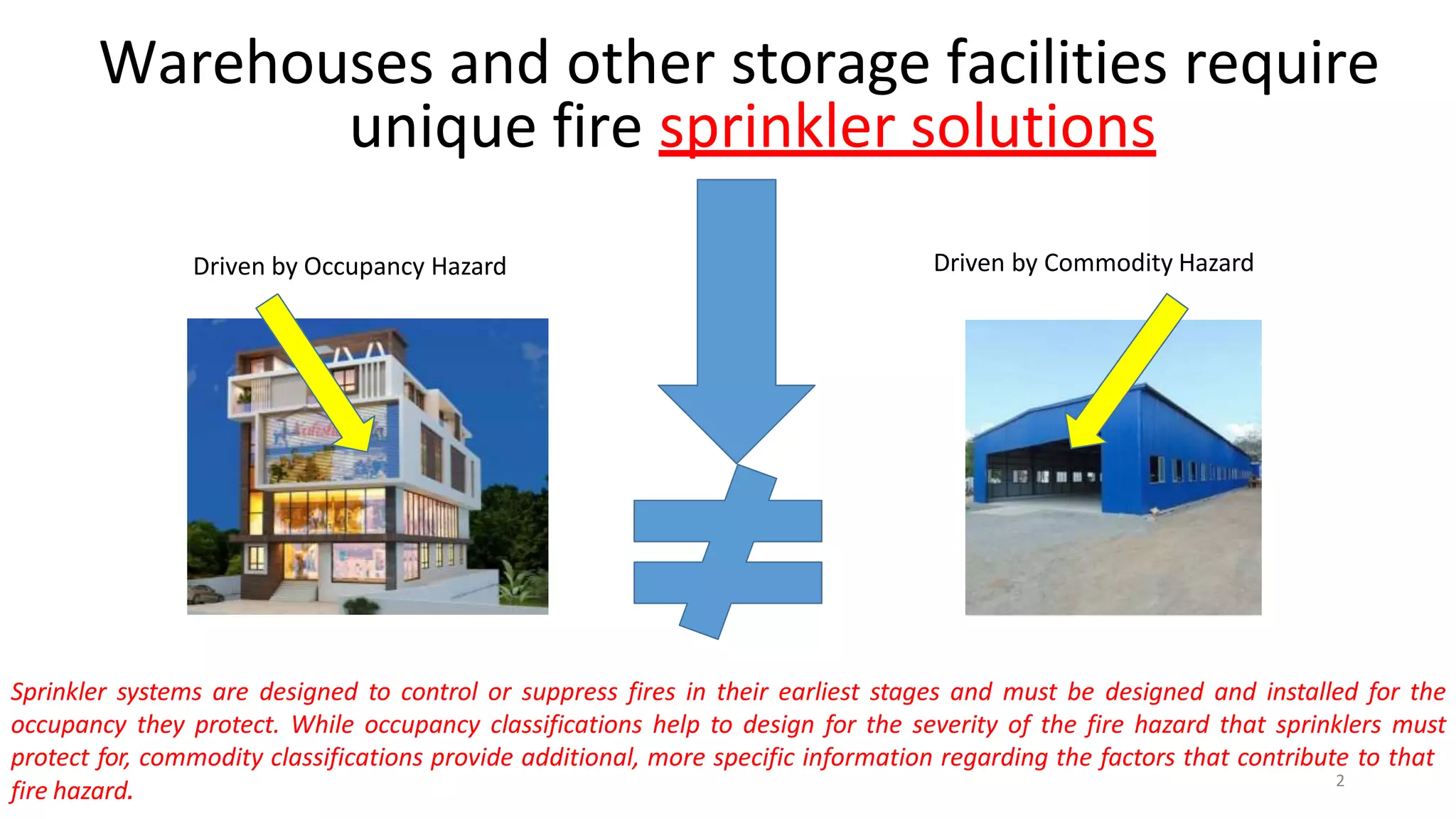
Driven by Occupancy Hazard Driven by Commodity Hazard
2
Sprinkler systems are designed to control or suppress fires in their earliest stages and must be designed and installed for the
occupancy they protect. While occupancy classifications help to design for the severity of the fire hazard that sprinklers must
protect for, commodity classifications provide additional, more specific information regarding the factors that contribute to that
fire hazard.
3
Unique Challenges
• Multiple factors combine to create a high fire hazard in warehouses.
• Packaging materials, the goods stored are often highly flammable.
Plus, the dense packing and high stacking of items can block water
flow in a situation where high ceilings already make it harder to
deliver water. Together, the features of storage occupancies create a
very challenging situation.
4
Let’s Understand the Terminologies First !!!
5
Available Height for Storage
Max. Height at which commodities can be stored above the floor and
still maintain necessary clearance from structural members and the
required clearance below sprinklers
Encapsulation A method packaging that either
of
consists of a plastic sheet completely
enclosing the sides and top of a pallet
load containing a combustible
commodity, a combustible package, or a
group of combustible commodities or
of
combustible packages, or consists
combustible commodities individually
wrapped in plastic sheeting and stored
exposed in a pallet load.
The term encapsulated does not apply to plastic-enclosed
products or packages inside a large, neoplastic, enclosed
container.
Where there are holes or voids in the plastic on the top of the carton that exceed more than half of the area of
the cover, the term encapsulated does not apply
6
Expanded Plastics ( Foamed or Cellular)
Those plastics, the density of which is
reduced by the presence of numerous
small cavities (cells), interconnecting or
dispersed throughout their mass.
7
Unexpanded Plastics
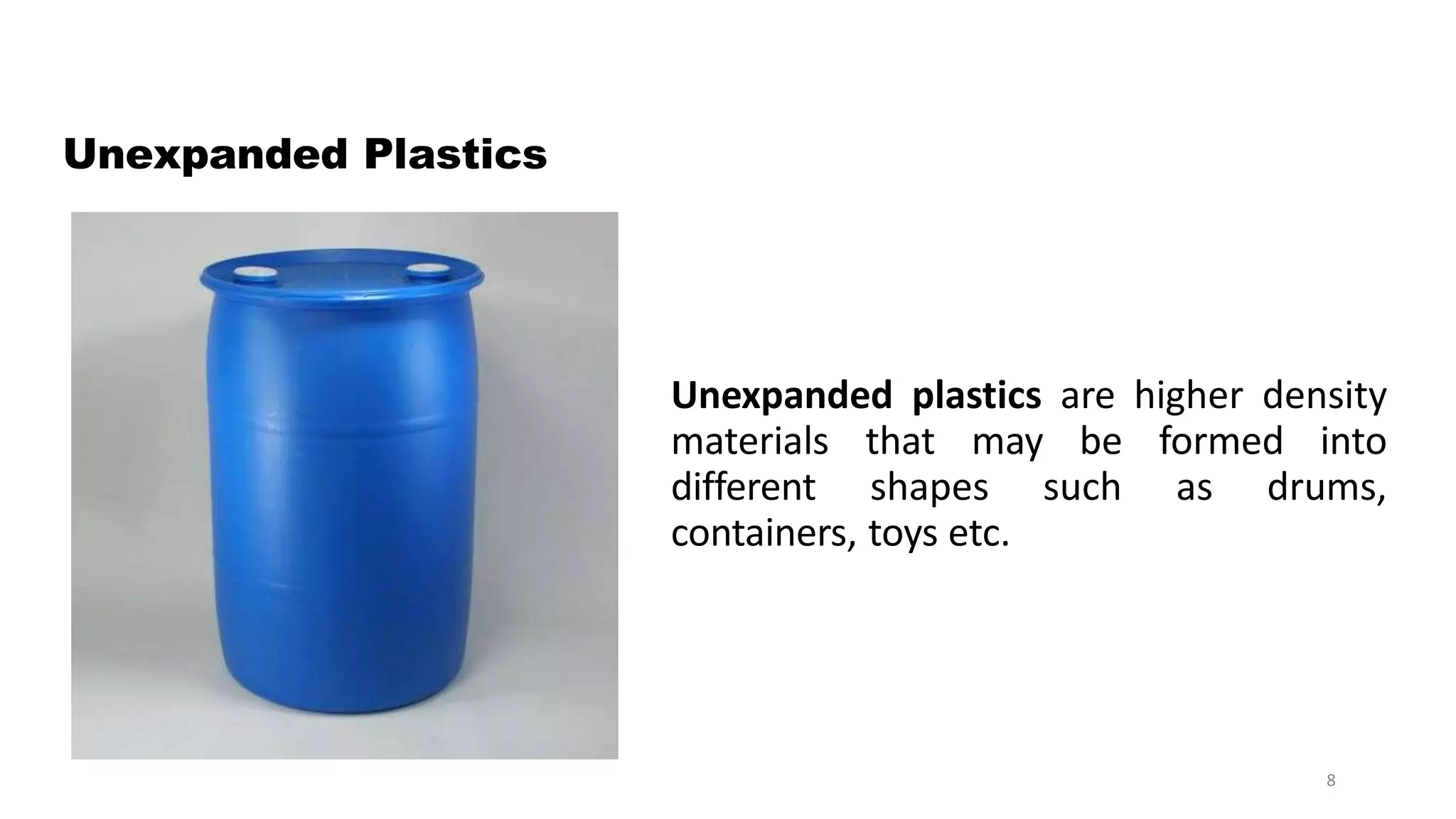
Unexpanded plastics are higher density
materials that may be formed into
different shapes such as drums,
containers, toys etc.
8
Free-Flowing
Plastic Materials
Those plastics that fall out of their
containers during a fire, fill flue
spaces, and create a smothering
effect on the fire.
9
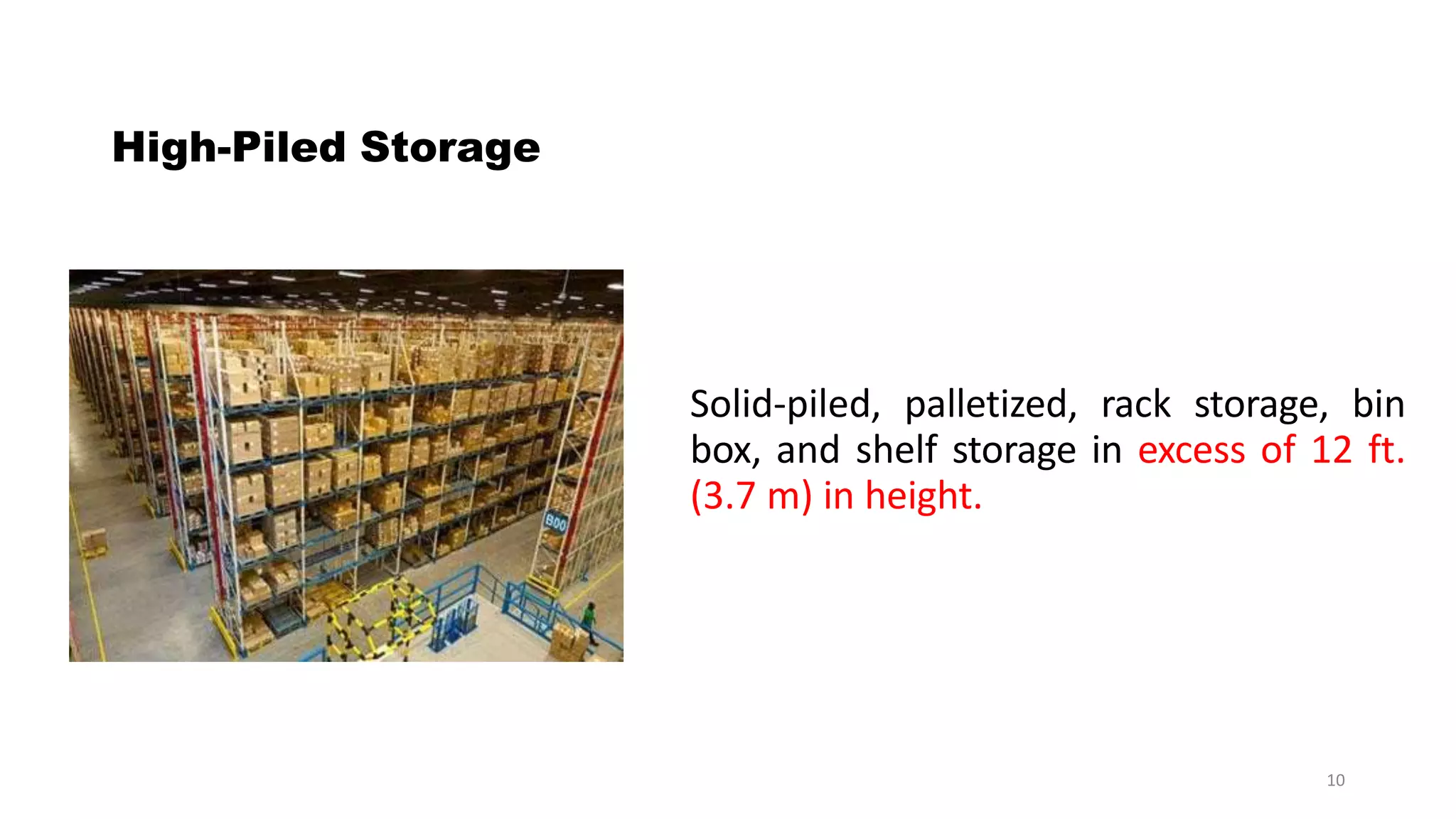
High-Piled Storage
Solid-piled, palletized, rack storage, bin
box, and shelf storage in excess of 12 ft.
(3.7 m) in height.
10
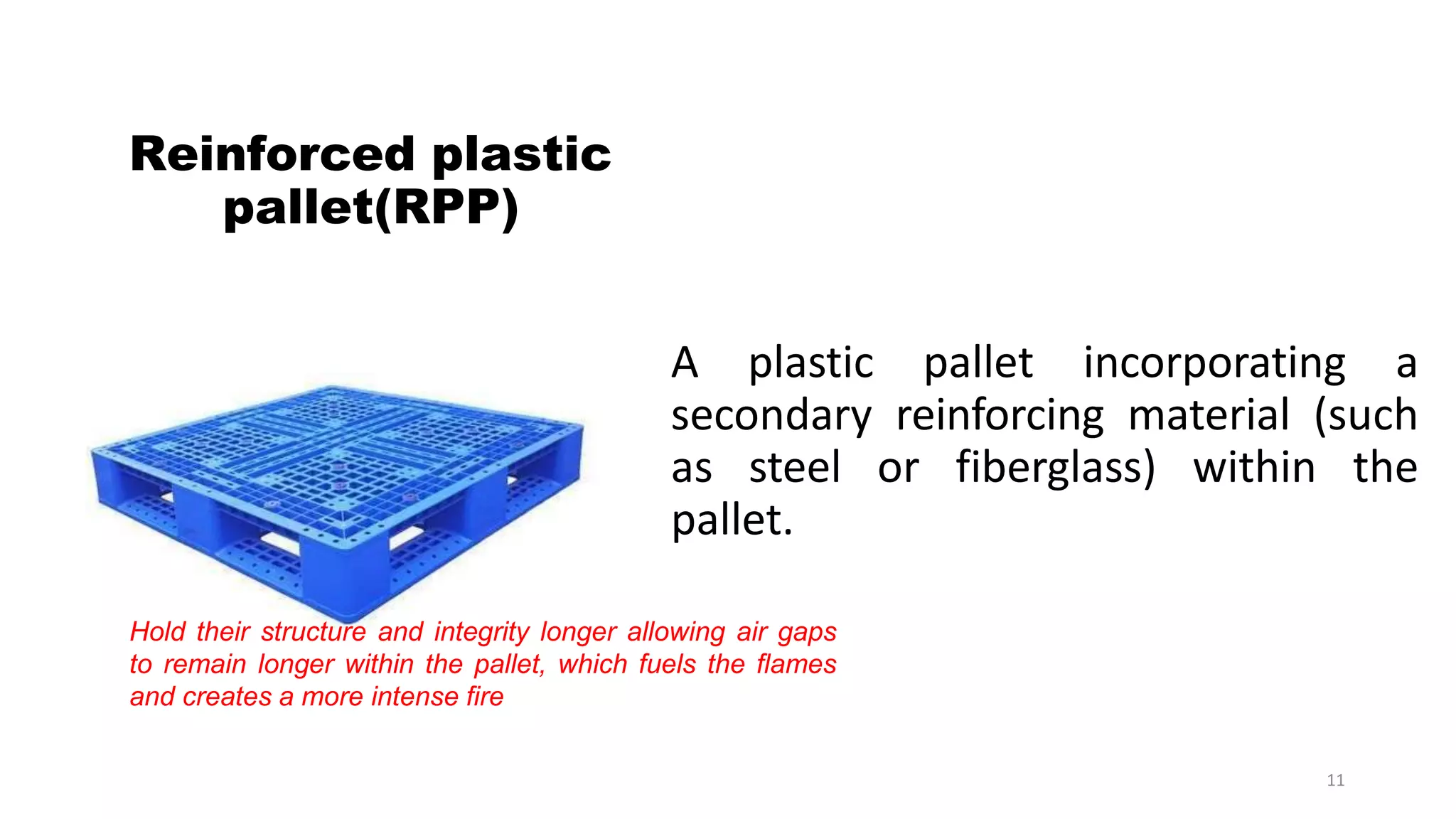
Reinforced plastic
pallet(RPP)
A plastic pallet incorporating a
secondary reinforcing material (such
as steel or fiberglass) within the
pallet.
Hold their structure and integrity longer allowing air gaps
to remain longer within the pallet, which fuels the flames
and creates a more intense fire
11
Types of Storage Arrangements
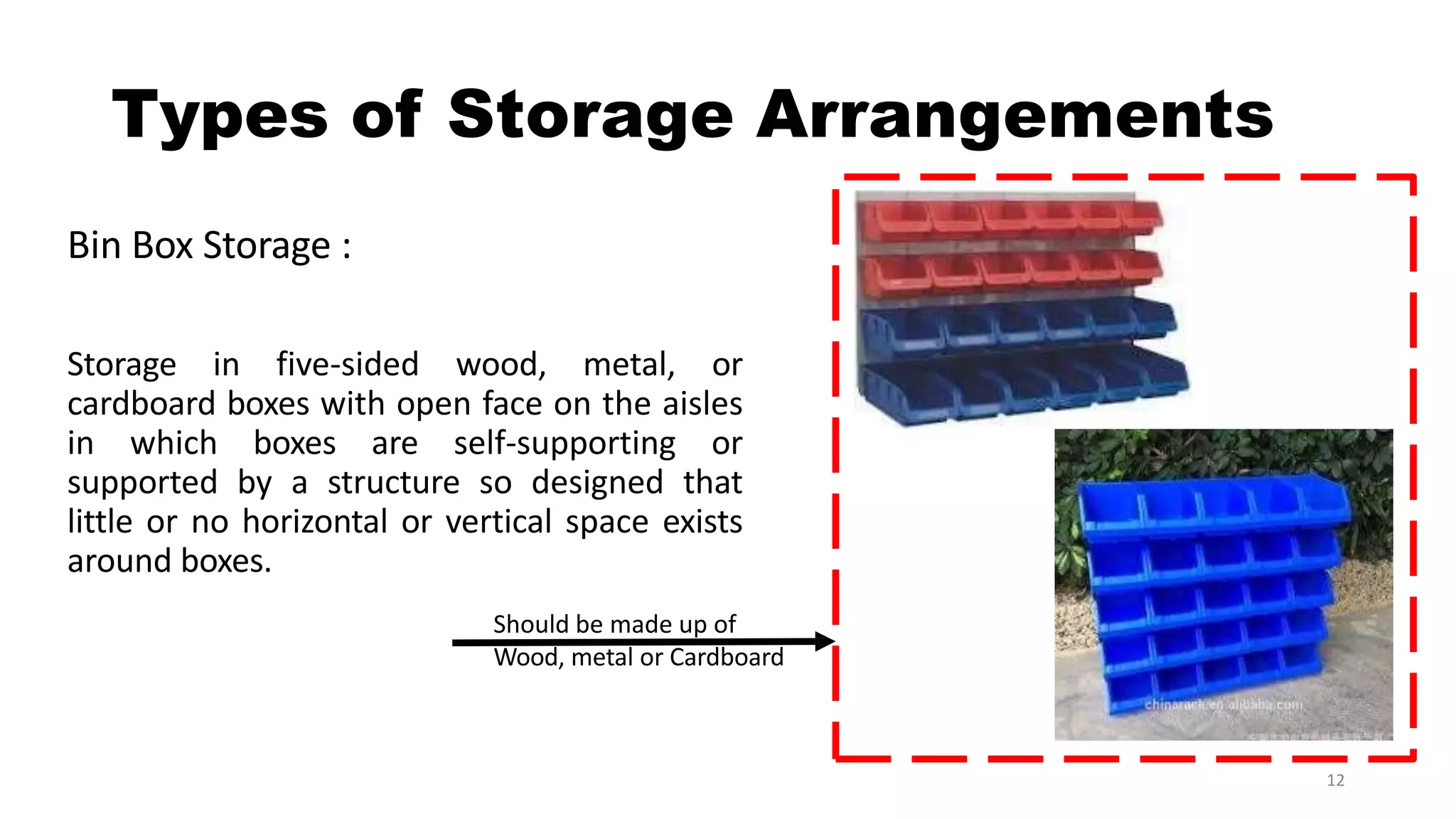
Bin Box Storage :
Storage in five-sided wood, metal, or
cardboard boxes with open face on the aisles
in which boxes are self-supporting or
supported by a structure so designed that
little or no horizontal or vertical space exists
around boxes.
Should be made up of
Wood, metal or Cardboard
12
Types of Storage Arrangements
Palletized Storage :
Storage of commodities on pallets or other
storage aids that form horizontal spaces
between tiers of storage.
13
Types of Storage Arrangements
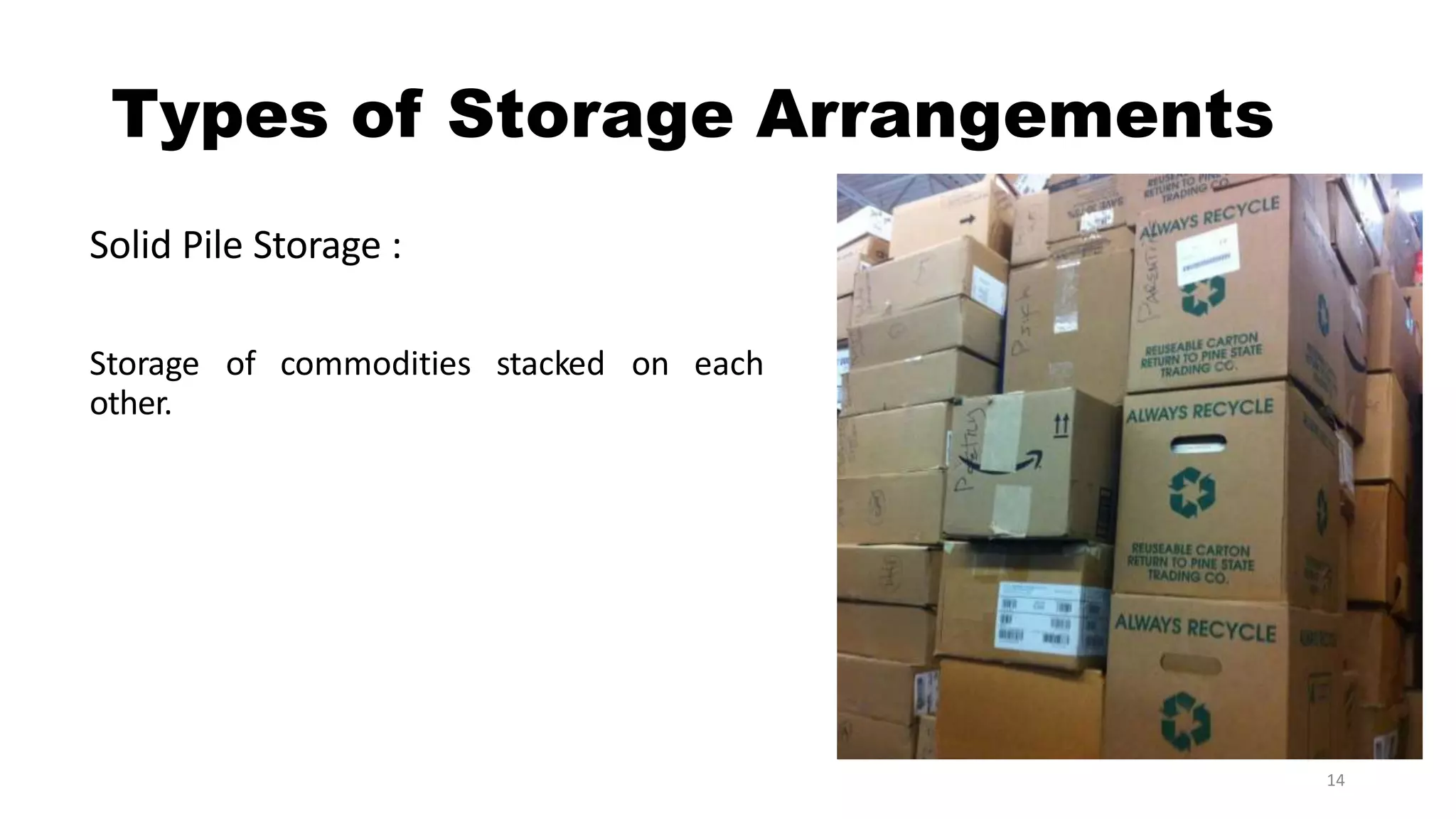
Solid Pile Storage :
Storage of commodities stacked on each
other.
14
Types of Storage Arrangements
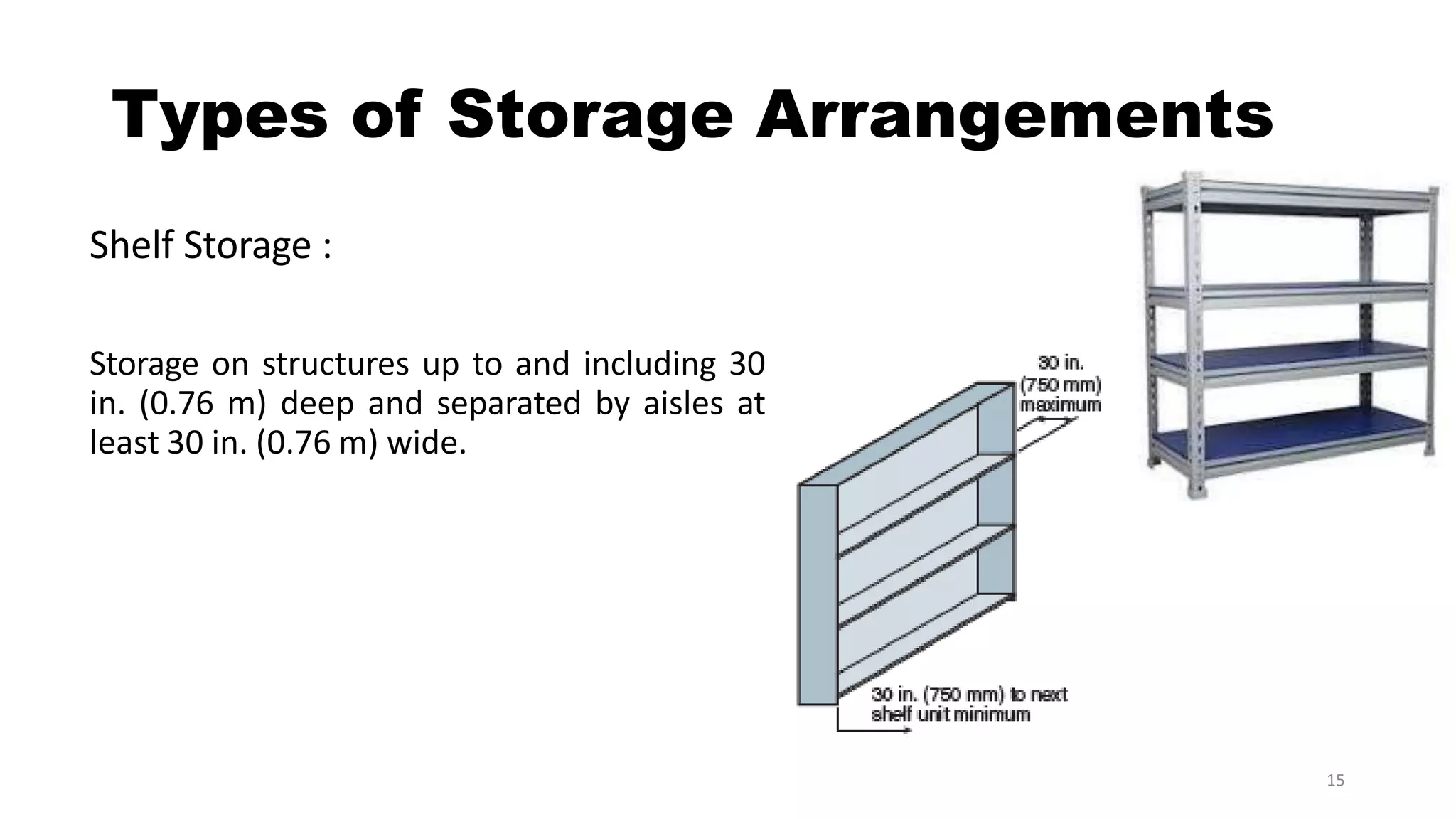
Shelf Storage :
Storage on structures up to and including 30
in. (0.76 m) deep and separated by aisles at
least 30 in. (0.76 m) wide.
15
Types of Storage Arrangements
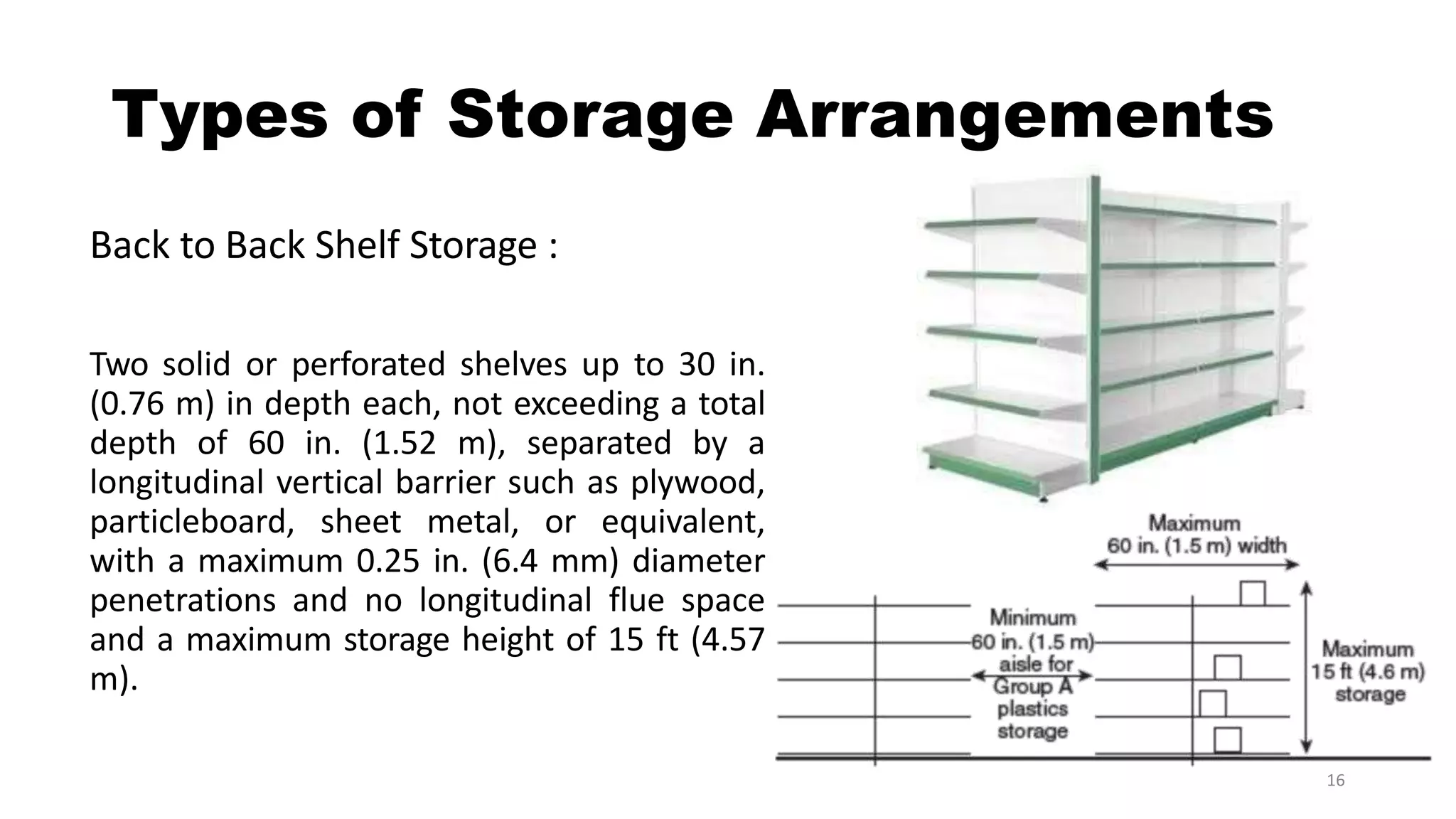
Back to Back Shelf Storage :
Two solid or perforated shelves up to 30 in.
(0.76 m) in depth each, not exceeding a total
depth of 60 in. (1.52 m), separated by a
longitudinal vertical barrier such as plywood,
particleboard, sheet metal, or equivalent,
with a maximum 0.25 in. (6.4 mm) diameter
penetrations and no longitudinal flue space
and a maximum storage height of 15 ft (4.57
m).
16
Types of Storage Arrangements
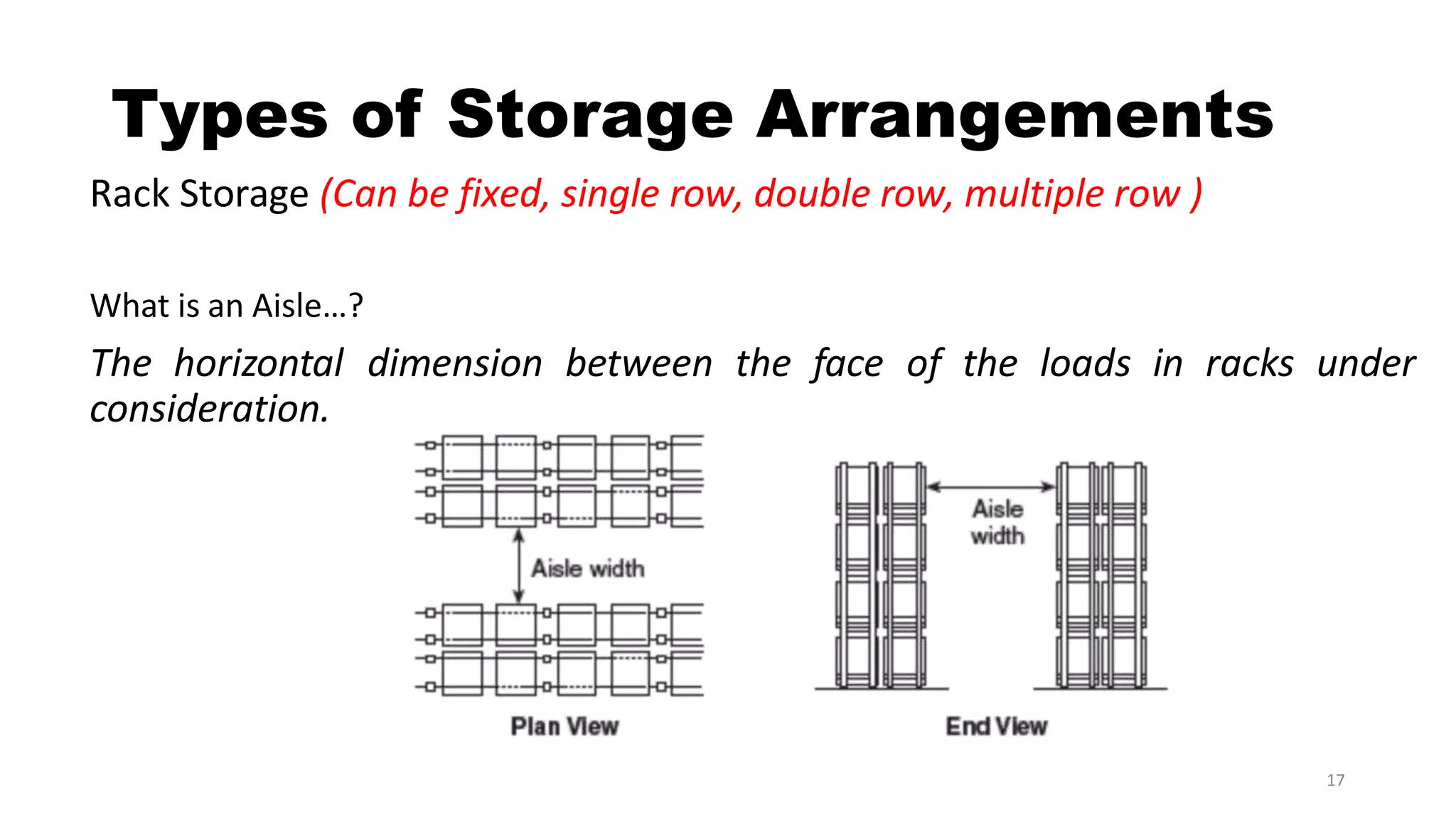
Rack Storage (Can be fixed, single row, double row, multiple row )
What is an Aisle…?
The horizontal dimension between the face of the loads in racks under
consideration.
17
Types of Storage
Arrangements
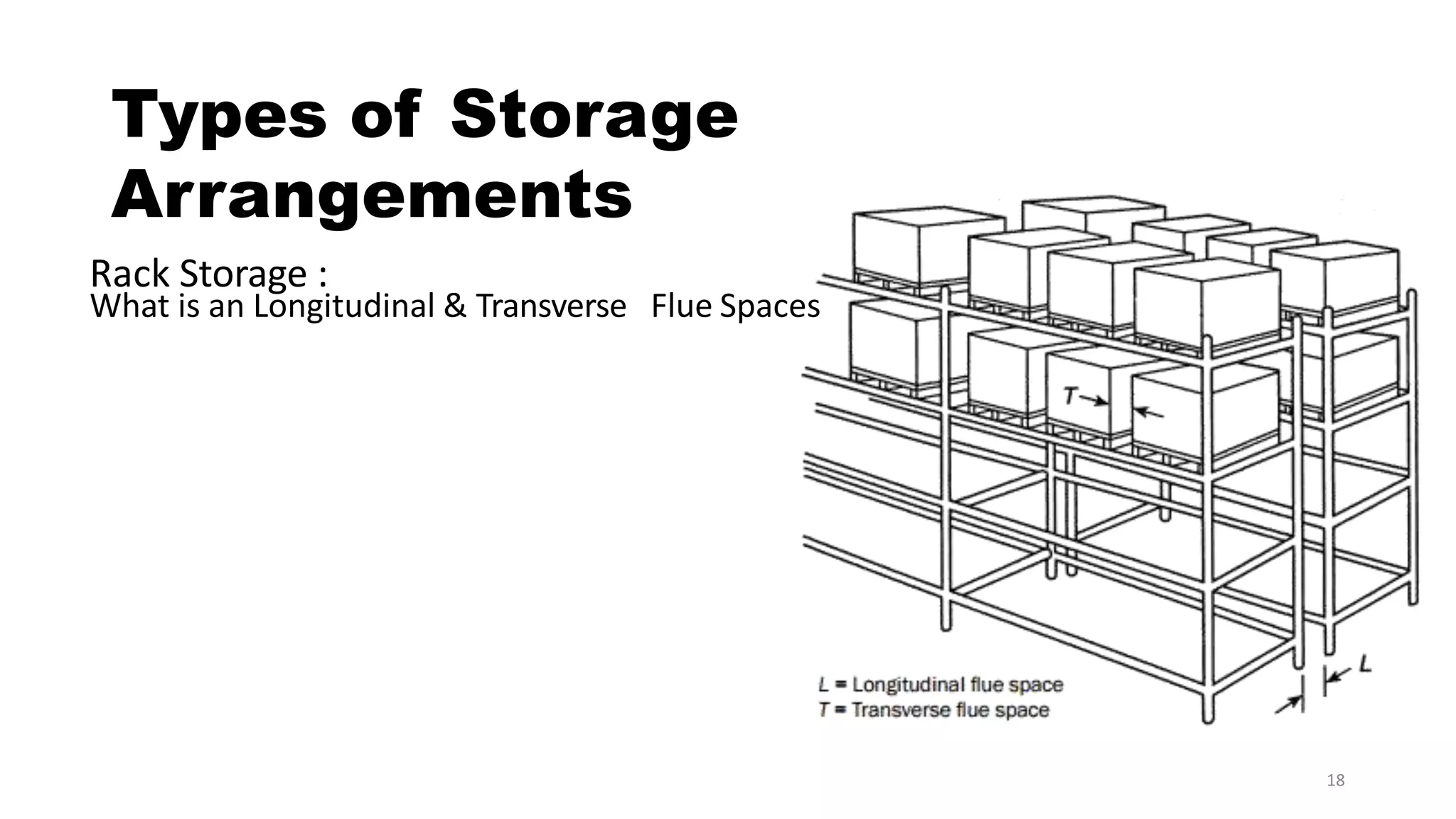
Rack Storage :
What is an Longitudinal & Transverse Flue Spaces
18
Use of Sprinkler in Racks
Plan View
= Horizontal Barrier
= Longitudinal Flue Space Sprinklers
= Face Sprinklers
Prevents vertical
spread of fire.
19
Elevation View
20
Pile Stability
• Stable :Those arrays where collapse, spillage of content, or leaning of
stacks across flue spaces is not likely to occur soon after initial fire
development.
• Unstable : Those arrays where collapse, spillage of contents, or
leaning of stacks across flue spaces occurs soon after initial fire
development
21
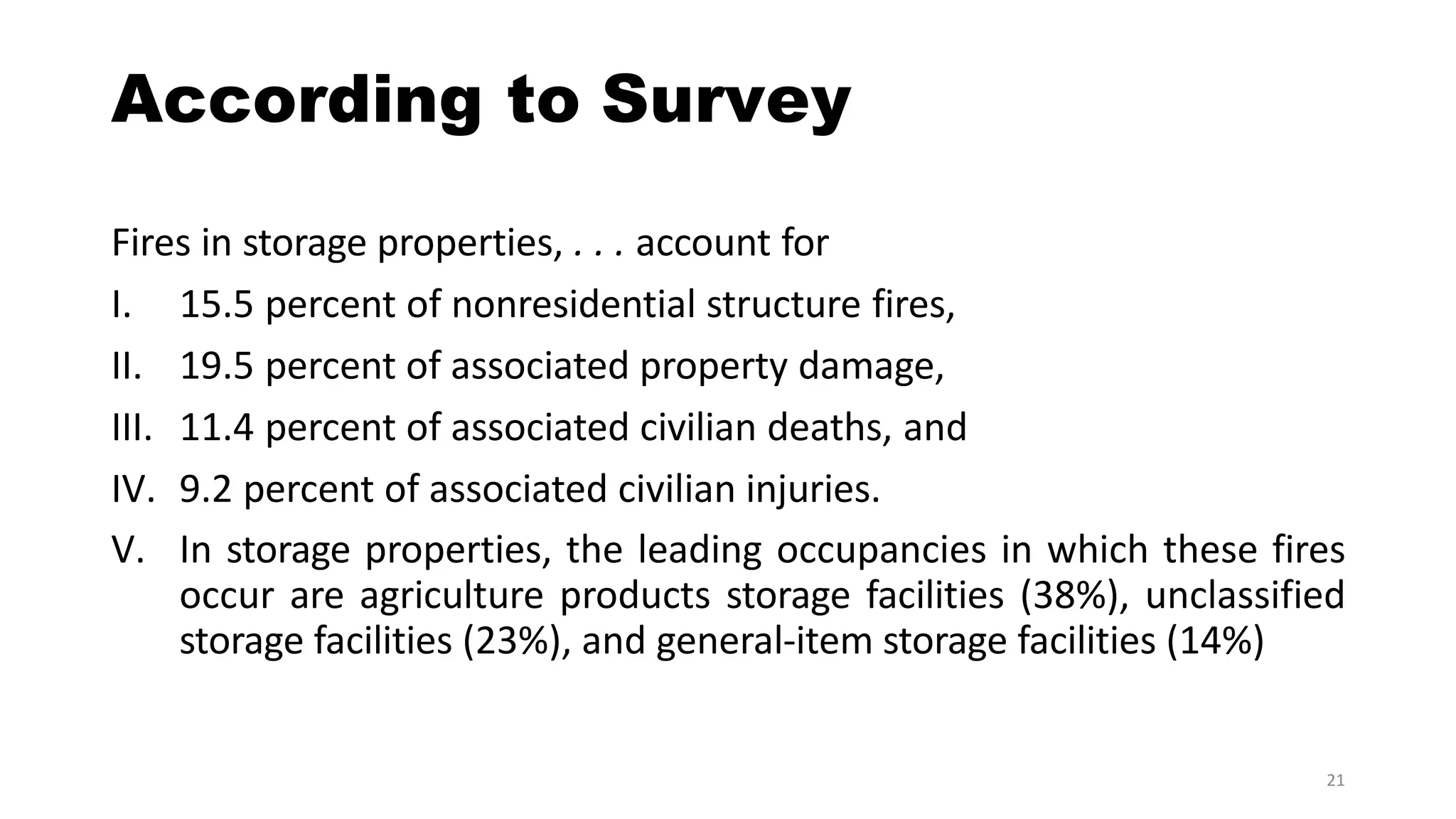
According to Survey
Fires in storage properties, . . . account for
I. 15.5 percent of nonresidential structure fires,
II. 19.5 percent of associated property damage,
III. 11.4 percent of associated civilian deaths, and
IV. 9.2 percent of associated civilian injuries.
V. In storage properties, the leading occupancies in which these fires
occur are agriculture products storage facilities (38%), unclassified
storage facilities (23%), and general-item storage facilities (14%)
22
Design Checklist for Sprinkler System
• Commodity Class
• Type of Pallet
• Storage Arrangement
• Ceiling height, Storage Height, Ceiling Clerance
• If the Storage is miscellaneous ?
• Other Consideration
Commodity Classification
Warehouse
commodity
(Carton, packaging,
plastic)
Plastic Group A-C
Class I -IV
Classify grouped
commodity into
one of seven hazard
groups (Based on
HRR) 23
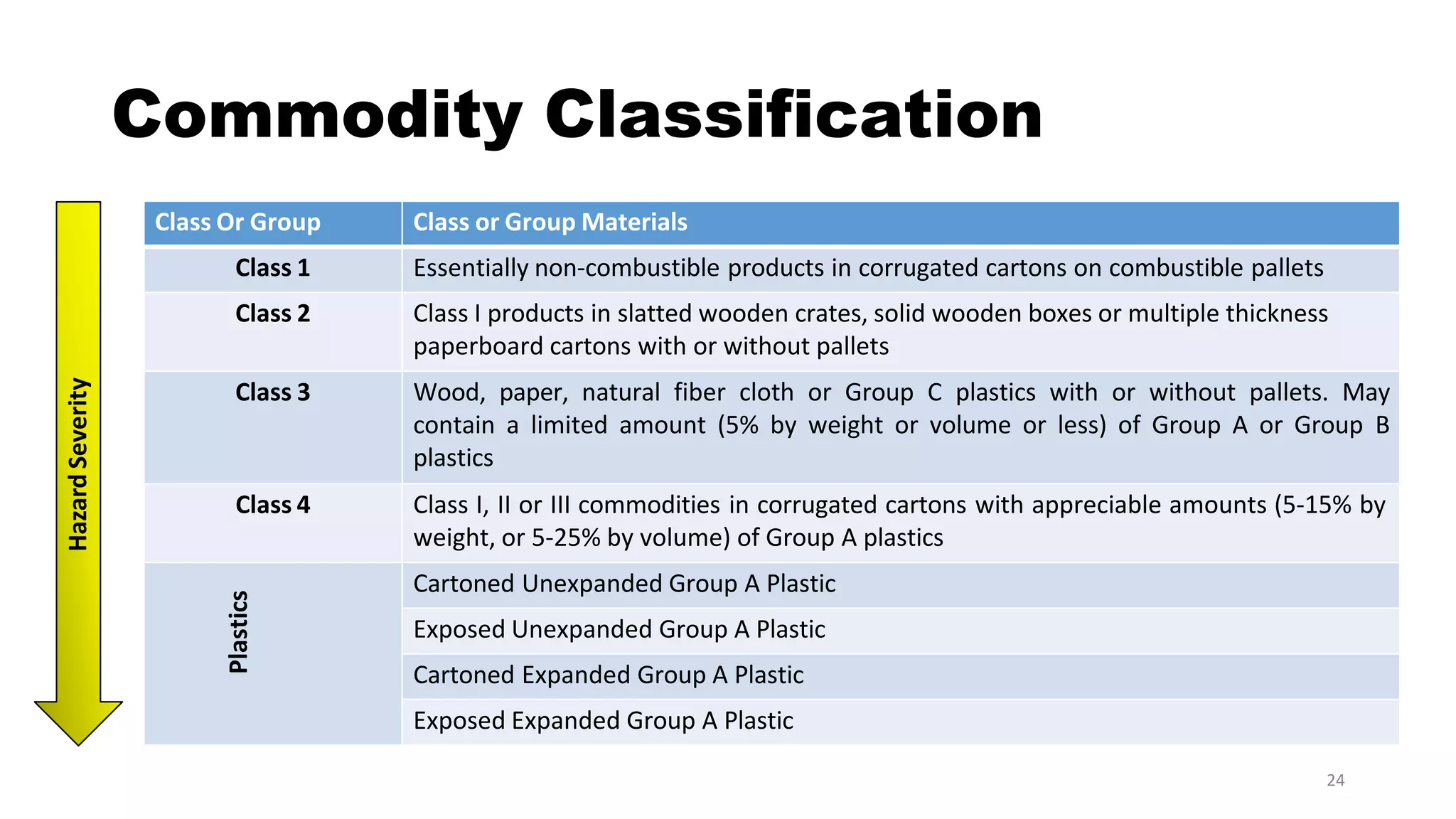
Commodity Classification
Class Or Group Class or Group Materials
Class 1 Essentially non-combustible products in corrugated cartons on combustible pallets
Class 2 Class I products in slatted wooden crates, solid wooden boxes or multiple thickness
paperboard cartons with or without pallets
Class 3 Wood, paper, natural fiber cloth or Group C plastics with or without pallets. May
contain a limited amount (5% by weight or volume or less) of Group A or Group B
plastics
Class 4 Class I, II or III commodities in corrugated cartons with appreciable amounts (5-15% by
weight, or 5-25% by volume) of Group A plastics
Plastics
Cartoned Unexpanded Group A Plastic
Exposed Unexpanded Group A Plastic
Cartoned Expanded Group A Plastic
Exposed Expanded Group A Plastic
Hazard
Severity
24
Commodity Classification -
Standardized Test Commodities
25
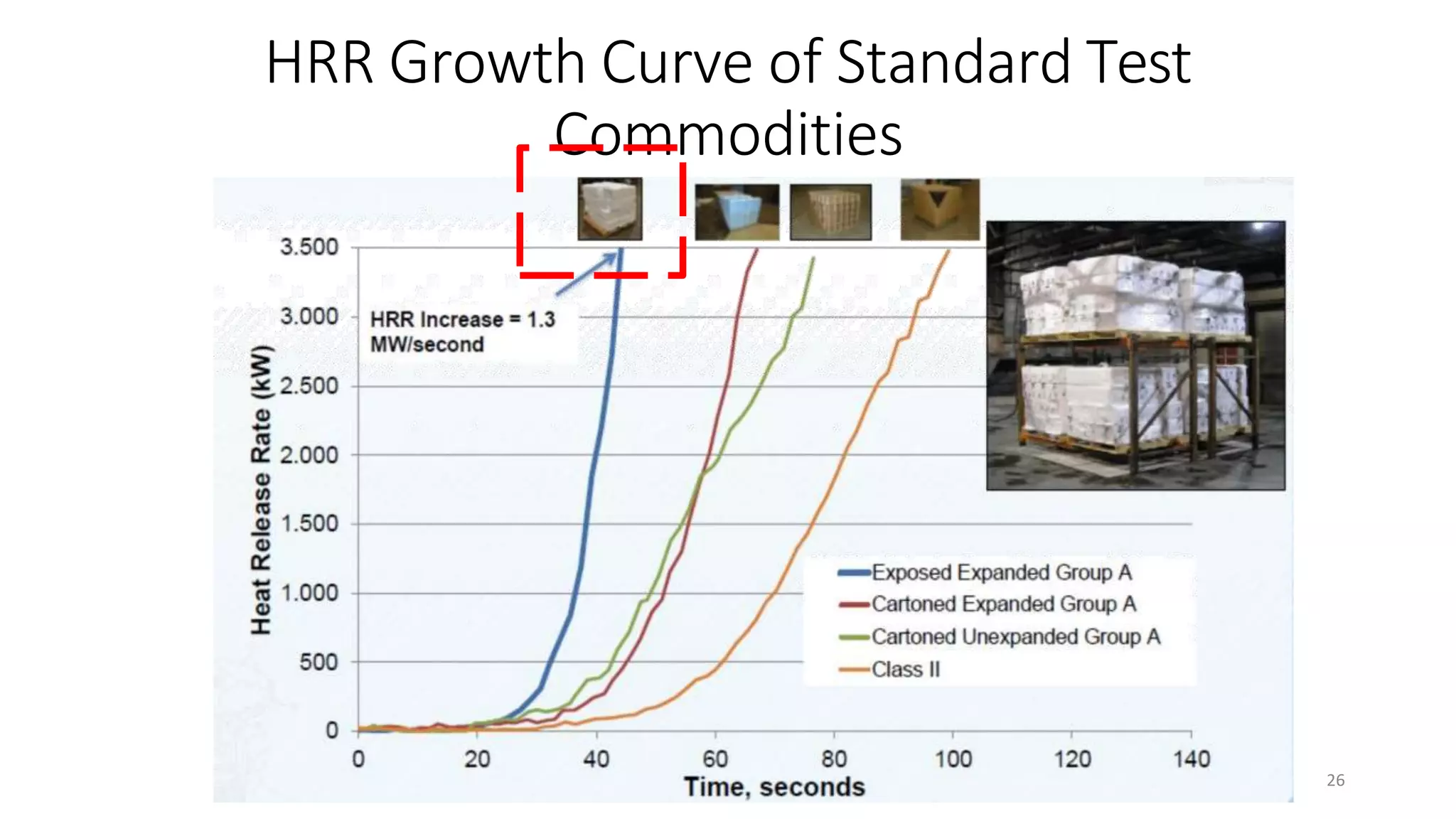
HRR Growth Curve of Standard Test
Commodities
26
27
Type of Pallet
• Wood
• URPP – one Class Modification
One class upgrade for un-reinforced plastic pallets
Class II → Class III
Class IV → Group A Plastics
• RPP – Two Class Modification
Two class upgrade for reinforced plastic pallets
Class II → Class IV
Class IV → Group A Plastics
28
Storage Arrangement
• Rack
• Single row
• Double row
• Multiple row
• Shelf
• Open rack
• Solid shelving
• Slatted shelf
• Solid Shelf
• Back to Back Shelf
• Solid pile
• Pelletized
• Bin box
29
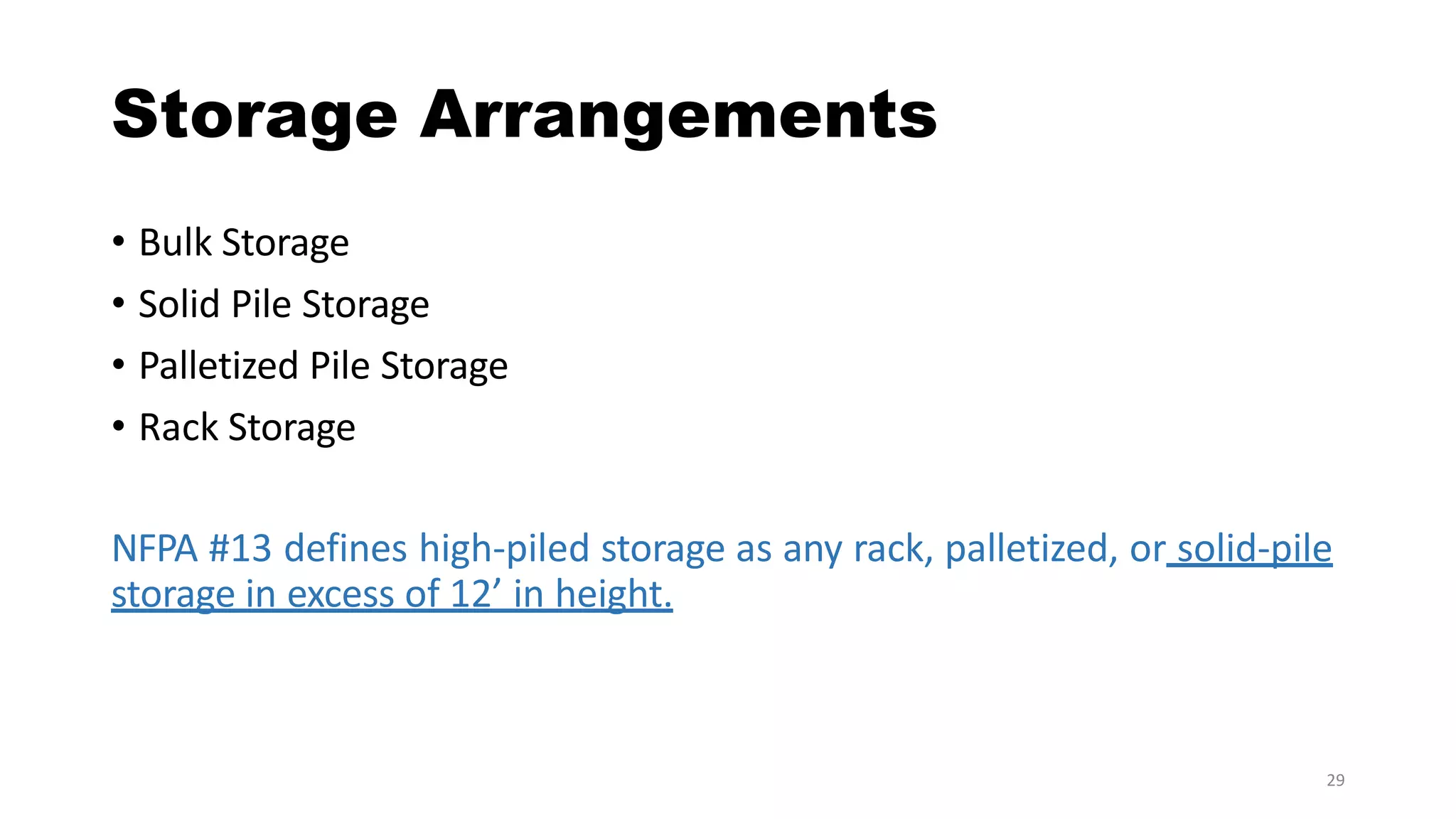
Storage Arrangements
• Bulk Storage
• Solid Pile Storage
• Palletized Pile Storage
• Rack Storage
NFPA #13 defines high-piled storage as any rack, palletized, or solid-pile
storage in excess of 12’ in height.
30
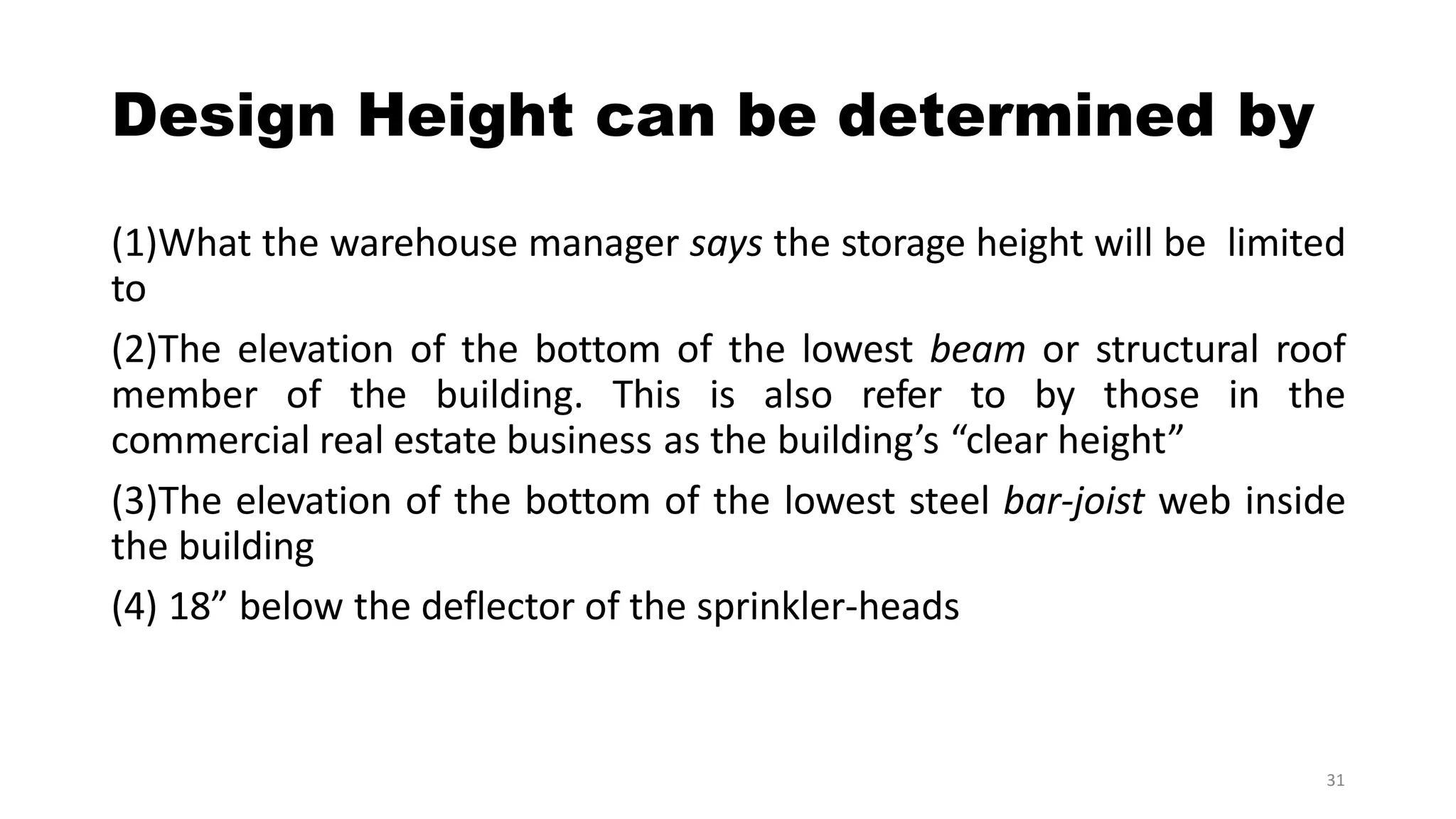
Storage Height and Clearance
“Fire severity is a function of height. The taller the burning materials,
the more rapidly the flames will accelerate”
“Materials stored twice as high will burn much more than twice as
fast.”
31
Design Height can be determined by
(1)What the warehouse manager says the storage height will be limited
to
(2)The elevation of the bottom of the lowest beam or structural roof
member of the building. This is also refer to by those in the
commercial real estate business as the building’s “clear height”
(3)The elevation of the bottom of the lowest steel bar-joist web inside
the building
(4) 18” below the deflector of the sprinkler-heads
32
How to Navigate through NFPA 13 for Storage
Requirements ?
FOR CLASS 1 TO 4 & GROUP B & C PLASTICS
How to Navigate through NFPA 13 for Storage
Requirements ?
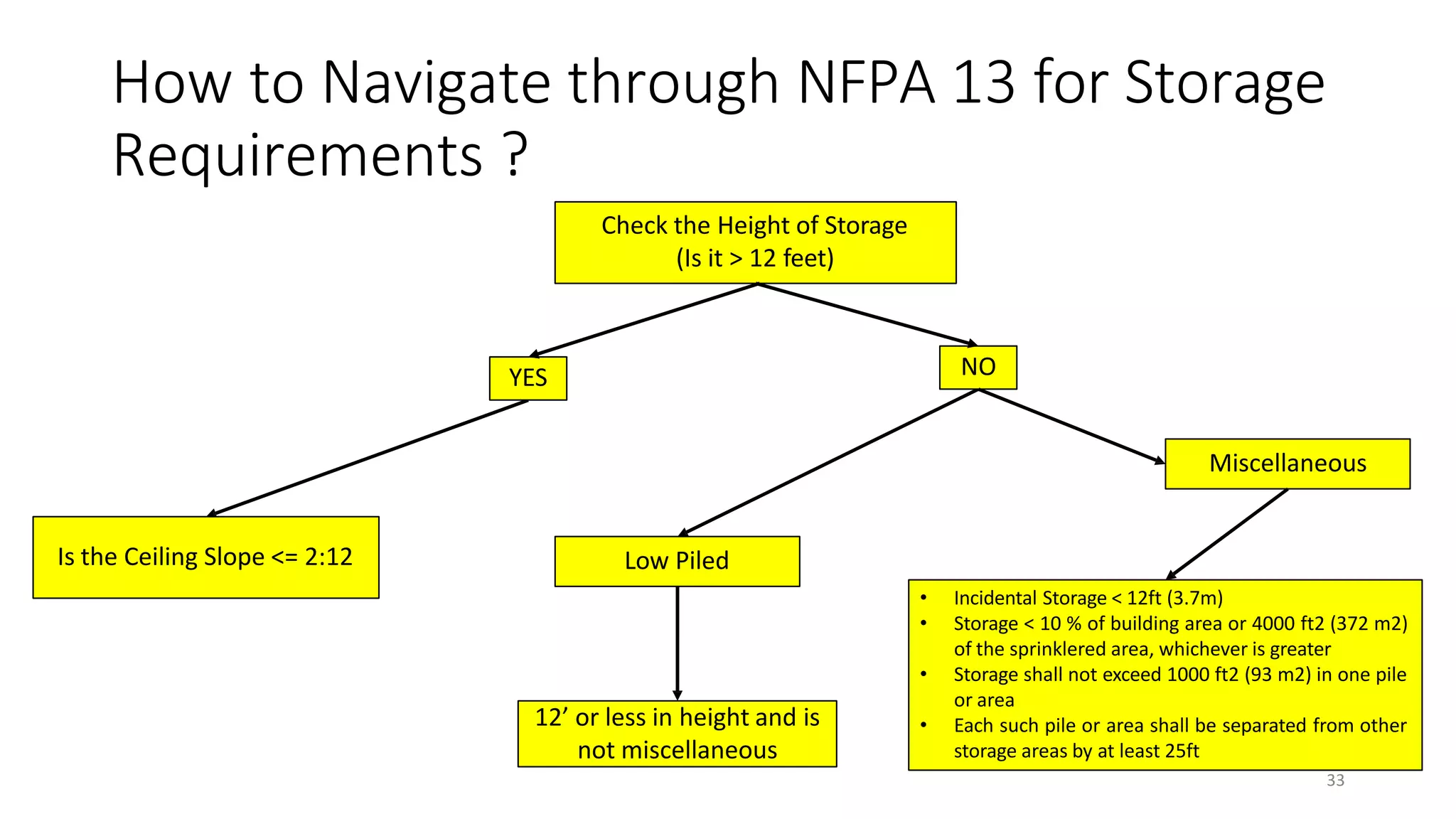
Check the Height of Storage
(Is it > 12 feet)
Is the Ceiling Slope <= 2:12 Low Piled
Miscellaneous
NO
YES
12’ or less in height and is
not miscellaneous
• Incidental Storage < 12ft (3.7m)
• Storage < 10 % of building area or 4000 ft2 (372 m2)
of the sprinklered area, whichever is greater
• Storage shall not exceed 1000 ft2 (93 m2) in one pile
or area
• Each such pile or area shall be separated from other
storage areas by at least 25ft
33
How to Navigate through NFPA 13 for Storage
Requirements ?
Is the Ceiling Slope <= 2:12
NO
Protection criteria are outside the scope of NFPA 13
WHY….?
34
Why Protection criteria for slope ceiling more than
2:12 are outside the scope of NFPA 13 ?
Firstly lets Understand the Slope of 2:12
Allowable Angle of inclination shall not be more than 9.42 degrees
Run= 12
Rise=2
∅
𝑂𝑝𝑝 𝑠𝑖𝑑𝑒
tan ∅ =
𝐴𝑑𝑗 𝑆𝑖𝑑𝑒
2
tan ∅ =
12
35
∅ = 9.42
36
Why Protection criteria for slope ceiling more than
2:12 are outside the scope of NFPA 13 ?
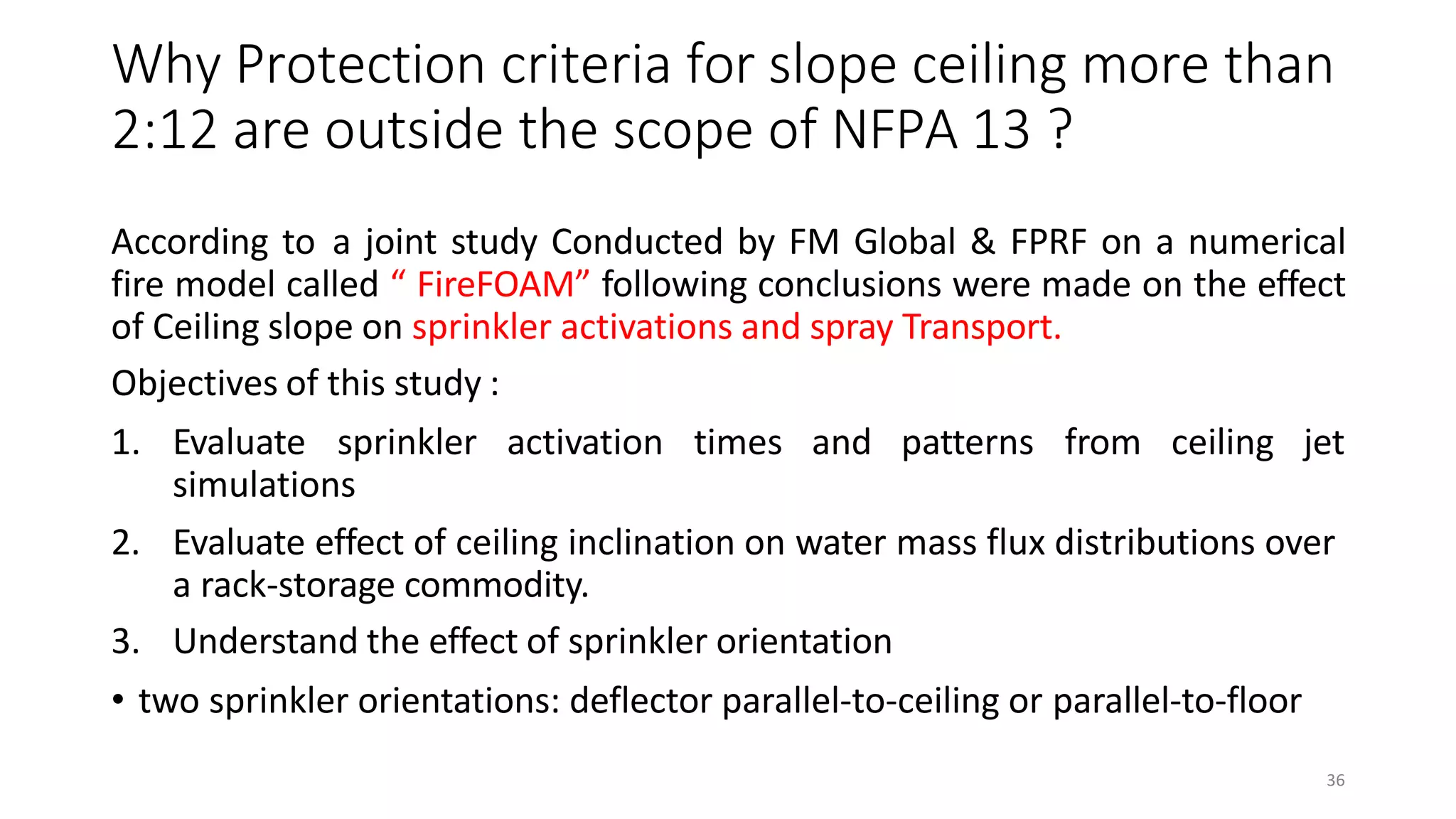
According to a joint study Conducted by FM Global & FPRF on a numerical
fire model called “ FireFOAM” following conclusions were made on the effect
of Ceiling slope on sprinkler activations and spray Transport.
Objectives of this study :
1. Evaluate sprinkler activation times and patterns from ceiling jet
simulations
2. Evaluate effect of ceiling inclination on water mass flux distributions over
a rack-storage commodity.
3. Understand the effect of sprinkler orientation
• two sprinkler orientations: deflector parallel-to-ceiling or parallel-to-floor
37
Why Protection criteria for slope ceiling more than
2:12 are outside the scope of NFPA 13 ?
Spray Result :
• For <=18.4 degrees (deflector parallel-to-ceiling )
• Water from the sprinklers on the lower side is projected towards the
fire region.
38
Why Protection criteria for slope ceiling more than
2:12 are outside the scope of NFPA 13 ?
Spray Result :
For 33.7 inclination
• low spray density on the fire region due to highly skewed activation
pattern
• water flux to fire region reduced by 54-76% as compared to horizontal
ceiling
How to Navigate through NFPA 13 for Storage
Requirements ?
39
Is the Ceiling Slope <= 2:12
YES
Is the storage a retail arrangement
YES
Apply design Criteria for storage and
display commodities
(21.9 & 23.11)
NO
Check & Apply design Criteria for bin
box, shelf, back to back shelf
How to Navigate through NFPA 13 for Storage
Requirements ?
40
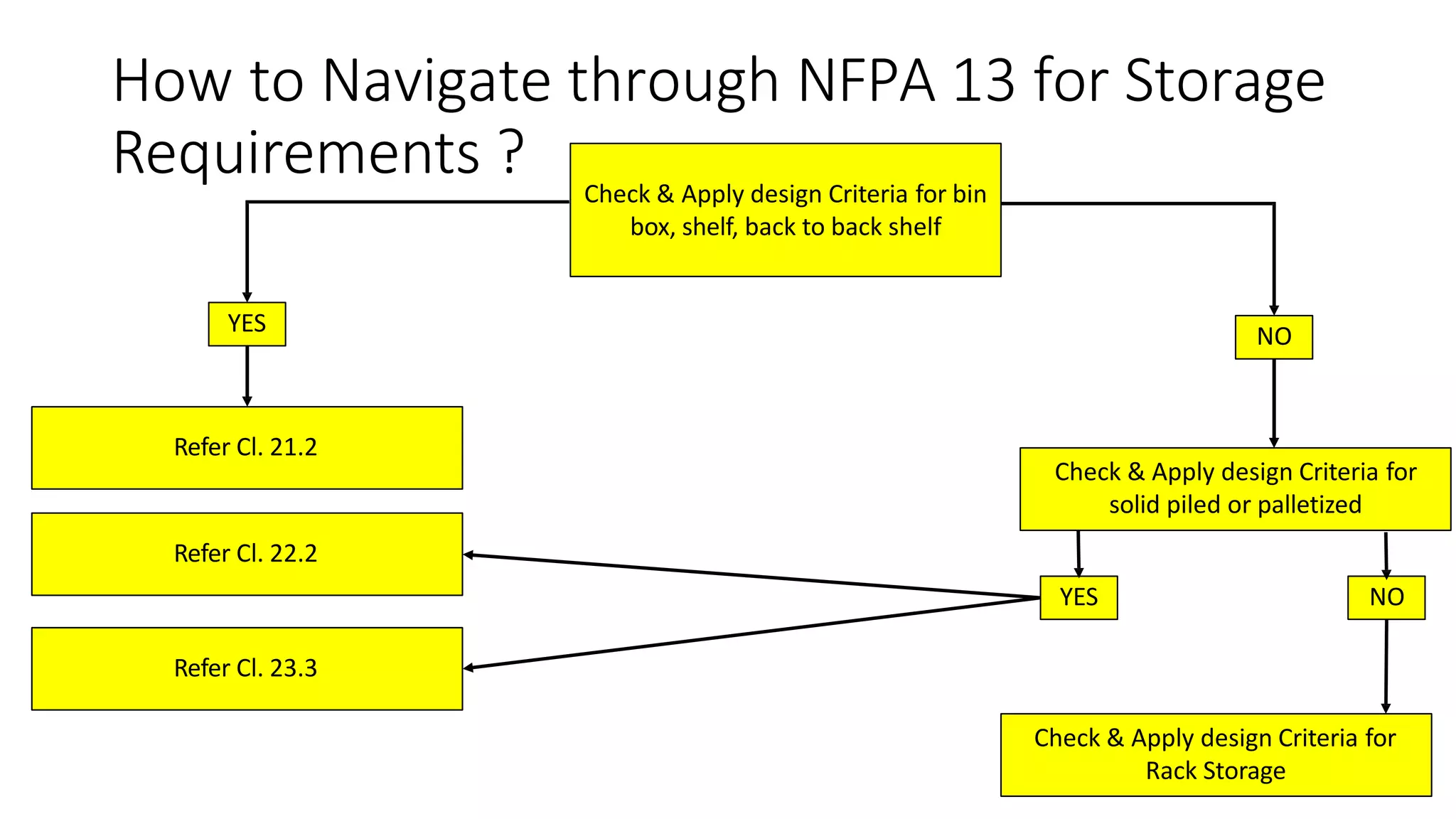
Check & Apply design Criteria for bin
box, shelf, back to back shelf
YES NO
Refer Cl. 21.2
Check & Apply design Criteria for
solid piled or palletized
YES NO
Refer Cl. 22.2
Refer Cl. 23.3
Check & Apply design Criteria for
Rack Storage
How to Navigate through NFPA 13 for Storage
Requirements ?
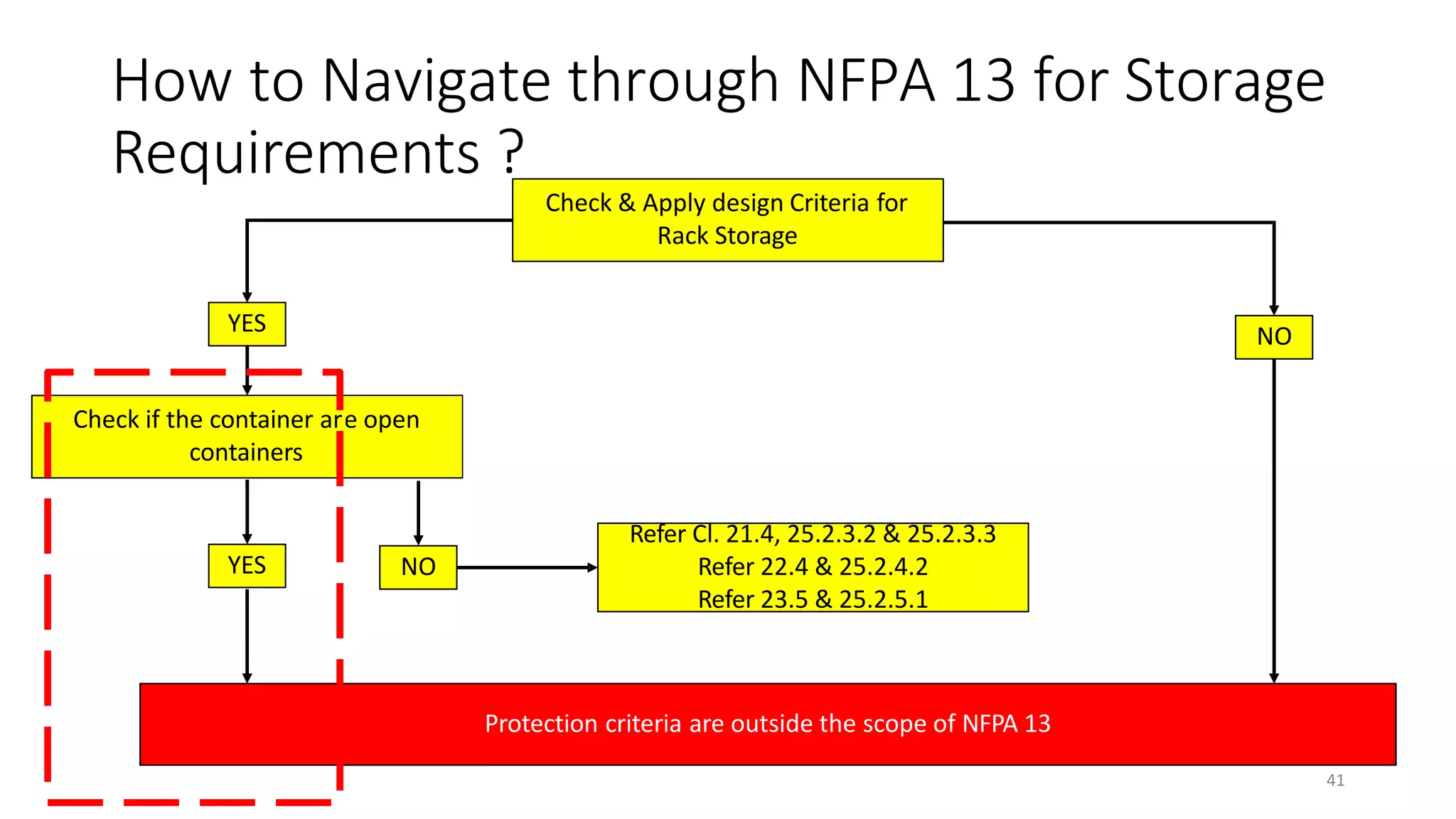
Check & Apply design Criteria for
Rack Storage
YES NO
e open
Check if the container ar
containers
YES NO
Protection criteria are outside the scope of NFPA 13
Refer Cl. 21.4, 25.2.3.2 & 25.2.3.3
Refer 22.4 & 25.2.4.2
Refer 23.5 & 25.2.5.1
41
42
Why NFPA 13 Does Not Permit Open-Top
Containers ?
Loss experience and large-scale fire tests indicate a greater hazard with
open-top combustible (paper, cardboard, or wood) containers. The
major factor appears to be the capture and retention of ceiling sprinkler
discharge within the open-top container and less water flow down the
flue and aisle faces. This does not apply to open-top containers with
mesh sides.
Sprinkler Selection
• A precise design approach is necessary to meet the challenges of
these occupancies, an effort that includes using storage fire
sprinklers.
CMDA CMSA ESFR RACK
43
44
22
MPH
Small Drops are Carried Back to Ceiling - May
Skip or Prevent Adjacent Sprinklers from
Opening
45
46
CMDA: control-mode density area sprinklers
• The “control-mode” in a control mode density area (CMDA) sprinkler
refers to the fact that these heads provide wetting and cooling to
control a fire until first responders can arrive. “Density-area” refers to
how CMDA systems are designed.
• A set of density-area curves specifies the amount of water flow
required for a given area. The system and its water source are
engineered based on them to provide the necessary flow and
pressure.
47
CMDA: control-mode density area sprinklers
• The “control-mode” in a control mode density area (CMDA) sprinkler
refers to the fact that these heads provide wetting and cooling to
control a fire until first responders can arrive. “Density-area” refers to
how CMDA systems are designed.
• A set of density-area curves specifies the amount of water flow
required for a given area. The system and its water source are
engineered based on them to provide the necessary flow and
pressure.
48
CMDA: control-mode density area sprinklers
• Does that mean CMDA sprinklers are almost identical to average fire
sprinklers ?
• Yes in Both Shape and Functions
• The two things separating a CMDA sprinkler from a regular sprinkler
are larger K-factors and higher temperature ratings.
49
CMSA: Control-mode special application
sprinklers
• Like CMDA sprinklers, control-mode special application (CMSA)
sprinklers are designed for “control” functions: wetting and cooling to
prevent fire spread. And like most storage sprinklers, CMSA sprinklers
usually have large K-factors. However, they differ from CMDA
sprinklers in two ways.
50
CMSA: Control-mode special application
sprinklers
1.CMSA sprinklers have unique sprinkler deflectors that produce
different water droplet sizes and spray patterns. This makes CMSA
sprinklers suited to “special applications;” in other words, high-
challenge storage occupancies. The unique deflector also requires the
sprinklers to carry a different listing.
2.CMSA sprinklers don’t use the design concepts employed by CMDA
sprinklers. No density/area curves are involved. Instead, different
variables are analyzed to calculate the necessary flow and pressure
for a given system
51
ESFR: Early-suppression fast response
sprinklers
• Unique among fire sprinklers, early-suppression fast-response (ESFR)
sprinklers provide fire suppression instead of fire control. The goal of
ESFR sprinklers isn’t preventing fire spread until firefighters can fully
extinguish it. Rather, they are meant to activate quickly and attack a
fire directly. The idea is that early fire suppression requires less total
water, allows less fire spread, and ultimately makes sprinkler systems
less expensive
52
ESFR: Early-suppression fast response
sprinklers
• ESFR sprinklers have large K-factors and feature uniquely designed
deflectors meant to produce large, high-momentum droplets that won’t
evaporate before penetrating a fire plume. Another major distinguishing
characteristic of ESFR sprinklers is fast-response elements designed to
operate sooner than standard sprinkler elements.
53
In-rack fire sprinklers
• In-rack sprinklers work just like their name suggests: sprinkler risers
and branch pipes are installed with storage racks to put sprinklers as
close to potential fires as possible. Of course, doing so creates
unique infrastructure challenges for warehouses—storage racks
become more permanent when plumbing is involved. But it solves the
issues posed by height and obstruction.
• Various ESFR and Control Mode ceiling level sprinklers introduced
since 1980 have led to ceiling-only protection dominating the storage
sprinkler market. But as storage buildings have evolved, the
limitations of ceiling-only sprinkler protection have become apparent
In-rack fire sprinklers
Cage Guard - Protect
sprinklers from heavy loads
and machinery moving around
them
Water Shield - Protect in-rack
sprinklers from the spray of other
sprinklers.
Water from a ceiling-level sprinkler head (or another
in-rack head) could cool the heat-sensitive element of
sprinklers near it, preventing them from operating as
designed.
54
55
Why In Rack Sprinklers ?
There are situations where tests have determined that ceiling
sprinklers—no matter how large the K-factor or water pressure—can’t
provide adequate control or suppression. Extremely flammable
commodities, high ceilings, high-piled storage, and obstructions to
water are common culprits. In these cases, in-rack fire sprinklers are
necessary.
56
Why In Rack Sprinklers ?
• Location matters. Being located closer to a rack storage fire gives in-
rack sprinklers an advantage over ceiling sprinklers in terms of both
activation and delivering water to the burning commodity. Thus, in-
rack sprinklers have the potential to activate when a fire is smaller
and requires less water to control.
• A key feature of in-rack sprinklers is that they do not depend on the
configuration of the building enclosure. The tallest current listing for
an ESFR sprinkler without in-rack sprinklers is 48 ft. There are typically
no limits on building height with in-rack sprinklers
57
Why In Rack Sprinklers ?
Two of the biggest challenges with ESFR sprinklers which do not affect in-
rack sprinklers:
(1) Sloped ceilings and
(2) Complicated ESFR obstruction rules.
58
Limits of Ceiling Only Sprinkler
1. Height :
The original ESFR sprinkler had a Nominal K-factor of 14.0 gpm/psi1/2 and
was designed with a discharge pressure of 50 psi to protect Cartoned
Unexpanded Group A plastics stored up to 25 ft. high under ceilings up to 30
ft. in height
59
Limits of Ceiling Only Sprinkler
What Does NFPA 13 say ?
• NFPA 13 limits K14.0 ESFR sprinklers to ceiling heights of 35 ft. when
protecting rack storage, unless in-rack sprinklers are provided.
• Ceiling-only design criteria to protect rack storage under ceilings up to 45
ft. tall are available with larger orifice K22.4 and K25.2 ESFR sprinklers.
Specific application criteria are also available for certain ESFR sprinklers
under ceiling heights up to 48 ft.
60
Limits of Ceiling Only Sprinkler
Limitations of ESFR as a Ceiling Only Sprinkler
• To be effective, an ESFR sprinkler must operate early in the development of a
storage fire. Even with a very sensitive operating element, ceiling-only ESFR
sprinklers are challenged to activate prior to a fire spreading across an aisle as
ceiling heights increase beyond 45 ft. The design criteria available for ESFR
sprinklers under a 48 ft. ceiling require minimum 6 ft. or 8 ft. aisles. For storage
buildings taller than 48 ft., in-rack sprinklers are likely to be required.
• Modern distribution facilities using either multi-level work platforms (pick
modules) or automated storage and retrieval systems often gain efficiency by
increasing the building height beyond the limits of ceiling-only sprinkler systems.
61
Limits of Ceiling Only Sprinkler
2. Water Demand :
Even if not required by height, the efficiency of ceiling sprinklers decreases with height. As
ceiling heights increase, the water demand required for ceiling-only sprinkler systems also
increases
62
Limits of Ceiling Only Sprinkler
Ceiling Height (ft) Sprinkler Basic Sprinkler Water Demand (gpm)
30 K25.2 EC 828
35 K25.2 EC 1275
40 K16.8 ESFR 1454
45 K22.4 ESFR 1700
48 K28.0 ESFR Specific Application 1987
Water Demand :
63
Limits of Ceiling Only Sprinkler
2. Water Demand :
Previous Table illustrates how the efficiency of ceiling-only sprinkler protection decreases
with ceiling height above 30 ft. Increasing the ceiling height by just 5 ft., 17%, from 30 ft. to
35 ft. increases the basic sprinkler water demand by more than 50%. Increasing the ceiling
height by 60%, from 30 ft. to 48 ft., increases the basic sprinkler water demand by 140%.
Thus, even in buildings that could be protected with ceiling sprinklers, ceiling-only sprinkler
protection may not be the most efficient use of water.
64
Limits of Ceiling Only Sprinkler
3. More Hazardous Commodity:
• The discussion so far has referenced protection criteria for Cartoned Unexpanded Group A
plastics. More hazardous commodities such as tires, Exposed Group A plastics, and aerosols
present an increased challenge to a sprinkler system.
• These commodities typically require in-rack sprinklers to be provided at lower storage
heights than would be required for a Cartoned Unexpanded Group A plastic commodity.
65
Limits of Ceiling Only Sprinkler
3. More Hazardous Commodity:
• For example, NFPA 13 limits storage of rubber tires on racks to 35 ft. of storage under a
40 ft. ceiling with ESFR sprinkler protection at the ceiling. The criterion requires more
than 2,600 gpm of basic sprinkler water demand from K25.2 ESFR sprinklers.
• Thus, while ceiling-only criteria are available for storage of Cartoned Unexpanded Group
A plastics under ceilings up to 48 ft. tall, other commodities have lower ceiling height
limits for ceiling-only protection. Even when ceiling-only protection options are available,
the water demand or other required features may make the installation of in-rack
sprinklers preferable.

warehouse storage - commuduties classifications.pptx

  • 1.
  • 2.
    Warehouses and otherstorage facilities require unique fire sprinkler solutions Driven by Occupancy Hazard Driven by Commodity Hazard 2 Sprinkler systems are designed to control or suppress fires in their earliest stages and must be designed and installed for the occupancy they protect. While occupancy classifications help to design for the severity of the fire hazard that sprinklers must protect for, commodity classifications provide additional, more specific information regarding the factors that contribute to that fire hazard.
  • 3.
    3 Unique Challenges • Multiplefactors combine to create a high fire hazard in warehouses. • Packaging materials, the goods stored are often highly flammable. Plus, the dense packing and high stacking of items can block water flow in a situation where high ceilings already make it harder to deliver water. Together, the features of storage occupancies create a very challenging situation.
  • 4.
    4 Let’s Understand theTerminologies First !!!
  • 5.
    5 Available Height forStorage Max. Height at which commodities can be stored above the floor and still maintain necessary clearance from structural members and the required clearance below sprinklers
  • 6.
    Encapsulation A methodpackaging that either of consists of a plastic sheet completely enclosing the sides and top of a pallet load containing a combustible commodity, a combustible package, or a group of combustible commodities or of combustible packages, or consists combustible commodities individually wrapped in plastic sheeting and stored exposed in a pallet load. The term encapsulated does not apply to plastic-enclosed products or packages inside a large, neoplastic, enclosed container. Where there are holes or voids in the plastic on the top of the carton that exceed more than half of the area of the cover, the term encapsulated does not apply 6
  • 7.
    Expanded Plastics (Foamed or Cellular) Those plastics, the density of which is reduced by the presence of numerous small cavities (cells), interconnecting or dispersed throughout their mass. 7
  • 8.
    Unexpanded Plastics Unexpanded plasticsare higher density materials that may be formed into different shapes such as drums, containers, toys etc. 8
  • 9.
    Free-Flowing Plastic Materials Those plasticsthat fall out of their containers during a fire, fill flue spaces, and create a smothering effect on the fire. 9
  • 10.
    High-Piled Storage Solid-piled, palletized,rack storage, bin box, and shelf storage in excess of 12 ft. (3.7 m) in height. 10
  • 11.
    Reinforced plastic pallet(RPP) A plasticpallet incorporating a secondary reinforcing material (such as steel or fiberglass) within the pallet. Hold their structure and integrity longer allowing air gaps to remain longer within the pallet, which fuels the flames and creates a more intense fire 11
  • 12.
    Types of StorageArrangements Bin Box Storage : Storage in five-sided wood, metal, or cardboard boxes with open face on the aisles in which boxes are self-supporting or supported by a structure so designed that little or no horizontal or vertical space exists around boxes. Should be made up of Wood, metal or Cardboard 12
  • 13.
    Types of StorageArrangements Palletized Storage : Storage of commodities on pallets or other storage aids that form horizontal spaces between tiers of storage. 13
  • 14.
    Types of StorageArrangements Solid Pile Storage : Storage of commodities stacked on each other. 14
  • 15.
    Types of StorageArrangements Shelf Storage : Storage on structures up to and including 30 in. (0.76 m) deep and separated by aisles at least 30 in. (0.76 m) wide. 15
  • 16.
    Types of StorageArrangements Back to Back Shelf Storage : Two solid or perforated shelves up to 30 in. (0.76 m) in depth each, not exceeding a total depth of 60 in. (1.52 m), separated by a longitudinal vertical barrier such as plywood, particleboard, sheet metal, or equivalent, with a maximum 0.25 in. (6.4 mm) diameter penetrations and no longitudinal flue space and a maximum storage height of 15 ft (4.57 m). 16
  • 17.
    Types of StorageArrangements Rack Storage (Can be fixed, single row, double row, multiple row ) What is an Aisle…? The horizontal dimension between the face of the loads in racks under consideration. 17
  • 18.
    Types of Storage Arrangements RackStorage : What is an Longitudinal & Transverse Flue Spaces 18
  • 19.
    Use of Sprinklerin Racks Plan View = Horizontal Barrier = Longitudinal Flue Space Sprinklers = Face Sprinklers Prevents vertical spread of fire. 19 Elevation View
  • 20.
    20 Pile Stability • Stable:Those arrays where collapse, spillage of content, or leaning of stacks across flue spaces is not likely to occur soon after initial fire development. • Unstable : Those arrays where collapse, spillage of contents, or leaning of stacks across flue spaces occurs soon after initial fire development
  • 21.
    21 According to Survey Firesin storage properties, . . . account for I. 15.5 percent of nonresidential structure fires, II. 19.5 percent of associated property damage, III. 11.4 percent of associated civilian deaths, and IV. 9.2 percent of associated civilian injuries. V. In storage properties, the leading occupancies in which these fires occur are agriculture products storage facilities (38%), unclassified storage facilities (23%), and general-item storage facilities (14%)
  • 22.
    22 Design Checklist forSprinkler System • Commodity Class • Type of Pallet • Storage Arrangement • Ceiling height, Storage Height, Ceiling Clerance • If the Storage is miscellaneous ? • Other Consideration
  • 23.
    Commodity Classification Warehouse commodity (Carton, packaging, plastic) PlasticGroup A-C Class I -IV Classify grouped commodity into one of seven hazard groups (Based on HRR) 23
  • 24.
    Commodity Classification Class OrGroup Class or Group Materials Class 1 Essentially non-combustible products in corrugated cartons on combustible pallets Class 2 Class I products in slatted wooden crates, solid wooden boxes or multiple thickness paperboard cartons with or without pallets Class 3 Wood, paper, natural fiber cloth or Group C plastics with or without pallets. May contain a limited amount (5% by weight or volume or less) of Group A or Group B plastics Class 4 Class I, II or III commodities in corrugated cartons with appreciable amounts (5-15% by weight, or 5-25% by volume) of Group A plastics Plastics Cartoned Unexpanded Group A Plastic Exposed Unexpanded Group A Plastic Cartoned Expanded Group A Plastic Exposed Expanded Group A Plastic Hazard Severity 24
  • 25.
  • 26.
    HRR Growth Curveof Standard Test Commodities 26
  • 27.
    27 Type of Pallet •Wood • URPP – one Class Modification One class upgrade for un-reinforced plastic pallets Class II → Class III Class IV → Group A Plastics • RPP – Two Class Modification Two class upgrade for reinforced plastic pallets Class II → Class IV Class IV → Group A Plastics
  • 28.
    28 Storage Arrangement • Rack •Single row • Double row • Multiple row • Shelf • Open rack • Solid shelving • Slatted shelf • Solid Shelf • Back to Back Shelf • Solid pile • Pelletized • Bin box
  • 29.
    29 Storage Arrangements • BulkStorage • Solid Pile Storage • Palletized Pile Storage • Rack Storage NFPA #13 defines high-piled storage as any rack, palletized, or solid-pile storage in excess of 12’ in height.
  • 30.
    30 Storage Height andClearance “Fire severity is a function of height. The taller the burning materials, the more rapidly the flames will accelerate” “Materials stored twice as high will burn much more than twice as fast.”
  • 31.
    31 Design Height canbe determined by (1)What the warehouse manager says the storage height will be limited to (2)The elevation of the bottom of the lowest beam or structural roof member of the building. This is also refer to by those in the commercial real estate business as the building’s “clear height” (3)The elevation of the bottom of the lowest steel bar-joist web inside the building (4) 18” below the deflector of the sprinkler-heads
  • 32.
    32 How to Navigatethrough NFPA 13 for Storage Requirements ? FOR CLASS 1 TO 4 & GROUP B & C PLASTICS
  • 33.
    How to Navigatethrough NFPA 13 for Storage Requirements ? Check the Height of Storage (Is it > 12 feet) Is the Ceiling Slope <= 2:12 Low Piled Miscellaneous NO YES 12’ or less in height and is not miscellaneous • Incidental Storage < 12ft (3.7m) • Storage < 10 % of building area or 4000 ft2 (372 m2) of the sprinklered area, whichever is greater • Storage shall not exceed 1000 ft2 (93 m2) in one pile or area • Each such pile or area shall be separated from other storage areas by at least 25ft 33
  • 34.
    How to Navigatethrough NFPA 13 for Storage Requirements ? Is the Ceiling Slope <= 2:12 NO Protection criteria are outside the scope of NFPA 13 WHY….? 34
  • 35.
    Why Protection criteriafor slope ceiling more than 2:12 are outside the scope of NFPA 13 ? Firstly lets Understand the Slope of 2:12 Allowable Angle of inclination shall not be more than 9.42 degrees Run= 12 Rise=2 ∅ 𝑂𝑝𝑝 𝑠𝑖𝑑𝑒 tan ∅ = 𝐴𝑑𝑗 𝑆𝑖𝑑𝑒 2 tan ∅ = 12 35 ∅ = 9.42
  • 36.
    36 Why Protection criteriafor slope ceiling more than 2:12 are outside the scope of NFPA 13 ? According to a joint study Conducted by FM Global & FPRF on a numerical fire model called “ FireFOAM” following conclusions were made on the effect of Ceiling slope on sprinkler activations and spray Transport. Objectives of this study : 1. Evaluate sprinkler activation times and patterns from ceiling jet simulations 2. Evaluate effect of ceiling inclination on water mass flux distributions over a rack-storage commodity. 3. Understand the effect of sprinkler orientation • two sprinkler orientations: deflector parallel-to-ceiling or parallel-to-floor
  • 37.
    37 Why Protection criteriafor slope ceiling more than 2:12 are outside the scope of NFPA 13 ? Spray Result : • For <=18.4 degrees (deflector parallel-to-ceiling ) • Water from the sprinklers on the lower side is projected towards the fire region.
  • 38.
    38 Why Protection criteriafor slope ceiling more than 2:12 are outside the scope of NFPA 13 ? Spray Result : For 33.7 inclination • low spray density on the fire region due to highly skewed activation pattern • water flux to fire region reduced by 54-76% as compared to horizontal ceiling
  • 39.
    How to Navigatethrough NFPA 13 for Storage Requirements ? 39 Is the Ceiling Slope <= 2:12 YES Is the storage a retail arrangement YES Apply design Criteria for storage and display commodities (21.9 & 23.11) NO Check & Apply design Criteria for bin box, shelf, back to back shelf
  • 40.
    How to Navigatethrough NFPA 13 for Storage Requirements ? 40 Check & Apply design Criteria for bin box, shelf, back to back shelf YES NO Refer Cl. 21.2 Check & Apply design Criteria for solid piled or palletized YES NO Refer Cl. 22.2 Refer Cl. 23.3 Check & Apply design Criteria for Rack Storage
  • 41.
    How to Navigatethrough NFPA 13 for Storage Requirements ? Check & Apply design Criteria for Rack Storage YES NO e open Check if the container ar containers YES NO Protection criteria are outside the scope of NFPA 13 Refer Cl. 21.4, 25.2.3.2 & 25.2.3.3 Refer 22.4 & 25.2.4.2 Refer 23.5 & 25.2.5.1 41
  • 42.
    42 Why NFPA 13Does Not Permit Open-Top Containers ? Loss experience and large-scale fire tests indicate a greater hazard with open-top combustible (paper, cardboard, or wood) containers. The major factor appears to be the capture and retention of ceiling sprinkler discharge within the open-top container and less water flow down the flue and aisle faces. This does not apply to open-top containers with mesh sides.
  • 43.
    Sprinkler Selection • Aprecise design approach is necessary to meet the challenges of these occupancies, an effort that includes using storage fire sprinklers. CMDA CMSA ESFR RACK 43
  • 44.
  • 45.
    22 MPH Small Drops areCarried Back to Ceiling - May Skip or Prevent Adjacent Sprinklers from Opening 45
  • 46.
    46 CMDA: control-mode densityarea sprinklers • The “control-mode” in a control mode density area (CMDA) sprinkler refers to the fact that these heads provide wetting and cooling to control a fire until first responders can arrive. “Density-area” refers to how CMDA systems are designed. • A set of density-area curves specifies the amount of water flow required for a given area. The system and its water source are engineered based on them to provide the necessary flow and pressure.
  • 47.
    47 CMDA: control-mode densityarea sprinklers • The “control-mode” in a control mode density area (CMDA) sprinkler refers to the fact that these heads provide wetting and cooling to control a fire until first responders can arrive. “Density-area” refers to how CMDA systems are designed. • A set of density-area curves specifies the amount of water flow required for a given area. The system and its water source are engineered based on them to provide the necessary flow and pressure.
  • 48.
    48 CMDA: control-mode densityarea sprinklers • Does that mean CMDA sprinklers are almost identical to average fire sprinklers ? • Yes in Both Shape and Functions • The two things separating a CMDA sprinkler from a regular sprinkler are larger K-factors and higher temperature ratings.
  • 49.
    49 CMSA: Control-mode specialapplication sprinklers • Like CMDA sprinklers, control-mode special application (CMSA) sprinklers are designed for “control” functions: wetting and cooling to prevent fire spread. And like most storage sprinklers, CMSA sprinklers usually have large K-factors. However, they differ from CMDA sprinklers in two ways.
  • 50.
    50 CMSA: Control-mode specialapplication sprinklers 1.CMSA sprinklers have unique sprinkler deflectors that produce different water droplet sizes and spray patterns. This makes CMSA sprinklers suited to “special applications;” in other words, high- challenge storage occupancies. The unique deflector also requires the sprinklers to carry a different listing. 2.CMSA sprinklers don’t use the design concepts employed by CMDA sprinklers. No density/area curves are involved. Instead, different variables are analyzed to calculate the necessary flow and pressure for a given system
  • 51.
    51 ESFR: Early-suppression fastresponse sprinklers • Unique among fire sprinklers, early-suppression fast-response (ESFR) sprinklers provide fire suppression instead of fire control. The goal of ESFR sprinklers isn’t preventing fire spread until firefighters can fully extinguish it. Rather, they are meant to activate quickly and attack a fire directly. The idea is that early fire suppression requires less total water, allows less fire spread, and ultimately makes sprinkler systems less expensive
  • 52.
    52 ESFR: Early-suppression fastresponse sprinklers • ESFR sprinklers have large K-factors and feature uniquely designed deflectors meant to produce large, high-momentum droplets that won’t evaporate before penetrating a fire plume. Another major distinguishing characteristic of ESFR sprinklers is fast-response elements designed to operate sooner than standard sprinkler elements.
  • 53.
    53 In-rack fire sprinklers •In-rack sprinklers work just like their name suggests: sprinkler risers and branch pipes are installed with storage racks to put sprinklers as close to potential fires as possible. Of course, doing so creates unique infrastructure challenges for warehouses—storage racks become more permanent when plumbing is involved. But it solves the issues posed by height and obstruction. • Various ESFR and Control Mode ceiling level sprinklers introduced since 1980 have led to ceiling-only protection dominating the storage sprinkler market. But as storage buildings have evolved, the limitations of ceiling-only sprinkler protection have become apparent
  • 54.
    In-rack fire sprinklers CageGuard - Protect sprinklers from heavy loads and machinery moving around them Water Shield - Protect in-rack sprinklers from the spray of other sprinklers. Water from a ceiling-level sprinkler head (or another in-rack head) could cool the heat-sensitive element of sprinklers near it, preventing them from operating as designed. 54
  • 55.
    55 Why In RackSprinklers ? There are situations where tests have determined that ceiling sprinklers—no matter how large the K-factor or water pressure—can’t provide adequate control or suppression. Extremely flammable commodities, high ceilings, high-piled storage, and obstructions to water are common culprits. In these cases, in-rack fire sprinklers are necessary.
  • 56.
    56 Why In RackSprinklers ? • Location matters. Being located closer to a rack storage fire gives in- rack sprinklers an advantage over ceiling sprinklers in terms of both activation and delivering water to the burning commodity. Thus, in- rack sprinklers have the potential to activate when a fire is smaller and requires less water to control. • A key feature of in-rack sprinklers is that they do not depend on the configuration of the building enclosure. The tallest current listing for an ESFR sprinkler without in-rack sprinklers is 48 ft. There are typically no limits on building height with in-rack sprinklers
  • 57.
    57 Why In RackSprinklers ? Two of the biggest challenges with ESFR sprinklers which do not affect in- rack sprinklers: (1) Sloped ceilings and (2) Complicated ESFR obstruction rules.
  • 58.
    58 Limits of CeilingOnly Sprinkler 1. Height : The original ESFR sprinkler had a Nominal K-factor of 14.0 gpm/psi1/2 and was designed with a discharge pressure of 50 psi to protect Cartoned Unexpanded Group A plastics stored up to 25 ft. high under ceilings up to 30 ft. in height
  • 59.
    59 Limits of CeilingOnly Sprinkler What Does NFPA 13 say ? • NFPA 13 limits K14.0 ESFR sprinklers to ceiling heights of 35 ft. when protecting rack storage, unless in-rack sprinklers are provided. • Ceiling-only design criteria to protect rack storage under ceilings up to 45 ft. tall are available with larger orifice K22.4 and K25.2 ESFR sprinklers. Specific application criteria are also available for certain ESFR sprinklers under ceiling heights up to 48 ft.
  • 60.
    60 Limits of CeilingOnly Sprinkler Limitations of ESFR as a Ceiling Only Sprinkler • To be effective, an ESFR sprinkler must operate early in the development of a storage fire. Even with a very sensitive operating element, ceiling-only ESFR sprinklers are challenged to activate prior to a fire spreading across an aisle as ceiling heights increase beyond 45 ft. The design criteria available for ESFR sprinklers under a 48 ft. ceiling require minimum 6 ft. or 8 ft. aisles. For storage buildings taller than 48 ft., in-rack sprinklers are likely to be required. • Modern distribution facilities using either multi-level work platforms (pick modules) or automated storage and retrieval systems often gain efficiency by increasing the building height beyond the limits of ceiling-only sprinkler systems.
  • 61.
    61 Limits of CeilingOnly Sprinkler 2. Water Demand : Even if not required by height, the efficiency of ceiling sprinklers decreases with height. As ceiling heights increase, the water demand required for ceiling-only sprinkler systems also increases
  • 62.
    62 Limits of CeilingOnly Sprinkler Ceiling Height (ft) Sprinkler Basic Sprinkler Water Demand (gpm) 30 K25.2 EC 828 35 K25.2 EC 1275 40 K16.8 ESFR 1454 45 K22.4 ESFR 1700 48 K28.0 ESFR Specific Application 1987 Water Demand :
  • 63.
    63 Limits of CeilingOnly Sprinkler 2. Water Demand : Previous Table illustrates how the efficiency of ceiling-only sprinkler protection decreases with ceiling height above 30 ft. Increasing the ceiling height by just 5 ft., 17%, from 30 ft. to 35 ft. increases the basic sprinkler water demand by more than 50%. Increasing the ceiling height by 60%, from 30 ft. to 48 ft., increases the basic sprinkler water demand by 140%. Thus, even in buildings that could be protected with ceiling sprinklers, ceiling-only sprinkler protection may not be the most efficient use of water.
  • 64.
    64 Limits of CeilingOnly Sprinkler 3. More Hazardous Commodity: • The discussion so far has referenced protection criteria for Cartoned Unexpanded Group A plastics. More hazardous commodities such as tires, Exposed Group A plastics, and aerosols present an increased challenge to a sprinkler system. • These commodities typically require in-rack sprinklers to be provided at lower storage heights than would be required for a Cartoned Unexpanded Group A plastic commodity.
  • 65.
    65 Limits of CeilingOnly Sprinkler 3. More Hazardous Commodity: • For example, NFPA 13 limits storage of rubber tires on racks to 35 ft. of storage under a 40 ft. ceiling with ESFR sprinkler protection at the ceiling. The criterion requires more than 2,600 gpm of basic sprinkler water demand from K25.2 ESFR sprinklers. • Thus, while ceiling-only criteria are available for storage of Cartoned Unexpanded Group A plastics under ceilings up to 48 ft. tall, other commodities have lower ceiling height limits for ceiling-only protection. Even when ceiling-only protection options are available, the water demand or other required features may make the installation of in-rack sprinklers preferable.