ARC ONE
arcone.mechbuilders@gmail.com
Fire
Introduction & Basic Design of AFSS
Protection
System
https://www.facebook.com/ArcOneEngineeringServices
0966-5388922 / 0938-3534138
Presented By:
Mechanical & Electrical Engineering Services
Training Rules
Please be considerate, take control of your
own noise. Sit in a quiet area
Speak clearly, don’t be afraid to ask if
people can hear you well.
Raise your hand, questions are entertained
anytime
Feel free to contribute your experience
Terminology and References
Refresher
01
02
03
Training
Course
Topics
Day 2
Occupancy Hazard Fire Control Approach
Storage Design Approach
Special Occupancy Design Approach
Design Approach
Determining the Design Area
Using the Density Area Curve
Number of Sprinklers to Calculate
Protection Area of Coverage
Walkthrough of Hydraulic Calculations
Fire Pump Selection
Tank Sizing
Hydraulic Calculation
Types of Hazards or Occupancies and Commodities
1.Refresher
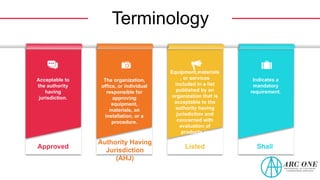
Terminology
Acceptable to
the authority
having
jurisdiction.
Approved
The organization,
office, or individual
responsible for
approving
equipment,
materials, an
installation, or a
procedure.
Authority Having
Jurisdiction
(AHJ)
Equipment,materials
, or services
included in a list
published by an
organization that is
acceptable to the
authority having
jurisdiction and
concerned with
evaluation of
products or
services.
Listed
Indicates a
mandatory
requirement.
Shall
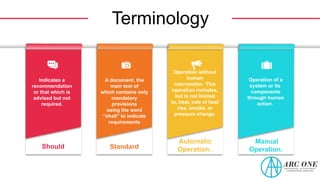
Terminology
Indicates a
recommendation
or that which is
advised but not
required.
Should
A document, the
main text of
which contains only
mandatory
provisions
using the word
“shall” to indicate
requirements
Standard
Operation without
human
intervention. This
operation includes,
but is not limited
to, heat, rate of heat
rise, smoke, or
pressure change.
Automatic
Operation.
Operation of a
system or its
components
through human
action.
Manual
Operation.
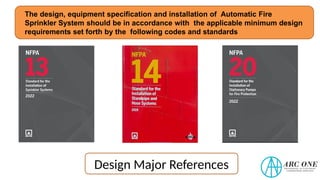
The design, equipment specification and installation of Automatic Fire
Sprinkler System should be in accordance with the applicable minimum design
requirements set forth by the following codes and standards
Design Major References
The design, equipment specification and installation of Automatic Fire
Sprinkler System should be in accordance with the applicable minimum design
requirements set forth by the following codes and standards
Design Major References
The design, equipment specification and installation of Automatic Fire
Sprinkler System should be in accordance with the applicable minimum design
requirements set forth by the following codes and standards
Design Major References
Types of Hazards
Light hazard occupancies shall be defined as occupancies or portions of other occupancies where the quantity
and/or combustibility of contents is low and fires with relatively low rates of heat release are expected.
Light hazard occupancies include occupancies having uses and conditions similar to the following:
1. Animal shelters
2. Churches
3. Prisons
4. Clubs
5. Eaves and overhangs
6. Educational
7. Museums
8. Residential
9. Restaurant seating areas
10. Theaters and auditoriums, excluding stages and prosceniums
Light Hazard
Light Hazard
Ordinary Hazard under Group 1 occupancies shall be defined as occupancies or portions of other
occupancies where combustibility is low, quantity of combustibles is moderate, stockpiles of combustibles
do not exceed 8 ft (2.4m), and fires with moderate rates of heat release are expected.
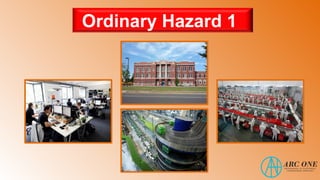
Ordinary hazard (Group 1) occupancies include occupancies having uses
and conditions similar to the following:
1. Hospitals and Hotels
2. Libraries (excluding book stores)
3. Restaurants
4. Schools and Offices
5. Data processing center (computer room excluding tape storage)
6. Laboratories (physical)
7. Laundries
8. Car parks
9. Leather good factories
10. Meat factories, Dairy products manufacturing and processing
11. Bakeries and Canneries
12. Biscuit and chocolate factories
13. Beverage manufacturing
14. Sheet metal product factories
15. Cement works
Ordinary Hazard Group 1
Ordinary Hazard 1
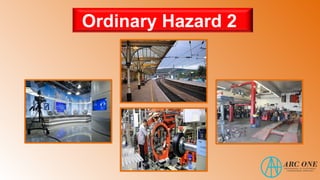
Ordinary Hazard under Group 2 occupancies shall be defined as occupancies or portions of other occupancies
where the quantity and combustibility of contents are moderate to high, stockpiles do not exceed 12 ft (3.7 m),
and fires with moderate to high rates of heat release are expected.
Ordinary hazard (Group 2) occupancies include occupancies having uses and
conditions similar to the following:
1. Broadcasting and TV studios
2. Railway stations
3. Exhibition halls
4. Clothing factories, Weaving mills and Textile manufacturing
5. Furniture showrooms and upholstery shops with no plastic foams
6. Archives, Storage rooms, File rooms
7. Department stores and Shopping center
8. Corn mills, Dehydrated vegetable factory and Sugar factory
9. Glass factory, Tobacco products manufacturing
10. Radio equipment factory
11. Refrigerator and washing machine factory
12. Machine shops, Metal working, Wood products assembly
13. Paper and pulp mills, Plastic fabrication
14. Post offices, Printing and publishing
15. Automotive repair shops
16. Tire manufacturing
Ordinary Hazard Group 2
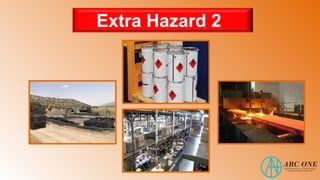
Ordinary Hazard 2
Extra Hazard Group 1
Extra Hazard under Group 1 occupancies shall be defined as occupancies or portions of other occupancies
where the quantity and combustibility of contents are very high and dust, lint, or other materials are present,
introducing the probability of rapidly developing fires with high rates of heat release but with little or no
combustible or flammable liquids.
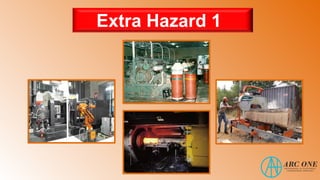
Extra hazard (Group 1) occupancies include occupancies having uses and
conditions similar to the following:
1. Aircraft hangars (except as governed by NFPA 409)
2. Combustible hydraulic fluid use areas
3. Die casting
4. Metal extruding
5. Plywood and particleboard manufacturing
6. Printing using inks having flash points below 100°F (38°C)
7. Rubber reclaiming, compounding, drying, milling, vulcanizing
8. Saw mills
9. Textile picking, opening, blending, combining of cotton, synthetics, wool shoddy, or burlap
10. Upholstering with plastic foams
Extra Hazard 1
Extra Hazard Group 2
Extra Hazard under Group 2 occupancies shall be defined as occupancies or portions of other occupancies
with moderate to substantial amounts of flammable or combustible liquids or occupancies where shielding of
combustibles is extensive.
Extra hazard (Group 2) occupancies include occupancies having uses and conditions similar to the following:
1. Asphalt saturating
2. Flammable liquids spraying
3. Manufactured home or modular building assemblies (where finished enclosure is present and has
combustible interiors)
4. Open oil quenching
5. Plastics manufacturing
6. Solvent cleaning
7. Varnish and paint dipping
Extra Hazard 2
2. Design
Approaches
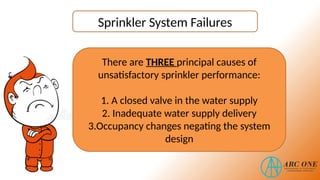
Sprinkler System Failures
There are THREE principal causes of
unsatisfactory sprinkler performance:
1. A closed valve in the water supply
2. Inadequate water supply delivery
3.Occupancy changes negating the system
design
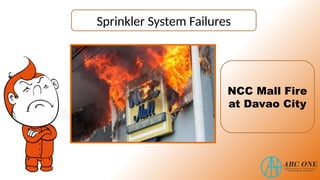
Sprinkler System Failures
NCC Mall Fire
at Davao City
Sprinkler System Failures
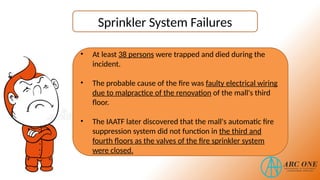
• At least 38 persons were trapped and died during the
incident.
• The probable cause of the fire was faulty electrical wiring
due to malpractice of the renovation of the mall's third
floor.
• The IAATF later discovered that the mall's automatic fire
suppression system did not function in the third and
fourth floors as the valves of the fire sprinkler system
were closed.
How do we avoid these
problems?
 Pre- planning
 Accurate design
 Proper identification of hazards
 Proper maintenance
 Proper testing
Solutions
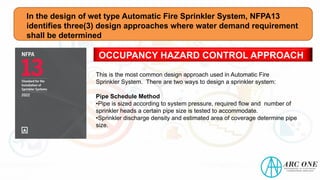
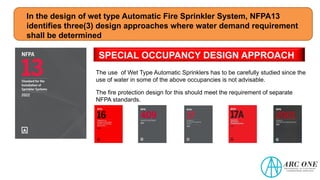
In the design of wet type Automatic Fire Sprinkler System, NFPA13
identifies three(3) design approaches where water demand requirement
shall be determined
OCCUPANCY HAZARD CONTROL APPROACH
This is the most common design approach used in Automatic Fire
Sprinkler System. There are two ways to design a sprinkler system:
Pipe Schedule Method
•Pipe is sized according to system pressure, required flow and number of
sprinkler heads a certain pipe size is tested to accommodate.
•Sprinkler discharge density and estimated area of coverage determine pipe
size.
In the design of wet type Automatic Fire Sprinkler System, NFPA13
identifies three(3) design approaches where water demand requirement
shall be determined
OCCUPANCY HAZARD CONTROL APPROACH
This is the most common design approach used in Automatic Fire
Sprinkler System. There are two ways to design a sprinkler system:
Hydraulic Calculation Method
•An engineered approach to match the fire hazard with the calculated potential
water supply pressure and volume required
•The design is primarily based on density/area curve and it is commonly use in
light and ordinary hazards occupancies
•The minimum duration of water supply should last by at least 60-90 minutes
PIPE SCHEDULE METHOD
OR HYDRAULIC
CALCULATION METHOD?
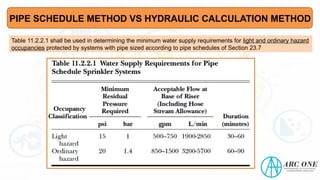
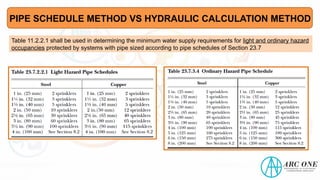
PIPE SCHEDULE METHOD VS HYDRAULIC CALCULATION METHOD
Pipe schedule method –uses tables that
indicate that steel pipe of certain size will
supply a certain number of heads.
In pipe schedules, only a limited number of
sprinklers may be supplied by a given pipe
size.
In a hydraulically calculated system, there is no limit to the
number of sprinklers that can be supplied by any size pipe,
the size is solely dictated by the rate of flow.
However, the total square footage covered by a single fire
riser is restricted, normally to 52,000 ft2, except 40,000 ft2in
storage occupancies. The calculations simply must prove that
the pipe size and configuration will be adequate to deliver the
required densities from the available water supply.
Therefore, pipe is sized to deliver the required flow and
pressure each head in the area of operation and size the pipe
back to the system water supply in order to deliver the
demand for the area of operation.
PIPE SCHEDULE METHOD VS HYDRAULIC CALCULATION METHOD
Table 11.2.2.1 shall be used in determining the minimum water supply requirements for light and ordinary hazard
occupancies protected by systems with pipe sized according to pipe schedules of Section 23.7
PIPE SCHEDULE METHOD VS HYDRAULIC CALCULATION METHOD
Table 11.2.2.1 shall be used in determining the minimum water supply requirements for light and ordinary hazard
occupancies protected by systems with pipe sized according to pipe schedules of Section 23.7
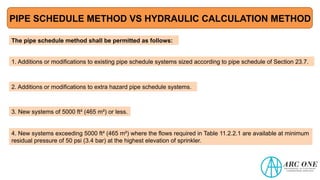
PIPE SCHEDULE METHOD VS HYDRAULIC CALCULATION METHOD
The pipe schedule method shall be permitted as follows:
1. Additions or modifications to existing pipe schedule systems sized according to pipe schedule of Section 23.7.
2. Additions or modifications to extra hazard pipe schedule systems.
3. New systems of 5000 ft² (465 m²) or less.
4. New systems exceeding 5000 ft² (465 m²) where the flows required in Table 11.2.2.1 are available at minimum
residual pressure of 50 psi (3.4 bar) at the highest elevation of sprinkler.
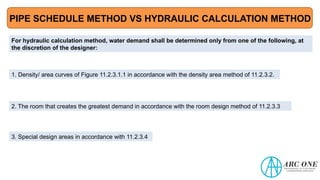
PIPE SCHEDULE METHOD VS HYDRAULIC CALCULATION METHOD
For hydraulic calculation method, water demand shall be determined only from one of the following, at
the discretion of the designer:
1. Density/ area curves of Figure 11.2.3.1.1 in accordance with the density area method of 11.2.3.2.
2. The room that creates the greatest demand in accordance with the room design method of 11.2.3.3
3. Special design areas in accordance with 11.2.3.4
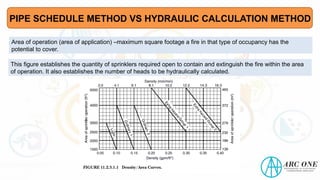
Area of operation (area of application) –maximum square footage a fire in that type of occupancy has the
potential to cover.
This figure establishes the quantity of sprinklers required open to contain and extinguish the fire within the area
of operation. It also establishes the number of heads to be hydraulically calculated.
PIPE SCHEDULE METHOD VS HYDRAULIC CALCULATION METHOD
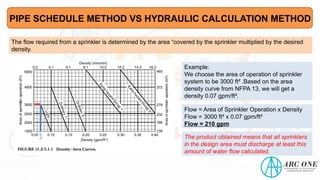
The flow required from a sprinkler is determined by the area “covered by the sprinkler multiplied by the desired
density.
0.07
Example:
We choose the area of operation of sprinkler
system to be 3000 ft² .Based on the area
density curve from NFPA 13, we will get a
density 0.07 gpm/ft².
Flow = Area of Sprinkler Operation x Density
Flow = 3000 ft² x 0.07 gpm/ft²
Flow = 210 gpm
The product obtained means that all sprinklers
in the design area must discharge at least this
amount of water flow calculated.
PIPE SCHEDULE METHOD VS HYDRAULIC CALCULATION METHOD
In the design of wet type Automatic Fire Sprinkler System, NFPA13
identifies three(3) design approaches where water demand requirement
shall be determined
STORAGE DESIGN APPROACH
NFPA 13 Chapter 12 defines that Storage Design Approach shall only be apply
to meet the requirements of Storage arrangements and commodities.
This design approach shall be applied for the protection of the following:
a.Plastic commodities
b.Commodities that are stored in Wooden or Plastic Pallets, Solid Piled, Bin
Boxes, Shelf and Multiple Racks storage
c.Plastic, Rubber Tires and Rolled Paper and related hazard commodities (Class
1 to Class 4 commodities)
In the design of wet type Automatic Fire Sprinkler System, NFPA13
identifies three(3) design approaches where water demand requirement
shall be determined
STORAGE DESIGN APPROACH
NFPA 13 mandatory requirements:
a.This design approach requires the use of Early Suppression Fast-Response
(ESFR) and Large Drop Sprinklers.
b.Aside from Automatic Sprinklers, NFPA 13 requires the installation of Automatic
Medium and High-Expansion Foam System in accordance with NFPA 11A.
c.In the Density/Area Curve, storage design should start with Ordinary Hazard 2
curve.
d.The minimum duration of water supply should last by at least 120-180 minutes.
In the design of wet type Automatic Fire Sprinkler System, NFPA13
identifies three(3) design approaches where water demand requirement
shall be determined
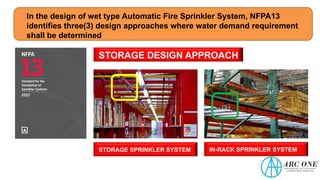
STORAGE DESIGN APPROACH
STORAGE SPRINKLER SYSTEM IN-RACK SPRINKLER SYSTEM
In the design of wet type Automatic Fire Sprinkler System, NFPA13
identifies three(3) design approaches where water demand requirement
shall be determined
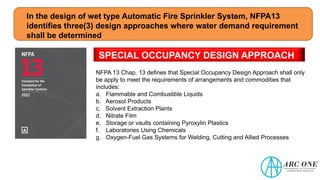
SPECIAL OCCUPANCY DESIGN APPROACH
NFPA 13 Chap. 13 defines that Special Occupancy Design Approach shall only
be apply to meet the requirements of arrangements and commodities that
includes:
a. Flammable and Combustible Liquids
b. Aerosol Products
c. Solvent Extraction Plants
d. Nitrate Film
e. Storage or vaults containing Pyroxylin Plastics
f. Laboratories Using Chemicals
g. Oxygen-Fuel Gas Systems for Welding, Cutting and Allied Processes
In the design of wet type Automatic Fire Sprinkler System, NFPA13
identifies three(3) design approaches where water demand requirement
shall be determined
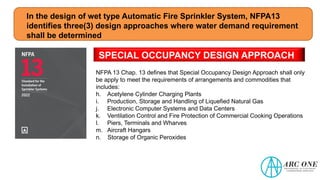
SPECIAL OCCUPANCY DESIGN APPROACH
NFPA 13 Chap. 13 defines that Special Occupancy Design Approach shall only
be apply to meet the requirements of arrangements and commodities that
includes:
h. Acetylene Cylinder Charging Plants
i. Production, Storage and Handling of Liquefied Natural Gas
j. Electronic Computer Systems and Data Centers
k. Ventilation Control and Fire Protection of Commercial Cooking Operations
l. Piers, Terminals and Wharves
m. Aircraft Hangars
n. Storage of Organic Peroxides
In the design of wet type Automatic Fire Sprinkler System, NFPA13
identifies three(3) design approaches where water demand requirement
shall be determined
SPECIAL OCCUPANCY DESIGN APPROACH
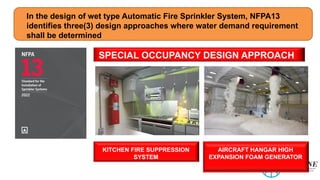
KITCHEN FIRE SUPPRESSION
SYSTEM
AIRCRAFT HANGAR HIGH
EXPANSION FOAM GENERATOR
In the design of wet type Automatic Fire Sprinkler System, NFPA13
identifies three(3) design approaches where water demand requirement
shall be determined
SPECIAL OCCUPANCY DESIGN APPROACH
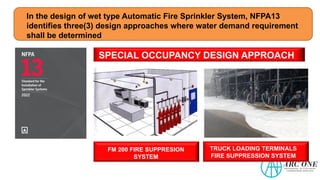
FM 200 FIRE SUPPRESION
SYSTEM
TRUCK LOADING TERMINALS
FIRE SUPPRESSION SYSTEM
In the design of wet type Automatic Fire Sprinkler System, NFPA13
identifies three(3) design approaches where water demand requirement
shall be determined
SPECIAL OCCUPANCY DESIGN APPROACH
The use of Wet Type Automatic Sprinklers has to be carefully studied since the
use of water in some of the above occupancies is not advisable.
The fire protection design for this should meet the requirement of separate
NFPA standards.
3. Hydraulic
Calculation
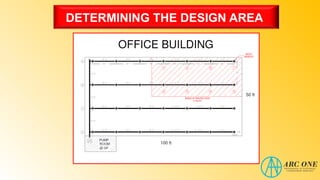
DETERMINING THE DESIGN AREA
UNDERESTIMATING THE HAZARD
POSES A HIGH RISK OF
FIRE TO OVERPOWER THE FIRE
SPRINKLERS – THIS WILL RESULT TO
LOSS OF PROPERTY OR LIFE
DETERMINING THE DESIGN AREA
Once the sprinkler spacing and piping layout has been proposed in conformance with the requirements of
NFPA 13, the design engineer should:
a. Demonstrate that the delivery of the prescribed rate of water application will be accomplished for the
sprinklers in the design area that might be reasonably expected to operate.
b. Demonstrate that the shape of the design area and location of the sprinklers, regardless of the location
of the fire within the building, will be adequately supplied with water in the event of fire.
c. The DESIGN AREA SHOULD BE THE MOST CHALLENGING AND FARTHEST LOCATION
of sprinkler in order to ensure that enough water is supplied if it opens in the event of fire.
OCCUPANCY HAZARD CLASSIFICATION is one the most critical steps in the design of
Automatic Fire Sprinkler System.
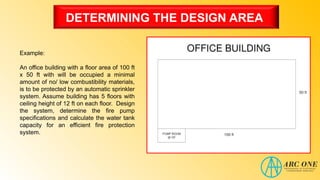
DETERMINING THE DESIGN AREA
Example:
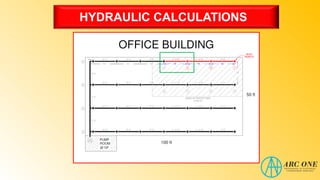
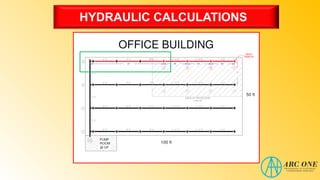
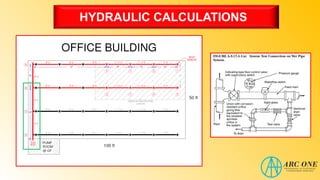
An office building with a floor area of 100 ft
x 50 ft with will be occupied a minimal
amount of no/ low combustibility materials,
is to be protected by an automatic sprinkler
system. Assume building has 5 floors with
ceiling height of 12 ft on each floor. Design
the system, determine the fire pump
specifications and calculate the water tank
capacity for an efficient fire protection
system.
DETERMINING THE DESIGN AREA
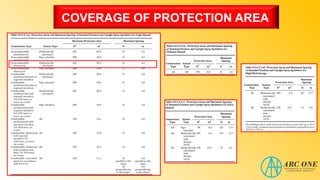
As per NFPA 13 Section 8.6.3
The maximum distance from
sprinkler to a wall shall not exceed
one-half of the allowable distance
between sprinklers as indicated in
Table 8.6.2.2 (a) through Table
8.6.2.2 (d). The distance from the
wall to the sprinkler shall be
measured perpendicular to the wall.
Sprinklers shall be located a
minimum of 4 inches from a wall.
COVERAGE OF PROTECTION AREA
USING THE DENSITY/ AREA CURVE
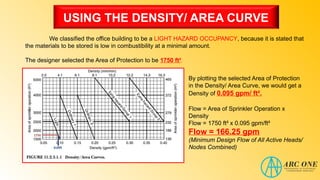
We classified the office building to be a LIGHT HAZARD OCCUPANCY, because it is stated that
the materials to be stored is low in combustibility at a minimal amount.
The designer selected the Area of Protection to be 1750 ft².
0.095
1750
By plotting the selected Area of Protection
in the Density/ Area Curve, we would get a
Density of 0.095 gpm/ ft².
Flow = Area of Sprinkler Operation x
Density
Flow = 1750 ft² x 0.095 gpm/ft²
Flow = 166.25 gpm
(Minimum Design Flow of All Active Heads/
Nodes Combined)
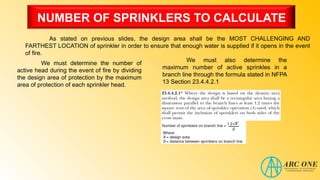
NUMBER OF SPRINKLERS TO CALCULATE
As stated on previous slides, the design area shall be the MOST CHALLENGING AND
FARTHEST LOCATION of sprinkler in order to ensure that enough water is supplied if it opens in the event
of fire.
We must determine the number of
active head during the event of fire by dividing
the design area of protection by the maximum
area of protection of each sprinkler head.
We must also determine the
maximum number of active sprinkles in a
branch line through the formula stated in NFPA
13 Section 23.4.4.2.1
DETERMINING THE DESIGN AREA
HYDRAULIC CALCULATIONS
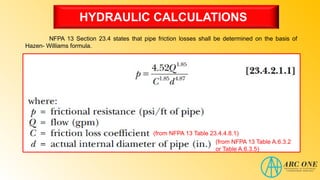
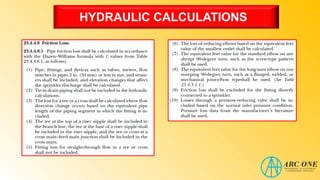
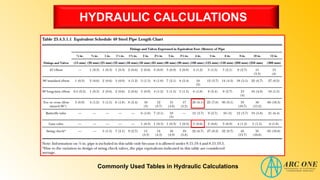
NFPA 13 Section 23.4 states that pipe friction losses shall be determined on the basis of
Hazen- Williams formula.
(from NFPA 13 Table A.6.3.2
or Table A.6.3.5)
(from NFPA 13 Table 23.4.4.8.1)
HYDRAULIC CALCULATIONS
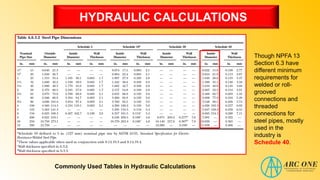
Though NPFA 13
Section 6.3 have
different minimum
requirements for
welded or roll-
grooved
connections and
threaded
connections for
steel pipes, mostly
used in the
industry is
Schedule 40.
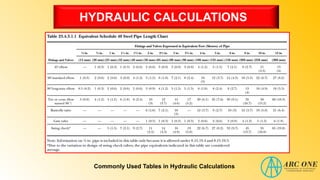
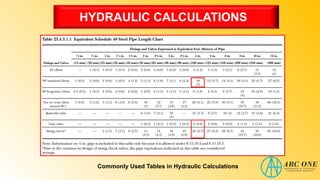
Commonly Used Tables in Hydraulic Calculations
HYDRAULIC CALCULATIONS
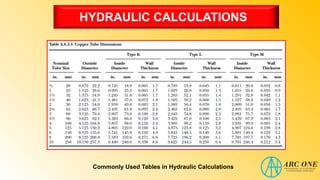
Commonly Used Tables in Hydraulic Calculations
HYDRAULIC CALCULATIONS
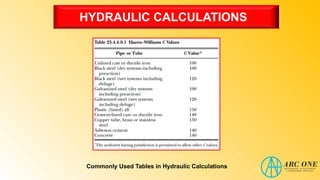
Commonly Used Tables in Hydraulic Calculations
HYDRAULIC CALCULATIONS
Commonly Used Tables in Hydraulic Calculations
HYDRAULIC CALCULATIONS
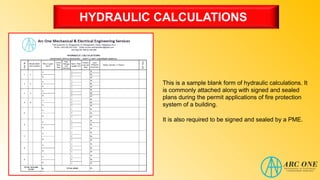
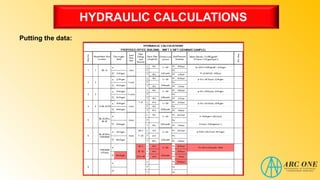
This is a sample blank form of hydraulic calculations. It
is commonly attached along with signed and sealed
plans during the permit applications of fire protection
system of a building.
It is also required to be signed and sealed by a PME.
HYDRAULIC CALCULATIONS
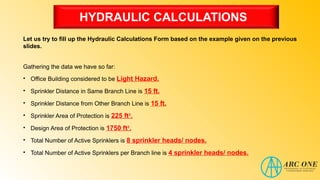
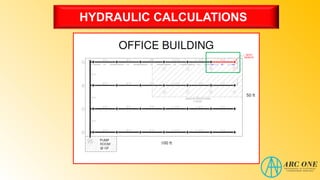
Let us try to fill up the Hydraulic Calculations Form based on the example given on the previous
slides.
Gathering the data we have so far:
• Office Building considered to be Light Hazard.
• Sprinkler Distance in Same Branch Line is 15 ft.
• Sprinkler Distance from Other Branch Line is 15 ft.
• Sprinkler Area of Protection is 225 ft².
• Design Area of Protection is 1750 ft².
• Total Number of Active Sprinklers is 8 sprinkler heads/ nodes.
• Total Number of Active Sprinklers per Branch line is 4 sprinkler heads/ nodes.
HYDRAULIC CALCULATIONS
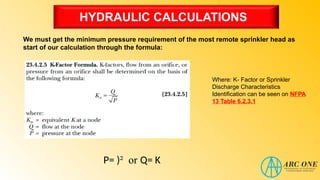
We must get the minimum pressure requirement of the most remote sprinkler head as
start of our calculation through the formula:
Where: K- Factor or Sprinkler
Discharge Characteristics
Identification can be seen on NFPA
13 Table 6.2.3.1
P= )² or Q= K
HYDRAULIC CALCULATIONS
Designer may select the K-Factor of Sprinkler to be used from
factor for different sprinkler heads may range from K = 5.6 (standard ½” orifice) to K =14.0 for ESFR
sprinklers. But there are things that must be kept in mind.
• An increase in the K- factor of a sprinkler yields a higher flow (gpm), but lower pressure. Conversely, a
decrease in the K- factor of a sprinkler yields a lower flow but higher pressure requirement.
• The pressure at the sprinkler head is critical for reasons other than the flow from the sprinkler.
• The pressure at the sprinkler head affects the head discharge droplet size and spray pattern which are
critical characteristics of the fire extinguishing performance of a sprinkler head
• As stated in NFPA 13 Section 23.4.4.11.1, the MINIMUM OPERATING PRESSURE of any sprinkler
shall be 7 psi (0.5 bar)
HYDRAULIC CALCULATIONS
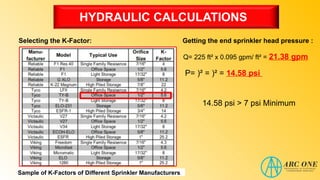
Selecting the K-Factor:
Sample of K-Factors of Different Sprinkler Manufacturers
Getting the end sprinkler head pressure :
P= )² = )² = 14.58 psi
Q= 225 ft² x 0.095 gpm/ ft² = 21.38 gpm
14.58 psi > 7 psi Minimum
HYDRAULIC CALCULATIONS
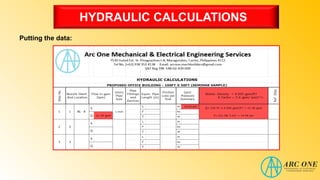
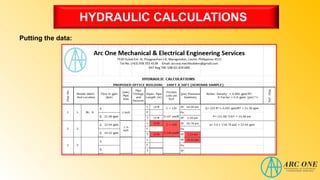
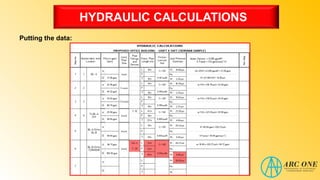
Putting the data:
HYDRAULIC CALCULATIONS
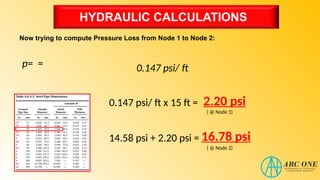
Now trying to compute Pressure Loss from Node 1 to Node 2:
p= = 0.147 psi/ ft
0.147 psi/ ft x 15 ft = 2.20 psi
14.58 psi + 2.20 psi = 16.78 psi
( @ Node 2)
( @ Node 1)
HYDRAULIC CALCULATIONS
Putting the data:
HYDRAULIC CALCULATIONS
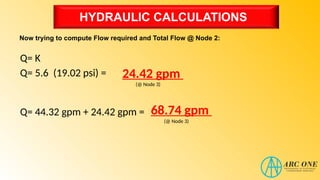
Now trying to compute Flow required and Total Flow @ Node 2:
(@ Node 2)
(@ Node 2)
Q= K
Q= 5.6 (16.78 psi) = 22.94 gpm
Q=21.38 gpm + 22.94 gpm = 44.32 gpm
HYDRAULIC CALCULATIONS
Putting the data:
HYDRAULIC CALCULATIONS
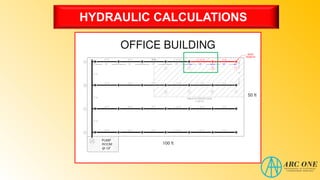
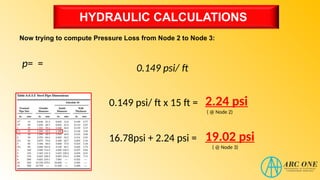
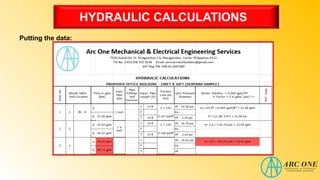
Now trying to compute Pressure Loss from Node 2 to Node 3:
p= = 0.149 psi/ ft
0.149 psi/ ft x 15 ft = 2.24 psi
16.78psi + 2.24 psi = 19.02 psi
( @ Node 3)
( @ Node 2)
HYDRAULIC CALCULATIONS
Putting the data:
HYDRAULIC CALCULATIONS
Now trying to compute Flow required and Total Flow @ Node 2:
(@ Node 3)
(@ Node 3)
Q= K
Q= 5.6 (19.02 psi) = 24.42 gpm
Q= 44.32 gpm + 24.42 gpm = 68.74 gpm
HYDRAULIC CALCULATIONS
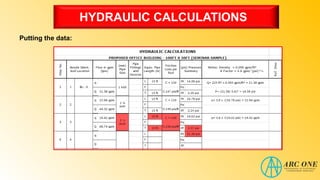
Putting the data:
HYDRAULIC CALCULATIONS
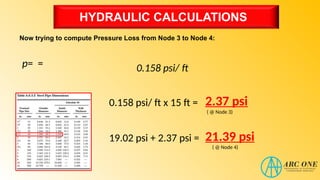
Now trying to compute Pressure Loss from Node 3 to Node 4:
p= = 0.158 psi/ ft
0.158 psi/ ft x 15 ft = 2.37 psi
19.02 psi + 2.37 psi = 21.39 psi
( @ Node 4)
( @ Node 3)
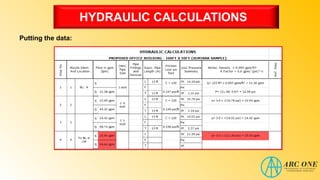
HYDRAULIC CALCULATIONS
Putting the data:
HYDRAULIC CALCULATIONS
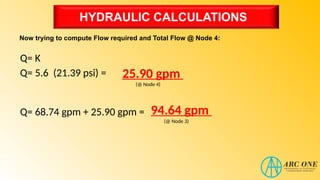
Now trying to compute Flow required and Total Flow @ Node 4:
(@ Node 3)
(@ Node 4)
Q= K
Q= 5.6 (21.39 psi) = 25.90 gpm
Q= 68.74 gpm + 25.90 gpm = 94.64 gpm
HYDRAULIC CALCULATIONS
Putting the data:
HYDRAULIC CALCULATIONS
Now trying to compute Pressure Loss from Node 4 to BL-A Cross Main:
p= = 0.085 psi/ ft
0.085 psi/ ft x (47 ft + 10 ft) = 4.84 psi
21.39 psi + 4.84 psi = 26.23 psi
( @ BL-A CM)
( @ Node 4)
HYDRAULIC CALCULATIONS
Putting the data:
HYDRAULIC CALCULATIONS
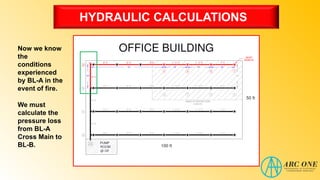
Now we know
the
conditions
experienced
by BL-A in the
event of fire.
We must
calculate the
pressure loss
from BL-A
Cross Main to
BL-B.
HYDRAULIC CALCULATIONS
Since we already know the conditions of BL-A, we must also get the conditions experienced by BL-B.
This K-Factor will be used also when
determining the flow of the 2nd
Branch line
or BL-B.
K- Factor =
18.48 gpm /
To get this, first, we must compute for the
K-Factor of BL-A with flow conditions of
94.64 gpm and pressure of 26.23 psi.
HYDRAULIC CALCULATIONS
Now we know the conditions experienced by BL-A in the event of fire.
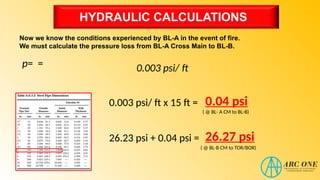
We must calculate the pressure loss from BL-A Cross Main to BL-B.
p= = 0.003 psi/ ft
0.003 psi/ ft x 15 ft = 0.04 psi
26.23 psi + 0.04 psi = 26.27 psi
( @ BL-B CM to TOR/BOR)
( @ BL- A CM to BL-B)
HYDRAULIC CALCULATIONS
Putting the data:
HYDRAULIC CALCULATIONS
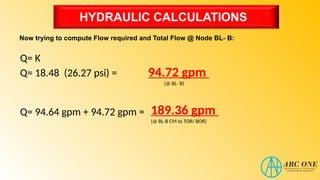
Now trying to compute Flow required and Total Flow @ Node BL- B:
(@ BL-B CM to TOR/ BOR)
(@ BL- B)
Q= K
Q= 18.48 (26.27 psi) = 94.72 gpm
Q= 94.64 gpm + 94.72 gpm = 189.36 gpm
HYDRAULIC CALCULATIONS
Putting the data:
HYDRAULIC CALCULATIONS
Commonly Used Tables in Hydraulic Calculations
HYDRAULIC CALCULATIONS
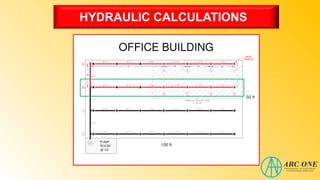
Knowing the total flow condition of the cross main. We can calculate the
pressure loss from BL-B Cross Main to the Top of Riser (TOR)
p= = 0.012 psi/ ft
0.012 psi/ ft x (33 ft + 22ft) = 0.66 psi
26.27 psi + 0.66 psi = 26.93 psi
( @ TOR/ BOR to Pump)
( @ BL- B CM to TOR/BOR)
HYDRAULIC CALCULATIONS
Putting the data:
HYDRAULIC CALCULATIONS
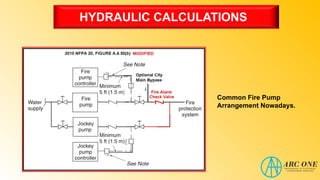
Common Fire Pump
Arrangement Nowadays.
HYDRAULIC CALCULATIONS
Commonly Used Tables in Hydraulic Calculations
HYDRAULIC CALCULATIONS
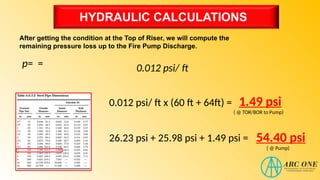
After getting the condition at the Top of Riser, we will compute the
remaining pressure loss up to the Fire Pump Discharge.
p= = 0.012 psi/ ft
0.012 psi/ ft x (60 ft + 64ft) = 1.49 psi
26.23 psi + 25.98 psi + 1.49 psi = 54.40 psi
( @ Pump)
( @ TOR/BOR to Pump)
HYDRAULIC CALCULATIONS
Putting the data:
HYDRAULIC CALCULATIONS
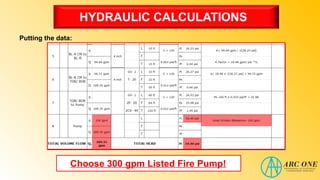
We already got the Flow and Pressure Requirements for the Sprinkler
System of the Building.
Since the common set up of Fire Protection System is a combined system
wherein the fire pump is supplying the demand requirement of both the sprinkler
systems and stand pipe / hose systems. We must add the Hose Stream
Allowance in the Pump Capacity.
HYDRAULIC CALCULATIONS
Putting the data:
Choose 300 gpm Listed Fire Pump!
HYDRAULIC CALCULATIONS
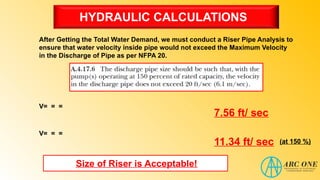
After Getting the Total Water Demand, we must conduct a Riser Pipe Analysis to
ensure that water velocity inside pipe would not exceed the Maximum Velocity
in the Discharge of Pipe as per NFPA 20.
V= = =
7.56 ft/ sec
V= = =
11.34 ft/ sec (at 150 %)
Size of Riser is Acceptable!
FIRE PUMP SELECTION
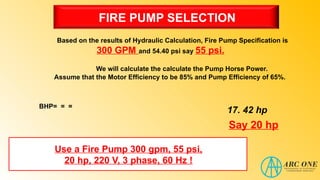
Based on the results of Hydraulic Calculation, Fire Pump Specification is
300 GPM and 54.40 psi say 55 psi.
BHP= = =
We will calculate the calculate the Pump Horse Power.
Assume that the Motor Efficiency to be 85% and Pump Efficiency of 65%.
17. 42 hp
Say 20 hp
Use a Fire Pump 300 gpm, 55 psi,
20 hp, 220 V, 3 phase, 60 Hz !
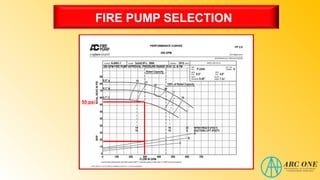
FIRE PUMP SELECTION
FIRE PUMP SELECTION
55 psi
SIZING THE FIRE TANK
After determining the specifications of Fire Pump, you must design a Tank sized
capable of holding enough water supply as per guidelines of NFPA 13.
300 gpm x 30 mins = 9000 gals
Tank Dimensions: 3mL x 4mW x 3mH
9510 Gallons
THANK YOU!

Fire-Protection-System-Introduction and Basic

  • 1.
    ARC ONE arcone.mechbuilders@gmail.com Fire Introduction &Basic Design of AFSS Protection System https://www.facebook.com/ArcOneEngineeringServices 0966-5388922 / 0938-3534138 Presented By: Mechanical & Electrical Engineering Services
  • 2.
    Training Rules Please beconsiderate, take control of your own noise. Sit in a quiet area Speak clearly, don’t be afraid to ask if people can hear you well. Raise your hand, questions are entertained anytime Feel free to contribute your experience
  • 3.
    Terminology and References Refresher 01 02 03 Training Course Topics Day2 Occupancy Hazard Fire Control Approach Storage Design Approach Special Occupancy Design Approach Design Approach Determining the Design Area Using the Density Area Curve Number of Sprinklers to Calculate Protection Area of Coverage Walkthrough of Hydraulic Calculations Fire Pump Selection Tank Sizing Hydraulic Calculation Types of Hazards or Occupancies and Commodities
  • 4.
  • 5.
    Terminology Acceptable to the authority having jurisdiction. Approved Theorganization, office, or individual responsible for approving equipment, materials, an installation, or a procedure. Authority Having Jurisdiction (AHJ) Equipment,materials , or services included in a list published by an organization that is acceptable to the authority having jurisdiction and concerned with evaluation of products or services. Listed Indicates a mandatory requirement. Shall
  • 6.
    Terminology Indicates a recommendation or thatwhich is advised but not required. Should A document, the main text of which contains only mandatory provisions using the word “shall” to indicate requirements Standard Operation without human intervention. This operation includes, but is not limited to, heat, rate of heat rise, smoke, or pressure change. Automatic Operation. Operation of a system or its components through human action. Manual Operation.
  • 7.
    The design, equipmentspecification and installation of Automatic Fire Sprinkler System should be in accordance with the applicable minimum design requirements set forth by the following codes and standards Design Major References
  • 8.
    The design, equipmentspecification and installation of Automatic Fire Sprinkler System should be in accordance with the applicable minimum design requirements set forth by the following codes and standards Design Major References
  • 9.
    The design, equipmentspecification and installation of Automatic Fire Sprinkler System should be in accordance with the applicable minimum design requirements set forth by the following codes and standards Design Major References
  • 10.
    Types of Hazards Lighthazard occupancies shall be defined as occupancies or portions of other occupancies where the quantity and/or combustibility of contents is low and fires with relatively low rates of heat release are expected. Light hazard occupancies include occupancies having uses and conditions similar to the following: 1. Animal shelters 2. Churches 3. Prisons 4. Clubs 5. Eaves and overhangs 6. Educational 7. Museums 8. Residential 9. Restaurant seating areas 10. Theaters and auditoriums, excluding stages and prosceniums Light Hazard
  • 11.
  • 12.
    Ordinary Hazard underGroup 1 occupancies shall be defined as occupancies or portions of other occupancies where combustibility is low, quantity of combustibles is moderate, stockpiles of combustibles do not exceed 8 ft (2.4m), and fires with moderate rates of heat release are expected. Ordinary hazard (Group 1) occupancies include occupancies having uses and conditions similar to the following: 1. Hospitals and Hotels 2. Libraries (excluding book stores) 3. Restaurants 4. Schools and Offices 5. Data processing center (computer room excluding tape storage) 6. Laboratories (physical) 7. Laundries 8. Car parks 9. Leather good factories 10. Meat factories, Dairy products manufacturing and processing 11. Bakeries and Canneries 12. Biscuit and chocolate factories 13. Beverage manufacturing 14. Sheet metal product factories 15. Cement works Ordinary Hazard Group 1
  • 13.
  • 14.
    Ordinary Hazard underGroup 2 occupancies shall be defined as occupancies or portions of other occupancies where the quantity and combustibility of contents are moderate to high, stockpiles do not exceed 12 ft (3.7 m), and fires with moderate to high rates of heat release are expected. Ordinary hazard (Group 2) occupancies include occupancies having uses and conditions similar to the following: 1. Broadcasting and TV studios 2. Railway stations 3. Exhibition halls 4. Clothing factories, Weaving mills and Textile manufacturing 5. Furniture showrooms and upholstery shops with no plastic foams 6. Archives, Storage rooms, File rooms 7. Department stores and Shopping center 8. Corn mills, Dehydrated vegetable factory and Sugar factory 9. Glass factory, Tobacco products manufacturing 10. Radio equipment factory 11. Refrigerator and washing machine factory 12. Machine shops, Metal working, Wood products assembly 13. Paper and pulp mills, Plastic fabrication 14. Post offices, Printing and publishing 15. Automotive repair shops 16. Tire manufacturing Ordinary Hazard Group 2
  • 15.
  • 16.
    Extra Hazard Group1 Extra Hazard under Group 1 occupancies shall be defined as occupancies or portions of other occupancies where the quantity and combustibility of contents are very high and dust, lint, or other materials are present, introducing the probability of rapidly developing fires with high rates of heat release but with little or no combustible or flammable liquids. Extra hazard (Group 1) occupancies include occupancies having uses and conditions similar to the following: 1. Aircraft hangars (except as governed by NFPA 409) 2. Combustible hydraulic fluid use areas 3. Die casting 4. Metal extruding 5. Plywood and particleboard manufacturing 6. Printing using inks having flash points below 100°F (38°C) 7. Rubber reclaiming, compounding, drying, milling, vulcanizing 8. Saw mills 9. Textile picking, opening, blending, combining of cotton, synthetics, wool shoddy, or burlap 10. Upholstering with plastic foams
  • 17.
  • 18.
    Extra Hazard Group2 Extra Hazard under Group 2 occupancies shall be defined as occupancies or portions of other occupancies with moderate to substantial amounts of flammable or combustible liquids or occupancies where shielding of combustibles is extensive. Extra hazard (Group 2) occupancies include occupancies having uses and conditions similar to the following: 1. Asphalt saturating 2. Flammable liquids spraying 3. Manufactured home or modular building assemblies (where finished enclosure is present and has combustible interiors) 4. Open oil quenching 5. Plastics manufacturing 6. Solvent cleaning 7. Varnish and paint dipping
  • 19.
  • 20.
  • 21.
    Sprinkler System Failures Thereare THREE principal causes of unsatisfactory sprinkler performance: 1. A closed valve in the water supply 2. Inadequate water supply delivery 3.Occupancy changes negating the system design
  • 22.
    Sprinkler System Failures NCCMall Fire at Davao City
  • 23.
    Sprinkler System Failures •At least 38 persons were trapped and died during the incident. • The probable cause of the fire was faulty electrical wiring due to malpractice of the renovation of the mall's third floor. • The IAATF later discovered that the mall's automatic fire suppression system did not function in the third and fourth floors as the valves of the fire sprinkler system were closed.
  • 24.
    How do weavoid these problems?
  • 25.
     Pre- planning Accurate design  Proper identification of hazards  Proper maintenance  Proper testing Solutions
  • 26.
    In the designof wet type Automatic Fire Sprinkler System, NFPA13 identifies three(3) design approaches where water demand requirement shall be determined OCCUPANCY HAZARD CONTROL APPROACH This is the most common design approach used in Automatic Fire Sprinkler System. There are two ways to design a sprinkler system: Pipe Schedule Method •Pipe is sized according to system pressure, required flow and number of sprinkler heads a certain pipe size is tested to accommodate. •Sprinkler discharge density and estimated area of coverage determine pipe size.
  • 27.
    In the designof wet type Automatic Fire Sprinkler System, NFPA13 identifies three(3) design approaches where water demand requirement shall be determined OCCUPANCY HAZARD CONTROL APPROACH This is the most common design approach used in Automatic Fire Sprinkler System. There are two ways to design a sprinkler system: Hydraulic Calculation Method •An engineered approach to match the fire hazard with the calculated potential water supply pressure and volume required •The design is primarily based on density/area curve and it is commonly use in light and ordinary hazards occupancies •The minimum duration of water supply should last by at least 60-90 minutes
  • 28.
    PIPE SCHEDULE METHOD ORHYDRAULIC CALCULATION METHOD?
  • 29.
    PIPE SCHEDULE METHODVS HYDRAULIC CALCULATION METHOD Pipe schedule method –uses tables that indicate that steel pipe of certain size will supply a certain number of heads. In pipe schedules, only a limited number of sprinklers may be supplied by a given pipe size. In a hydraulically calculated system, there is no limit to the number of sprinklers that can be supplied by any size pipe, the size is solely dictated by the rate of flow. However, the total square footage covered by a single fire riser is restricted, normally to 52,000 ft2, except 40,000 ft2in storage occupancies. The calculations simply must prove that the pipe size and configuration will be adequate to deliver the required densities from the available water supply. Therefore, pipe is sized to deliver the required flow and pressure each head in the area of operation and size the pipe back to the system water supply in order to deliver the demand for the area of operation.
  • 30.
    PIPE SCHEDULE METHODVS HYDRAULIC CALCULATION METHOD Table 11.2.2.1 shall be used in determining the minimum water supply requirements for light and ordinary hazard occupancies protected by systems with pipe sized according to pipe schedules of Section 23.7
  • 31.
    PIPE SCHEDULE METHODVS HYDRAULIC CALCULATION METHOD Table 11.2.2.1 shall be used in determining the minimum water supply requirements for light and ordinary hazard occupancies protected by systems with pipe sized according to pipe schedules of Section 23.7
  • 32.
    PIPE SCHEDULE METHODVS HYDRAULIC CALCULATION METHOD The pipe schedule method shall be permitted as follows: 1. Additions or modifications to existing pipe schedule systems sized according to pipe schedule of Section 23.7. 2. Additions or modifications to extra hazard pipe schedule systems. 3. New systems of 5000 ft² (465 m²) or less. 4. New systems exceeding 5000 ft² (465 m²) where the flows required in Table 11.2.2.1 are available at minimum residual pressure of 50 psi (3.4 bar) at the highest elevation of sprinkler.
  • 33.
    PIPE SCHEDULE METHODVS HYDRAULIC CALCULATION METHOD For hydraulic calculation method, water demand shall be determined only from one of the following, at the discretion of the designer: 1. Density/ area curves of Figure 11.2.3.1.1 in accordance with the density area method of 11.2.3.2. 2. The room that creates the greatest demand in accordance with the room design method of 11.2.3.3 3. Special design areas in accordance with 11.2.3.4
  • 34.
    Area of operation(area of application) –maximum square footage a fire in that type of occupancy has the potential to cover. This figure establishes the quantity of sprinklers required open to contain and extinguish the fire within the area of operation. It also establishes the number of heads to be hydraulically calculated. PIPE SCHEDULE METHOD VS HYDRAULIC CALCULATION METHOD
  • 35.
    The flow requiredfrom a sprinkler is determined by the area “covered by the sprinkler multiplied by the desired density. 0.07 Example: We choose the area of operation of sprinkler system to be 3000 ft² .Based on the area density curve from NFPA 13, we will get a density 0.07 gpm/ft². Flow = Area of Sprinkler Operation x Density Flow = 3000 ft² x 0.07 gpm/ft² Flow = 210 gpm The product obtained means that all sprinklers in the design area must discharge at least this amount of water flow calculated. PIPE SCHEDULE METHOD VS HYDRAULIC CALCULATION METHOD
  • 36.
    In the designof wet type Automatic Fire Sprinkler System, NFPA13 identifies three(3) design approaches where water demand requirement shall be determined STORAGE DESIGN APPROACH NFPA 13 Chapter 12 defines that Storage Design Approach shall only be apply to meet the requirements of Storage arrangements and commodities. This design approach shall be applied for the protection of the following: a.Plastic commodities b.Commodities that are stored in Wooden or Plastic Pallets, Solid Piled, Bin Boxes, Shelf and Multiple Racks storage c.Plastic, Rubber Tires and Rolled Paper and related hazard commodities (Class 1 to Class 4 commodities)
  • 37.
    In the designof wet type Automatic Fire Sprinkler System, NFPA13 identifies three(3) design approaches where water demand requirement shall be determined STORAGE DESIGN APPROACH NFPA 13 mandatory requirements: a.This design approach requires the use of Early Suppression Fast-Response (ESFR) and Large Drop Sprinklers. b.Aside from Automatic Sprinklers, NFPA 13 requires the installation of Automatic Medium and High-Expansion Foam System in accordance with NFPA 11A. c.In the Density/Area Curve, storage design should start with Ordinary Hazard 2 curve. d.The minimum duration of water supply should last by at least 120-180 minutes.
  • 38.
    In the designof wet type Automatic Fire Sprinkler System, NFPA13 identifies three(3) design approaches where water demand requirement shall be determined STORAGE DESIGN APPROACH STORAGE SPRINKLER SYSTEM IN-RACK SPRINKLER SYSTEM
  • 39.
    In the designof wet type Automatic Fire Sprinkler System, NFPA13 identifies three(3) design approaches where water demand requirement shall be determined SPECIAL OCCUPANCY DESIGN APPROACH NFPA 13 Chap. 13 defines that Special Occupancy Design Approach shall only be apply to meet the requirements of arrangements and commodities that includes: a. Flammable and Combustible Liquids b. Aerosol Products c. Solvent Extraction Plants d. Nitrate Film e. Storage or vaults containing Pyroxylin Plastics f. Laboratories Using Chemicals g. Oxygen-Fuel Gas Systems for Welding, Cutting and Allied Processes
  • 40.
    In the designof wet type Automatic Fire Sprinkler System, NFPA13 identifies three(3) design approaches where water demand requirement shall be determined SPECIAL OCCUPANCY DESIGN APPROACH NFPA 13 Chap. 13 defines that Special Occupancy Design Approach shall only be apply to meet the requirements of arrangements and commodities that includes: h. Acetylene Cylinder Charging Plants i. Production, Storage and Handling of Liquefied Natural Gas j. Electronic Computer Systems and Data Centers k. Ventilation Control and Fire Protection of Commercial Cooking Operations l. Piers, Terminals and Wharves m. Aircraft Hangars n. Storage of Organic Peroxides
  • 41.
    In the designof wet type Automatic Fire Sprinkler System, NFPA13 identifies three(3) design approaches where water demand requirement shall be determined SPECIAL OCCUPANCY DESIGN APPROACH KITCHEN FIRE SUPPRESSION SYSTEM AIRCRAFT HANGAR HIGH EXPANSION FOAM GENERATOR
  • 42.
    In the designof wet type Automatic Fire Sprinkler System, NFPA13 identifies three(3) design approaches where water demand requirement shall be determined SPECIAL OCCUPANCY DESIGN APPROACH FM 200 FIRE SUPPRESION SYSTEM TRUCK LOADING TERMINALS FIRE SUPPRESSION SYSTEM
  • 43.
    In the designof wet type Automatic Fire Sprinkler System, NFPA13 identifies three(3) design approaches where water demand requirement shall be determined SPECIAL OCCUPANCY DESIGN APPROACH The use of Wet Type Automatic Sprinklers has to be carefully studied since the use of water in some of the above occupancies is not advisable. The fire protection design for this should meet the requirement of separate NFPA standards.
  • 44.
  • 45.
    DETERMINING THE DESIGNAREA UNDERESTIMATING THE HAZARD POSES A HIGH RISK OF FIRE TO OVERPOWER THE FIRE SPRINKLERS – THIS WILL RESULT TO LOSS OF PROPERTY OR LIFE
  • 46.
    DETERMINING THE DESIGNAREA Once the sprinkler spacing and piping layout has been proposed in conformance with the requirements of NFPA 13, the design engineer should: a. Demonstrate that the delivery of the prescribed rate of water application will be accomplished for the sprinklers in the design area that might be reasonably expected to operate. b. Demonstrate that the shape of the design area and location of the sprinklers, regardless of the location of the fire within the building, will be adequately supplied with water in the event of fire. c. The DESIGN AREA SHOULD BE THE MOST CHALLENGING AND FARTHEST LOCATION of sprinkler in order to ensure that enough water is supplied if it opens in the event of fire. OCCUPANCY HAZARD CLASSIFICATION is one the most critical steps in the design of Automatic Fire Sprinkler System.
  • 47.
    DETERMINING THE DESIGNAREA Example: An office building with a floor area of 100 ft x 50 ft with will be occupied a minimal amount of no/ low combustibility materials, is to be protected by an automatic sprinkler system. Assume building has 5 floors with ceiling height of 12 ft on each floor. Design the system, determine the fire pump specifications and calculate the water tank capacity for an efficient fire protection system.
  • 48.
    DETERMINING THE DESIGNAREA As per NFPA 13 Section 8.6.3 The maximum distance from sprinkler to a wall shall not exceed one-half of the allowable distance between sprinklers as indicated in Table 8.6.2.2 (a) through Table 8.6.2.2 (d). The distance from the wall to the sprinkler shall be measured perpendicular to the wall. Sprinklers shall be located a minimum of 4 inches from a wall.
  • 49.
  • 50.
    USING THE DENSITY/AREA CURVE We classified the office building to be a LIGHT HAZARD OCCUPANCY, because it is stated that the materials to be stored is low in combustibility at a minimal amount. The designer selected the Area of Protection to be 1750 ft². 0.095 1750 By plotting the selected Area of Protection in the Density/ Area Curve, we would get a Density of 0.095 gpm/ ft². Flow = Area of Sprinkler Operation x Density Flow = 1750 ft² x 0.095 gpm/ft² Flow = 166.25 gpm (Minimum Design Flow of All Active Heads/ Nodes Combined)
  • 51.
    NUMBER OF SPRINKLERSTO CALCULATE As stated on previous slides, the design area shall be the MOST CHALLENGING AND FARTHEST LOCATION of sprinkler in order to ensure that enough water is supplied if it opens in the event of fire. We must determine the number of active head during the event of fire by dividing the design area of protection by the maximum area of protection of each sprinkler head. We must also determine the maximum number of active sprinkles in a branch line through the formula stated in NFPA 13 Section 23.4.4.2.1
  • 52.
  • 53.
    HYDRAULIC CALCULATIONS NFPA 13Section 23.4 states that pipe friction losses shall be determined on the basis of Hazen- Williams formula. (from NFPA 13 Table A.6.3.2 or Table A.6.3.5) (from NFPA 13 Table 23.4.4.8.1)
  • 54.
    HYDRAULIC CALCULATIONS Though NPFA13 Section 6.3 have different minimum requirements for welded or roll- grooved connections and threaded connections for steel pipes, mostly used in the industry is Schedule 40. Commonly Used Tables in Hydraulic Calculations
  • 55.
    HYDRAULIC CALCULATIONS Commonly UsedTables in Hydraulic Calculations
  • 56.
    HYDRAULIC CALCULATIONS Commonly UsedTables in Hydraulic Calculations
  • 57.
  • 58.
    HYDRAULIC CALCULATIONS Commonly UsedTables in Hydraulic Calculations
  • 59.
    HYDRAULIC CALCULATIONS This isa sample blank form of hydraulic calculations. It is commonly attached along with signed and sealed plans during the permit applications of fire protection system of a building. It is also required to be signed and sealed by a PME.
  • 60.
    HYDRAULIC CALCULATIONS Let ustry to fill up the Hydraulic Calculations Form based on the example given on the previous slides. Gathering the data we have so far: • Office Building considered to be Light Hazard. • Sprinkler Distance in Same Branch Line is 15 ft. • Sprinkler Distance from Other Branch Line is 15 ft. • Sprinkler Area of Protection is 225 ft². • Design Area of Protection is 1750 ft². • Total Number of Active Sprinklers is 8 sprinkler heads/ nodes. • Total Number of Active Sprinklers per Branch line is 4 sprinkler heads/ nodes.
  • 61.
    HYDRAULIC CALCULATIONS We mustget the minimum pressure requirement of the most remote sprinkler head as start of our calculation through the formula: Where: K- Factor or Sprinkler Discharge Characteristics Identification can be seen on NFPA 13 Table 6.2.3.1 P= )² or Q= K
  • 62.
    HYDRAULIC CALCULATIONS Designer mayselect the K-Factor of Sprinkler to be used from factor for different sprinkler heads may range from K = 5.6 (standard ½” orifice) to K =14.0 for ESFR sprinklers. But there are things that must be kept in mind. • An increase in the K- factor of a sprinkler yields a higher flow (gpm), but lower pressure. Conversely, a decrease in the K- factor of a sprinkler yields a lower flow but higher pressure requirement. • The pressure at the sprinkler head is critical for reasons other than the flow from the sprinkler. • The pressure at the sprinkler head affects the head discharge droplet size and spray pattern which are critical characteristics of the fire extinguishing performance of a sprinkler head • As stated in NFPA 13 Section 23.4.4.11.1, the MINIMUM OPERATING PRESSURE of any sprinkler shall be 7 psi (0.5 bar)
  • 63.
    HYDRAULIC CALCULATIONS Selecting theK-Factor: Sample of K-Factors of Different Sprinkler Manufacturers Getting the end sprinkler head pressure : P= )² = )² = 14.58 psi Q= 225 ft² x 0.095 gpm/ ft² = 21.38 gpm 14.58 psi > 7 psi Minimum
  • 64.
  • 65.
  • 66.
    HYDRAULIC CALCULATIONS Now tryingto compute Pressure Loss from Node 1 to Node 2: p= = 0.147 psi/ ft 0.147 psi/ ft x 15 ft = 2.20 psi 14.58 psi + 2.20 psi = 16.78 psi ( @ Node 2) ( @ Node 1)
  • 67.
  • 68.
    HYDRAULIC CALCULATIONS Now tryingto compute Flow required and Total Flow @ Node 2: (@ Node 2) (@ Node 2) Q= K Q= 5.6 (16.78 psi) = 22.94 gpm Q=21.38 gpm + 22.94 gpm = 44.32 gpm
  • 69.
  • 70.
  • 71.
    HYDRAULIC CALCULATIONS Now tryingto compute Pressure Loss from Node 2 to Node 3: p= = 0.149 psi/ ft 0.149 psi/ ft x 15 ft = 2.24 psi 16.78psi + 2.24 psi = 19.02 psi ( @ Node 3) ( @ Node 2)
  • 72.
  • 73.
    HYDRAULIC CALCULATIONS Now tryingto compute Flow required and Total Flow @ Node 2: (@ Node 3) (@ Node 3) Q= K Q= 5.6 (19.02 psi) = 24.42 gpm Q= 44.32 gpm + 24.42 gpm = 68.74 gpm
  • 74.
  • 75.
  • 76.
    HYDRAULIC CALCULATIONS Now tryingto compute Pressure Loss from Node 3 to Node 4: p= = 0.158 psi/ ft 0.158 psi/ ft x 15 ft = 2.37 psi 19.02 psi + 2.37 psi = 21.39 psi ( @ Node 4) ( @ Node 3)
  • 77.
  • 78.
    HYDRAULIC CALCULATIONS Now tryingto compute Flow required and Total Flow @ Node 4: (@ Node 3) (@ Node 4) Q= K Q= 5.6 (21.39 psi) = 25.90 gpm Q= 68.74 gpm + 25.90 gpm = 94.64 gpm
  • 79.
  • 80.
  • 81.
    HYDRAULIC CALCULATIONS Now tryingto compute Pressure Loss from Node 4 to BL-A Cross Main: p= = 0.085 psi/ ft 0.085 psi/ ft x (47 ft + 10 ft) = 4.84 psi 21.39 psi + 4.84 psi = 26.23 psi ( @ BL-A CM) ( @ Node 4)
  • 82.
  • 83.
    HYDRAULIC CALCULATIONS Now weknow the conditions experienced by BL-A in the event of fire. We must calculate the pressure loss from BL-A Cross Main to BL-B.
  • 84.
    HYDRAULIC CALCULATIONS Since wealready know the conditions of BL-A, we must also get the conditions experienced by BL-B. This K-Factor will be used also when determining the flow of the 2nd Branch line or BL-B. K- Factor = 18.48 gpm / To get this, first, we must compute for the K-Factor of BL-A with flow conditions of 94.64 gpm and pressure of 26.23 psi.
  • 85.
    HYDRAULIC CALCULATIONS Now weknow the conditions experienced by BL-A in the event of fire. We must calculate the pressure loss from BL-A Cross Main to BL-B. p= = 0.003 psi/ ft 0.003 psi/ ft x 15 ft = 0.04 psi 26.23 psi + 0.04 psi = 26.27 psi ( @ BL-B CM to TOR/BOR) ( @ BL- A CM to BL-B)
  • 86.
  • 87.
  • 88.
    HYDRAULIC CALCULATIONS Now tryingto compute Flow required and Total Flow @ Node BL- B: (@ BL-B CM to TOR/ BOR) (@ BL- B) Q= K Q= 18.48 (26.27 psi) = 94.72 gpm Q= 94.64 gpm + 94.72 gpm = 189.36 gpm
  • 89.
  • 90.
  • 91.
    HYDRAULIC CALCULATIONS Commonly UsedTables in Hydraulic Calculations
  • 92.
    HYDRAULIC CALCULATIONS Knowing thetotal flow condition of the cross main. We can calculate the pressure loss from BL-B Cross Main to the Top of Riser (TOR) p= = 0.012 psi/ ft 0.012 psi/ ft x (33 ft + 22ft) = 0.66 psi 26.27 psi + 0.66 psi = 26.93 psi ( @ TOR/ BOR to Pump) ( @ BL- B CM to TOR/BOR)
  • 93.
  • 94.
    HYDRAULIC CALCULATIONS Common FirePump Arrangement Nowadays.
  • 95.
    HYDRAULIC CALCULATIONS Commonly UsedTables in Hydraulic Calculations
  • 96.
    HYDRAULIC CALCULATIONS After gettingthe condition at the Top of Riser, we will compute the remaining pressure loss up to the Fire Pump Discharge. p= = 0.012 psi/ ft 0.012 psi/ ft x (60 ft + 64ft) = 1.49 psi 26.23 psi + 25.98 psi + 1.49 psi = 54.40 psi ( @ Pump) ( @ TOR/BOR to Pump)
  • 97.
  • 98.
    HYDRAULIC CALCULATIONS We alreadygot the Flow and Pressure Requirements for the Sprinkler System of the Building. Since the common set up of Fire Protection System is a combined system wherein the fire pump is supplying the demand requirement of both the sprinkler systems and stand pipe / hose systems. We must add the Hose Stream Allowance in the Pump Capacity.
  • 99.
    HYDRAULIC CALCULATIONS Putting thedata: Choose 300 gpm Listed Fire Pump!
  • 100.
    HYDRAULIC CALCULATIONS After Gettingthe Total Water Demand, we must conduct a Riser Pipe Analysis to ensure that water velocity inside pipe would not exceed the Maximum Velocity in the Discharge of Pipe as per NFPA 20. V= = = 7.56 ft/ sec V= = = 11.34 ft/ sec (at 150 %) Size of Riser is Acceptable!
  • 101.
    FIRE PUMP SELECTION Basedon the results of Hydraulic Calculation, Fire Pump Specification is 300 GPM and 54.40 psi say 55 psi. BHP= = = We will calculate the calculate the Pump Horse Power. Assume that the Motor Efficiency to be 85% and Pump Efficiency of 65%. 17. 42 hp Say 20 hp Use a Fire Pump 300 gpm, 55 psi, 20 hp, 220 V, 3 phase, 60 Hz !
  • 102.
  • 103.
  • 104.
    SIZING THE FIRETANK After determining the specifications of Fire Pump, you must design a Tank sized capable of holding enough water supply as per guidelines of NFPA 13. 300 gpm x 30 mins = 9000 gals Tank Dimensions: 3mL x 4mW x 3mH 9510 Gallons

  • 105.