WannaCry
An OS course perspective
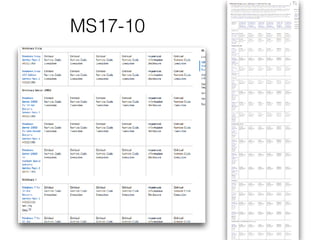
MS17-10
Pool corruption
• Pools are memory regions for kernel mode code
• Used by drivers and kernel software
• Standard heap management
• Minimal protection, performance optimization
• Pool corruption: Writing over the end of your
allocated region
EternalBlue Exploit
• https://github.com/RiskSense-Ops/MS17-010/blob/
master/exploits/eternalblue/
ms17_010_eternalblue.rb
• https://gist.github.com/worawit/
bd04bad3cd231474763b873df081c09a
• https://securingtomorrow.mcafee.com/executive-
perspectives/analysis-wannacry-ransomware-
outbreak/
Attacking the pool (I)
• Windows file sharing listens on port 445 for
imcoming SMB connections
• Network stack is kernel mode code (srvnet.sys)
• Incoming network data is stored in kernel mode
buffer from the non-paged pool
• Problem: Heap allocation ‚fills the holes‘
Attacking the pool (II)
• Approach: Allocate large chunks in pool
• Leads to ‚de-randomization‘
• Large chunks become aligned one after the
other
• Exploit triggers this by opening multiple SMB
connections and sending large packages
(grooming)
Overflow
• Send large initial SMB1 package
• Kernel needs to store received data
• srvnet.sys allocates space in non-paged pool
• Grooming
• First connection is closed, leaving adjacent hole
• Sending of overflow data, hole is used
Overflow
• Overflow overwrites SMB data structure stored in
subsequent memory
• struct SRVNET_POOLHDR
• Contains a pointer being called when finalizing a
SMB request
• If accidental overwriting is done right, then the
callback target is the data we sent before
• Close connection, kernel stack calls our function
Game over.

WannaCry - An OS course perspective

  • 1.
  • 5.
  • 6.
    Pool corruption • Poolsare memory regions for kernel mode code • Used by drivers and kernel software • Standard heap management • Minimal protection, performance optimization • Pool corruption: Writing over the end of your allocated region
  • 7.
    EternalBlue Exploit • https://github.com/RiskSense-Ops/MS17-010/blob/ master/exploits/eternalblue/ ms17_010_eternalblue.rb •https://gist.github.com/worawit/ bd04bad3cd231474763b873df081c09a • https://securingtomorrow.mcafee.com/executive- perspectives/analysis-wannacry-ransomware- outbreak/
  • 8.
    Attacking the pool(I) • Windows file sharing listens on port 445 for imcoming SMB connections • Network stack is kernel mode code (srvnet.sys) • Incoming network data is stored in kernel mode buffer from the non-paged pool • Problem: Heap allocation ‚fills the holes‘
  • 9.
    Attacking the pool(II) • Approach: Allocate large chunks in pool • Leads to ‚de-randomization‘ • Large chunks become aligned one after the other • Exploit triggers this by opening multiple SMB connections and sending large packages (grooming)
  • 10.
    Overflow • Send largeinitial SMB1 package • Kernel needs to store received data • srvnet.sys allocates space in non-paged pool • Grooming • First connection is closed, leaving adjacent hole • Sending of overflow data, hole is used
  • 11.
    Overflow • Overflow overwritesSMB data structure stored in subsequent memory • struct SRVNET_POOLHDR • Contains a pointer being called when finalizing a SMB request • If accidental overwriting is done right, then the callback target is the data we sent before • Close connection, kernel stack calls our function
  • 12.