1
Mobile Computing Lab
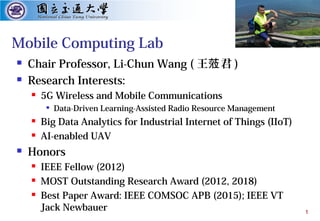
 Chair Professor, Li-Chun Wang ( 王 君蒞 )
 Research Interests:
 5G Wireless and Mobile Communications

Data-Driven Learning-Assisted Radio Resource Management
 Big Data Analytics for Industrial Internet of Things (IIoT)
 AI-enabled UAV
 Honors
 IEEE Fellow (2012)
 MOST Outstanding Research Award (2012, 2018)
 Best Paper Award: IEEE COMSOC APB (2015); IEEE VT
Jack Newbauer
2
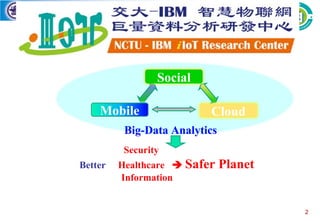
intelligent Internet of Things (iIoT)
Social
Mobile Cloud
Big-Data Analytics
Security
Better Healthcare  Safer Planet
Information
3交通大學電機所
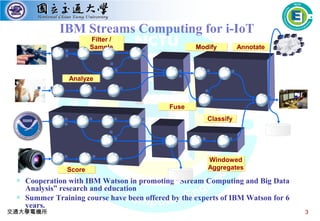
IBM Streams Computing for i-IoT
∗ Cooperation with IBM Watson in promoting “Stream Computing and Big Data
Analysis” research and education
∗ Summer Training course have been offered by the experts of IBM Watson for 6
years.
ModifyModify
Filter /
Sample
Filter /
Sample
ClassifyClassify
FuseFuse
AnnotateAnnotate
ScoreScore
Windowed
Aggregates
Windowed
Aggregates
AnalyzeAnalyze
4
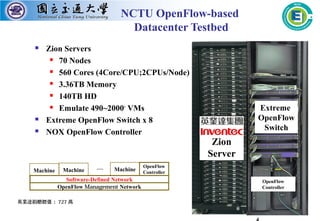
Zion
Server
Extreme
OpenFlow
Switch
OpenFlow
Controller
NCTU OpenFlow-based
Datacenter Testbed
 Zion Servers
 70 Nodes
 560 Cores (4Core/CPU;2CPUs/Node)
 3.36TB Memory
 140TB HD
 Emulate 490~2000+
VMs
 Extreme OpenFlow Switch x 8
 NOX OpenFlow Controller
Machine Machine Machine….
OpenFlow Management Network
OpenFlow
Controller
Production NetworkSoftware-Defined Network
英業達捐贈價 :值 727 萬
5
A Book for 5G
5
6
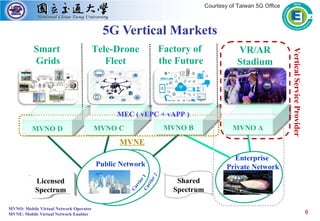
5G Vertical Markets
MVNO DMVNO D
MVNO: Mobile Virtual Network Operator
MVNE: Mobile Virtual Network Enabler
MVNO CMVNO C MVNO BMVNO B MVNO AMVNO A
Carrier2
Carrier1
Public Network
Factory of
the Future
VR/AR
Stadium
Tele-Drone
Fleet
SI(B)
Enterprise
Private Network
VerticalServiceProvider
MEC ( vEPC + vAPP )
MVNE
Licensed
Spectrum
Licensed
Spectrum
Shared
Spectrum
Smart
Grids
Courtesy of Taiwan 5G Office
7
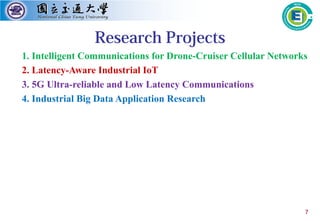
Research Projects
1. Intelligent Communications for Drone-Cruiser Cellular Networks
2. Latency-Aware Industrial IoT
3. 5G Ultra-reliable and Low Latency Communications
4. Industrial Big Data Application Research
8
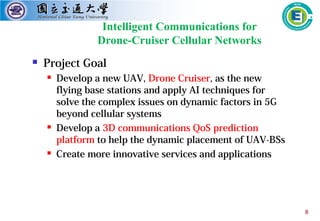
Intelligent Communications for
Drone-Cruiser Cellular Networks
 Project Goal
 Develop a new UAV, Drone Cruiser, as the new
flying base stations and apply AI techniques for
solve the complex issues on dynamic factors in 5G
beyond cellular systems
 Develop a 3D communications QoS prediction
platform to help the dynamic placement of UAV-BSs
 Create more innovative services and applications
9
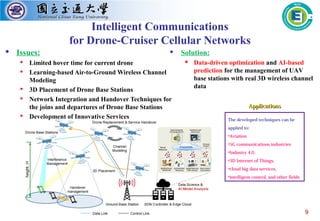
Intelligent Communications
for Drone-Cruiser Cellular Networks
 Issues:
 Limited hover time for current drone
 Learning-based Air-to-Ground Wireless Channel
Modeling
 3D Placement of Drone Base Stations
 Network Integration and Handover Techniques for
the joins and departures of Drone Base Stations
 Development of Innovative Services The developed techniques can be
applied to:
•Aviation
•5G communications industries
•Industry 4.0,
•3D Internet of Things,
•cloud big data services,
•intelligent control, and other fields
ApplicationsApplications
 Solution:
 Data-driven optimization and AI-based
prediction for the management of UAV
base stations with real 3D wireless channel
data
10
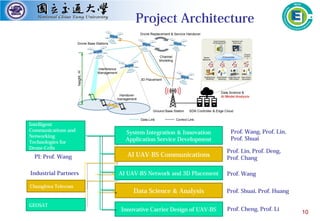
Project Architecture
Intelligent
Communications and
Networking
Technologies for
Drone-Cells
Data Science & Analysis
Prof. Wang
Prof. Lin, Prof. Deng,
Prof. Chang
Prof. Wang, Prof. Lin,
Prof. Shuai
Prof. Shuai, Prof. Huang
PI: Prof. Wang
Industrial Partners
GEOSAT 
Chunghwa Telecom
AI UAV-BS Communications
System Integration & Innovation
Application Service Development
AI UAV-BS Network and 3D Placement
Innovative Carrier Design of UAV-BS Prof. Cheng, Prof. Li
11
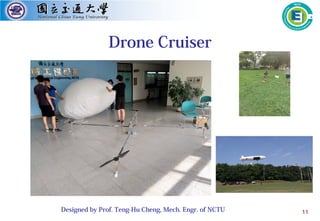
Drone Cruiser
Designed by Prof. Teng-Hu Cheng, Mech. Engr. of NCTU
12
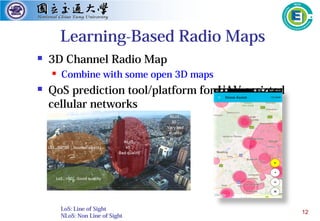
Learning-Based Radio Maps
 3D Channel Radio Map
 Combine with some open 3D maps
 QoS prediction tool/platform for UAV-assisted
cellular networks
LoS: Line of Sight
NLoS: Non Line of Sight
13
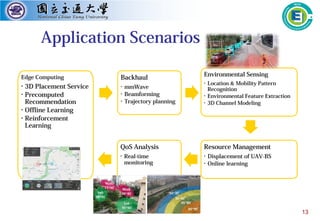
Application Scenarios
Edge Computing
• 3D Placement Service
• Precomputed
Recommendation
• Offline Learning
• Reinforcement
Learning
Backhaul
• mmWave
• Beamforming
• Trajectory planning
Environmental Sensing
• Location & Mobility Pattern
Recognition
• Environmental Feature Extraction
• 3D Channel Modeling
Resource Management
• Displacement of UAV-BS
• Online learning
QoS Analysis
• Real-time
monitoring
14
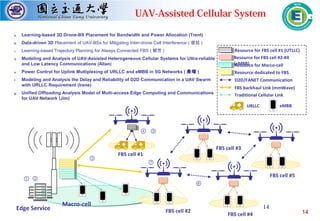
UAV-Assisted Cellular System
14Macro-cell
FBS cell #1
FBS cell #2
FBS cell #3
FBS cell #4
Resource for FBS cell #1 (UTLLC)
Resource for FBS cell #2-#4
(eMBB)Resource for Marco-cell
Resource dedicated to FBS
URLLC eMBB
D2D/FANET Communication
FBS backhaul Link (mmWave)
Traditional Cellular Link
a. Learning-based 3D Drone-BS Placement for Bandwidth and Power Allocation (Trent)
b. Data-driven 3D Placement of UAV-BSs for Mitigating Inter-drone Cell Interference ( 俊廷 )
c. Learning-based Trajectory Planning for Always Connected FBS ( 郁芳 )
d. Modeling and Analysis of UAV-Assisted Heterogeneous Cellular Systems for Ultra-reliable
and Low Latency Communications (Allan)
e. Power Control for Uplink Multiplexing of URLLC and eMBB in 5G Networks ( 晨曜 )
f. Modeling and Analysis the Delay and Reliability of D2D Communication in a UAV Swarm
with URLLC Requirement (Irene)
g. Unified Offloading Analysis Model of Multi-access Edge Computing and Communications
for UAV Network (Jim)
① ②
③
④
FBS cell #5
⑤
⑥
Edge Service
⑦
15
 Challenge: The existing transmission mechanism can not reach the strict delay
requirements of IIoT
 Network resources are limited
 Traffic characteristics change dynamically
 Approach: Delay-aware group-based MTC scheme
 Adaptively adjust aggregation buffer size based on the change of real-time traffic
 Adaptive cluster partition scheme by bin packing based on delay performance
 Gain:
 [Uplink transmission latency] 303 ms → 113 ms (↓62%)
5G Machine Type Communications for Latency-Aware Industrial
Internet of Things (IIoT)
303 ms303 ms
113 ms113 ms
62%62%
Move
Reliable Device-
aggregator Associations
Fixed Aggregator
Moving
Aggregator
IIoT TestbedIIoT Testbed
16
 Challenge: The existing 802.11ad link setup latency
can not reach the AR/VR requirement.
 802.11ad link setup latency: >40 ms
 AR/VR latency requirement: ~ 4 ms
 Approach:
 AI-based light-weight WiFi fingerprint beam search
 Gain:
 [Beam search latency] 10.95 ms → 1.09 ms (↓90%)
 [Probability of availability] 89% → 98% (↑11%)
Low-Latency High-availability 5G Indoor Communications
Training Trajectory
Signal Mapping
Ideal Practical
17
UPER scheme
Almost achieve
URLLC requirement
Delay requirement (1 ms)
 Challenge: How to avoid resource collision between urgent uplink URLLC
with other services (e.g., eMBB or mMTC)?
 Approach:
 User-initiated probabilistic elastic reservation (UPER) scheme

Probabilistic resource selection between dedicated and shared resource blocks.

K-repetition transmit in frequency domain.
 Gain: (For 0.25 ms grant-free transmission interval)
 [Average delay time] 0.56 ms → 0.385 ms (↓31%)
 [1 ms delay reliability] 85.59% → 99.994% (↑14.404%)
Resource sharing for 5G URLLC Cellular Systems
UPER
others
URLLC
Unreserved
others
URLLC
URLLC dedicated resources
Shared resources
URLLC
UL traffic
eMBB/mMTC
UL traffic
Resource blocks
Reserved resources
UL UL UL UL UL UL UL
0.25 ms
URLLC:
Ultra Reliable Ultra Low
Latency Communications
18
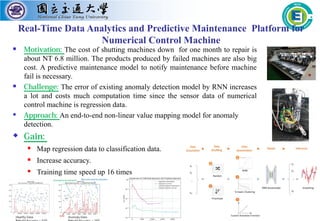
 Motivation: The cost of shutting machines down for one month to repair is
about NT 6.8 million. The products produced by failed machines are also big
cost. A predictive maintenance model to notify maintenance before machine
fail is necessary.
 Challenge: The error of existing anomaly detection model by RNN increases
a lot and costs much computation time since the sensor data of numerical
control machine is regression data.
 Approach: An end-to-end non-linear value mapping model for anomaly
detection.
 Gain:
 Map regression data to classification data.
 Increase accuracy.
 Training time speed up 16 times
Real-Time Data Analytics and Predictive Maintenance Platform for
Numerical Control Machine
19
實驗室理念
學生為本,創意為先,以終為始,莫忘初衷
Learning
Optimistic
Value
Everlasting
歡迎 們你 !
20
Cooperation Partner/Funder

Wang lab introduction_1204_2018

  • 1.
    1 Mobile Computing Lab Chair Professor, Li-Chun Wang ( 王 君蒞 )  Research Interests:  5G Wireless and Mobile Communications  Data-Driven Learning-Assisted Radio Resource Management  Big Data Analytics for Industrial Internet of Things (IIoT)  AI-enabled UAV  Honors  IEEE Fellow (2012)  MOST Outstanding Research Award (2012, 2018)  Best Paper Award: IEEE COMSOC APB (2015); IEEE VT Jack Newbauer
  • 2.
    2 intelligent Internet ofThings (iIoT) Social Mobile Cloud Big-Data Analytics Security Better Healthcare  Safer Planet Information
  • 3.
    3交通大學電機所 IBM Streams Computingfor i-IoT ∗ Cooperation with IBM Watson in promoting “Stream Computing and Big Data Analysis” research and education ∗ Summer Training course have been offered by the experts of IBM Watson for 6 years. ModifyModify Filter / Sample Filter / Sample ClassifyClassify FuseFuse AnnotateAnnotate ScoreScore Windowed Aggregates Windowed Aggregates AnalyzeAnalyze
  • 4.
    4 Zion Server Extreme OpenFlow Switch OpenFlow Controller NCTU OpenFlow-based Datacenter Testbed Zion Servers  70 Nodes  560 Cores (4Core/CPU;2CPUs/Node)  3.36TB Memory  140TB HD  Emulate 490~2000+ VMs  Extreme OpenFlow Switch x 8  NOX OpenFlow Controller Machine Machine Machine…. OpenFlow Management Network OpenFlow Controller Production NetworkSoftware-Defined Network 英業達捐贈價 :值 727 萬
  • 5.
  • 6.
    6 5G Vertical Markets MVNODMVNO D MVNO: Mobile Virtual Network Operator MVNE: Mobile Virtual Network Enabler MVNO CMVNO C MVNO BMVNO B MVNO AMVNO A Carrier2 Carrier1 Public Network Factory of the Future VR/AR Stadium Tele-Drone Fleet SI(B) Enterprise Private Network VerticalServiceProvider MEC ( vEPC + vAPP ) MVNE Licensed Spectrum Licensed Spectrum Shared Spectrum Smart Grids Courtesy of Taiwan 5G Office
  • 7.
    7 Research Projects 1. IntelligentCommunications for Drone-Cruiser Cellular Networks 2. Latency-Aware Industrial IoT 3. 5G Ultra-reliable and Low Latency Communications 4. Industrial Big Data Application Research
  • 8.
    8 Intelligent Communications for Drone-CruiserCellular Networks  Project Goal  Develop a new UAV, Drone Cruiser, as the new flying base stations and apply AI techniques for solve the complex issues on dynamic factors in 5G beyond cellular systems  Develop a 3D communications QoS prediction platform to help the dynamic placement of UAV-BSs  Create more innovative services and applications
  • 9.
    9 Intelligent Communications for Drone-CruiserCellular Networks  Issues:  Limited hover time for current drone  Learning-based Air-to-Ground Wireless Channel Modeling  3D Placement of Drone Base Stations  Network Integration and Handover Techniques for the joins and departures of Drone Base Stations  Development of Innovative Services The developed techniques can be applied to: •Aviation •5G communications industries •Industry 4.0, •3D Internet of Things, •cloud big data services, •intelligent control, and other fields ApplicationsApplications  Solution:  Data-driven optimization and AI-based prediction for the management of UAV base stations with real 3D wireless channel data
  • 10.
    10 Project Architecture Intelligent Communications and Networking Technologiesfor Drone-Cells Data Science & Analysis Prof. Wang Prof. Lin, Prof. Deng, Prof. Chang Prof. Wang, Prof. Lin, Prof. Shuai Prof. Shuai, Prof. Huang PI: Prof. Wang Industrial Partners GEOSAT  Chunghwa Telecom AI UAV-BS Communications System Integration & Innovation Application Service Development AI UAV-BS Network and 3D Placement Innovative Carrier Design of UAV-BS Prof. Cheng, Prof. Li
  • 11.
    11 Drone Cruiser Designed byProf. Teng-Hu Cheng, Mech. Engr. of NCTU
  • 12.
    12 Learning-Based Radio Maps 3D Channel Radio Map  Combine with some open 3D maps  QoS prediction tool/platform for UAV-assisted cellular networks LoS: Line of Sight NLoS: Non Line of Sight
  • 13.
    13 Application Scenarios Edge Computing •3D Placement Service • Precomputed Recommendation • Offline Learning • Reinforcement Learning Backhaul • mmWave • Beamforming • Trajectory planning Environmental Sensing • Location & Mobility Pattern Recognition • Environmental Feature Extraction • 3D Channel Modeling Resource Management • Displacement of UAV-BS • Online learning QoS Analysis • Real-time monitoring
  • 14.
    14 UAV-Assisted Cellular System 14Macro-cell FBScell #1 FBS cell #2 FBS cell #3 FBS cell #4 Resource for FBS cell #1 (UTLLC) Resource for FBS cell #2-#4 (eMBB)Resource for Marco-cell Resource dedicated to FBS URLLC eMBB D2D/FANET Communication FBS backhaul Link (mmWave) Traditional Cellular Link a. Learning-based 3D Drone-BS Placement for Bandwidth and Power Allocation (Trent) b. Data-driven 3D Placement of UAV-BSs for Mitigating Inter-drone Cell Interference ( 俊廷 ) c. Learning-based Trajectory Planning for Always Connected FBS ( 郁芳 ) d. Modeling and Analysis of UAV-Assisted Heterogeneous Cellular Systems for Ultra-reliable and Low Latency Communications (Allan) e. Power Control for Uplink Multiplexing of URLLC and eMBB in 5G Networks ( 晨曜 ) f. Modeling and Analysis the Delay and Reliability of D2D Communication in a UAV Swarm with URLLC Requirement (Irene) g. Unified Offloading Analysis Model of Multi-access Edge Computing and Communications for UAV Network (Jim) ① ② ③ ④ FBS cell #5 ⑤ ⑥ Edge Service ⑦
  • 15.
    15  Challenge: Theexisting transmission mechanism can not reach the strict delay requirements of IIoT  Network resources are limited  Traffic characteristics change dynamically  Approach: Delay-aware group-based MTC scheme  Adaptively adjust aggregation buffer size based on the change of real-time traffic  Adaptive cluster partition scheme by bin packing based on delay performance  Gain:  [Uplink transmission latency] 303 ms → 113 ms (↓62%) 5G Machine Type Communications for Latency-Aware Industrial Internet of Things (IIoT) 303 ms303 ms 113 ms113 ms 62%62% Move Reliable Device- aggregator Associations Fixed Aggregator Moving Aggregator IIoT TestbedIIoT Testbed
  • 16.
    16  Challenge: Theexisting 802.11ad link setup latency can not reach the AR/VR requirement.  802.11ad link setup latency: >40 ms  AR/VR latency requirement: ~ 4 ms  Approach:  AI-based light-weight WiFi fingerprint beam search  Gain:  [Beam search latency] 10.95 ms → 1.09 ms (↓90%)  [Probability of availability] 89% → 98% (↑11%) Low-Latency High-availability 5G Indoor Communications Training Trajectory Signal Mapping Ideal Practical
  • 17.
    17 UPER scheme Almost achieve URLLCrequirement Delay requirement (1 ms)  Challenge: How to avoid resource collision between urgent uplink URLLC with other services (e.g., eMBB or mMTC)?  Approach:  User-initiated probabilistic elastic reservation (UPER) scheme  Probabilistic resource selection between dedicated and shared resource blocks.  K-repetition transmit in frequency domain.  Gain: (For 0.25 ms grant-free transmission interval)  [Average delay time] 0.56 ms → 0.385 ms (↓31%)  [1 ms delay reliability] 85.59% → 99.994% (↑14.404%) Resource sharing for 5G URLLC Cellular Systems UPER others URLLC Unreserved others URLLC URLLC dedicated resources Shared resources URLLC UL traffic eMBB/mMTC UL traffic Resource blocks Reserved resources UL UL UL UL UL UL UL 0.25 ms URLLC: Ultra Reliable Ultra Low Latency Communications
  • 18.
    18  Motivation: Thecost of shutting machines down for one month to repair is about NT 6.8 million. The products produced by failed machines are also big cost. A predictive maintenance model to notify maintenance before machine fail is necessary.  Challenge: The error of existing anomaly detection model by RNN increases a lot and costs much computation time since the sensor data of numerical control machine is regression data.  Approach: An end-to-end non-linear value mapping model for anomaly detection.  Gain:  Map regression data to classification data.  Increase accuracy.  Training time speed up 16 times Real-Time Data Analytics and Predictive Maintenance Platform for Numerical Control Machine
  • 19.
  • 20.

Editor's Notes