DESIGN AND FABRICATION OF WALL CLIMBING ROBOT
[ME049]
Guide: Mr. Gautham Hebbar, Associate Professor, Dept. of Mechanical Engineering.
Co-Guide: Mr. Veeresh R. K, Assistant Professor, Dept. of Mechanical Engineering.
By,
K. Ramkrishna Shenoy (4NM14ME143)
Rakshith Kishore K. (4NM14ME141)
Nagabhushana (4NM14ME101)
Nagaraj D Shenoy (4NM14ME102)
ABSTARCT
Wall-climbing robots have been widely used in fields of inspection, building cleaning,
welding, and so on. These robots can freely move on surfaces with various inclinations, e.g.
vertical walls and ceilings. In addition to fundamental locomotion (e.g. wheels, tracks and
legs) for robot mobility, a wall-climbing robot must counter the force of gravity for firmly
adhering to the inclined work surface by employing adhesion mechanisms (e.g. vacuum
suction, magnetic adhesion, etc). In the past decades, various adhesion and locomotion
mechanisms have been developed for wall-climbing robots. In practical applications, one of
the greatest challenges for wall-climbing robots is to develop optimum adhesion and
locomotion mechanisms which enable wall-climbing robots to freely move on various types
of complex shaped structure surfaces with various inclined walls, such as milk tanks,
cooling towers, and nuclear power plants and so on. Aim of the project is to be fabricating a
wall climbing robot using suction force.
NEED
Wall climbing robots are mainly adopted in places where direct access by a human operator
is very expensive because of the need for scaffolding, or very dangerous due to the presence
of a hostile environment.
 Painting and cleaning of walls of a building takes time, and is risky for workers and
cost of operation is also high.
 Maintenance of building and industries are costly. Hence regular maintenance is
difficult.
 Inspection of chimneys, cooling towers and nuclear power plants is difficult for
human workers.
 Skilled and experienced workers are required for inspection and maintenance.
 Other methods available for this job are costly.
OBJECTIVES
 To design a wall climbing robot for cleaning, painting and crack detection on walls.
 To fabricate a wall climbing robot
 To test the performance of a wall climbing robot
KEYWORDS
Wall climbing, suction cups, tracked wheel mechanism
INTRODUCTION
Wall climbing robots have been developed for decades to increase working efficiency and
to ensure worker’s safety. The robots are popular in various prospective applications such as
cleaning, inspecting, painting, and blasting for high-rise structures. In the field of the
climbing robots, locomotion mechanism design to enlarge the applicable areas of the
climbing robots is the major issue. Wall-climbing robots, which have been developed in the
last few decades, are mainly employed for the tasks that are dangerous or costly when
performed by a human operator in the harsh environment. Some tasks include wall cleaning
of high buildings, remote maintenance of large storage tanks, inspection of large concrete
structures such as bridge pylons, cooling towers or dams and in-pipe inspections.
According to the adhesion method, these robots are generally classified into four groups:
magnetic, vacuum or suction cups, gripping to the surface and propulsion type. According
to locomotion mechanisms they are classified as legged mechanisms, translation
mechanism, wheel driven mechanism and tracked wheel mechanism. We are adopting
tracked wheel mechanism with combination of suction cups and vacuum adhesion.
PROBLEM DEFINITION
Direct access by a human operator is very expensive because of the need for scaffolding, or
very dangerous due to the presence of a hostile environment in a variety of applications like
maintenance, building, inspection and safety in the process and construction industries.
LITERATURE REVIEW
 Shunsuke Nansai and Rajesh Elara Mohan has presented in ‘A Survey of Wall
Climbing Robots: Recent Advances and Challenges’ that the tracked locomotion is
relatively faster and less complex. It is also commonly used in applications such as
inspection and maintenance of large tanks.
 Yuan Chang has presented in ‘Development of a wall climbing inspection robot with
high mobility on Complex shaped walls’ that Vacuum adhesion, or negative
pressure suction, is considered the most commonly used adhesion method for wall-
climbing robots. Its advantages include simple structure and good adaptability to
various types of surfaces (including non-ferromagnetic surface). Negative pressure
suction cup or chamber is the common vacuum adhesion mechanisms for wall-
climbing robot in practical applications. Negative pressure is generated through the
vibration of the suction cup, and can be strengthened by increasing the amplitude
and frequency of the vibration. This way has the advantages of low power
consumption, high stability in suction and relatively low noise. Moreover, compared
with the vacuum pump based adhesion mechanisms, the vibration mechanism is
relatively light and compact.
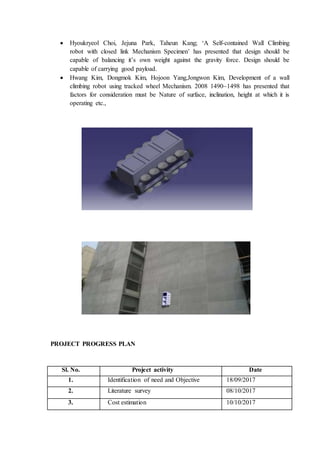
 Hyoukryeol Choi, Jejuna Park, Taheun Kang; ‘A Self-contained Wall Climbing
robot with closed link Mechanism Specimen’ has presented that design should be
capable of balancing it’s own weight against the gravity force. Design should be
capable of carrying good payload.
 Hwang Kim, Dongmok Kim, Hojoon Yang,Jongwon Kim, Development of a wall
climbing robot using tracked wheel Mechanism. 2008 1490~1498 has presented that
factors for consideration must be Nature of surface, inclination, height at which it is
operating etc.,
PROJECT PROGRESS PLAN
Sl. No. Project activity Date
1. Identification of need and Objective 18/09/2017
2. Literature survey 08/10/2017
3. Cost estimation 10/10/2017
4. Design 12/10/2017
TIME SCHEDULE
The following table shows our planning about the activities to be carried out
Sl. No. Project activity Month
1. Design calculation and modification November
2. Ordering of parts December
3. Fabrication of robot January
4. Assembly February
5. Report writing April
REFERENCES:
 Frey, C.B.; Osborne, M.A. The future of employment: How susceptible are jobs to
computerisation. Retriev. Sept. 2013, 7, 2013.
 S. Hirose and K. Arikawa, “Coupled and Decoupled Actuation of Robotic
Mechanisms,” Proc. of the 2000 IEEE International Conference on Robotics and
Automation, 2000, pp. 33-39.
 H. Kim, D. Kim, H. Yang, K. Lee, K. Seo, D. Chang, J. Kim, "Development of a
wall-climbing robot using a tracked wheel mechanism," Journal of Mechanical
Science and Technology, vol. 22, no. 8, pp. 1490-1498, 2008.08
 Hwang Kim, Dongmok Kim, Hojoon Yang ,Jongwon Kim, Development of a wall
climbing robot using tracked wheel Mechanism. 2008 1490~1498
 Hyoukryeol Choi, Jaejun Park, Taheun Kang; A Self-contained Wall Climbing robot
with closedlink Mechanism
 Wall Climbing Robots with Track-wheel Mechanism Giuk Lee, Junhwan Park,
Hwang Kim, Kunchan Seo, Jongwon Kim School of Mechanical and Aerospace
Engineering Seoul National University Seoul, Korea 978-1-4244-925 3-4 /11

wall climbing robot

  • 1.
    DESIGN AND FABRICATIONOF WALL CLIMBING ROBOT [ME049] Guide: Mr. Gautham Hebbar, Associate Professor, Dept. of Mechanical Engineering. Co-Guide: Mr. Veeresh R. K, Assistant Professor, Dept. of Mechanical Engineering. By, K. Ramkrishna Shenoy (4NM14ME143) Rakshith Kishore K. (4NM14ME141) Nagabhushana (4NM14ME101) Nagaraj D Shenoy (4NM14ME102)
  • 2.
    ABSTARCT Wall-climbing robots havebeen widely used in fields of inspection, building cleaning, welding, and so on. These robots can freely move on surfaces with various inclinations, e.g. vertical walls and ceilings. In addition to fundamental locomotion (e.g. wheels, tracks and legs) for robot mobility, a wall-climbing robot must counter the force of gravity for firmly adhering to the inclined work surface by employing adhesion mechanisms (e.g. vacuum suction, magnetic adhesion, etc). In the past decades, various adhesion and locomotion mechanisms have been developed for wall-climbing robots. In practical applications, one of the greatest challenges for wall-climbing robots is to develop optimum adhesion and locomotion mechanisms which enable wall-climbing robots to freely move on various types of complex shaped structure surfaces with various inclined walls, such as milk tanks, cooling towers, and nuclear power plants and so on. Aim of the project is to be fabricating a wall climbing robot using suction force. NEED Wall climbing robots are mainly adopted in places where direct access by a human operator is very expensive because of the need for scaffolding, or very dangerous due to the presence of a hostile environment.  Painting and cleaning of walls of a building takes time, and is risky for workers and cost of operation is also high.  Maintenance of building and industries are costly. Hence regular maintenance is difficult.  Inspection of chimneys, cooling towers and nuclear power plants is difficult for human workers.  Skilled and experienced workers are required for inspection and maintenance.  Other methods available for this job are costly. OBJECTIVES  To design a wall climbing robot for cleaning, painting and crack detection on walls.  To fabricate a wall climbing robot  To test the performance of a wall climbing robot KEYWORDS Wall climbing, suction cups, tracked wheel mechanism
  • 3.
    INTRODUCTION Wall climbing robotshave been developed for decades to increase working efficiency and to ensure worker’s safety. The robots are popular in various prospective applications such as cleaning, inspecting, painting, and blasting for high-rise structures. In the field of the climbing robots, locomotion mechanism design to enlarge the applicable areas of the climbing robots is the major issue. Wall-climbing robots, which have been developed in the last few decades, are mainly employed for the tasks that are dangerous or costly when performed by a human operator in the harsh environment. Some tasks include wall cleaning of high buildings, remote maintenance of large storage tanks, inspection of large concrete structures such as bridge pylons, cooling towers or dams and in-pipe inspections. According to the adhesion method, these robots are generally classified into four groups: magnetic, vacuum or suction cups, gripping to the surface and propulsion type. According to locomotion mechanisms they are classified as legged mechanisms, translation mechanism, wheel driven mechanism and tracked wheel mechanism. We are adopting tracked wheel mechanism with combination of suction cups and vacuum adhesion. PROBLEM DEFINITION Direct access by a human operator is very expensive because of the need for scaffolding, or very dangerous due to the presence of a hostile environment in a variety of applications like maintenance, building, inspection and safety in the process and construction industries. LITERATURE REVIEW  Shunsuke Nansai and Rajesh Elara Mohan has presented in ‘A Survey of Wall Climbing Robots: Recent Advances and Challenges’ that the tracked locomotion is relatively faster and less complex. It is also commonly used in applications such as inspection and maintenance of large tanks.  Yuan Chang has presented in ‘Development of a wall climbing inspection robot with high mobility on Complex shaped walls’ that Vacuum adhesion, or negative pressure suction, is considered the most commonly used adhesion method for wall- climbing robots. Its advantages include simple structure and good adaptability to various types of surfaces (including non-ferromagnetic surface). Negative pressure suction cup or chamber is the common vacuum adhesion mechanisms for wall- climbing robot in practical applications. Negative pressure is generated through the vibration of the suction cup, and can be strengthened by increasing the amplitude and frequency of the vibration. This way has the advantages of low power consumption, high stability in suction and relatively low noise. Moreover, compared with the vacuum pump based adhesion mechanisms, the vibration mechanism is relatively light and compact.
  • 4.
     Hyoukryeol Choi,Jejuna Park, Taheun Kang; ‘A Self-contained Wall Climbing robot with closed link Mechanism Specimen’ has presented that design should be capable of balancing it’s own weight against the gravity force. Design should be capable of carrying good payload.  Hwang Kim, Dongmok Kim, Hojoon Yang,Jongwon Kim, Development of a wall climbing robot using tracked wheel Mechanism. 2008 1490~1498 has presented that factors for consideration must be Nature of surface, inclination, height at which it is operating etc., PROJECT PROGRESS PLAN Sl. No. Project activity Date 1. Identification of need and Objective 18/09/2017 2. Literature survey 08/10/2017 3. Cost estimation 10/10/2017
  • 5.
    4. Design 12/10/2017 TIMESCHEDULE The following table shows our planning about the activities to be carried out Sl. No. Project activity Month 1. Design calculation and modification November 2. Ordering of parts December 3. Fabrication of robot January 4. Assembly February 5. Report writing April REFERENCES:  Frey, C.B.; Osborne, M.A. The future of employment: How susceptible are jobs to computerisation. Retriev. Sept. 2013, 7, 2013.  S. Hirose and K. Arikawa, “Coupled and Decoupled Actuation of Robotic Mechanisms,” Proc. of the 2000 IEEE International Conference on Robotics and Automation, 2000, pp. 33-39.  H. Kim, D. Kim, H. Yang, K. Lee, K. Seo, D. Chang, J. Kim, "Development of a wall-climbing robot using a tracked wheel mechanism," Journal of Mechanical Science and Technology, vol. 22, no. 8, pp. 1490-1498, 2008.08  Hwang Kim, Dongmok Kim, Hojoon Yang ,Jongwon Kim, Development of a wall climbing robot using tracked wheel Mechanism. 2008 1490~1498  Hyoukryeol Choi, Jaejun Park, Taheun Kang; A Self-contained Wall Climbing robot with closedlink Mechanism  Wall Climbing Robots with Track-wheel Mechanism Giuk Lee, Junhwan Park, Hwang Kim, Kunchan Seo, Jongwon Kim School of Mechanical and Aerospace Engineering Seoul National University Seoul, Korea 978-1-4244-925 3-4 /11