English 9: W.9-10.1 (Write Arguments)
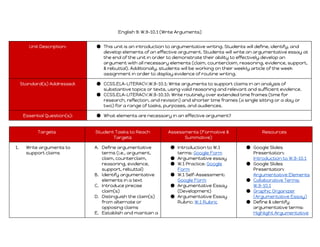
Unit Description: ● This unit is an introduction to argumentative writing. Students will define, identify, and
develop elements of an effective argument. Students will write an argumentative essay at
the end of the unit in order to demonstrate their ability to effectively develop an
argument with all necessary elements (claim, counterclaim, reasoning, evidence, support,
& rebuttal). Additionally, students will be working on their weekly article of the week
assignment in order to display evidence of routine writing.
Standard(s) Addressed: ● CCSS.ELA-LITERACY.W.9-10.1: Write arguments to support claims in an analysis of
substantive topics or texts, using valid reasoning and relevant and sufficient evidence.
● CCSS.ELA-LITERACY.W.9-10.10: Write routinely over extended time frames (time for
research, reflection, and revision) and shorter time frames (a single sitting or a day or
two) for a range of tasks, purposes, and audiences.
Essential Question(s): ● What elements are necessary in an effective argument?
Targets Student Tasks to Reach
Targets
Assessments (Formative &
Summative)
Resources
1. Write arguments to
support claims
A. Define argumentative
terms (i.e., argument,
claim, counterclaim,
reasoning, evidence,
support, rebuttal)
B. Identify argumentative
elements in a text
C. Introduce precise
claim(s)
D. Distinguish the claim(s)
from alternate or
opposing claims
E. Establish and maintain a
● Introduction to W.1
terms: ​Google Form
● Argumentative essay
● W.1 Practice: ​Google
Form
● W.1 Self-Assessment:
Google Form
● Argumentative Essay
(Development)
● Argumentative Essay
Rubric: ​W.1 Rubric
● Google Slides
Presentation:
Introduction to W.9-10.1
● Google Slides
Presentation:
Argumentative Elements
● Collaborative Terms:
W.9-10.1
● Graphic Organizer
(Argumentative Essay)
● Define & identify
argumentative terms:
Highlight Argumentative
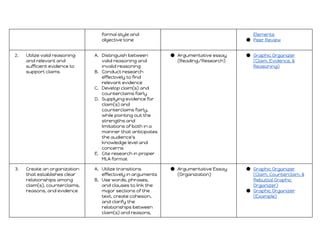
formal style and
objective tone
Elements
● Peer Review
2. Utilize valid reasoning
and relevant and
sufficient evidence to
support claims
A. Distinguish between
valid reasoning and
invalid reasoning
B. Conduct research
effectively to find
relevant evidence
C. Develop claim(s) and
counterclaims fairly
D. Supplying evidence for
claim(s) and
counterclaims fairly,
while pointing out the
strengths and
limitations of both in a
manner that anticipates
the audience's
knowledge level and
concerns
E. Cite research in proper
MLA format
● Argumentative essay
(Reading/Research)
● Graphic Organizer
(Claim, Evidence, &
Reasoning)
3. Create an organization
that establishes clear
relationships among
claim(s), counterclaims,
reasons, and evidence
A. Utilize transitions
effectively in arguments
B. Use words, phrases,
and clauses to link the
major sections of the
text, create cohesion,
and clarify the
relationships between
claim(s) and reasons,
● Argumentative Essay
(Organization)
● Graphic Organizer
(Claim, Counterclaim, &
Rebuttal Graphic
Organizer)
● Graphic Organizer
(Example)
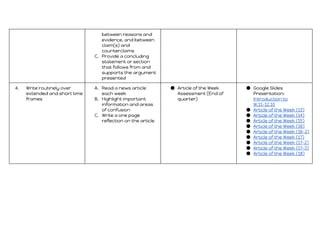
between reasons and
evidence, and between
claim(s) and
counterclaims
C. Provide a concluding
statement or section
that follows from and
supports the argument
presented
4. Write routinely over
extended and short time
frames
A. Read a news article
each week
B. Highlight important
information and areas
of confusion
C. Write a one page
reflection on the article
● Article of the Week
Assessment (End of
quarter)
● Google Slides
Presentation:
Introduction to
W.11-12.10
● Article of the Week (13)
● Article of the Week (14)
● Article of the Week (15)
● Article of the Week (16)
● Article of the Week (16-2)
● Article of the Week (17)
● Article of the Week (17-2)
● Article of the Week (17-3)
● Article of the Week (18)

W.9 10.1 writeargumentskeigher (2)

  • 1.
    English 9: W.9-10.1(Write Arguments) Unit Description: ● This unit is an introduction to argumentative writing. Students will define, identify, and develop elements of an effective argument. Students will write an argumentative essay at the end of the unit in order to demonstrate their ability to effectively develop an argument with all necessary elements (claim, counterclaim, reasoning, evidence, support, & rebuttal). Additionally, students will be working on their weekly article of the week assignment in order to display evidence of routine writing. Standard(s) Addressed: ● CCSS.ELA-LITERACY.W.9-10.1: Write arguments to support claims in an analysis of substantive topics or texts, using valid reasoning and relevant and sufficient evidence. ● CCSS.ELA-LITERACY.W.9-10.10: Write routinely over extended time frames (time for research, reflection, and revision) and shorter time frames (a single sitting or a day or two) for a range of tasks, purposes, and audiences. Essential Question(s): ● What elements are necessary in an effective argument? Targets Student Tasks to Reach Targets Assessments (Formative & Summative) Resources 1. Write arguments to support claims A. Define argumentative terms (i.e., argument, claim, counterclaim, reasoning, evidence, support, rebuttal) B. Identify argumentative elements in a text C. Introduce precise claim(s) D. Distinguish the claim(s) from alternate or opposing claims E. Establish and maintain a ● Introduction to W.1 terms: ​Google Form ● Argumentative essay ● W.1 Practice: ​Google Form ● W.1 Self-Assessment: Google Form ● Argumentative Essay (Development) ● Argumentative Essay Rubric: ​W.1 Rubric ● Google Slides Presentation: Introduction to W.9-10.1 ● Google Slides Presentation: Argumentative Elements ● Collaborative Terms: W.9-10.1 ● Graphic Organizer (Argumentative Essay) ● Define & identify argumentative terms: Highlight Argumentative
  • 2.
    formal style and objectivetone Elements ● Peer Review 2. Utilize valid reasoning and relevant and sufficient evidence to support claims A. Distinguish between valid reasoning and invalid reasoning B. Conduct research effectively to find relevant evidence C. Develop claim(s) and counterclaims fairly D. Supplying evidence for claim(s) and counterclaims fairly, while pointing out the strengths and limitations of both in a manner that anticipates the audience's knowledge level and concerns E. Cite research in proper MLA format ● Argumentative essay (Reading/Research) ● Graphic Organizer (Claim, Evidence, & Reasoning) 3. Create an organization that establishes clear relationships among claim(s), counterclaims, reasons, and evidence A. Utilize transitions effectively in arguments B. Use words, phrases, and clauses to link the major sections of the text, create cohesion, and clarify the relationships between claim(s) and reasons, ● Argumentative Essay (Organization) ● Graphic Organizer (Claim, Counterclaim, & Rebuttal Graphic Organizer) ● Graphic Organizer (Example)
  • 3.
    between reasons and evidence,and between claim(s) and counterclaims C. Provide a concluding statement or section that follows from and supports the argument presented 4. Write routinely over extended and short time frames A. Read a news article each week B. Highlight important information and areas of confusion C. Write a one page reflection on the article ● Article of the Week Assessment (End of quarter) ● Google Slides Presentation: Introduction to W.11-12.10 ● Article of the Week (13) ● Article of the Week (14) ● Article of the Week (15) ● Article of the Week (16) ● Article of the Week (16-2) ● Article of the Week (17) ● Article of the Week (17-2) ● Article of the Week (17-3) ● Article of the Week (18)