How to teach grammar
Alice Chiu
0936-825423
Main Menu
1. What is grammar?
2. What should be taught?
3. How should it be taught?
4. Examples of PPT slides
5. Online Resources
1. What is grammar?
 Grammar is not…
– a discrete set of meaningless
decontextualized or static structure
– prescriptive rules about linguistic form
 What is grammar then?
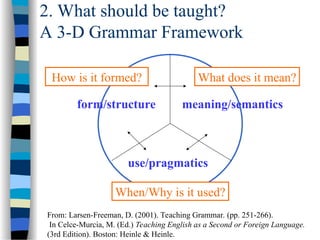
2. What should be taught?
A 3-D Grammar Framework
form/structure
use/pragmatics
meaning/semantics
From: Larsen-Freeman, D. (2001). Teaching Grammar. (pp. 251-266).
In Celce-Murcia, M. (Ed.) Teaching English as a Second or Foreign Language.
(3rd Edition). Boston: Heinle & Heinle.
How is it formed? What does it mean?
When/Why is it used?
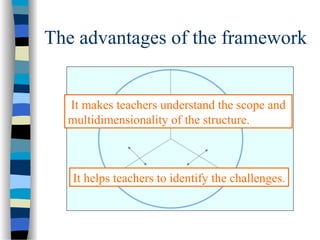
The advantages of the framework
form/structure
use/pragmatics
meaning/semantics
It makes teachers understand the scope and
multidimensionality of the structure.
It helps teachers to identify the challenges.
2.1 Teaching form
 20 questions (questions)
 family portraits (possessives)
 describing a person or a place by using
relative clauses
 information gap activity (practice
different forms/patterns)
 sentence-unscrambling task
(a problem-solving activity)
2.2 Teaching Meaning
Making association between form and meaning
 realia and pictures (comparative forms)
 actions
–TPR (imperative form)
–matching: phrase-meaning association
(phrasal verbs)
–story telling with action (phrasal verbs)
2.3 Teaching Use
 Role plays in different social contexts
– Example 1: giving advice
• Giving advice to friends
• Giving advice to young kids
• Advice columnist (speaking and writing)
– Example 2: past tense vs. present perfect
• Job interview
 Linguistic discourse context
– Teaching passive voices: focus on issues rather
than agents
• a text completion task
3. How should grammar be taught?
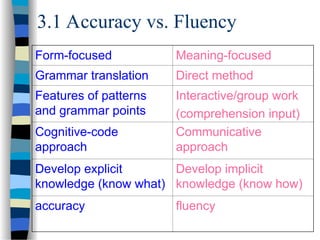
3.1 Accuracy vs. Fluency
3.2 Striking a Balance
3.3 from Cognitive Approach to
Communicative Approach
3.4 Important features
3.5 Sequencing
3.6 Providing Feedback
3.7 General Guidelines
3.8 Conclusion
3.1 Accuracy vs. Fluency
Form-focused Meaning-focused
Grammar translation Direct method
Features of patterns
and grammar points
Interactive/group work
(comprehension input)
Cognitive-code
approach
Communicative
approach
Develop explicit
knowledge (know what)
Develop implicit
knowledge (know how)
accuracy fluency
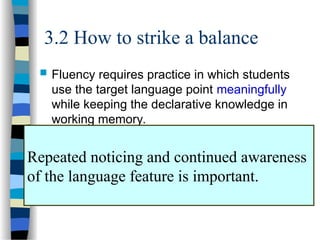
3.2 How to strike a balance
 Fluency requires practice in which students
use the target language point meaningfully
while keeping the declarative knowledge in
working memory.
 Meaningful practice of form:
– Students have to receive feedback on the
accuracy.
– Concentrate on one or two new forms at a time.
Repeated noticing and continued awareness
of the language feature is important.
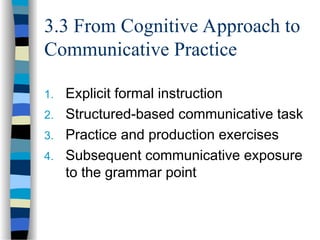
3.3 From Cognitive Approach to
Communicative Practice
1. Explicit formal instruction
2. Structured-based communicative task
3. Practice and production exercises
4. Subsequent communicative exposure
to the grammar point
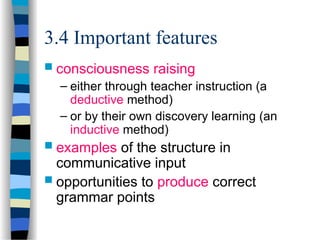
3.4 Important features
 consciousness raising
– either through teacher instruction (a
deductive method)
– or by their own discovery learning (an
inductive method)
 examples of the structure in
communicative input
 opportunities to produce correct
grammar points
3.5 Sequencing
 A grammar checklist
 Not following a prescribed sequence
rigidly
 Many structures would arise naturally in
the course working on the tasks and
content and would be dealt with then.
3.6 Ways to Provide feedback
 Giving explicit rules
 Recasting
 Self-correcting
 Peer-correcting
 Collecting students’ errors, identifying
the prototypical ones, & dealing with
them collectively in class as an
anonymous fashion.
3.7 General Principles for Grammar
Teaching
 little and often (recycle and revisit)
 planned and systematic
 offering learners a range of opportunities
 Involving acceptance of classroom code
switching and mother tongue
 text-based, problem-solving grammar
activities
 active corrective feedback and elicitation
 supported in meaning-oriented activities and
tasks
3.8 Conclusion
 By thinking of grammar as a skill to be mastered,
rather than a set of rules to be memorized, we’ll be
helping students go a long way toward the goal of
being able to accurately convey meaning in an
appropriate manner.
 When the psychological conditions of learning
and application are matched, what has been
learned is more likely to be transfer. Therefore,
presenting rules and forms in the context of
communicative interaction is necessary.
4. Examples of PPT Slides
 Integrating ppt into grammar teaching
– Visual learners
– Interesting stories
 Examples
– ….require that S V….
– Inversions ( 倒裝句 )
– as…as possible
5. Online resources for self-study
 Oxford University Press online practice
– Natural Grammar
– Oxford Learner’s Grammar
– The Good Grammar Book
 English works: grammar exercises
 Big Dog’s grammar
End of this Session
 References
Larsen-Freeman, D. (2001). Teaching Grammar. (pp.
251-266). In Celce-Murcia, M. (Ed.) Teaching English
as a Second or Foreign Language. (3rd Edition).
Boston: Heinle & Heinle.
Fotos, S. (2001). Cognitive Approaches to Grammar
Instruction. (pp. 267-284). In Celce-Murcia, M. (Ed.)
Teaching English as a Second or Foreign Language.
(3rd Edition). Boston: Heinle & Heinle.

How to teach grammar--------------------

  • 1.
    How to teachgrammar Alice Chiu 0936-825423
  • 2.
    Main Menu 1. Whatis grammar? 2. What should be taught? 3. How should it be taught? 4. Examples of PPT slides 5. Online Resources
  • 3.
    1. What isgrammar?  Grammar is not… – a discrete set of meaningless decontextualized or static structure – prescriptive rules about linguistic form  What is grammar then?
  • 4.
    2. What shouldbe taught? A 3-D Grammar Framework form/structure use/pragmatics meaning/semantics From: Larsen-Freeman, D. (2001). Teaching Grammar. (pp. 251-266). In Celce-Murcia, M. (Ed.) Teaching English as a Second or Foreign Language. (3rd Edition). Boston: Heinle & Heinle. How is it formed? What does it mean? When/Why is it used?
  • 5.
    The advantages ofthe framework form/structure use/pragmatics meaning/semantics It makes teachers understand the scope and multidimensionality of the structure. It helps teachers to identify the challenges.
  • 6.
    2.1 Teaching form 20 questions (questions)  family portraits (possessives)  describing a person or a place by using relative clauses  information gap activity (practice different forms/patterns)  sentence-unscrambling task (a problem-solving activity)
  • 7.
    2.2 Teaching Meaning Makingassociation between form and meaning  realia and pictures (comparative forms)  actions –TPR (imperative form) –matching: phrase-meaning association (phrasal verbs) –story telling with action (phrasal verbs)
  • 8.
    2.3 Teaching Use Role plays in different social contexts – Example 1: giving advice • Giving advice to friends • Giving advice to young kids • Advice columnist (speaking and writing) – Example 2: past tense vs. present perfect • Job interview  Linguistic discourse context – Teaching passive voices: focus on issues rather than agents • a text completion task
  • 9.
    3. How shouldgrammar be taught? 3.1 Accuracy vs. Fluency 3.2 Striking a Balance 3.3 from Cognitive Approach to Communicative Approach 3.4 Important features 3.5 Sequencing 3.6 Providing Feedback 3.7 General Guidelines 3.8 Conclusion
  • 10.
    3.1 Accuracy vs.Fluency Form-focused Meaning-focused Grammar translation Direct method Features of patterns and grammar points Interactive/group work (comprehension input) Cognitive-code approach Communicative approach Develop explicit knowledge (know what) Develop implicit knowledge (know how) accuracy fluency
  • 11.
    3.2 How tostrike a balance  Fluency requires practice in which students use the target language point meaningfully while keeping the declarative knowledge in working memory.  Meaningful practice of form: – Students have to receive feedback on the accuracy. – Concentrate on one or two new forms at a time. Repeated noticing and continued awareness of the language feature is important.
  • 12.
    3.3 From CognitiveApproach to Communicative Practice 1. Explicit formal instruction 2. Structured-based communicative task 3. Practice and production exercises 4. Subsequent communicative exposure to the grammar point
  • 13.
    3.4 Important features consciousness raising – either through teacher instruction (a deductive method) – or by their own discovery learning (an inductive method)  examples of the structure in communicative input  opportunities to produce correct grammar points
  • 14.
    3.5 Sequencing  Agrammar checklist  Not following a prescribed sequence rigidly  Many structures would arise naturally in the course working on the tasks and content and would be dealt with then.
  • 15.
    3.6 Ways toProvide feedback  Giving explicit rules  Recasting  Self-correcting  Peer-correcting  Collecting students’ errors, identifying the prototypical ones, & dealing with them collectively in class as an anonymous fashion.
  • 16.
    3.7 General Principlesfor Grammar Teaching  little and often (recycle and revisit)  planned and systematic  offering learners a range of opportunities  Involving acceptance of classroom code switching and mother tongue  text-based, problem-solving grammar activities  active corrective feedback and elicitation  supported in meaning-oriented activities and tasks
  • 17.
    3.8 Conclusion  Bythinking of grammar as a skill to be mastered, rather than a set of rules to be memorized, we’ll be helping students go a long way toward the goal of being able to accurately convey meaning in an appropriate manner.  When the psychological conditions of learning and application are matched, what has been learned is more likely to be transfer. Therefore, presenting rules and forms in the context of communicative interaction is necessary.
  • 18.
    4. Examples ofPPT Slides  Integrating ppt into grammar teaching – Visual learners – Interesting stories  Examples – ….require that S V…. – Inversions ( 倒裝句 ) – as…as possible
  • 19.
    5. Online resourcesfor self-study  Oxford University Press online practice – Natural Grammar – Oxford Learner’s Grammar – The Good Grammar Book  English works: grammar exercises  Big Dog’s grammar
  • 20.
    End of thisSession  References Larsen-Freeman, D. (2001). Teaching Grammar. (pp. 251-266). In Celce-Murcia, M. (Ed.) Teaching English as a Second or Foreign Language. (3rd Edition). Boston: Heinle & Heinle. Fotos, S. (2001). Cognitive Approaches to Grammar Instruction. (pp. 267-284). In Celce-Murcia, M. (Ed.) Teaching English as a Second or Foreign Language. (3rd Edition). Boston: Heinle & Heinle.