The PDP Framework
This lesson framework helps teachers plan and deliver effective listening, video
and reading lessons. The framework is based on research and using it helps ensure
students are motivated, engaged and active before, while and after (pre, during
and post – PDP) listening to, watching or reading a text.
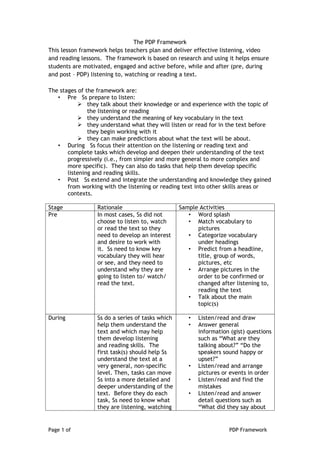
The stages of the framework are:
• Pre Ss prepare to listen:
Ø they talk about their knowledge or and experience with the topic of
the listening or reading
Ø they understand the meaning of key vocabulary in the text
Ø they understand what they will listen or read for in the text before
they begin working with it
Ø they can make predictions about what the text will be about.
• During Ss focus their attention on the listening or reading text and
complete tasks which develop and deepen their understanding of the text
progressively (i.e., from simpler and more general to more complex and
more specific). They can also do tasks that help them develop specific
listening and reading skills.
• Post Ss extend and integrate the understanding and knowledge they gained
from working with the listening or reading text into other skills areas or
contexts.
Stage Rationale Sample Activities
Pre In most cases, Ss did not
choose to listen to, watch
or read the text so they
need to develop an interest
and desire to work with
it. Ss need to know key
vocabulary they will hear
or see, and they need to
understand why they are
going to listen to/ watch/
read the text.
• Word splash
• Match vocabulary to
pictures
• Categorize vocabulary
under headings
• Predict from a headline,
title, group of words,
pictures, etc
• Arrange pictures in the
order to be confirmed or
changed after listening to,
reading the text
• Talk about the main
topic(s)
During Ss do a series of tasks which
help them understand the
text and which may help
them develop listening
and reading skills. The
first task(s) should help Ss
understand the text at a
very general, non-specific
level. Then, tasks can move
Ss into a more detailed and
deeper understanding of the
text. Before they do each
task, Ss need to know what
they are listening, watching
• Listen/read and draw
• Answer general
information (gist) questions
such as “What are they
talking about?” “Do the
speakers sound happy or
upset?”
• Listen/read and arrange
pictures or events in order
• Listen/read and find the
mistakes
• Listen/read and answer
detail questions such as
“What did they say about
Page 1 of PDP Framework
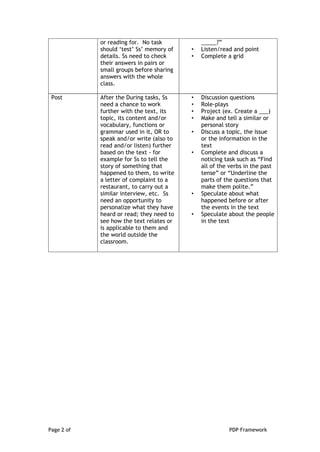
or reading for. No task
should ‘test’ Ss’ memory of
details. Ss need to check
their answers in pairs or
small groups before sharing
answers with the whole
class.
_____?”
• Listen/read and point
• Complete a grid
Post After the During tasks, Ss
need a chance to work
further with the text, its
topic, its content and/or
vocabulary, functions or
grammar used in it, OR to
speak and/or write (also to
read and/or listen) further
based on the text - for
example for Ss to tell the
story of something that
happened to them, to write
a letter of complaint to a
restaurant, to carry out a
similar interview, etc. Ss
need an opportunity to
personalize what they have
heard or read; they need to
see how the text relates or
is applicable to them and
the world outside the
classroom.
• Discussion questions
• Role-plays
• Project (ex. Create a ___)
• Make and tell a similar or
personal story
• Discuss a topic, the issue
or the information in the
text
• Complete and discuss a
noticing task such as “Find
all of the verbs in the past
tense” or “Underline the
parts of the questions that
make them polite.”
• Speculate about what
happened before or after
the events in the text
• Speculate about the people
in the text
Page 2 of PDP Framework

PDP framework

  • 1.
    The PDP Framework Thislesson framework helps teachers plan and deliver effective listening, video and reading lessons. The framework is based on research and using it helps ensure students are motivated, engaged and active before, while and after (pre, during and post – PDP) listening to, watching or reading a text. The stages of the framework are: • Pre Ss prepare to listen: Ø they talk about their knowledge or and experience with the topic of the listening or reading Ø they understand the meaning of key vocabulary in the text Ø they understand what they will listen or read for in the text before they begin working with it Ø they can make predictions about what the text will be about. • During Ss focus their attention on the listening or reading text and complete tasks which develop and deepen their understanding of the text progressively (i.e., from simpler and more general to more complex and more specific). They can also do tasks that help them develop specific listening and reading skills. • Post Ss extend and integrate the understanding and knowledge they gained from working with the listening or reading text into other skills areas or contexts. Stage Rationale Sample Activities Pre In most cases, Ss did not choose to listen to, watch or read the text so they need to develop an interest and desire to work with it. Ss need to know key vocabulary they will hear or see, and they need to understand why they are going to listen to/ watch/ read the text. • Word splash • Match vocabulary to pictures • Categorize vocabulary under headings • Predict from a headline, title, group of words, pictures, etc • Arrange pictures in the order to be confirmed or changed after listening to, reading the text • Talk about the main topic(s) During Ss do a series of tasks which help them understand the text and which may help them develop listening and reading skills. The first task(s) should help Ss understand the text at a very general, non-specific level. Then, tasks can move Ss into a more detailed and deeper understanding of the text. Before they do each task, Ss need to know what they are listening, watching • Listen/read and draw • Answer general information (gist) questions such as “What are they talking about?” “Do the speakers sound happy or upset?” • Listen/read and arrange pictures or events in order • Listen/read and find the mistakes • Listen/read and answer detail questions such as “What did they say about Page 1 of PDP Framework
  • 2.
    or reading for.No task should ‘test’ Ss’ memory of details. Ss need to check their answers in pairs or small groups before sharing answers with the whole class. _____?” • Listen/read and point • Complete a grid Post After the During tasks, Ss need a chance to work further with the text, its topic, its content and/or vocabulary, functions or grammar used in it, OR to speak and/or write (also to read and/or listen) further based on the text - for example for Ss to tell the story of something that happened to them, to write a letter of complaint to a restaurant, to carry out a similar interview, etc. Ss need an opportunity to personalize what they have heard or read; they need to see how the text relates or is applicable to them and the world outside the classroom. • Discussion questions • Role-plays • Project (ex. Create a ___) • Make and tell a similar or personal story • Discuss a topic, the issue or the information in the text • Complete and discuss a noticing task such as “Find all of the verbs in the past tense” or “Underline the parts of the questions that make them polite.” • Speculate about what happened before or after the events in the text • Speculate about the people in the text Page 2 of PDP Framework