K-Nearest Neighbor
Different Learning Methods
 Eager Learning
 Explicit description of target function on
the whole training set
 Instance-based Learning
 Learning=storing all training instances
 Classification=assigning target function
to a new instance
 Referred to as “Lazy” learning
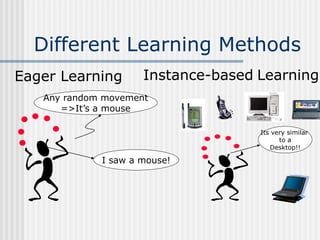
Different Learning Methods
Eager Learning
Any random movement
=>It’s a mouse
I saw a mouse!
Its very similar
to a
Desktop!!
Instance-based Learning
 K-Nearest Neighbor Algorithm
 Weighted Regression
 Case-based reasoning
 KNN algorithm is one of the simplest classification
algorithm
 non-parametric
 it does not make any assumptions on the underlying data
distribution
 lazy learning algorithm.
 there is no explicit training phase or it is very minimal.
 also means that the training phase is pretty fast .
 Lack of generalization means that KNN keeps all the training
data.
 Its purpose is to use a database in which the data
points are separated into several classes to predict
the classification of a new sample point.
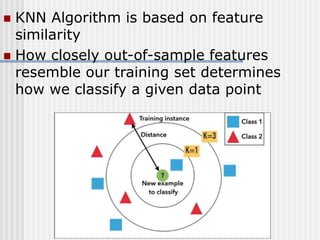
 KNN Algorithm is based on feature
similarity
 How closely out-of-sample features
resemble our training set determines
how we classify a given data point
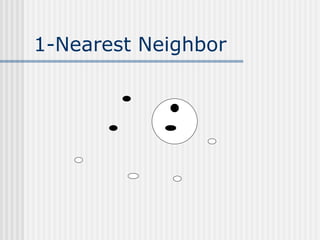
1-Nearest Neighbor
3-Nearest Neighbor
Classification steps
1. Training phase: a model is constructed
from the training instances.
 classification algorithm finds relationships
between predictors and targets
 relationships are summarised in a model
2. Testing phase: test the model on a test
sample whose class labels are known but
not used for training the model
3. Usage phase: use the model for
classification on new data whose class
labels are unknown
K-Nearest Neighbor
 Features
 All instances correspond to points in an
n-dimensional Euclidean space
 Classification is delayed till a new
instance arrives
 Classification done by comparing
feature vectors of the different points
 Target function may be discrete or real-
valued
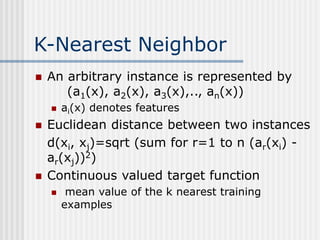
K-Nearest Neighbor
 An arbitrary instance is represented by
(a1(x), a2(x), a3(x),.., an(x))
 ai(x) denotes features
 Euclidean distance between two instances
d(xi, xj)=sqrt (sum for r=1 to n (ar(xi) -
ar(xj))2)
 Continuous valued target function
 mean value of the k nearest training
examples
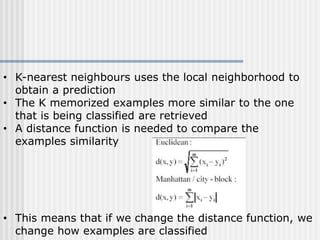
• K-nearest neighbours uses the local neighborhood to
obtain a prediction
• The K memorized examples more similar to the one
that is being classified are retrieved
• A distance function is needed to compare the
examples similarity
• This means that if we change the distance function, we
change how examples are classified
 If the ranges of the features differ,
feaures with bigger values will
dominate decision
 In general feature values are
normalized prior to distance
calculation
Voronoi Diagram
 Decision surface formed by the
training examples
Voronoi diagram
 We frequently need to find the
nearest hospital, surgery or
supermarket.
 A map divided into cells, each cell
covering the region closest to a
particular centre, can assist us in
our quest.
Remarks
+Highly effective inductive inference
method for noisy training data and
complex target functions
+Target function for a whole space
may be described as a combination
of less complex local approximations
+Learning is very simple
- Classification is time consuming
Remarks
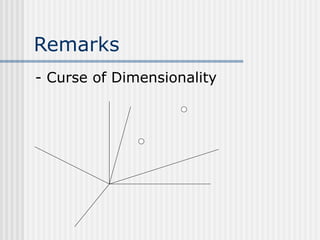
- Curse of Dimensionality
Remarks
- Curse of Dimensionality
Remarks
- Curse of Dimensionality
Remarks
 Efficient memory indexing
 To retrieve the stored training examples
(kd-tree)

instance bases k nearest neighbor algorithm.ppt

  • 1.
  • 2.
    Different Learning Methods Eager Learning  Explicit description of target function on the whole training set  Instance-based Learning  Learning=storing all training instances  Classification=assigning target function to a new instance  Referred to as “Lazy” learning
  • 3.
    Different Learning Methods EagerLearning Any random movement =>It’s a mouse I saw a mouse! Its very similar to a Desktop!! Instance-based Learning
  • 4.
    Instance-based Learning  K-NearestNeighbor Algorithm  Weighted Regression  Case-based reasoning
  • 5.
     KNN algorithmis one of the simplest classification algorithm  non-parametric  it does not make any assumptions on the underlying data distribution  lazy learning algorithm.  there is no explicit training phase or it is very minimal.  also means that the training phase is pretty fast .  Lack of generalization means that KNN keeps all the training data.  Its purpose is to use a database in which the data points are separated into several classes to predict the classification of a new sample point.
  • 6.
     KNN Algorithmis based on feature similarity  How closely out-of-sample features resemble our training set determines how we classify a given data point
  • 7.
  • 8.
  • 9.
    Classification steps 1. Trainingphase: a model is constructed from the training instances.  classification algorithm finds relationships between predictors and targets  relationships are summarised in a model 2. Testing phase: test the model on a test sample whose class labels are known but not used for training the model 3. Usage phase: use the model for classification on new data whose class labels are unknown
  • 10.
    K-Nearest Neighbor  Features All instances correspond to points in an n-dimensional Euclidean space  Classification is delayed till a new instance arrives  Classification done by comparing feature vectors of the different points  Target function may be discrete or real- valued
  • 11.
    K-Nearest Neighbor  Anarbitrary instance is represented by (a1(x), a2(x), a3(x),.., an(x))  ai(x) denotes features  Euclidean distance between two instances d(xi, xj)=sqrt (sum for r=1 to n (ar(xi) - ar(xj))2)  Continuous valued target function  mean value of the k nearest training examples
  • 12.
    • K-nearest neighboursuses the local neighborhood to obtain a prediction • The K memorized examples more similar to the one that is being classified are retrieved • A distance function is needed to compare the examples similarity • This means that if we change the distance function, we change how examples are classified
  • 13.
     If theranges of the features differ, feaures with bigger values will dominate decision  In general feature values are normalized prior to distance calculation
  • 14.
    Voronoi Diagram  Decisionsurface formed by the training examples
  • 15.
    Voronoi diagram  Wefrequently need to find the nearest hospital, surgery or supermarket.  A map divided into cells, each cell covering the region closest to a particular centre, can assist us in our quest.
  • 16.
    Remarks +Highly effective inductiveinference method for noisy training data and complex target functions +Target function for a whole space may be described as a combination of less complex local approximations +Learning is very simple - Classification is time consuming
  • 17.
    Remarks - Curse ofDimensionality
  • 18.
    Remarks - Curse ofDimensionality
  • 19.
    Remarks - Curse ofDimensionality
  • 20.
    Remarks  Efficient memoryindexing  To retrieve the stored training examples (kd-tree)