ADVANCED COMPUTER
GRAPHICS
CS 4360 – FALL 2024
WEEK 1 – COURSE
INTRODUCTION
YOMNA HASSAN
Based on the course: Tecnologias de
Jogos de Vídeo, Abel Gomes
COURSE CONTENT
01
WHAT IS EXPECTED FROM THE COURSE
1- Overview
Welcome to the advanced graphics programming course! In this course builds on the computer
graphics programming concepts introduced in CS 4350. Students are given a deeper
understanding of the components of the 3D graphics pipeline, and how they are used in modern
graphical applications. Topics include advanced texture mapping, practical uses of vertex and
pixel shaders, screen post-processing, particle systems, and graphics engine design. We hope
that you find Computer Graphics to be challenging, interesting, and rewarding.
2- Expected Background and Review Material
No extensive CS background is required in this course. Basic mathematical operations
knowledge would be assistive in understanding some examples represented in this course.
Prerequisites: Students should have successfully completed CS-4350.
WHAT IS EXPECTED FROM THE COURSE
3- Intended Learning Outcomes
On completion of this course, students should be able to:
LO1. Demonstrate an understanding of computer graphics algorithms for rendering
optimization.
LO2. Interpret the culling and scene management techniques to enhance computer graphics
scenes.
LO3. Demonstrate an understanding of the current techniques used for modern computer
graphics pipeline.
LO4. Create computer graphics algorithms for scene optimization.
LO5: Demonstrate an understanding of computer graphics post-processing techniques.
WHAT IS EXPECTED FROM THE COURSE
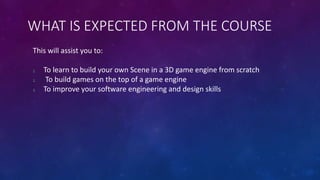
This will assist you to:
1. To learn to build your own Scene in a 3D game engine from scratch
2. To build games on the top of a game engine
3. To improve your software engineering and design skills
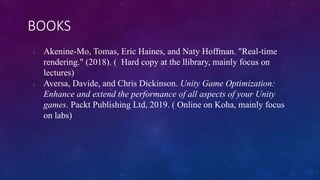
BOOKS
1. Akenine-Mo, Tomas, Eric Haines, and Naty Hoffman. "Real-time
rendering." (2018). ( Hard copy at the llibrary, mainly focus on
lectures)
2. Aversa, Davide, and Chris Dickinson. Unity Game Optimization:
Enhance and extend the performance of all aspects of your Unity
games. Packt Publishing Ltd, 2019. ( Online on Koha, mainly focus
on labs)
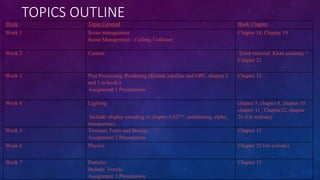
TOPICS OUTLINE
Week Topic Covered Book Chapter
Week 1 Scene management
Scene Management : Culling, Collision
Chapter 18, Chapter 19
Week 2 Camera Extra material: Khan academy +
Chapter 22
Week 3 Post Processing, Rendering (Include pipeline and GPU, chapter 2
and 3 in book))
Assignment 1 Presentation
Chapter 12
Week 4 Lighting
Include: display encoding in chapter 5.6)???: antialiasing, alpha,
transparency.
chapter 5, chapter 8, chapter 10,
chapter 11 , Chapter22, chapter
26 (On website)
Week 5 Textures, Fonts and Storage
Assignment 2 Presentation
Chapter 15
Week 6 Physics Chapter 25 (on website)
Week 7 Particles
Include: Voxels
Assignment 3 Presentation
Chapter 13
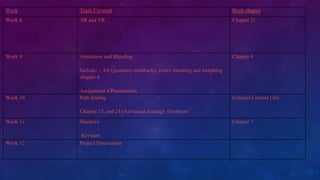
Week Topic Covered Book chapter
Week 8 AR and VR Chapter 21
Week 9 Animation and Blending
Include: : 4.6 (geometry cashback), vertex blending and morphing
chapter 4
Assignment 4 Presentation
Chapter 4
Week 10 Path finding
Chapter 23, and 24 (Advanced reading): Hardware
External Content (AI)
Week 11 Shadows
Revision
Chapter 7
Week 12 Project Discussions
COURSE
REGULATIONS
02
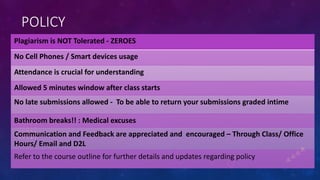
POLICY
Plagiarism is NOT Tolerated - ZEROES
No Cell Phones / Smart devices usage
Attendance is crucial for understanding
Allowed 5 minutes window after class starts
No late submissions allowed - To be able to return your submissions graded intime
Bathroom breaks!! : Medical excuses
Communication and Feedback are appreciated and encouraged – Through Class/ Office
Hours/ Email and D2L
Refer to the course outline for further details and updates regarding policy
SUBMISSIONS
03
SUBMISSIONS
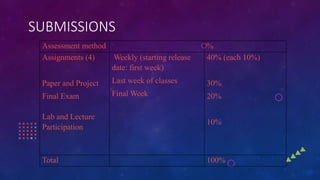
Assessment method %
Assignments (4)
Paper and Project
Final Exam
Lab and Lecture
Participation
Weekly (starting release
date: first week)
Last week of classes
Final Week
40% (each 10%)
30%
20%
10%
Total 100%
SUBMISSIONS
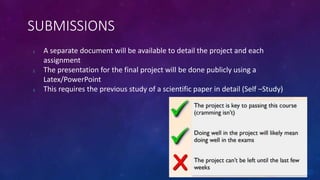
1. A separate document will be available to detail the project and each
assignment
2. The presentation for the final project will be done publicly using a
Latex/PowerPoint
3. This requires the previous study of a scientific paper in detail (Self –Study)
PLAGIRISM
BACKGROUND
SURVEY
04
Who took academic writing?
PLATFORMS AND
TOOLS
05
TOOLS
1. Overleaf IEEE conference Template:
IEEE Conference Template - Overleaf, Online LaTeX Editor
2. Unity 3D (Download Unity Hub)
GAME ENGINE
GRAPHICS (RENDERING) ENGINE
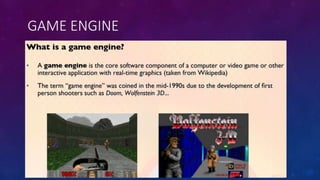
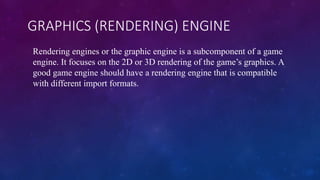
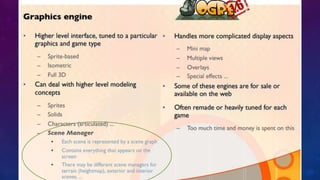
Rendering engines or the graphic engine is a subcomponent of a game
engine. It focuses on the 2D or 3D rendering of the game’s graphics. A
good game engine should have a rendering engine that is compatible
with different import formats.
W1_CourseIntroduction.pptx advancedgraphics

W1_CourseIntroduction.pptx advancedgraphics

  • 1.
    ADVANCED COMPUTER GRAPHICS CS 4360– FALL 2024 WEEK 1 – COURSE INTRODUCTION YOMNA HASSAN Based on the course: Tecnologias de Jogos de Vídeo, Abel Gomes
  • 2.
  • 3.
    WHAT IS EXPECTEDFROM THE COURSE 1- Overview Welcome to the advanced graphics programming course! In this course builds on the computer graphics programming concepts introduced in CS 4350. Students are given a deeper understanding of the components of the 3D graphics pipeline, and how they are used in modern graphical applications. Topics include advanced texture mapping, practical uses of vertex and pixel shaders, screen post-processing, particle systems, and graphics engine design. We hope that you find Computer Graphics to be challenging, interesting, and rewarding. 2- Expected Background and Review Material No extensive CS background is required in this course. Basic mathematical operations knowledge would be assistive in understanding some examples represented in this course. Prerequisites: Students should have successfully completed CS-4350.
  • 4.
    WHAT IS EXPECTEDFROM THE COURSE 3- Intended Learning Outcomes On completion of this course, students should be able to: LO1. Demonstrate an understanding of computer graphics algorithms for rendering optimization. LO2. Interpret the culling and scene management techniques to enhance computer graphics scenes. LO3. Demonstrate an understanding of the current techniques used for modern computer graphics pipeline. LO4. Create computer graphics algorithms for scene optimization. LO5: Demonstrate an understanding of computer graphics post-processing techniques.
  • 5.
    WHAT IS EXPECTEDFROM THE COURSE This will assist you to: 1. To learn to build your own Scene in a 3D game engine from scratch 2. To build games on the top of a game engine 3. To improve your software engineering and design skills
  • 6.
    BOOKS 1. Akenine-Mo, Tomas,Eric Haines, and Naty Hoffman. "Real-time rendering." (2018). ( Hard copy at the llibrary, mainly focus on lectures) 2. Aversa, Davide, and Chris Dickinson. Unity Game Optimization: Enhance and extend the performance of all aspects of your Unity games. Packt Publishing Ltd, 2019. ( Online on Koha, mainly focus on labs)
  • 7.
    TOPICS OUTLINE Week TopicCovered Book Chapter Week 1 Scene management Scene Management : Culling, Collision Chapter 18, Chapter 19 Week 2 Camera Extra material: Khan academy + Chapter 22 Week 3 Post Processing, Rendering (Include pipeline and GPU, chapter 2 and 3 in book)) Assignment 1 Presentation Chapter 12 Week 4 Lighting Include: display encoding in chapter 5.6)???: antialiasing, alpha, transparency. chapter 5, chapter 8, chapter 10, chapter 11 , Chapter22, chapter 26 (On website) Week 5 Textures, Fonts and Storage Assignment 2 Presentation Chapter 15 Week 6 Physics Chapter 25 (on website) Week 7 Particles Include: Voxels Assignment 3 Presentation Chapter 13
  • 8.
    Week Topic CoveredBook chapter Week 8 AR and VR Chapter 21 Week 9 Animation and Blending Include: : 4.6 (geometry cashback), vertex blending and morphing chapter 4 Assignment 4 Presentation Chapter 4 Week 10 Path finding Chapter 23, and 24 (Advanced reading): Hardware External Content (AI) Week 11 Shadows Revision Chapter 7 Week 12 Project Discussions
  • 9.
  • 10.
    POLICY Plagiarism is NOTTolerated - ZEROES No Cell Phones / Smart devices usage Attendance is crucial for understanding Allowed 5 minutes window after class starts No late submissions allowed - To be able to return your submissions graded intime Bathroom breaks!! : Medical excuses Communication and Feedback are appreciated and encouraged – Through Class/ Office Hours/ Email and D2L Refer to the course outline for further details and updates regarding policy
  • 11.
  • 12.
    SUBMISSIONS Assessment method % Assignments(4) Paper and Project Final Exam Lab and Lecture Participation Weekly (starting release date: first week) Last week of classes Final Week 40% (each 10%) 30% 20% 10% Total 100%
  • 13.
    SUBMISSIONS 1. A separatedocument will be available to detail the project and each assignment 2. The presentation for the final project will be done publicly using a Latex/PowerPoint 3. This requires the previous study of a scientific paper in detail (Self –Study)
  • 14.
  • 15.
  • 16.
  • 17.
  • 18.
    TOOLS 1. Overleaf IEEEconference Template: IEEE Conference Template - Overleaf, Online LaTeX Editor 2. Unity 3D (Download Unity Hub)
  • 19.
  • 21.
    GRAPHICS (RENDERING) ENGINE Renderingengines or the graphic engine is a subcomponent of a game engine. It focuses on the 2D or 3D rendering of the game’s graphics. A good game engine should have a rendering engine that is compatible with different import formats.