Today we will learn and reflect on the Reconstruction and the Jim Crow Redemption
eras following the Civil War, and some stories on the Civil Rights struggles through
the New Deal and World War II era.
Southerners were stubborn, Southerners were intransigent, Southerners could
never accept St Paul’s declaration that “There is neither Jew nor Greek, there is
neither slave nor free, there is neither male nor female; for you are all one in Christ
Jesus.” It was incomprehensible that Southerners, and many Northerners, would
ever regard negroes as equal to free white men, in their eyes, negroes were inferior,
they would always be subservient. General Sherman may have burned Atlanta and
destroyed livestock, crops, and railroads in his mark to the sea; General Grant may
have continually fought and flanked Robert E Lee until he was cornered and cut off
from supplies at Appomattox; these two Union generals may have momentarily
exhausted the ability of the South to continue the war; but the true Civil War to
change racial attitudes is a war that is being fought to this very day.
Our primary source will be lecture notes from the Yale
University undergraduate class lectures by Professor
Holloway for his African American History class, these are
the other videos where we explore stories from these Yale
lectures.
At the end of our talk, we will discuss the sources used for
this video. Feel free to follow along in the PowerPoint
script we uploaded to SlideShare. Please, we welcome
interesting questions in the comments. Let us learn and
reflect together!
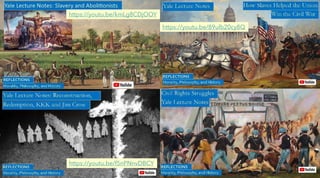
https://youtu.be/kmLg8CDjOOY
https://youtu.be/89ulb20cy8Q
https://youtu.be/f5nPNnvDBCY
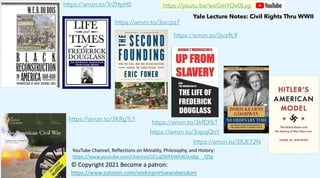
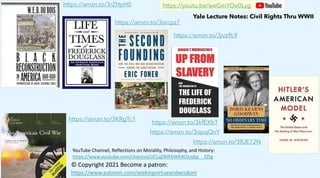
https://amzn.to/3KRgTc1
https://amzn.to/3orcpz7
https://amzn.to/3jvz9L9
https://amzn.to/3rZHpH0
© Copyright 2021 Become a patron:
https://www.patreon.com/seekingvirtueandwisdom
YouTube Channel, Reflections on Morality, Philosophy, and History:
https://www.youtube.com/channel/UCLqDkfFbWhXOnzdjp__YZtg
https://amzn.to/3kfEXbT
Yale Lecture Notes: Civil Rights Thru WWII
https://youtu.be/weGmYOe0Lyg
https://amzn.to/3fUE72N
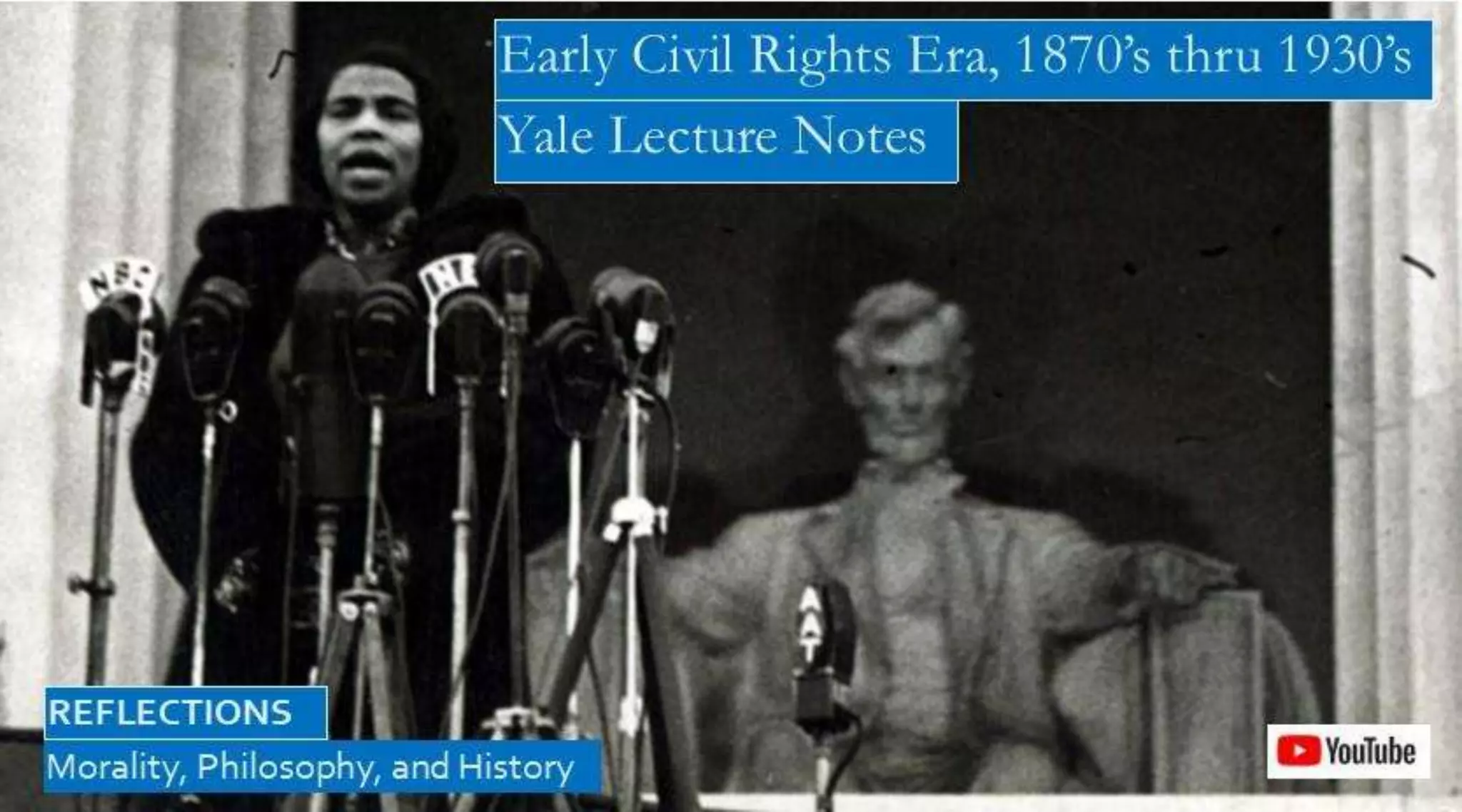
https://amzn.to/3opqQnY
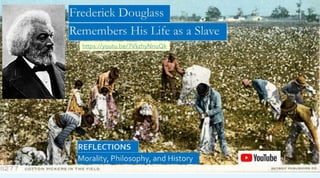
You can view the early Civil Rights black leaders as belonging to
three generations. Frederick Douglass, who escaped from slavery
in the 1830’s, belonged to the first generation of black leaders.
We reviewed his best-selling slave autobiography, his abolitionist
readers wanted to know what life as a slave was like.
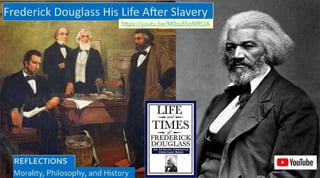
And we also have a second video of his later autobiography
where he describes his Civil War experiences, when he lobbied
Lincoln to allow blacks to serve in the Union Army, and his
experiences as an abolitionist black leader after the Civil War.
https://youtu.be/7VkzhyNnuQk
https://youtu.be/M0sx85oMRQA
There have been disagreements among the Civil Rights leaders, particularly in the
decades following the Redemption era. There was definite tension between those
who were followers of Booker T Washington, the accommodationist, and WEB
Dubois, the activist. They are like the good cop and bad cop of early Civil Rights
history.
Booker T Washington and WEB Dubois both lived a long life. Booker T Washington
lived from 1856 through 1915 and was the last black leader who witnessed the
emancipation of slaves during the Civil War; he was a second-generation black
leader. WEB Dubois lived from 1868 through 1963 ; he was a third-generation
black leader, he was a founder of both the Niagara Conference and the
NAACP. WEB Dubois earned his PhD in history from Harvard and was part of the
Talented Tenth movement who believed that black leaders should seek higher
education to better enable them to champion the causes of their race.
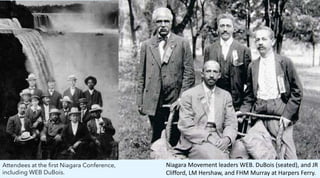
Niagara Movement leaders WEB. DuBois (seated), and JR
Clifford, LM Hershaw, and FHM Murray at Harpers Ferry.
Attendees at the first Niagara Conference,
including WEB DuBois.
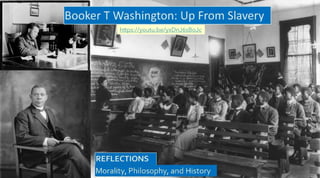
Booker T Washington was the first President of the Tuskegee Institute in
Alabama, a black school that taught blacks practical agricultural and
technical skills so they could get the best jobs that were available to
them. He lived in the worst of the Jim Crow years where lynchings and
Jim Crow cruelties were at their height. This message of humility and
subservience was a popular message among the white elites, and he was
able to tap the white philanthropists like Carnegie, JC Penney,
Rockefeller, Taft and Eastman among others, to establish half a dozen
more black schools across the south. Though publicly he distanced
himself from the younger activists like WEB Dubois, privately and
secretly he helped fund the NAACP and the activities of WEB Dubois.
https://youtu.be/yxDnJ6sBoJc
Booker T. Washington’s most famous speech was at
the 1895 Cotton States and International Exposition
at Atlanta, Georgia.
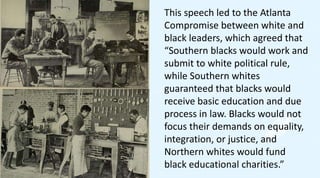
This speech led to the Atlanta
Compromise between white and
black leaders, which agreed that
“Southern blacks would work and
submit to white political rule,
while Southern whites
guaranteed that blacks would
receive basic education and due
process in law. Blacks would not
focus their demands on equality,
integration, or justice, and
Northern whites would fund
black educational charities.”
This likely led to Washington receiving more funds
for his endeavors to uplift his black students, but had
little effect on providing blacks with more due
process since it did not address restoring black
voting rights.
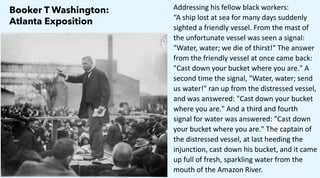
Addressing his fellow black workers:
“A ship lost at sea for many days suddenly
sighted a friendly vessel. From the mast of
the unfortunate vessel was seen a signal:
"Water, water; we die of thirst!" The answer
from the friendly vessel at once came back:
"Cast down your bucket where you are." A
second time the signal, "Water, water; send
us water!" ran up from the distressed vessel,
and was answered: "Cast down your bucket
where you are." And a third and fourth
signal for water was answered: "Cast down
your bucket where you are." The captain of
the distressed vessel, at last heeding the
injunction, cast down his bucket, and it came
up full of fresh, sparkling water from the
mouth of the Amazon River.
Booker T Washington:
Atlanta Exposition
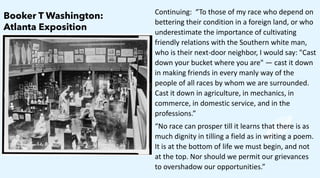
Continuing: “To those of my race who depend on
bettering their condition in a foreign land, or who
underestimate the importance of cultivating
friendly relations with the Southern white man,
who is their next-door neighbor, I would say: "Cast
down your bucket where you are" — cast it down
in making friends in every manly way of the
people of all races by whom we are surrounded.
Cast it down in agriculture, in mechanics, in
commerce, in domestic service, and in the
professions.”
“No race can prosper till it learns that there is as
much dignity in tilling a field as in writing a poem.
It is at the bottom of life we must begin, and not
at the top. Nor should we permit our grievances
to overshadow our opportunities.”
Booker T Washington:
Atlanta Exposition
We quote more of speech in our video on Booker T Washington,
including his message to the white businessmen, encouraging
them to hire more black workers, as they are loyal and
dependable employees.
SUPREME COURT DOCTRINE OF SEPARATE BUT EQUAL
In that same year of 1895 the Supreme Court hands down its–
hands down its decision in Plessy v. Ferguson. This was a test case
where Homer Plessy, an octoroon, or someone who had only one
black great-grandparent, bought a ticket for the train’s white-only
coach car, to test a new state law separating the races.
Supreme Court, Washington, DC
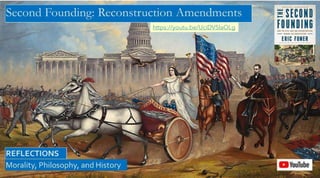
We will take a few slides from our video on Eric Foner’s book on
the Second Founding, on the Reconstruction Amendments.
https://youtu.be/UciDV5laOLg
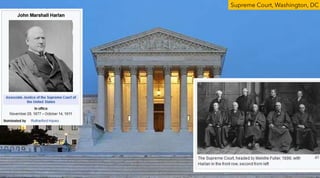
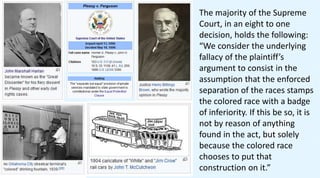
The majority of the Supreme
Court, in an eight to one
decision, holds the following:
“We consider the underlying
fallacy of the plaintiff’s
argument to consist in the
assumption that the enforced
separation of the races stamps
the colored race with a badge
of inferiority. If this be so, it is
not by reason of anything
found in the act, but solely
because the colored race
chooses to put that
construction on it.”
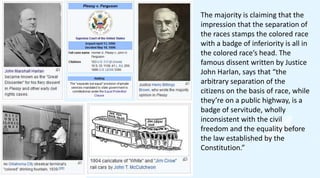
The majority is claiming that the
impression that the separation of
the races stamps the colored race
with a badge of inferiority is all in
the colored race’s head. The
famous dissent written by Justice
John Harlan, says that “the
arbitrary separation of the
citizens on the basis of race, while
they’re on a public highway, is a
badge of servitude, wholly
inconsistent with the civil
freedom and the equality before
the law established by the
Constitution.”
Professor Holloway states,
“The majority is saying the badge of inferiority is
nonexistent. It’s a construction. It’s in their minds.
And Harlan says exactly the opposite. This initiated
the judicial separate but equal doctrine that would
not be overturned until the 1960’s Civil Rights era.”
WEB DUBOIS, BLACK SCHOLAR AND ACTIVIST
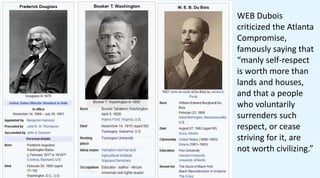
WEB Dubois
criticized the Atlanta
Compromise,
famously saying that
“manly self-respect
is worth more than
lands and houses,
and that a people
who voluntarily
surrenders such
respect, or cease
striving for it, are
not worth civilizing.”
WEB Dubois was more in the next generation, he differed from Booker T
Washington by insisting on civil rights, political power, and higher
education for blacks. While Booker T Washington was giving his speech
at the Atlanta convention, WEB Dubois was earning his PhD at
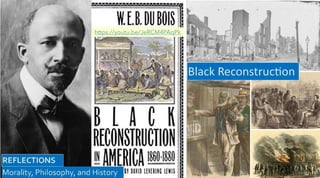
Harvard. WEB Dubois became a teacher and prolific writer, writing Souls
of Black Folk and Black Reconstruction in America, which ran counter to
the then current Reconstruction scholarship influenced by notions of
white supremacy. He was also one of the black leaders who founded the
NAACP, and was active in the NAACP for many decades. During this time
he edited the NAACP monthly magazine, The Crisis. We have a video
reviewing his book on Black Reconstruction.
https://youtu.be/JeRCM4PAqPk
WEB Dubois caused
controversy when
he encourages
blacks to sign up to
fight in World War
I. He writes, “This is
the crisis of the
world. Let us, while
this war lasts, forget
our special
grievances and
close our ranks
shoulder to
shoulder with our
white citizens and
the allied nations
that are fighting for
democracy.”
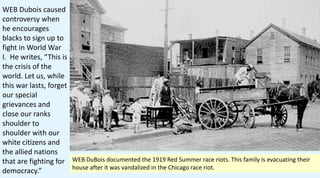
WEB DuBois documented the 1919 Red Summer race riots. This family is evacuating their
house after it was vandalized in the Chicago race riot.
In the summer of 1919, when the black soldiers were
returning home from World War I, race riots, where
whites attacked and often burned black
communities, where blacks had no legal recourse,
and were often arrested although they were the
victims of the riots, erupted in cities across the
country.
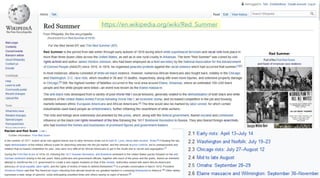
https://en.wikipedia.org/wiki/Red_Summer
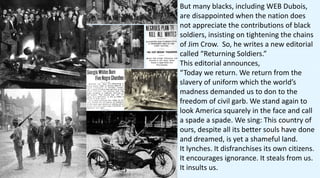
But many blacks, including WEB Dubois,
are disappointed when the nation does
not appreciate the contributions of black
soldiers, insisting on tightening the chains
of Jim Crow. So, he writes a new editorial
called “Returning Soldiers.”
This editorial announces,
“Today we return. We return from the
slavery of uniform which the world’s
madness demanded us to don to the
freedom of civil garb. We stand again to
look America squarely in the face and call
a spade a spade. We sing: This country of
ours, despite all its better souls have done
and dreamed, is yet a shameful land.
It lynches. It disfranchises its own citizens.
It encourages ignorance. It steals from us.
It insults us.
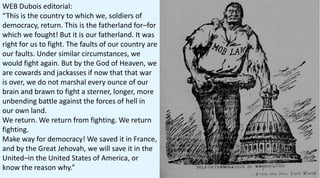
WEB Dubois editorial:
“This is the country to which we, soldiers of
democracy, return. This is the fatherland for–for
which we fought! But it is our fatherland. It was
right for us to fight. The faults of our country are
our faults. Under similar circumstances, we
would fight again. But by the God of Heaven, we
are cowards and jackasses if now that that war
is over, we do not marshal every ounce of our
brain and brawn to fight a sterner, longer, more
unbending battle against the forces of hell in
our own land.
We return. We return from fighting. We return
fighting.
Make way for democracy! We saved it in France,
and by the Great Jehovah, we will save it in the
United–in the United States of America, or
know the reason why.”
NEW DEAL AND MARION ANDERSON CONCERT
The Democratic Party embraced progressive ideas in its New Deal
policies that established government welfare programs to help the
unemployed and destitute, and created the Social Security program to
benefit ordinary workers when they were too old to work. The New
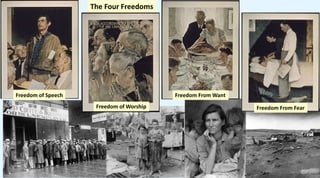
Deal ethos was revealed in the 1941 Four Freedoms speech, that
declared that people everywhere in the world ought to enjoy the Four
Freedoms of freedom of speech, freedom of worship, freedom from
want, and freedom from fear. Our fight against fascism gave FDR room
to further their Civil Rights agenda so our ideological enemies would
not embarrass us by pointing out injustices to our black and poor
citizens.
Freedom of Speech
Freedom of Worship Freedom From Fear
Freedom From Want
The Four Freedoms
The Democratic Party at the time of the New Deal included
socialists, civil rights activists, and Deep South good-old-boy
white supremacists under the same big tent. Often the New
Deal programs would benefit all the poor, including the black
poor, but sometimes when the New Deal programs were
administered by local officials in the Deep South blacks were
specifically excluded from the New Deal programs.
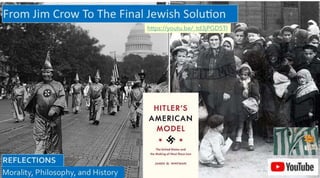
We will take a few slides from our video, From Jim Crow to the
Final Jewish Solution, where we discuss the lynching bill and
Eleanor Roosevelt, drawing from Doris Kearns biography, No
Ordinary Time.
https://youtu.be/_td3jPGD5TI
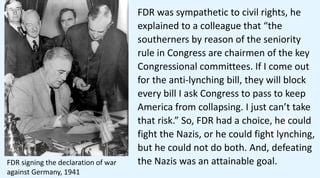
FDR was sympathetic to civil rights, he
explained to a colleague that “the
southerners by reason of the seniority
rule in Congress are chairmen of the key
Congressional committees. If I come out
for the anti-lynching bill, they will block
every bill I ask Congress to pass to keep
America from collapsing. I just can’t take
that risk.” So, FDR had a choice, he could
fight the Nazis, or he could fight lynching,
but he could not do both. And, defeating
the Nazis was an attainable goal.
FDR signing the declaration of war
against Germany, 1941
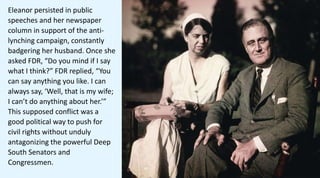
Eleanor persisted in public
speeches and her newspaper
column in support of the anti-
lynching campaign, constantly
badgering her husband. Once she
asked FDR, “Do you mind if I say
what I think?” FDR replied, “You
can say anything you like. I can
always say, ‘Well, that is my wife;
I can’t do anything about her.’”
This supposed conflict was a
good political way to push for
civil rights without unduly
antagonizing the powerful Deep
South Senators and
Congressmen.
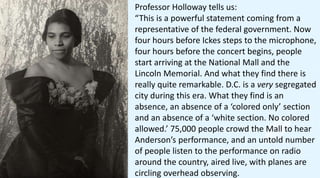
One famous example is Eleanor’s intervention to host the Marion Anderson
concert. Marion Anderson was both black and was considered by high society in
Europe to be one of the world’s greatest contralto opera singers. Howard University
was planning to invite her to give a concert in Washington but was having trouble
finding a concert hall. The DAR, Daughters of the American Revolution, had a
suitable concert hall, but their policy excluded blacks both from the audience and
the stage. They try to book her at the white high school auditorium, the Board of
Education said they would make an exception to allow a one-time integrated
performance. They refused to change their policy permanently, they did not want
this to be a precedent to break from their separate but equal practice.
Eleanor Roosevelt gets involved, writes a scathing column in the newspaper, and
makes this headline news. She enlists the aid of Howard Ickes, Secretary of the
Interior, to permit Marion Anderson to perform at the National Mall at the foot of
the Lincoln Memorial.
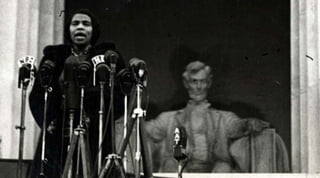
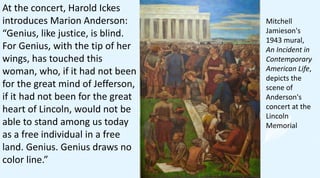
At the concert, Harold Ickes
introduces Marion Anderson:
“Genius, like justice, is blind.
For Genius, with the tip of her
wings, has touched this
woman, who, if it had not been
for the great mind of Jefferson,
if it had not been for the great
heart of Lincoln, would not be
able to stand among us today
as a free individual in a free
land. Genius. Genius draws no
color line.”
Mitchell
Jamieson's
1943 mural,
An Incident in
Contemporary
American Life,
depicts the
scene of
Anderson's
concert at the
Lincoln
Memorial
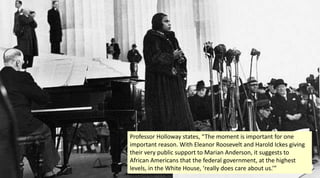
Professor Holloway tells us:
“This is a powerful statement coming from a
representative of the federal government. Now
four hours before Ickes steps to the microphone,
four hours before the concert begins, people
start arriving at the National Mall and the
Lincoln Memorial. And what they find there is
really quite remarkable. D.C. is a very segregated
city during this era. What they find is an
absence, an absence of a ‘colored only’ section
and an absence of a ‘white section. No colored
allowed.’ 75,000 people crowd the Mall to hear
Anderson’s performance, and an untold number
of people listen to the performance on radio
around the country, aired live, with planes are
circling overhead observing.
Professor Holloway states, “The moment is important for one
important reason. With Eleanor Roosevelt and Harold Ickes giving
their very public support to Marian Anderson, it suggests to
African Americans that the federal government, at the highest
levels, in the White House, ‘really does care about us.’”
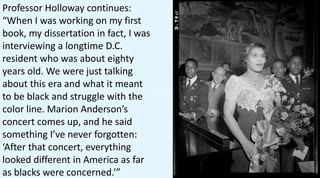
Professor Holloway continues:
“When I was working on my first
book, my dissertation in fact, I was
interviewing a longtime D.C.
resident who was about eighty
years old. We were just talking
about this era and what it meant
to be black and struggle with the
color line. Marion Anderson’s
concert comes up, and he said
something I’ve never forgotten:
‘After that concert, everything
looked different in America as far
as blacks were concerned.’”
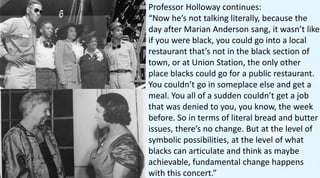
Professor Holloway continues:
“Now he’s not talking literally, because the
day after Marian Anderson sang, it wasn’t like
if you were black, you could go into a local
restaurant that’s not in the black section of
town, or at Union Station, the only other
place blacks could go for a public restaurant.
You couldn’t go in someplace else and get a
meal. You all of a sudden couldn’t get a job
that was denied to you, you know, the week
before. So in terms of literal bread and butter
issues, there’s no change. But at the level of
symbolic possibilities, at the level of what
blacks can articulate and think as maybe
achievable, fundamental change happens
with this concert.”
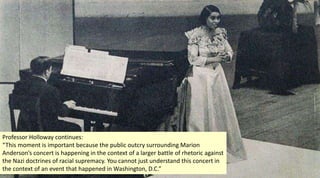
Professor Holloway continues:
“This moment is important because the public outcry surrounding Marion
Anderson’s concert is happening in the context of a larger battle of rhetoric against
the Nazi doctrines of racial supremacy. You cannot just understand this concert in
the context of an event that happened in Washington, D.C.”
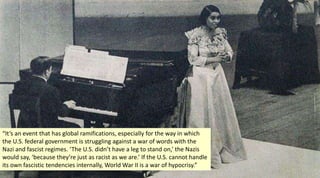
“It’s an event that has global ramifications, especially for the way in which
the U.S. federal government is struggling against a war of words with the
Nazi and fascist regimes. ‘The U.S. didn’t have a leg to stand on,’ the Nazis
would say, ‘because they’re just as racist as we are.’ If the U.S. cannot handle
its own fascistic tendencies internally, World War II is a war of hypocrisy.”
SOURCES:
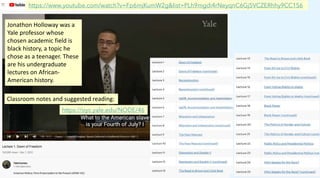
Jonathon Holloway was a Yale professor whose chosen academic field is
black history, a topic he chose as a teenager. These are his
undergraduate lectures on African-American history. As you can see, the
first six lectures cover this history through Reconstruction, the
remaindering nineteen courses cover the history of Jim Crow and the
Civil Rights Era.
https://www.youtube.com/watch?v=Fp6mjKumW2g&list=PLh9mgdi4rNeyqnC6Gj5VCZERhhy9CC1S6
Jonathon Holloway was a
Yale professor whose
chosen academic field is
black history, a topic he
chose as a teenager. These
are his undergraduate
lectures on African-
American history.
Classroom notes and suggested reading:
https://oyc.yale.edu/NODE/46
Professor David Blight’s lectures on The Civil War and
Reconstruction Era 1845-1877 have a different
perspective. He gives us background on Southern culture
for the first few lectures, the following history lectures
quickly pick up the pace. He covers many topics more
important for American history like the pre-Civil War
history of the Polk administration and the acquisition of
Texas and California, Henry Clay and the Compromise of
1850, and how the Republican Party formed from the
ashes of the Whig, Free Labor and other parties.
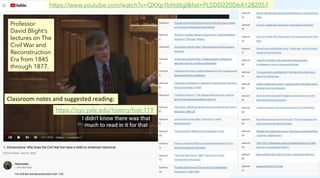
https://www.youtube.com/watch?v=QXXp1bHd6gI&list=PL5DD220D6A1282057
Professor
David Blight’s
lectures on The
Civil War and
Reconstruction
Era from 1845
through 1877.
Classroom notes and suggested reading:
https://oyc.yale.edu/history/hist-119
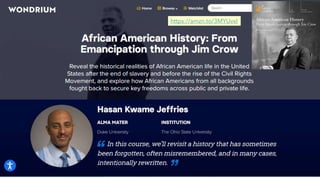
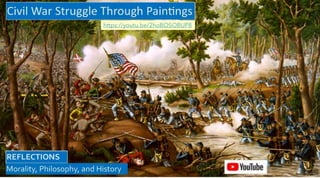
Wondrium has recently released, in 2022, a video on civil rights
through the years of Jim Crow. We also have a video of Civil
War through Paintings, that also uses a Wondrium course on
conventional Civil War history by Thomas Gallagher.
https://amzn.to/3MYUvxI
https://youtu.be/2hoBOSOBUP8
https://wp.me/pachSU-tQ
https://www.patreon.com/seekingvirtueandwisdom
https://www.meetup.com/Reflections/
https://amzn.to/3KRgTc1
https://amzn.to/3orcpz7
https://amzn.to/3jvz9L9
https://amzn.to/3rZHpH0
© Copyright 2021 Become a patron:
https://www.patreon.com/seekingvirtueandwisdom
YouTube Channel, Reflections on Morality, Philosophy, and History:
https://www.youtube.com/channel/UCLqDkfFbWhXOnzdjp__YZtg
https://amzn.to/3kfEXbT
Yale Lecture Notes: Civil Rights Thru WWII
https://youtu.be/weGmYOe0Lyg
https://amzn.to/3fUE72N
https://amzn.to/3opqQnY
https://www.patreon.com/seekingvirtueandwisdom
To find the source of any direct
quotes in this blog, please type in
the phrase to the search box in
my blog to see the referenced
footnote.
YouTube Description has links for:
• Script PDF file
• Blog
• Amazon Bookstore
© Copyright 2021
Blog and YouTube Description
include links for Amazon books
and lectures mentioned, please
support our channel with these
affiliate commissions.
Link to blog: https://wp.me/pachSU-q3
https://www.youtube.com/channel/UCLqDkfFbWhXOnzdjp__YZtg/

YaleLecturesCivilRightsEarly SS.pdf

  • 2.
    Today we willlearn and reflect on the Reconstruction and the Jim Crow Redemption eras following the Civil War, and some stories on the Civil Rights struggles through the New Deal and World War II era. Southerners were stubborn, Southerners were intransigent, Southerners could never accept St Paul’s declaration that “There is neither Jew nor Greek, there is neither slave nor free, there is neither male nor female; for you are all one in Christ Jesus.” It was incomprehensible that Southerners, and many Northerners, would ever regard negroes as equal to free white men, in their eyes, negroes were inferior, they would always be subservient. General Sherman may have burned Atlanta and destroyed livestock, crops, and railroads in his mark to the sea; General Grant may have continually fought and flanked Robert E Lee until he was cornered and cut off from supplies at Appomattox; these two Union generals may have momentarily exhausted the ability of the South to continue the war; but the true Civil War to change racial attitudes is a war that is being fought to this very day.
  • 3.
    Our primary sourcewill be lecture notes from the Yale University undergraduate class lectures by Professor Holloway for his African American History class, these are the other videos where we explore stories from these Yale lectures. At the end of our talk, we will discuss the sources used for this video. Feel free to follow along in the PowerPoint script we uploaded to SlideShare. Please, we welcome interesting questions in the comments. Let us learn and reflect together!
  • 4.
  • 5.
    https://amzn.to/3KRgTc1 https://amzn.to/3orcpz7 https://amzn.to/3jvz9L9 https://amzn.to/3rZHpH0 © Copyright 2021Become a patron: https://www.patreon.com/seekingvirtueandwisdom YouTube Channel, Reflections on Morality, Philosophy, and History: https://www.youtube.com/channel/UCLqDkfFbWhXOnzdjp__YZtg https://amzn.to/3kfEXbT Yale Lecture Notes: Civil Rights Thru WWII https://youtu.be/weGmYOe0Lyg https://amzn.to/3fUE72N https://amzn.to/3opqQnY
  • 6.
    You can viewthe early Civil Rights black leaders as belonging to three generations. Frederick Douglass, who escaped from slavery in the 1830’s, belonged to the first generation of black leaders. We reviewed his best-selling slave autobiography, his abolitionist readers wanted to know what life as a slave was like. And we also have a second video of his later autobiography where he describes his Civil War experiences, when he lobbied Lincoln to allow blacks to serve in the Union Army, and his experiences as an abolitionist black leader after the Civil War.
  • 7.
  • 8.
  • 9.
    There have beendisagreements among the Civil Rights leaders, particularly in the decades following the Redemption era. There was definite tension between those who were followers of Booker T Washington, the accommodationist, and WEB Dubois, the activist. They are like the good cop and bad cop of early Civil Rights history. Booker T Washington and WEB Dubois both lived a long life. Booker T Washington lived from 1856 through 1915 and was the last black leader who witnessed the emancipation of slaves during the Civil War; he was a second-generation black leader. WEB Dubois lived from 1868 through 1963 ; he was a third-generation black leader, he was a founder of both the Niagara Conference and the NAACP. WEB Dubois earned his PhD in history from Harvard and was part of the Talented Tenth movement who believed that black leaders should seek higher education to better enable them to champion the causes of their race.
  • 10.
    Niagara Movement leadersWEB. DuBois (seated), and JR Clifford, LM Hershaw, and FHM Murray at Harpers Ferry. Attendees at the first Niagara Conference, including WEB DuBois.
  • 11.
    Booker T Washingtonwas the first President of the Tuskegee Institute in Alabama, a black school that taught blacks practical agricultural and technical skills so they could get the best jobs that were available to them. He lived in the worst of the Jim Crow years where lynchings and Jim Crow cruelties were at their height. This message of humility and subservience was a popular message among the white elites, and he was able to tap the white philanthropists like Carnegie, JC Penney, Rockefeller, Taft and Eastman among others, to establish half a dozen more black schools across the south. Though publicly he distanced himself from the younger activists like WEB Dubois, privately and secretly he helped fund the NAACP and the activities of WEB Dubois.
  • 12.
  • 13.
    Booker T. Washington’smost famous speech was at the 1895 Cotton States and International Exposition at Atlanta, Georgia.
  • 14.
    This speech ledto the Atlanta Compromise between white and black leaders, which agreed that “Southern blacks would work and submit to white political rule, while Southern whites guaranteed that blacks would receive basic education and due process in law. Blacks would not focus their demands on equality, integration, or justice, and Northern whites would fund black educational charities.”
  • 15.
    This likely ledto Washington receiving more funds for his endeavors to uplift his black students, but had little effect on providing blacks with more due process since it did not address restoring black voting rights.
  • 16.
    Addressing his fellowblack workers: “A ship lost at sea for many days suddenly sighted a friendly vessel. From the mast of the unfortunate vessel was seen a signal: "Water, water; we die of thirst!" The answer from the friendly vessel at once came back: "Cast down your bucket where you are." A second time the signal, "Water, water; send us water!" ran up from the distressed vessel, and was answered: "Cast down your bucket where you are." And a third and fourth signal for water was answered: "Cast down your bucket where you are." The captain of the distressed vessel, at last heeding the injunction, cast down his bucket, and it came up full of fresh, sparkling water from the mouth of the Amazon River. Booker T Washington: Atlanta Exposition
  • 17.
    Continuing: “To thoseof my race who depend on bettering their condition in a foreign land, or who underestimate the importance of cultivating friendly relations with the Southern white man, who is their next-door neighbor, I would say: "Cast down your bucket where you are" — cast it down in making friends in every manly way of the people of all races by whom we are surrounded. Cast it down in agriculture, in mechanics, in commerce, in domestic service, and in the professions.” “No race can prosper till it learns that there is as much dignity in tilling a field as in writing a poem. It is at the bottom of life we must begin, and not at the top. Nor should we permit our grievances to overshadow our opportunities.” Booker T Washington: Atlanta Exposition
  • 18.
    We quote moreof speech in our video on Booker T Washington, including his message to the white businessmen, encouraging them to hire more black workers, as they are loyal and dependable employees. SUPREME COURT DOCTRINE OF SEPARATE BUT EQUAL In that same year of 1895 the Supreme Court hands down its– hands down its decision in Plessy v. Ferguson. This was a test case where Homer Plessy, an octoroon, or someone who had only one black great-grandparent, bought a ticket for the train’s white-only coach car, to test a new state law separating the races.
  • 19.
  • 20.
    We will takea few slides from our video on Eric Foner’s book on the Second Founding, on the Reconstruction Amendments.
  • 21.
  • 22.
    The majority ofthe Supreme Court, in an eight to one decision, holds the following: “We consider the underlying fallacy of the plaintiff’s argument to consist in the assumption that the enforced separation of the races stamps the colored race with a badge of inferiority. If this be so, it is not by reason of anything found in the act, but solely because the colored race chooses to put that construction on it.”
  • 23.
    The majority isclaiming that the impression that the separation of the races stamps the colored race with a badge of inferiority is all in the colored race’s head. The famous dissent written by Justice John Harlan, says that “the arbitrary separation of the citizens on the basis of race, while they’re on a public highway, is a badge of servitude, wholly inconsistent with the civil freedom and the equality before the law established by the Constitution.”
  • 24.
    Professor Holloway states, “Themajority is saying the badge of inferiority is nonexistent. It’s a construction. It’s in their minds. And Harlan says exactly the opposite. This initiated the judicial separate but equal doctrine that would not be overturned until the 1960’s Civil Rights era.” WEB DUBOIS, BLACK SCHOLAR AND ACTIVIST
  • 25.
    WEB Dubois criticized theAtlanta Compromise, famously saying that “manly self-respect is worth more than lands and houses, and that a people who voluntarily surrenders such respect, or cease striving for it, are not worth civilizing.”
  • 26.
    WEB Dubois wasmore in the next generation, he differed from Booker T Washington by insisting on civil rights, political power, and higher education for blacks. While Booker T Washington was giving his speech at the Atlanta convention, WEB Dubois was earning his PhD at Harvard. WEB Dubois became a teacher and prolific writer, writing Souls of Black Folk and Black Reconstruction in America, which ran counter to the then current Reconstruction scholarship influenced by notions of white supremacy. He was also one of the black leaders who founded the NAACP, and was active in the NAACP for many decades. During this time he edited the NAACP monthly magazine, The Crisis. We have a video reviewing his book on Black Reconstruction.
  • 27.
  • 28.
    WEB Dubois caused controversywhen he encourages blacks to sign up to fight in World War I. He writes, “This is the crisis of the world. Let us, while this war lasts, forget our special grievances and close our ranks shoulder to shoulder with our white citizens and the allied nations that are fighting for democracy.” WEB DuBois documented the 1919 Red Summer race riots. This family is evacuating their house after it was vandalized in the Chicago race riot.
  • 29.
    In the summerof 1919, when the black soldiers were returning home from World War I, race riots, where whites attacked and often burned black communities, where blacks had no legal recourse, and were often arrested although they were the victims of the riots, erupted in cities across the country.
  • 30.
  • 31.
    But many blacks,including WEB Dubois, are disappointed when the nation does not appreciate the contributions of black soldiers, insisting on tightening the chains of Jim Crow. So, he writes a new editorial called “Returning Soldiers.” This editorial announces, “Today we return. We return from the slavery of uniform which the world’s madness demanded us to don to the freedom of civil garb. We stand again to look America squarely in the face and call a spade a spade. We sing: This country of ours, despite all its better souls have done and dreamed, is yet a shameful land. It lynches. It disfranchises its own citizens. It encourages ignorance. It steals from us. It insults us.
  • 32.
    WEB Dubois editorial: “Thisis the country to which we, soldiers of democracy, return. This is the fatherland for–for which we fought! But it is our fatherland. It was right for us to fight. The faults of our country are our faults. Under similar circumstances, we would fight again. But by the God of Heaven, we are cowards and jackasses if now that that war is over, we do not marshal every ounce of our brain and brawn to fight a sterner, longer, more unbending battle against the forces of hell in our own land. We return. We return from fighting. We return fighting. Make way for democracy! We saved it in France, and by the Great Jehovah, we will save it in the United–in the United States of America, or know the reason why.”
  • 33.
    NEW DEAL ANDMARION ANDERSON CONCERT The Democratic Party embraced progressive ideas in its New Deal policies that established government welfare programs to help the unemployed and destitute, and created the Social Security program to benefit ordinary workers when they were too old to work. The New Deal ethos was revealed in the 1941 Four Freedoms speech, that declared that people everywhere in the world ought to enjoy the Four Freedoms of freedom of speech, freedom of worship, freedom from want, and freedom from fear. Our fight against fascism gave FDR room to further their Civil Rights agenda so our ideological enemies would not embarrass us by pointing out injustices to our black and poor citizens.
  • 34.
    Freedom of Speech Freedomof Worship Freedom From Fear Freedom From Want The Four Freedoms
  • 35.
    The Democratic Partyat the time of the New Deal included socialists, civil rights activists, and Deep South good-old-boy white supremacists under the same big tent. Often the New Deal programs would benefit all the poor, including the black poor, but sometimes when the New Deal programs were administered by local officials in the Deep South blacks were specifically excluded from the New Deal programs. We will take a few slides from our video, From Jim Crow to the Final Jewish Solution, where we discuss the lynching bill and Eleanor Roosevelt, drawing from Doris Kearns biography, No Ordinary Time.
  • 36.
  • 37.
    FDR was sympatheticto civil rights, he explained to a colleague that “the southerners by reason of the seniority rule in Congress are chairmen of the key Congressional committees. If I come out for the anti-lynching bill, they will block every bill I ask Congress to pass to keep America from collapsing. I just can’t take that risk.” So, FDR had a choice, he could fight the Nazis, or he could fight lynching, but he could not do both. And, defeating the Nazis was an attainable goal. FDR signing the declaration of war against Germany, 1941
  • 38.
    Eleanor persisted inpublic speeches and her newspaper column in support of the anti- lynching campaign, constantly badgering her husband. Once she asked FDR, “Do you mind if I say what I think?” FDR replied, “You can say anything you like. I can always say, ‘Well, that is my wife; I can’t do anything about her.’” This supposed conflict was a good political way to push for civil rights without unduly antagonizing the powerful Deep South Senators and Congressmen.
  • 39.
    One famous exampleis Eleanor’s intervention to host the Marion Anderson concert. Marion Anderson was both black and was considered by high society in Europe to be one of the world’s greatest contralto opera singers. Howard University was planning to invite her to give a concert in Washington but was having trouble finding a concert hall. The DAR, Daughters of the American Revolution, had a suitable concert hall, but their policy excluded blacks both from the audience and the stage. They try to book her at the white high school auditorium, the Board of Education said they would make an exception to allow a one-time integrated performance. They refused to change their policy permanently, they did not want this to be a precedent to break from their separate but equal practice. Eleanor Roosevelt gets involved, writes a scathing column in the newspaper, and makes this headline news. She enlists the aid of Howard Ickes, Secretary of the Interior, to permit Marion Anderson to perform at the National Mall at the foot of the Lincoln Memorial.
  • 41.
    At the concert,Harold Ickes introduces Marion Anderson: “Genius, like justice, is blind. For Genius, with the tip of her wings, has touched this woman, who, if it had not been for the great mind of Jefferson, if it had not been for the great heart of Lincoln, would not be able to stand among us today as a free individual in a free land. Genius. Genius draws no color line.” Mitchell Jamieson's 1943 mural, An Incident in Contemporary American Life, depicts the scene of Anderson's concert at the Lincoln Memorial
  • 42.
    Professor Holloway tellsus: “This is a powerful statement coming from a representative of the federal government. Now four hours before Ickes steps to the microphone, four hours before the concert begins, people start arriving at the National Mall and the Lincoln Memorial. And what they find there is really quite remarkable. D.C. is a very segregated city during this era. What they find is an absence, an absence of a ‘colored only’ section and an absence of a ‘white section. No colored allowed.’ 75,000 people crowd the Mall to hear Anderson’s performance, and an untold number of people listen to the performance on radio around the country, aired live, with planes are circling overhead observing.
  • 43.
    Professor Holloway states,“The moment is important for one important reason. With Eleanor Roosevelt and Harold Ickes giving their very public support to Marian Anderson, it suggests to African Americans that the federal government, at the highest levels, in the White House, ‘really does care about us.’”
  • 44.
    Professor Holloway continues: “WhenI was working on my first book, my dissertation in fact, I was interviewing a longtime D.C. resident who was about eighty years old. We were just talking about this era and what it meant to be black and struggle with the color line. Marion Anderson’s concert comes up, and he said something I’ve never forgotten: ‘After that concert, everything looked different in America as far as blacks were concerned.’”
  • 45.
    Professor Holloway continues: “Nowhe’s not talking literally, because the day after Marian Anderson sang, it wasn’t like if you were black, you could go into a local restaurant that’s not in the black section of town, or at Union Station, the only other place blacks could go for a public restaurant. You couldn’t go in someplace else and get a meal. You all of a sudden couldn’t get a job that was denied to you, you know, the week before. So in terms of literal bread and butter issues, there’s no change. But at the level of symbolic possibilities, at the level of what blacks can articulate and think as maybe achievable, fundamental change happens with this concert.”
  • 46.
    Professor Holloway continues: “Thismoment is important because the public outcry surrounding Marion Anderson’s concert is happening in the context of a larger battle of rhetoric against the Nazi doctrines of racial supremacy. You cannot just understand this concert in the context of an event that happened in Washington, D.C.”
  • 47.
    “It’s an eventthat has global ramifications, especially for the way in which the U.S. federal government is struggling against a war of words with the Nazi and fascist regimes. ‘The U.S. didn’t have a leg to stand on,’ the Nazis would say, ‘because they’re just as racist as we are.’ If the U.S. cannot handle its own fascistic tendencies internally, World War II is a war of hypocrisy.”
  • 48.
    SOURCES: Jonathon Holloway wasa Yale professor whose chosen academic field is black history, a topic he chose as a teenager. These are his undergraduate lectures on African-American history. As you can see, the first six lectures cover this history through Reconstruction, the remaindering nineteen courses cover the history of Jim Crow and the Civil Rights Era.
  • 49.
    https://www.youtube.com/watch?v=Fp6mjKumW2g&list=PLh9mgdi4rNeyqnC6Gj5VCZERhhy9CC1S6 Jonathon Holloway wasa Yale professor whose chosen academic field is black history, a topic he chose as a teenager. These are his undergraduate lectures on African- American history. Classroom notes and suggested reading: https://oyc.yale.edu/NODE/46
  • 50.
    Professor David Blight’slectures on The Civil War and Reconstruction Era 1845-1877 have a different perspective. He gives us background on Southern culture for the first few lectures, the following history lectures quickly pick up the pace. He covers many topics more important for American history like the pre-Civil War history of the Polk administration and the acquisition of Texas and California, Henry Clay and the Compromise of 1850, and how the Republican Party formed from the ashes of the Whig, Free Labor and other parties.
  • 51.
    https://www.youtube.com/watch?v=QXXp1bHd6gI&list=PL5DD220D6A1282057 Professor David Blight’s lectures onThe Civil War and Reconstruction Era from 1845 through 1877. Classroom notes and suggested reading: https://oyc.yale.edu/history/hist-119
  • 52.
    Wondrium has recentlyreleased, in 2022, a video on civil rights through the years of Jim Crow. We also have a video of Civil War through Paintings, that also uses a Wondrium course on conventional Civil War history by Thomas Gallagher.
  • 53.
  • 54.
  • 55.
  • 56.
  • 57.
    https://amzn.to/3KRgTc1 https://amzn.to/3orcpz7 https://amzn.to/3jvz9L9 https://amzn.to/3rZHpH0 © Copyright 2021Become a patron: https://www.patreon.com/seekingvirtueandwisdom YouTube Channel, Reflections on Morality, Philosophy, and History: https://www.youtube.com/channel/UCLqDkfFbWhXOnzdjp__YZtg https://amzn.to/3kfEXbT Yale Lecture Notes: Civil Rights Thru WWII https://youtu.be/weGmYOe0Lyg https://amzn.to/3fUE72N https://amzn.to/3opqQnY
  • 58.
  • 59.
    To find thesource of any direct quotes in this blog, please type in the phrase to the search box in my blog to see the referenced footnote. YouTube Description has links for: • Script PDF file • Blog • Amazon Bookstore © Copyright 2021 Blog and YouTube Description include links for Amazon books and lectures mentioned, please support our channel with these affiliate commissions. Link to blog: https://wp.me/pachSU-q3
  • 60.