NATIONAL CONFERENCE & EXHIBITION 2014 
Vulnerable Customers 
Presented by Paul Bonello 
ANZ Banking Group 
Platinum Sponsor 
Silver Sponsor Bronze Sponsor 
Risk Manager of the Year 
Award Sponsor 
Conference and Exhibition Partners
Vulnerable customers and Elder abuse 
National Conference & Exhibition 2014 
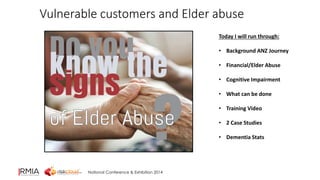
Today I will run through: 
• Background ANZ Journey 
• Financial/Elder Abuse 
• Cognitive Impairment 
• What can be done 
• Training Video 
• 2 Case Studies 
• Dementia Stats
Vulnerable customers and Elder abuse 
National Conference & Exhibition 2014 
Background 
Banks have a responsibility to ensure that their customers can conduct their banking safely and securely. Some people may have 
restricted physical or mental capacity in which to conduct their banking activities and require additional support. 
In 2013 a working group was formed at ANZ to implement a process to address the growing issue of Vulnerable Customers and 
Elder Abuse. 
Representatives from Risk, Legal, Customer Advocate team, Complaints, Retail and Operations worked together to implement a 
process to enable Frontline staff to escalate cases where they suspect Cognitive Impairment or abuse. 
We engaged with the Office of the Public Advocate, Senior Rights Victoria and other State Advocate bodies to understand their 
process for escalation. 
This was further emphasized when the ABA issued Industry guidelines in June 2013 advising Institutions on protecting vulnerable 
customers from potential financial abuse. 
The guideline is voluntary and has been developed with input from and agreed with member banks. Member banks are encouraged 
to follow this industry guideline and incorporate it into their internal process, procedures and policies.
Vulnerable customers and Elder abuse 
What is financial / elder abuse? 
Financial abuse can take many forms and it usually consists of a number of actions over a period of time, rather than a single event. 
A ‘financial abuser’ can be someone you hardly know or someone you have known for many years. 
They could be family members, friends, acquaintances or strangers who befriend you. They may also be professionals or caregivers 
employed to help you. 
A financial abuser is anyone who manipulates, threatens, pressures or otherwise influences you to gain access to your money, 
property or other valuables. Abusers often take advantage of the trust or power they are given. 
Examples of financial / elder abuse includes and is not limited to: 
National Conference & Exhibition 2014 
• Taking money or property 
• Forging an older person's signature 
• Getting an older person to sign a deed, will, or power of attorney through deception, coercion, or undue influence 
• Using the older person's property or possessions without permission 
• Telemarketing scams. Perpetrators call victims and use deception, scare tactics, or exaggerated claims to get them to send money. 
They may also make charges against victims' credit cards without authorization (i.e. Nigerian money scam, online dating, South 
African diamond scam)
Vulnerable customers and Elder abuse 
National Conference & Exhibition 2014
Vulnerable customers and Elder abuse 
Financial abuse transition points 
Risk factors for financial abuse include transition points in an older person’s life, such as: 
• Widowhood for a woman with little or no experience with financial matters 
• When an older person’s health is changing and he/she begins relying on new-found male or female friends 
• When cognitive capacity is starting to decrease 
• When a person becomes dependent on others to aid with banking or shopping 
Some key indicators of evidence of financial / elder abuse 
• Increase in withdrawals from bank accounts or transfers between accounts to third parties of high value 
• Unpaid bills, eviction notices, or notices to discontinue utilities (i.e. power, water) 
• Suspicious signatures on cheques / withdrawal slips or other documents 
• New “best” friends 
• Family members or third parties (i.e. carers, church members) attending the branch with the customer coercing / influencing 
them to withdraw large amounts of funds 
National Conference & Exhibition 2014 
Common perpetrators 
• Family members, including children, grandchildren, or spouses. (They may for example have substance abuse, gambling, or 
financial problems) 
• Unscrupulous professionals or tradesmen who may overcharge for services or products (i.e. cutting lawns, plumbing or roofing 
issues) 
• Use their positions of trust or respect to gain confidence of the vulnerable person.
Vulnerable Customers (Financial Abuse / Cognitive Impairments) 
National Conference & Exhibition 2014 
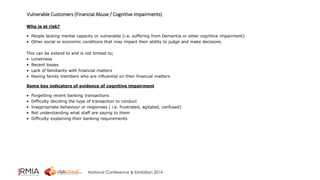
Who is at risk? 
• People lacking mental capacity or vulnerable (i.e. suffering from Dementia or other cognitive impairment) 
• Other social or economic conditions that may impact their ability to judge and make decisions. 
This can be extend to and is not limited to; 
• Loneliness 
• Recent losses 
• Lack of familiarity with financial matters 
• Having family members who are influential on their financial matters 
Some key indicators of evidence of cognitive impairment 
• Forgetting recent banking transactions 
• Difficulty deciding the type of transaction to conduct 
• Inappropriate behaviour or responses ( i.e. frustrated, agitated, confused) 
• Not understanding what staff are saying to them 
• Difficulty explaining their banking requirements
Vulnerable Customers (Financial Abuse / Cognitive Impairments) 
National Conference & Exhibition 2014 
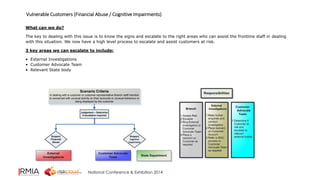
What can we do? 
The key to dealing with this issue is to know the signs and escalate to the right areas who can assist the frontline staff in dealing 
with this situation. We now have a high level process to escalate and assist customers at risk. 
3 key areas we can escalate to include: 
• External Investigations 
• Customer Advocate Team 
• Relevant State body 
Scenario Criteria 
In dealing with a customer or customer representative Branch staff member 
is concerned with unusual activity on their accounts or unusual behaviour is 
being displayed by the customer 
Suspect 
Cognitive 
Impairment 
Suspect 
Financial 
Abuse 
Judgement – Determine 
if escalation required
Vulnerable Customers (Financial Abuse / Cognitive Impairments) 
“Is it Dementia” support video. 
Alzheimer’s Australia has created two short videos targeting the banking and finance industry. These 
are located on the Alzheimer's Association website under “Is it dementia” 
These videos illustrate what frontline staff encounter and provide assistance and advice on: 
• what to expect 
• how to respond and 
• what pro-active measures you could put in place to assist your customers 
http://isitdementia.com.au/banking.html 
National Conference & Exhibition 2014
Vulnerable Customers (Financial Abuse / Cognitive Impairments) 
National Conference & Exhibition 2014 
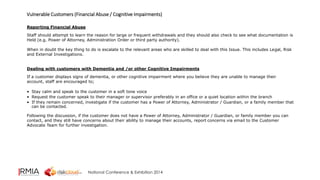
Reporting Financial Abuse 
Staff should attempt to learn the reason for large or frequent withdrawals and they should also check to see what documentation is 
Held (e.g. Power of Attorney, Administration Order or third party authority). 
When in doubt the key thing to do is escalate to the relevant areas who are skilled to deal with this Issue. This includes Legal, Risk 
and External Investigations. 
Dealing with customers with Dementia and /or other Cognitive Impairments 
If a customer displays signs of dementia, or other cognitive impairment where you believe they are unable to manage their 
account, staff are encouraged to; 
• Stay calm and speak to the customer in a soft tone voice 
• Request the customer speak to their manager or supervisor preferably in an office or a quiet location within the branch 
• If they remain concerned, investigate if the customer has a Power of Attorney, Administrator / Guardian, or a family member that 
can be contacted. 
Following the discussion, if the customer does not have a Power of Attorney, Administrator / Guardian, or family member you can 
contact, and they still have concerns about their ability to manage their accounts, report concerns via email to the Customer 
Advocate Team for further investigation.
Vulnerable Customers (Financial Abuse / Cognitive Impairments) 
National Conference & Exhibition 2014 
Case Study 1 
What would you do? 
• The customer, Ms D, is aged in her nineties and has significant funds held in Term Deposit. 
• Her Son, Mr D accompanies her to the branch advising the staff that she is now living with him and he is her primary carer 
• Mr D later attends the branch with his mother and a POA signed by his mother is provided. 
• Mr D advises the branch that he would like to withdraw $300,000 to invest funds for his Mother 
Case Study 2 
• The customer, Ms B, is aged in her sixties and has funds held in a Term Deposit and various Access accounts. 
• Her Son and Husband advise the bank that she has been moved to a Nursing home. Furthermore they sell the family home with 
the proceeds of the sale going solely to Mr B 
• Funds are then progressively removed from her account on a monthly basis. Mr B is not accompanied by his wife when these 
transactions take place
Vulnerable Customers (Financial Abuse / Cognitive Impairments) 
National Conference & Exhibition 2014 
More Information 
Case Study 1 
• Previous History of Cheque Fraud no charges laid as it was her son 
• Instruction to the branch previously not to allow the son access to her funds 
• Son abusive to Staff at their local branch, police called on several occasions 
• Security required for Branch staff for 2 months 
• Escalated to the Advocate Office in Queensland POA suspended pending investigation 
Case Study 2 
• My Mother suffering Dementia 
• Administration order taken out 
• Funds used to buy an Apartment for my father and disabled brother in a retirement village close to my mother 
• Funds removed are for living expenses for my mother
Vulnerable Customers (Financial Abuse / Cognitive Impairments) 
National Conference & Exhibition 2014 
Alzheimer's Stats: 
• Based on current Alzheimer Australia Statistics the total population suffering from Dementia represents almost a Quarter 
of customers across the industry over 65 
Alzheimer's Stats: 
• 65 to 75 year olds with Dementia 10% 
• 76 plus with Dementia 30% 
This equates to: 
$42,000,000,000 Deposits 
$ 8,000,000,000 Lending
Vulnerable Customers (Financial Abuse / Cognitive Impairments) 
Thank you for your time today 
National Conference & Exhibition 2014 
Questions
NATIONAL CONFERENCE & EXHIBITION 2014 
Thank you. 
Platinum Sponsor 
Silver Sponsor Bronze Sponsor 
Risk Manager of the Year 
Award Sponsor 
Conference and Exhibition Partners

Vulnerable Customers

  • 1.
    NATIONAL CONFERENCE &EXHIBITION 2014 Vulnerable Customers Presented by Paul Bonello ANZ Banking Group Platinum Sponsor Silver Sponsor Bronze Sponsor Risk Manager of the Year Award Sponsor Conference and Exhibition Partners
  • 2.
    Vulnerable customers andElder abuse National Conference & Exhibition 2014 Today I will run through: • Background ANZ Journey • Financial/Elder Abuse • Cognitive Impairment • What can be done • Training Video • 2 Case Studies • Dementia Stats
  • 3.
    Vulnerable customers andElder abuse National Conference & Exhibition 2014 Background Banks have a responsibility to ensure that their customers can conduct their banking safely and securely. Some people may have restricted physical or mental capacity in which to conduct their banking activities and require additional support. In 2013 a working group was formed at ANZ to implement a process to address the growing issue of Vulnerable Customers and Elder Abuse. Representatives from Risk, Legal, Customer Advocate team, Complaints, Retail and Operations worked together to implement a process to enable Frontline staff to escalate cases where they suspect Cognitive Impairment or abuse. We engaged with the Office of the Public Advocate, Senior Rights Victoria and other State Advocate bodies to understand their process for escalation. This was further emphasized when the ABA issued Industry guidelines in June 2013 advising Institutions on protecting vulnerable customers from potential financial abuse. The guideline is voluntary and has been developed with input from and agreed with member banks. Member banks are encouraged to follow this industry guideline and incorporate it into their internal process, procedures and policies.
  • 4.
    Vulnerable customers andElder abuse What is financial / elder abuse? Financial abuse can take many forms and it usually consists of a number of actions over a period of time, rather than a single event. A ‘financial abuser’ can be someone you hardly know or someone you have known for many years. They could be family members, friends, acquaintances or strangers who befriend you. They may also be professionals or caregivers employed to help you. A financial abuser is anyone who manipulates, threatens, pressures or otherwise influences you to gain access to your money, property or other valuables. Abusers often take advantage of the trust or power they are given. Examples of financial / elder abuse includes and is not limited to: National Conference & Exhibition 2014 • Taking money or property • Forging an older person's signature • Getting an older person to sign a deed, will, or power of attorney through deception, coercion, or undue influence • Using the older person's property or possessions without permission • Telemarketing scams. Perpetrators call victims and use deception, scare tactics, or exaggerated claims to get them to send money. They may also make charges against victims' credit cards without authorization (i.e. Nigerian money scam, online dating, South African diamond scam)
  • 5.
    Vulnerable customers andElder abuse National Conference & Exhibition 2014
  • 6.
    Vulnerable customers andElder abuse Financial abuse transition points Risk factors for financial abuse include transition points in an older person’s life, such as: • Widowhood for a woman with little or no experience with financial matters • When an older person’s health is changing and he/she begins relying on new-found male or female friends • When cognitive capacity is starting to decrease • When a person becomes dependent on others to aid with banking or shopping Some key indicators of evidence of financial / elder abuse • Increase in withdrawals from bank accounts or transfers between accounts to third parties of high value • Unpaid bills, eviction notices, or notices to discontinue utilities (i.e. power, water) • Suspicious signatures on cheques / withdrawal slips or other documents • New “best” friends • Family members or third parties (i.e. carers, church members) attending the branch with the customer coercing / influencing them to withdraw large amounts of funds National Conference & Exhibition 2014 Common perpetrators • Family members, including children, grandchildren, or spouses. (They may for example have substance abuse, gambling, or financial problems) • Unscrupulous professionals or tradesmen who may overcharge for services or products (i.e. cutting lawns, plumbing or roofing issues) • Use their positions of trust or respect to gain confidence of the vulnerable person.
  • 7.
    Vulnerable Customers (FinancialAbuse / Cognitive Impairments) National Conference & Exhibition 2014 Who is at risk? • People lacking mental capacity or vulnerable (i.e. suffering from Dementia or other cognitive impairment) • Other social or economic conditions that may impact their ability to judge and make decisions. This can be extend to and is not limited to; • Loneliness • Recent losses • Lack of familiarity with financial matters • Having family members who are influential on their financial matters Some key indicators of evidence of cognitive impairment • Forgetting recent banking transactions • Difficulty deciding the type of transaction to conduct • Inappropriate behaviour or responses ( i.e. frustrated, agitated, confused) • Not understanding what staff are saying to them • Difficulty explaining their banking requirements
  • 8.
    Vulnerable Customers (FinancialAbuse / Cognitive Impairments) National Conference & Exhibition 2014 What can we do? The key to dealing with this issue is to know the signs and escalate to the right areas who can assist the frontline staff in dealing with this situation. We now have a high level process to escalate and assist customers at risk. 3 key areas we can escalate to include: • External Investigations • Customer Advocate Team • Relevant State body Scenario Criteria In dealing with a customer or customer representative Branch staff member is concerned with unusual activity on their accounts or unusual behaviour is being displayed by the customer Suspect Cognitive Impairment Suspect Financial Abuse Judgement – Determine if escalation required
  • 9.
    Vulnerable Customers (FinancialAbuse / Cognitive Impairments) “Is it Dementia” support video. Alzheimer’s Australia has created two short videos targeting the banking and finance industry. These are located on the Alzheimer's Association website under “Is it dementia” These videos illustrate what frontline staff encounter and provide assistance and advice on: • what to expect • how to respond and • what pro-active measures you could put in place to assist your customers http://isitdementia.com.au/banking.html National Conference & Exhibition 2014
  • 10.
    Vulnerable Customers (FinancialAbuse / Cognitive Impairments) National Conference & Exhibition 2014 Reporting Financial Abuse Staff should attempt to learn the reason for large or frequent withdrawals and they should also check to see what documentation is Held (e.g. Power of Attorney, Administration Order or third party authority). When in doubt the key thing to do is escalate to the relevant areas who are skilled to deal with this Issue. This includes Legal, Risk and External Investigations. Dealing with customers with Dementia and /or other Cognitive Impairments If a customer displays signs of dementia, or other cognitive impairment where you believe they are unable to manage their account, staff are encouraged to; • Stay calm and speak to the customer in a soft tone voice • Request the customer speak to their manager or supervisor preferably in an office or a quiet location within the branch • If they remain concerned, investigate if the customer has a Power of Attorney, Administrator / Guardian, or a family member that can be contacted. Following the discussion, if the customer does not have a Power of Attorney, Administrator / Guardian, or family member you can contact, and they still have concerns about their ability to manage their accounts, report concerns via email to the Customer Advocate Team for further investigation.
  • 11.
    Vulnerable Customers (FinancialAbuse / Cognitive Impairments) National Conference & Exhibition 2014 Case Study 1 What would you do? • The customer, Ms D, is aged in her nineties and has significant funds held in Term Deposit. • Her Son, Mr D accompanies her to the branch advising the staff that she is now living with him and he is her primary carer • Mr D later attends the branch with his mother and a POA signed by his mother is provided. • Mr D advises the branch that he would like to withdraw $300,000 to invest funds for his Mother Case Study 2 • The customer, Ms B, is aged in her sixties and has funds held in a Term Deposit and various Access accounts. • Her Son and Husband advise the bank that she has been moved to a Nursing home. Furthermore they sell the family home with the proceeds of the sale going solely to Mr B • Funds are then progressively removed from her account on a monthly basis. Mr B is not accompanied by his wife when these transactions take place
  • 12.
    Vulnerable Customers (FinancialAbuse / Cognitive Impairments) National Conference & Exhibition 2014 More Information Case Study 1 • Previous History of Cheque Fraud no charges laid as it was her son • Instruction to the branch previously not to allow the son access to her funds • Son abusive to Staff at their local branch, police called on several occasions • Security required for Branch staff for 2 months • Escalated to the Advocate Office in Queensland POA suspended pending investigation Case Study 2 • My Mother suffering Dementia • Administration order taken out • Funds used to buy an Apartment for my father and disabled brother in a retirement village close to my mother • Funds removed are for living expenses for my mother
  • 13.
    Vulnerable Customers (FinancialAbuse / Cognitive Impairments) National Conference & Exhibition 2014 Alzheimer's Stats: • Based on current Alzheimer Australia Statistics the total population suffering from Dementia represents almost a Quarter of customers across the industry over 65 Alzheimer's Stats: • 65 to 75 year olds with Dementia 10% • 76 plus with Dementia 30% This equates to: $42,000,000,000 Deposits $ 8,000,000,000 Lending
  • 14.
    Vulnerable Customers (FinancialAbuse / Cognitive Impairments) Thank you for your time today National Conference & Exhibition 2014 Questions
  • 15.
    NATIONAL CONFERENCE &EXHIBITION 2014 Thank you. Platinum Sponsor Silver Sponsor Bronze Sponsor Risk Manager of the Year Award Sponsor Conference and Exhibition Partners