What is good customer service?
• The Golden Rule:
–Do unto others as you would have them do
unto you.
• The Platinum Rule:
–Treat others the way they want to be
treated!
• Think about how the person you are helping
would want to be treated. That is more
important than how you want to be treated.
Definition
• “Customer service is the practice of delivering
products and services to both internal and
external customers via the efforts of
employees or through the provision of an
appropriate servicescape.”
YOU are the library
You represent the entire system to
each customer you encounter.
Each of us are responsible for creating a
positive experience for every customer no
matter what.
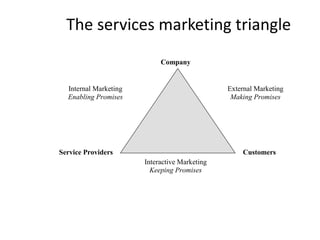
The services marketing triangle
Company
Internal Marketing
Enabling Promises
External Marketing
Making Promises
Service Providers Customers
Interactive Marketing
Keeping Promises
Characteristics of good customer service
• Promptness: the quality or habit of arriving or being on
time.
• Politeness: is the practical application of good manners
or etiquette.
• Professionalism: All customers should be treated
professionally, which means the use of competent
hands and appropriate technology where applicable
• Personalization: is a tailored means of meeting the
customer's needs more effectively and efficiently,
making interactions faster and easier and,
consequently, increasing customer satisfaction and the
likelihood of repeat visits
Skills of Efficient Customer Services
• Patience - to accept or tolerate setbacks, problems, or pressures
• Attentiveness - being alert, observant and attentive) to
customers.
• Good Communication Skills- able to convey information to
customers clearly and simply
• Knowledge of the Library Services
• Ability to Use "Positive Language“
• Ability to "Read" Customers
• Ability to Work under Pressure
• Tenacity - a great work ethic and a willingness
• Willingness to Learn
First Impressions
• By greeting every customer who enters your
library you are establishing a positive first
impression.
• People generally formulate their first
impressions in the first seven seconds.
• You have the power to set a positive or
negative image in those first few seconds.
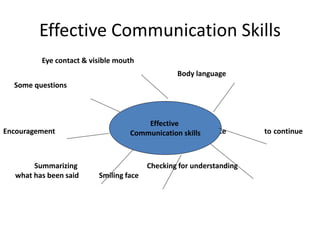
Effective Communication Skills
Eye contact & visible mouth
Body language
Some questions
Encouragement silence to continue
Summarizing Checking for understanding
what has been said Smiling face
Effective
Communication skills
Communicating with customers
• To create a welcoming and positive work environment,
we will…
– be visible, approachable, proactive, and ready to assist
– be professional in attire, language and etiquette
– watch for customers who need help
– make eye contact and greet the customer
– acknowledge promptly (e.g. within two working days) to
external and internal customers be it in person, via email,
phone, or instant message
– actively listen to the customer’s query
– acknowledge waiting customers
• Library staff members take responsibility for seeing
that the customer is satisfied. They:
– Respond confidently to a customer request
– Say, “Let me find out...,” rather than “I don’t know.”
– Offer the customer a positive alternative such as keeping
materials aside until the customer has obtained the
necessary borrower’s identification or referring the
customer to other sources likely to help
– Ask the patron if the question has been answered or if
s/he found what was needed
– In summary, what do most customers really want? They
want someone to acknowledge their presence, listen to
them, and help them obtain what they want.
Listening/Inquiring
• Library staff members are effective in identifying the
customer’s exact need, in a manner that keeps the
customer at ease.
• They respect the needs of those who desire confidentiality
and privacy when dealing with sensitive questions relating
to health conditions or legal issues, including:
– Lower their voice if speaking confidentially to the customer
– Do not use an exasperated tone of voice
– Put a “smile” in their voice
– Do not interrupt
– Listen actively, asking questions as necessary
– Rephrase the customer’s question to check for understanding
– Avoid using library jargon
– Listen to the message and are not influenced by the appearance
or age of the customer
Skills for Customer Service
• Know about your organisation
• Learn the technical parts of the job
• Communicate well
• Be consistent
• Be organised
• Know your place in the team and be a team
player
Exceed Customers Expectations
• Need to understand what customers expect first.
• The most effective way of determining what
customers want is to simply ask them.
- “How can I assist you today?”
- “Is there anything else I can do for you?”
• Never say “I don’t know.” Instead, say “Let me
find the answer for you.”
• Anticipate their needs.

Customer service

  • 3.
    What is goodcustomer service? • The Golden Rule: –Do unto others as you would have them do unto you. • The Platinum Rule: –Treat others the way they want to be treated! • Think about how the person you are helping would want to be treated. That is more important than how you want to be treated.
  • 4.
    Definition • “Customer serviceis the practice of delivering products and services to both internal and external customers via the efforts of employees or through the provision of an appropriate servicescape.”
  • 5.
    YOU are thelibrary You represent the entire system to each customer you encounter.
  • 6.
    Each of usare responsible for creating a positive experience for every customer no matter what.
  • 7.
    The services marketingtriangle Company Internal Marketing Enabling Promises External Marketing Making Promises Service Providers Customers Interactive Marketing Keeping Promises
  • 8.
    Characteristics of goodcustomer service • Promptness: the quality or habit of arriving or being on time. • Politeness: is the practical application of good manners or etiquette. • Professionalism: All customers should be treated professionally, which means the use of competent hands and appropriate technology where applicable • Personalization: is a tailored means of meeting the customer's needs more effectively and efficiently, making interactions faster and easier and, consequently, increasing customer satisfaction and the likelihood of repeat visits
  • 9.
    Skills of EfficientCustomer Services • Patience - to accept or tolerate setbacks, problems, or pressures • Attentiveness - being alert, observant and attentive) to customers. • Good Communication Skills- able to convey information to customers clearly and simply • Knowledge of the Library Services • Ability to Use "Positive Language“ • Ability to "Read" Customers • Ability to Work under Pressure • Tenacity - a great work ethic and a willingness • Willingness to Learn
  • 10.
    First Impressions • Bygreeting every customer who enters your library you are establishing a positive first impression. • People generally formulate their first impressions in the first seven seconds. • You have the power to set a positive or negative image in those first few seconds.
  • 11.
    Effective Communication Skills Eyecontact & visible mouth Body language Some questions Encouragement silence to continue Summarizing Checking for understanding what has been said Smiling face Effective Communication skills
  • 12.
    Communicating with customers •To create a welcoming and positive work environment, we will… – be visible, approachable, proactive, and ready to assist – be professional in attire, language and etiquette – watch for customers who need help – make eye contact and greet the customer – acknowledge promptly (e.g. within two working days) to external and internal customers be it in person, via email, phone, or instant message – actively listen to the customer’s query – acknowledge waiting customers
  • 13.
    • Library staffmembers take responsibility for seeing that the customer is satisfied. They: – Respond confidently to a customer request – Say, “Let me find out...,” rather than “I don’t know.” – Offer the customer a positive alternative such as keeping materials aside until the customer has obtained the necessary borrower’s identification or referring the customer to other sources likely to help – Ask the patron if the question has been answered or if s/he found what was needed – In summary, what do most customers really want? They want someone to acknowledge their presence, listen to them, and help them obtain what they want.
  • 14.
    Listening/Inquiring • Library staffmembers are effective in identifying the customer’s exact need, in a manner that keeps the customer at ease. • They respect the needs of those who desire confidentiality and privacy when dealing with sensitive questions relating to health conditions or legal issues, including: – Lower their voice if speaking confidentially to the customer – Do not use an exasperated tone of voice – Put a “smile” in their voice – Do not interrupt – Listen actively, asking questions as necessary – Rephrase the customer’s question to check for understanding – Avoid using library jargon – Listen to the message and are not influenced by the appearance or age of the customer
  • 15.
    Skills for CustomerService • Know about your organisation • Learn the technical parts of the job • Communicate well • Be consistent • Be organised • Know your place in the team and be a team player
  • 16.
    Exceed Customers Expectations •Need to understand what customers expect first. • The most effective way of determining what customers want is to simply ask them. - “How can I assist you today?” - “Is there anything else I can do for you?” • Never say “I don’t know.” Instead, say “Let me find the answer for you.” • Anticipate their needs.