Aortic Valve Endocarditis Post
Ventricular Septal Defect Device
Closure: Case Report
Yasser Mubarak
Assistant Professor of Cardiothoracic Surgery
Minia University, Egypt.
Abstract
Ventricular septal defect (VSD) is a common congenital heart disease (CHD) in
childhood, and its incidence is about 20% of CHD. Surgical closure is safe procedure
with low mortality. Transcatheter VSD closure offers excellent results. Coil system is
developed for transcatheter VSD occlusion. Infective endocarditis (IE) is a rare but
serious complication after device closure. IE represents a surgical challenge
associated with perioperative mortality.
Introduction
Transcatheter VSD closure is less invasive, has a faster recovery and requires less
hospital stay time. Percutaneous techniques have been developed in order to
reduce the impact of such drawback of surgery. It avoids extracorporeal circulatory
support during surgery and has the benefit of shorter recovery time. The incidence
of IE after device closure of VSD is extremely rare.
Transcatheter VSD closure is reported to be a safe and effective procedure, and
has 94.8% a success rate. Its early complications include HB, device embolization,
AI, TR, hemolysis, and residual shunts. However, Device is a foreign body; IE is
considered a rare complication. Only a few cases with Amplatzer-device associated
endocarditis have been reported in children after closure of atrial septal defects
and two cases were reported after VSD closure.
CASE REPORT
A 25-year-old male patient has history of previous device closure of
perimembranous VSD during childhood. The transcatheter VSD closure
was done successful without residual shunt, intraoperative or
postoperative complications.
He presented by a persistent fever up to 40°C which failed to respond
to one week course of antibiotics. HR was 140 bpm, RR was 30 bpm,
and BP was 100/60 mmHg on admission. A new diastolic murmur was
detected in the aortic area.
Laboratory investigations showed an elevated ESR of 140 mm/h, CRP
of 98 mg/dl, TLC of 30,000/cmm.
Three sets of blood cultures were taken, and all grew Pseudomonas.
Echocardiography (TTE&TEE) revealed vegetation of 20 mm × 5 mm
attached to VSD device and aorta with severe AI.
The patient was started empirically on vancomycin without
improvement clinically or laboratory. Also, he developed anemia,
dyspnea, and signs of heart failure.
Urgent surgical intervention underwent on cardiopulmonary bypass
(CPB). It revealed a destroyed right coronary cusp with vegetation and
necrotic tissues around the coil.
Infected tissue was complete removal and sent to the laboratory for
culture examination.
The coil was extracted and the VSD was closed by Dacron patch using a
continuous Prolene suture. Aortic valve replaced by size 23
bioprosthetic valve. Tricuspid valve tested and repaired.
The bypass and cross clamp time were 37min. and 15 min,
respectively. He required moderate doses of inotropes (adrenaline,
dopamine, and dobutamine) and was continued on antibiotics.
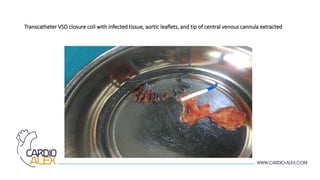
Transcatheter VSD closure coil with infected tissue, aortic leaflets, and tip of central venous cannula extracted
Conclusion
Transcatheter VSD device closure is safe and avoids complications of
surgical closure, however its complications are serious and may need
urgent surgical intervention.
VSD device closure.pptx

VSD device closure.pptx

  • 2.
    Aortic Valve EndocarditisPost Ventricular Septal Defect Device Closure: Case Report Yasser Mubarak Assistant Professor of Cardiothoracic Surgery Minia University, Egypt.
  • 3.
    Abstract Ventricular septal defect(VSD) is a common congenital heart disease (CHD) in childhood, and its incidence is about 20% of CHD. Surgical closure is safe procedure with low mortality. Transcatheter VSD closure offers excellent results. Coil system is developed for transcatheter VSD occlusion. Infective endocarditis (IE) is a rare but serious complication after device closure. IE represents a surgical challenge associated with perioperative mortality.
  • 4.
    Introduction Transcatheter VSD closureis less invasive, has a faster recovery and requires less hospital stay time. Percutaneous techniques have been developed in order to reduce the impact of such drawback of surgery. It avoids extracorporeal circulatory support during surgery and has the benefit of shorter recovery time. The incidence of IE after device closure of VSD is extremely rare.
  • 5.
    Transcatheter VSD closureis reported to be a safe and effective procedure, and has 94.8% a success rate. Its early complications include HB, device embolization, AI, TR, hemolysis, and residual shunts. However, Device is a foreign body; IE is considered a rare complication. Only a few cases with Amplatzer-device associated endocarditis have been reported in children after closure of atrial septal defects and two cases were reported after VSD closure.
  • 6.
    CASE REPORT A 25-year-oldmale patient has history of previous device closure of perimembranous VSD during childhood. The transcatheter VSD closure was done successful without residual shunt, intraoperative or postoperative complications.
  • 7.
    He presented bya persistent fever up to 40°C which failed to respond to one week course of antibiotics. HR was 140 bpm, RR was 30 bpm, and BP was 100/60 mmHg on admission. A new diastolic murmur was detected in the aortic area. Laboratory investigations showed an elevated ESR of 140 mm/h, CRP of 98 mg/dl, TLC of 30,000/cmm.
  • 8.
    Three sets ofblood cultures were taken, and all grew Pseudomonas. Echocardiography (TTE&TEE) revealed vegetation of 20 mm × 5 mm attached to VSD device and aorta with severe AI. The patient was started empirically on vancomycin without improvement clinically or laboratory. Also, he developed anemia, dyspnea, and signs of heart failure.
  • 9.
    Urgent surgical interventionunderwent on cardiopulmonary bypass (CPB). It revealed a destroyed right coronary cusp with vegetation and necrotic tissues around the coil. Infected tissue was complete removal and sent to the laboratory for culture examination.
  • 10.
    The coil wasextracted and the VSD was closed by Dacron patch using a continuous Prolene suture. Aortic valve replaced by size 23 bioprosthetic valve. Tricuspid valve tested and repaired. The bypass and cross clamp time were 37min. and 15 min, respectively. He required moderate doses of inotropes (adrenaline, dopamine, and dobutamine) and was continued on antibiotics.
  • 11.
    Transcatheter VSD closurecoil with infected tissue, aortic leaflets, and tip of central venous cannula extracted
  • 12.
    Conclusion Transcatheter VSD deviceclosure is safe and avoids complications of surgical closure, however its complications are serious and may need urgent surgical intervention.