Quantum Security Groups
       Session

            Dave Lapsley
             @davlaps
           http://slidesha.re/HQvDTk
http://etherpad.openstack.org/quantum-folsom
Session Goals

• Introduction to Nova Security Groups
• Proposal:
  – Move Security Groups from Nova to Quantum
• Discussion:
  – Provider Firewalling
  – Access Control Lists
  – Other
Proposal: move Security Groups
    from Nova to Quantum

    Naturally fit within network API
   Allow plugins to implement them
         in a compatible way
Features and Use Cases
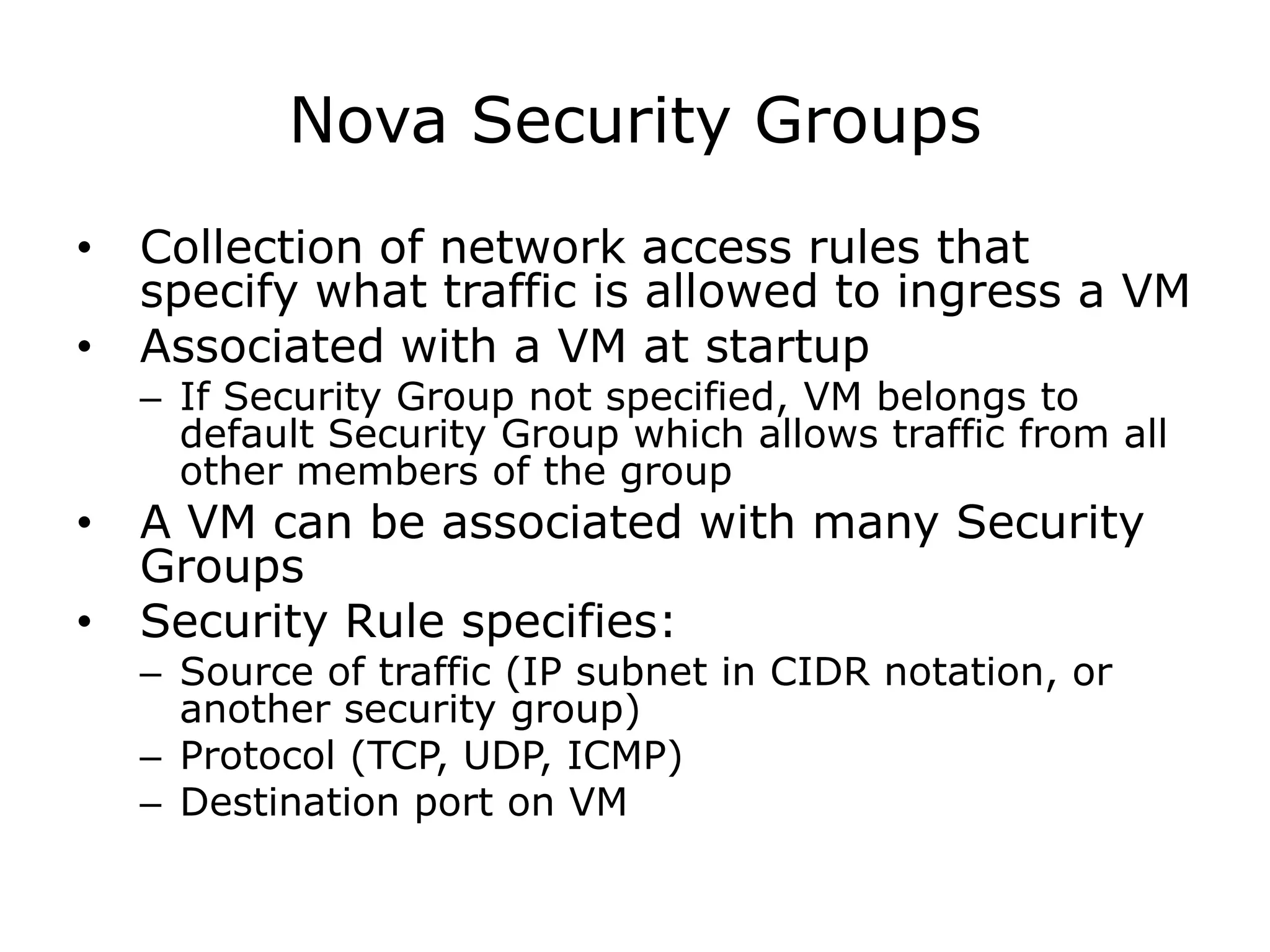
Nova Security Groups
•   Collection of network access rules that
    specify what traffic is allowed to ingress a VM
•   Associated with a VM at startup
    – If Security Group not specified, VM belongs to
      default Security Group which allows traffic from all
      other members of the group
•   A VM can be associated with many Security
    Groups
•   Security Rule specifies:
    – Source of traffic (IP subnet in CIDR notation, or
      another security group)
    – Protocol (TCP, UDP, ICMP)
    – Destination port on VM
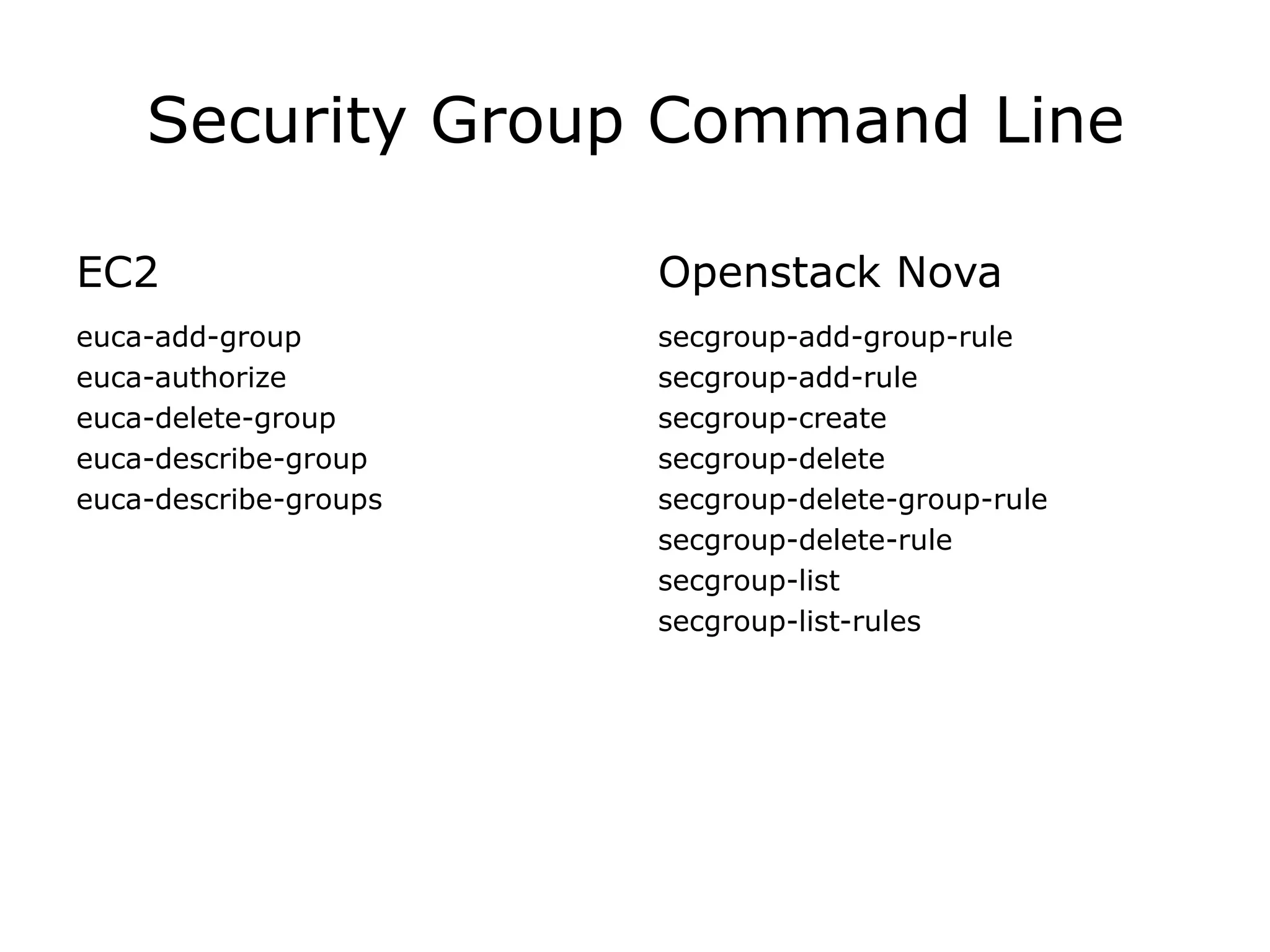
Security Group Command Line

EC2                    Openstack Nova
euca-add-group         secgroup-add-group-rule
euca-authorize         secgroup-add-rule
euca-delete-group      secgroup-create
euca-describe-group    secgroup-delete
euca-describe-groups   secgroup-delete-group-rule
                       secgroup-delete-rule
                       secgroup-list
                       secgroup-list-rules
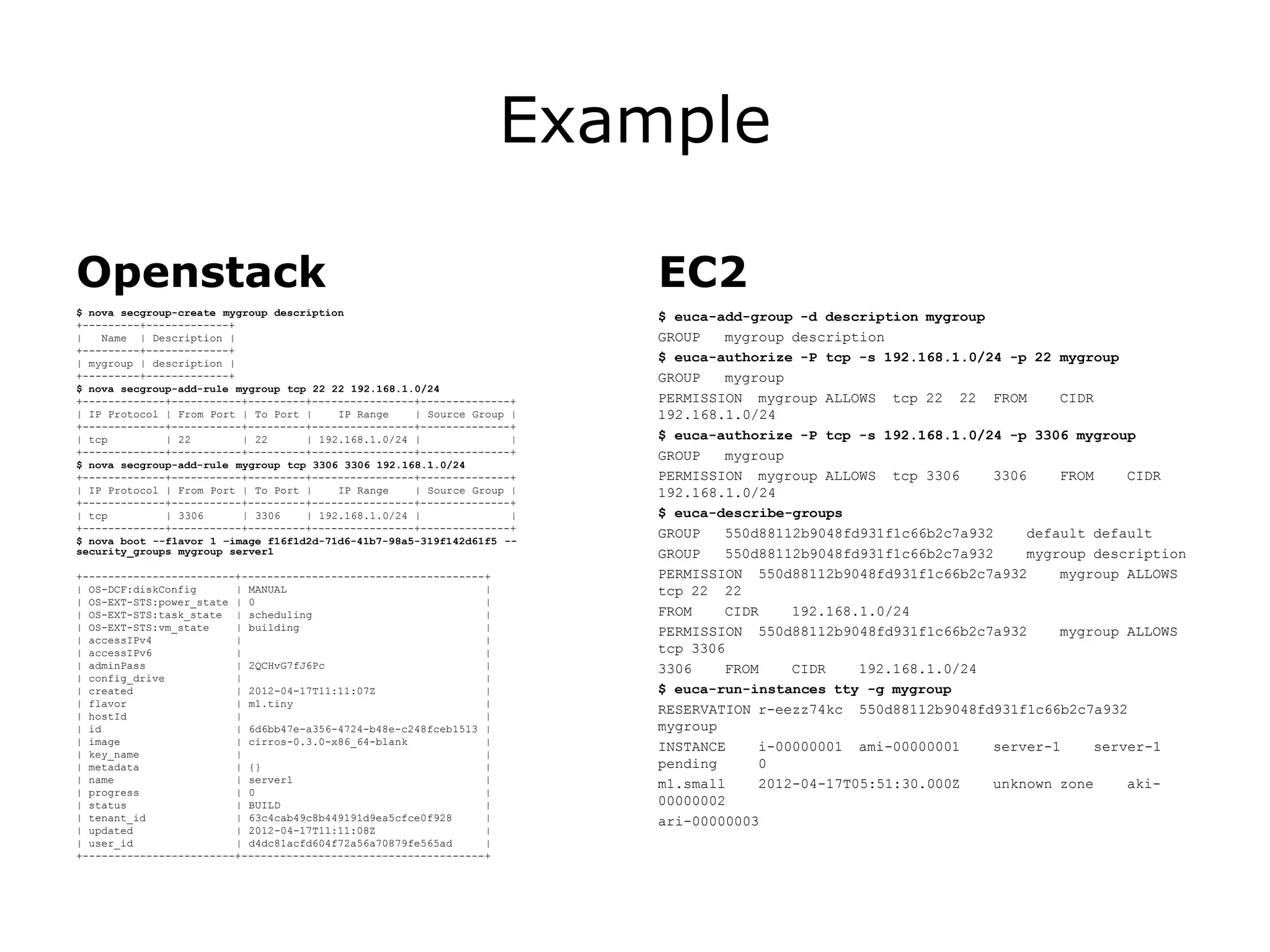
Example

Openstack                                                               EC2
$ nova secgroup-create mygroup description                              $ euca-add-group -d description mygroup
+---------+-------------+
|   Name | Description |                                                GROUP   mygroup description
+---------+-------------+
| mygroup | description |                                               $ euca-authorize -P tcp -s 192.168.1.0/24 -p 22 mygroup
+---------+-------------+                                               GROUP   mygroup
$ nova secgroup-add-rule mygroup tcp 22 22 192.168.1.0/24
+-------------+-----------+---------+----------------+--------------+   PERMISSION mygroup ALLOWS tcp 22 22 FROM        CIDR
| IP Protocol | From Port | To Port |    IP Range    | Source Group |   192.168.1.0/24
+-------------+-----------+---------+----------------+--------------+
| tcp         | 22        | 22      | 192.168.1.0/24 |              |   $ euca-authorize -P tcp -s 192.168.1.0/24 -p 3306 mygroup
+-------------+-----------+---------+----------------+--------------+   GROUP   mygroup
$ nova secgroup-add-rule mygroup tcp 3306 3306 192.168.1.0/24
+-------------+-----------+---------+----------------+--------------+   PERMISSION mygroup ALLOWS tcp 3306      3306    FROM    CIDR
| IP Protocol | From Port | To Port |    IP Range    | Source Group |   192.168.1.0/24
+-------------+-----------+---------+----------------+--------------+
| tcp         | 3306      | 3306    | 192.168.1.0/24 |              |   $ euca-describe-groups
+-------------+-----------+---------+----------------+--------------+
$ nova boot --flavor 1 –image f16f1d2d-71d6-41b7-98a5-319f142d61f5 --
                                                                        GROUP   550d88112b9048fd931f1c66b2c7a932    default default
security_groups mygroup server1                                         GROUP   550d88112b9048fd931f1c66b2c7a932    mygroup description
+------------------------+--------------------------------------+       PERMISSION 550d88112b9048fd931f1c66b2c7a932     mygroup ALLOWS
| OS-DCF:diskConfig      | MANUAL                               |       tcp 22 22
| OS-EXT-STS:power_state | 0                                    |
| OS-EXT-STS:task_state | scheduling                            |       FROM    CIDR    192.168.1.0/24
| OS-EXT-STS:vm_state    | building                             |       PERMISSION 550d88112b9048fd931f1c66b2c7a932     mygroup ALLOWS
| accessIPv4             |                                      |
| accessIPv6             |                                      |       tcp 3306
| adminPass              | 2QCHvG7fJ6Pc                         |       3306    FROM    CIDR    192.168.1.0/24
| config_drive           |                                      |
| created                | 2012-04-17T11:11:07Z                 |       $ euca-run-instances tty -g mygroup
| flavor                 | m1.tiny                              |
| hostId                 |                                      |
                                                                        RESERVATION r-eezz74kc 550d88112b9048fd931f1c66b2c7a932
| id                     | 6d6bb47e-a356-4724-b48e-c248fceb1513 |       mygroup
| image                  | cirros-0.3.0-x86_64-blank            |
| key_name               |                                      |
                                                                        INSTANCE    i-00000001 ami-00000001     server-1    server-1
| metadata               | {}                                   |       pending     0
| name                   | server1                              |       m1.small    2012-04-17T05:51:30.000Z    unknown zone    aki-
| progress               | 0                                    |
| status                 | BUILD                                |       00000002
| tenant_id              | 63c4cab49c8b449191d9ea5cfce0f928     |       ari-00000003
| updated                | 2012-04-17T11:11:08Z                 |
| user_id                | d4dc81acfd604f72a56a70879fe565ad     |
+------------------------+--------------------------------------+
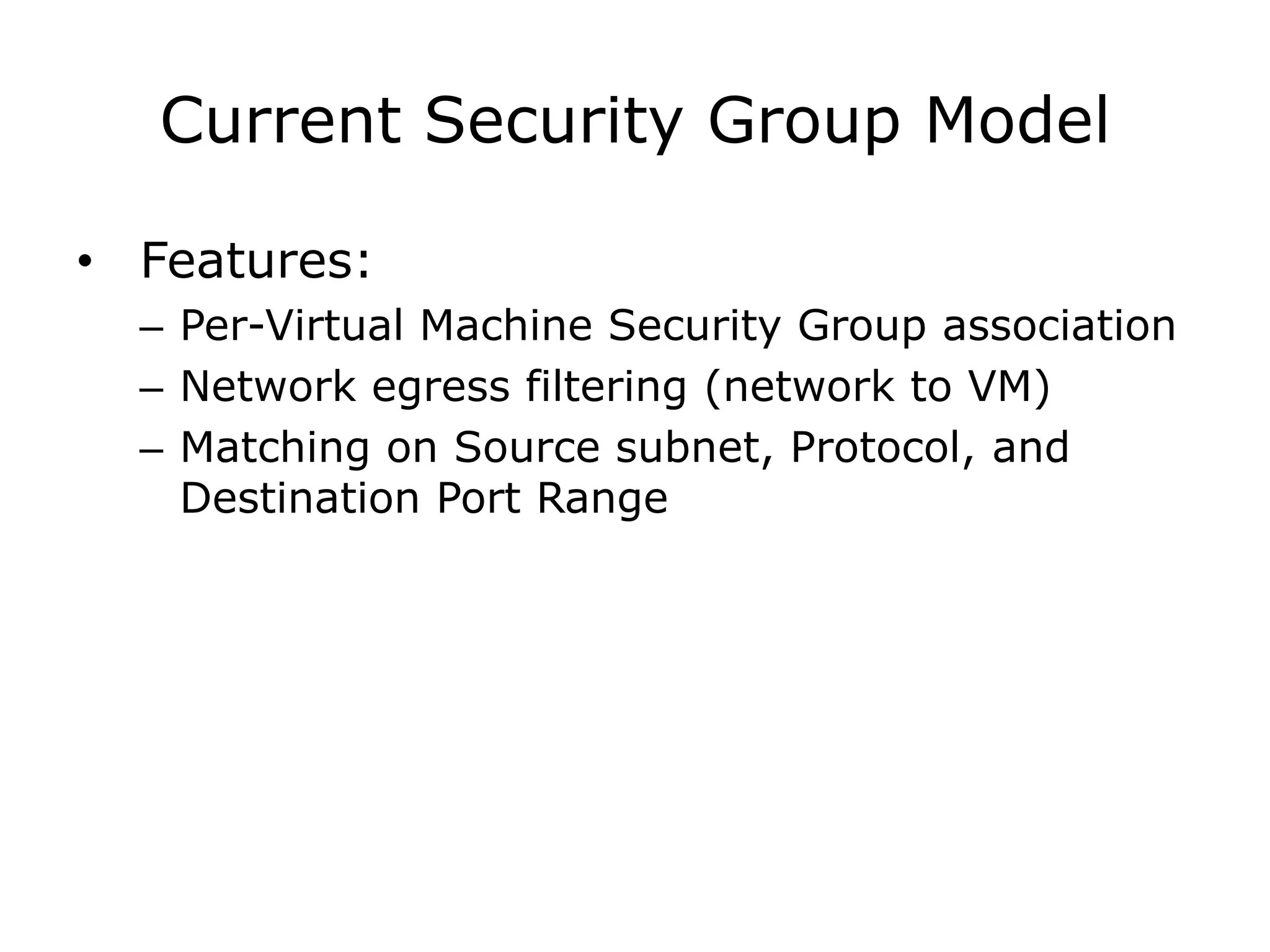
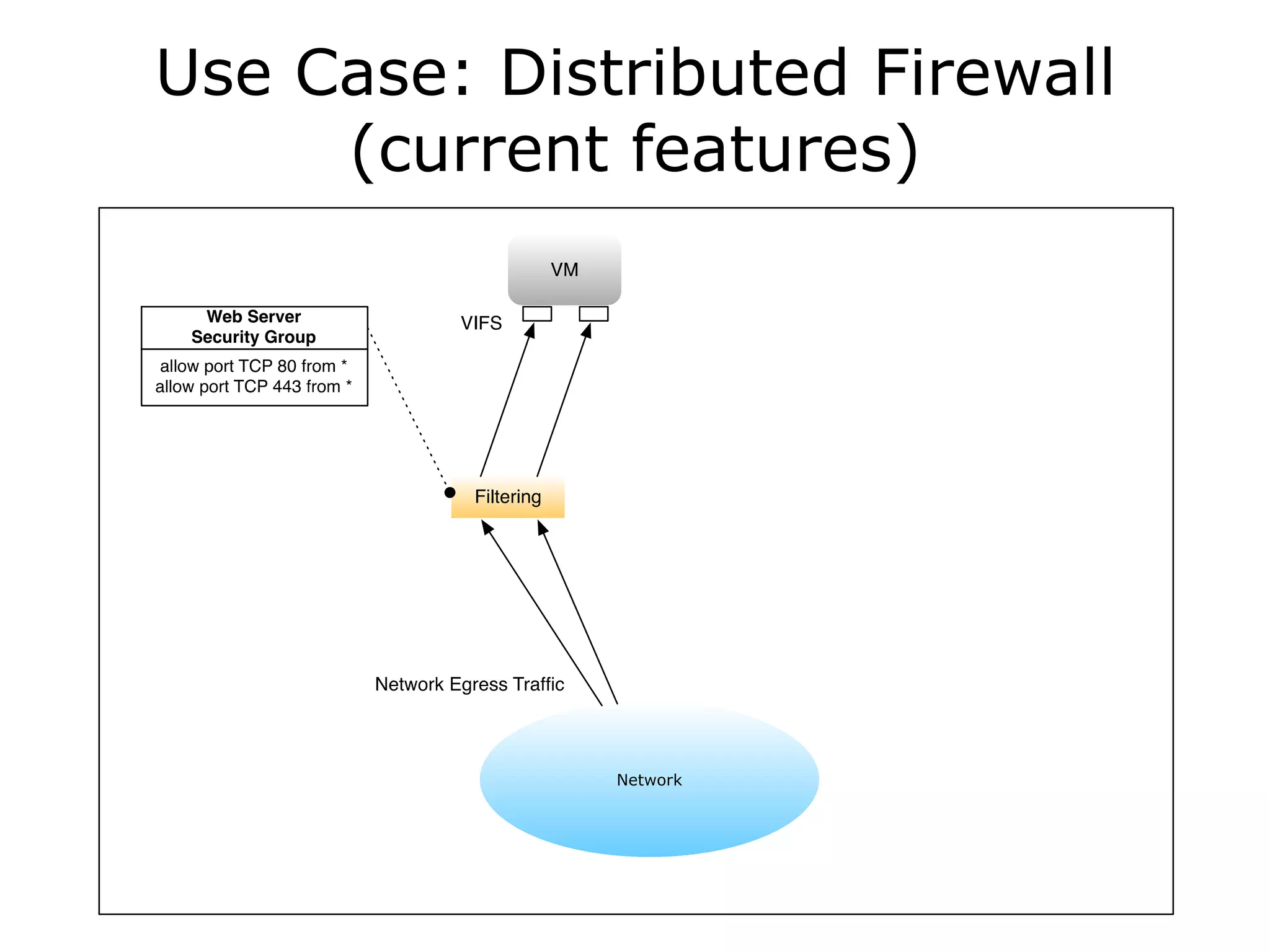
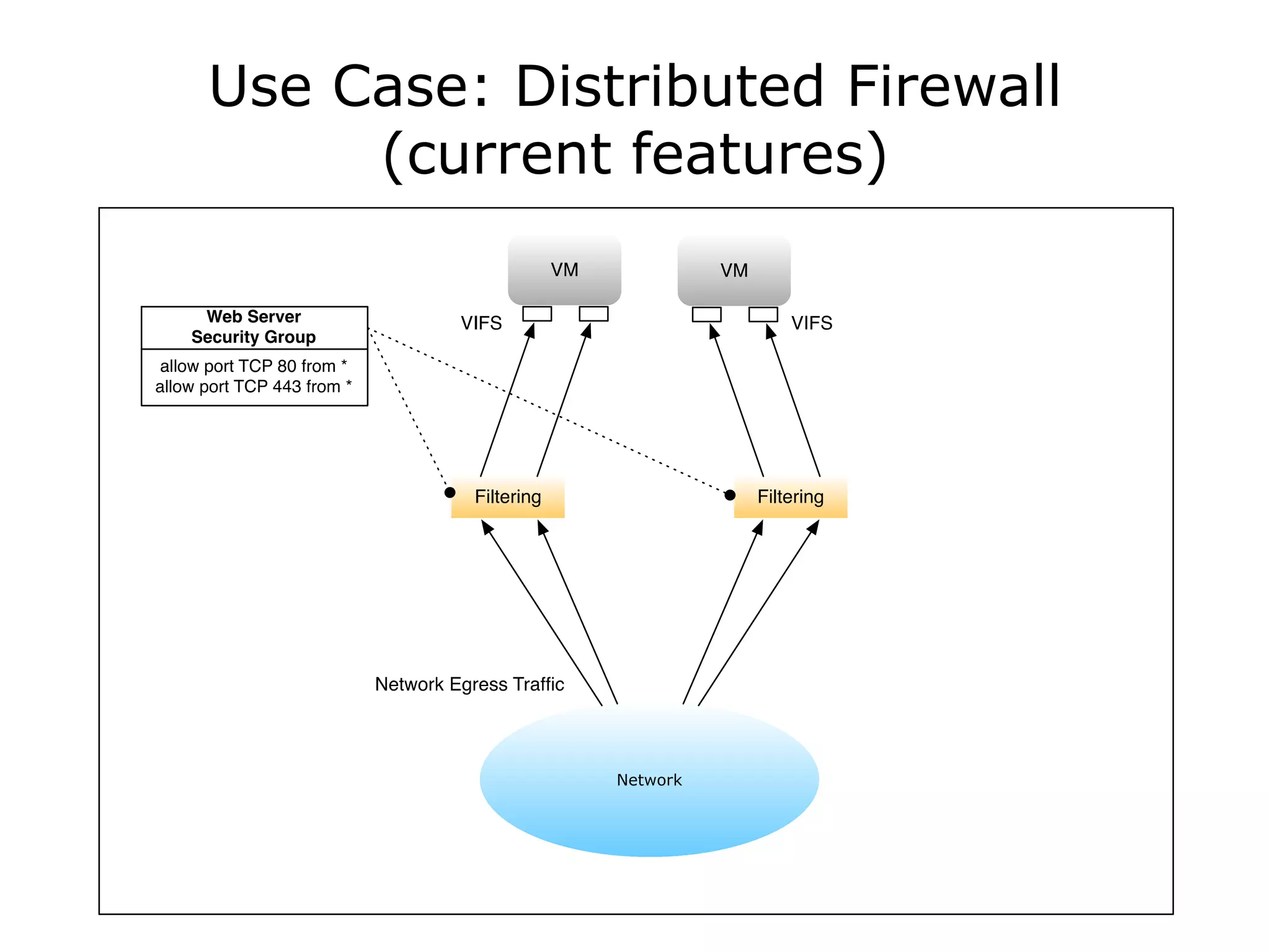
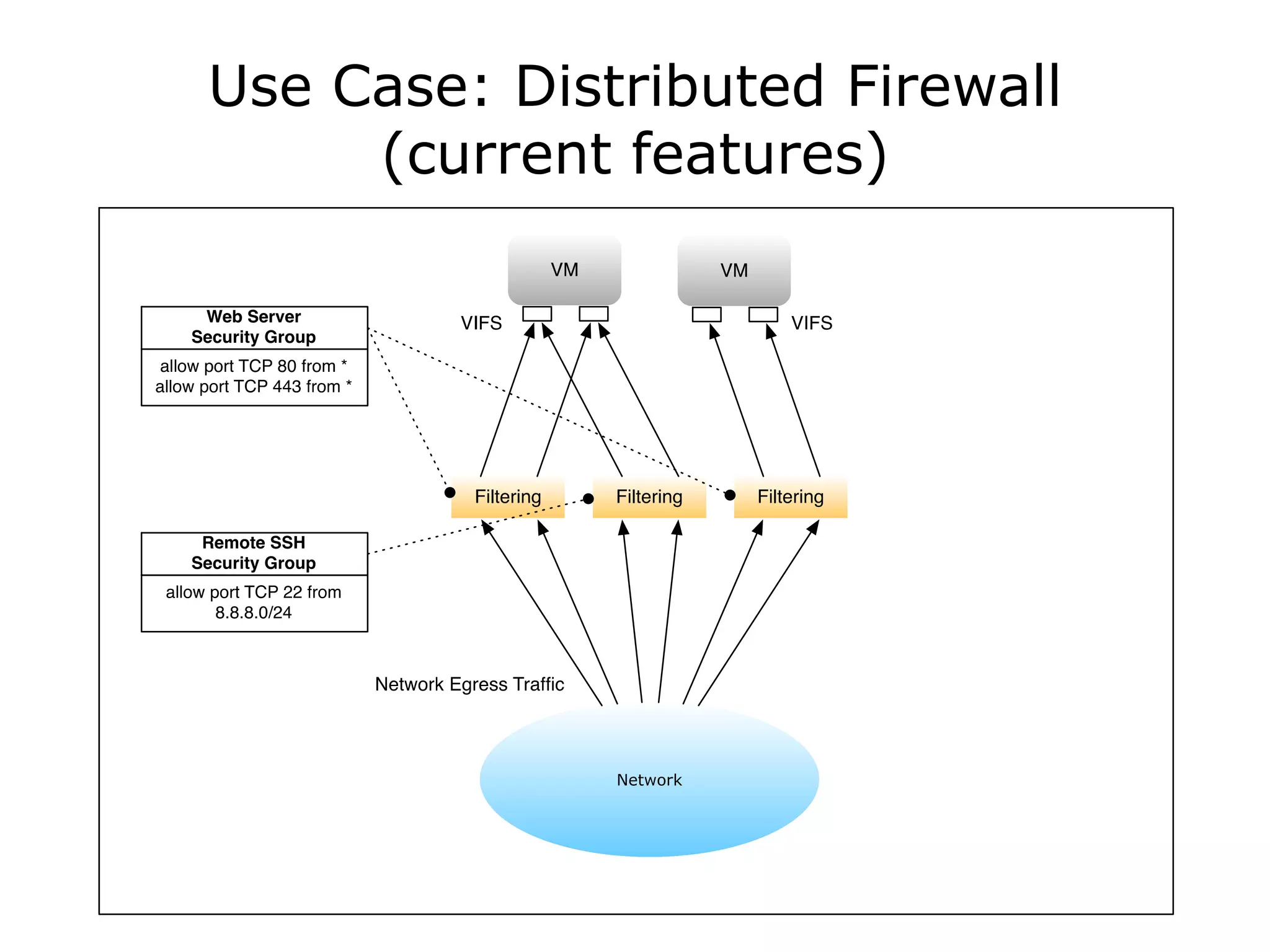
Current Security Group Model

• Features:
  – Per-Virtual Machine Security Group association
  – Network egress filtering (network to VM)
  – Matching on Source subnet, Protocol, and
    Destination Port Range
Use Case: Distributed Firewall
     (current features)
Use Case: Distributed Firewall
     (current features)
Use Case: Distributed Firewall
     (current features)
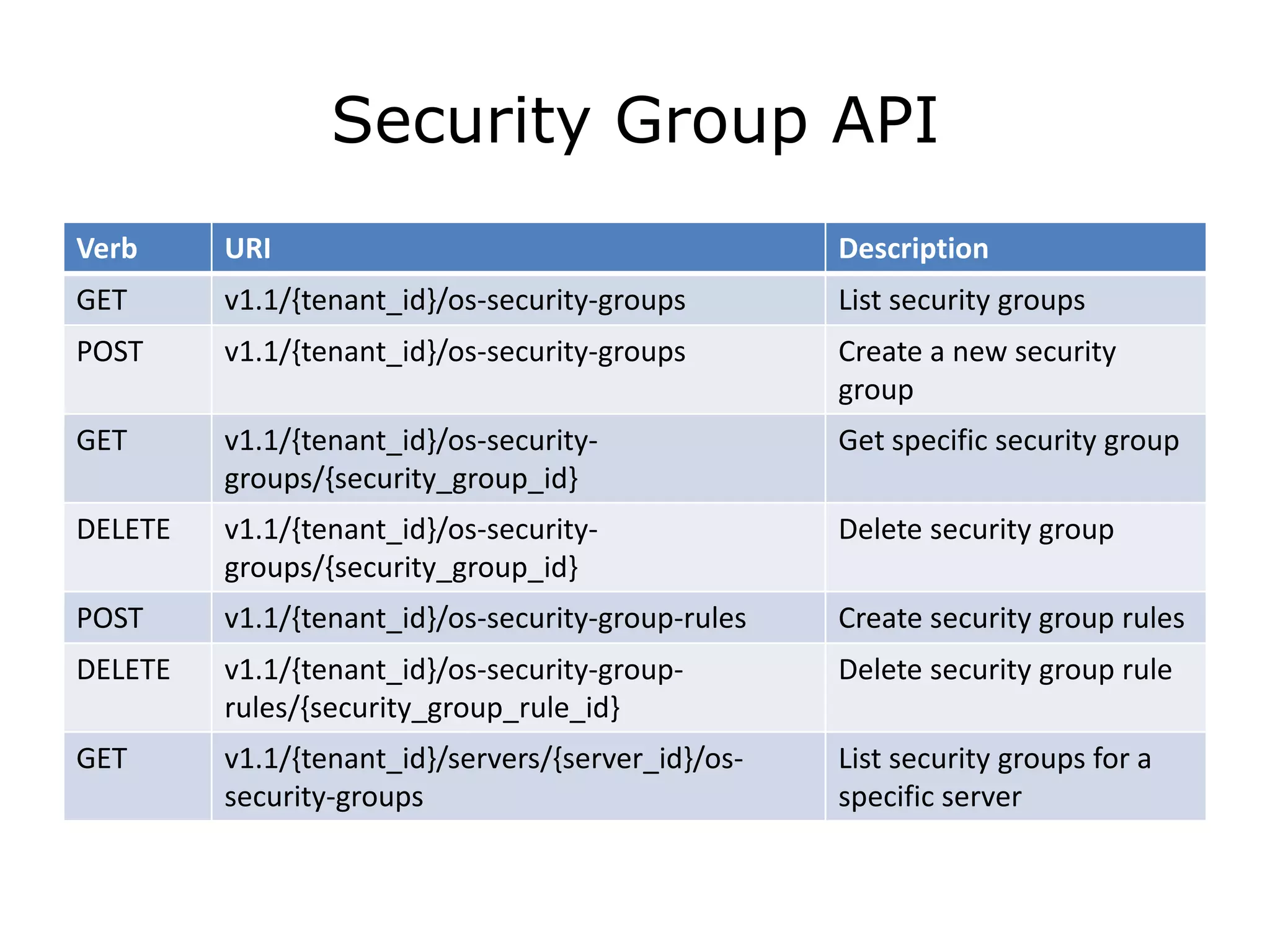
Security Group API
Verb     URI                                        Description
GET      v1.1/{tenant_id}/os-security-groups        List security groups
POST     v1.1/{tenant_id}/os-security-groups        Create a new security
                                                    group
GET      v1.1/{tenant_id}/os-security-              Get specific security group
         groups/{security_group_id}
DELETE   v1.1/{tenant_id}/os-security-              Delete security group
         groups/{security_group_id}
POST     v1.1/{tenant_id}/os-security-group-rules   Create security group rules
DELETE   v1.1/{tenant_id}/os-security-group-        Delete security group rule
         rules/{security_group_rule_id}
GET      v1.1/{tenant_id}/servers/{server_id}/os-   List security groups for a
         security-groups                            specific server
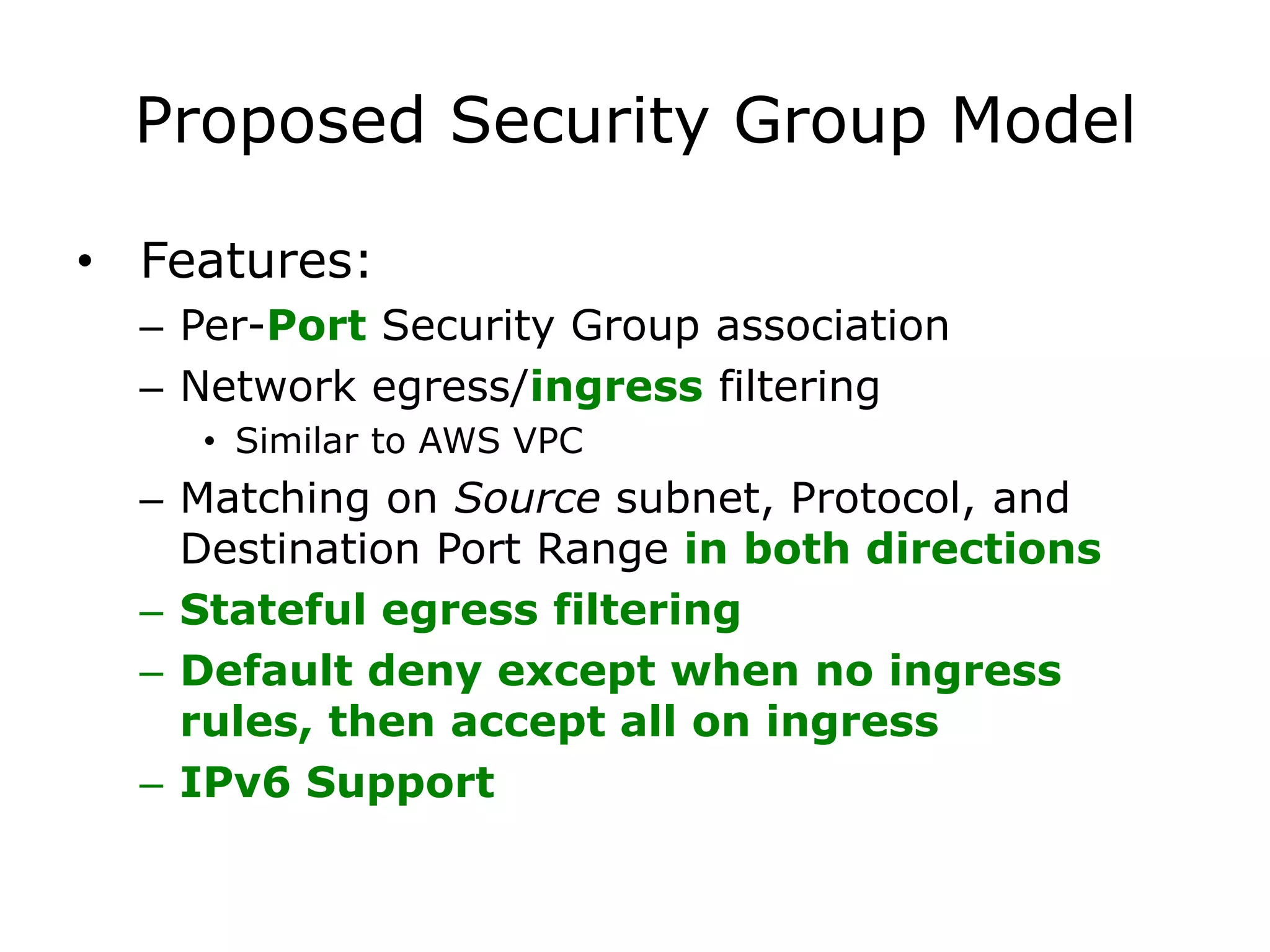
Proposed Security Group Model

• Features:
  – Per-Port Security Group association
  – Network egress/ingress filtering
    • Similar to AWS VPC
  – Matching on Source subnet, Protocol, and
    Destination Port Range in both directions
  – Stateful egress filtering
  – Default deny except when no ingress
    rules, then accept all on ingress
  – IPv6 Support
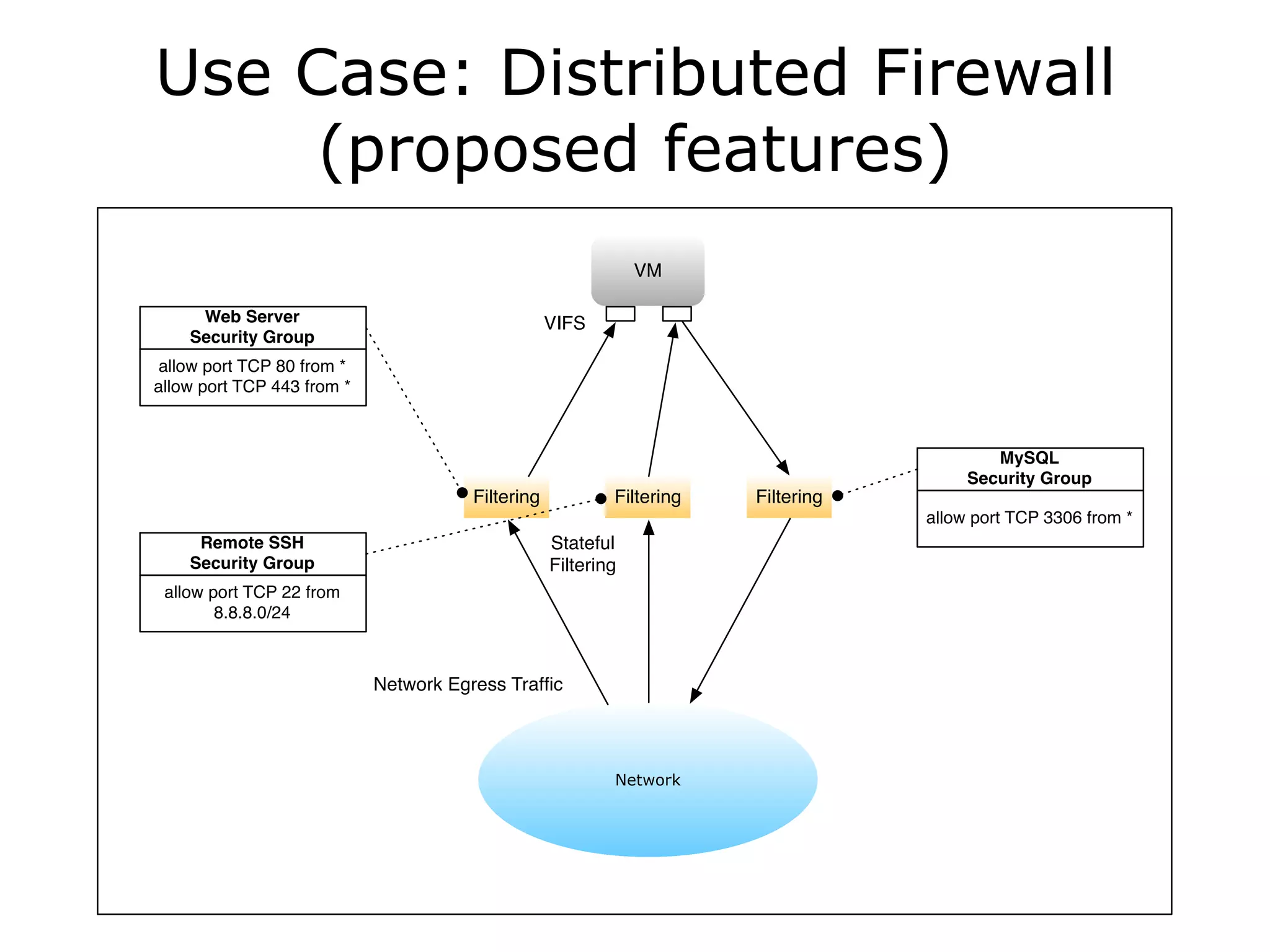
Use Case: Distributed Firewall
     (proposed features)
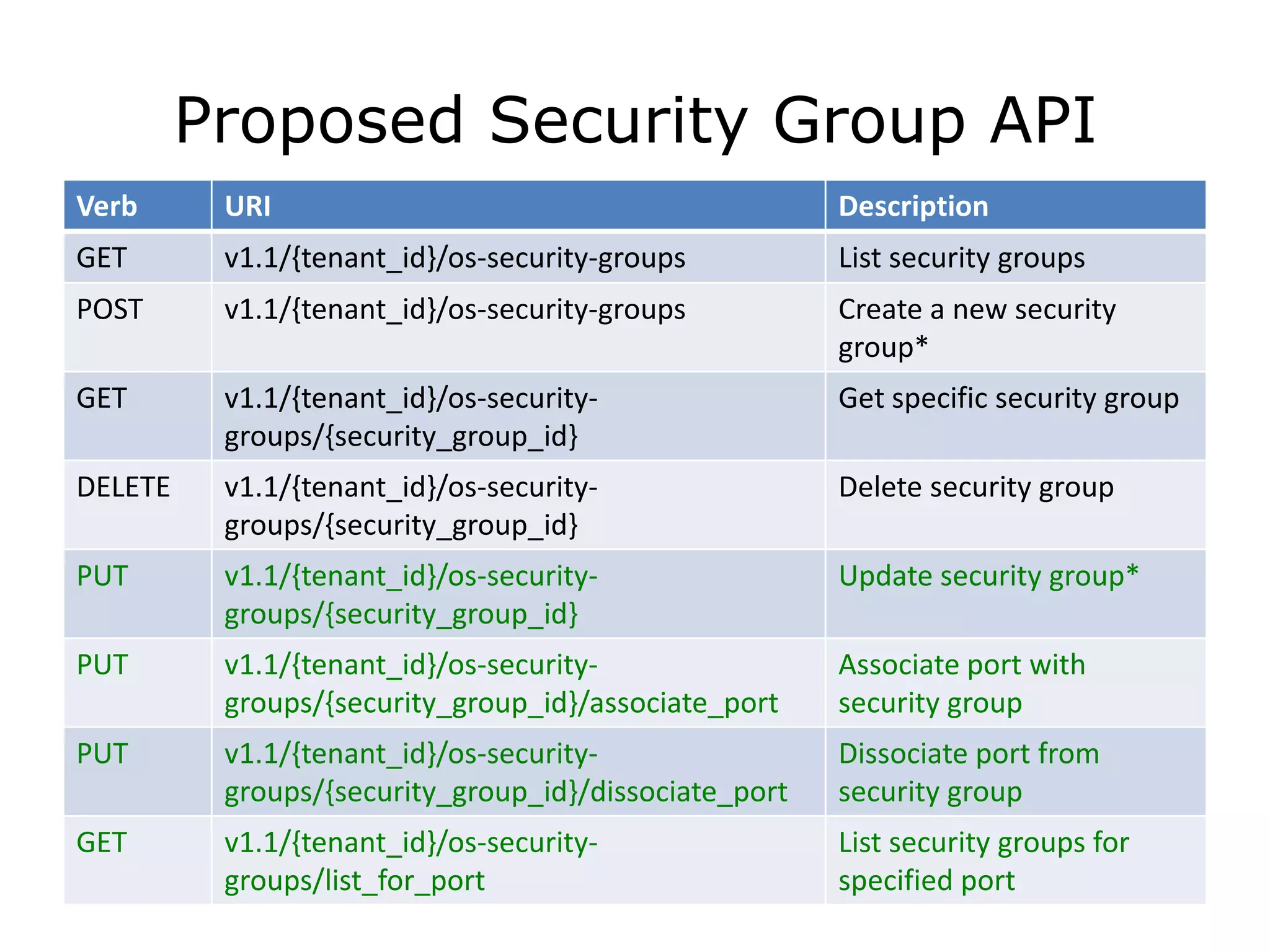
Proposed Security Group API
Verb      URI                                          Description
GET       v1.1/{tenant_id}/os-security-groups          List security groups
POST      v1.1/{tenant_id}/os-security-groups          Create a new security
                                                       group*
GET       v1.1/{tenant_id}/os-security-                Get specific security group
          groups/{security_group_id}
DELETE    v1.1/{tenant_id}/os-security-                Delete security group
          groups/{security_group_id}
PUT       v1.1/{tenant_id}/os-security-                Update security group*
          groups/{security_group_id}
PUT       v1.1/{tenant_id}/os-security-                Associate port with
          groups/{security_group_id}/associate_port    security group
PUT       v1.1/{tenant_id}/os-security-                Dissociate port from
          groups/{security_group_id}/dissociate_port   security group
GET       v1.1/{tenant_id}/os-security-                List security groups for
          groups/list_for_port                         specified port
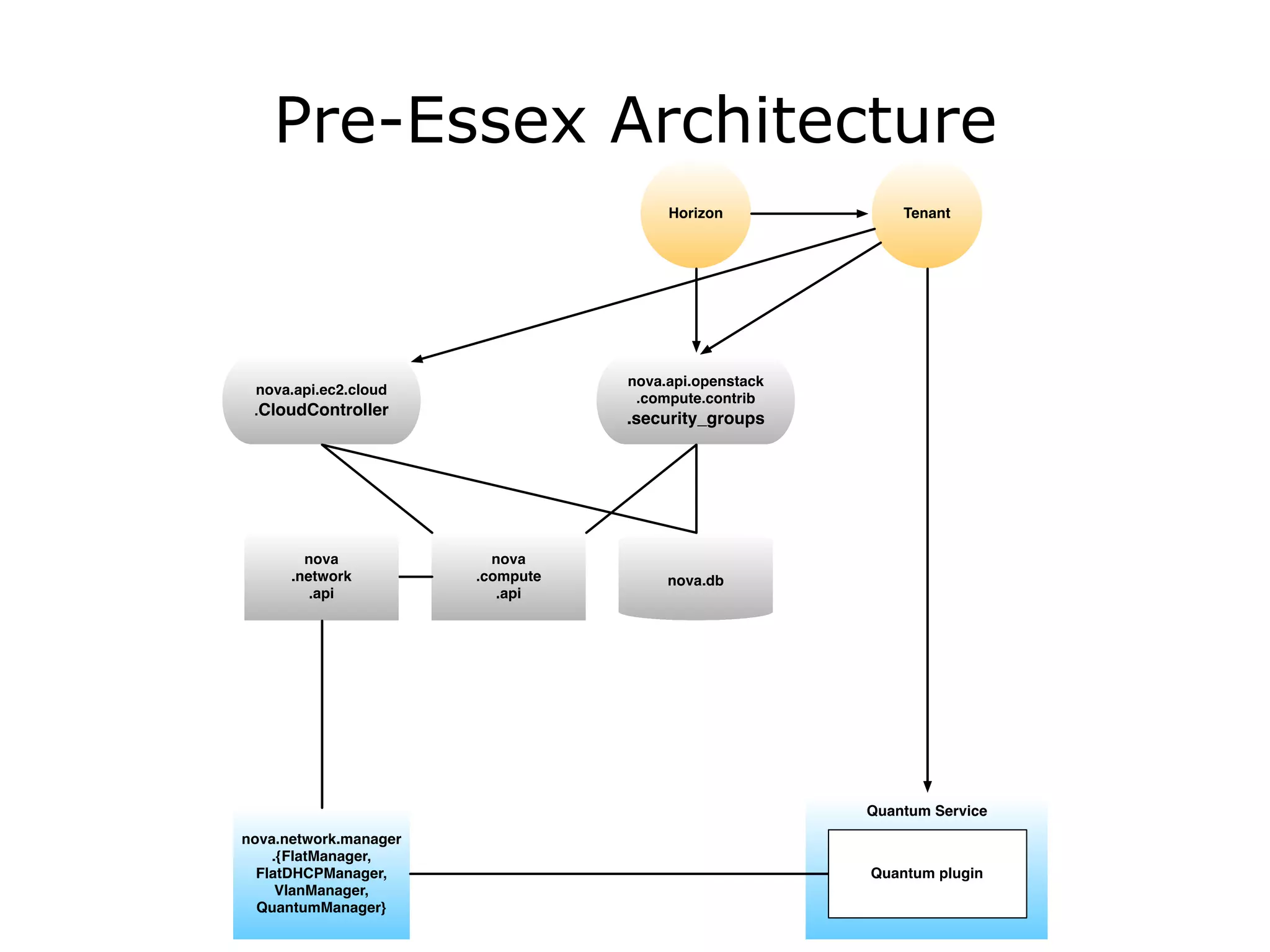
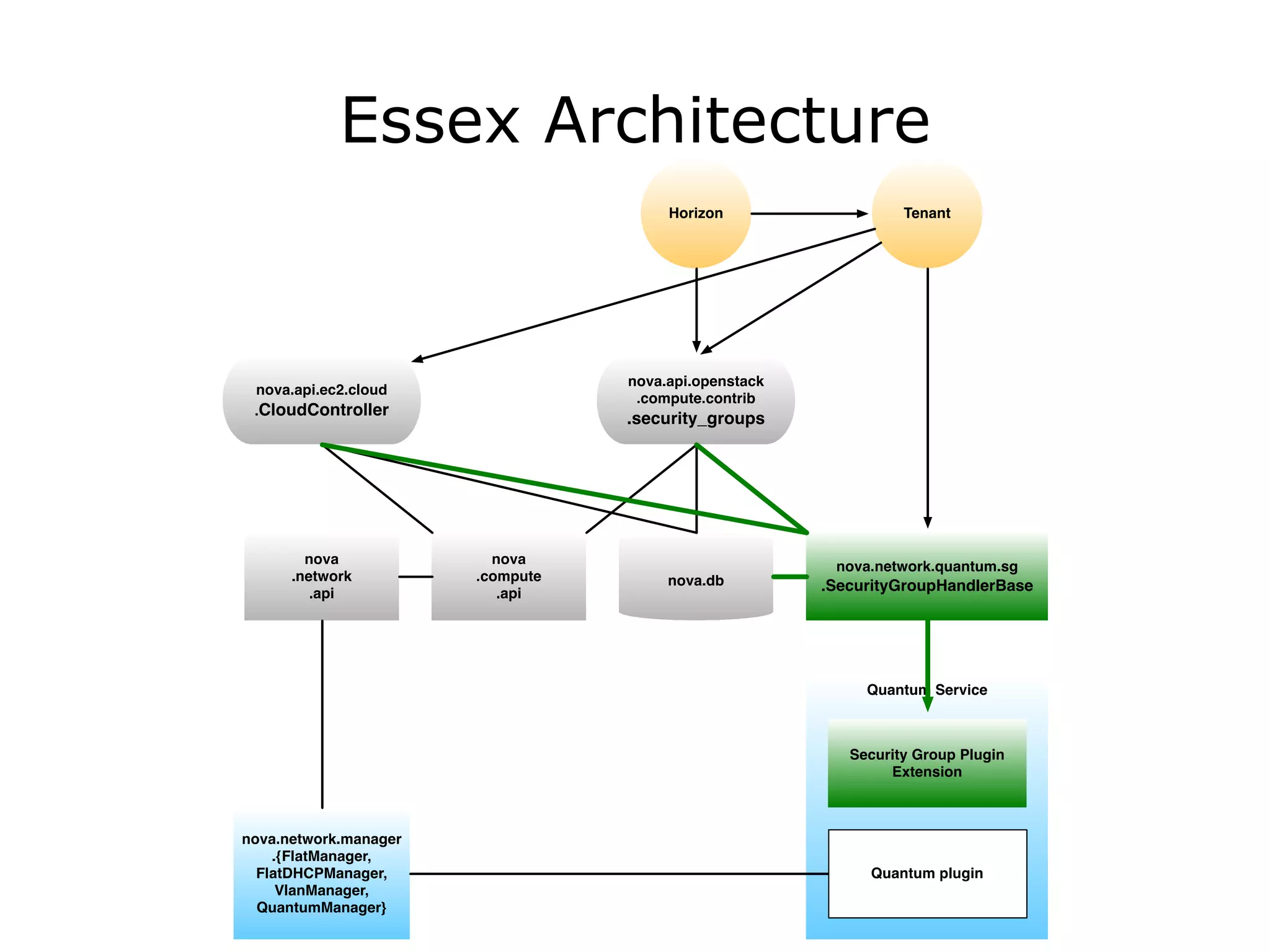
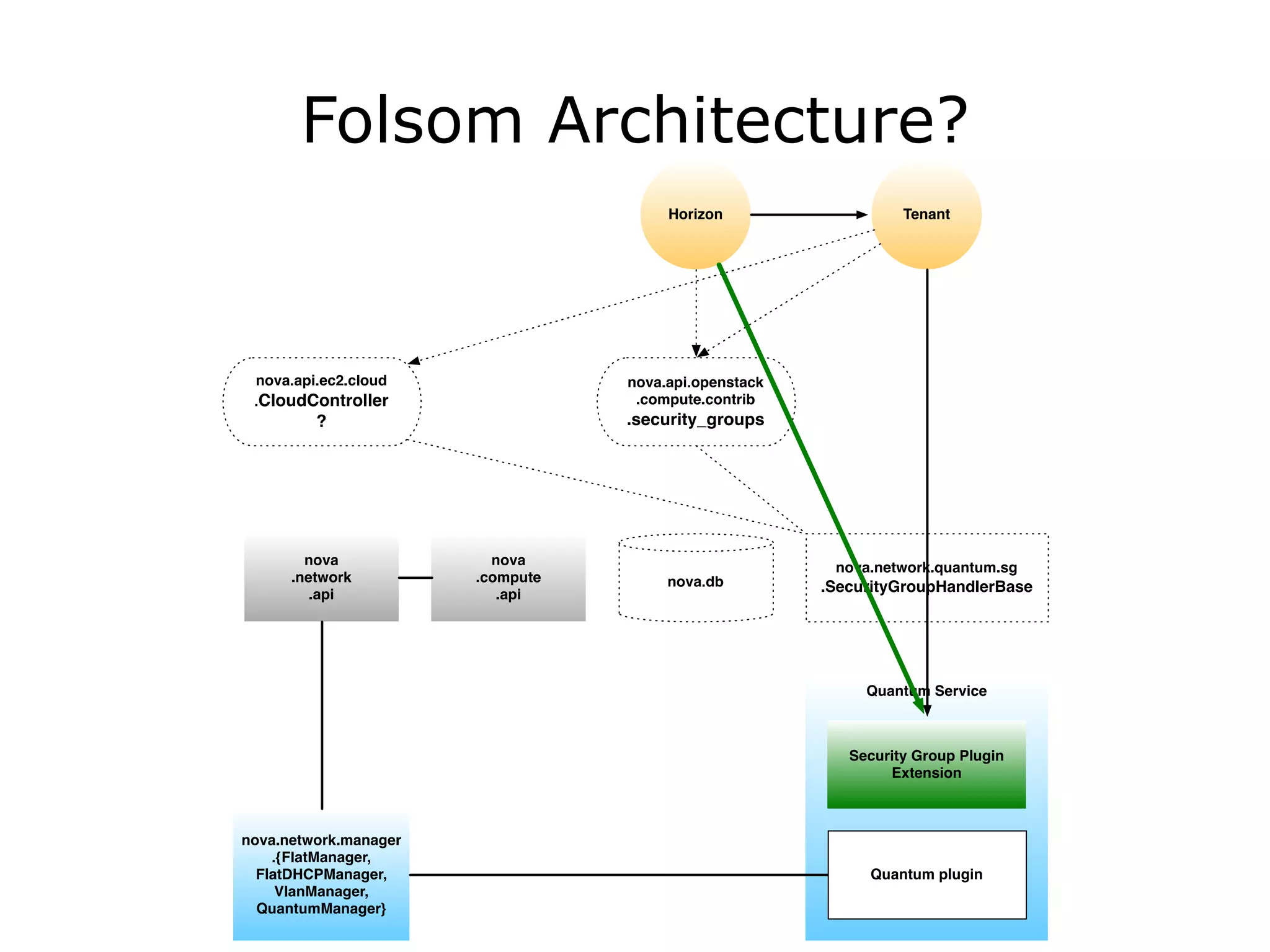
Architecture
Pre-Essex Architecture
Essex Architecture
Folsom Architecture?
Other Features
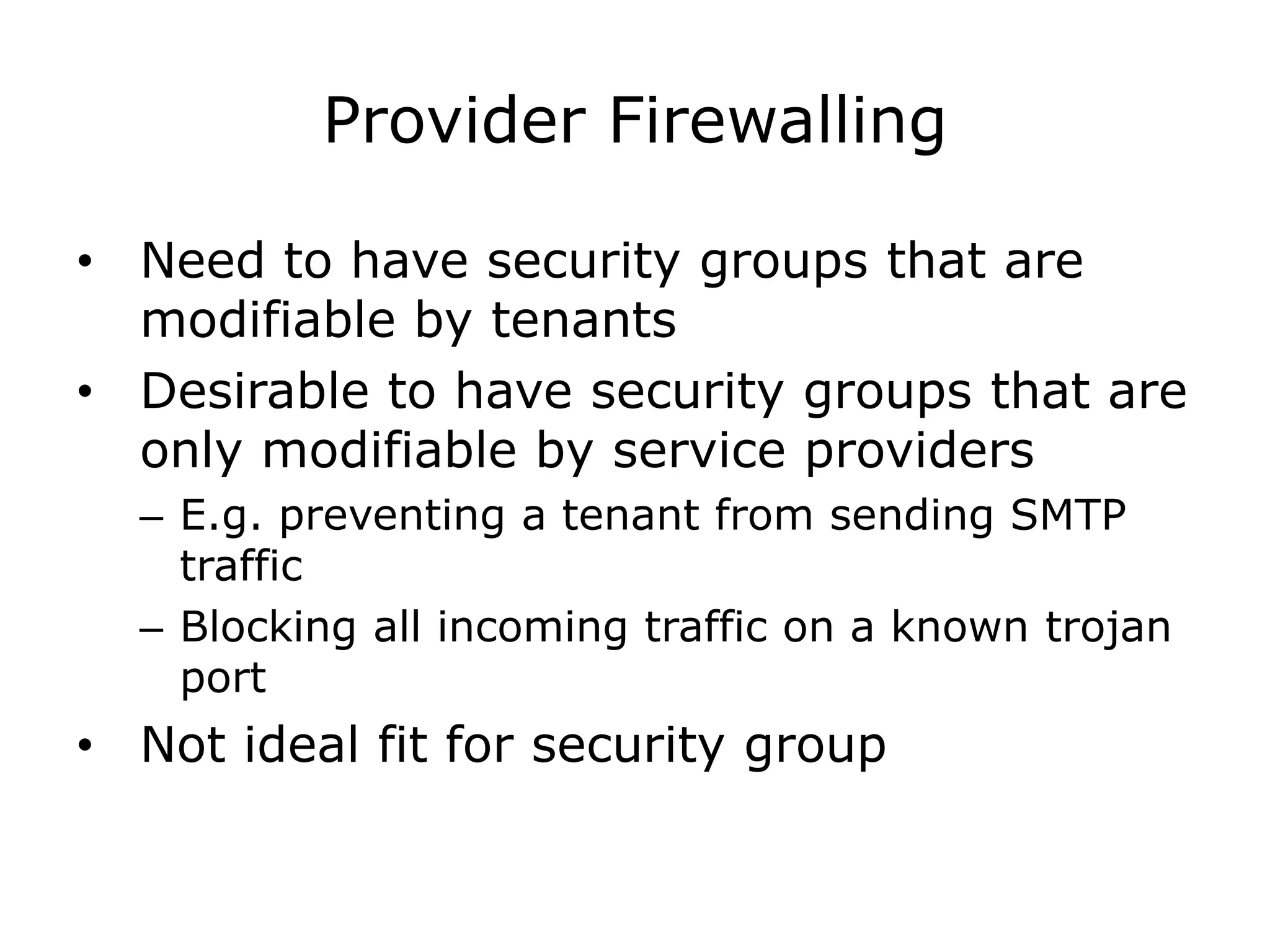
Provider Firewalling

• Need to have security groups that are
  modifiable by tenants
• Desirable to have security groups that are
  only modifiable by service providers
  – E.g. preventing a tenant from sending SMTP
    traffic
  – Blocking all incoming traffic on a known trojan
    port
• Not ideal fit for security group
Access Control Lists

• Current security group model is
  somewhat limited
• Would be nice to have a more generic
  ACL capability
• Features:
  –   Ingress/Egress filtering
  –   Port-based association
  –   More sophisticated matching
  –   Allow/deny
  –   Combination of ACLs
Comments, Questions,
   Suggestions?

      @davlaps

Openstack Quantum Security Groups Session

  • 1.
    Quantum Security Groups Session Dave Lapsley @davlaps http://slidesha.re/HQvDTk http://etherpad.openstack.org/quantum-folsom
  • 2.
    Session Goals • Introductionto Nova Security Groups • Proposal: – Move Security Groups from Nova to Quantum • Discussion: – Provider Firewalling – Access Control Lists – Other
  • 3.
    Proposal: move SecurityGroups from Nova to Quantum Naturally fit within network API Allow plugins to implement them in a compatible way
  • 4.
  • 5.
    Nova Security Groups • Collection of network access rules that specify what traffic is allowed to ingress a VM • Associated with a VM at startup – If Security Group not specified, VM belongs to default Security Group which allows traffic from all other members of the group • A VM can be associated with many Security Groups • Security Rule specifies: – Source of traffic (IP subnet in CIDR notation, or another security group) – Protocol (TCP, UDP, ICMP) – Destination port on VM
  • 6.
    Security Group CommandLine EC2 Openstack Nova euca-add-group secgroup-add-group-rule euca-authorize secgroup-add-rule euca-delete-group secgroup-create euca-describe-group secgroup-delete euca-describe-groups secgroup-delete-group-rule secgroup-delete-rule secgroup-list secgroup-list-rules
  • 7.
    Example Openstack EC2 $ nova secgroup-create mygroup description $ euca-add-group -d description mygroup +---------+-------------+ | Name | Description | GROUP mygroup description +---------+-------------+ | mygroup | description | $ euca-authorize -P tcp -s 192.168.1.0/24 -p 22 mygroup +---------+-------------+ GROUP mygroup $ nova secgroup-add-rule mygroup tcp 22 22 192.168.1.0/24 +-------------+-----------+---------+----------------+--------------+ PERMISSION mygroup ALLOWS tcp 22 22 FROM CIDR | IP Protocol | From Port | To Port | IP Range | Source Group | 192.168.1.0/24 +-------------+-----------+---------+----------------+--------------+ | tcp | 22 | 22 | 192.168.1.0/24 | | $ euca-authorize -P tcp -s 192.168.1.0/24 -p 3306 mygroup +-------------+-----------+---------+----------------+--------------+ GROUP mygroup $ nova secgroup-add-rule mygroup tcp 3306 3306 192.168.1.0/24 +-------------+-----------+---------+----------------+--------------+ PERMISSION mygroup ALLOWS tcp 3306 3306 FROM CIDR | IP Protocol | From Port | To Port | IP Range | Source Group | 192.168.1.0/24 +-------------+-----------+---------+----------------+--------------+ | tcp | 3306 | 3306 | 192.168.1.0/24 | | $ euca-describe-groups +-------------+-----------+---------+----------------+--------------+ $ nova boot --flavor 1 –image f16f1d2d-71d6-41b7-98a5-319f142d61f5 -- GROUP 550d88112b9048fd931f1c66b2c7a932 default default security_groups mygroup server1 GROUP 550d88112b9048fd931f1c66b2c7a932 mygroup description +------------------------+--------------------------------------+ PERMISSION 550d88112b9048fd931f1c66b2c7a932 mygroup ALLOWS | OS-DCF:diskConfig | MANUAL | tcp 22 22 | OS-EXT-STS:power_state | 0 | | OS-EXT-STS:task_state | scheduling | FROM CIDR 192.168.1.0/24 | OS-EXT-STS:vm_state | building | PERMISSION 550d88112b9048fd931f1c66b2c7a932 mygroup ALLOWS | accessIPv4 | | | accessIPv6 | | tcp 3306 | adminPass | 2QCHvG7fJ6Pc | 3306 FROM CIDR 192.168.1.0/24 | config_drive | | | created | 2012-04-17T11:11:07Z | $ euca-run-instances tty -g mygroup | flavor | m1.tiny | | hostId | | RESERVATION r-eezz74kc 550d88112b9048fd931f1c66b2c7a932 | id | 6d6bb47e-a356-4724-b48e-c248fceb1513 | mygroup | image | cirros-0.3.0-x86_64-blank | | key_name | | INSTANCE i-00000001 ami-00000001 server-1 server-1 | metadata | {} | pending 0 | name | server1 | m1.small 2012-04-17T05:51:30.000Z unknown zone aki- | progress | 0 | | status | BUILD | 00000002 | tenant_id | 63c4cab49c8b449191d9ea5cfce0f928 | ari-00000003 | updated | 2012-04-17T11:11:08Z | | user_id | d4dc81acfd604f72a56a70879fe565ad | +------------------------+--------------------------------------+
  • 8.
    Current Security GroupModel • Features: – Per-Virtual Machine Security Group association – Network egress filtering (network to VM) – Matching on Source subnet, Protocol, and Destination Port Range
  • 9.
    Use Case: DistributedFirewall (current features)
  • 10.
    Use Case: DistributedFirewall (current features)
  • 11.
    Use Case: DistributedFirewall (current features)
  • 12.
    Security Group API Verb URI Description GET v1.1/{tenant_id}/os-security-groups List security groups POST v1.1/{tenant_id}/os-security-groups Create a new security group GET v1.1/{tenant_id}/os-security- Get specific security group groups/{security_group_id} DELETE v1.1/{tenant_id}/os-security- Delete security group groups/{security_group_id} POST v1.1/{tenant_id}/os-security-group-rules Create security group rules DELETE v1.1/{tenant_id}/os-security-group- Delete security group rule rules/{security_group_rule_id} GET v1.1/{tenant_id}/servers/{server_id}/os- List security groups for a security-groups specific server
  • 13.
    Proposed Security GroupModel • Features: – Per-Port Security Group association – Network egress/ingress filtering • Similar to AWS VPC – Matching on Source subnet, Protocol, and Destination Port Range in both directions – Stateful egress filtering – Default deny except when no ingress rules, then accept all on ingress – IPv6 Support
  • 14.
    Use Case: DistributedFirewall (proposed features)
  • 15.
    Proposed Security GroupAPI Verb URI Description GET v1.1/{tenant_id}/os-security-groups List security groups POST v1.1/{tenant_id}/os-security-groups Create a new security group* GET v1.1/{tenant_id}/os-security- Get specific security group groups/{security_group_id} DELETE v1.1/{tenant_id}/os-security- Delete security group groups/{security_group_id} PUT v1.1/{tenant_id}/os-security- Update security group* groups/{security_group_id} PUT v1.1/{tenant_id}/os-security- Associate port with groups/{security_group_id}/associate_port security group PUT v1.1/{tenant_id}/os-security- Dissociate port from groups/{security_group_id}/dissociate_port security group GET v1.1/{tenant_id}/os-security- List security groups for groups/list_for_port specified port
  • 16.
  • 17.
  • 18.
  • 19.
  • 20.
  • 21.
    Provider Firewalling • Needto have security groups that are modifiable by tenants • Desirable to have security groups that are only modifiable by service providers – E.g. preventing a tenant from sending SMTP traffic – Blocking all incoming traffic on a known trojan port • Not ideal fit for security group
  • 22.
    Access Control Lists •Current security group model is somewhat limited • Would be nice to have a more generic ACL capability • Features: – Ingress/Egress filtering – Port-based association – More sophisticated matching – Allow/deny – Combination of ACLs
  • 23.
    Comments, Questions, Suggestions? @davlaps