Module - 3
OP-AMPAPPLICATIONS
Sources
 Voltage Sources
circuit that produces a constant output voltage to a give
range of loads.
 Current Sources
produces a constant output current.
 Current Sinks
Absorbs a constant current from a load.
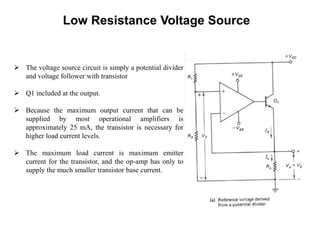
Low Resistance Voltage Source
 The voltage source circuit is simply a potential divider
and voltage follower with transistor
 Q1 included at the output.
 Because the maximum output current that can be
supplied by most operational amplifiers is
approximately 25 mA, the transistor is necessary for
higher load current levels.
 The maximum load current is maximum emitter
current for the transistor, and the op-amp has only to
supply the much smaller transistor base current.
Low Resistance Voltage Source from Zener diode
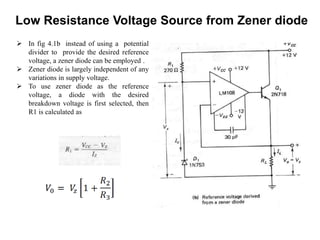
 In fig 4.1b instead of using a potential
divider to provide the desired reference
voltage, a zener diode can be employed .
 Zener diode is largely independent of any
variations in supply voltage.
 To use zener diode as the reference
voltage, a diode with the desired
breakdown voltage is first selected, then
R1 is calculated as
Precision Voltage Source
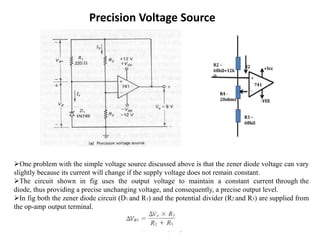
One problem with the simple voltage source discussed above is that the zener diode voltage can vary
slightly because its current will change if the supply voltage does not remain constant.
The circuit shown in fig uses the output voltage to maintain a constant current through the
diode, thus providing a precise unchanging voltage, and consequently, a precise output level.
In fig both the zener diode circuit (D1 and R1) and the potential divider (R2 and R3) are supplied from
the op-amp output terminal.
Current Sources
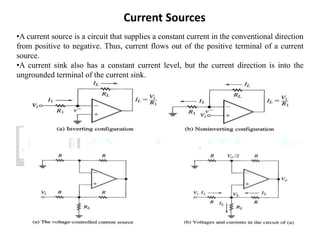
•A current source is a circuit that supplies a constant current in the conventional direction
from positive to negative. Thus, current flows out of the positive terminal of a current
source.
•A current sink also has a constant current level, but the current direction is into the
ungrounded terminal of the current sink.
Current Sources
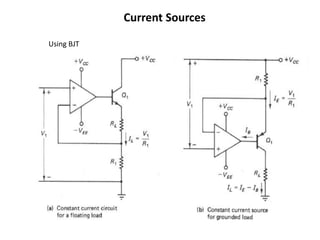
Using BJT
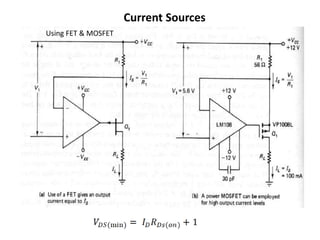
Current Sources
Using FET & MOSFET
Op-Amp Circuits using Diodes
• Log Amplifiers
• Antilog Amplifiers
• Rectifiers
– Precision Rectifiers
• Half wave
• Full wave
– Precision Full wave rectifiers
LOG AMPLIFIER
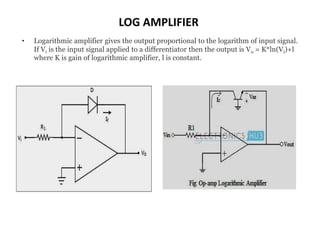
• Logarithmic amplifier gives the output proportional to the logarithm of input signal.
If Vi is the input signal applied to a differentiator then the output is Vo = K*ln(Vi)+l
where K is gain of logarithmic amplifier, l is constant.
• ID = IS.[eq(Vbe)/kT – 1]
Where,
– IS = the saturation current,
– k = Boltzmann’s constant
– T = absolute temperature (in K)
• Since IE = IC for grounded base transistor,
ID = IS. [eq(Vbe)/kT – 1]
(ID/IS) = [eq(Vbe)/kT – 1]
(ID/IS) + 1 = [eq(Vbe)/kT]
(ID+IS)/IS = eq(Vbe)/kT
eq(Vbe)/kT = (ID/IS) since ID >> IS
• Taking natural log on both sides of the above equation, we get
Vbe = (kT/q) ln[ID/IS]
• The collector current ID = Vin/R1 and Vout = -Vbe
• and ID =IF
Vout = -(kT/q) ln[Vin/R1.IS]

Voltage sources

  • 1.
  • 2.
    Sources  Voltage Sources circuitthat produces a constant output voltage to a give range of loads.  Current Sources produces a constant output current.  Current Sinks Absorbs a constant current from a load.
  • 3.
    Low Resistance VoltageSource  The voltage source circuit is simply a potential divider and voltage follower with transistor  Q1 included at the output.  Because the maximum output current that can be supplied by most operational amplifiers is approximately 25 mA, the transistor is necessary for higher load current levels.  The maximum load current is maximum emitter current for the transistor, and the op-amp has only to supply the much smaller transistor base current.
  • 4.
    Low Resistance VoltageSource from Zener diode  In fig 4.1b instead of using a potential divider to provide the desired reference voltage, a zener diode can be employed .  Zener diode is largely independent of any variations in supply voltage.  To use zener diode as the reference voltage, a diode with the desired breakdown voltage is first selected, then R1 is calculated as
  • 5.
    Precision Voltage Source Oneproblem with the simple voltage source discussed above is that the zener diode voltage can vary slightly because its current will change if the supply voltage does not remain constant. The circuit shown in fig uses the output voltage to maintain a constant current through the diode, thus providing a precise unchanging voltage, and consequently, a precise output level. In fig both the zener diode circuit (D1 and R1) and the potential divider (R2 and R3) are supplied from the op-amp output terminal.
  • 6.
    Current Sources •A currentsource is a circuit that supplies a constant current in the conventional direction from positive to negative. Thus, current flows out of the positive terminal of a current source. •A current sink also has a constant current level, but the current direction is into the ungrounded terminal of the current sink.
  • 7.
  • 8.
  • 9.
    Op-Amp Circuits usingDiodes • Log Amplifiers • Antilog Amplifiers • Rectifiers – Precision Rectifiers • Half wave • Full wave – Precision Full wave rectifiers
  • 10.
    LOG AMPLIFIER • Logarithmicamplifier gives the output proportional to the logarithm of input signal. If Vi is the input signal applied to a differentiator then the output is Vo = K*ln(Vi)+l where K is gain of logarithmic amplifier, l is constant.
  • 11.
    • ID =IS.[eq(Vbe)/kT – 1] Where, – IS = the saturation current, – k = Boltzmann’s constant – T = absolute temperature (in K) • Since IE = IC for grounded base transistor, ID = IS. [eq(Vbe)/kT – 1] (ID/IS) = [eq(Vbe)/kT – 1] (ID/IS) + 1 = [eq(Vbe)/kT] (ID+IS)/IS = eq(Vbe)/kT eq(Vbe)/kT = (ID/IS) since ID >> IS • Taking natural log on both sides of the above equation, we get Vbe = (kT/q) ln[ID/IS] • The collector current ID = Vin/R1 and Vout = -Vbe • and ID =IF Vout = -(kT/q) ln[Vin/R1.IS]