

UNCLASSIF
                                        IED


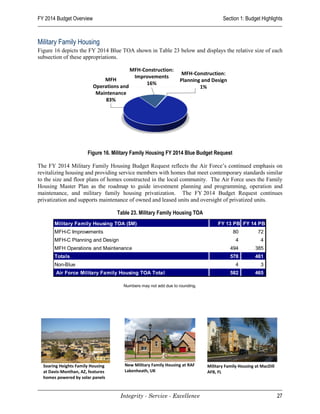
     FY14 Supporting Exhibits
      (M-1, O-1, P-1, R-1, C-1)


Integrity - Service - Excellence          1
United States Air Force

                       FY 2014 Budget Overview


The information contained in the Budget Overview Book is supported by the Air Force J-Books.
        Preparation of the J-Book report/study cost the Department of Defense a total of
  approximately $2,822,000. This includes $960,000 in expenses and $1,862,000 in DoD labor.

                         Generated on 27 Mar 13; RefID: D-1B2BFFC
FY 2014 Budget Overview                                                                             Foreword


Foreword
Over the past decade, the Air Force put great emphasis on fielding the war fighting capabilities that are
necessary for ongoing joint and coalition operations. The Air Force was specifically designed to bring air
power, the ability to project military power or influence through the control and exploitation of air, space,
and cyberspace, anywhere in the world. As the indispensable partner in the joint fight, the Air Force
supports the Defense Strategic Guidance and Combatant Commander needs across the globe with our
core missions: (1) air and space superiority; (2) intelligence, surveillance, and reconnaissance; (3) rapid
global mobility; (4) global strike; and (5) command and control. We already combine our air, space, and
cyber forces to maximize these enduring core missions but the way we execute must continually evolve as
we strive to sustain our Nation’s asymmetric airpower advantage.
The Defense Strategic Guidance directed a rebalance of forces, with a renewed focus on the Asia-Pacific
region, as well as continued emphasis on the Middle East. These national priorities hinge upon a strong
and capable Air Force. To remain the most capable Air Force in the world, we must continue to
modernize our over-aged and over-worked weapon systems. In terms of average aircraft age, Air Force
“iron” is older than it’s ever been. Additionally, high operations tempo has shortened service lives,
increasing the cost to sustain and maintain our weapon systems. Faced with compounding fiscal
challenges, we must make prudent choices to ensure the Air Force continues to preserve our Nation’s
airpower advantage. To this end, the Air Force is committed to avoiding a hollow force; one that looks
good on paper, but has more units and equipment than it can support, lacks the resources to adequately
man, train and maintain them, or keep up with advancing technologies. Our budget request maintains and
modernizes our key air and space inventories in line with the Defense Strategic Guidance.
For the FY 2013 Budget, the Air Force, Guard and Reserve leadership came together to develop the
FY 2013 Total Force Proposal (TFP). The purpose of the TFP was to rebalance aircraft and personnel
reductions across the Total Force, while continuing efforts to reduce unaffordable force structure. The
TFP was subsequently presented to Congress and included in the FY 2013 National Defense
Authorization Act (FY 2013 NDAA). The TFP restored about 38 percent of the aircraft and 55 percent of
the personnel reductions originally proposed for the Guard and Reserve. With these changes, the active
duty Air Force will reduce to approximately 329,500 personnel in FY 2013, approaching the same size as
when we were established as a separate service in 1947. At the same time, the FY 2013 NDAA permits
the Air Force to proceed with selected aircraft retirements and transfers necessary to meet budget targets
while protecting readiness and modernization.
With the onset of Sequestration, we have begun implementing immediate actions to mitigate an
approximate $10B reduction to Air Force Total Obligation Authority. We’ve taken steps to minimize
impacts to readiness and our people; however, the results of these cuts will be felt across all Air Force
Core Missions and challenge the goals of our FY 2014 Budget Submission which does not reflect
Sequestration reductions. Given today’s fiscally constrained environment, the Air Force must pursue the
best combination of choices available to balance force reductions and manage war-fighting risks,
resources and the bow-wave of impacts from FY 2013. Taking these actions allows us to keep faith with
our 687,634 total force Airmen and continue to excel in our role to fly, fight, and win in air, space and
cyberspace.


                                                  EDWARD L. BOLTON, JR., Major General, USAF
                                                  Deputy Assistant Secretary (Budget)

                                    Integrity - Service - Excellence
Integrity - Service - Excellence
FY 2014 Budget Overview                                                                                                                       Table of Contents


Table of Contents
     Table of Figures ....................................................................................................................... ii
     Table of Tables ....................................................................................................................... iii
     Introduction ..............................................................................................................................1
     Section 1: FY 2014 Budget Highlights (Overview) ...................................................................2
             Total Air Force (Components) .................................................................................................................. 5
             Military Personnel Total ............................................................................................................................ 6
             Operation and Maintenance ................................................................................................................... 10
             Research, Development, Test & Evaluation ........................................................................................... 16
             Procurement ........................................................................................................................................... 18
             Military Construction ............................................................................................................................... 23
             Military Family Housing........................................................................................................................... 27
             Base Realignment and Closure .............................................................................................................. 28
             Summary ................................................................................................................................................ 29
     Section 2: Performance Based Budget (Overview) ................................................................30
             Alignment to Department of Defense Priorities ....................................................................................... 31
             Performance Management ..................................................................................................................... 32
             Summary of Planned Accomplishments ................................................................................................. 32
             Nuclear Deterrence Operations .............................................................................................................. 33
             Air Superiority ......................................................................................................................................... 37
             Space Superiority ................................................................................................................................... 40
             Cyberspace Superiority .......................................................................................................................... 43
             Global Precision Attack........................................................................................................................... 45
             Rapid Global Mobility .............................................................................................................................. 48
             Special Operations ................................................................................................................................. 51
             Global Integrated Intelligence, Surveillance and Reconnaissance ......................................................... 54
             Command and Control............................................................................................................................ 56
             Personnel Recovery ............................................................................................................................... 59
             Building Partnerships .............................................................................................................................. 62
             Agile Combat Support............................................................................................................................. 65
     Section 3: Working Capital Fund ............................................................................................79
             Working Capital Fund Organization ........................................................................................................ 80
             Consolidated Sustainment Activity Group .............................................................................................. 80
             Supply Management Activity Group – Retail .......................................................................................... 82
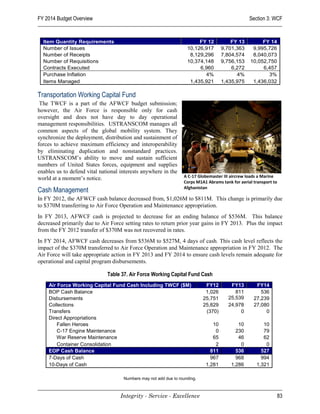
             Transportation Working Capital Fund ..................................................................................................... 83
             Cash Management ................................................................................................................................. 83
     Conclusion .............................................................................................................................84
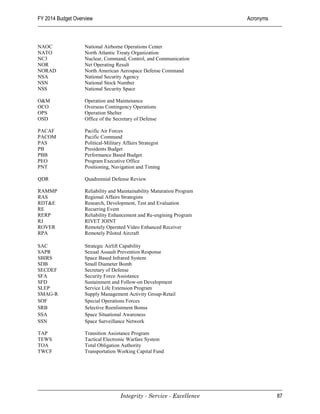
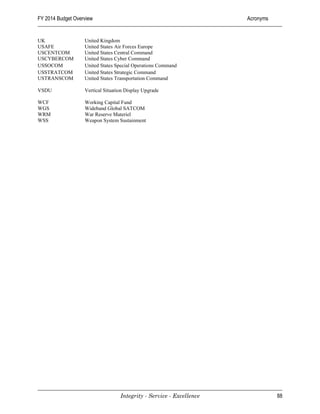
     Acronyms ...............................................................................................................................85


                                                    Integrity - Service - Excellence                                                                                    i
FY 2014 Budget Overview                                                                                                                   Table of Contents


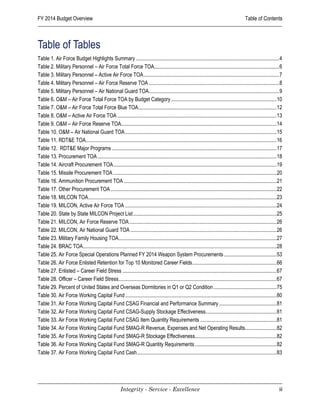
Table of Figures
Figure 1. Military Personnel - Total Force FY 2014 Blue Budget Request ..................................................................... 6
Figure 2. Military Personnel – Active Air Force FY 2014 Blue Budget Request ............................................................. 7
Figure 3. Military Personnel – Air Force Reserve FY 2014 Blue Budget Request ......................................................... 8
Figure 4. Military Personnel – Air National Guard FY 2014 Blue Budget Request......................................................... 9
Figure 5. O&M Budget Request FY 2014 Blue Budget Request .................................................................................. 10
Figure 6. O&M – Active Air Force FY 2014 Blue Budget Request ............................................................................... 13
Figure 7. O&M – Air Force Reserve FY 2014 Blue Budget Request ........................................................................... 14
Figure 8. O&M – Air National Guard FY 2014 Blue Budget Request ........................................................................... 15
Figure 9. RDT&E FY 2014 Blue Budget Request ........................................................................................................ 16
Figure 10. Procurement FY 2014 Blue Budget Request .............................................................................................. 18
Figure 11. Aircraft Procurement FY 2014 Blue Budget Request .................................................................................. 19
Figure 12. Missile Procurement FY 2014 Blue Budget Request .................................................................................. 20
Figure 13. Ammunition Procurement FY 2014 Blue Budget Request .......................................................................... 21
Figure 14. Other Procurement FY 2014 Blue Budget Request .................................................................................... 22
Figure 15. MILCON FY 2014 Blue Budget Request..................................................................................................... 23
Figure 16. Military Family Housing FY 2014 Blue Budget Request ............................................................................. 27
Figure 17. Air Force Performance Pyramid .................................................................................................................. 30
Figure 18. Air Force Core Functions ............................................................................................................................ 31
Figure 19. FY 2014 Budget Request by Air Force Core Function ................................................................................ 32
Figure 20. Nuclear Deterrence Operations TOA by Appropriation ............................................................................... 33
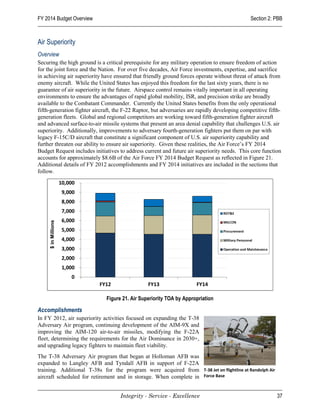
Figure 21. Air Superiority TOA by Appropriation .......................................................................................................... 37
Figure 22. Space Superiority TOA by Appropriation .................................................................................................... 40
Figure 23. Cyberspace Superiority TOA by Appropriation ........................................................................................... 43
Figure 24. Global Precision Attack TOA by Appropriation ........................................................................................... 45
Figure 25. Rapid Global Mobility TOA by Appropriation............................................................................................... 48
Figure 26. Special Operations TOA by Appropriation .................................................................................................. 51
Figure 27. Global Integrated ISR TOA by Appropriation .............................................................................................. 54
Figure 28. Command and Control TOA by Appropriation ............................................................................................ 56
Figure 29. Personnel Recovery TOA by Appropriation ................................................................................................ 59
Figure 30. Overseas Contingency Operations Saves and Assists ............................................................................... 60
Figure 31. Building Partnerships TOA by Appropriation............................................................................................... 62
Figure 32. Agile Combat Support TOA by Appropriation ............................................................................................. 65
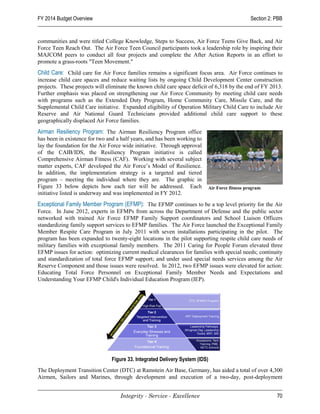
Figure 33. Integrated Delivery System (IDS)................................................................................................................ 70
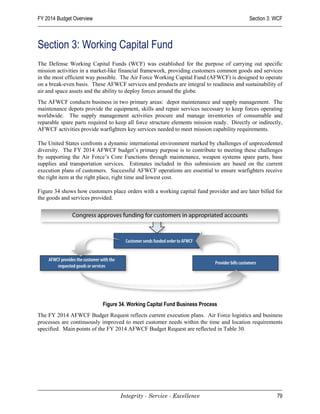
Figure 34. Working Capital Fund Business Process .................................................................................................... 79
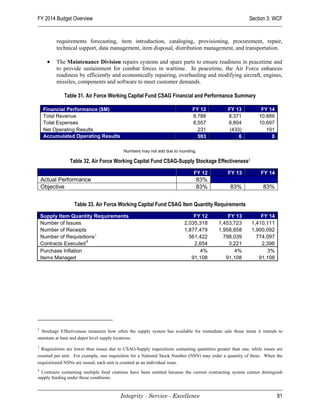
Figure 35. Air Force Working Capital Fund Activity Groups ......................................................................................... 80


                                                       Integrity - Service - Excellence                                                                          ii
FY 2014 Budget Overview                                                                                                                        Table of Contents


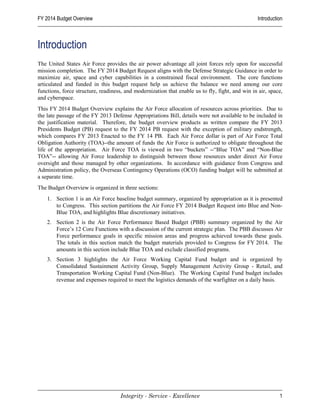
Table of Tables
Table 1. Air Force Budget Highlights Summary ............................................................................................................. 4
Table 2. Military Personnel – Air Force Total Force TOA............................................................................................... 6
Table 3. Military Personnel – Active Air Force TOA ....................................................................................................... 7
Table 4. Military Personnel – Air Force Reserve TOA ................................................................................................... 8
Table 5. Military Personnel – Air National Guard TOA ................................................................................................... 9
Table 6. O&M – Air Force Total Force TOA by Budget Category ................................................................................ 10
Table 7. O&M – Air Force Total Force Blue TOA ......................................................................................................... 12
Table 8. O&M – Active Air Force TOA ......................................................................................................................... 13
Table 9. O&M – Air Force Reserve TOA...................................................................................................................... 14
Table 10. O&M – Air National Guard TOA ................................................................................................................... 15
Table 11. RDT&E TOA................................................................................................................................................. 16
Table 12. RDT&E Major Programs ............................................................................................................................. 17
Table 13. Procurement TOA ........................................................................................................................................ 18
Table 14. Aircraft Procurement TOA ............................................................................................................................ 19
Table 15. Missile Procurement TOA ............................................................................................................................ 20
Table 16. Ammunition Procurement TOA .................................................................................................................... 21
Table 17. Other Procurement TOA .............................................................................................................................. 22
Table 18. MILCON TOA ............................................................................................................................................... 23
Table 19. MILCON, Active Air Force TOA ................................................................................................................... 24
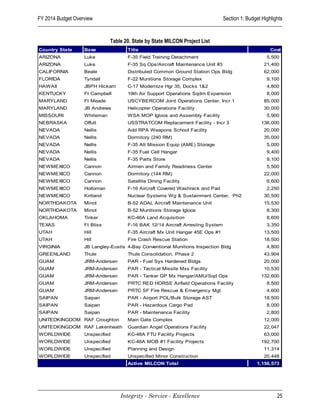
Table 20. State by State MILCON Project List ............................................................................................................. 25
Table 21. MILCON, Air Force Reserve TOA ................................................................................................................ 26
Table 22. MILCON, Air National Guard TOA ............................................................................................................... 26
Table 23. Military Family Housing TOA........................................................................................................................ 27
Table 24. BRAC TOA ................................................................................................................................................... 28
Table 25. Air Force Special Operations Planned FY 2014 Weapon System Procurements ........................................ 53
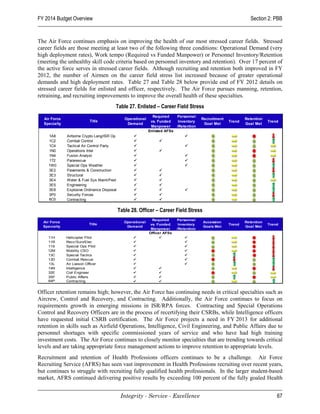
Table 26. Air Force Enlisted Retention for Top 10 Monitored Career Fields ................................................................ 66
Table 27. Enlisted – Career Field Stress ..................................................................................................................... 67
Table 28. Officer – Career Field Stress........................................................................................................................ 67
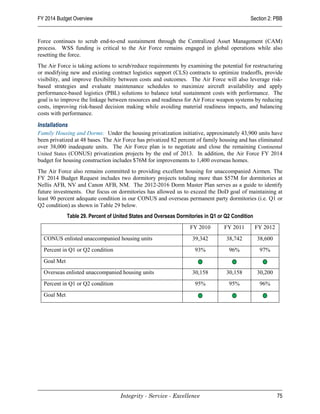
Table 29. Percent of United States and Overseas Dormitories in Q1 or Q2 Condition ................................................ 75
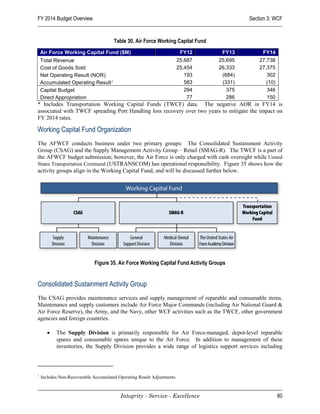
Table 30. Air Force Working Capital Fund ................................................................................................................... 80
Table 31. Air Force Working Capital Fund CSAG Financial and Performance Summary ............................................ 81
Table 32. Air Force Working Capital Fund CSAG-Supply Stockage Effectiveness...................................................... 81
Table 33. Air Force Working Capital Fund CSAG Item Quantity Requirements .......................................................... 81
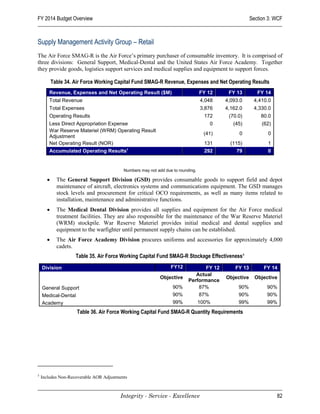
Table 34. Air Force Working Capital Fund SMAG-R Revenue, Expenses and Net Operating Results........................82
Table 35. Air Force Working Capital Fund SMAG-R Stockage Effectiveness.............................................................. 82
Table 36. Air Force Working Capital Fund SMAG-R Quantity Requirements .............................................................. 82
Table 37. Air Force Working Capital Fund Cash .......................................................................................................... 83


                                                         Integrity - Service - Excellence                                                                             iii
FY 2014 Budget Overview                                                                          Introduction


Introduction
The United States Air Force provides the air power advantage all joint forces rely upon for successful
mission completion. The FY 2014 Budget Request aligns with the Defense Strategic Guidance in order to
maximize air, space and cyber capabilities in a constrained fiscal environment. The core functions
articulated and funded in this budget request help us achieve the balance we need among our core
functions, force structure, readiness, and modernization that enable us to fly, fight, and win in air, space,
and cyberspace.
This FY 2014 Budget Overview explains the Air Force allocation of resources across priorities. Due to
the late passage of the FY 2013 Defense Appropriations Bill, details were not available to be included in
the justification material. Therefore, the budget overview products as written compare the FY 2013
Presidents Budget (PB) request to the FY 2014 PB request with the exception of military endstrength,
which compares FY 2013 Enacted to the FY 14 PB. Each Air Force dollar is part of Air Force Total
Obligation Authority (TOA)--the amount of funds the Air Force is authorized to obligate throughout the
life of the appropriation. Air Force TOA is viewed in two “buckets” --“Blue TOA” and “Non-Blue
TOA”-- allowing Air Force leadership to distinguish between those resources under direct Air Force
oversight and those managed by other organizations. In accordance with guidance from Congress and
Administration policy, the Overseas Contingency Operations (OCO) funding budget will be submitted at
a separate time.
The Budget Overview is organized in three sections:
    1. Section 1 is an Air Force baseline budget summary, organized by appropriation as it is presented
       to Congress. This section partitions the Air Force FY 2014 Budget Request into Blue and Non-
       Blue TOA, and highlights Blue discretionary initiatives.
    2. Section 2 is the Air Force Performance Based Budget (PBB) summary organized by the Air
       Force’s 12 Core Functions with a discussion of the current strategic plan. The PBB discusses Air
       Force performance goals in specific mission areas and progress achieved towards these goals.
       The totals in this section match the budget materials provided to Congress for FY 2014. The
       amounts in this section include Blue TOA and exclude classified programs.
    3. Section 3 highlights the Air Force Working Capital Fund budget and is organized by
       Consolidated Sustainment Activity Group, Supply Management Activity Group - Retail, and
       Transportation Working Capital Fund (Non-Blue). The Working Capital Fund budget includes
       revenue and expenses required to meet the logistics demands of the warfighter on a daily basis.


                                    Integrity - Service - Excellence                                       1
FY 2014 Budget Overview                                                          Section 1: Budget Highlights


Section 1: FY 2014 Budget Highlights (Overview)
The Air Force FY 2014 Budget Request is strategy-based, fiscally informed, and sets a course toward
full-spectrum readiness of the force to execute the Defense Strategic Guidance (DSG). The capability to
sustain these national priorities hinges upon a strong and capable Air Force. To prevent a hollow force,
the Air Force took steps in FY 2013 to become smaller in order to maintain a fully trained and ready force
in a shrinking budgetary environment. By remaining smaller, we trade size for quality by maintaining our
focus on readiness and modernization. It reallocates manpower to our highest priorities and sustains, with
less than desirable risk, our cornerstone programs across the broad Air Force portfolio of mission sets.
The FY 2014 Budget Request supports military end strength of 503,400. This includes Active component
end strength of 327,600, reduced by 1,860 from the FY 2013 Enacted position; Reserve component end
strength of 70,400, a decrease of 480; and Air National Guard end strength of 105,400, a decrease of 300.
The budget reflects rebalancing between Active and Reserve Components to preserve the Total Force
capability and capacity requirements of the DSG. However, in the fiscally constrained environment
imposed by the Budget Control Act, the Air Force supports efforts to slow the rate of growth in overall
military compensation. This is necessary to protect readiness and avoid driving even deeper reductions to
force structure and delay modernization efforts critical to support national defense.
The FY 2014 Operation and Maintenance (O&M) budget request funds the day-to-day expenses of the
Air Force to meet mission sustainment activities. It supports 79 major installations (72 Active, 2 Air
National Guard and 5 Air Force Reserve), funds flying operations, space operations, cyber operations,
intelligence, logistics, nuclear deterrence, search and rescue and special operations activities. The O&M
budget also supports a consistent, equitable and attainable flying hour program, prioritized full spectrum
training venues, weapon system sustainment, pay and benefits for civilian personnel, sustainment of our
power projection platforms (our installations) and developing and caring for our Airmen and their
families.
The Research, Development, Test and Evaluation (RDT&E) appropriation funds basic and applied
scientific research as well as future weapon systems’ development, test and evaluation. The FY 2014
request includes funding for the KC-46A and supports system development of the F-35A Joint Strike
Fighter, the next generation strike aircraft for the U.S. Air Force, Navy, Marine Corps and our allies. The
request also includes funding for design, integration, testing and certification of the mission components
for the Combat Rescue Helicopter, America’s premier helicopter for day, night and marginal weather
Combat Search and Rescue, replacing the aging HH-60G. RDT&E funding also supports such programs
as Space Situational Awareness Systems, Global Positioning Systems, long-range, penetrating bomber as
well as Minuteman III Intercontinental Ballistic Missile modernization projects ensuring future viability
of the nation’s nuclear deterrence operations.
The Procurement portfolio delivers both immediate and future capabilities through investment across four
specific appropriations: Aircraft, Missile, Ammunition and Other Procurement. A new multi-year C-130
procurement initiative leverages resources across services, and funds the procurement of six C-130J
aircraft, one HC-130, four MC-130s and five AC-130s in FY 2014. Additionally, the Air Force procures
twelve MQ-9, nineteen F-35A, and three CV-22B Osprey in addition to various upgrades and
modifications to the existing fleet. The Air Force will continue Evolutionary Acquisition for Space
Efficiency/Efficient Space Procurement (EASE/ESP) approach for a fixed price block buy of Advanced
Extremely High Frequency satellite vehicles 5 and 6 and Space-Based Infrared System Geosynchronous
Earth Orbit (GEO)-5 and 6. Additionally, the budget request procures munitions to maintain appropriate
War Reserve Materiel munitions quantities and required test and training inventory levels including 6,965
Joint Direct Attack Munitions and general purpose bombs, practice bombs and rockets.


                                    Integrity - Service - Excellence                                       2
FY 2014 Budget Overview                                                             Section 1: Budget Highlights


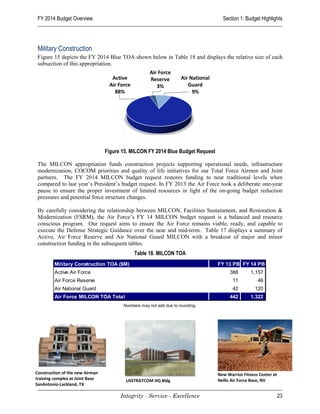
The Air Force Military Construction (MILCON) appropriation funds construction projects supporting
operational needs, infrastructure modernization, Combatant Commands (COCOM) priorities and quality
of life initiatives for Airmen and Joint personnel. In FY 2013 the Air Force took a deliberate one-year
pause to ensure the proper investment of limited resources in light of the on-going budget reduction
pressures and potential force structure changes. The FY 2014 MILCON budget request restores funding
to historic levels when compared to last year. In FY 2014, the Air Force requests $1,322M for the Active,
Guard and Reserve MILCON programs, an $880M increase from FY 2013. The 53-project program
affects 24 states/territories and 3 countries, and specifically supports the Air Force’s strategic priorities of
ensuring we remain ready, capable and viable to execute the Defense Strategic Guidance over the near
and mid-term.
The FY 2014 Air Force budget continues efforts to create more value from the resources managed and
consumed across our Air Force core function areas. The FY 2014 Air Force budget reflects $1.3B in
program reductions across operating, investment and military construction budgets as part of the
Department of Defense (DoD) reported More Disciplined Use of Resources (MDUR) accounting. Across
the future year’s defense program, the Air Force has contributed $7.9B in program reductions supporting
MDUR. These changes are integral to the Service Core Function budgets reflected throughout the Air
Force budget overview. We continue to engage and deliver on many fronts in driving improvements and
getting the most from resources available to the Air Force.
The FY 2014 budget incorporates force structure requirements authorized in the FY 2013 NDAA. The Air
Force FY13 PB submission made the difficult choice to divest a portion of combat and combat support
aircraft to balance reductions from the Budget Control Act of 2011 with the need to retain critical core Air
Force capabilities, resulting in programmed savings of $8.7B across the Future Years Defense Program
(FYDP). To address concerns on the balancing of reductions between components, the Air Force
submitted a TFP to restore a portion of these aircraft and associated personnel at an added cost of over
$1B across the FYDP. The FY 2013 NDAA incorporated the TFP, and also required the retention of
additional aircraft to include Intra-theater airlift, RQ-4 Block 30, and B-1 aircraft, and delayed the
retirement of C-5A aircraft. In total these FY 2013 NDAA authorized force structure changes added
$1.7B in FYDP costs above the original FY 2013 PB submission, including $602M in FY 2013.
While not reflected in the detailed justification contained in this publication, the result of sequestration
forced the Air Force to implement immediate actions to mitigate an FY 2013 top-line reduction of
approximately $10B. These actions include: a furlough of more than 170,000 civil service employees up
to 22-days, an 18% reduction in flying hours and weapon system sustainment, a reduction for F-35A lot
buys (lot sizes ranging from 19 - 14), delay of more than 20 military construction projects, and deferment
of critical mission facility requirements (such as runway/taxiway repairs and critical repairs to installation
homes/facilities). To counter these actions, in FY 2014 the Air Force must plan for a surge in flight
training operations, rebuild degraded unit readiness, accept further delays to modernization, absorb a 2 - 3
year backlog in depot maintenance inductions, and invest additional funding to restore infrastructure.
While the Air Force has made every effort to minimize impacts to readiness and people, the bow-wave of
reductions, deferments, and cancelations will challenge the strategic choices made in the FY 2014 budget
submission.
The United States Air Force provides the air power advantage all joint forces rely upon for successful
mission completion. The priorities articulated and funded in this budget request achieve the balance
required to support the Defense Strategic Guidance in today’s fiscally constrained environment. This
budget request allocates resources to set a course towards full-spectrum readiness, sustains the gains
achieved in reinvigorating the nuclear enterprise, focuses on our most pressing force structure and
modernization challenges, and continues to develop and care for our most precious resource, our Airmen
and their families.


                                     Integrity - Service - Excellence                                         3
FY 2014 Budget Overview                                                                             Section 1: Budget Highlights


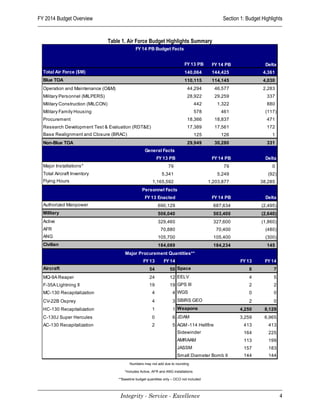
                                   Table 1. Air Force Budget Highlights Summary
                                                 FY 14 PB Budget Facts


                                                                                FY 13 PB       FY 14 PB                Delta
  Total Air Force ($M)                                                          140,064        144,425                4,361
  Blue TOA                                                                      110,115        114,145                4,030
  Operation and Maintenance (O&M)                                                 44,294        46,577                2,283
  Military Personnel (MILPERS)                                                    28,922        29,259                  337
  Military Construction (MILCON)                                                        442      1,322                  880
  Military Family Housing                                                               578        461                 (117)
  Procurement                                                                     18,366        18,837                  471
  Research Development Test & Evaluation (RDT&E)                                  17,389        17,561                  172
  Base Realignment and Closure (BRAC)                                                   125        126                     1
  Non-Blue TOA                                                                    29,949        30,280                  331
                                                       General Facts
                                                                FY 13 PB                       FY 14 PB                Delta
  Major Installations*                                                79                            79                     0
  Total Aircraft Inventory                                        5,341                          5,249                   (92)
  Flying Hours                                              1,165,592                         1,203,877              38,285
                                                     Personnel Facts
                                                       FY 13 Enacted                           FY 14 PB                Delta
  Authorized Manpower                                           690,129                         687,634               (2,495)
  Military                                                      506,040                         503,400               (2,640)
  Active                                                        329,460                         327,600               (1,860)
  AFR                                                            70,880                          70,400                (480)
  ANG                                                           105,700                         105,400                (300)
  Civilian                                                      184,089                         184,234                 145
                                           Major Procurement Quantities**
                                                      FY 13        FY 14                                    FY 13      FY 14
  Aircraft                                                54           50 Space                                 8          7
  MQ-9A Reaper                                            24           12 EELV                                  4          5
  F-35A Lightning II                                      19           19 GPS III                               2          2
  MC-130 Recapitalization                                   4            4 WGS                                  0          0
  CV-22B Osprey                                             4            3 SBIRS GEO                            2          0
  HC-130 Recapitalization                                   1            1 Weapons                         4,250       8,129
  C-130J Super Hercules                                     0            6 JDAM                            3,259       6,965
  AC-130 Recapitalization                                   2            5 AGM -114 Hellfire                 413         413
                                                                            Sidewinder                       164         225
                                                                            AMRAAM                           113         199
                                                                            JASSM                            157         183
                                                                            Small Diameter Bomb II           144         144
                                              Numbers may not add due to rounding

                                          *Includes Active, AFR and ANG installations

                                       **Baseline budget quantities only – OCO not included


                                        Integrity - Service - Excellence                                                        4
FY 2014 Budget Overview                                                        Section 1: Budget Highlights


Total Air Force (Components)
The components of the Air Force--Active, Reserve, and Guard--make up the Total Force which support
the domains of air, space, and cyberspace. The integration of the Active, Reserve, and Guard components
allow for a flexible and agile response in today’s complex strategic environment. The correct mix of
operational forces must be leveraged across the Total Force to shift quickly and efficiently from one
mission to another. The Air Force seeks to balance capabilities across the components to meet the
Nation’s military challenges now and into the future.

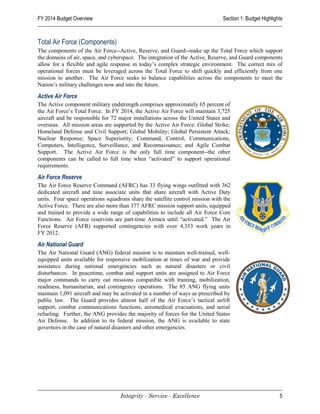
Active Air Force
The Active component military endstrength comprises approximately 65 percent of
the Air Force’s Total Force. In FY 2014, the Active Air Force will maintain 3,725
aircraft and be responsible for 72 major installations across the United States and
overseas. All mission areas are supported by the Active Air Force: Global Strike;
Homeland Defense and Civil Support; Global Mobility; Global Persistent Attack;
Nuclear Response; Space Superiority; Command, Control, Communications,
Computers, Intelligence, Surveillance, and Reconnaissance; and Agile Combat
Support. The Active Air Force is the only full time component--the other
components can be called to full time when “activated” to support operational
requirements.

Air Force Reserve
The Air Force Reserve Command (AFRC) has 33 flying wings outfitted with 362
dedicated aircraft and nine associate units that share aircraft with Active Duty
units. Four space operations squadrons share the satellite control mission with the
Active Force. There are also more than 377 AFRC mission support units, equipped
and trained to provide a wide range of capabilities to include all Air Force Core
Functions. Air Force reservists are part-time Airmen until “activated.” The Air
Force Reserve (AFR) supported contingencies with over 4,353 work years in
FY 2012.

Air National Guard
The Air National Guard (ANG) federal mission is to maintain well-trained, well-
equipped units available for responsive mobilization at times of war and provide
assistance during national emergencies such as natural disasters or civil
disturbances. In peacetime, combat and support units are assigned to Air Force
major commands to carry out missions compatible with training, mobilization,
readiness, humanitarian, and contingency operations. The 85 ANG flying units
maintain 1,091 aircraft and may be activated in a number of ways as prescribed by
public law. The Guard provides almost half of the Air Force’s tactical airlift
support, combat communications functions, aeromedical evacuations, and aerial
refueling. Further, the ANG provides the majority of forces for the United States
Air Defense. In addition to its federal mission, the ANG is available to state
governors in the case of natural disasters and other emergencies.


                                   Integrity - Service - Excellence                                      5
FY 2014 Budget Overview                                                                      Section 1: Budget Highlights


Military Personnel Total
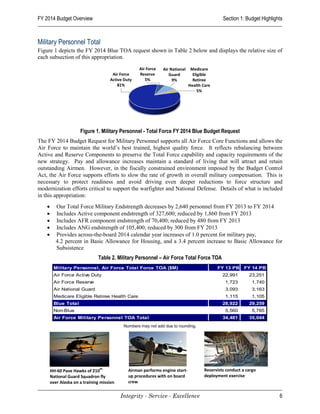
Figure 1 depicts the FY 2014 Blue TOA request shown in Table 2 below and displays the relative size of
each subsection of this appropriation.


                       Figure 1. Military Personnel - Total Force FY 2014 Blue Budget Request
The FY 2014 Budget Request for Military Personnel supports all Air Force Core Functions and allows the
Air Force to maintain the world’s best trained, highest quality force. It reflects rebalancing between
Active and Reserve Components to preserve the Total Force capability and capacity requirements of the
new strategy. Pay and allowance increases maintain a standard of living that will attract and retain
outstanding Airmen. However, in the fiscally constrained environment imposed by the Budget Control
Act, the Air Force supports efforts to slow the rate of growth in overall military compensation. This is
necessary to protect readiness and avoid driving even deeper reductions to force structure and
modernization efforts critical to support the warfighter and National Defense. Details of what is included
in this appropriation:
    •      Our Total Force Military Endstrength decreases by 2,640 personnel from FY 2013 to FY 2014
    •      Includes Active component endstrength of 327,600; reduced by 1,860 from FY 2013
    •      Includes AFR component endstrength of 70,400; reduced by 480 from FY 2013
    •      Includes ANG endstrength of 105,400; reduced by 300 from FY 2013
    •      Provides across-the-board 2014 calendar year increases of 1.0 percent for military pay,
           4.2 percent in Basic Allowance for Housing, and a 3.4 percent increase to Basic Allowance for
           Subsistence
                                Table 2. Military Personnel – Air Force Total Force TOA
         Military Personnel, Air Force Total Force TOA ($M)                               FY 13 PB      FY 14 PB
         Air Force Active Duty                                                               22,991       23,251
         Air Force Reserve                                                                    1,723         1,740
         Air National Guard                                                                   3,093         3,163
         Medicare Eligible Retiree Health Care                                                1,115         1,105
         Blue Total                                                                          28,922       29,259
         Non-Blue                                                                             5,560         5,785
         Air Force Military Personnel TOA Total                                              34,481       35,044
                                             Numbers may not add due to rounding.


                                 th
        HH-60 Pave Hawks of 210                Airman performs engine start-        Reservists conduct a cargo
        National Guard Squadron fly            up procedures with on board          deployment exercise
        over Alaska on a training mission      crew


                                            Integrity - Service - Excellence                                           6
FY 2014 Budget Overview                                                                Section 1: Budget Highlights


Military Personnel – Active Air Force
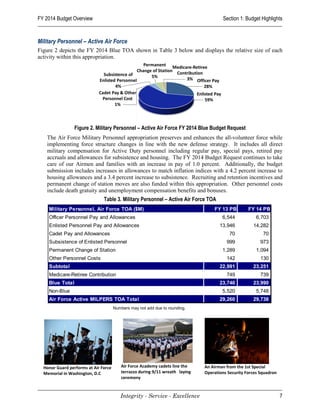
Figure 2 depicts the FY 2014 Blue TOA shown in Table 3 below and displays the relative size of each
activity within this appropriation.


                 Figure 2. Military Personnel – Active Air Force FY 2014 Blue Budget Request
   The Air Force Military Personnel appropriation preserves and enhances the all-volunteer force while
   implementing force structure changes in line with the new defense strategy. It includes all direct
   military compensation for Active Duty personnel including regular pay, special pays, retired pay
   accruals and allowances for subsistence and housing. The FY 2014 Budget Request continues to take
   care of our Airmen and families with an increase in pay of 1.0 percent. Additionally, the budget
   submission includes increases in allowances to match inflation indices with a 4.2 percent increase to
   housing allowances and a 3.4 percent increase to subsistence. Recruiting and retention incentives and
   permanent change of station moves are also funded within this appropriation. Other personnel costs
   include death gratuity and unemployment compensation benefits and bonuses.
                               Table 3. Military Personnel – Active Air Force TOA
    Military Personnel, Air Force TOA ($M)                                         FY 13 PB         FY 14 PB
    Officer Personnel Pay and Allowances                                               6,544           6,703
    Enlisted Personnel Pay and Allowances                                             13,946          14,282
    Cadet Pay and Allowances                                                               70              70
    Subsistence of Enlisted Personnel                                                    999              973
    Permanent Change of Station                                                        1,289           1,094
    Other Personnel Costs                                                                142              130
    Subtotal                                                                          22,991          23,251
    Medicare-Retiree Contribution                                                        749              739
    Blue Total                                                                        23,740          23,990
    Non-Blue                                                                           5,520           5,748
    Air Force Active MILPERS TOA Total                                                29,260          29,738
                                      Numbers may not add due to rounding.


  Honor Guard performs at Air Force       Air Force Academy cadets line the    An Airman from the 1st Special
                                                                               Airlift Wing Commander, oversees
  Memorial in Washington, D.C             terrazzo during 9/11 wreath laying   Operations Security Forces Squadron
                                                                               strategic airlift operations
                                          ceremony


                                         Integrity - Service - Excellence                                            7
FY 2014 Budget Overview                                                                  Section 1: Budget Highlights


Military Personnel – Air Force Reserve
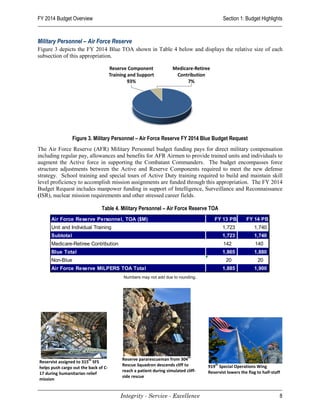
Figure 3 depicts the FY 2014 Blue TOA shown in Table 4 below and displays the relative size of each
subsection of this appropriation.


                 Figure 3. Military Personnel – Air Force Reserve FY 2014 Blue Budget Request
The Air Force Reserve (AFR) Military Personnel budget funding pays for direct military compensation
including regular pay, allowances and benefits for AFR Airmen to provide trained units and individuals to
augment the Active force in supporting the Combatant Commanders. The budget encompasses force
structure adjustments between the Active and Reserve Components required to meet the new defense
strategy. School training and special tours of Active Duty training required to build and maintain skill
level proficiency to accomplish mission assignments are funded through this appropriation. The FY 2014
Budget Request includes manpower funding in support of Intelligence, Surveillance and Reconnaissance
(ISR), nuclear mission requirements and other stressed career fields.

                               Table 4. Military Personnel – Air Force Reserve TOA
      Air Force Reserve Personnel, TOA ($M)                                         FY 13 PB         FY 14 PB
      Unit and Individual Training                                                       1,723           1,740
      Subtotal                                                                           1,723           1,740
      Medicare-Retiree Contribution                                                      142              140
      Blue Total                                                                         1,865           1,880
      Non-Blue                                                                            20               20
      Air Force Reserve MILPERS TOA Total                                                1,885           1,900
                                        Numbers may not add due to rounding.


                                                                         th
                         th            Reserve pararescueman from 304
Reservist assigned to 315 SFS
                                       Rescue Squadron descends cliff to            th
                                                                                 919 Special Operations Wing
helps push cargo out the back of C-
                                       reach a patient during simulated cliff-   Reservist lowers the flag to half-staff
17 during humanitarian relief
                                       side rescue
mission


                                       Integrity - Service - Excellence                                                8
FY 2014 Budget Overview                                                               Section 1: Budget Highlights


Military Personnel – Air National Guard
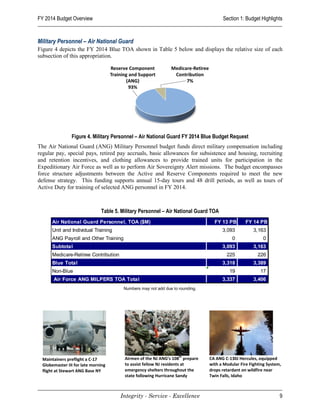
Figure 4 depicts the FY 2014 Blue TOA shown in Table 5 below and displays the relative size of each
subsection of this appropriation.


                Figure 4. Military Personnel – Air National Guard FY 2014 Blue Budget Request
The Air National Guard (ANG) Military Personnel budget funds direct military compensation including
regular pay, special pays, retired pay accruals, basic allowances for subsistence and housing, recruiting
and retention incentives, and clothing allowances to provide trained units for participation in the
Expeditionary Air Force as well as to perform Air Sovereignty Alert missions. The budget encompasses
force structure adjustments between the Active and Reserve Components required to meet the new
defense strategy. This funding supports annual 15-day tours and 48 drill periods, as well as tours of
Active Duty for training of selected ANG personnel in FY 2014.


                               Table 5. Military Personnel – Air National Guard TOA
      Air National Guard Personnel, TOA ($M)                                     FY 13 PB        FY 14 PB
      Unit and Individual Training                                                    3,093          3,163
      ANG Payroll and Other Training                                                      0              0
      Subtotal                                                                        3,093          3,163
      Medicare-Retiree Contribution                                                    225             226
      Blue Total                                                                      3,318          3,389
      Non-Blue                                                                           19             17
       Air Force ANG MILPERS TOA Total                                                3,337          3,406
                                        Numbers may not add due to rounding.


                                                                   th
  Maintainers preflight a C-17           Airmen of the NJ ANG’s 108 prepare    CA ANG C-130J Hercules, equipped
  Globemaster III for late morning       to assist fellow NJ residents at      with a Modular Fire Fighting System,
  flight at Stewart ANG Base NY          emergency shelters throughout the     drops retardant on wildfire near
                                         state following Hurricane Sandy       Twin Falls, Idaho


                                       Integrity - Service - Excellence                                           9
FY 2014 Budget Overview                                                           Section 1: Budget Highlights


Operation and Maintenance
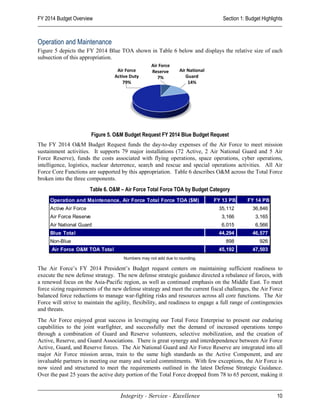
Figure 5 depicts the FY 2014 Blue TOA shown in Table 6 below and displays the relative size of each
subsection of this appropriation.


                         Figure 5. O&M Budget Request FY 2014 Blue Budget Request
The FY 2014 O&M Budget Request funds the day-to-day expenses of the Air Force to meet mission
sustainment activities. It supports 79 major installations (72 Active, 2 Air National Guard and 5 Air
Force Reserve), funds the costs associated with flying operations, space operations, cyber operations,
intelligence, logistics, nuclear deterrence, search and rescue and special operations activities. All Air
Force Core Functions are supported by this appropriation. Table 6 describes O&M across the Total Force
broken into the three components.
                        Table 6. O&M – Air Force Total Force TOA by Budget Category
     Operation and Maintenance, Air Force Total Force TOA ($M)                FY 13 PB       FY 14 PB
     Active Air Force                                                           35,112         36,846
     Air Force Reserve                                                           3,166           3,165
     Air National Guard                                                          6,015           6,566
     Blue Total                                                                 44,294         46,577
     Non-Blue                                                                      898             926
      Air Force O&M TOA Total                                                   45,192         47,503
                                      Numbers may not add due to rounding.

The Air Force’s FY 2014 President’s Budget request centers on maintaining sufficient readiness to
execute the new defense strategy. The new defense strategic guidance directed a rebalance of forces, with
a renewed focus on the Asia-Pacific region, as well as continued emphasis on the Middle East. To meet
force sizing requirements of the new defense strategy and meet the current fiscal challenges, the Air Force
balanced force reductions to manage war-fighting risks and resources across all core functions. The Air
Force will strive to maintain the agility, flexibility, and readiness to engage a full range of contingencies
and threats.
The Air Force enjoyed great success in leveraging our Total Force Enterprise to present our enduring
capabilities to the joint warfighter, and successfully met the demand of increased operations tempo
through a combination of Guard and Reserve volunteers, selective mobilization, and the creation of
Active, Reserve, and Guard Associations. There is great synergy and interdependence between Air Force
Active, Guard, and Reserve forces. The Air National Guard and Air Force Reserve are integrated into all
major Air Force mission areas, train to the same high standards as the Active Component, and are
invaluable partners in meeting our many and varied commitments. With few exceptions, the Air Force is
now sized and structured to meet the requirements outlined in the latest Defense Strategic Guidance.
Over the past 25 years the active duty portion of the Total Force dropped from 78 to 65 percent, making it


                                    Integrity - Service - Excellence                                       10
FY 2014 Budget Overview                                                            Section 1: Budget Highlights


increasingly critical to find the right balance. Too much force structure in the Active component does not
capitalize on the lower cost of operation in the Reserves. Too little force structure in the Active
component requires Guardsman and Reservists to deploy more often, even in peacetime, breaking the
model of a part-time force. The Air Force cannot afford to address force structure issues in three separate
stovepipes. It is essential to manage the health of the Total Force holistically in order to sustain Air Force
capabilities for forward presence, rapid response, and meeting high-rate rotational demands with a smaller
force.
Given the projected decline in defense budgets, the Air Force is working hard to avoid a hollow military.
Mitigating the risk associated with a smaller military requires a ready force. The Total Force must be
more ready to meet near-term contingencies, including those that may involve contested operational
environments. Over the past decade, the ability of combat air forces to conduct full-spectrum training has
been hampered by operational commitments focused on very specific counter-insurgency missions and
air-to-ground support. The Air Force is rebuilding to full-spectrum readiness by adding more flying
hours to support air superiority and air defense suppression training. The increase to flying hours also
drives an increase to maintenance costs to ensure aircraft availability. Additionally, to be fully effective,
training must be supported with flight simulators and training ranges that emulate the modern threat
environments our pilots may likely face. The completion of combat operations in Iraq and Afghanistan
are important milestones, but other international security challenges remain and in some cases, are
growing. The Air Force must be ready for other current and emerging requirements.
Key highlights:
   • Incorporated $1.7B in costs across the FYDP to support the FY 2013 NDAA force structure adds
           o FY 2013 PB submission made the difficult choice to divest force structure resulting in
                programmed savings of $8.7B from FY13-17
           o The Active and Reserve Components presented the Total Force Plan (TFP) to Congress
                addressing concerns on the force structure mix between Active and Reserve Components
                at a cost of over $1B above the FY 2013 PB submission
           o In the FY 2013 NDAA, Congress added additional force structure beyond the TFP
                resulting in an additional costs of nearly $.7B across the FY 2013 FYDP
   • 11 Active C-21 aircraft retire in FY 2014
   • As part of DoD’s initiative to comply with the Budget Control Act of 2011, the November 9,
       2011 Executive Order 13589, “Promoting Efficient Spending,” and the 11 May 2012 Executive
       Order, “Promoting Efficient Spending to Support Agency Operations,” the Air Force continued
       progress towards a More Disciplined Use of Defense Dollars. Some specific examples include:
           o Reduced funding for administrative travel
           o Reduced funding for service support contracts
           o Reduced on-hand support equipment inventories through improved procurement practices
           o Reduced the size of the overall vehicle fleet
   • Funds 1.2M flying hours and sustains a fleet of 5,178 aircraft
   • Reflects the Joint Force emphasis on ISR capacity and continues progress to reach 65 Combat Air
       Patrols (CAPs)
   • Air Force is the lead Service for space launch, supporting DoD, National and Commercial
       agencies
           o Supports 26 launches in FY 2014 and operations at two spacelift ranges
   • Funds facility sustainment at 80 percent for daily operations at 79 Total Force major installations


                                     Integrity - Service - Excellence                                       11
FY 2014 Budget Overview                                                           Section 1: Budget Highlights


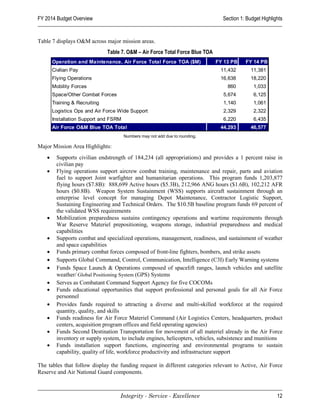
Table 7 displays O&M across major mission areas.
                                Table 7. O&M – Air Force Total Force Blue TOA
        Operation and Maintenance, Air Force Total Force TOA ($M)               FY 13 PB    FY 14 PB
        Civilian Pay                                                             11,432        11,381
        Flying Operations                                                        16,638        18,220
        Mobility Forces                                                             860         1,033
        Space/Other Combat Forces                                                 5,674         6,125
        Training & Recruiting                                                     1,140         1,061
        Logistics Ops and Air Force Wide Support                                  2,329         2,322
        Installation Support and FSRM                                             6,220         6,435
        Air Force O&M Blue TOA Total                                             44,293        46,577
                                        Numbers may not add due to rounding.

Major Mission Area Highlights:
   •      Supports civilian endstrength of 184,234 (all appropriations) and provides a 1 percent raise in
          civilian pay
   •      Flying operations support aircrew combat training, maintenance and repair, parts and aviation
          fuel to support Joint warfighter and humanitarian operations. This program funds 1,203,877
          flying hours ($7.8B): 888,699 Active hours ($5.3B), 212,966 ANG hours ($1.6B), 102,212 AFR
          hours ($0.8B). Weapon System Sustainment (WSS) supports aircraft sustainment through an
          enterprise level concept for managing Depot Maintenance, Contractor Logistic Support,
          Sustaining Engineering and Technical Orders. The $10.5B baseline program funds 69 percent of
          the validated WSS requirements
   •      Mobilization preparedness sustains contingency operations and wartime requirements through
          War Reserve Materiel prepositioning, weapons storage, industrial preparedness and medical
          capabilities
    •     Supports combat and specialized operations, management, readiness, and sustainment of weather
          and space capabilities
    •     Funds primary combat forces composed of front-line fighters, bombers, and strike assets
    •     Supports Global Command, Control, Communication, Intelligence (C3I) Early Warning systems
    •     Funds Space Launch & Operations composed of spacelift ranges, launch vehicles and satellite
          weather/ Global Positioning System (GPS) Systems
   •      Serves as Combatant Command Support Agency for five COCOMs
   •      Funds educational opportunities that support professional and personal goals for all Air Force
          personnel
   •      Provides funds required to attracting a diverse and multi-skilled workforce at the required
          quantity, quality, and skills
   •      Funds readiness for Air Force Materiel Command (Air Logistics Centers, headquarters, product
          centers, acquisition program offices and field operating agencies)
   •      Funds Second Destination Transportation for movement of all materiel already in the Air Force
          inventory or supply system, to include engines, helicopters, vehicles, subsistence and munitions
   •      Funds installation support functions, engineering and environmental programs to sustain
          capability, quality of life, workforce productivity and infrastructure support

The tables that follow display the funding request in different categories relevant to Active, Air Force
Reserve and Air National Guard components.


                                     Integrity - Service - Excellence                                      12
FY 2014 Budget Overview                                                                   Section 1: Budget Highlights


O&M – Active Air Force
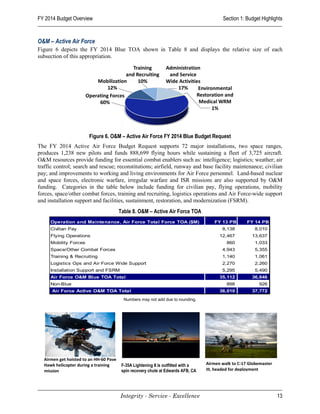
Figure 6 depicts the FY 2014 Blue TOA shown in Table 8 and displays the relative size of each
subsection of this appropriation.


                       Figure 6. O&M – Active Air Force FY 2014 Blue Budget Request
The FY 2014 Active Air Force Budget Request supports 72 major installations, two space ranges,
produces 1,238 new pilots and funds 888,699 flying hours while sustaining a fleet of 3,725 aircraft.
O&M resources provide funding for essential combat enablers such as: intelligence; logistics; weather; air
traffic control; search and rescue; reconstitutions; airfield, runway and base facility maintenance; civilian
pay; and improvements to working and living environments for Air Force personnel. Land-based nuclear
and space forces, electronic warfare, irregular warfare and ISR missions are also supported by O&M
funding. Categories in the table below include funding for civilian pay, flying operations, mobility
forces, space/other combat forces, training and recruiting, logistics operations and Air Force-wide support
and installation support and facilities, sustainment, restoration, and modernization (FSRM).
                                        Table 8. O&M – Active Air Force TOA
     Operation and Maintenance, Air Force Total Force TOA ($M)                        FY 13 PB        FY 14 PB
     Civilian Pay                                                                         8,138          8,010
     Flying Operations                                                                   12,467         13,637
     Mobility Forces                                                                        860          1,033
     Space/Other Combat Forces                                                            4,943          5,355
     Training & Recruiting                                                                1,140          1,061
     Logistics Ops and Air Force Wide Support                                             2,270          2,260
     Installation Support and FSRM                                                        5,295          5,490
     Air Force O&M Blue TOA Total                                                        35,112         36,846
     Non-Blue                                                                               898            926
      Air Force Active O&M TOA Total                                                     36,010         37,772

                                          Numbers may not add due to rounding.


  Airmen get hoisted to an HH-60 Pave
  Hawk helicopter during a training      F-35A Lightening II is outfitted with a   Airmen walk to C-17 Globemaster
  mission                                spin recovery chute at Edwards AFB, CA    III, headed for deployment


                                        Integrity - Service - Excellence                                             13
FY 2014 Budget Overview                                                                Section 1: Budget Highlights


O&M – Air Force Reserve
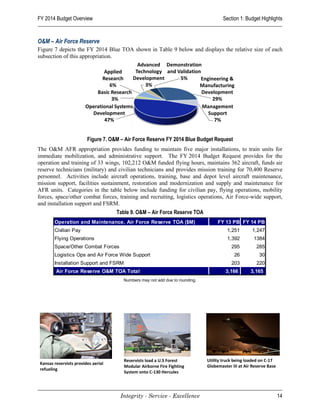
Figure 7 depicts the FY 2014 Blue TOA shown in Table 9 below and displays the relative size of each
subsection of this appropriation.


                         Figure 7. O&M – Air Force Reserve FY 2014 Blue Budget Request
The O&M AFR appropriation provides funding to maintain five major installations, to train units for
immediate mobilization, and administrative support. The FY 2014 Budget Request provides for the
operation and training of 33 wings, 102,212 O&M funded flying hours, maintains 362 aircraft, funds air
reserve technicians (military) and civilian technicians and provides mission training for 70,400 Reserve
personnel. Activities include aircraft operations, training, base and depot level aircraft maintenance,
mission support, facilities sustainment, restoration and modernization and supply and maintenance for
AFR units. Categories in the table below include funding for civilian pay, flying operations, mobility
forces, space/other combat forces, training and recruiting, logistics operations, Air Force-wide support,
and installation support and FSRM.
                                     Table 9. O&M – Air Force Reserve TOA
        Operation and Maintenance, Air Force Reserve TOA ($M)                       FY 13 PB FY 14 PB
        Civilian Pay                                                                     1,251       1,247
        Flying Operations                                                                1,392        1384
        Space/Other Combat Forces                                                          295          285
        Logistics Ops and Air Force Wide Support                                            26           30
        Installation Support and FSRM                                                      203          220
         Air Force Reserve O&M TOA Total                                                3,166        3,165
                                        Numbers may not add due to rounding.


                                        Reservists load a U.S Forest           Utility truck being loaded on C-17
 Kansas reservists provides aerial
                                        Modular Airborne Fire Fighting         Globemaster III at Air Reserve Base
 refueling
                                        System onto C-130 Hercules


                                      Integrity - Service - Excellence                                               14
FY 2014 Budget Overview                                                                    Section 1: Budget Highlights


O&M – Air National Guard
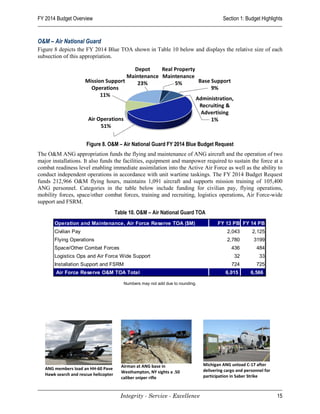
Figure 8 depicts the FY 2014 Blue TOA shown in Table 10 below and displays the relative size of each
subsection of this appropriation.


                       Figure 8. O&M – Air National Guard FY 2014 Blue Budget Request
The O&M ANG appropriation funds the flying and maintenance of ANG aircraft and the operation of two
major installations. It also funds the facilities, equipment and manpower required to sustain the force at a
combat readiness level enabling immediate assimilation into the Active Air Force as well as the ability to
conduct independent operations in accordance with unit wartime taskings. The FY 2014 Budget Request
funds 212,966 O&M flying hours, maintains 1,091 aircraft and supports mission training of 105,400
ANG personnel. Categories in the table below include funding for civilian pay, flying operations,
mobility forces, space/other combat forces, training and recruiting, logistics operations, Air Force-wide
support and FSRM.
                                       Table 10. O&M – Air National Guard TOA
       Operation and Maintenance, Air Force Reserve TOA ($M)                            FY 13 PB FY 14 PB
       Civilian Pay                                                                          2,043       2,125
       Flying Operations                                                                     2,780        3199
       Space/Other Combat Forces                                                               436          484
       Logistics Ops and Air Force Wide Support                                                 32           33
       Installation Support and FSRM                                                           724          725
        Air Force Reserve O&M TOA Total                                                     6,015        6,566

                                          Numbers may not add due to rounding.


                                         Airman at ANG base in                   Michigan ANG unload C-17 after
   ANG members load an HH-60 Pave                                                delivering cargo and personnel for
                                         Westhampton, NY sights a .50
   Hawk search and rescue helicopter                                             participation in Saber Strike
                                         caliber sniper rifle


                                         Integrity - Service - Excellence                                             15
FY 2014 Budget Overview                                                               Section 1: Budget Highlights


Research, Development, Test & Evaluation
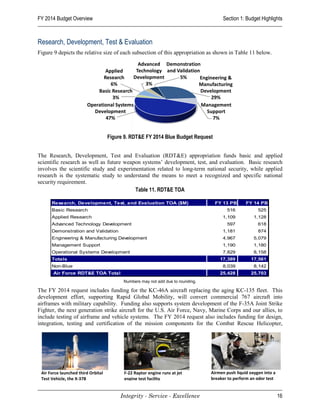
Figure 9 depicts the relative size of each subsection of this appropriation as shown in Table 11 below.


                                    Figure 9. RDT&E FY 2014 Blue Budget Request


The Research, Development, Test and Evaluation (RDT&E) appropriation funds basic and applied
scientific research as well as future weapon systems’ development, test, and evaluation. Basic research
involves the scientific study and experimentation related to long-term national security, while applied
research is the systematic study to understand the means to meet a recognized and specific national
security requirement.
                                          Table 11. RDT&E TOA

      Research, Development, Test, and Evaluation TOA ($M)                        FY 13 PB        FY 14 PB
      Basic Research                                                                    516             525
      Applied Research                                                                1,109           1,128
      Advanced Technology Development                                                   597             618
      Demonstration and Validation                                                    1,181             874
      Engineering & Manufacturing Development                                         4,967           5,079
      Management Support                                                              1,190           1,180
      Operational Systems Development                                                 7,829           8,158
      Totals                                                                         17,389         17,561
      Non-Blue                                                                        8,039           8,142
       Air Force RDT&E TOA Total                                                     25,428         25,703
                                          Numbers may not add due to rounding.

The FY 2014 request includes funding for the KC-46A aircraft replacing the aging KC-135 fleet. This
development effort, supporting Rapid Global Mobility, will convert commercial 767 aircraft into
airframes with military capability. Funding also supports system development of the F-35A Joint Strike
Fighter, the next generation strike aircraft for the U.S. Air Force, Navy, Marine Corps and our allies, to
include testing of airframe and vehicle systems. The FY 2014 request also includes funding for design,
integration, testing and certification of the mission components for the Combat Rescue Helicopter,


 Air Force launched third Orbital         F-22 Raptor engine runs at jet         Airmen push liquid oxygen into a
 Test Vehicle, the X-37B                  engine test facility                   breaker to perform an odor test


                                         Integrity - Service - Excellence                                           16
FY 2014 Budget Overview                                                           Section 1: Budget Highlights


America’s premier helicopter for day, night and marginal weather Combat Search and Rescue, replacing
the aging HH-60G. RDT&E funding also supports such programs as Space Situational Awareness
Systems, Global Positioning Systems, Long-Range Strike Bomber, as well as Minuteman III
Intercontinental Ballistic Missile modernization projects ensuring future viability of the nation’s nuclear
deterrence operations. RDT&E also continues funding for basic research including university research
supporting defense programs, and test and evaluation of existing and future systems.
Table 12 summarizes the major developments funded in this submission.

                                      Table 12. RDT&E Major Programs
        RDT&E Largest Programs                                               FY 13 PB    FY 14 PB
        KC-46                                                                  1,816         1,559
        F-35                                                                   1,210           816
        Test and Evaluation Support                                              722           743
        Space Situational Awareness Systems                                      267           400
        CSAR HH-60 Recapitalization                                              123           394
        GPS III - Operational Control Segment                                    372           384
        Long Range Strike - Bomber                                               292           379
        Defense Research Sciences                                                362           373
        SBIRS High EMD                                                           449           353
        F-22A Squadrons                                                          372           329
        B-2 Defensive Management Systems                                         281           304
        Advanced EHF MILSATCOM                                                   229           273
        NATO AGS                                                                 210           264
        Totals                                                                 6,705         6,571
                                      Numbers may not add due to rounding.


                                    Integrity - Service - Excellence                                       17
FY 2014 Budget Overview                                                               Section 1: Budget Highlights


Procurement
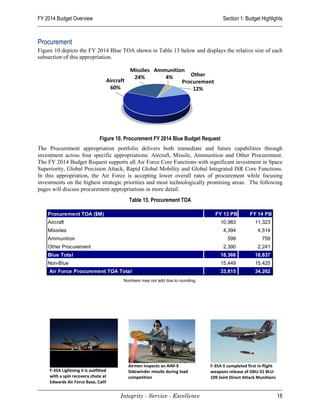
Figure 10 depicts the FY 2014 Blue TOA shown in Table 13 below and displays the relative size of each
subsection of this appropriation.


                                Figure 10. Procurement FY 2014 Blue Budget Request
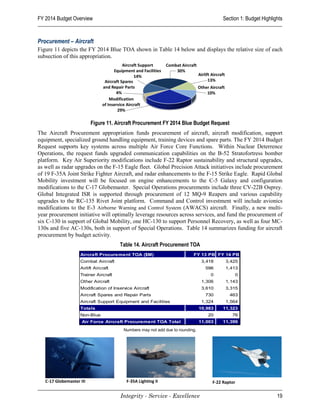
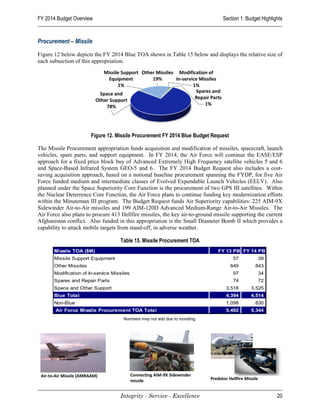
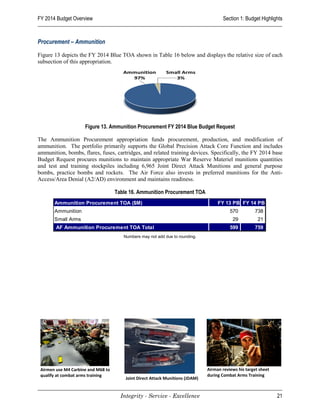
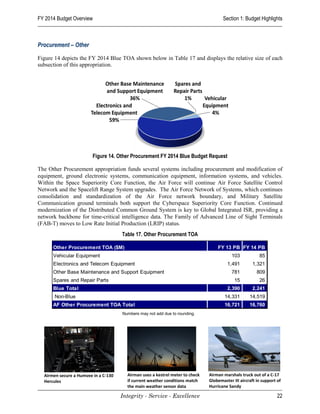
The Procurement appropriation portfolio delivers both immediate and future capabilities through
investment across four specific appropriations: Aircraft, Missile, Ammunition and Other Procurement.
The FY 2014 Budget Request supports all Air Force Core Functions with significant investment in Space
Superiority, Global Precision Attack, Rapid Global Mobility and Global Integrated ISR Core Functions.
In this appropriation, the Air Force is accepting lower overall rates of procurement while focusing
investments on the highest strategic priorities and most technologically promising areas. The following
pages will discuss procurement appropriations in more detail.
                                            Table 13. Procurement TOA

    Procurement TOA ($M)                                                          FY 13 PB          FY 14 PB
    Aircraft                                                                         10,983            11,323
    Missiles                                                                          4,394             4,514
    Ammunition                                                                          599               759
    Other Procurement                                                                 2,390             2,241
    Blue Total                                                                       18,366            18,837
    Non-Blue                                                                         15,449            15,425
    Air Force Procurement TOA Total                                                  33,815            34,262
                                         Numbers may not add due to rounding.


                                           Airmen inspects an AIM-9             F-35A II completed first in-flight
     F-35A Lightning II is outfitted       Sidewinder missile during load       weapons release of GBU-31 BLU-
     with a spin recovery chute at         competition                          109 Joint Direct Attack Munitions
     Edwards Air Force Base, Calif


                                        Integrity - Service - Excellence                                             18
FY 2014 Budget Overview                                                                   Section 1: Budget Highlights


Procurement – Aircraft
Figure 11 depicts the FY 2014 Blue TOA shown in Table 14 below and displays the relative size of each
subsection of this appropriation.


                          Figure 11. Aircraft Procurement FY 2014 Blue Budget Request
The Aircraft Procurement appropriation funds procurement of aircraft, aircraft modification, support
equipment, specialized ground handling equipment, training devices and spare parts. The FY 2014 Budget
Request supports key systems across multiple Air Force Core Functions. Within Nuclear Deterrence
Operations, the request funds upgraded communication capabilities on the B-52 Stratofortress bomber
platform. Key Air Superiority modifications include F-22 Raptor sustainability and structural upgrades,
as well as radar upgrades on the F-15 Eagle fleet. Global Precision Attack initiatives include procurement
of 19 F-35A Joint Strike Fighter Aircraft, and radar enhancements to the F-15 Strike Eagle. Rapid Global
Mobility investment will be focused on engine enhancements to the C-5 Galaxy and configuration
modifications to the C-17 Globemaster. Special Operations procurements include three CV-22B Osprey.
Global Integrated ISR is supported through procurement of 12 MQ-9 Reapers and various capability
upgrades to the RC-135 Rivet Joint platform. Command and Control investment will include avionics
modifications to the E-3 Airborne Warning and Control System (AWACS) aircraft. Finally, a new multi-
year procurement initiative will optimally leverage resources across services, and fund the procurement of
six C-130 in support of Global Mobility, one HC-130 to support Personnel Recovery, as well as four MC-
130s and five AC-130s, both in support of Special Operations. Table 14 summarizes funding for aircraft
procurement by budget activity.
                                       Table 14. Aircraft Procurement TOA
                    Aircraft Procurement TOA ($M)                          FY 13 PB FY 14 PB
                    Combat Aircraft                                              3,418     3,425
                    Airlift Aircraft                                              596      1,413
                    Trainer Aircraft                                                0          0
                    Other Aircraft                                               1,306     1,143
                    Modification of Inservice Aircraft                           3,610     3,315
                    Aircraft Spares and Repair Parts                              730        463
                    Aircraft Support Equipment and Facilities                    1,324     1,564
                    Totals                                                      10,983    11,323
                    Non-Blue                                                       20         76
                     Air Force Aircraft Procurement TOA Total                   11,003    11,399
                                         Numbers may not add due to rounding.


   C-17 Globemaster III                   F-35A Lighting II                          F-22 Raptor

                                       Integrity - Service - Excellence                                            19
FY 2014 Budget Overview                                                             Section 1: Budget Highlights


Procurement – Missile

Figure 12 below depicts the FY 2014 Blue TOA shown in Table 15 below and displays the relative size of
each subsection of this appropriation.


                        Figure 12. Missile Procurement FY 2014 Blue Budget Request

The Missile Procurement appropriation funds acquisition and modification of missiles, spacecraft, launch
vehicles, spare parts, and support equipment. In FY 2014, the Air Force will continue the EASE/ESP
approach for a fixed price block buy of Advanced Extremely High Frequency satellite vehicles 5 and 6
and Space-Based Infrared System GEO-5 and 6. The FY 2014 Budget Request also includes a cost-
saving acquisition approach, based on a notional baseline procurement spanning the FYDP, for five Air
Force funded medium and intermediate classes of Evolved Expendable Launch Vehicles (EELV). Also
planned under the Space Superiority Core Function is the procurement of two GPS III satellites. Within
the Nuclear Deterrence Core Function, the Air Force plans to continue funding key modernization efforts
within the Minuteman III program. The Budget Request funds Air Superiority capabilities: 225 AIM-9X
Sidewinder Air-to-Air missiles and 199 AIM-120D Advanced Medium-Range Air-to-Air Missiles. The
Air Force also plans to procure 413 Hellfire missiles, the key air-to-ground missile supporting the current
Afghanistan conflict. Also funded in this appropriation is the Small Diameter Bomb II which provides a
capability to attack mobile targets from stand-off, in adverse weather.

                                     Table 15. Missile Procurement TOA
       Missile TOA ($M)                                                           FY 13 PB FY 14 PB
       Missile Support Equipment                                                         57               39
       Other Missiles                                                                   649          843
       Modification of In-service Missiles                                               97               34
       Spares and Repair Parts                                                           74               72
       Space and Other Support                                                        3,518        3,525
       Blue Total                                                                     4,394        4,514
       Non-Blue                                                                       1,098          830
        Air Force Missile Procurement TOA Total                                       5,492        5,344
                                       Numbers may not add due to rounding.


 Air-to-Air Missile (AMRAAM)                 Connecting AIM-9X Sidewinder
                                             missile                          Predator Hellfire Missile


                                     Integrity - Service - Excellence                                          20
FY 2014 Budget Overview                                                               Section 1: Budget Highlights


Procurement – Ammunition

Figure 13 depicts the FY 2014 Blue TOA shown in Table 16 below and displays the relative size of each
subsection of this appropriation.


                     Figure 13. Ammunition Procurement FY 2014 Blue Budget Request

The Ammunition Procurement appropriation funds procurement, production, and modification of
ammunition. The portfolio primarily supports the Global Precision Attack Core Function and includes
ammunition, bombs, flares, fuses, cartridges, and related training devices. Specifically, the FY 2014 base
Budget Request procures munitions to maintain appropriate War Reserve Materiel munitions quantities
and test and training stockpiles including 6,965 Joint Direct Attack Munitions and general purpose
bombs, practice bombs and rockets. The Air Force also invests in preferred munitions for the Anti-
Access/Area Denial (A2/AD) environment and maintains readiness.

                                    Table 16. Ammunition Procurement TOA
       Ammunition Procurement TOA ($M)                                              FY 13 PB FY 14 PB
       Ammunition                                                                         570         738
       Small Arms                                                                          29           21
        AF Ammunition Procurement TOA Total                                               599         759
                                       Numbers may not add due to rounding.


 Airmen use M4 Carbine and M68 to                                              Airman reviews his target sheet
 qualify at combat arms training                                               during Combat Arms Training
                                        Joint Direct Attack Munitions (JDAM)


                                      Integrity - Service - Excellence                                           21
FY 2014 Budget Overview                                                               Section 1: Budget Highlights


Procurement – Other

Figure 14 depicts the FY 2014 Blue TOA shown below in Table 17 and displays the relative size of each
subsection of this appropriation.


                         Figure 14. Other Procurement FY 2014 Blue Budget Request

The Other Procurement appropriation funds several systems including procurement and modification of
equipment, ground electronic systems, communication equipment, information systems, and vehicles.
Within the Space Superiority Core Function, the Air Force will continue Air Force Satellite Control
Network and the Spacelift Range System upgrades. The Air Force Network of Systems, which continues
consolidation and standardization of the Air Force network boundary, and Military Satellite
Communication ground terminals both support the Cyberspace Superiority Core Function. Continued
modernization of the Distributed Common Ground System is key to Global Integrated ISR, providing a
network backbone for time-critical intelligence data. The Family of Advanced Line of Sight Terminals
(FAB-T) moves to Low Rate Initial Production (LRIP) status.
                                      Table 17. Other Procurement TOA

      Other Procurement TOA ($M)                                                   FY 13 PB FY 14 PB
      Vehicular Equipment                                                                 103            85
      Electronics and Telecom Equipment                                                 1,491        1,321
      Other Base Maintenance and Support Equipment                                        781           809
      Spares and Repair Parts                                                               15           26
      Blue Total                                                                        2,390        2,241
       Non-Blue                                                                        14,331       14,519
      AF Other Procurement TOA Total                                                   16,721       16,760
                                      Numbers may not add due to rounding.


  Airmen secure a Humvee in a C-130     Airman uses a kestrel meter to check   Airman marshals truck out of a C-17
  Hercules                              if current weather conditions match    Globemaster III aircraft in support of
                                        the main weather sensor data           Hurricane Sandy

                                      Integrity - Service - Excellence                                             22
FY 2014 Budget Overview                                                           Section 1: Budget Highlights


 Military Construction
 Figure 15 depicts the FY 2014 Blue TOA shown below in Table 18 and displays the relative size of each
 subsection of this appropriation.


                                 Figure 15. MILCON FY 2014 Blue Budget Request

 The MILCON appropriation funds construction projects supporting operational needs, infrastructure
 modernization, COCOM priorities and quality of life initiatives for our Total Force Airmen and Joint
 partners. The FY 2014 MILCON budget request restores funding to near traditional levels when
 compared to last year’s President’s budget request. In FY 2013 the Air Force took a deliberate one-year
 pause to ensure the proper investment of limited resources in light of the on-going budget reduction
 pressures and potential force structure changes.

 By carefully considering the relationship between MILCON, Facilities Sustainment, and Restoration &
 Modernization (FSRM), the Air Force’s FY 14 MILCON budget request is a balanced and resource
 conscious program. Our request aims to ensure the Air Force remains viable, ready, and capable to
 execute the Defense Strategic Guidance over the near and mid-term. Table 17 displays a summary of
 Active, Air Force Reserve and Air National Guard MILCON with a breakout of major and minor
 construction funding in the subsequent tables.
                                             Table 18. MILCON TOA
         Military Construction TOA ($M)                                          FY 13 PB FY 14 PB
         Active Air Force                                                             388        1,157
         Air Force Reserve                                                              11          46
         Air National Guard                                                             42         120
         Air Force MILCON TOA Total                                                   442        1,322
                                        Numbers may not add due to rounding.


Construction of the new Airman                                                   New Warrior Fitness Center at
training complex at Joint Base           USSTRATCOM HQ Bldg                      Nellis Air Force Base, NV
SanAntonio-Lackland, TX

                                       Integrity - Service - Excellence                                          23
FY 2014 Budget Overview                                                       Section 1: Budget Highlights


MILCON – Active Air Force
The Active Air Force FY 2014 MILCON budget request ensures that the Air Force remains ready,
capable, and viable to execute the Defense Strategic Guidance over the near and mid-term. The
itemization of projects for the Active component’s MILCON budget that follows is binned according to
those categories (ready, capable, viable) which the Air Force has developed to meet strategic priorities
and is in order of their share of the budget. COCOM priorities comprise the largest portion of the FY
2014 MILCON budget request for the active component. At $413.4 million, COCOM projects comprise
36% of the budget and support re-balancing capabilities toward the Asia-Pacific region, the Headquarters
STRATCOM Replacement Facility (Increment 3) ($136.0M), and the Headquarters CYBERCOM Joint
Operations Center (Increment 1) ($85.0M). The Air Force allocated $337.3 million (29% of the MILCON
budget) toward projects which support continued viability of Air Force structure, including the KC-46A
mission facilities ($264.3M), the F-35A mission facilities ($63.9M), and the F-22 mission facilities
($9.1M). Full spectrum readiness remains the top priority; accordingly, the Air Force allocated $192
million (17% of the MILCON budget) to requirements which specifically enable continued readiness of
our Airmen: operations/training/support facilities ($71.1M), dormitories ($57.0M), consolidation
($43.9M), AT/FP ($12.0M), and an ASOS expansion ($8.0M). Last, but not least, to ensure the Air Force
remains capable, the service funded $182.1 million (16% of the MILCON budget) towards capability
projects. Capability based projects support: Cyber/ISR facilities ($82.0M), a Nuclear Sustainment Center
($30.5M), B-52 facilities ($23.8M), a Guardian Angel facilities ($22M), Guam PRTC ($13.1M), WSA
Massive Ordnance Penetrator (MOP) Igloos facility ($5.9M), and a C-17 modernized hangar ($4.8M). A
State by State MILCON project list is included in Table 20.


                                Table 19. MILCON, Active Air Force TOA
        Military Construction, Air Force (Active) TOA ($M)                 FY 13 PB FY 14 PB
        Major Construction                                                      351      1,125
        Minor Construction                                                       18         21
        Planning and Design                                                      19         11
        AF Active MILCON TOA Total                                              388      1,157

                                    Numbers may not add due to rounding.


                                   Integrity - Service - Excellence                                    24
FY 2014 Budget Overview                                                         Section 1: Budget Highlights


                              Table 20. State by State MILCON Project List
Country State      Base              Title                                                            Cost
ARIZONA            Luke              F-35 Field Training Detachment                                 5,500
ARIZONA            Luke              F-35 Sq Ops/Aircraft Maintenance Unit #3                      21,400
CALIFORNIA         Beale             Distributed Common Ground Station Ops Bldg                    62,000
FLORIDA            Tyndall           F-22 Munitions Storage Complex                                 9,100
HAWAII             JBPH Hickam       C-17 Modernize Hgr 35, Docks 1&2                               4,800
KENTUCKY           Ft Campbell       19th Air Support Operations Sqdrn Expansion                    8,000
MARYLAND           Ft Meade          USCYBERCOM Joint Operations Center, Incr 1                    85,000
MARYLAND           JB Andrews        Helicopter Operations Facility                                30,000
MISSOURI           Whiteman          WSA MOP Igloos and Assembly Facility                           5,900
NEBRASKA           Offutt            USSTRATCOM Replacement Facility - Incr 3                     136,000
NEVADA             Nellis            Add RPA Weapons School Facility                               20,000
NEVADA             Nellis            Dormitory (240 RM)                                            35,000
NEVADA             Nellis            F-35 Alt Mission Equip (AME) Storage                           5,000
NEVADA             Nellis            F-35 Fuel Cell Hangar                                          9,400
NEVADA             Nellis            F-35 Parts Store                                               9,100
NEWMEXICO          Cannon            Airmen and Family Readiness Center                             5,500
NEWMEXICO          Cannon            Dormitory (144 RM)                                            22,000
NEWMEXICO          Cannon            Satellite Dining Facility                                      6,600
NEWMEXICO          Holloman          F-16 Aircraft Covered Washrack and Pad                         2,250
NEWMEXICO          Kirtland          Nuclear Systems Wg & Sustainment Center, Ph2                  30,500
NORTHDAKOTA        Minot             B-52 ADAL Aircraft Maintenance Unit                           15,530
NORTHDAKOTA        Minot             B-52 Munitions Storage Igloos                                  8,300
OKLAHOMA           Tinker            KC-46A Land Acquisition                                        8,600
TEXAS              Ft Bliss          F-16 BAK 12/14 Aircraft Arresting System                       3,350
UTAH               Hill              F-35 Aircraft Mx Unit Hangar 45E Ops #1                       13,500
UTAH               Hill              Fire Crash Rescue Station                                     18,500
VIRGINIA           JB Langley-Eustis 4-Bay Conventional Munitions Inspection Bldg                   4,800
GREENLAND          Thule             Thule Consolidation, Phase 2                                  43,904
GUAM               JRM-Andersen      PAR - Fuel Sys Hardened Bldgs                                 20,000
GUAM               JRM-Andersen      PAR - Tactical Missile Mxs Facility                           10,530
GUAM               JRM-Andersen      PAR - Tanker GP Mx Hangar/AMU/Sqd Ops                        132,600
GUAM               JRM-Andersen      PRTC RED HORSE Airfield Operations Facility                    8,500
GUAM               JRM-Andersen      PRTC SF Fire Rescue & Emergency Mgt                            4,600
SAIPAN             Saipan            PAR - Airport POL/Bulk Storage AST                            18,500
SAIPAN             Saipan            PAR - Hazardous Cargo Pad                                      8,000
SAIPAN             Saipan            PAR - Maintenance Facility                                     2,800
UNITEDKINGDOM RAF Croughton          Main Gate Complex                                             12,000
UNITEDKINGDOM RAF Lakenheath         Guardian Angel Operations Facility                            22,047
WORLDWIDE          Unspecified       KC-46A FTU Facility Projects                                  63,000
WORLDWIDE          Unspecified       KC-46A MOB #1 Facility Projects                              192,700
WORLDWIDE          Unspecified       Planning and Design                                           11,314
WORLDWIDE          Unspecified       Unspecified Minor Construction                                20,448
                                     Active MILCON Total                                       1,156,573


                                  Integrity - Service - Excellence                                       25
FY 2014 Budget Overview                                                       Section 1: Budget Highlights


MILCON – Air Force Reserve
                                Table 21. MILCON, Air Force Reserve TOA
      Military Construction, Air Force Reserve TOA ($M)                     FY 13 PB FY 14 PB
      Major Construction                                                            6          42
      Minor Construction                                                            2           2
      Planning and Design                                                           3           2
      AF Reserve MILCON TOA Total                                                  11          46
                                    Numbers may not add due to rounding.


The FY 2014 AFR MILCON request supports three projects: a Joint Regional Deployment Processing
Center – Phase 1 at March ARB, CA which will receive and process Marine, Army Reserve and Total Air
Force personnel in support of joint deployment operations world-wide; an Air Control Group Squadron
Operations facility at Tinker AFB, OK providing space for flight crews and administrative support
personnel for the Reserve associate AWACS flying squadron; and an Entry Control Complex at
Homestead ARB, FL providing a Pass & ID center, truck inspection facility, gatehouse and over-watch
which are needed to process vehicles and personnel. This project will provide safe, secure and efficient
processing of vehicles and personnel during peak hours.


MILCON – Air National Guard
                               Table 22. MILCON, Air National Guard TOA
      Military Construction, Air National Guard TOA ($M)                    FY 13 PB FY 14 PB
      Major Construction                                                           33          93
      Minor Construction                                                             6         13
      Planning and Design                                                            4         13
       AF ANG MILCON TOA Total                                                     42        120

                                    Numbers may not add due to rounding.


The Air Force National Guard FY 2014 MILCON budget request supports: Distributed Common Ground
Station at Birmingham, AL and Hulman Airport, IN; CYBER Warfare facilities at Martin State Airport
and Fort Meade, MD; an Intra-Theater Airlift conversion at Great Falls, MT; Remotely Piloted Aircraft
(RPA) flight training unit hangar at Fort Drum, NY; an Air Intelligence Facility at Springfield-Beckley
Airport, OH; a C-130J flight simulator at Quonset, RI; a Dormitory and Classroom facility at McGhee
Tyson Airport, TN; and a Communications Operations and Training Facility at Fort Indiantown Gap, PA.


                                   Integrity - Service - Excellence                                    26
FY 2014 Budget Overview                                                             Section 1: Budget Highlights


Military Family Housing
Figure 16 depicts the FY 2014 Blue TOA shown in Table 23 below and displays the relative size of each
subsection of these appropriations.


                       Figure 16. Military Family Housing FY 2014 Blue Budget Request

The FY 2014 Military Family Housing Budget Request reflects the Air Force’s continued emphasis on
revitalizing housing and providing service members with homes that meet contemporary standards similar
to the size and floor plans of homes constructed in the local community. The Air Force uses the Family
Housing Master Plan as the roadmap to guide investment planning and programming, operation and
maintenance, and military family housing privatization. The FY 2014 Budget Request continues
privatization and supports maintenance of owned and leased units and oversight of privatized units.

                                   Table 23. Military Family Housing TOA
       Military Family Housing TOA ($M)                                           FY 13 PB FY 14 PB
       MFH-C Improvements                                                                80           72
       MFH-C Planning and Design                                                           4            4
       MFH Operations and Maintenance                                                   494          385
       Totals                                                                           578          461
       Non-Blue                                                                            4            3
        Air Force Military Family Housing TOA Total                                     582          465

                                      Numbers may not add due to rounding.


  Soaring Heights Family Housing      New Military Family Housing at RAF     Military Family Housing at MacDill
  at Davis-Monthan, AZ, features      Lakenheath, UK                         AFB, FL
  homes powered by solar panels


                                     Integrity - Service - Excellence                                             27
FY 2014 Budget Overview                                                         Section 1: Budget Highlights


Base Realignment and Closure
Table 24 below displays the relative size of each subsection of this appropriation. The law authorizes
Base Realignment and Closure (BRAC) accounts to fund one-time costs that are a direct result of BRAC-
directed actions. In prior years, Air Force BRAC funds paid for implementation actions including
construction, force structure realignment, personnel/equipment movement, required training,
environmental compliance/restoration and property/program management. The FY 2013 National
Defense Authorization Act closes the existing BRAC 1995 and BRAC 2005 accounts and transfers
remaining funds into a consolidated DoD Base Closure Account in FY 2014.
The FY 2014 budget for BRAC, totaling $126M, includes funds for environmental restoration and
property management at 29 installations closed under previous BRAC rounds.


                                            Table 24. BRAC TOA
       Base Realignment and Closure TOA ($M)                                 FY 13 PB FY 14 PB
       BRAC 1995                                                                   123            0
       BRAC 2005                                                                      2           0
       DOD Base Closure Account                                                       0        126
       Blue Total                                                                  125         126
       Non-Blue                                                                       0           0
        AIR FORCE BRAC TOA Total                                                   125         126

                                      Numbers may not add due to rounding

                                                       .


                                        Crane removing first of two air
   Monitoring Well installation at      stripper towers, used to treat      “Pump and treat” system reduced
   former Galena FOL in Galena, AK      contaminated groundwater at the     groundwater plume at Reese AFB,
                                        former Castle AFB in Atwater, CA    TX by 99% since 2004


                                     Integrity - Service - Excellence                                     28
FY 2014 Budget Overview                                                          Section 1: Budget Highlights


Summary
The Air Force’s FY 2014 President’s Budget request centers on maintaining sufficient readiness to
execute the new defense strategy. It reallocates resources to our highest priorities and sustains, with less
than desirable margins, our cornerstone programs across the broad Air Force portfolio of mission sets.
The Air Force has made hard choices to align with the President’s strategic guidance by balancing force
reductions to manage war-fighting risks and resources. While the Air Force will be smaller, it will
maintain the agility, flexibility, and readiness to engage a full range of contingencies and threats. The
current fiscal environment will require hard choices and tradeoffs to maintain a trained and ready force
able to meet the Defense Strategic Guidance.


                                    Integrity - Service - Excellence                                      29
FY 2014 Budget Overview                                                                    Section 2: PBB


Section 2: Performance Based Budget (Overview)
This section discusses how the Air Force budget is aligned
to accomplish strategic goals and objectives and provides
historical performance information on specific program
areas. The performance based budget described in this                                     Air Force
section is organized by Air Force Core Function. The core                                 Mission
functions encompass the full range of Air Force
capabilities that provide the foundation of activities to                                 Core
support the Air Force’s core missions. Air Force programs                                 Missions
within each core function support the objectives, the core
missions, and ultimately the mission of the United States                                 Core
Air Force as depicted in Figure 17.                                                       Functions

Air Force Mission:                                           Figure 17. Air Force Performance Pyramid

Fly, fight and win…in air, space, and cyberspace.


Air Force Core Missions:
        •   Air and Space Superiority
        •   Intelligence, Surveillance, and Reconnaissance (ISR)
        •   Rapid Global Mobility
        •   Global Strike
        •   Command and Control


Air Force Core Functions:
Nuclear Deterrence                              Special Operations
Air Superiority                                 Global Integrated ISR
Space Superiority                               Command and Control
Cyberspace Superiority                          Personnel Recovery
Global Precision Attack                         Building Partnerships
Rapid Global Mobility                           Agile Combat Support


                                    Integrity - Service - Excellence                                    30
FY 2014 Budget Overview                                                                                                    Section 2: PBB


Alignment to Department of Defense Priorities
The Air Force FY 2014 Budget Request supports Department of Defense (DoD) priorities in the
Quadrennial Defense Review (QDR) and contributes to overall department performance objectives. The
direction from the QDR, National Security Strategy and National Military Strategy creates the vision and
guides the Air Force’s Annual Planning and Programming Guidance, the Air Force Core Function Master
Plans and the Force Planning Construct.
The Air Force core functions provide a framework for balancing investments across Air Force capabilities
and enduring contributions aligning resources to the defense strategy. Air Force Core Functions describe
what the Air Force provides to Combatant Commanders beyond Global Vigilance, Reach, and Power.
The Air Force’s resource choices represented in this budget request were balanced across the 12 Core
Functions to address both near- and long-term requirements. While the core functions appear individually
in this document, it is important to recognize their inherent interdependence to support the Air Force core
mission and national security needs. The 12 Air Force Core Functions are defined below:
     Nuclear                                                               Cyberspace           Global Precision           Rapid Global
                            Air Superiority       Space Superiority
    Deterrence                                                             Superiority              Attack                   Mobility
 Operate, maintain,       Deliver dominance in   Deliver dominance in   Deliver dominance in   Hold at risk or strike   Timely deployment,
 and secure nuclear           the air battle          space over         cyberspace of one         rapidly and              employment,
  forces to achieve                                   adversaries        force over another     persistently any            sustainment,
assured capability to                                                   that permits conduct    target to achieve        augmentation and
 deter an adversary                                                     of operations by the     precise effects          redeployment of
 from taking actions                                                           former                                   military forces and
   against US vital                                                                                                          capabilities
       interest

                          Global Integrated        Command and              Personnel               Building              Agile Combat
Special Operations
                                 ISR                  Control               Recovery              Partnerships              Support
 Specialized airpower       Conducting and              Ability of       Recovery and return    Set conditions for      Field, base, protect,
operations conducted         synchronizing           commanders to        of US military, DoD    interaction with       support and sustain
 in hostile, denied or      surveillance and      integrate operations     civilians and DoD   partner, competitor      air, space and cyber
  politically sensitive     reconnaissance       in multiple theaters at contractor personnel or adversary leaders,             forces
    environments           across all domains         multiple levels                           military forces or
                                                                                              relevant populations


                                                 Figure 18. Air Force Core Functions


                                                 Integrity - Service - Excellence                                                          31
FY 2014 Budget Overview                                                                     Section 2: PBB


Performance Management
The Air Force has made progress in its performance management system to include alignment between
DoD and Air Force strategic objectives. Part of this effort includes enhancing the relevance, utility, and
maturity of performance measures used to support Air Force senior decision makers. Some measures
used in the Air Force performance management system are included in this budgetary publication. The
Air Force has conducted quarterly reviews and uses performance measures to make enterprise-level
decisions regarding resources and prioritization of effort to assure the most effective use of defense
dollars. This is an evolutionary process to continuously improve the quality of the performance measures
used for decision support. Future performance budgets will evolve with the Air Force performance
management system.

Summary of Planned Accomplishments
The Air Force FY 2014 Budget Request continues to realign the Air Force to the imperatives of the
Defense Strategic Guidance in order to maximize our air, space and cyber capabilities in a constrained
fiscal environment. The overarching focus of the FY 2014 Budget Request is to ensure the current and
future readiness of the Air Force to execute the major tenets of the 2012 Defense Strategic Guidance,
including the shift of emphasis to Asia-Pacific and anti-access/area denial challenges in the Middle East.
Specifically, this budget allocates resources to set a course towards full-spectrum readiness, preserves a
highly responsive and scalable force, focuses on our pressing force structure and modernization
challenges, and continues to develop and care for our most precious resource, our Airmen and their
families.
The following pages of this performance budget section will describe in greater detail by Air Force Core
Function the successes and challenges the Air Force is experiencing and the initiatives implemented to
make further improvement. All dollar figures within this section will be Air Force “Blue” Total
Obligation Authority (TOA) unless stated otherwise. The funding in the bar charts on the following
pages depicts FY 2012 actuals, FY 2013 Budget Submission, and FY 2014 Budget Request figures.


                      Figure 19. FY 2014 Budget Request by Air Force Core Function


                                   Integrity - Service - Excellence                                    32
FY 2014 Budget Overview                                                                       Section 2: PBB


Nuclear Deterrence Operations
Overview
“I want you to know that stewardship of a safe, secure, and effective nuclear deterrent remains the #1 Air
Force priority. Our focus will not waiver. We will sustain an uncompromising standard of excellence in
nuclear deterrence operations.” 1 The Air Force will continue fulfilling its responsibility of providing
safe, secure, and effective nuclear capabilities within its Nuclear Deterrence Operations Service Core
Function (SCF). This responsibility includes maintaining strategic deterrence and stability, strengthening
regional deterrence, providing assurance and dissuading nuclear proliferation and nuclear terrorism. The
Air Force’s intercontinental ballistic missiles and heavy bombers provide two legs of the nation’s nuclear
TRIAD. Dual-capable fighters and bombers extend deterrence and provide assurance to our allies and
partners. The Air Force continues to modernize and recapitalize these vital systems to maintain a credible
deterrent. In FY 2014 the Air Force is requesting $5.4B as outlined in Figure 20 below to resource
Nuclear Deterrence Operations. Additional details of FY 2012 accomplishments and FY 2014 initiatives
are included in the sections that follow.


                              Figure 20. Nuclear Deterrence Operations TOA by Appropriation

Accomplishments
Continuing to strengthen the Air Force nuclear enterprise remains a
top priority. In 2012 the Air Force continued to develop the skill and
leadership of its “nuclear-minded” Airmen at all levels which enabled
it to institutionalize improvements and capitalize on gains made since
the Air Force began reinvigorating the nuclear enterprise in 2008. Air
Force Global Strike Command (AFGSC), the Air Force Nuclear
Weapons Center (AFNWC) and the Assistant Chief of Staff, Strategic
Deterrence, and Nuclear Integration (AF/A10) continued to support
for the Airmen, equipment, and processes that produce nuclear Minuteman III ICBM maintenance
deterrence every day.


1
    CSAF Letter to the Airmen of the USAF Nuclear Force, 17 Oct 12


                                                Integrity - Service - Excellence                         33
FY 2014 Budget Overview                                                                      Section 2: PBB


Organization and Culture: In 2012, the Air Force reaped the benefits of increased performance and
accountability from organizational changes it made over the last few years. AFGSC assumed duties as
the Air Force’s Core Function Lead Integrator (CFLI) for Nuclear Deterrence Operations. As the CFLI,
AFGSC serves as the chief advocate for nuclear programs and builds a Core Function Master Plan to
provide a comprehensive blueprint to ensure long-term sustainment and modernization of weapon
delivery and nuclear command, control and communication systems. AFGSC is fully engaged with Air
Force Material Command and the Air Force Nuclear Weapons Center to ensure sustainment and
modernization plans remain aligned and executable.
In addition, organizational changes were complemented by procedural changes that created a stronger
nuclear enterprise. As the human capital functional authority for the Air Force nuclear enterprise,
AF/A10 continued to build and develop nuclear-leader expertise throughout the enterprise.
Developmental Teams have been established for all nuclear-related career fields to ensure Airmen are
deliberately developed with the right education, skills and experience necessary to lead this critical
mission in the decades to come. Additionally, the Air Force is separating the Space and Missile officer
career field which will allow officers to gain depth and experience in the nuclear enterprise over their
careers. These efforts will provide an experienced workforce and a future leadership pool of Senior NCOs
and officers in sufficient numbers with the needed skills to meet the Air Force’s nuclear deterrent
operations requirements.
In FY 2012, the Air Force also changed its organizational structure to improve support to Nuclear
Command, Control, and Communications (NC3). AF/A10 formed the NC3 "Community of Interest,"
which has been successful in uniting the diverse Air Force NC3 community to coordinate NC3 issues and
develop solutions to present to the Nuclear Working Group and other forums. In addition, the Air Force
is co-chairing the Modernized Hybrid Solution (MHS) Management Team, to address issues such as
configuration management, terms of reference, and sustainment of the MHS. Finally, AF/A10 sponsored
the first Air Force NC3 Summit, bringing together the Air Force NC3 community to develop a
comprehensive and coordinated approach to support NC3.
                                  Modernization and Recapitalization: In 2012, modernizing and
                                  recapitalizing nuclear programs remained an institutional priority.
                                  AFGSC produced a Core Function Master Plan that will guide
                                  Minuteman III sustainment through 2030. AFGSC ensured continued
                                  Intercontinental Ballistic Missile (ICBM) operations by investing in
                                  infrastructure, support equipment, cryptographic updates, security
                                  upgrades, and fuse modernization. The Air Force continued ICBM
                                  research and development and maintained the associated critical
Minuteman III ICBM Flight Test at nuclear skills essential in keeping the Minuteman III viable while
Vandenberg AFB
                                  addressing a follow-on system.          The multifaceted Air Force
sustainment and recapitalization effort successfully addressed and developed critical deterrence initiatives
including beginning an Analysis of Alternatives for the Ground-Based Strategic Deterrence (GBSD),
which will examine potential follow-on systems to the Minuteman III. A study for the future Long-Range
Stand-Off (LRSO) weapon, the Air Launched Cruise Missile follow-on, has recently been completed, and
a life-extended B61 gravity bomb program is underway. The Air Force also began developing a new
nuclear-capable long range penetrating bomber in 2012.        The Air Force evaluated NC3 requirements,
and modernizing lagging infrastructure to ensure credible, reliable, and survivable nuclear command and
control.

FY 2014 Initiatives
Strengthening the nuclear enterprise will remain a top priority within the Air Force. The Air Force has
made significant progress that enabled the nuclear enterprise to operate at a higher proficiency level. In
FY 2014, the Air Force will continue vital recapitalization, modernization, and sustainment efforts.

                                    Integrity - Service - Excellence                                     34
FY 2014 Budget Overview                                                                    Section 2: PBB


Some of the FY 2014 funded efforts include upgrading 28 B-52s with the Combat Network
Communication Technology (CONECT) system which will provide secure line-of-sight and beyond line-
of-sight communications, improved situational awareness and machine-to-machine retargeting
capabilities. The B-2 Defensive Management Systems program will continue development to achieve a
Milestone B decision in FY 2014. This upgrade will enable improved threat identification and location
while providing real-time re-routing to ensure the B-2 remains survivable against emerging and
proliferating threats. The Air Launched Cruise Missile will continue to be sustained until 2030 while the
follow-on LRSO program intends to reach a Milestone A decision in early FY 2014. Additional
investments will be made to sustain the ICBM force through 2030 including improvements and
replacements to the guidance system, propulsion system and ballistic missile fuze components. The Air
Force will also conduct studies to aid development of a ground-based strategic deterrence solution as a
follow-on to Minuteman III as directed by the 2010 Nuclear Posture Review. Additionally, the Air Force
will remain focused on human capital and carefully balance requirements for the Airmen of the nuclear
enterprise.
The FY 2014 Budget Request also funds the Air Force’s portion of
the B61 life extension program.        In partnership with the
Department of Energy, the life extension program will reduce the
number of B61 variants, overcome aging problems, and improve
safety, security, and reliability.
With the February 2011 entry-into-force of the New Strategic Arms
Reduction Treaty, the Air Force must implement a force structure
that provides for a safe, secure, and effective strategic deterrent
posture that remains within Treaty limits. Nuclear deterrence B-52H Stratofortress soars through
remains a critical mission with no margin for error. As long as sky at Minot Air Force Base
nuclear weapons exist, the Air Force is committed to meeting the President’s direction to maintain safe,
secure, and effective nuclear deterrence capabilities. The quantity of nuclear-capable bombers and
ICBMs comprising the bulk of the Nation’s deterrent force may be reduced as the Air Force continues to
implement the New START Treaty. Consistent with the Treaty’s protocols and obligations, the FY 2014
Budget Request funds compliance activities and force reduction options to meet the central limits of the
Treaty. These include actions such as the elimination of phantom ICBM launchers and bombers, and the
conversion of some B-52Hs from nuclear-capable to conventional-only capability. Further, the transition
of all ICBMs to a single warhead configuration is required by the 2010 Nuclear Posture Review.
In FY 2013, the Air Force developed a dedicated NC3 Issue Team to address NC3-related budget issues
for FY 2014. This approach resulted in successfully funding a replacement Low Frequency system for
the National Airborne Operations Center. In addition, NC3 is now allotted dedicated time during all
Nuclear Working Group, Nuclear Issues Resolution and Integration Board and Nuclear Oversight Board
meetings.
The FY 2014 Budget Request also highlights two critical elements of America's nuclear triad and
forward-deployed extended deterrence. Looking forward, continuing to strengthen the nuclear enterprise
entails a long-term, systematic effort to refine, and improve upon earlier initiatives. The Nuclear
Deterrence Operations Service Core Function reflects the Air Force’s firm and steadfast conviction that
nuclear deterrence and global strike operations require the highest standards of performance and
accountability.
Charting Our Flight Path: The Air Force continues to strengthen its nuclear enterprise. The Secretary of
the Air Force and Air Force Chief of Staff have articulated a flight path to guide the Air Force’s
commitment to sustained success across the nuclear enterprise. The Air Force will continue to:
       Operate and sustain safe, secure and effective nuclear forces.

                                    Integrity - Service - Excellence                                  35
FY 2014 Budget Overview                                                                     Section 2: PBB


      Field an effective workforce to meet Nuclear Enterprise requirements.
      Provide the nation with effective military capabilities that extend deterrence and assure allies and
       partners.
      Revitalize Air Force thinking about the role of 21st century deterrence in the increasingly
       complex global strategic environment.
      Ensure continued emphasis on and advocacy of the Nuclear Enterprise.
The Air Force continues to strengthen the Nuclear Deterrence Operations Service Core Function and
institutionalize the structure, process and cultural changes underway. The FY 2014 Budget Request
continues to strengthen the Air Force nuclear enterprise and enables the Service Core Function to
maintain its role as a bedrock of strategic deterrence and stability.


                                   Integrity - Service - Excellence                                     36
FY 2014 Budget Overview                                                                        Section 2: PBB


Air Superiority
Overview
Securing the high ground is a critical prerequisite for any military operation to ensure freedom of action
for the joint force and the Nation. For over five decades, Air Force investments, expertise, and sacrifice
in achieving air superiority have ensured that friendly ground forces operate without threat of attack from
enemy aircraft. While the United States has enjoyed this freedom for the last sixty years, there is no
guarantee of air superiority in the future. Airspace control remains vitally important in all operating
environments to ensure the advantages of rapid global mobility, ISR, and precision strike are broadly
available to the Combatant Commander. Currently the United States benefits from the only operational
fifth-generation fighter aircraft, the F-22 Raptor, but adversaries are rapidly developing competitive fifth-
generation fleets. Global and regional competitors are working toward fifth-generation fighter aircraft
and advanced surface-to-air missile systems that present an area denial capability that challenges U.S. air
superiority. Additionally, improvements to adversary fourth-generation fighters put them on par with
legacy F-15C/D aircraft that constitute a significant component of U.S. air superiority capability and
further threaten our ability to ensure air superiority. Given these realities, the Air Force’s FY 2014
Budget Request includes initiatives to address current and future air superiority needs. This core function
accounts for approximately $8.6B of the Air Force FY 2014 Budget Request as reflected in Figure 21.
Additional details of FY 2012 accomplishments and FY 2014 initiatives are included in the sections that
follow.


                              Figure 21. Air Superiority TOA by Appropriation

Accomplishments
In FY 2012, air superiority activities focused on expanding the T-38
Adversary Air program, continuing development of the AIM-9X and
improving the AIM-120 air-to-air missiles, modifying the F-22A
fleet, determining the requirements for the Air Dominance in 2030+,
and upgrading legacy fighters to maintain fleet viability.
The T-38 Adversary Air program that began at Holloman AFB was
expanded to Langley AFB and Tyndall AFB in support of F-22A
training. Additional T-38s for the program were acquired from T-38 Jet on flightline at Randolph Air
aircraft scheduled for retirement and in storage. When complete in Force Base


                                     Integrity - Service - Excellence                                      37
FY 2014 Budget Overview                                                                          Section 2: PBB


FY 2013, the program will include 20 T-38s at Tyndall AFB and 14 at Langley AFB. The T-38 provides
an extremely cost effective platform to provide training scenarios for F-22A pilots.
The AIM-9X Block II program has consistently delivered on-cost and ahead of schedule for nine straight
years. Significant performance improvements include: new computer, improved lock-on-after-launch,
infrared counter-countermeasures, data link, lofting, and laser target detector. Software development is
on schedule with successful live fire events demonstrating all planned capabilities. Block II production
started in FY 2011 and active affordability improvements are underway to drive costs down.
F-22A basing actions are finalized and will maximize combat
squadrons available for contingencies by consolidating aircraft at
existing bases (moving the Combat Squadron from Holloman to
Tyndall), while increasing operational flexibility. The Air Force is
working to provide a common configuration by upgrading Block
10 training aircraft to a Block 20 configuration and upgrading
Block 20 combat-coded aircraft to a Block 30/35 aircraft
configuration. As part of the F-22A modernization effort, Block
30/35 aircraft are being fielded with Increment 3.1 capabilities that
                                                                        F-22 Raptors from Tyndall Air Force Base
include air-to-ground and electronic attack modes for the APG-77
radar. The Air Force continues to research, test, and develop Increment 3.2B capabilities on Block 30/35
aircraft that include modifications to use the most advanced air-to-air weapons, such as the AIM-120D
Advanced Medium-Range Air-to-Air Missile (AMRAAM) and the AIM-9X Sidewinder, as well as
upgrades to achieve the desired find, fix, track, and target capabilities. Future upgrades will also include
an automatic ground collision avoidance system and advanced data links to allow data transmission to
other types of aircraft.
To meet air superiority goals, Air Force projections require 249 legacy F-15C/Ds to remain viable
through 2030. The average age of the F-15C/D fleet is over 25 years old and full scale fatigue tests are
currently underway to study possible extensions to their service life, currently projected to be at least
2025. Given the fatigue data collected to date and the unique six year depot maintenance cycle of the
fleet, it is expected that service life will be extended beyond this date when testing completes. The Air
Force continues to modernize the F-15 fleet with APG-63(V)3 Active Electronically Scanned Array
(AESA) radars. AESA radars are a quantum leap in capability over older mechanically-scanned radars
and are one of the modernization efforts needed to keep the F-15 viable through 2030. In addition, the
Air Force continues the Advanced Display Core Processor program which replaces the current 1970’s-era
central computer. These efforts should successfully enable the F-15C/D fleet to operate safely and
effectively through at least 2030.

FY 2014 Initiatives
Combat Air Forces structure is constantly assessed in relation to the dynamic security environment, joint
force needs, and the current fiscal climate. The Air Force’s new fighter force plans fulfill Combatant
Command strategies and requirements with an increased amount of risk. Part of the plan calls for current
legacy fleet service life sustainment and modernization efforts as well as F-22A upgrades to increase its
air superiority capabilities and operational effectiveness.
F-15C/D: As earlier stated, the average age of the F-15C/D fleet is over 25 years. In response to the
challenges created by age, the Air Force is conducting extensive investigation into the service life of the
fighter fleet to better understand the feasibility of extending their service life given the economic and
operational environments. Current projections indicate the F-15 C/D fleet is viable until about 2025 with
full-scale fatigue testing currently underway that is expected to extend fleet viability through the 2030
time-frame.


                                     Integrity - Service - Excellence                                        38
FY 2014 Budget Overview                                                                       Section 2: PBB


                                      To ensure the F-15C/D remains viable through 2030, the FY 2014
                                      Budget Request continues the Air Force initiative to modernize the F-
                                      15 fleet for offensive and defensive viability with AESA radars and
                                      begins development of an Eagle Passive/Active Warning Survivability
                                      System (EPAWSS), which will replace the obsolete and operationally
                                      limited Tactical Electronic Warfare System (TEWS). AESA radars
                                      outperform older radars by spreading broadcasts across a band of
                                      frequencies making it very difficult to detect and allowing aircraft to
F-15D Eagle at Nellis Air Force Base,
                                      maintain a reduced signature.           EPAWSS bolsters F-15C/D
survivability through the installation of a new radar warning receiver, internal jammer, and
countermeasures dispenser system integrated with the AESA radar. These efforts, combined with the
mission computer upgrade, will successfully enable the 175 F-15C/D "Long-Term Eagle Fleet" to operate
safely and effectively through at least 2030.
F-22A: The F-22A and F-35A represent the newest generation of fighter aircraft for the United States.
Both aircraft are necessary to maintain superiority and access for joint and coalition forces. While both of
these aircraft provide air superiority and global precision attack capabilities, the F-22A’s primary role is
air superiority. Details on F-35A initiatives are discussed in the Global Precision Attack Core Function of
this document. Air Force investment in the F-22 program consists of three major efforts in the
subcategories of organic sustainment, aircraft availability, and combat capability modernization.
The Air Force received its last production F-22A in 2012, culminating the 187 aircraft production run. As
the Raptor transitions from production into sustainment, the Air Force is investing in organic depot
standup activities to ensure the Air Force depot system contributes to F-22A structural and avionics
sustainment for the lifecycle of the weapons system. The Air Force also plans to reprioritize and
emphasize aircraft availability by continuing to invest in the Reliability
and Maintainability Maturation Program (RAMMP).                 RAMMP
continuously evaluates the entire air vehicle and its interconnected
subsystems making it the built-in process to assess and implement
necessary modifications to rectify identified deficiencies, such as last
year’s life support system malfunctions resulting in a five month fleet
grounding and ongoing corrosion control efforts. Increment 3.1
capabilities continue to field, including APG-77 radar air-to-ground and
electronic attack improvements. Also in FY 2013, the Air Force F-22 Raptor runs training mission
prudently responded to the new fiscal environment by segmenting over the Pacific Ocean
follow-on Increment 3.2 capabilities into two separate deliveries: Increments 3.2A and B. Continuing
investment in Increment 3.2A and 3.2B research, testing and development efforts will eventually
incorporate the most advanced air-to-air weapons in the inventory to include the AIM-120D Advanced
Medium-Range Air-to-Air Missile and the AIM-9X Sidewinder to counter anti-access threats.
Air Superiority Munitions: The Air Force continues to enhance development, production and integration of
modern munitions for air superiority. The FY 2014 Budget Request includes AIM-9X Block 2 and AIM-
120D development, integration, and production. The AIM-9X adds lock-on-after launch and data link
capabilities that allow pilots to release the missile without having the target “locked” at the time of
launch. This decreases time required from target identification to firing. The AIM-120D is the next
iteration of the AMRAAM missile with increased range and radar capabilities. The AIM-120D program
was restructured to slow production while the test program demonstrates software and production delays
are resolved. The Air Force has plans to increase production rates of both missiles across the FYDP.


                                    Integrity - Service - Excellence                                      39
FY 2014 Budget Overview                                                                     Section 2: PBB


Space Superiority
Overview
Space Superiority is the ability to provide the degree of access and freedom of action necessary to create
military effects in, through, and from space and deny our adversaries enabling operations by United States
and Allied forces. Space capabilities are increasingly vital to our warfighting abilities and to our daily
lives. Through the Space Superiority Core Function, Airmen provide Joint Force Commanders with
Global Access, Global Persistence, and Global Awareness. These aspects are critical to the lethality,
precision, flexibility and responsiveness required to deter aggression, win America’s wars, and conduct
missions such as humanitarian and disaster relief operations. In addition, the U.S. and global economy
rely on space systems and space operations to enable such vital activities as transportation, commerce,
and agriculture.
The Air Force is the DoD’s steward of space, offering vital capabilities to support the warfighter. These
space capabilities include nuclear survivable communications; launch detection/missile tracking;
positioning, navigation and timing (PNT); space situational awareness (SSA); space control; military
satellite communications; access to space for all National Security Space (NSS) missions; and weather
data. Rapid technology advancements and the long-lead time for developing new space technology
results in an ongoing need to plan, design, and implement space advancements. This core function
accounts for approximately $10.1B of the Air Force FY 2014 Budget Request as reflected in Figure 22.
Additional details of FY 2012 accomplishments and FY 2014 initiatives are included in the sections that
follow.


                            Figure 22. Space Superiority TOA by Appropriation

Accomplishments
By any measure, FY 2012 has been a watershed year for the Air Force in space. Today, more than ever
before, the world has witnessed Air Force Space Command’s game-changing capabilities, honed over
30 years of existence. The way America fights today is underpinned by the very assets space superiority
brings to the joint fight.
In FY 2012, the Air Force conducted eight flawless launches of the EELV. These launches make 56
consecutive EELV launches to date and 89 successful NSS missions. In terms of NSS, FY 2012


                                   Integrity - Service - Excellence                                    40
FY 2014 Budget Overview                                                                      Section 2: PBB


witnessed the lengthening of the unprecedented NSS launch record with its 88th successful mission since
1999. An impressive record that was accomplished while simultaneously driving down launch costs.
During the past year the Air Force successfully launched the fourth Wideband Global SATCOM (WGS)
satellite to its operational orbit. WGS-4 is the first in the new Block II series. As the DoD’s newest
SATCOM workhorse, WGS provides high capacity satellite communication to the joint force including
the ability to seamlessly connect users across the X and Ka frequency bands. With an order placed for a
10th satellite, WGS is an example of international partnership with participation from Australia, Canada,
Denmark, Luxembourg, the Netherlands, and New Zealand. WGS-5 is expected to launch in FY 2013.
                                 The Air Force also launched the second Advanced Extremely High
                                 Frequency (AEHF) satellite in May 2012. AEHF delivers increased
                                 capacity for survivable, secure, protected, and jam-resistant satellite
                                 communication for strategic and tactical warfighters as well as our most
                                 senior national leadership. AEHF efforts include our international
                                 partners: United Kingdom, the Netherlands, and Canada.
                                  The Air Force continues to sustain and modernize the GPS for the
 AEHF SV-2 launch, 4 May 2012
                                  nation, providing all-weather, 24/7 precise PNT information to an
                                  unlimited number of civil and military users. Since declaring Full
Operational Capability in 1995, the GPS has met or exceeded performance standards for accuracy,
availability, and reliability and is committed to do so in the future. The third of 12 GPS Block IIF
satellites launched on October 2012, continues the sustainment of this critical mission and fielding
improved capabilities for civilian (L2C and L5 signals) and military (M-Code) users. In an effort to
maintain mission assurance and meet the nation’s civil and military requirements, the Air Force continues
to develop the next generation of satellites (GPS III), control segment (OCX), and military GPS user
equipment (MGUE). Developers are using an innovative, non-flying, but fully functional GPS III
prototype to work systems integration issues up front resulting in early discovery of potential
manufacturing or design issues. In order to provide full coverage, the Air Force maintains a minimum of
24 fully mission-capable GPS satellites at all times. At the close of FY 2012 the Department had 30
operational satellites in orbit.
The Air Force achieved a major milestone in space command and
control, completing the operational utility evaluation for the first
increment of the Joint Space Operations Center (JSpOC) Mission
System (JMS) at Vandenberg AFB. For years, the Air Force has
been tracking objects in space, counting and reporting numbers, and
watching the population steadily grow. With the transition to JMS,
the nation will better understand the space operational environment,
assess the threat, and improve the ability to command and control
forces to respond. JMS enables moving from a reactive posture in
space to a much more predictive one. Increment 1 of JMS is simply
the first step toward that future. This past year the Air Force Joint Space Operations Center display
supported the international community by providing monitoring and
tracking analysis on the reentry of the failed Russian Phobos-Grunt spacecraft. The Air Force also
predicted the reentry and breakup of a failed Russian Breeze-M rocket body, guaranteeing our Nation’s
leadership the highest quality space situational awareness.

FY 2014 Initiatives
The FY 2014 Budget Request continues to modernize the GPS program with delivery of the first GPS III
satellite, providing improved anti-jam capabilities and accuracy, and a new civil signal (L1C); the budget
request funds two GPS III satellites (7 and 8). The Air Force continues the efficient space procurement for


                                    Integrity - Service - Excellence                                    41
FY 2014 Budget Overview                                                                           Section 2: PBB


the block buys of AEHF (vehicles 5 and 6) and the Space-Based Infrared System (SBIRS) (GEO vehicles
5 and 6); both programs are incrementally funded as previously approved by Congress. The FY 2014
request implements a new EELV acquisition strategy that emphasizes best value to the taxpayer through
increased competition (including new entrants) while remaining focused on mission success; the budget
request funds procurement of five EELV launch services. In addition, the Air Force took step to sustain
and extend Defense Meteorological Satellite Program (DMSP) which has been supporting the Joint
warfighting and intelligence community users for 50 years. The next DMSP satellite is set to launch in
FY 2014 with the final satellite available for launch when required to sustain the DoD’s operational
needs. Continuing DMSP allows the Air Force to re-define the space-based weather requirements and
capabilities needed by the DoD to deliver a follow-on system to the warfighter in the most cost effective
manner.
                                        The Space Fence will be a system of two land-based radars to detect,
                                        track, identify and characterize orbiting objects. Site I will be located
                                        at Kwajalein Atoll in the Marshall Islands and will be the most
                                        accurate, high capacity radar in the Space Surveillance Network (SSN).
                                        It will provide a critical SSN capability needed to give warfighters the
                                        ability to maintain a full and accurate orbital catalog, ensure orbital
                                        safety, and perform conjunction assessments. The Space Fence data
                                        will be fed to the JSpOC at Vandenberg AFB. This data will be
                                        integrated with other SSN data to provide a comprehensive SSA and
                                        integrated space picture.
 Ground radar space surveillance
 system to detect, track and identify
                                   The Space Fence will provide enhanced space surveillance capabilities
 small space objects               to detect and track orbiting objects such as commercial and military
satellites and space debris. The Space Fence will have greater sensitivity, allowing it to detect, track and
measure an object the size of a softball orbiting more than 1,200 miles in space. Because it is an uncued
tracking system, it will provide evidence of satellite break-ups, collisions, or unexpected maneuvers of
satellites. It will form the foundation of improved SSA by expanding the ability and capacity to detect,
track, identify and characterize orbiting objects, such as commercial and military satellites, smaller
objects, maneuvering satellites, break-up events and lower inclination
objects.
Relocating the C-Band Radar enhances current SSA capability with
coverage of the Southern Hemisphere; taking the first step toward an SSA
partnership with Australia. The 2012 Defense Strategic Guidance states
"today space systems and their supporting infrastructure face a range of
threats that may degrade, disrupt, or destroy assets.” Accordingly, DoD
will continue to work with domestic and international allies and partners
and invest in advanced capabilities to defend its networks, operational
capability, and resiliency in cyberspace and space in following the 2011
National Security Space Strategy objective to "strengthen safety, stability Relocating Antigua range radar
and security in space."                                                     to Australia for SSA use.

Air Force Space Command (AFSPC) took the initiative to fund continued development and sustainment
of AEHF operations in FY 2014. AFSPC funded interim contractor support to sustain the mission control
segment, crypto, AEHF Calibration facility, and interim C2 terminal through FY 2015 Interim Operational
Capability (IOC). Additionally, the Air Force developed the GEO 5-6 acquisition strategy to build two
clones of SBIRS GEO 4 with projected deliveries in 2019 and 2020. This strategy leverages previous
investments in the existing GEO satellite design and allows the Air Force to sustain essential mission
capabilities while the near-term Space Modernization Initiative (SMI) Investment Plan informs the trade
space for system evolution beyond SBIRS GEO 5 and SBIRS GEO 6.


                                         Integrity - Service - Excellence                                     42
FY 2014 Budget Overview                                                                      Section 2: PBB


Cyberspace Superiority
Overview
Cyberspace Superiority is the degree of control of one force over an adversary to conduct full-spectrum
military cyberspace operations that permit freedom of action in cyberspace at a given time and place
while denying those freedoms to that adversary. It lets Joint Force commanders integrate operations in
multiple theaters at multiple levels through planning, coordinating, tasking, executing, monitoring and
assessing air, space, and cyberspace operations across the range of military operations. Every military
operation, across the entire spectrum of conflict, relies on the cyber domain. Air Force Space Command
is the Air Force lead for cyberspace operations and provides COCOM support to the United States Cyber
Command (USCYBERCOM) through the 24th Air Force (AFCYBER). This core function makes up 4%
of the Air Force budget and includes $1.4 billion for Cyberspace Operations in the Air Force FY 2014
Budget Request for Information Technology as reflected in Figure 23. The Air Force will spend 91
percent in domain establishment and cyberspace infrastructure, 5 percent in Cyber Defense, and 3 percent
in Cyber Offense. To improve the capabilities and increase the availability of Air Force operational cyber
capabilities to the joint warfighter, the service increased funding for crypto algorithms, enhanced a cyber
test and training range, provided an annual technology refresh to keep the range current and relevant in a
dynamic environment, and enhanced procurement and O&M funding in support of active cyber defense.
Additional details of FY 2012 accomplishments and FY 2014 initiatives are included in the sections that
follow.


                          Figure 23. Cyberspace Superiority TOA by Appropriation

Accomplishments
In 2012, the Air Force continued to strengthen its cyber mission. The Air Force completed the
deployment of the Air Force Network (AFNET) NIPRNET Gateways, continued progress toward a single
Air Force network, graduated its first cyber weapons instructors, and the year culminated with a Cyber
Summit hosted by the Secretary of the Air Force to discuss the status of Air Force cyber organization,
manpower, and capabilities, as well as the role the Air Force should play as military operations in the
cyber domain mature.
The Air Force has completed deployment of the AFNET NIPRNET Gateways at 16 regional locations.
AFNET traffic, which originally used 104 base locations for network traffic has now been reduced to 16
AFNET Gateways creating a more secure and centralized managed network. The new gateways support
the development of a single Air Force network.

                                    Integrity - Service - Excellence                                    43
FY 2014 Budget Overview                                                                      Section 2: PBB


The AFNET Active Directory Exchange (ADX) migration program continued to move towards a single
Air Force Network. The estimated completion date is EOY 2013. This single network will allow Air
Force personnel the ability to log on to the unclassified network at any Air Force installation. Airmen all
over the globe will simply insert their Common Access Card wherever they are and use the Air Force
network and shared resources away from their home station. AFNET migration will standardize network
operations across the entire enterprise thereby enhancing security and allowing improved oversight of
network threats, vulnerabilities, and performance. The AFNET also interfaces with several personnel
databases, such as Defense Enrollment Eligibility Reporting System, to provide automatic updates to user
accounts. To date, 37.4 percent of NIPRNET users across 62 bases have migrated. Of the bases
migrated, Air Force Reserve Command and Air Mobility Command have been completely migrated into
the AFNET, while AETC, AFSPC, PACAF, and ANG have partially migrated.
On 16 June 2012, the Air Force completed its first cyber weapons instructor course (WIC) at the U.S. Air
Force Weapons School, 328th Weapons Squadron, Nellis AFB. The initial course had eight graduates.
Throughput for the WIC is five active duty and one guard/reserve student per five and half month class.
The course focuses on developing instructors who can fill weapons and tactics billets within Air Force
operational squadrons. The course has a tactical focus on defensive platforms operated by the Air Force
and an operational focus on integrating cyber (and other non-kinetic) effects with kinetic operations.
The Secretary of the Air Force recently hosted over 30 Air Force senior leaders to consider Air Force
roles and way-ahead in Cyberspace. The resulting 'Cyber Summit' occurred in November 2012, and it
baselined Air Force understanding of cyber operations, Air Force roles within the cyber domain, and
cyber capabilities to support Combatant Command requirements. There are several initiatives that will
command significant budgetary attention starting in FY 2014, including our continued effort to build a
single AFNET Migration, supporting the Joint Information Environment initiative, and building the Air
Force component of the proposed USCYBERCOM force construct, along with developing the capabilities
and Airmen that will operate them over the course of the next several crucial years.

FY 2014 Initiatives
The FY 2014 funding will support consolidating and improving
network security and capability to provide seamless information
flow among air, space, and terrestrial network environments and
most importantly, complete mission assurance to the warfighter.
The Air Force will replace crypto devices to stay in compliance with
National Security Agency (NSA)-mandated cease-key dates.      In the
area of Cyber Defense, the Air Force will increase the operational
capacity of the Cyber Hunter mission capability. The Air Force will
provide the resources for new network defense “speed of need” 561st Network Operations Squadron,
capabilities from development to sustainment. Additionally, the Air Colorado Springs, CO
Force continues to plan for and influence development of the DoD
Joint Information Environment (JIE). Air Force personnel are working with their Service counterparts,
CYBERCOM, DISA, DoD CIO, and other DoD Agencies and Combatant Commands to shape the
strategy, planning, and implementation of this overarching DoD initiative. Air Force programs are being
examined and shaped to ensure they are postured into the JIE framework.
The Air Force is also working with joint staff and USCYBERCOM to provide the forces required for the
cyber mission teams at the national, Combatant Command, and service level. With the recent Secretary of
Defense (SECDEF) approved force planning model for USCYBERCOM, the Air Force will review its
force presentation to USCYBERCOM and make required changes to align service component capabilities
with required force structure.


                                    Integrity - Service - Excellence                                    44
FY 2014 Budget Overview                                                                         Section 2: PBB


Global Precision Attack
Overview
The Global Precision Attack core function describes the Air Force ability to hold any target at risk across
the air, land, and sea domains. This is primarily accomplished with A-10, F-15E, F-16, and B-1B aircraft.
These aircraft perform both traditional strike and non-traditional ISR roles to support joint and coalition
ground forces on a daily basis. While the United States and coalition team have a distinct precision attack
advantage in Afghanistan today, potential adversaries are leveraging technologies to improve existing
airframes with advanced radars, jammers, sensors, and more capable surface-to-air missile systems.
Increasingly sophisticated adversaries and the proliferation of anti-access and area-denial capabilities will
challenge the ability of Air Force legacy fighters and bombers to engage in heavily defended areas. In
response to these challenges, the Air Force’s FY 2014 Budget Request encompasses a balanced approach
to precision strike capabilities within fiscal constraints to influence, manipulate, or dismantle an
opponent’s capacity to deny access. This core function accounts for approximately $15.7B of the Air
Force FY 2014 Budget Request as reflected in Figure 24. Additional details of FY 2012
accomplishments and FY 2014 initiatives are included in the sections that follow.


                          Figure 24. Global Precision Attack TOA by Appropriation

Accomplishments
The Air Force currently has nearly 30,000 Airmen deployed to contingencies across the globe with over
21,000 in the United States Central Command (USCENTCOM) AOR. Air Force global precision attack
aircraft flew over 41,000 hours and 7,000 sorties in support of Overseas Contingency Operations in FY
2012.

The Air Force completed the upgrade of the Sniper Compact Multi-
band Datalink (CMDL) pods and directed the upgrade of all legacy
Sniper pods to Sensor Enhancement (SE) capability and
functionality. The Air Force began taking delivery and active
testing of the LITENING and Sniper SE pods (with advanced
features and upgrades such as Two-Way Data Link Transmitter and
Data Recorder). Both capabilities significantly increase long-range
battlefield situational awareness and help ensure positive target
identification. In addition, the CMDL upgrade ensures air-to-
                                                                         F-16 with Sniper Pod


                                    Integrity - Service - Excellence                                       45
FY 2014 Budget Overview                                                                            Section 2: PBB


ground transmissions are protected from enemy exploitation while also seamlessly integrating with Joint
Terminal Attack Controllers via the Remotely Operated Video Enhanced Receiver (ROVER) system.

After completing the transition from A-10A to the newer C model in June 2011, the Air Force, in FY
2012, continued to take delivery of wings from the Wing Replacement Program (WRP). WRP will
replace old wings that are not economically reparable, with brand new wings manufactured by Boeing.
Up to 283 wing sets will be replaced under this program, which extends beyond the current FYDP.

In FY 2012, the Air Force continued developmental testing of preferred air-to-ground munitions,
completed critical Joint Air-to-Surface Standoff Missile (JASSM) test firings, and will complete final
system refinement, design and test of the MOP. The MOP is a weapon system designed to accomplish
the difficult, complicated mission of reaching and destroying our adversaries' weapons of mass
destruction located in well protected facilities. It is more powerful than its predecessor, the BLU-109.
Finally, the Air Force continued development of the second increment of the Small Diameter Bomb
(SDB) providing the Air Force even greater capability and flexibility in all weather conditions.
The Air Force continues delivery of the F-35A Lightning II at Eglin AFB to increase its training fleet
capacity so it can meet increasing pilot and maintenance personnel production requirements. The Air
Force is also preparing for delivery of F-35As to Edwards AFB as part of the Operational Test fleet, to
Nellis AFB as part of the Force Development Evaluation fleet, and to Luke AFB for stand up of its
second pilot training location. While continuing to increase its F-35A fleet, the Air Force also continues
to modernize the legacy fighter fleet to maintain sufficient capability and capacity until the F-35A fleet is
fully operational.

FY 2014 Initiatives
The FY 2014 Budget Request in Global Precision Attack funds modernization of legacy fighters, the B-
1B, F-35A development and procurement, development of a new Long Range Strike-Bomber (LRS-B)
capability, and continued investment in preferred air-to-ground munitions. As a whole, the adjustments
described below provide a sustainable, relevant fleet.
F-15E: The Air Force continues to support future precision attack capabilities with AESA radars for the
F-15E. AESA radars on the Strike Eagle will ensure weapon system viability, improve reliability,
maintainability and performance, while providing a robust, all-weather, air-to-ground targeting capability.
Additionally, the agile beam transmissions from AESA radars improve F-15E survivability. The Air
Force will further enhance electronic protection capabilities against newer surface-to-air threats. Like the
F-15C/D, F-15E modernization includes EPAWSS to promote aircraft survivability against modern
threats.
F-16: The FY 2014 Budget Request continues two life extension
programs for the F-16: Structural Service Life Extension Program
(SLEP) and CAPES; F-16 SLEP & CAPES are a bridge to the F-35A.
SLEP activities include a full scale durability test and structural
modifications to add 8-10 years of service life to each airframe. The
CAPES upgrades include an AESA radar, a new cockpit display, data
link enhancements, and an improved defensive suite.                   F-16 Crews Chiefs execute hot pit
                                                                             refueling technique
F-35A: To counter the anti-access and area denial challenge the United States faces in many potential
theaters, the Air Force is procuring the F-35A Lightning II. This aircraft is will provide significant
capability gains over the legacy aircraft it will replace. The aircraft benefits from stealth technology and
its one engine will provide more power than the two engines used in the Euro fighter or the F-18. The
aircraft holds its weapons inside versus on pylons, improving stealth and maneuverability. The FY 2014
Budget Request includes funding for the continued development of the F-35A weapon system and


                                    Integrity - Service - Excellence                                          46
FY 2014 Budget Overview                                                                      Section 2: PBB


procurement of 19 F-35A aircraft. The F-35A will eventually replace the F-16 and A-10 aircraft for
Global Precision Attack functions and will complement the F-22A Raptor for air superiority functions.
The F-35A brings significant increases in capabilities and a smaller basing footprint requiring less
infrastructure and sustainment materiel. While this aircraft has experienced some program delays, the
Under Secretary of Defense for Acquisition, Technology and Logistics certified the program as essential
to National security.
Long Range Strike: The Air Force is committed to modernizing bomber capacity and capabilities to
support LRS military options. Development of the next steps to advance the family of systems critical to
the LRS capability is ongoing. These steps include the platforms, ISR, electronic warfare,
communications, and weapons that make up this critical national capability. The future bomber, LRS-B,
must be able to penetrate the increasingly dense anti-access/area denial environments developing around
the world. To this end, the Air Force FY 2014 Budget Request includes funding to continue the
development of an affordable, long range, and penetrating aircraft that incorporates proven technologies.
This follow-on bomber represents a key component to the joint portfolio of conventional and nuclear
deep-strike capabilities.
B-1B Modernization: In addition to the development of LRS-B, the Air Force will continue to modernize
the B-1B to ensure the fleet remains viable until recapitalization can be accomplished. The FY 2014
Budget Request includes the continuation of the B-1 Integrated Battle Station contract which concurrently
procures and installs Vertical Situation Display Upgrade (VSDU), Central Integrated Test System (CITS),
and Fully Integrated Data Link (FIDL). VSDU and CITS each address obsolescence and diminishing
manufacturing sources for the B-1 fleet. FIDL provides both the electronic backbone for VSDU and
CITS, as well as a capability enhancement of line-of-sight/beyond line-of-sight Link 16 communications.
In addition, the FY 2014 Budget Request includes upgrades to flight and maintenance training devices to
ensure continued sustainability and common configuration with the aircraft fleet. These initiatives will
help bridge the gap until the next generation long range strike aircraft is operational (B-2 and B-52
initiatives are addressed in the Nuclear Deterrence Operations core function on page 37).
Global Precision Attack Munitions: The FY 2014 Budget
Request includes procurement for the Guided Bomb Unit
(GBU)-53B, Small Diameter Bomb Increment II (SDB II).
The GBU-53B provides a capability to hold moving targets at
risk in all weather and at stand-off ranges. SDB II is a key
part of the anti-access and area denial solution for future
conflicts and will be integrated onto the F-22 and F-35A,
among other legacy platforms.
The procurement of 80 AGM-158B Joint Air-to-Surface
Standoff Missile-Extended Range (JASSM-ER) and 103
JASSM baseline variants is also included with the FY 2014 GBU-53/SDB II fit check on F-22A Raptor
Budget Request. The JASSM-ER is an upgraded version of
the baseline JASSM that can fly a much greater distance providing excellent stand-off ranges in an anti-
access and area denied environment, increasing the flexibility and lethality of the force.
The FY 2014 Budget Request for Global Precision Attack capabilities reflect the need to win today’s
fight, while investing in systems to address the anti-access and aerial denial challenge faced by the United
States. It also continues to modernize the legacy fighter and bomber fleet to maintain sufficient capability
and capacity as the Air Force transitions to a fully operational F-35A fleet.


                                    Integrity - Service - Excellence                                     47
FY 2014 Budget Overview                                                                        Section 2: PBB


Rapid Global Mobility
Overview
Rapid Global Mobility consists of a responsive mobility system that delivers and sustains combat forces
and provides humanitarian assistance around the globe in support of joint, coalition, and civilian partners,
helping the nation achieve its security objectives, both locally and abroad. This core function accounts for
approximately $16.5B of the Air Force FY 2014 Budget Request as reflected in Figure 25. (Note: It is
important to understand that unlike the other operations discussed in this performance based budget that
are funded entirely by appropriated dollars, global airlift operations are funded primarily by airlift
customer transportation accounts through the Transportation Working Capital Fund). To ensure mobility
capacity is sufficient to meet future operations, a Mobility Capability & Requirements Study (MCRS)
was conducted to evaluate the mobility system, as directed by the Secretary of Defense, to ensure proper
resources will be available to support a variety of strategic engagements. This analysis, published in
February 2010, informed strategic planning and support decisions regarding future mobility force
structure. Updated guidance in the 2010 Quadrennial Defense Review and the Department of Defense’s
ongoing Comprehensive Review have changed the basis for much of the study though various cases and
excursions in the study remain relevant and continue to inform ongoing budget decisions. Based on
further analysis building upon MCRS and the defense strategy, the Air Force reduced portions of the
airlift and tanker fleets in relation to reductions in force structure across the Department, retiring some of
the oldest, least capable aircraft while continuing modernization efforts to ensure the remaining aircraft
are the most capable to meet the requirement. This analysis also validated the Air Force plan to address
the tanker replacement as its number one modernization priority and to sustain the current airlift capacity
through modernization, reliability and efficiency upgrades.                Additional details of FY 2012
accomplishments and FY 2014 initiatives are included in the sections that follow.


                           Figure 25. Rapid Global Mobility TOA by Appropriation

Accomplishments
Tanker Operations: Air Force tankers extend the range and persistence of other aircraft to conduct
operations around the world. In FY 2012, Air Force tankers in the USCENTCOM AOR refueled more
than 74,000 joint and coalition aircraft with over 980 million pounds of fuel. Since September 11, 2001,
the Air Force has delivered more than 15 billion pounds of fuel to Air Force, joint, and coalition aircraft.
The KC-135 and the KC-10 are the primary aircraft providing refueling capability to both United States
and coalition aircraft. These aircraft must respond to both planned and changing combat conditions that


                                     Integrity - Service - Excellence                                      48
FY 2014 Budget Overview                                                                           Section 2: PBB


demand aircraft availability to perform against each mission. While current operational requirements are
being met, the KC-46A program is critical to meet future operational demands in this mission area.

Airlift Operations: The bulk of airlift operations are supported by C-5, C-17, and C-130 aircraft to deliver
supplies and equipment to both United States and coalition forces and for humanitarian relief efforts. The
ability to deliver critical supplies into the most remote regions of Afghanistan provides Combined Forces
Land Component Commanders the freedom to maneuver and arrange forces as needed. In many locations,
Airmen, Soldiers and Marines depend exclusively on airlifters to bring them supplies to carry out their
missions. In FY 2012, Air Force airlift in the USCENTCOM AOR moved more than 247,000 short tons
of cargo, transported over 866,000 passengers, and airdropped more than 49 million pounds of critical
supplies. Since September 11, 2001, Air Mobility Command has executed more than 469,000 airlift
sorties moving approximately 4 million tons of cargo and nearly 7.4 million passengers in support of
Operations IRAQI FREEDOM/NEW DAWN and Operation ENDURING FREEDOM.

Aeromedical Evacuation: The men and women who put themselves in
harm’s way serving the Nation can be assured they will receive rapid,
top-notch medical care if required. Aeromedical Evacuation brings
patients to world-class medical treatment, fulfilling the Air Force
priority of caring for service members and their families. Aircraft
already airborne can be re-routed within minutes of notice to address
priority cases. Aeromedical Evacuation crew members, working in
concert with Critical Care Air Transport Teams, provide state of the
art care to patients while airborne. In FY 2012, aeromedical
evacuation crews moved approximately 6,000 patients within the AF Aeromedical personnel care for
USCENTCOM AOR alone. Globally, aeromedical evacuations crews fellow warfighters
performed nearly 13,000 patient movements during FY 2012,
averaging 36 per day and providing time-sensitive transport for those most in need.

FY 2014 Initiatives
The Air Force continues to recapitalize its oldest aircraft while ensuring legacy mobility fleet viability
through modernization. The FY 2014 Budget Request provides for initiatives including Tanker
replacement and modernization upgrades to the C-5, C-17 and C-130 fleets.
Tanker Replacement: The FY 2014 Budget Request reflects a balanced approach across the tanker and
airlift portfolios. The KC-46A tanker recapitalization program remains an Air Force top priority; without
tankers, the Air Force isn’t global. The new tanker is intended to replace the oldest KC-135 aircraft built
in 1957. More than a mere replacement for aged KC-135s, the KC-46A will provide a forward leap in
capability. The KC-46A will be able to multi-point refuel joint and coalition aircraft, carry cargo or
passengers, conduct aeromedical evacuation and self-deploy to any theater. The program plan is to
                                       purchase 179 KC-46A aircraft. By 2028, the Air Force expects to
                                       base 179 KC-46As at one formal training unit (FTU) and up to 10
                                       main operating bases (MOB). Final basing decision for the FTU,
                                       MOB 1, and MOB 2 will be made and announced in the spring of
                                       2014.
                                                Airlift Modernization: The FY 2014 Budget Request continues the
                                                long-standing Air Force objective to modernize its C-130 fleet.
                                                With the Air Force as lead service, a new joint multiyear
C-5M Galaxy sits on flightline at Dover Air
                                                procurement effort will procure 79 C-130J variant aircraft and
Force Base                                      saves 9.5% over an annual contract. This FY 2014-FY 2018 effort
                                                includes 43 HC/MC-130J and 29 C-130J Air Force aircraft which


                                              Integrity - Service - Excellence                               49
FY 2014 Budget Overview                                                                        Section 2: PBB


replace older C-130s from the active Air Force, Air National Guard and Air Force Reserve units.
Additionally, a “New Start” requirement began in FY 2013 to replace the C-5 Core Mission Computer
(CMC) and Weather Radar to mitigate obsolescence of the existing system. This effort centers on
replacing the existing CMC to obtain sufficient capability/capacity for future requirements. An upgraded,
common fleet offers life cycle cost benefits including greater reliability and simplified fleet-wide training.
Another part of the C-5 Galaxy modernization plan is the Reliability Enhancement and Re-engining
Program (RERP). RERP includes new engines that produce 22 percent more thrust and upgrades to
cockpits, skin, and frames, pressurization systems and landing gear. These upgrades not only result in
higher reliability and availability rates, but the newly designated C-5M Super Galaxy has a shorter takeoff
distance, higher climb rate, increased cargo loads and greater range. The FY 2014 Budget Request
continues funding for this program.
The FY 2014 Budget Request supports KC-46A development and modernizes America’s airlift aircraft
while incorporating upgrades to improve fuel efficiency and performance. These investments sustain the
strategic advantage of rapid global mobility the United States uses to support global joint, coalition, and
humanitarian missions.


                                     Integrity - Service - Excellence                                      50
FY 2014 Budget Overview                                                                         Section 2: PBB


Special Operations
Overview
The United States faces adversaries who choose to fight using a hybrid
of irregular, disruptive, catastrophic and traditional capabilities as a way
to achieve their strategic objectives. This involves persistent/protracted
conflict in which conventional and irregular warfare (including
counterinsurgency) are blurred and can occur simultaneously. This
operational environment is likely to continue for the foreseeable future.
The Special Operations Core Function is at the heart of tackling these
challenges. Special Operations capabilities can be tailored to achieve
military objectives with or without broad conventional force Special Operations Weather Team
                                                                             Member collects weather data using
requirements and can support the application of diplomatic, specialized equipment
informational and economic instruments of national power. Special
Operations are typically low-visibility, clandestine, conducted in all environments and are particularly
well suited for denied or politically sensitive environments. Operations in Afghanistan and Iraq have
increased the requirement for low-density/high-demand Special Operations Forces (SOF) personnel and
platforms. High demand is expected to continue as counterterrorism and irregular warfare missions are
prosecuted. Consequently, DoD’s prioritized investments continue to grow the nation’s special
operations capabilities. This core function accounts for approximately $1.6B of the Air Force FY 2014
Budget Request as reflected in Figure 26 below. Additional details of FY 2011 accomplishments and FY
2014 initiatives are included in the sections that follow.


                            Figure 26. Special Operations TOA by Appropriation
As the lead command for Air Force Special Operations Forces (AFSOF), Air Force Special Operations
Command (AFSOC) receives funding from both the Air Force and United States Special Operations
Command (USSOCOM). In general terms, base operating support and service common equipment are
funded by the Air Force, while SOF dedicated operations, including flying hours, SOF unique equipment,
modifications to service common equipment and new SOF mission MILCON are funded through
USSOCOM. This unique funding construct demands synchronization between the Air Force and
USSOCOM.


                                     Integrity - Service - Excellence                                       51
FY 2014 Budget Overview                                                                     Section 2: PBB


Accomplishments
In FY 2012, AFSOC flew thousands of direct-action and Special Tactics combat sorties in support of
Operations ENDURING FREEDOM, ODYSSEY DAWN and UNIFIED PROTECTOR. 2012 saw
AFSOC airmen fly 14,761 combat sorties for over 51,221 combat hours. Airmen moved 15.6 million
pounds of cargo, transported over 33,500 passengers and fired 16,600 rounds of ammunition. These
missions achieved critical effects as the Air Force partners with the joint and coalition team to win
today’s fight.
                                   FY 2012 also saw continued high operational deployments of Special
                                   Operations capability including the armed AC-130W Stinger II, an
                                   aircraft that went from concept to deployment in 22 months. The Stinger
                                   II is designed to provide ISR, strike, and armed over-watch, and is
                                   modified with the new Precision Strike Package. The strike package
                                   includes sensors, a 30 mm gun system, Standoff Precision Guided
                                   Munitions, a mission operator console, communications suite, and flight
                                   deck hardware. Additionally, Small Diameter Bomb capability was
AC-130W Stinger II SOPGM common
launch tubes
                                   demonstrated on the aircraft in 2011 and was first deployed in July
                                   2012. The CV-22 Osprey completed its third combat deployment in FY
 2012 after reaching initial operational capability in FY 2009. The Osprey combines vertical/short takeoff
 and landing capabilities with extended range and speed, allowing SOF to strike farther away in less time
 than when employing conventional rotary wing lift. The ability to produce combat capability on the
 battlefield continues to be supported by the Air Force Special Operations Training Center (AFSOTC),
 Hurlburt Field, FL. AFSOTC graduated 587 aircrew and support personnel in FY 2012, and conducted
 SOF training and education courses for over 7,000 personnel.
AFSOC has continued to grow to meet the increasing requirement for special operations capability. In
June 2012 AFSOC stood up the 24th Special Operations Wing, comprised of over 1,200 Special Tactics
personnel, fulfilling a critical combat capability. The Nonstandard Aviation Program, which provides
dedicated, agile, intra-theater airlift for the Geographic Combatant Commanders’ (GCC) Theater Special
Operations Commands (TSOCs) was delivered to all 5 GCC’s as of September 2012 and flew 5,590
missions and more than 13,400 hours in support of Special Operations Forces. To meet the rising demand
for ISR, AFSOC received approval to increase the U-28A program of record from 22 to 32 mission
aircraft in April 2012. AFSOC’s U-28 aircrews flew 7112 missions and
more than 36,100 hours in FY 2012 and will be able to support an
additional 28 deployed sorties per day with the added aircraft. Finally,
the 919 SOW, AFSOCs gained reserve wing, was approved to be re-
missioned into the Aviation Foreign Internal Defense (AvFID) mission,
furthering the command’s Total Force Integration efforts. A Wing-to-
Wing Classic association force structure concept was approved in March
2012, supporting all AvFID operations and maintenance functions, in
addition to supporting the Combat Aviation Advisor flying training. The C-145A lands on a road in
                                                                          Afghanistan
919 SOW will transition from the MC-130E Combat Talon I mission and
fly the C-145A.

FY 2014 Initiatives
In the FY 2014 Budget Request, the Air Force continues to invest in special operations aviation and
support its Battlefield Airmen and their joint SOF partners. Support for specialized air mobility and
precision strike capabilities includes continued recapitalization of aging MC-130P and AC-130H aircraft
with the procurement of four MC-130J aircraft and five AC-130J gunships in FY 2014. Fielding of the
Air Force’s SOF vertical lift capability remains on track with procurement of the final three CV-22
aircraft in FY 2014. Aircraft deliveries will grow the CV-22 fleet to 43 aircraft in FY 2014 with


                                    Integrity - Service - Excellence                                   52
FY 2014 Budget Overview                                                                          Section 2: PBB


completion of the full program of record (50 aircraft) projected for FY 2016. Table 25 shows the planned
FY 2014 Air Force Special Operations weapon system procurements as well as the key capability
provided by each.
          Table 25. Air Force Special Operations Planned FY 2014 Weapon System Procurements

          Weapon System                          Role/Capability                         FY 14 Qty

          MC-130              Low-level air refueling, infiltration, exfiltration, and
                                                                                            4
          Recapitalization    resupply of special operations forces
          AC-130              Modular precision strike package with sensors,
                                                                                            5
          Recapitalization    communications, and weapons
          CV-22               High speed vertical lift                                      3
          Total                                                                             12


The FY 2014 Budget Request also adds non-recurring engineering funds to improve CV-22 inlet barrier
filters that increase operational effectiveness in desert environments while reducing sustainment costs,
research and development funding for an MQ-9 Extended Range capability in support of growing
Combatant Commander global ISR requirements and operations and maintenance funding for Melrose
Range, a premier training complex for combat air force, electronic combat, and special operations air to
ground integration training.
AFSOC, the USSOCOM air component, is engaged in operations
around the world. Many AFSOC operations support strategies
aimed at building relationships to prevent future conflict within a
region. AFSOC employs a dedicated force that executes the mission
areas of SOF mobility, shaping and stability operations, battlefield
air operations, ISR, precision strike, agile combat support, C2, and
information operations enabling delivery of special operations
combat power anytime, anywhere. Air Force special operations is
also pushing the innovation and technology envelope to develop Special Tactics operator reads coordinates
responsive, relevant and sustainable capabilities to achieve to aircrew
Combatant Commander goals within the context of a dynamic
security environment. As an adaptive learning organization, AFSOC’s understanding of irregular
challenges has been the catalyst to modify the Air Force Special Operation’s warfighting approach. In
summary, AFSOC has evolved organizations and capabilities to remain a step ahead in an ever-changing
environment.


                                   Integrity - Service - Excellence                                         53
FY 2014 Budget Overview                                                                     Section 2: PBB


Global Integrated Intelligence, Surveillance and Reconnaissance
Overview
Global Integrated ISR is the synchronization of surveillance and reconnaissance across all domains to
achieve decision superiority. This includes the production of essential intelligence through planning,
collecting, processing, analyzing and rapidly disseminating critical information to decision-makers across
the spectrum of worldwide military operations and at all levels of warfare. Through the Global Integrated
ISR Core Function, Airmen provide timely, fused, and actionable intelligence to joint force commanders.
The FY 2014 request ensures the Services’ ability to execute the major tenets of the January 2012
Defense Strategic Guidance while remaining committed to providing unparalleled, full-spectrum ISR of
all-source collection to the Nation’s deployed military forces. The Global Integrated ISR core function
accounts for approximately $7.1B of the Air Force FY 2014 Budget Request as reflected in Figure 27.
Additional details of FY 2012 accomplishments and FY 2014 initiatives are included in the sections that
follow.


                          Figure 27. Global Integrated ISR TOA by Appropriation

Accomplishments
Global Integrated ISR provides a variety of operations across every domain, and impacts almost every
mission area. Combatant Command requirements, similar to U.S. Central Command missions in Iraq and
Afghanistan, highlight the continued and constant need for timely, fused data from all available sources.
To address these needs, the Air Force continues to expand manned and unmanned airborne ISR capacity
and intelligence processing, exploitation, and dissemination (PED) capabilities. In 2012, the Air Force
                                expanded the number of MQ-1B Predator and MQ-9A Reaper Remotely
                                Piloted Aircraft (RPA) CAPs to 60. The RC-135 RIVET JOINT (RJ)
                                delivered over 12,000 flying hours in support of Combatant Commanders
                                wartime requirements and began integrating a WGS capability onto the
                                RC-135 fleet. The MC-12W proved to be a work horse for Air Force
                                manned tactical ISR as the fleet amassed over 84,000 flight hours. The
                                RQ-4 Global Hawk flew 12,800 hours in support of theater operations.
                                The U-2 continues to satisfy Combatant Commander's high-altitude ISR
                                requests. Ongoing sustainment efforts to U-2 aircraft fielded an upgrade
MC-12 Project Liberty
                                that doubled the multi-spectral resolution for sensors used in Afghanistan
and the Persian Gulf region. The U-2 also integrated the SPIRITT hyper-spectral sensor to support
USCENTCOM, and began fielding cockpit pressurization modifications to extend the ability to meet the
Combatant Commanders' increasing demand for U-2 support.


                                   Integrity - Service - Excellence                                    54
FY 2014 Budget Overview                                                                      Section 2: PBB


In FY 2012, the US Department of Defense and the United Kingdom (UK) Ministry of Defense continued
to pool resources in the co-manned RC-135V/W RIVET JOINT program to better meet intelligence
challenges of the future through a robust and unmatched international intelligence sharing partnership.
Throughout 2012, this unprecedented international ISR partnership continued to pay significant
operational benefit to both Air Force and Royal Air Force (RAF) co-manned RC-135 missions supporting
Combatant Commander operational requirements in the USCENTCOM, US European Command and US
Africa Command Areas of Operations with RAF crew members recently passing a collective 22,000
flight hours on the RC-135 since the effort began in 2011.
Analysts within the Air Force Distributed Common Ground System (AF DCGS), the Air Force’s premier
global ISR weapon system, provided actionable intelligence to warfighters and decision makers at
tactical, operational, and strategic levels 24 hours a day throughout the year. While conducting
continuous ISR operations, AF DCGS further evolved to process, exploit, and disseminate imagery and
signals intelligence data from an increased number and variety of sensors and platforms, to include wide
area motion imagery (WAMI) and hyper-spectral imagery (HSI) sensors. While heavily focused on
ongoing operations in Afghanistan, AF DCGS also provides simultaneous support to multiple Combatant
Commands daily, and can rapidly respond to emerging ISR requirements from across the globe.
Furthermore, AF DCGS put renewed emphasis on its ISR collaboration with our Coalition partners. In
addition to long-standing combined operations with the Republic of Korea and the UK, AF DCGS
successfully partnered with the Royal Australian Air Force to exploit high altitude imagery through the
Joint Airborne ISR Exploitation Environment (JAISREE) program.

FY 2014 Initiatives
The FY 2014 Budget Request supports the ultimate goal of Global Integrated ISR operations to achieve
desired effects in support of national security objectives through decision superiority across the operating
environment and adversary intentions. The FY 2014 Global Integrated ISR request remains
approximately 5 percent of the Air Force total budget request and “right sizes” the Global Integrated ISR
Core Function for critical support to military operations and national security objectives for today and
tomorrow.
                               The budget request realigns funds to “right-size” the RPA force, ensures
                               the viability of high altitude conventional assets, improves the Air Force
                               targeting enterprise, and addresses the ISR enterprise-wide need for end-to-
                               end automation from collection through dissemination. The Air Force
                               remains on track to field 65 MQ-1B Predator and MQ-9A Reaper CAPs by
                               May 2014. The Air Force will begin R&D activities to extend MQ-9
 RQ-4 Global Hawk              aircraft duration and range. The budget request rephased RDT&E funding
                               for RQ-4 Global Hawk ground station and communications suite
sustainment and increases U-2 Dragon Lady readiness and sustainment funding, including manpower, to
support over 15,500 hours of requested operational support. The FY 2014 Global Integrated ISR budget
request increases personnel at the Air Force Targeting Center to support deliberate planning requirements
and invests in Network Centric Collaboration Targeting capabilities which includes developing targeting
automation tools, machine-to-machine interfaces, and auto-populate capabilities across ISR intelligence
and C2 systems. Additionally, the FY 2014 Budget Requests military construction investments for a new
DCGS building supporting more than 200 operators, maintainers, support personnel, and mission systems
at Beale AFB, California; and alters an intelligence operation facility to provide a Sensitive
Compartmented Information Facility (SCIF) for an ANG ISR Group in Springfield, Ohio.


                                    Integrity - Service - Excellence                                     55
FY 2014 Budget Overview                                                                        Section 2: PBB


Command and Control
Overview
 Military operations in the 21st century are highly complex and require close coordination to be effective.
An effective Command and Control (C2) system allows efficient and effective coordination of all the
means that Airmen can bring to bear on a conflict and speed the outcome in our favor. C2 is the key
operational function that ties all the other functions together to achieve our military objectives. It enables
commanders to integrate operations in multiple theaters at multiple levels through planning, coordinating,
tasking, executing, monitoring, and assessing air, space, and cyberspace operations across the range of
military operations. C2 operations enable efficient and effective exploitation of air, space, and cyber
domains and include both air and ground based systems such as the E-3 Airborne Warning and Control
System (AWACS), E-8C Joint Surveillance Target Attack Radar System (Joint STARS), E-4B National
Airborne Operations Center (NAOC), Air and Operations Centers (AOC), and Control and Reporting
Centers. The FY 2014 Budget Request for this core function is approximately $5.7B as reflected in
Figure 28 below. Additional details of FY 2012 accomplishments and FY 2014 initiatives are included in
the sections that follow.


                          Figure 28. Command and Control TOA by Appropriation

Accomplishments
In FY 2012, the Joint Surveillance and Target Attack Radar System (JSTARS) Enhanced Land Maritime
Mode (ELMM) modification was also completed. The radar mode provides improved Ground Moving
Target Indicator (GMTI)/Maritime Moving Target Indicator (MMTI) geo-location accuracy, reduced
clutter, adds Synthetic Aperture Radar (SAR) capability, and improved imagery transmission in support
of Combatant Commanders C2 Battle Management decisions.
Development of a new integrated avionics system continued on E-3
Airborne Warning and Control System (AWACS) aircraft which will
allow the E-3 to operate in congested civil airspace. Block 40/45
equipment upgrades initiated in November 2010 on the E-3 are replacing
a mission computer system installed in the 1970s. These ongoing
upgrades will provide new computer equipment that will improve
information sharing, target tracking and identification as well as
integrate sensory inputs both on and off the aircraft.
                                                                             E-3 AWACS over Nevada after
                                                                             refueling during exercise

                                     Integrity - Service - Excellence                                      56
FY 2014 Budget Overview                                                                      Section 2: PBB


The E-4B National Airborne Operations Center began to receive significant communications upgrades to
four aircraft in FY 2012, further reinforcing the Air Force commitment to the nuclear mission. In
addition, a study was commissioned to assess options to ensure future nuclear C2 mission support.
The Air Force began fielding updates to AOC 10.1. and awarded the modernization contract for
development and delivery of AOC 10.2 to the warfighter. In FY 2012, the Air Force leveraged a
government-led approach to ensure improved, timely, and more efficient delivery of 10.2. AOC 10.2 will
resolve capability shortfalls related to cyber vulnberabilities,
automation, joint system interoperability, and machine-to-machine
integration. The Air Force is also moving forward with the third
part of the AOC modernization strategy, replacing Theater Battle
Management Core System - Force Level mission functionality with
Command and Control (C2) Air Operations Suite (C2AOS)
applications and C2 Information Services (C2IS). C2AOS-C2IS
will provide interfaces that AOC operators will employ to manage
and schedule airspaces and missions and facilitate air operations
                                                                    AOC Weapons System Locations
data for use by other applications. Moreover, C2AOS-C2IS will lay
the foundation for the integration of the AOC Weapon System with the Missile Defense Agency’s
command and control, battle management and communications system and provide the Area Air Defense
Commander with a more effective tool for the C2 of Integrated Air and Missile Defense capabilities.
Since 2006, the Air Force, in partnership with the Department of Homeland Security, Customs and
Border Protection has been in a 50/50 cost share program to extend service life on the 81 interior Long
Range Radar Systems through 2025. The $287M program began deployment of the Common Air Route
Surveillance Radars in May 2011 and will deploy through 2015 when the program is completed. Results
of the preliminary testing data indicate many improvements in the radar performance as well as extending
the life of these radar systems. In addition, the AN/FPS-117 in Alaska, Canada, Hawaii and Puerto Rico
have an approved $126M service life extension program called the Electronic Parts Replacment Program
(EPRP) with contract award in May of 2011 to Lockheed Martin. The EPRP is funded through FY 2015
with deployment through 2015.
Battle Control System – Fixed (BCS-F) completed deployment of version 3.1 with operational acceptance
in June 2010. BCS-F version 3.2 began site acceptance testing in October 2011 with operational testing
to begin in April 2012. BCS-F provides the full spectrum of tactical-level aerospace battle management
and execution functions to NORAD and PACOM region and sector commanders which include;
Integrated Battle Management and Intelligence, Information Superiority and Precision tracking and
engagement.
The Air Force will establish a ready reserve capability for future AOC restructuring considerations. In
addition to the stand-up of Reserve units, the Air Force funded AOC Reserve unit training suites to be
fielded by 2014. AOC 10.1 will continue to be sustained, while investment in AOC 10.2 is ongoing.

FY 2014 Initiatives
The C2 emphasis in the FY 2014 budget complies with DoD’s budget reduction goals while maintaining
viable C2 capability. Support for the E-3 AWACS and E-8 JSTARS programs extended the FY 2012
program plans. The E-3 AWACS will continue the Block 40/45 upgrades while investments in JSTARS
will sustain the fleet as the Air Force continues to assess its GMTI strategy in the context of the findings
of the Synthetic Aperture Radar (SAR)/Moving Target Indicator (MTI)/JSTARS Analysis of Alternatives
(AoA) and the constrained budget environment. The FY 2014 program includes full funding for Joint
Tactical Radio System (JTRS) waveform development and the handheld/manpack programs.


                                    Integrity - Service - Excellence                                     57
FY 2014 Budget Overview                                                                            Section 2: PBB


The Air Force added funds to its Three Dimensional Expeditionary Long-Range Radar (3DELRR)
development program to account for increased engineering and manufacturing design costs and to
improve vendor competition in FY 2014 to reduce long-term program costs. The 3DELRR will replace
the legacy TPS-75 radar and be the principal Air Force long-range radar, improving aircraft and ballistic
missile warning. It will provide a Multi-Source Integration (MSI) capability for an improved picture of
the battlespace and threat identification.
The Air Force added $70.5M across the FYDP to develop and procure a replacement for the current
computer in the Control Reporting Center’s (CRC) operations module. The new CRC computer will
improve tracking capacities and fusing capabilities to suport air battle management. The Air Force also
took the first step towards implementing the Joint Aerial Layer Network by funding $135M across the
FYDP to develop and field a terminal linking 5th generation fighter aircraft with 4th generation aircraft
and Command and Control systems.
                                           The Deployable Radar Approach Control (D-RAPCON) Program
                                           received $17.6M in RDT&E from FY 2014 to FY 2016 to adjust for
                                           contract delays. The D-RAPCON system will replace the 40 year
                                           old AN/MPN-14K and AN/TPN-19 Airport Surveillance Radar and
                                           Operations Shelter (OPS) subsystems with state of the art digital
                                           systems. The D-RAPCON will provide both a terminal and enroute
                                           aircraft surveillance capability, and will be used with the Deployable
                                           Instrument Landing System and a fixed or mobile control tower to
                                           provide a complete air traffic control capability. The D-RAPCON
Candidate…mobile surveillance and air
traffic control radar system (D-RAPCON)
                                           will support tactical military operations and also provide a capability
                                           to support domestic disaster relief.
In support of modernizing NC3 capability the Air Force has requested $20M to begin replacement of the
E-4B National Air Operations Center’s Low Frequency system in FY 2014. The C2 core function directly
supports Nuclear Deterrence Operations by ensuring the viability of Nuclear Command Control and
Communications (NC3). In other NC3 areas the FY 2014 budget right sizes distributed NC3 operations
and invested in improved sustainment of Integrated Threat Warning and Attack Assessment for Senior
Leaders alongside improved sustainment for the National Military Command Center. The Joint Precision
Approach Landing System (JPALS) Increment 2 (Land-based) was transferred to the USN. The Air Force
transferred about $161M (FYDP) to the USN so that JPALS Inc 2 can be completed.


                                          Integrity - Service - Excellence                                     58
FY 2014 Budget Overview                                                                     Section 2: PBB


Personnel Recovery
Overview
Personnel Recovery is defined as the sum of military, diplomatic and civil efforts to prepare for and
execute the recovery and reintegration of isolated personnel. National Security Presidential Directive-12
widened the pool of potential isolated personnel to include nearly any US citizen or groups of citizens
abroad who may be taken hostage.
The Air Force is fully committed to training and preparing personnel to avoid and survive isolating events
by deploying highly trained, properly organized and fully equipped dedicated rescue forces to quickly
recover isolated personnel by multiple means. The increased use of military and civilian personnel in
support of Overseas Contingency Operations has significantly increased the demand for Air Force rescue
forces beyond the traditional combat search and rescue mission. The Air Force’s Personnel Recovery
capability is made possible through the collective and coordinated employment of the Rescue Triad: HH-
60G Pave Hawk helicopters, HC-130P/N/J Combat King aircraft, and Guardian Angel pararescue forces.
The Air Force is further supported in these endeavors by the training, preparation, planning and
reintegration efforts of Guardian Angel Survival, Evasion, Resistance and Escape Specialists.
This core function accounts for approximately $1.7B of the Air Force FY 2014 Budget Request as
reflected in Figure 29 below. Additional details of FY 2012 accomplishments and FY 2014 initiatives are
included in the sections that follow.


         Figure 29. Personnel Recovery TOA by Appropriation
A highly leveraged joint and multi-role force, rescue assets have
remained heavily tasked and engaged in operations at home and
abroad since September 2001. Overseas Contingency Operations
continue to place high demands on aircraft, equipment, and most
importantly, personnel.       Personnel Recovery operations in
Afghanistan persist, while operations in the Horn of Africa grow and
a European personnel recovery commitment continues as North
Africa remains volatile. To that end, the rescue force is dedicated to
Combat Search and Rescue support for Combatant Commander HH-60G helicopters take off from the
theater plans and in regional hot spots. Furthermore, Air Force deck of the French aircraft carrier
rescue forces serve as a Global Response Force with both Tonnerre during Operation UNIFIED
                                                                       PROTECTOR


                                   Integrity - Service - Excellence                                    59
FY 2014 Budget Overview                                                                   Section 2: PBB


contingency and humanitarian missions maintaining a rapid deployment capability. In addition to
worldwide response, this response force contributes to United States Northern Command’s Defense
Support to Civil Authorities for disaster relief and humanitarian assistance operations.
The operational tempo on these Low Supply/High Demand assets has taken its toll on personnel and
equipment. Each rescue weapon system maintains a deploy-to-dwell ratio below the Air Force target of
1:2. The wear shows on the aircraft too; with battle damage, structural cracks in aging aircraft and
extremely high utilization rates in Overseas Contingency Operations leaving insufficient HH-60 aircraft
in the active force to ensure combat readiness. The programmed and ongoing HC-130J conversion will
improve rescue fixed-wing fleet health; however, the conversion process initially will place some strain
on the force balancing operational demands with squadron transformation

Accomplishments
In CY 2011, rescue forces flew over 7,624 hours and 7,638 combat sorties in support of CENTCOM,
averaging 21 combat sorties per day. CY 12 saw a significant decrease in HH-60G and HC-130P
operations with 4,632 hours and 4,927 combat sorties respectively in support of Overseas Contingency
Operations. Figure 30 shows the number of saves and assists performed from CY 2010 through 2012.
Air Force Rescue forces are credited with saving 1,981 coalition lives in CY 2010, 1,691 lives in 2011,
and 1,194 lives in 2012.


                     Figure 30. Overseas Contingency Operations Saves and Assists
Coalition and joint teammates have come to rely heavily on Air Force rescue forces in Overseas
Contingency Operations resulting in 1,194 coalition, joint and partner nation lives saved during
CENTCOM and combined joint operations in Afghanistan alone this year. The vast majority of missions
flown were Casualty Evacuation, intra-theater Aeromedical Evacuation and special operations support.
In addition to Overseas Contingency Operations, rescue forces contributed 600 missions this calendar
year to United States Northern Command for disaster relief and humanitarian assistance operations.
Specifically, Air Force Rescue provided Hurricane Isaac and Hurricane Sandy rescue and recovery
support and conducted numerous extended distance and duration water rescue missions in the Pacific and
Atlantic Oceans. Over 7,000 lives have been saved by Rescue Airmen since 2001 demonstrating full
spectrum Personnel Recovery capability.


                                   Integrity - Service - Excellence                                  60
FY 2014 Budget Overview                                                                      Section 2: PBB


FY 2014 Initiatives
Several investments have been made to recapitalize Personnel
Recovery equipment and continue growing the forces critical to
providing Personnel Recovery expertise and capability. First, the
Air Force will replace HH-60Gs lost through operations and
attrition, via the Operational Loss Replacement program and
plans to award the Combat Rescue Helicopter contract in fourth
quarter FY 2013 to recapitalize legacy HH-60Gs. In addition to
HH-60G recapitalization, the Air Force will replace its legacy
HC-130P/Ns with HC-130Js. The first of 7 HC-130 squadrons is
currently converting to the new HC-130J and recapitalization and An HC-130J aircrew and maintenance
conversion efforts are scheduled for completion in FY 2023. team stand at attention in front of their
Finally, reconstitution and modernization of Guardian Angel plane on Davis Monthan Air Force Base
equipment, along with a personnel increase to a targeted 42 Unit
Type Codes (completed in FY 2015), will facilitate continued growth to better support standing
Combatant Commander requirements. The result of this total force modernization, in execution of the
ACC Core Function Master Plan future vision, will be a well-resourced force dedicated to the primary
mission of Combat Search and Rescue. Additionally, inherent and multi-faceted operational capabilities
enable the Air Force to present flexible solutions for collateral missions during varying degrees of crisis.


                                    Integrity - Service - Excellence                                     61
FY 2014 Budget Overview                                                                      Section 2: PBB


Building Partnerships
Overview
Building partnership is a key part of the U.S. Air Force’s long-term security goals. Through exercises,
conferences, training, and other activities, the Air Force partners with hundreds of nations on mutual
security cooperation objectives, which are outlined in the Air Force Global Partnership Strategy
(AFGPS). The AFGPS, released in November 2011, guides the USAF on future security cooperation
efforts and is specifically aimed at nurturing and deepening existing partnerships and creating new ones to
counter violent extremism, deter and defeat aggressions, strengthen international and regional security,
and shape the future force. The BP core function accounts for approximately $0.3B of the Air Force FY
2014 Budget Request as reflected in Figure 31 below. Additional details of FY 2012 accomplishments
and FY 2014 initiatives are included in the sections that follow.


                          Figure 31. Building Partnerships TOA by Appropriation

Accomplishments
The C-17 Strategic Airlift Capability (SAC), reached 8,000 flight hours in August 2012, and declared full
operational capability in November 2012. The consortium, known as the Heavy Airlift Wing (HAW),
operates a fleet of three C-17s and is governed by a 2008 Memorandum of Agreement between 12
nations. The program continues to mature and provided direct logistics support to International Security
Assistance Forces operations in 2012. The Air Force continued to strengthen and institutionalize
capabilities within the general purpose forces to conduct Security Force Assistance (SFA) and Building
Partner Capacity (BPC) activities with partner nations. A key part of these
activities was the work of the USAF air advisors assigned to the 321st Air
Expeditionary Wing (AEW) in Iraq and the 438 AEW in Afghanistan which
enabled their Iraqi and Afghan counterparts to build operationally capable air
forces that will meet security requirements for their respective countries.
The International Affairs Specialist (IAS) Program develops and manages the
Air Force’s Regional Affairs Strategists (RAS) and Political-Military Affairs
Strategists (PAS). RAS officers are deliberately developed with a regionally-
focused advanced academic degree, language proficiency and in-region Member of 818th Mobility
experience. These officers perform functions most critical to creating and Support Advisory Squadron,
sustaining partnerships, including serving as Attachés and Security center, assists Ghanaian AF
                                                                              members in preparing to
Cooperation Officers. The USAF’s RAS inventory increased to 304 in 2012,
a 26 percent increase from 2011. PAS officers serve as political advisors and in key political-military


                                    Integrity - Service - Excellence                                    62
FY 2014 Budget Overview                                                                        Section 2: PBB


billets to advise Combatant Commanders and key combat support agencies. These officers enable the
international relationships leveraged to Build Partnerships. Demand for PAS officers remains high and
88 are developed every year for one-time assignments.
                                         The Military Personnel Exchange Program (MPEP) enables United
                                         States military personnel to exchange positions with military
                                         personnel from other nations to promote partnerships,
                                         interoperability, and standardization. MPEP is a valuable means of
                                         military-to-military cooperation as it supports security cooperation
                                         goals and contributes to interoperability and coalition warfighting
                                         capability. In FY12, 154 reciprocal exchanges were in place to meet
                                         MPEP mission requirements with plans to establish 43 non-reciprocal
 U.S. and French pilot swap as part of   exchanges by the end of FY15.
 the three-year foreign exchange pilot
                                      In FY2012 the Air Force trained 38 partners in 14 undergraduate and
 program
                                      graduate aircraft platforms and 113 partners in 255 tech training
programs through the reimbursable Foreign Military Sales system. During that same time, the Air Force
conducted a total of 6 RED FLAG international exercises and 19 GREEN FLAG exercises; active
participants included: Japan, Australia, UK, Norway, Canada, Saudi Arabia, Korea, UAE, and Colombia.
A variety of partner aircraft were utilized to include: Eurofighter, F-16, F-15, AWACS, and C-130.
The Air Force established and executed a number of Memorandums of Understanding (MOU) increasing
global capability and leveraging partnership capacity. The Wideband Global Satellite Communications
(WGS) MOU, valued at more than $10 billion US dollars with Canada, Denmark, Luxembourg, the
Netherlands, New Zealand, and the United States in Jan 2012. This MOU will enable expansion of the
WGS program with a ninth satellite thus increasing interoperability and partner access to improve critical
communications for military forces across the globe. The Air Force concluded the Space Situational
Awareness Partnership “Sapphire” Memorandum of Understanding (MOU) with Canada on May, 4,
2012. The MOU, valued at more than $1 billion US dollars, will remain in place for five (5) years and
sets a foundation for even longer term cooperation. The Rivet Joint Sustainment and Follow-on
Development (SFD) Memorandum of Understanding (MOU) signed in FY 2011 and continuing through
2017 between the United States and the United Kingdom is the last piece of the “One Fleet concept”.
This unique ‘one fleet concept” offers great benefits to the U.S. and supports our closest coalition partner.
UK personnel have participated in over 700 operational and 450 training missions over EUCOM,
CENTCOM and AFRICOM AORs with over 22, 800 hours flown on U.S. RJs through a co-manning
agreement.
The North Atlantic Treaty Organization (NATO) Alliance Ground Surveillance (AGS) Program, a
consortium of 13 NATO nations, is governed by a 2009 Program Memorandum of Understanding
(PMOU) to design, develop, acquire, operate, and initially support a NATO-owned airborne ground
surveillance platform and associated ground stations at a total cost of $2.4B. The NATO AGS Program
continues to mature as seen by the recent signature (May 12) of the contract between NATO Ground
Surveillance Management Agency (NAGSMA) and Northrup Grumman for acquisition of 5 Global Hawk
aircraft with Multi-Platform Radar Technology Insertion Program (MP-RTIP) sensors. The NATO AGS
will provide NATO with ground and maritime moving target indicator capability, as well as provide radar
imagery of areas and stationary objects that is interoperable with national systems by 2017.
The Universal Armaments Interface (UAI) Project Demonstration Agreement (PDA) signed 13 Aug 2012
between the U.S. and France is an interoperability demonstration integrating the French Armament Air
Sol Modulaire (AASM) precision-guided weapon and certifying compliance and flight-testing of the
AASM on a USAF F-16. This PDA and others similar to it will allow the U.S. to support the
development of the NATO UAI Standardization Agreement which will increase interoperability with our
closest allies and leverage more than $11M in partner contributions.


                                         Integrity - Service - Excellence                                 63
FY 2014 Budget Overview                                                                       Section 2: PBB


Additionally, the Air Force signed 30 International Cooperative Research, Development, and Acquisition
(ICRD&A) agreements involving partnerships with 18 nations and one NATO organization. These
ICRD&A agreements have a value of $17.1B, leveraging $4.4B in partner contributions.

FY 2014 Initiatives
Looking forward to FY 2014, the Air Force will continue to
emphasize deeper levels of language skills and regional knowledge
for Airmen. The cadre of RAS program will continue to grow in
order to meet global RAS requirements. A combination of certified
RAS and “best fit” officers will fill approximately 283 of 320
billets with approximately 190 of these officers working in-
country. Through continued program management, PAS officers
will fill 265 of 310 billets. The two Mobility Support Advisory
Squadrons (MSAS) and two Contingency Response Groups in
Guam and Germany will continue to develop their air advisor Political-Military Affairs Strategist (PAS)
capabilities along with language and region-specific skills to is interviewed by national media after
                                                                      observing local elections in The Gambia
conduct training and exchanges with partner nations. Additionally,
U.S. Airmen assigned to NATO Air Training Command-Afghanistan will provide valuable training
assistance to the nascent Afghan Air Force, while continuing to increase the Afghans’ ability to become a
self-sustaining force and support the rule of law. To meet these requirements, the Air Force is increasing
throughput capacity of its Air Advisor Academy to meet the greater demand for general purpose force
Airmen to conduct Security Force Assistance and partner engagement missions across the globe.
The Air Force will dedicate resources and manpower to enhance the capabilities of partner nations
through a wide variety of security cooperation activities. International cooperation on a Search and
Rescue (SAR/GPS) project with Canada will significantly improve capability, reliability, and worldwide
coverage of civil SAR capabilities. The project aims to integrate 24 Canadian SAR repeaters onto USAF
GPS III Space Vehicles. USAF has committed to re-locating and establishing the US owned C-band
radar from Antigua to H.E. Holt Station in Western Australia; improving southern hemisphere space
situational awareness and bolstering our strong space partnership with Australia. The USAF will provide
support to a ten-member aviation detachment (AV-DET) in Poland to strengthen our working relationship
with the Polish Air Force’s F-16 and C-130 flying operations. The detachment will provide USAF
training and military-to-military engagement with Poland through the use of rotational USAF aircraft and
continuous engagement between the AV-Det and the Polish AF across the FYDP. The US role in the 12-
nation Strategic Airlift Consortium continues through the operation and sustainment of 3 C-17 aircraft at
Papa AB, Hungary. This consortium enables a unique fully operational force of 3 C-17s to meet both
USAF and European partner global airlift requirements. Fielding of the Joint Strike Fighter will
strengthen partnerships with key allies.
The Air force will continue to enhance coalition capability through training and exercises. Coalition
partners will be able to increase combat proficiency by continuing to train on Nevada Test and Training
Ranges, Utah Test and Training Ranges, and ranges such as Goldwater and White Sands Missile Range in
FY14. Partner aircrews will continue to get vital training for large force employment and high end major
combat operations through RED FLAG and GREEN FLAG exercises. Additionally, the USAF will train
NATO fighter pilots through the Euro NATO Joint Jet Pilot Training program. The USAF will continue
to fund the Gulf Air Warfare Center in an effort to continue developing regional coalition partners’
capabilities; 6 of 14 nations participating in OPERATION UNIFIED PROTECTOR against Libya
previously trained at the Gulf Air Warfare Center. The Air Force will expand the Center to include
training in Integrated Air and Missile Defense. United States Air Forces Europe (USAFE) will establish the
European Integrated Air and Missile Defense Center (EIAMDC) to train and educate USAFE and
international partner personnel on missile defense procedures to include simulated wargames.


                                    Integrity - Service - Excellence                                      64
FY 2014 Budget Overview                                                                    Section 2: PBB


Agile Combat Support
Overview
Agile Combat Support (ACS) is the ability to field, base, protect, support, and sustain air, space, and
cyberspace forces across the full range of military operations to achieve joint effects. Air, space, and
cyberspace power relies on a myriad of combat support activities that Airmen provide on the ground.
These include functions like force protection, installation support, logistics, personnel management,
finance, acquisition, family support, military medicine, and other combat support functions. This core
function accounts for over 29 percent of Air Force funding and this section will focus on the following
key areas: personnel and force management, support to Airmen and their families, the energy program,
acquisition excellence, installation support, and weapons system sustainment. Since the topics discussed
in ACS are so broad, each will discuss accomplishments and initiatives together by subject area. This
core function accounts for approximately $32B of the Air Force FY 2014 Budget Request as reflected in
Figure 32 below. Additional details of FY 2012 accomplishments and FY 2014 initiatives are included in
the sections that follow.


                          Figure 32. Agile Combat Support TOA by Appropriation

Recruiting / Retaining / Training
Endstrength/Force Shaping: The FY 2014 Budget Request realigns Active Duty and Reserve Component
military manpower. Maintaining the appropriate Active-Reserve force mix is critical to the ability of the
Air Force to meet forward presence requirements, maintain rapid response, and meet high-rate rotational
demands within a smaller force. The overall Air Force end strength budgeted for in FY 2014 is 687,634
personnel. This includes approximately 327,600 active duty, 70,400 Reserve, 105,400 Air National
Guard and 184,234 2 civilian personnel. Air Force efficiency efforts reduce manning in overhead and
support functions and shift resources to warfighter and readiness programs such as nuclear enterprise,
ISR, and Building Partnership Capacity. The current economy has slowed attrition and had the effect of
increasing active duty manning. As a result, the Air Force exceeded endstrength in FY 2012 by 159 as
remaining within two percent of authorized, active duty endstrength as required by law.


2
    Excludes OCO and Army/Navy TWCF positions


                                   Integrity - Service - Excellence                                   65
FY 2014 Budget Overview                                                                                  Section 2: PBB


In order to avoid exceeding authorized end strength, the Air Force executed the force management
program in FY 2012 with a mix of voluntary and involuntary programs and incentives. This included
decreasing enlisted accessions; granting service commitment waivers for officers commissioned through
the United States Air Force Academy and Reserve Officer Training Corps; granting contract waivers for
enlisted members; waiving some education cost recoupment; waiving enlisted and officer time-in-grade
requirements for retirement; and executing an enlisted Date-of-Separation rollback. Additionally, the Air
Force used Temporary Early Retirement Authority to target specific NCO grades with 15-19 years of
service, giving them the ability to retire. The Air Force continued to use the authority to allow officers to
retire with a minimum of 8 years commissioned service versus the normally required 10 years. Also, the
Air Force used involuntary programs such as Reduction in Force, Force Shaping Board, and Selective
Early Retirement Board to reduce officer end strength.
Recruiting and Retention: The Air Force’s strategic advantage begins with its ability to recruit, develop,
and retain innovative warriors with a commitment to high standards. In FY 2011, 98 percent of recruits
scored at or above the 50th percentile of the Armed Forces Qualification Test and 99 percent had at least
a high school diploma. This trend is projected to continue through FY 2013. Sustainment of quality
Airmen in the Air Force starts with attracting the best and brightest across the broadest landscape.
The Air Force is experiencing record high retention rates; however, retention within specific enlisted
skills and year groups remains challenging. To that end, the Selective Reenlistment Bonus (SRB)
program is the most instrumental tool to ensure Airmen remain in our most critical skills. Critical skills
are characterized by retention levels insufficient to sustain the career field at an adequate level. SRBs are
a retention tool used to address reenlistment challenges within specific year groups. To ensure the most
prudent and effective expenditure of funds, the Air Force performs a top-to-bottom review of all skills
twice each year. Retaining an adequate SRB budget allows for the distribution of bonuses to alleviate
manning shortfalls.
Table 26 displays historical retention (i.e. average career length) for the ten most closely monitored
enlisted career fields from FY 2009 – FY 2012. The table reflects the success of these bonuses as the
retention trend has been strong, even for our historically hard-to-retain career fields. In total, the Air
Force currently provides SRBs to 55 enlisted Air Force Specialties in various combinations of three
separate year group cohorts (17 months-6 years, 6-10 years, 10-14 years, 18-20 years). This permits
precise targeted retention improvements. Maintaining our current budget will solidify these positive
trends.
                   Table 26. Air Force Enlisted Retention for Top 10 Monitored Career Fields
Air Force                                                                                              FY12
                                                     FY09      FY10      FY11      FY12                        Retention
Specialty                     Title                                                          Trend   Retention
                                                   Retention Retention Retention Retention                     Goal Met
   Code                                                                                                Goal*
  1C4X1           Tactical Air Control Party         10.20     12.10     14.30     14.41               14.26
  1W0X2         Special Operations Weather           21.00     20.64     19.98     22.70               18.67
  3E8X1         Explosive Ordnance Disposal          11.20     11.60     11.94     14.69               13.35
  6C0X1                   Contracting                 7.50      7.60     11.36     12.07                8.92
  1C2X1                 Combat Control               15.10     15.80     12.97     14.17               14.15
  1T2X1                   Pararescue                 13.20     14.60     16.38     14.51               13.02
 1N1X1A             Geospatial Intelligence           9.60      9.20      9.64      9.66               12.85
  1A8X1 Airborne Cryptologic Language Analyst         9.58      8.26     10.07      8.08               11.85
  1C1X1                Air Traffic Control            9.96     11.22     11.73     10.65               12.13
  1T0X1    Survival, Evasion, Resistance, & Escape   16.30     16.20     13.82     16.82               15.10
*Average Career Length measured in terms of completed service


Combat Control and Pararescue career fields also received the Office of the Secretary of Defense (OSD)-
approved Critical Skills Retention Bonus (CSRB). This incentive program is critical to maintaining Air
Force Special Operations capabilities.


                                         Integrity - Service - Excellence                                             66
FY 2014 Budget Overview                                                                                            Section 2: PBB


The Air Force continues emphasis on improving the health of our most stressed career fields. Stressed
career fields are those meeting at least two of the following three conditions: Operational Demand (very
high deployment rates), Work tempo (Required vs Funded Manpower) or Personnel Inventory/Retention
(meeting the unhealthy skill code criteria based on personnel inventory and retention). Over 17 percent of
the active force serves in stressed career fields. Although recruiting and retention both improved in FY
2012, the number of Airmen on the career field stress list increased because of greater operational
demands and high deployment rates. Table 27 and Table 28 below provide end of FY 2012 details on
stressed career fields for enlisted and officer, respectively. The Air Force pursues manning, retention,
retraining, and recruiting improvements to improve the overall health of these specialties.
                                         Table 27. Enlisted – Career Field Stress
                                                                Required    Personnel
  Air Force                                     Operational                               Recruitment           Retention
                             Title                             vs. Funded    Inventory                  Trend               Trend
  Specialty                                      Demand                                    Goal Met             Goal Met
                                                               Manpower     /Retention
                                                              Enlisted AFSs
    1A8       Airborne Crypto Lang/ISR Op                                       
    1C2       Combat Control                                       
    1C4       Tactical Air Control Party                                        
    1N0       Operations Intel                                     
    1N4       Fusion Analyst                                                    
    1T2       Pararescue                                                        
    1W0       Special Ops Weather                                               
    3E2       Pavements & Construction                             
    3E3       Structural                                           
    3E4       Water & Fuel Sys Maint/Pest                          
    3E5       Engineering                                          
    3E8       Explosive Ordinance Disposal                                     
    3P0       Security Forces                                      
    6C0       Contracting                                          

                                             Table 28. Officer – Career Field Stress
                                                               Required      Personnel
  Air Force                                     Operational                               Accession             Retention
                            Title                             vs. Funded      Inventory                 Trend               Trend
  Specialty                                      Demand                                   Goals Met             Goal Met
                                                               Manpower      /Retention
                                                              Officer AFSs
    11H       Helicopter Pilot                                                 
    11R       Recc/Surv/Elec                                                    
    11S       Special Ops Pilot                                                 
    12M       Mobility CSO                                                      
    13C       Special Tactics                                                   
    13D       Combat Rescue                                                     
    13L       Air Liaison Officer                                               
    14N       Intelligence                                        
    32E       Civil Engineer                                      
    35P       Public Affairs                                      
    64P       Contracting                                         


Officer retention remains high; however, the Air Force has continuing needs in critical specialties such as
Aircrew, Control and Recovery, and Contracting. Additionally, the Air Force continues to focus on
requirements growth in emerging missions in ISR/RPA forces. Contracting and Special Operations
Control and Recovery Officers are in the process of recertifying their CSRBs, while Intelligence officers
have requested initial CSRB certification. The Air Force projects a need in FY 2013 for additional
retention in skills such as Airfield Operations, Intelligence, Civil Engineering, and Public Affairs due to
personnel shortages with specific commissioned years of service and who have had high training
investment costs. The Air Force continues to closely monitor specialties that are trending towards critical
levels and are taking appropriate force management actions to improve retention to appropriate levels.
Recruitment and retention of Health Professions officers continues to be a challenge. Air Force
Recruiting Service (AFRS) has seen vast improvement in Health Professions recruiting over recent years,
but continues to struggle with recruiting fully qualified health professionals. In the larger student-based
market, AFRS continued delivering positive results by exceeding 100 percent of the fully goaled Health


                                              Integrity - Service - Excellence                                                  67
FY 2014 Budget Overview                                                                         Section 2: PBB


Professions Scholarship Program requirements, and 100 percent of the Financial Assistance Program
requirements. Overall, AFRS recruited 98 percent of their FY 2012 Health professions goal. Specialty-
trained physician recruiting remains a challenge within the critical health profession specialties.
Enhancing and continuing financial incentives and accession bonuses are keys to recruiting and retaining
Health Profession officers. Although recruitment and retention of medical specialties remains
challenging, overall the Air Force is making improvements in meeting retention goals.
Language Training: Today’s global environment calls for Airmen to have the knowledge, skills, and
attitudes to build partnerships and effectively communicate with international partners and potential
adversaries. Air Force leaders recognize that without the proper training and development to produce
cross-culturally competent Airmen, forces will lack the critical warfighting skills to ensure mission
success, especially for counterinsurgency and building partnership operations. As a result, the Air Force
continues to pursue and implement initiatives to expand and enhance language proficiency and cultural
expertise as discussed in the Building Partnerships Core Function. The Air Force focus on language and
culture training has resulted in an increase in filled language-required billets with qualified Airmen;
however, a significant capability gap remains. The Foreign Language Proficiency Bonus (FLPB) has
focused incentives on these gaps, resulting in efficiencies. FLPB is a monetary incentive paid to eligible
and qualified military personnel possessing foreign language proficiency. The Air Force created FLPB to
encourage Total Force Airmen to acquire, maintain, and enhance foreign language skills vital to national
defense.
The Air Force also increased the culture and language content of selected pre-deployment training courses
and continued to grow the Language Enabled Airman Program (LEAP). LEAP is a career-long program
designed to select, deliberately develop and sustain a cadre of language-enabled Airmen. The goal of
LEAP is to identify Airmen who speak a foreign language, maintain their abilities through individual
customized sustainment plans and ensure they utilize their language skills by filling language-required
billets or taskings. The Air Force Culture and Language Center (AFCLC) has increased the efficiency
and the number and language immersions for LEAP by arranging with foreign universities to house
LEAP Airmen on campuses and offer meals and board in the price of tuition. On 7 January 2013, 12
students began four-week immersions in Togo Africa, Japan, Uruguay, Germany and Brazil. Similar
agreements are in process for other foreign universities. 110 Airmen will attend the eMentor virtual
language refresher training program using 30 languages. The Air Force Academy’s language programs
serve as an “onramp” for LEAP. Every cadet receives at least two semesters of required foreign language
coursework, which exposes cadets to college-level language courses and identifies those with an interest
in and aptitude for continued language study. To date, there are approximately 1,155 participants in
LEAP and AFCLC will its next LEAP selection board (Spring 2013) focus on the enlisted corps.
                                     Basic Military Training:The Air Force expanded Basic Military
                                     Training (BMT) from 6.5 weeks to 8.5 weeks in December 2008 to
                                        incorporate a greater focus on warfighting skills. In May 2010, the
                                        Air Force’s 22nd Basic Military Training Triennial Review
                                        Committee validated the positive effect that expanded BMT has on
                                        graduates. The committee noted trainees are given a skill set that they
                                        “can directly transfer to their first duty station.” In addition, the
 Basic Military Training trainee low
                                        attrition rate has been reduced from around 8 percent prior to the
 crawls to the next point during Airmen change, to 5.9 percent in FY 2011 and 5.8 percent in FY 2012 due in
 and Warriors course                    part to instructors having time needed to mentor and teach trainees.
                                        In addition, the Air Force continues to improve facilities that support
our newest Airmen at Joint Base San Antonio, TX by bringing three new recruit facilities (dormitory,
classroom, and in-processing center) online in FY 2013. These projects improve BMT and provide
incoming Airmen with facilities commensurate with the commitment they make to our Nation.


                                     Integrity - Service - Excellence                                       68
FY 2014 Budget Overview                                                                      Section 2: PBB


Taking Care of Our People
Regardless of any strategy realignment or future mission commitment, the hallmark of our success as an
Air Force has always been, and will remain, our people. Our mission effectiveness depends first and
foremost on the readiness and dedication of our Airmen. The Air Force is sustaining cost-effective
services and programs to maintain balanced, healthy, and resilient Airmen and families so that they are
equipped to meet the demands of high operations tempo and persistent conflict.
Air Force Caring for People Forum: The Air Force Caring for People
Forum was held in September 2012. Both the Secretary of the Air Force
and the Air Force Chief of Staff participated in the forum. For the 2nd
year, the Caring for People (CfP) Forum consisted of a “3-tiered”
approach which began at the installation level. Community members
met to identify, develop, and prioritize issues that affect their personal
and professional lives. Issues which could not be addressed at
installation level were elevated to Major Command (MAJCOM)-level
Community Action Information Board/Integrated Delivery System
(CAIB/IDS) for review. MAJCOMs then forwarded up to 10 issues for General Welsh at the Air Force Caring
                                                                           for People Forum
review and action at the CfP Forum. Each group presented their top
three recommendations to Forum membership for vote. Those initiatives voted in the final Top 10 were
presented to the Air Force CAIB for review and action at the end of the Forum.
Transition Assistance and Force Management: The Air Force is an active partner in the sub-working
group of the White House Veterans Employment Initiative. The purpose of the overall employment
initiative is to reduce unemployment of our veterans. The sub-working group is focusing on a total re-
engineering of the existing Transition Assistance Program (TAP). TAP is a joint responsibility of the
Departments of Defense, Labor, and Veterans’ Affairs. The new redesigned TAP was implemented at all
Air Force installations November 21, 2012.
Military Spouse Employment Partnership (MSEP): Air Force joined the other Services in the creation of
the MSEP. Modeled after the previous Army Spouse Employment Partnership, MSEP represents
increased access to potentially thousands of flexible, portable job opportunities for military spouses. The
MSEP website provides global 24-7 online assistance for all military spouses via Military OneSource, a
digital recruiting platform offering access to job seeking military spouses, a simplified “search and
match” for companies seeking skilled military spouses, and trainings to improve workplace alignment
between employers and spouses. MSEP has high level interest as it directly addresses the spouse
employment pillar of the First Lady’s “Joining Forces” initiative and the President’s Strengthening Our
Military Families (PSD-9) Report, signed in January 2011. Additional partners were hosted at a new
partners signing event, November 2012.
Child Education: The Air Force actively participates with the other Services, Department of Education,
and Department of Defense Education Activity (DoDEA) in revising and developing initiatives to
implement the Memorandum of Understanding between the Department of Defense and Department of
Education. Additionally, the Air Force is part of the working group developing the 2012 - 2017 DoDEA
Strategic Plan. In 2012, the Interstate Compact on Educational Opportunity for Military Children, which
facilitates transitions between school districts when families move, added four states as signatories. This
brings the total members to 43 and covers more than 90 percent of military connected students.
Youth: Youth Programs were highlighted in FY 2012 with the continuing work of the Air Force Teen
Council along with contributions from attendees of the annual Air Force Youth of the Year Teen Forum.
Together this group of dedicated Air Force teens initiated the 2012 Air Force Teen Movement and
developed quarterly projects reaching out to all installations. The four projects focused on preparing
teens for future success in college and the workforce and inspiring them to get involved in their


                                    Integrity - Service - Excellence                                    69
FY 2014 Budget Overview                                                                       Section 2: PBB


communities and were titled College Knowledge, Steps to Success, Air Force Teens Give Back, and Air
Force Teen Reach Out. The Air Force Teen Council participants took a leadership role by inspiring their
MAJCOM peers to conduct all four projects and complete the After Action Reports in an effort to
promote a grass-roots "Teen Movement."
Child Care: Child care for Air Force families remains a significant focus area. Air Force continues to
increase child care spaces and reduce waiting lists by ongoing Child Development Center construction
projects. These projects will eliminate the known child care space deficit of 6,318 by the end of FY 2013.
Further emphasis was placed on strengthening our Air Force Community by meeting child care needs
with programs such as the Extended Duty Program, Home Community Care, Missile Care, and the
Supplemental Child Care initiative. Expanded eligibility of Operation Military Child Care to include Air
Reserve and Air National Guard Technicians provided additional child care support to these
geographically displaced Air Force families.
Airman Resiliency Program: The Airman Resiliency Program office
has been in existence for two and a half years, and has been working to
lay the foundation for the Air Force wide initiative. Through approval
of the CAIB/IDS, the Resiliency Program initiative is called
Comprehensive Airman Fitness (CAF). Working with several subject
matter experts, CAF developed the Air Force’s Model of Resilience.
In addition, the implementation strategy is a targeted and tiered
program – meeting the individual where they are. The graphic in
Figure 33 below depicts how each tier will be addressed. Each             Air Force fitness program
initiative listed is underway and was implemented in FY 2012.
Exceptional Family Member Program (EFMP): The EFMP continues to be a top level priority for the Air
Force. In June 2012, experts in EFMPs from across the Department of Defense and the public sector
networked with trained Air Force EFMP Family Support coordinators and School Liaison Officers
standardizing family support services to EFMP families. The Air Force launched the Exceptional Family
Member Respite Care Program in July 2011 with seven installations participating in the pilot. The
program has been expanded to twenty-eight locations in the pilot supporting respite child care needs of
military families with exceptional family members. The 2011 Caring for People Forum elevated three
EFMP issues for action: optimizing current medical clearances for families with special needs; continuity
and standardization of total force EFMP support; and under used special needs services among the Air
Reserve Component and those issues were resolved. In 2012, two EFMP issues were elevated for action:
Educating Total Force Personnel on Exceptional Family Member Needs and Expectations and
Understanding Your EFMP Child's Individual Education Program (IEP).


                                Figure 33. Integrated Delivery System (IDS)
The Deployment Transition Center (DTC) at Ramstein Air Base, Germany, has aided a total of over 4,300
Airmen, Sailors and Marines, through development and execution of a two-day, post-deployment


                                   Integrity - Service - Excellence                                      70
FY 2014 Budget Overview                                                                          Section 2: PBB


decompression training event. DTC satisfaction ratings are consistently above 90 percent. Research
tying together medical utilization and Post-Deployment Health Reassessment responses, in comparison
with a control group, demonstrates that individuals who attended the DTC reported lower levels of
alcohol usage, fewer reported Post Traumatic Stress symptoms, and less conflict with others.
Wounded Warriors: The Air Force is highly committed to the
Wounded Warrior Program that ensures access to medical and
rehabilitation treatments for the ill and wounded. This service
is provided with two very distinct entities. The first is the Air
Force Warrior and Survivor Care Division. This division is
dedicated to providing Airmen and families with
comprehensive non-clinical care. This care network provides
dedicated Recovery Care Coordinator coverage from the
moment Air Force Casualty reports an Airman in Seriously
                                                                  Air Force Team during opening ceremony of
Injured or Very Seriously Injured status. Care is constantly Warrior Games at Colorado Springs, CO
improving as the service continues to build a culture of
understanding and concern for wounded, ill and injured Airmen. The program manager and 42 Recovery
Care Coordinators continue to provide exceptional service to our wounded warriors across the continental
United States, PACAF and USAFE.
The second entity is the Air Force Wounded Warrior program. This program provides personalized care
to Airman with a combat and or hostile-related illness or injury requiring long-term care that will require
a Medical Evaluation Board or Physical Evaluation Board to determine their fitness for duty. This critical
program continues to provide support and advocacy throughout the Airman's recovery and if retention is
not feasible, the Non-Medical Care Managers will ensure wounded warriors and their families/caregivers
receive professional, individualized guidance and support to help them successfully navigate the complex
process of transitioning out of the Air Force.
Food Transformation Initiative (FTI): Air Force implemented the FTI to address Airmen’s concerns with
dining facility closings, lack of healthy food options and insufficient operating hours. The FTI focuses on
building efficient and operationally sound methods to feed Airmen. It will enhance food quality, variety
and availability while maintaining home base and warfighting capabilities and saving the Air Force on
food service contract costs. Implementation at six pilot bases began in October 2010. Since
implementation, the Air Force has achieved a 29 percent increase in dining facility customer counts and a
53 percent increase in hours of operation. The next portfolio of bases will implement FTI in Spring 2013.
Morale, Welfare and Recreation (MWR) Programs: Air Force MWR programs are a key component of Air
                                              Force resources for building healthy families and communities
                                              by providing high quality recreational outlets that support units,
                                              individuals and families.         These programs contribute
                                              significantly to the Air Force readiness and retention equation.
                                              Mission sustaining programs that contribute directly to physical
                                              and mental well-being of military members such as fitness
                                              centers, lap pools, sports, and athletics, were enhanced in FY
                                              2012 through DOD financial support of $30M. The funding
                                              was used for equipment replacement, minor construction and
                                              renovation projects for improving fitness and sports facilities
Airmen take the trail during monthly Warfit   throughout the Air Force.
Run at Schriever Air Force Base, CO
                                          Airman & Family Readiness Centers (A&FRC): The Airman and
Family Readiness Center promotes family preparedness through education and participation in readiness
support. Families are provided assistance during extended absences of the military member, emergencies,


                                         Integrity - Service - Excellence                                    71
FY 2014 Budget Overview                                                                        Section 2: PBB


and natural disasters. In 2012 A&FRCs provided support to 700K Airmen and their families as the
military member supported the Air Force in deployments to the AOR; 1.7M assists with Relocation
Services, financial readiness and personal work life issues. Air Force operates 82 A&FRCs around the
world to include a Center staffed by deployed civilians, Military Family Life Counselor and a Readiness
NCO at Al Udeid, Qatar.
Sexual Assault Prevention and Response (SAPR): The Air Force has built a sound SAPR education and
training foundation and currently provides an hour of training for all members. The last two years, have
focused on Bystander Intervention Training as a primary prevention effort and service-wide training
which was completed in Sep 2012 along with the distribution of the Wing Commander’s SAPR Guide,
developed by SMEs and current Wing Commanders and Command Chiefs. The guide includes statistics,
facts and talking points to help installation leaders encourage healthy conversations with their Airmen.
SAPR utilized the Unit Climate Assessment, a known commander’s management tool, to proactively
assess climate dimensions within our purview. The SAPR survey is evolutionary to include current
human relation topics. 17,717 Active Duty Air Force surveys were completed in 2012 with SAPR
questions received between May-Sep 2012. Air Force SAPR is the first Service to implement the DoD
Defense Sexual Assault Incident Database (DSAID) to streamline data collection efforts and reporting.

Business Process Improvements
Audit Readiness: The Chief Financial Officers’ Act provides direction for achieving a clean audit through
leadership commitment, modernized government financial management systems, and strengthened
financial reporting. Sound financial management helps to ensure maximum combat capability for each
taxpayer’s dollar. The Air Force is committed to achieving the SECDEF’s goal for audit readiness on the
statement of Budgetary Resources in 2014 and full compliance with legislative requirements for a clean
audit by 2017. These goals are challenging for an organization as large and diverse as the Air Force,
however the strong engagement of Air Force leadership, additional financial resources provided in recent
years, and a focus on fielding effective financial systems, will help achieve it. Over the last two years, the
Air Force has made real progress towards audit readiness, receiving clean opinions on two important
components of our budget and accounting processes from independent public accounting firms and five
components of our existence and completeness of mission critical assets from the Department of Defense
Inspector General. The Department is focusing its efforts on the information most relevant to decision
makers and the Air Force Financial Improvement Plan is closely aligned with the DoD strategy to achieve
a clean audit. In the coming years, the Air Force expects it will have independent auditors examine the
audit readiness of its inventories, base-level funds distribution process, civilian pay process, military pay
processes, and among other areas.
The entire Air Force leadership is committed to improving its business processes to eliminate excessive
costs and enhance management controls to achieve audit readiness. Efficiencies and audit readiness
complement each other and the Air Force is investing significant recourses to achieve these goals. The
Service recently extended deployment of the Defense Enterprise Account Management System (DEAMS)
at Scott AFB, IL. DEAMS allows multiple users to access common data reducing data entry time and
enhancing audit readiness.
Recapture Acquisition Excellence: The Air Force continues to deliver superior weapons systems to meet a
dynamic international environment marked by security challenges of unprecedented diversity. Air and
space systems’ extended operational lifetimes testify to superior capabilities of our country’s industries
and the Air Force acquisition community’s ability to manage systems development, delivery, and
sustainment. The United States and its allies benefit from these extended lifetimes, but there are also
associated challenges which require concerted stakeholder effort to justify needs, provide resources, and
deliver capabilities. The Air Force is addressing challenges through a high-level focus on the acquisition
community, who is responsible for delivering air, space, and cyberspace capabilities. These focus areas


                                     Integrity - Service - Excellence                                      72
FY 2014 Budget Overview                                                                             Section 2: PBB


include acquisition oversight, agile manpower, should-cost management, contract services, and
acquisition efficiencies.
The Air Force simplified its Air Staff acquisition oversight
processes through streamlining and reducing non-value added
information. This resulted in providing the Service Acquisition
Executive the critical information needed to make informed and
timely decisions. Following completion of the Air Force’s
Acquisition Improvement Plan in 2011, the Secretary of the Air
Force approved a follow-on effort called Acquisition Continuous
Process Improvement (CPI 2.0). The requirements sufficiency
initiative under CPI 2.0 will provide a better understanding of the
costs associated with requirements and any potential affordability
tradeoffs at key requirements and acquisition decision points. The
Air Force established a review group to examine requirements The first QF-16 drone arrives at Tyndall Air
and the costs associated with them, with an eye towards limiting Force Base, Fla., escorted by a QF-4
new program starts and addressing affordability issues before they
migrate into capability documents. The Air Force now mandates
cost and schedule versus capability tradeoff curves at the General Officer-level requirements councils to
ensure affordability is addressed in any requirements discussions. Finally, the Air Force is working on its
ability to negotiate better business deals through improvements in business base forecasting and better
understanding of the business side of the Defense industry.
The Air Force needs more agile means to adjust manpower resources across acquisition programs to
better meet mission needs with available resources. Starting with the Air Force Life Cycle Management
Center, the Air Force will revalidate all programs and projects, assess assigned inventory against
validated requirements, and develop a resource alignment process for program office staffing and
workforce skill mix. The resulting process will help guide training, classification of positions, and
replenishment hiring to fill shortfalls and adjust skill mix.
                                                 The Air Force continues its efforts to implement an effective
                                                 Should-Cost management program, which is an internal
                                                 management tool for incentivizing performance to a target cost.
                                                 After successfully launching its policies through the designation
                                                 of pilot programs (JSF, Global Hawk Blocks 30 and 40, EELV,
                                                 and SBIRS), the Air Force expanded its efforts across all its
                                                 acquisition programs. Program managers across the acquisition
                                                 enterprise are now responsible for developing and continuously
                                                 updating Should-Cost estimates.
Cutting the ribbon during the unveiling of the
Air Force Life Cycle Management Center’s The Air Force continues enhancing its acquisition of services.
new Information Technology Complex Oct. 5The Air Force is improving the effectiveness of its services
at Wright-Patterson AFB, OH
                                         requirements definition process by increasing the dialogue
between requirement owners, Program Executive Offices (PEOs) and the HAF staff. The Air Force’s
collaboration with Defense Acquisition University (DAU) to develop training resources and improve the
available templates and tools is paying off. The Air Force is particularly pleased with DAU’s Automated
Requirements Roadmap Tool and is experiencing increased customer-demanded usage across the Air
Force and correlating improvements in requirement definition.
Over the past year, the Air Force acquisition system performance has improved slightly. There are
favorable trends in Program Manager Assessments, Cost Performance, improvements in Workforce
Capabilities and in some areas of Contracting and Funding performance. The Air Force’s continual


                                          Integrity - Service - Excellence                                     73
FY 2014 Budget Overview                                                                       Section 2: PBB


pursuit of acquisition excellence has strengthened its ability to provide relevant, game-changing
capabilities to its warfighters and solidified its commitment to rebuild an Air Force acquisition culture
that delivers military products and services as promised: on time, within budget and in compliance with
all laws, policies and regulations.
More Disciplined Use of Resources: The FY 2014 Air Force budget continues to reflect efforts to create
more value from the resources managed and consumed across our Air Force core function areas. The FY
2014 Air Force budget reflects $1.3B in further reductions across operating, investment and military
construction budgets. Across the future year’s program, the Air Force has contributed $7.9B in program
reductions as part of the DoD reported More Disciplined Use of Resources (MDUR) accounting. These
changes are integral to the Service Core Function budgets reflected throughout the Air Force budget
overview.

Across the future year’s program, there are $3.22B in reductions associated with better business practices
(i.e., efficiencies) and reprioritizing portions of our operating budgets. There is $2.43B in investment
program terminations and restructuring, of which $935M is associated with terminations and the
remainder from restructuring. The third major area is military construction where $2.41B is reduced in
light of the on-going budget reduction pressures and potential force structure changes.

The top four MDUR initiatives (out of 43 total) within the Air Force PB 2014 represent 55% of the total
savings. They are (1) Military Construction reductions across the Active, Reserves, and National Guard
(-$265.1M in FY14 / -$2,229.1M across FY14-18); (2) Evolved Expendable Launch Vehicle savings
accruing largely from planned use of Atlas vs. Delta boosters for a number of launches as the launch
manifest is made clear (-$106.2M in FY14 / -$1,094.9M across FY14-18); (3) C-130J multi-year
procurement committing the Air Force to annual procurement quantities across FY14-18 of 16/13/27/10/6
while also saving the Marine Corps $35.8M across the FYDP for KC-130 procurements (-$82.6M in
FY14 / -$526.2M across FY14-18) and (4) termination of the Space Based Surveillance Block 10 follow-
on satellite (-$8M in FY14 / -$494.4M across FY14-18).

The Air Force is managing significant efficiency and MDUR commitments from the FY 2012 and FY
2013 budget submissions. The risks associated with the FY 2014 MDUR initiatives are taken to best
preserve readiness and Department strategic priorities. Important to note is MDUR to the Air Force is
more than the discrete program changes reflected in the budget submission. It is also full commitment to
Administration, Congressional, and Department campaigns to cut waste and improve fiscal stewardship
while ensuring needed readiness and Air, Space, and Cyber capabilities to our command authorities.

The Air Force will continue to engage and deliver on many fronts in driving improvements and getting
the most from resources available to the Air Force. Those improvements span acquisition (from major
programs to base level services), supply chain management (internal to the Air Force and DoD enterprise
initiatives), information services (from IT infrastructure to functional applications), human capital
                                       management (across the total force), energy (spanning operational
                                       training to installation consumption), administrative savings (travel
                                       restrictions and controlling conference spending), and more.
                                           Weapon System Sustainment (WSS): WSS provides sustainability
                                           for weapon systems and programs to provide Global Power,
                                           Global Reach, and Global Vigilance. The Air Force requirement
                                           to fund WSS continues to grow across the FYDP due to the Air
                                           Force’s focus on readiness, maintenance increases on new aircraft,
An F-15 Eagle fighter jet engine is pushed operations tempo, growth in depot work packages for some legacy
to maximum thrust                          aircraft, and space/cyber sustainment normalization. The Air


                                    Integrity - Service - Excellence                                      74
FY 2014 Budget Overview                                                                     Section 2: PBB


Force continues to scrub end-to-end sustainment through the Centralized Asset Management (CAM)
process. WSS funding is critical to the Air Force remains engaged in global operations while also
resetting the force.
The Air Force is taking actions to scrub/reduce requirements by examining the potential for restructuring
or modifying new and existing contract logistics support (CLS) contracts to optimize tradeoffs, provide
visibility, and improve flexibility between costs and outcomes. The Air Force will also leverage risk-
based strategies and evaluate maintenance schedules to maximize aircraft availability and apply
performance-based logistics (PBL) solutions to balance total sustainment costs with performance. The
goal is to improve the linkage between resources and readiness for Air Force weapon systems by reducing
costs, improving risk-based decision making while avoiding material readiness impacts, and balancing
costs with performance.

Installations
Family Housing and Dorms: Under the housing privatization initiative, approximately 43,900 units have
been privatized at 48 bases. The Air Force has privatized 82 percent of family housing and has eliminated
over 38,000 inadequate units. The Air Force plan is to negotiate and close the remaining Continental
United States (CONUS) privatization projects by the end of 2013. In addition, the Air Force FY 2014
budget for housing construction includes $76M for improvements to 1,400 overseas homes.
The Air Force also remains committed to providing excellent housing for unaccompanied Airmen. The
FY 2014 Budget Request includes two dormitory projects totaling more than $57M for dormitories at
Nellis AFB, NV and Canon AFB, NM. The 2012-2016 Dorm Master Plan serves as a guide to identify
future investments. Our focus on dormitories has allowed us to exceed the DoD goal of maintaining at
least 90 percent adequate condition in our CONUS and overseas permanent party dormitories (i.e. Q1 or
Q2 condition) as shown in Table 29 below.
             Table 29. Percent of United States and Overseas Dormitories in Q1 or Q2 Condition
                                                                  FY 2010        FY 2011         FY 2012
  CONUS enlisted unaccompanied housing units                       39,342         38,742         38,600
  Percent in Q1 or Q2 condition                                     93%            96%            97%
  Goal Met
  Overseas enlisted unaccompanied housing units                    30,158         30,158         30,200
  Percent in Q1 or Q2 condition                                     95%            95%            96%
  Goal Met


                                    Integrity - Service - Excellence                                       75
FY 2014 Budget Overview                                                                       Section 2: PBB


Installation Investment Strategy: In 2012, Air Force civil engineers accelerated transformation efforts
which resulted in the stand-up of the Air Force Civil Engineer Center (AFCEC)—a new Field Operating
Agency (FOA), combining three legacy FOAs (Air Force Civil Engineer Support Agency, Air Force
Center for Engineering and the Environment, and the Air Force Real Property Agency). AFCEC delivers
responsive, flexible, full-spectrum installation engineering services to installations world-wide through
employment of centralized asset management principles, process standardization, and strategic sourcing
tools. Embracing the culture of efficiency, Civil Engineers continue to focus on delivering effective
installations—the Air Force’s three-dimensional platforms for projecting air, space and cyberspace power
world-wide—while simultaneously reducing overhead in recognition of the continued fiscal challenges
facing both the Department and the Nation as a whole.
The Air Force’s FY 2014 Budget employs a balanced approach inherent in our Installation Investment
Strategy. The Air Force views installations as power projection platforms comprised of both built and
natural infrastructure which: (1) effectively enable Air Force core operational capabilities—we deliver
air, space and cyber capabilities from our installations; (2) send a strategic message of commitment to
allies and intent to adversaries; (3) foster partnership-building by stationing our Airmen side-by-side with
our coalition partners; and (4) enable worldwide accessibility in times of peace and when needed for
conflict. Taken together, these strategic imperatives build sustainable installations to enable the Air Force
to support the vectors outlined in the Defense Strategic Guidance.
In recognition of the linkages between Facilities Sustainment, Restoration & Modernization, and
MILCON, the Air Force resourced the combination of these three primary infrastructure accounts to two
percent of plant replacement value. The Air Force maintained facilities sustainment resources at 80
percent of the OSD’s Facilities Sustainment Model, while increasing restoration and modernization
funding levels by $60M over FY 2013 Budget levels to recapitalize aging facilities, promote
consolidation, and enable demolition of excess facility footprint. Additionally, we allocated over $630M
of our FY 2014 MILCON program to replacing facilities beyond their useful life. Although the FY 2014
Budget represents a significant increase in facility and infrastructure program investments from FY 2013
levels, these levels still signify a significant risk to installation sustainability over the long term. The
inability to divest of excess installation capacity noted in the 2004 report to Congress results in making
hard choices between full spectrum combat readiness and combat support programs, required by the
constrained fiscal environment. Only a future Base Realignment and Closure will allow the Air Force to
“right-size” its installation portfolio and avoid hollowing infrastructure through continued reallocation of
scarce resources to weapon system modernization and sustainment, and operations.
In FY 2014, the Air Force requests $1,322M for the Active, Guard and Reserve MILCON programs, an
$880M increase from FY 2013. The 53-project program affects 24 states/territories and 3 countries, and
specifically supports the Air Force’s strategic priorities to remain ready, capable and viable of executing
the Defense Strategic Guidance over the near and mid-term. Most notably, the request supports new
mission beddowns for key weapon system modernization efforts (F-35A and KC-46A), strengthens the
nuclear enterprise (B-52 and the second phase of the Nuclear Systems Wing and Sustainment Center),
realignments (KC-46A, F-35A, F-22, F-16, and MQ-9), and re-balancing to the Asia-Pacific theater.
Additionally, the request includes the third increment of the United States Strategic Command
(USSTRATCOM) Headquarters replacement facility at Offutt AFB, NE, and quality of life projects for
unaccompanied dormitories at Nellis AFB, NV, and Cannon AFB, NM, as well as an Airman and Family
Readiness facility and new dining facility at Cannon AFB, NM.
The ability to recover installations across the full spectrum of contingencies remains an important
capability both in peace and in war. The Air Force utilizes an all-hazards approach to combat support and
emergency management that fully integrates doctrine, training, leader development and education,
materiel, and Airmen in order to maximize preservation of life, minimize loss or degradation of resources,
and continue, sustain, and restore combat power for the Air Force and joint forces. Our FY 2014 Budget


                                    Integrity - Service - Excellence                                      76
FY 2014 Budget Overview                                                                                 Section 2: PBB


specifically enhances expeditionary engineer training and modernizes airfield damage repair capabilities
to support the Defense Strategic Guidance, targeted at increasing capability for full spectrum response.
These research and development activities are particularly critical to the Air Force’s overall anti-
access/area denial capabilities for the regional Combatant Commanders, and improve overall base
resiliency against near-peer adversaries.
As the DoD faces new fiscal constraints, all military installations will be impacted by reduced budgets.
The Air Force will strive to maintain the critical balance between operational capability, infrastructure,
and personnel as it works to reduce its overall budget requirements while continuing to pursue building
sustainable installations to enable the Air Force to continue to “fight, fly and win” in air, space and
cyberspace.

Energy
Energy is a fundamental requirement for all Air Force missions,
operations, and organizations. By itself, energy represents a risk
because the Air Force is reliant on outside entities, including
foreign nations, for the resources needed to meet its mission and
because energy provides the Air Force with the ability to become
more efficient, avoid costs, and mission effectiveness. As such,
the Air Force has a strategic rationale and operational imperative
for both decreasing energy demand and diversifying sources of
supply as a means to enhance its energy security. The Air Force is
creating an energy posture that is robust, resilient, and ready by An A-10C Thunderbolt II takes off from
improving resiliency, reducing energy consumption, assuring Eglin Air Force Base, FL, marking the first
energy supplies, and fostering an energy aware culture.            flight of an aircraft powered solely by an
                                                                             alcohol-derived jet fuel blend.
The Air Force, like the rest of the country, is heavily constrained in
this budget environment with fiduciary responsibilities to continue to look for ways to operate more
efficiently. In FY 2012, the Air Force spent over $9.1B on fuel and electricity, which represented nearly
8 percent of the total Air Force budget, and expect that number to only increase in future years as the
price of energy continues to increase. Every dollar the Air Force does not need to spend on energy allows
the Air Force to invest that dollar into enhancing a high quality and ready force.
                                            As part of our institutional effort to utilize energy to sustain an
                                            assured energy advantage to meet future challenges, the Air Force is
                                            requesting over $530M for energy initiatives in FY 2014. This
                                            includes over $32M for aviation energy, $216M for facility energy
                                            initiatives, and over $290M for materiel acquisition and energy
                                            RDT&E opportunities. The focus of these initiatives are to improve
                                            the Air Force’s energy security by diversifying its drop-in and
                                            renewable sources of energy and increasing access to reliable and
                                            uninterrupted energy supplies, while increasing the energy efficiency
                                            and operational efficiency for Air Force systems and processes
                                            without degrading mission capabilities. By continuously improving
                                            efficiency, the Air Force will be able to decrease the amount of
                                            energy required by its systems and operations, while increasing the
                                            flexibility, range, and endurance in all operations.
Air Force Space Command is preparing
to install two 1.6 megawatt utility-scale   The Air Force has a number of energy goals across installations,
wind turbines at Cape Cod Air Force         aviation, and ground vehicles to focus its efforts and improve its
Station, Mass.                              energy use. The Air Force is continuing to reduce the amount of
                                            energy it uses to power its facilities and expects to achieve over a 37


                                            Integrity - Service - Excellence                                       77
FY 2014 Budget Overview                                                                     Section 2: PBB


percent reduction in its energy intensity by 2020. Currently, the Air Force has 266 renewable energy
projects on 89 sites in operation or under construction and anticipates meeting its goal of acquiring 25
percent of its energy from renewable sources by 2025. In addition, the Air Force has instituted a number
of fuel saving initiatives and reduced the amount of fuel its aircraft has consumed by over 300 million
gallons since 2006, meeting its goal to reduce its aviation fuel consumption by 10 percent without
negatively impact mission capabilities, despite the operational requirements associated with ongoing
operations. The Air Force has also continued to invest in energy efficient engine technologies, such as
the Adaptive Engine Technology Development (AETD) program. AETD is an aircraft engine
architecture development program which will combine the high performance capability of military
engines with the fuel efficiency of commercial engines, with a goal of significantly reducing average fuel
consumption by 25 percent.
As it builds the forces needed for the future, energy will remain a critical concern. Current and future
operations require more fuel and energy, with strategic and operational risks and consequences not faced
by previous generations. Moving forward, the Air Force will continue to identify near, mid, and long
term solutions to improve its energy security, from new technologies to improved policies. The Air
Force’s strong energy posture will continue to enable the warfighters, expand operational effectiveness,
and enhance national security.


                                   Integrity - Service - Excellence                                    78
FY 2014 Budget Overview                                                                    Section 3: WCF


Section 3: Working Capital Fund
The Defense Working Capital Funds (WCF) was established for the purpose of carrying out specific
mission activities in a market-like financial framework, providing customers common goods and services
in the most efficient way possible. The Air Force Working Capital Fund (AFWCF) is designed to operate
on a break-even basis. These AFWCF services and products are integral to readiness and sustainability of
air and space assets and the ability to deploy forces around the globe.
The AFWCF conducts business in two primary areas: depot maintenance and supply management. The
maintenance depots provide the equipment, skills and repair services necessary to keep forces operating
worldwide. The supply management activities procure and manage inventories of consumable and
reparable spare parts required to keep all force structure elements mission ready. Directly or indirectly,
AFWCF activities provide warfighters key services needed to meet mission capability requirements.

The United States confronts a dynamic international environment marked by challenges of unprecedented
diversity. The FY 2014 AFWCF budget’s primary purpose is to contribute to meeting these challenges
by supporting the Air Force’s Core Functions through maintenance, weapon systems spare parts, base
supplies and transportation services. Estimates included in this submission are based on the current
execution plans of customers. Successful AFWCF operations are essential to ensure warfighters receive
the right item at the right place, right time and lowest cost.

Figure 34 shows how customers place orders with a working capital fund provider and are later billed for
the goods and services provided.


                            Figure 34. Working Capital Fund Business Process
The FY 2014 AFWCF Budget Request reflects current execution plans. Air Force logistics and business
processes are continuously improved to meet customer needs within the time and location requirements
specified. Main points of the FY 2014 AFWCF Budget Request are reflected in Table 30.


                                   Integrity - Service - Excellence                                    79
FY 2014 Budget Overview                                                                      Section 3: WCF


                                       Table 30. Air Force Working Capital Fund
    Air Force Working Capital Fund ($M)                                  FY12        FY13         FY14
    Total Revenue                                                       25,687      25,695       27,738
    Cost of Goods Sold                                                  25,454      26,333       27,375
    Net Operating Result (NOR)                                             193       (684)          302
    Accumulated Operating Result 1                                         583       (331)          (10)
    Capital Budget                                                         294         375          346
    Direct Appropriation                                                    77         286          150
* Includes Transportation Working Capital Funds (TWCF) data. The negative AOR in FY14 is
associated with TWCF spreading Port Handling loss recovery over two years to mitigate the impact on
FY 2014 rates.

Working Capital Fund Organization
The AFWCF conducts business under two primary groups: The Consolidated Sustainment Activity
Group (CSAG) and the Supply Management Activity Group – Retail (SMAG-R). The TWCF is a part of
the AFWCF budget submission; however, the Air Force is only charged with cash oversight while United
States Transportation Command (USTRANSCOM) has operational responsibility. Figure 35 shows how the
activity groups align in the Working Capital Fund, and will be discussed further below.


                              Figure 35. Air Force Working Capital Fund Activity Groups


Consolidated Sustainment Activity Group
The CSAG provides maintenance services and supply management of reparable and consumable items.
Maintenance and supply customers include Air Force Major Commands (including Air National Guard &
Air Force Reserve), the Army, and the Navy, other WCF activities such as the TWCF, other government
agencies and foreign countries.

       •   The Supply Division is primarily responsible for Air Force-managed, depot-level reparable
           spares and consumable spares unique to the Air Force. In addition to management of these
           inventories, the Supply Division provides a wide range of logistics support services including


1
    Includes Non-Recoverable Accumulated Operating Result Adjustments


                                          Integrity - Service - Excellence                                 80
FY 2014 Budget Overview                                                                                     Section 3: WCF


          requirements forecasting, item introduction, cataloging, provisioning, procurement, repair,
          technical support, data management, item disposal, distribution management, and transportation.

      •   The Maintenance Division repairs systems and spare parts to ensure readiness in peacetime and
          to provide sustainment for combat forces in wartime. In peacetime, the Air Force enhances
          readiness by efficiently and economically repairing, overhauling and modifying aircraft, engines,
          missiles, components and software to meet customer demands.

             Table 31. Air Force Working Capital Fund CSAG Financial and Performance Summary

     Financial Performance ($M)                                                FY 12             FY 13            FY 14
     Total Revenue                                                             8,788             8,371           10,889
     Total Expenses                                                            8,557             8,804           10,697
     Net Operating Results                                                       231              (433)             191
     Accumulated Operating Results                                               593                  6               0

                                           Numbers may not add due to rounding.

                Table 32. Air Force Working Capital Fund CSAG-Supply Stockage Effectiveness2

                                                                               FY 12             FY 13           FY 14
    Actual Performance                                                          83%
    Objective                                                                   83%               83%              83%


                  Table 33. Air Force Working Capital Fund CSAG Item Quantity Requirements

    Supply Item Quantity Requirements                                         FY 12             FY 13            FY 14
    Number of Issues                                                      2,035,318         1,453,723        1,410,111
    Number of Receipts                                                    1,877,479         1,958,858        1,900,092
    Number of Requisitions 3                                                561,422           798,039          774,097
                       4
    Contracts Executed                                                        2,654             3,221            2,396
    Purchase Inflation                                                          4%                4%               3%
    Items Managed                                                            91,108            91,108           91,108


2
 Stockage Effectiveness measures how often the supply system has available for immediate sale those items it intends to
maintain at base and depot level supply locations.
3
  Requisitions are lower than issues due to CSAG-Supply requisitions containing quantities greater than one, while issues are
counted per unit. For example, one requisition for a National Stock Number (NSN) may order a quantity of three. When the
requisitioned NSNs are issued, each unit is counted as an individual issue.
4
  Contracts containing multiple fund citations have been omitted because the current contracting system cannot distinguish
supply funding under those conditions.


                                          Integrity - Service - Excellence                                                81
FY 2014 Budget Overview                                                                              Section 3: WCF


Supply Management Activity Group – Retail
The Air Force SMAG-R is the Air Force’s primary purchaser of consumable inventory. It is comprised of
three divisions: General Support, Medical-Dental and the United States Air Force Academy. Together
they provide goods, logistics support services and medical supplies and equipment to support forces.

          Table 34. Air Force Working Capital Fund SMAG-R Revenue, Expenses and Net Operating Results
       Revenue, Expenses and Net Operating Result ($M)                           FY 12    FY 13         FY 14
       Total Revenue                                                             4,048   4,093.0      4,410.0
       Total Expenses                                                            3,876   4,162.0      4,330.0
       Operating Results                                                          172     (70.0)         80.0
       Less Direct Appropriation Expense                                            0       (45)          (62)
       War Reserve Materiel (WRM) Operating Result
                                                                                  (41)        0             0
       Adjustment
       Net Operating Result (NOR)                                                 131      (115)            1
       Accumulated Operating Results5                                             292        79             0


                                          Numbers may not add due to rounding.

      •     The General Support Division (GSD) provides consumable goods to support field and depot
            maintenance of aircraft, electronics systems and communications equipment. The GSD manages
            stock levels and procurement for critical OCO requirements, as well as many items related to
            installation, maintenance and administrative functions.
      •     The Medical Dental Division provides all supplies and equipment for the Air Force medical
            treatment facilities. They are also responsible for the maintenance of the War Reserve Materiel
            (WRM) stockpile. War Reserve Materiel provides initial medical and dental supplies and
            equipment to the warfighter until permanent supply chains can be established.
      •     The Air Force Academy Division procures uniforms and accessories for approximately 4,000
            cadets.
                    Table 35. Air Force Working Capital Fund SMAG-R Stockage Effectiveness 5
    Division                                                     FY12            FY 12       FY 13         FY 14
                                                                             Actual
                                                            Objective                    Objective     Objective
                                                                          Performance
    General Support                                               90%          87%            90%           90%
    Medical-Dental                                                90%          87%            90%           90%
    Academy                                                       99%         100%            99%           99%
                     Table 36. Air Force Working Capital Fund SMAG-R Quantity Requirements


5
    Includes Non-Recoverable AOR Adjustments


                                        Integrity - Service - Excellence                                         82
FY 2014 Budget Overview                                                                           Section 3: WCF


  Item Quantity Requirements                                             FY 12           FY 13         FY 14
  Number of Issues                                                  10,126,917       9,701,363     9,995,726
  Number of Receipts                                                 8,129,296       7,804,574     8,040,073
  Number of Requisitions                                            10,374,148       9,756,153    10,052,750
  Contracts Executed                                                     6,960           6,272         6,457
  Purchase Inflation                                                       4%              4%            3%
  Items Managed                                                      1,435,921       1,435,975     1,436,032

Transportation Working Capital Fund
 The TWCF is a part of the AFWCF budget submission;
however, the Air Force is responsible only for cash
oversight and does not have day to day operational
management responsibilities. USTRANSCOM manages all
common aspects of the global mobility system. They
synchronize the deployment, distribution and sustainment of
forces to achieve maximum efficiency and interoperability
by eliminating duplication and nonstandard practices.
USTRANSCOM’s ability to move and sustain sufficient
numbers of United States forces, equipment and supplies
enables us to defend vital national interests anywhere in the
world at a moment’s notice.                                       A C-17 Globemaster III aircrew loads a Marine
                                                                  Corps M1A1 Abrams tank for aerial transport to
Cash Management                                                   Afghanistan

In FY 2012, the AFWCF cash balance decreased from, $1,026M to $811M. This change is primarily due
to $370M transferring to Air Force Operation and Maintenance appropriation.
In FY 2013, AFWCF cash is projected to decrease for an ending balance of $536M. This balance
decreased primarily due to Air Force setting rates to return prior year gains in FY 2013. Plus the impact
from the FY 2012 transfer of $370M was not recovered in rates.
In FY 2014, AFWCF cash decreases from $536M to $527M, 4 days of cash. This cash level reflects the
impact of the $370M transferred to Air Force Operation and Maintenance appropriation in FY 2012. The
Air Force will take appropriate action in FY 2013 and FY 2014 to ensure cash levels remain adequate for
operational and capital program disbursements.

                              Table 37. Air Force Working Capital Fund Cash
    Air Force Working Capital Fund Cash Including TWCF ($M)                  FY12       FY13         FY14
    BOP Cash Balance                                                         1,026        811          536
    Disbursements                                                           25,751     25,539       27,239
    Collections                                                             25,829     24,978       27,080
    Transfers                                                                (370)          0            0
    Direct Appropriations
        Fallen Heroes                                                           10          10          10
        C-17 Engine Maintenance                                                  0         230          79
        War Reserve Maintenance                                                 65          46          62
        Container Consolidation                                                  2           0           0
    EOP Cash Balance                                                           811         536         527
    7-Days of Cash                                                             967         968         994
    10-Days of Cash                                                          1,281       1,286       1,321

                                     Numbers may not add due to rounding.


                                    Integrity - Service - Excellence                                           83
FY 2014 Budget Overview                                                                       Conclusion


Conclusion
The Air Force FY 2014 Budget Request is strategy-based, fiscally informed, and sets a course toward
full-spectrum readiness to execute the Defense Strategic Guidance. The budget reflects prudent choices
to avoid a hollow force and ensure that the Air Force is able to unleash the full potential of airpower. It
allocates resources across the Air Force Service Core Functions which support the objectives and
ultimately the mission of the United States Air Force that enable us to fly, fight, and win in air, space, and
cyberspace.


                                     Integrity - Service - Excellence                                      84
FY 2014 Budget Overview                                                  Acronyms


Acronyms
A2/AD              Anti-Access/Area Denial
AEHF               Advanced Extremely High Frequency
AESA               Active Electronically Scanned Array
AEW                Air Expeditionary Wing
AFB                Air Force Base
AFCYBER            Air Force Cyber Command
AFGSC              Air Force Global Strike Command
AFNET              Air Force Network
AFNWC              Air Force Nuclear Weapons Center
AFR                Air Force Reserve
AFRC               Air Force Reserve Command
AFRICOM            Africa Command
AFRS               Air Force Recruiting Service
AFSOF              Air Force Special Operations Forces
AFWCF              Air Force Working Capital Fund
AIM                Air Intercept Missile
AMRAAM             Advanced Medium-Range Air-to-Air Missile
ANG                Air National Guard
AOC                Air Operations Center
AOR                Area of Responsibility
AWACS              Airborne Warning and Control System

B                  Billion
BCS-F              Battle Control System-Fixed
BMT                Basic Military Training
BPC                Building Partnership Capacity
BRAC               Base Realignment and Closure

C2                 Command and Control
C3I                Command, Control, Communication, Intelligence
CAF                Comprehensive Airman Fitness
CAIB               Community Action Information Board
CAP                Combat Air Patrol
CAPES              Combat Avionics Programmed Extension Suite
CITS               Central Integrated Test System
CMDL               Compact Multi-Band Datalink
COCOM              Combatant Command
CONUS              Continental United States
CPI                Continuous Process Improvement

CSAF               Chief of Staff, United States Air Force
CSAG               Consolidated Sustainment Activity Group
CY                 Calendar Year

DAU                Defense Acquisition University
DCGS               Distributed Common Ground System
DEAMS              Defense Enterprise Accounting and Management System
DSG                Defense Strategic Guidance
DMSP               Defense Meteorological Satellite Program
DoD                Department of Defense
DoDEA              Department of Defense Education Activity
D-RAPCON           Deployable Radar Approach Control
DTC                Deployment Transition Center


                                   Integrity - Service - Excellence                 85
FY 2014 Budget Overview                                                              Acronyms


EASE               Evolutionary Acquisition for Space Efficiency
EELV               Evolved Expendable Launch Vehicle
EFMP               Exceptional Family Member Program
EPAWSS             Eagle Passive/Active Warning Survivability System
EPRP               Electronic Parts Replacement Program
ESP                Efficient Space Procurement
ESPC               Energy Savings Performance Contract

FAB-T              Family of Advanced Beyond Line of Sight Terminals
FIDL               Fully Integrated Data Link
FSRM               Facilities, Sustainment, Restoration and Modernization
FTI                Food Transformation Initiative
FY                 Fiscal Year
FYDP               Future Years Defense Program

GBU                Guided Bomb Unit
GCC                Geographic Combatant Commanders
GEO                Geosynchronous Earth Orbit
GPS                Global Positioning System
GSD                General Support Division

IAS                International Affairs Specialist
ICBM               Intercontinental Ballistic Missile
ICRD&A             International Cooperative Research, Development and Acquisition
IED                Improvised Explosive Device
IOC                Interim Operational Capability
ISR                Intelligence, Surveillance and Reconnaissance

JASSM              Joint Air-to-Surface Standoff Missile
JMS                Joint Space Operation Center Mission System
Joint STARS        Joint Surveillance Target Attack Radar System
JON                Justification of Numbers
JPALS              Joint Precision Approach Landing System
JTRS               Joint Tactical Radio System

LEAP               Language Enabled Airmen Program
LRS                Long Range Strike
LRSO               Long Range Stand-Off

M                  Million
MAJCOM             Major Command
MDUR               More Disciplined Use of Resources
MILCON             Military Construction
MISO               Military Information Support Operations
MOP                Massive Ordnance Penetrator
MOU                Memorandum of Understanding
MPEP               Military Personnel Exchange Program
MSAS               Mobility Support Advisory Squadron
MSEP               Military Spouse Employment Partnership
MSI                Multi-Source Integration
MWR                Morale, Welfare, Recreation


                                   Integrity - Service - Excellence                             86
FY 2014 Budget Overview                                                 Acronyms


NAOC               National Airborne Operations Center
NATO               North Atlantic Treaty Organization
NC3                Nuclear, Command, Control, and Communication
NOR                Net Operating Result
NORAD              North American Aerospace Defense Command
NSA                National Security Agency
NSN                National Stock Number
NSS                National Security Space

O&M                Operation and Maintenance
OCO                Overseas Contingency Operations
OPS                Operation Shelter
OSD                Office of the Secretary of Defense

PACAF              Pacific Air Forces
PACOM              Pacific Command
PAS                Political-Military Affairs Strategist
PB                 Presidents Budget
PBB                Performance Based Budget
PEO                Program Executive Office
PNT                Positioning, Navigation and Timing

QDR                Quadrennial Defense Review

RAMMP              Reliability and Maintainability Maturation Program
RAS                Regional Affairs Strategists
RDT&E              Research, Development, Test and Evaluation
RE                 Recurring Event
RERP               Reliability Enhancement and Re-engining Program
RJ                 RIVET JOINT
ROVER              Remotely Operated Video Enhanced Receiver
RPA                Remotely Piloted Aircraft

SAC                Strategic Airlift Capability
SAPR               Sexual Assault Prevention Response
SBIRS              Space Based Infrared System
SDB                Small Diameter Bomb
SECDEF             Secretary of Defense
SFA                Security Force Assistance
SFD                Sustainment and Follow-on Development
SLEP               Service Life Extension Program
SMAG-R             Supply Management Activity Group-Retail
SOF                Special Operations Forces
SRB                Selective Reenlistment Bonus
SSA                Space Situational Awareness
SSN                Space Surveillance Network

TAP                Transition Assistance Program
TEWS               Tactical Electronic Warfare System
TOA                Total Obligation Authority
TWCF               Transportation Working Capital Fund


                                    Integrity - Service - Excellence               87
FY 2014 Budget Overview                                               Acronyms


UK                 United Kingdom
USAFE              United States Air Forces Europe
USCENTCOM          United States Central Command
USCYBERCOM         United States Cyber Command
USSOCOM            United States Special Operations Command
USSTRATCOM         United States Strategic Command
USTRANSCOM         United States Transportation Command

VSDU               Vertical Situation Display Upgrade

WCF                Working Capital Fund
WGS                Wideband Global SATCOM
WRM                War Reserve Materiel
WSS                Weapon System Sustainment


                                   Integrity - Service - Excellence              88

USAF FY2014 Budget Overview

  • 1.
    UNCLASSIF IED FY14 Supporting Exhibits (M-1, O-1, P-1, R-1, C-1) Integrity - Service - Excellence 1
  • 2.
    United States AirForce FY 2014 Budget Overview The information contained in the Budget Overview Book is supported by the Air Force J-Books. Preparation of the J-Book report/study cost the Department of Defense a total of approximately $2,822,000. This includes $960,000 in expenses and $1,862,000 in DoD labor. Generated on 27 Mar 13; RefID: D-1B2BFFC
  • 4.
    FY 2014 BudgetOverview Foreword Foreword Over the past decade, the Air Force put great emphasis on fielding the war fighting capabilities that are necessary for ongoing joint and coalition operations. The Air Force was specifically designed to bring air power, the ability to project military power or influence through the control and exploitation of air, space, and cyberspace, anywhere in the world. As the indispensable partner in the joint fight, the Air Force supports the Defense Strategic Guidance and Combatant Commander needs across the globe with our core missions: (1) air and space superiority; (2) intelligence, surveillance, and reconnaissance; (3) rapid global mobility; (4) global strike; and (5) command and control. We already combine our air, space, and cyber forces to maximize these enduring core missions but the way we execute must continually evolve as we strive to sustain our Nation’s asymmetric airpower advantage. The Defense Strategic Guidance directed a rebalance of forces, with a renewed focus on the Asia-Pacific region, as well as continued emphasis on the Middle East. These national priorities hinge upon a strong and capable Air Force. To remain the most capable Air Force in the world, we must continue to modernize our over-aged and over-worked weapon systems. In terms of average aircraft age, Air Force “iron” is older than it’s ever been. Additionally, high operations tempo has shortened service lives, increasing the cost to sustain and maintain our weapon systems. Faced with compounding fiscal challenges, we must make prudent choices to ensure the Air Force continues to preserve our Nation’s airpower advantage. To this end, the Air Force is committed to avoiding a hollow force; one that looks good on paper, but has more units and equipment than it can support, lacks the resources to adequately man, train and maintain them, or keep up with advancing technologies. Our budget request maintains and modernizes our key air and space inventories in line with the Defense Strategic Guidance. For the FY 2013 Budget, the Air Force, Guard and Reserve leadership came together to develop the FY 2013 Total Force Proposal (TFP). The purpose of the TFP was to rebalance aircraft and personnel reductions across the Total Force, while continuing efforts to reduce unaffordable force structure. The TFP was subsequently presented to Congress and included in the FY 2013 National Defense Authorization Act (FY 2013 NDAA). The TFP restored about 38 percent of the aircraft and 55 percent of the personnel reductions originally proposed for the Guard and Reserve. With these changes, the active duty Air Force will reduce to approximately 329,500 personnel in FY 2013, approaching the same size as when we were established as a separate service in 1947. At the same time, the FY 2013 NDAA permits the Air Force to proceed with selected aircraft retirements and transfers necessary to meet budget targets while protecting readiness and modernization. With the onset of Sequestration, we have begun implementing immediate actions to mitigate an approximate $10B reduction to Air Force Total Obligation Authority. We’ve taken steps to minimize impacts to readiness and our people; however, the results of these cuts will be felt across all Air Force Core Missions and challenge the goals of our FY 2014 Budget Submission which does not reflect Sequestration reductions. Given today’s fiscally constrained environment, the Air Force must pursue the best combination of choices available to balance force reductions and manage war-fighting risks, resources and the bow-wave of impacts from FY 2013. Taking these actions allows us to keep faith with our 687,634 total force Airmen and continue to excel in our role to fly, fight, and win in air, space and cyberspace. EDWARD L. BOLTON, JR., Major General, USAF Deputy Assistant Secretary (Budget) Integrity - Service - Excellence
  • 5.
    Integrity - Service- Excellence
  • 6.
    FY 2014 BudgetOverview Table of Contents Table of Contents Table of Figures ....................................................................................................................... ii Table of Tables ....................................................................................................................... iii Introduction ..............................................................................................................................1 Section 1: FY 2014 Budget Highlights (Overview) ...................................................................2 Total Air Force (Components) .................................................................................................................. 5 Military Personnel Total ............................................................................................................................ 6 Operation and Maintenance ................................................................................................................... 10 Research, Development, Test & Evaluation ........................................................................................... 16 Procurement ........................................................................................................................................... 18 Military Construction ............................................................................................................................... 23 Military Family Housing........................................................................................................................... 27 Base Realignment and Closure .............................................................................................................. 28 Summary ................................................................................................................................................ 29 Section 2: Performance Based Budget (Overview) ................................................................30 Alignment to Department of Defense Priorities ....................................................................................... 31 Performance Management ..................................................................................................................... 32 Summary of Planned Accomplishments ................................................................................................. 32 Nuclear Deterrence Operations .............................................................................................................. 33 Air Superiority ......................................................................................................................................... 37 Space Superiority ................................................................................................................................... 40 Cyberspace Superiority .......................................................................................................................... 43 Global Precision Attack........................................................................................................................... 45 Rapid Global Mobility .............................................................................................................................. 48 Special Operations ................................................................................................................................. 51 Global Integrated Intelligence, Surveillance and Reconnaissance ......................................................... 54 Command and Control............................................................................................................................ 56 Personnel Recovery ............................................................................................................................... 59 Building Partnerships .............................................................................................................................. 62 Agile Combat Support............................................................................................................................. 65 Section 3: Working Capital Fund ............................................................................................79 Working Capital Fund Organization ........................................................................................................ 80 Consolidated Sustainment Activity Group .............................................................................................. 80 Supply Management Activity Group – Retail .......................................................................................... 82 Transportation Working Capital Fund ..................................................................................................... 83 Cash Management ................................................................................................................................. 83 Conclusion .............................................................................................................................84 Acronyms ...............................................................................................................................85 Integrity - Service - Excellence i
  • 7.
    FY 2014 BudgetOverview Table of Contents Table of Figures Figure 1. Military Personnel - Total Force FY 2014 Blue Budget Request ..................................................................... 6 Figure 2. Military Personnel – Active Air Force FY 2014 Blue Budget Request ............................................................. 7 Figure 3. Military Personnel – Air Force Reserve FY 2014 Blue Budget Request ......................................................... 8 Figure 4. Military Personnel – Air National Guard FY 2014 Blue Budget Request......................................................... 9 Figure 5. O&M Budget Request FY 2014 Blue Budget Request .................................................................................. 10 Figure 6. O&M – Active Air Force FY 2014 Blue Budget Request ............................................................................... 13 Figure 7. O&M – Air Force Reserve FY 2014 Blue Budget Request ........................................................................... 14 Figure 8. O&M – Air National Guard FY 2014 Blue Budget Request ........................................................................... 15 Figure 9. RDT&E FY 2014 Blue Budget Request ........................................................................................................ 16 Figure 10. Procurement FY 2014 Blue Budget Request .............................................................................................. 18 Figure 11. Aircraft Procurement FY 2014 Blue Budget Request .................................................................................. 19 Figure 12. Missile Procurement FY 2014 Blue Budget Request .................................................................................. 20 Figure 13. Ammunition Procurement FY 2014 Blue Budget Request .......................................................................... 21 Figure 14. Other Procurement FY 2014 Blue Budget Request .................................................................................... 22 Figure 15. MILCON FY 2014 Blue Budget Request..................................................................................................... 23 Figure 16. Military Family Housing FY 2014 Blue Budget Request ............................................................................. 27 Figure 17. Air Force Performance Pyramid .................................................................................................................. 30 Figure 18. Air Force Core Functions ............................................................................................................................ 31 Figure 19. FY 2014 Budget Request by Air Force Core Function ................................................................................ 32 Figure 20. Nuclear Deterrence Operations TOA by Appropriation ............................................................................... 33 Figure 21. Air Superiority TOA by Appropriation .......................................................................................................... 37 Figure 22. Space Superiority TOA by Appropriation .................................................................................................... 40 Figure 23. Cyberspace Superiority TOA by Appropriation ........................................................................................... 43 Figure 24. Global Precision Attack TOA by Appropriation ........................................................................................... 45 Figure 25. Rapid Global Mobility TOA by Appropriation............................................................................................... 48 Figure 26. Special Operations TOA by Appropriation .................................................................................................. 51 Figure 27. Global Integrated ISR TOA by Appropriation .............................................................................................. 54 Figure 28. Command and Control TOA by Appropriation ............................................................................................ 56 Figure 29. Personnel Recovery TOA by Appropriation ................................................................................................ 59 Figure 30. Overseas Contingency Operations Saves and Assists ............................................................................... 60 Figure 31. Building Partnerships TOA by Appropriation............................................................................................... 62 Figure 32. Agile Combat Support TOA by Appropriation ............................................................................................. 65 Figure 33. Integrated Delivery System (IDS)................................................................................................................ 70 Figure 34. Working Capital Fund Business Process .................................................................................................... 79 Figure 35. Air Force Working Capital Fund Activity Groups ......................................................................................... 80 Integrity - Service - Excellence ii
  • 8.
    FY 2014 BudgetOverview Table of Contents Table of Tables Table 1. Air Force Budget Highlights Summary ............................................................................................................. 4 Table 2. Military Personnel – Air Force Total Force TOA............................................................................................... 6 Table 3. Military Personnel – Active Air Force TOA ....................................................................................................... 7 Table 4. Military Personnel – Air Force Reserve TOA ................................................................................................... 8 Table 5. Military Personnel – Air National Guard TOA ................................................................................................... 9 Table 6. O&M – Air Force Total Force TOA by Budget Category ................................................................................ 10 Table 7. O&M – Air Force Total Force Blue TOA ......................................................................................................... 12 Table 8. O&M – Active Air Force TOA ......................................................................................................................... 13 Table 9. O&M – Air Force Reserve TOA...................................................................................................................... 14 Table 10. O&M – Air National Guard TOA ................................................................................................................... 15 Table 11. RDT&E TOA................................................................................................................................................. 16 Table 12. RDT&E Major Programs ............................................................................................................................. 17 Table 13. Procurement TOA ........................................................................................................................................ 18 Table 14. Aircraft Procurement TOA ............................................................................................................................ 19 Table 15. Missile Procurement TOA ............................................................................................................................ 20 Table 16. Ammunition Procurement TOA .................................................................................................................... 21 Table 17. Other Procurement TOA .............................................................................................................................. 22 Table 18. MILCON TOA ............................................................................................................................................... 23 Table 19. MILCON, Active Air Force TOA ................................................................................................................... 24 Table 20. State by State MILCON Project List ............................................................................................................. 25 Table 21. MILCON, Air Force Reserve TOA ................................................................................................................ 26 Table 22. MILCON, Air National Guard TOA ............................................................................................................... 26 Table 23. Military Family Housing TOA........................................................................................................................ 27 Table 24. BRAC TOA ................................................................................................................................................... 28 Table 25. Air Force Special Operations Planned FY 2014 Weapon System Procurements ........................................ 53 Table 26. Air Force Enlisted Retention for Top 10 Monitored Career Fields ................................................................ 66 Table 27. Enlisted – Career Field Stress ..................................................................................................................... 67 Table 28. Officer – Career Field Stress........................................................................................................................ 67 Table 29. Percent of United States and Overseas Dormitories in Q1 or Q2 Condition ................................................ 75 Table 30. Air Force Working Capital Fund ................................................................................................................... 80 Table 31. Air Force Working Capital Fund CSAG Financial and Performance Summary ............................................ 81 Table 32. Air Force Working Capital Fund CSAG-Supply Stockage Effectiveness...................................................... 81 Table 33. Air Force Working Capital Fund CSAG Item Quantity Requirements .......................................................... 81 Table 34. Air Force Working Capital Fund SMAG-R Revenue, Expenses and Net Operating Results........................82 Table 35. Air Force Working Capital Fund SMAG-R Stockage Effectiveness.............................................................. 82 Table 36. Air Force Working Capital Fund SMAG-R Quantity Requirements .............................................................. 82 Table 37. Air Force Working Capital Fund Cash .......................................................................................................... 83 Integrity - Service - Excellence iii
  • 9.
    FY 2014 BudgetOverview Introduction Introduction The United States Air Force provides the air power advantage all joint forces rely upon for successful mission completion. The FY 2014 Budget Request aligns with the Defense Strategic Guidance in order to maximize air, space and cyber capabilities in a constrained fiscal environment. The core functions articulated and funded in this budget request help us achieve the balance we need among our core functions, force structure, readiness, and modernization that enable us to fly, fight, and win in air, space, and cyberspace. This FY 2014 Budget Overview explains the Air Force allocation of resources across priorities. Due to the late passage of the FY 2013 Defense Appropriations Bill, details were not available to be included in the justification material. Therefore, the budget overview products as written compare the FY 2013 Presidents Budget (PB) request to the FY 2014 PB request with the exception of military endstrength, which compares FY 2013 Enacted to the FY 14 PB. Each Air Force dollar is part of Air Force Total Obligation Authority (TOA)--the amount of funds the Air Force is authorized to obligate throughout the life of the appropriation. Air Force TOA is viewed in two “buckets” --“Blue TOA” and “Non-Blue TOA”-- allowing Air Force leadership to distinguish between those resources under direct Air Force oversight and those managed by other organizations. In accordance with guidance from Congress and Administration policy, the Overseas Contingency Operations (OCO) funding budget will be submitted at a separate time. The Budget Overview is organized in three sections: 1. Section 1 is an Air Force baseline budget summary, organized by appropriation as it is presented to Congress. This section partitions the Air Force FY 2014 Budget Request into Blue and Non- Blue TOA, and highlights Blue discretionary initiatives. 2. Section 2 is the Air Force Performance Based Budget (PBB) summary organized by the Air Force’s 12 Core Functions with a discussion of the current strategic plan. The PBB discusses Air Force performance goals in specific mission areas and progress achieved towards these goals. The totals in this section match the budget materials provided to Congress for FY 2014. The amounts in this section include Blue TOA and exclude classified programs. 3. Section 3 highlights the Air Force Working Capital Fund budget and is organized by Consolidated Sustainment Activity Group, Supply Management Activity Group - Retail, and Transportation Working Capital Fund (Non-Blue). The Working Capital Fund budget includes revenue and expenses required to meet the logistics demands of the warfighter on a daily basis. Integrity - Service - Excellence 1
  • 10.
    FY 2014 BudgetOverview Section 1: Budget Highlights Section 1: FY 2014 Budget Highlights (Overview) The Air Force FY 2014 Budget Request is strategy-based, fiscally informed, and sets a course toward full-spectrum readiness of the force to execute the Defense Strategic Guidance (DSG). The capability to sustain these national priorities hinges upon a strong and capable Air Force. To prevent a hollow force, the Air Force took steps in FY 2013 to become smaller in order to maintain a fully trained and ready force in a shrinking budgetary environment. By remaining smaller, we trade size for quality by maintaining our focus on readiness and modernization. It reallocates manpower to our highest priorities and sustains, with less than desirable risk, our cornerstone programs across the broad Air Force portfolio of mission sets. The FY 2014 Budget Request supports military end strength of 503,400. This includes Active component end strength of 327,600, reduced by 1,860 from the FY 2013 Enacted position; Reserve component end strength of 70,400, a decrease of 480; and Air National Guard end strength of 105,400, a decrease of 300. The budget reflects rebalancing between Active and Reserve Components to preserve the Total Force capability and capacity requirements of the DSG. However, in the fiscally constrained environment imposed by the Budget Control Act, the Air Force supports efforts to slow the rate of growth in overall military compensation. This is necessary to protect readiness and avoid driving even deeper reductions to force structure and delay modernization efforts critical to support national defense. The FY 2014 Operation and Maintenance (O&M) budget request funds the day-to-day expenses of the Air Force to meet mission sustainment activities. It supports 79 major installations (72 Active, 2 Air National Guard and 5 Air Force Reserve), funds flying operations, space operations, cyber operations, intelligence, logistics, nuclear deterrence, search and rescue and special operations activities. The O&M budget also supports a consistent, equitable and attainable flying hour program, prioritized full spectrum training venues, weapon system sustainment, pay and benefits for civilian personnel, sustainment of our power projection platforms (our installations) and developing and caring for our Airmen and their families. The Research, Development, Test and Evaluation (RDT&E) appropriation funds basic and applied scientific research as well as future weapon systems’ development, test and evaluation. The FY 2014 request includes funding for the KC-46A and supports system development of the F-35A Joint Strike Fighter, the next generation strike aircraft for the U.S. Air Force, Navy, Marine Corps and our allies. The request also includes funding for design, integration, testing and certification of the mission components for the Combat Rescue Helicopter, America’s premier helicopter for day, night and marginal weather Combat Search and Rescue, replacing the aging HH-60G. RDT&E funding also supports such programs as Space Situational Awareness Systems, Global Positioning Systems, long-range, penetrating bomber as well as Minuteman III Intercontinental Ballistic Missile modernization projects ensuring future viability of the nation’s nuclear deterrence operations. The Procurement portfolio delivers both immediate and future capabilities through investment across four specific appropriations: Aircraft, Missile, Ammunition and Other Procurement. A new multi-year C-130 procurement initiative leverages resources across services, and funds the procurement of six C-130J aircraft, one HC-130, four MC-130s and five AC-130s in FY 2014. Additionally, the Air Force procures twelve MQ-9, nineteen F-35A, and three CV-22B Osprey in addition to various upgrades and modifications to the existing fleet. The Air Force will continue Evolutionary Acquisition for Space Efficiency/Efficient Space Procurement (EASE/ESP) approach for a fixed price block buy of Advanced Extremely High Frequency satellite vehicles 5 and 6 and Space-Based Infrared System Geosynchronous Earth Orbit (GEO)-5 and 6. Additionally, the budget request procures munitions to maintain appropriate War Reserve Materiel munitions quantities and required test and training inventory levels including 6,965 Joint Direct Attack Munitions and general purpose bombs, practice bombs and rockets. Integrity - Service - Excellence 2
  • 11.
    FY 2014 BudgetOverview Section 1: Budget Highlights The Air Force Military Construction (MILCON) appropriation funds construction projects supporting operational needs, infrastructure modernization, Combatant Commands (COCOM) priorities and quality of life initiatives for Airmen and Joint personnel. In FY 2013 the Air Force took a deliberate one-year pause to ensure the proper investment of limited resources in light of the on-going budget reduction pressures and potential force structure changes. The FY 2014 MILCON budget request restores funding to historic levels when compared to last year. In FY 2014, the Air Force requests $1,322M for the Active, Guard and Reserve MILCON programs, an $880M increase from FY 2013. The 53-project program affects 24 states/territories and 3 countries, and specifically supports the Air Force’s strategic priorities of ensuring we remain ready, capable and viable to execute the Defense Strategic Guidance over the near and mid-term. The FY 2014 Air Force budget continues efforts to create more value from the resources managed and consumed across our Air Force core function areas. The FY 2014 Air Force budget reflects $1.3B in program reductions across operating, investment and military construction budgets as part of the Department of Defense (DoD) reported More Disciplined Use of Resources (MDUR) accounting. Across the future year’s defense program, the Air Force has contributed $7.9B in program reductions supporting MDUR. These changes are integral to the Service Core Function budgets reflected throughout the Air Force budget overview. We continue to engage and deliver on many fronts in driving improvements and getting the most from resources available to the Air Force. The FY 2014 budget incorporates force structure requirements authorized in the FY 2013 NDAA. The Air Force FY13 PB submission made the difficult choice to divest a portion of combat and combat support aircraft to balance reductions from the Budget Control Act of 2011 with the need to retain critical core Air Force capabilities, resulting in programmed savings of $8.7B across the Future Years Defense Program (FYDP). To address concerns on the balancing of reductions between components, the Air Force submitted a TFP to restore a portion of these aircraft and associated personnel at an added cost of over $1B across the FYDP. The FY 2013 NDAA incorporated the TFP, and also required the retention of additional aircraft to include Intra-theater airlift, RQ-4 Block 30, and B-1 aircraft, and delayed the retirement of C-5A aircraft. In total these FY 2013 NDAA authorized force structure changes added $1.7B in FYDP costs above the original FY 2013 PB submission, including $602M in FY 2013. While not reflected in the detailed justification contained in this publication, the result of sequestration forced the Air Force to implement immediate actions to mitigate an FY 2013 top-line reduction of approximately $10B. These actions include: a furlough of more than 170,000 civil service employees up to 22-days, an 18% reduction in flying hours and weapon system sustainment, a reduction for F-35A lot buys (lot sizes ranging from 19 - 14), delay of more than 20 military construction projects, and deferment of critical mission facility requirements (such as runway/taxiway repairs and critical repairs to installation homes/facilities). To counter these actions, in FY 2014 the Air Force must plan for a surge in flight training operations, rebuild degraded unit readiness, accept further delays to modernization, absorb a 2 - 3 year backlog in depot maintenance inductions, and invest additional funding to restore infrastructure. While the Air Force has made every effort to minimize impacts to readiness and people, the bow-wave of reductions, deferments, and cancelations will challenge the strategic choices made in the FY 2014 budget submission. The United States Air Force provides the air power advantage all joint forces rely upon for successful mission completion. The priorities articulated and funded in this budget request achieve the balance required to support the Defense Strategic Guidance in today’s fiscally constrained environment. This budget request allocates resources to set a course towards full-spectrum readiness, sustains the gains achieved in reinvigorating the nuclear enterprise, focuses on our most pressing force structure and modernization challenges, and continues to develop and care for our most precious resource, our Airmen and their families. Integrity - Service - Excellence 3
  • 12.
    FY 2014 BudgetOverview Section 1: Budget Highlights Table 1. Air Force Budget Highlights Summary FY 14 PB Budget Facts FY 13 PB FY 14 PB Delta Total Air Force ($M) 140,064 144,425 4,361 Blue TOA 110,115 114,145 4,030 Operation and Maintenance (O&M) 44,294 46,577 2,283 Military Personnel (MILPERS) 28,922 29,259 337 Military Construction (MILCON) 442 1,322 880 Military Family Housing 578 461 (117) Procurement 18,366 18,837 471 Research Development Test & Evaluation (RDT&E) 17,389 17,561 172 Base Realignment and Closure (BRAC) 125 126 1 Non-Blue TOA 29,949 30,280 331 General Facts FY 13 PB FY 14 PB Delta Major Installations* 79 79 0 Total Aircraft Inventory 5,341 5,249 (92) Flying Hours 1,165,592 1,203,877 38,285 Personnel Facts FY 13 Enacted FY 14 PB Delta Authorized Manpower 690,129 687,634 (2,495) Military 506,040 503,400 (2,640) Active 329,460 327,600 (1,860) AFR 70,880 70,400 (480) ANG 105,700 105,400 (300) Civilian 184,089 184,234 145 Major Procurement Quantities** FY 13 FY 14 FY 13 FY 14 Aircraft 54 50 Space 8 7 MQ-9A Reaper 24 12 EELV 4 5 F-35A Lightning II 19 19 GPS III 2 2 MC-130 Recapitalization 4 4 WGS 0 0 CV-22B Osprey 4 3 SBIRS GEO 2 0 HC-130 Recapitalization 1 1 Weapons 4,250 8,129 C-130J Super Hercules 0 6 JDAM 3,259 6,965 AC-130 Recapitalization 2 5 AGM -114 Hellfire 413 413 Sidewinder 164 225 AMRAAM 113 199 JASSM 157 183 Small Diameter Bomb II 144 144 Numbers may not add due to rounding *Includes Active, AFR and ANG installations **Baseline budget quantities only – OCO not included Integrity - Service - Excellence 4
  • 13.
    FY 2014 BudgetOverview Section 1: Budget Highlights Total Air Force (Components) The components of the Air Force--Active, Reserve, and Guard--make up the Total Force which support the domains of air, space, and cyberspace. The integration of the Active, Reserve, and Guard components allow for a flexible and agile response in today’s complex strategic environment. The correct mix of operational forces must be leveraged across the Total Force to shift quickly and efficiently from one mission to another. The Air Force seeks to balance capabilities across the components to meet the Nation’s military challenges now and into the future. Active Air Force The Active component military endstrength comprises approximately 65 percent of the Air Force’s Total Force. In FY 2014, the Active Air Force will maintain 3,725 aircraft and be responsible for 72 major installations across the United States and overseas. All mission areas are supported by the Active Air Force: Global Strike; Homeland Defense and Civil Support; Global Mobility; Global Persistent Attack; Nuclear Response; Space Superiority; Command, Control, Communications, Computers, Intelligence, Surveillance, and Reconnaissance; and Agile Combat Support. The Active Air Force is the only full time component--the other components can be called to full time when “activated” to support operational requirements. Air Force Reserve The Air Force Reserve Command (AFRC) has 33 flying wings outfitted with 362 dedicated aircraft and nine associate units that share aircraft with Active Duty units. Four space operations squadrons share the satellite control mission with the Active Force. There are also more than 377 AFRC mission support units, equipped and trained to provide a wide range of capabilities to include all Air Force Core Functions. Air Force reservists are part-time Airmen until “activated.” The Air Force Reserve (AFR) supported contingencies with over 4,353 work years in FY 2012. Air National Guard The Air National Guard (ANG) federal mission is to maintain well-trained, well- equipped units available for responsive mobilization at times of war and provide assistance during national emergencies such as natural disasters or civil disturbances. In peacetime, combat and support units are assigned to Air Force major commands to carry out missions compatible with training, mobilization, readiness, humanitarian, and contingency operations. The 85 ANG flying units maintain 1,091 aircraft and may be activated in a number of ways as prescribed by public law. The Guard provides almost half of the Air Force’s tactical airlift support, combat communications functions, aeromedical evacuations, and aerial refueling. Further, the ANG provides the majority of forces for the United States Air Defense. In addition to its federal mission, the ANG is available to state governors in the case of natural disasters and other emergencies. Integrity - Service - Excellence 5
  • 14.
    FY 2014 BudgetOverview Section 1: Budget Highlights Military Personnel Total Figure 1 depicts the FY 2014 Blue TOA request shown in Table 2 below and displays the relative size of each subsection of this appropriation. Figure 1. Military Personnel - Total Force FY 2014 Blue Budget Request The FY 2014 Budget Request for Military Personnel supports all Air Force Core Functions and allows the Air Force to maintain the world’s best trained, highest quality force. It reflects rebalancing between Active and Reserve Components to preserve the Total Force capability and capacity requirements of the new strategy. Pay and allowance increases maintain a standard of living that will attract and retain outstanding Airmen. However, in the fiscally constrained environment imposed by the Budget Control Act, the Air Force supports efforts to slow the rate of growth in overall military compensation. This is necessary to protect readiness and avoid driving even deeper reductions to force structure and modernization efforts critical to support the warfighter and National Defense. Details of what is included in this appropriation: • Our Total Force Military Endstrength decreases by 2,640 personnel from FY 2013 to FY 2014 • Includes Active component endstrength of 327,600; reduced by 1,860 from FY 2013 • Includes AFR component endstrength of 70,400; reduced by 480 from FY 2013 • Includes ANG endstrength of 105,400; reduced by 300 from FY 2013 • Provides across-the-board 2014 calendar year increases of 1.0 percent for military pay, 4.2 percent in Basic Allowance for Housing, and a 3.4 percent increase to Basic Allowance for Subsistence Table 2. Military Personnel – Air Force Total Force TOA Military Personnel, Air Force Total Force TOA ($M) FY 13 PB FY 14 PB Air Force Active Duty 22,991 23,251 Air Force Reserve 1,723 1,740 Air National Guard 3,093 3,163 Medicare Eligible Retiree Health Care 1,115 1,105 Blue Total 28,922 29,259 Non-Blue 5,560 5,785 Air Force Military Personnel TOA Total 34,481 35,044 Numbers may not add due to rounding. th HH-60 Pave Hawks of 210 Airman performs engine start- Reservists conduct a cargo National Guard Squadron fly up procedures with on board deployment exercise over Alaska on a training mission crew Integrity - Service - Excellence 6
  • 15.
    FY 2014 BudgetOverview Section 1: Budget Highlights Military Personnel – Active Air Force Figure 2 depicts the FY 2014 Blue TOA shown in Table 3 below and displays the relative size of each activity within this appropriation. Figure 2. Military Personnel – Active Air Force FY 2014 Blue Budget Request The Air Force Military Personnel appropriation preserves and enhances the all-volunteer force while implementing force structure changes in line with the new defense strategy. It includes all direct military compensation for Active Duty personnel including regular pay, special pays, retired pay accruals and allowances for subsistence and housing. The FY 2014 Budget Request continues to take care of our Airmen and families with an increase in pay of 1.0 percent. Additionally, the budget submission includes increases in allowances to match inflation indices with a 4.2 percent increase to housing allowances and a 3.4 percent increase to subsistence. Recruiting and retention incentives and permanent change of station moves are also funded within this appropriation. Other personnel costs include death gratuity and unemployment compensation benefits and bonuses. Table 3. Military Personnel – Active Air Force TOA Military Personnel, Air Force TOA ($M) FY 13 PB FY 14 PB Officer Personnel Pay and Allowances 6,544 6,703 Enlisted Personnel Pay and Allowances 13,946 14,282 Cadet Pay and Allowances 70 70 Subsistence of Enlisted Personnel 999 973 Permanent Change of Station 1,289 1,094 Other Personnel Costs 142 130 Subtotal 22,991 23,251 Medicare-Retiree Contribution 749 739 Blue Total 23,740 23,990 Non-Blue 5,520 5,748 Air Force Active MILPERS TOA Total 29,260 29,738 Numbers may not add due to rounding. Honor Guard performs at Air Force Air Force Academy cadets line the An Airman from the 1st Special Airlift Wing Commander, oversees Memorial in Washington, D.C terrazzo during 9/11 wreath laying Operations Security Forces Squadron strategic airlift operations ceremony Integrity - Service - Excellence 7
  • 16.
    FY 2014 BudgetOverview Section 1: Budget Highlights Military Personnel – Air Force Reserve Figure 3 depicts the FY 2014 Blue TOA shown in Table 4 below and displays the relative size of each subsection of this appropriation. Figure 3. Military Personnel – Air Force Reserve FY 2014 Blue Budget Request The Air Force Reserve (AFR) Military Personnel budget funding pays for direct military compensation including regular pay, allowances and benefits for AFR Airmen to provide trained units and individuals to augment the Active force in supporting the Combatant Commanders. The budget encompasses force structure adjustments between the Active and Reserve Components required to meet the new defense strategy. School training and special tours of Active Duty training required to build and maintain skill level proficiency to accomplish mission assignments are funded through this appropriation. The FY 2014 Budget Request includes manpower funding in support of Intelligence, Surveillance and Reconnaissance (ISR), nuclear mission requirements and other stressed career fields. Table 4. Military Personnel – Air Force Reserve TOA Air Force Reserve Personnel, TOA ($M) FY 13 PB FY 14 PB Unit and Individual Training 1,723 1,740 Subtotal 1,723 1,740 Medicare-Retiree Contribution 142 140 Blue Total 1,865 1,880 Non-Blue 20 20 Air Force Reserve MILPERS TOA Total 1,885 1,900 Numbers may not add due to rounding. th th Reserve pararescueman from 304 Reservist assigned to 315 SFS Rescue Squadron descends cliff to th 919 Special Operations Wing helps push cargo out the back of C- reach a patient during simulated cliff- Reservist lowers the flag to half-staff 17 during humanitarian relief side rescue mission Integrity - Service - Excellence 8
  • 17.
    FY 2014 BudgetOverview Section 1: Budget Highlights Military Personnel – Air National Guard Figure 4 depicts the FY 2014 Blue TOA shown in Table 5 below and displays the relative size of each subsection of this appropriation. Figure 4. Military Personnel – Air National Guard FY 2014 Blue Budget Request The Air National Guard (ANG) Military Personnel budget funds direct military compensation including regular pay, special pays, retired pay accruals, basic allowances for subsistence and housing, recruiting and retention incentives, and clothing allowances to provide trained units for participation in the Expeditionary Air Force as well as to perform Air Sovereignty Alert missions. The budget encompasses force structure adjustments between the Active and Reserve Components required to meet the new defense strategy. This funding supports annual 15-day tours and 48 drill periods, as well as tours of Active Duty for training of selected ANG personnel in FY 2014. Table 5. Military Personnel – Air National Guard TOA Air National Guard Personnel, TOA ($M) FY 13 PB FY 14 PB Unit and Individual Training 3,093 3,163 ANG Payroll and Other Training 0 0 Subtotal 3,093 3,163 Medicare-Retiree Contribution 225 226 Blue Total 3,318 3,389 Non-Blue 19 17 Air Force ANG MILPERS TOA Total 3,337 3,406 Numbers may not add due to rounding. th Maintainers preflight a C-17 Airmen of the NJ ANG’s 108 prepare CA ANG C-130J Hercules, equipped Globemaster III for late morning to assist fellow NJ residents at with a Modular Fire Fighting System, flight at Stewart ANG Base NY emergency shelters throughout the drops retardant on wildfire near state following Hurricane Sandy Twin Falls, Idaho Integrity - Service - Excellence 9
  • 18.
    FY 2014 BudgetOverview Section 1: Budget Highlights Operation and Maintenance Figure 5 depicts the FY 2014 Blue TOA shown in Table 6 below and displays the relative size of each subsection of this appropriation. Figure 5. O&M Budget Request FY 2014 Blue Budget Request The FY 2014 O&M Budget Request funds the day-to-day expenses of the Air Force to meet mission sustainment activities. It supports 79 major installations (72 Active, 2 Air National Guard and 5 Air Force Reserve), funds the costs associated with flying operations, space operations, cyber operations, intelligence, logistics, nuclear deterrence, search and rescue and special operations activities. All Air Force Core Functions are supported by this appropriation. Table 6 describes O&M across the Total Force broken into the three components. Table 6. O&M – Air Force Total Force TOA by Budget Category Operation and Maintenance, Air Force Total Force TOA ($M) FY 13 PB FY 14 PB Active Air Force 35,112 36,846 Air Force Reserve 3,166 3,165 Air National Guard 6,015 6,566 Blue Total 44,294 46,577 Non-Blue 898 926 Air Force O&M TOA Total 45,192 47,503 Numbers may not add due to rounding. The Air Force’s FY 2014 President’s Budget request centers on maintaining sufficient readiness to execute the new defense strategy. The new defense strategic guidance directed a rebalance of forces, with a renewed focus on the Asia-Pacific region, as well as continued emphasis on the Middle East. To meet force sizing requirements of the new defense strategy and meet the current fiscal challenges, the Air Force balanced force reductions to manage war-fighting risks and resources across all core functions. The Air Force will strive to maintain the agility, flexibility, and readiness to engage a full range of contingencies and threats. The Air Force enjoyed great success in leveraging our Total Force Enterprise to present our enduring capabilities to the joint warfighter, and successfully met the demand of increased operations tempo through a combination of Guard and Reserve volunteers, selective mobilization, and the creation of Active, Reserve, and Guard Associations. There is great synergy and interdependence between Air Force Active, Guard, and Reserve forces. The Air National Guard and Air Force Reserve are integrated into all major Air Force mission areas, train to the same high standards as the Active Component, and are invaluable partners in meeting our many and varied commitments. With few exceptions, the Air Force is now sized and structured to meet the requirements outlined in the latest Defense Strategic Guidance. Over the past 25 years the active duty portion of the Total Force dropped from 78 to 65 percent, making it Integrity - Service - Excellence 10
  • 19.
    FY 2014 BudgetOverview Section 1: Budget Highlights increasingly critical to find the right balance. Too much force structure in the Active component does not capitalize on the lower cost of operation in the Reserves. Too little force structure in the Active component requires Guardsman and Reservists to deploy more often, even in peacetime, breaking the model of a part-time force. The Air Force cannot afford to address force structure issues in three separate stovepipes. It is essential to manage the health of the Total Force holistically in order to sustain Air Force capabilities for forward presence, rapid response, and meeting high-rate rotational demands with a smaller force. Given the projected decline in defense budgets, the Air Force is working hard to avoid a hollow military. Mitigating the risk associated with a smaller military requires a ready force. The Total Force must be more ready to meet near-term contingencies, including those that may involve contested operational environments. Over the past decade, the ability of combat air forces to conduct full-spectrum training has been hampered by operational commitments focused on very specific counter-insurgency missions and air-to-ground support. The Air Force is rebuilding to full-spectrum readiness by adding more flying hours to support air superiority and air defense suppression training. The increase to flying hours also drives an increase to maintenance costs to ensure aircraft availability. Additionally, to be fully effective, training must be supported with flight simulators and training ranges that emulate the modern threat environments our pilots may likely face. The completion of combat operations in Iraq and Afghanistan are important milestones, but other international security challenges remain and in some cases, are growing. The Air Force must be ready for other current and emerging requirements. Key highlights: • Incorporated $1.7B in costs across the FYDP to support the FY 2013 NDAA force structure adds o FY 2013 PB submission made the difficult choice to divest force structure resulting in programmed savings of $8.7B from FY13-17 o The Active and Reserve Components presented the Total Force Plan (TFP) to Congress addressing concerns on the force structure mix between Active and Reserve Components at a cost of over $1B above the FY 2013 PB submission o In the FY 2013 NDAA, Congress added additional force structure beyond the TFP resulting in an additional costs of nearly $.7B across the FY 2013 FYDP • 11 Active C-21 aircraft retire in FY 2014 • As part of DoD’s initiative to comply with the Budget Control Act of 2011, the November 9, 2011 Executive Order 13589, “Promoting Efficient Spending,” and the 11 May 2012 Executive Order, “Promoting Efficient Spending to Support Agency Operations,” the Air Force continued progress towards a More Disciplined Use of Defense Dollars. Some specific examples include: o Reduced funding for administrative travel o Reduced funding for service support contracts o Reduced on-hand support equipment inventories through improved procurement practices o Reduced the size of the overall vehicle fleet • Funds 1.2M flying hours and sustains a fleet of 5,178 aircraft • Reflects the Joint Force emphasis on ISR capacity and continues progress to reach 65 Combat Air Patrols (CAPs) • Air Force is the lead Service for space launch, supporting DoD, National and Commercial agencies o Supports 26 launches in FY 2014 and operations at two spacelift ranges • Funds facility sustainment at 80 percent for daily operations at 79 Total Force major installations Integrity - Service - Excellence 11
  • 20.
    FY 2014 BudgetOverview Section 1: Budget Highlights Table 7 displays O&M across major mission areas. Table 7. O&M – Air Force Total Force Blue TOA Operation and Maintenance, Air Force Total Force TOA ($M) FY 13 PB FY 14 PB Civilian Pay 11,432 11,381 Flying Operations 16,638 18,220 Mobility Forces 860 1,033 Space/Other Combat Forces 5,674 6,125 Training & Recruiting 1,140 1,061 Logistics Ops and Air Force Wide Support 2,329 2,322 Installation Support and FSRM 6,220 6,435 Air Force O&M Blue TOA Total 44,293 46,577 Numbers may not add due to rounding. Major Mission Area Highlights: • Supports civilian endstrength of 184,234 (all appropriations) and provides a 1 percent raise in civilian pay • Flying operations support aircrew combat training, maintenance and repair, parts and aviation fuel to support Joint warfighter and humanitarian operations. This program funds 1,203,877 flying hours ($7.8B): 888,699 Active hours ($5.3B), 212,966 ANG hours ($1.6B), 102,212 AFR hours ($0.8B). Weapon System Sustainment (WSS) supports aircraft sustainment through an enterprise level concept for managing Depot Maintenance, Contractor Logistic Support, Sustaining Engineering and Technical Orders. The $10.5B baseline program funds 69 percent of the validated WSS requirements • Mobilization preparedness sustains contingency operations and wartime requirements through War Reserve Materiel prepositioning, weapons storage, industrial preparedness and medical capabilities • Supports combat and specialized operations, management, readiness, and sustainment of weather and space capabilities • Funds primary combat forces composed of front-line fighters, bombers, and strike assets • Supports Global Command, Control, Communication, Intelligence (C3I) Early Warning systems • Funds Space Launch & Operations composed of spacelift ranges, launch vehicles and satellite weather/ Global Positioning System (GPS) Systems • Serves as Combatant Command Support Agency for five COCOMs • Funds educational opportunities that support professional and personal goals for all Air Force personnel • Provides funds required to attracting a diverse and multi-skilled workforce at the required quantity, quality, and skills • Funds readiness for Air Force Materiel Command (Air Logistics Centers, headquarters, product centers, acquisition program offices and field operating agencies) • Funds Second Destination Transportation for movement of all materiel already in the Air Force inventory or supply system, to include engines, helicopters, vehicles, subsistence and munitions • Funds installation support functions, engineering and environmental programs to sustain capability, quality of life, workforce productivity and infrastructure support The tables that follow display the funding request in different categories relevant to Active, Air Force Reserve and Air National Guard components. Integrity - Service - Excellence 12
  • 21.
    FY 2014 BudgetOverview Section 1: Budget Highlights O&M – Active Air Force Figure 6 depicts the FY 2014 Blue TOA shown in Table 8 and displays the relative size of each subsection of this appropriation. Figure 6. O&M – Active Air Force FY 2014 Blue Budget Request The FY 2014 Active Air Force Budget Request supports 72 major installations, two space ranges, produces 1,238 new pilots and funds 888,699 flying hours while sustaining a fleet of 3,725 aircraft. O&M resources provide funding for essential combat enablers such as: intelligence; logistics; weather; air traffic control; search and rescue; reconstitutions; airfield, runway and base facility maintenance; civilian pay; and improvements to working and living environments for Air Force personnel. Land-based nuclear and space forces, electronic warfare, irregular warfare and ISR missions are also supported by O&M funding. Categories in the table below include funding for civilian pay, flying operations, mobility forces, space/other combat forces, training and recruiting, logistics operations and Air Force-wide support and installation support and facilities, sustainment, restoration, and modernization (FSRM). Table 8. O&M – Active Air Force TOA Operation and Maintenance, Air Force Total Force TOA ($M) FY 13 PB FY 14 PB Civilian Pay 8,138 8,010 Flying Operations 12,467 13,637 Mobility Forces 860 1,033 Space/Other Combat Forces 4,943 5,355 Training & Recruiting 1,140 1,061 Logistics Ops and Air Force Wide Support 2,270 2,260 Installation Support and FSRM 5,295 5,490 Air Force O&M Blue TOA Total 35,112 36,846 Non-Blue 898 926 Air Force Active O&M TOA Total 36,010 37,772 Numbers may not add due to rounding. Airmen get hoisted to an HH-60 Pave Hawk helicopter during a training F-35A Lightening II is outfitted with a Airmen walk to C-17 Globemaster mission spin recovery chute at Edwards AFB, CA III, headed for deployment Integrity - Service - Excellence 13
  • 22.
    FY 2014 BudgetOverview Section 1: Budget Highlights O&M – Air Force Reserve Figure 7 depicts the FY 2014 Blue TOA shown in Table 9 below and displays the relative size of each subsection of this appropriation. Figure 7. O&M – Air Force Reserve FY 2014 Blue Budget Request The O&M AFR appropriation provides funding to maintain five major installations, to train units for immediate mobilization, and administrative support. The FY 2014 Budget Request provides for the operation and training of 33 wings, 102,212 O&M funded flying hours, maintains 362 aircraft, funds air reserve technicians (military) and civilian technicians and provides mission training for 70,400 Reserve personnel. Activities include aircraft operations, training, base and depot level aircraft maintenance, mission support, facilities sustainment, restoration and modernization and supply and maintenance for AFR units. Categories in the table below include funding for civilian pay, flying operations, mobility forces, space/other combat forces, training and recruiting, logistics operations, Air Force-wide support, and installation support and FSRM. Table 9. O&M – Air Force Reserve TOA Operation and Maintenance, Air Force Reserve TOA ($M) FY 13 PB FY 14 PB Civilian Pay 1,251 1,247 Flying Operations 1,392 1384 Space/Other Combat Forces 295 285 Logistics Ops and Air Force Wide Support 26 30 Installation Support and FSRM 203 220 Air Force Reserve O&M TOA Total 3,166 3,165 Numbers may not add due to rounding. Reservists load a U.S Forest Utility truck being loaded on C-17 Kansas reservists provides aerial Modular Airborne Fire Fighting Globemaster III at Air Reserve Base refueling System onto C-130 Hercules Integrity - Service - Excellence 14
  • 23.
    FY 2014 BudgetOverview Section 1: Budget Highlights O&M – Air National Guard Figure 8 depicts the FY 2014 Blue TOA shown in Table 10 below and displays the relative size of each subsection of this appropriation. Figure 8. O&M – Air National Guard FY 2014 Blue Budget Request The O&M ANG appropriation funds the flying and maintenance of ANG aircraft and the operation of two major installations. It also funds the facilities, equipment and manpower required to sustain the force at a combat readiness level enabling immediate assimilation into the Active Air Force as well as the ability to conduct independent operations in accordance with unit wartime taskings. The FY 2014 Budget Request funds 212,966 O&M flying hours, maintains 1,091 aircraft and supports mission training of 105,400 ANG personnel. Categories in the table below include funding for civilian pay, flying operations, mobility forces, space/other combat forces, training and recruiting, logistics operations, Air Force-wide support and FSRM. Table 10. O&M – Air National Guard TOA Operation and Maintenance, Air Force Reserve TOA ($M) FY 13 PB FY 14 PB Civilian Pay 2,043 2,125 Flying Operations 2,780 3199 Space/Other Combat Forces 436 484 Logistics Ops and Air Force Wide Support 32 33 Installation Support and FSRM 724 725 Air Force Reserve O&M TOA Total 6,015 6,566 Numbers may not add due to rounding. Airman at ANG base in Michigan ANG unload C-17 after ANG members load an HH-60 Pave delivering cargo and personnel for Westhampton, NY sights a .50 Hawk search and rescue helicopter participation in Saber Strike caliber sniper rifle Integrity - Service - Excellence 15
  • 24.
    FY 2014 BudgetOverview Section 1: Budget Highlights Research, Development, Test & Evaluation Figure 9 depicts the relative size of each subsection of this appropriation as shown in Table 11 below. Figure 9. RDT&E FY 2014 Blue Budget Request The Research, Development, Test and Evaluation (RDT&E) appropriation funds basic and applied scientific research as well as future weapon systems’ development, test, and evaluation. Basic research involves the scientific study and experimentation related to long-term national security, while applied research is the systematic study to understand the means to meet a recognized and specific national security requirement. Table 11. RDT&E TOA Research, Development, Test, and Evaluation TOA ($M) FY 13 PB FY 14 PB Basic Research 516 525 Applied Research 1,109 1,128 Advanced Technology Development 597 618 Demonstration and Validation 1,181 874 Engineering & Manufacturing Development 4,967 5,079 Management Support 1,190 1,180 Operational Systems Development 7,829 8,158 Totals 17,389 17,561 Non-Blue 8,039 8,142 Air Force RDT&E TOA Total 25,428 25,703 Numbers may not add due to rounding. The FY 2014 request includes funding for the KC-46A aircraft replacing the aging KC-135 fleet. This development effort, supporting Rapid Global Mobility, will convert commercial 767 aircraft into airframes with military capability. Funding also supports system development of the F-35A Joint Strike Fighter, the next generation strike aircraft for the U.S. Air Force, Navy, Marine Corps and our allies, to include testing of airframe and vehicle systems. The FY 2014 request also includes funding for design, integration, testing and certification of the mission components for the Combat Rescue Helicopter, Air Force launched third Orbital F-22 Raptor engine runs at jet Airmen push liquid oxygen into a Test Vehicle, the X-37B engine test facility breaker to perform an odor test Integrity - Service - Excellence 16
  • 25.
    FY 2014 BudgetOverview Section 1: Budget Highlights America’s premier helicopter for day, night and marginal weather Combat Search and Rescue, replacing the aging HH-60G. RDT&E funding also supports such programs as Space Situational Awareness Systems, Global Positioning Systems, Long-Range Strike Bomber, as well as Minuteman III Intercontinental Ballistic Missile modernization projects ensuring future viability of the nation’s nuclear deterrence operations. RDT&E also continues funding for basic research including university research supporting defense programs, and test and evaluation of existing and future systems. Table 12 summarizes the major developments funded in this submission. Table 12. RDT&E Major Programs RDT&E Largest Programs FY 13 PB FY 14 PB KC-46 1,816 1,559 F-35 1,210 816 Test and Evaluation Support 722 743 Space Situational Awareness Systems 267 400 CSAR HH-60 Recapitalization 123 394 GPS III - Operational Control Segment 372 384 Long Range Strike - Bomber 292 379 Defense Research Sciences 362 373 SBIRS High EMD 449 353 F-22A Squadrons 372 329 B-2 Defensive Management Systems 281 304 Advanced EHF MILSATCOM 229 273 NATO AGS 210 264 Totals 6,705 6,571 Numbers may not add due to rounding. Integrity - Service - Excellence 17
  • 26.
    FY 2014 BudgetOverview Section 1: Budget Highlights Procurement Figure 10 depicts the FY 2014 Blue TOA shown in Table 13 below and displays the relative size of each subsection of this appropriation. Figure 10. Procurement FY 2014 Blue Budget Request The Procurement appropriation portfolio delivers both immediate and future capabilities through investment across four specific appropriations: Aircraft, Missile, Ammunition and Other Procurement. The FY 2014 Budget Request supports all Air Force Core Functions with significant investment in Space Superiority, Global Precision Attack, Rapid Global Mobility and Global Integrated ISR Core Functions. In this appropriation, the Air Force is accepting lower overall rates of procurement while focusing investments on the highest strategic priorities and most technologically promising areas. The following pages will discuss procurement appropriations in more detail. Table 13. Procurement TOA Procurement TOA ($M) FY 13 PB FY 14 PB Aircraft 10,983 11,323 Missiles 4,394 4,514 Ammunition 599 759 Other Procurement 2,390 2,241 Blue Total 18,366 18,837 Non-Blue 15,449 15,425 Air Force Procurement TOA Total 33,815 34,262 Numbers may not add due to rounding. Airmen inspects an AIM-9 F-35A II completed first in-flight F-35A Lightning II is outfitted Sidewinder missile during load weapons release of GBU-31 BLU- with a spin recovery chute at competition 109 Joint Direct Attack Munitions Edwards Air Force Base, Calif Integrity - Service - Excellence 18
  • 27.
    FY 2014 BudgetOverview Section 1: Budget Highlights Procurement – Aircraft Figure 11 depicts the FY 2014 Blue TOA shown in Table 14 below and displays the relative size of each subsection of this appropriation. Figure 11. Aircraft Procurement FY 2014 Blue Budget Request The Aircraft Procurement appropriation funds procurement of aircraft, aircraft modification, support equipment, specialized ground handling equipment, training devices and spare parts. The FY 2014 Budget Request supports key systems across multiple Air Force Core Functions. Within Nuclear Deterrence Operations, the request funds upgraded communication capabilities on the B-52 Stratofortress bomber platform. Key Air Superiority modifications include F-22 Raptor sustainability and structural upgrades, as well as radar upgrades on the F-15 Eagle fleet. Global Precision Attack initiatives include procurement of 19 F-35A Joint Strike Fighter Aircraft, and radar enhancements to the F-15 Strike Eagle. Rapid Global Mobility investment will be focused on engine enhancements to the C-5 Galaxy and configuration modifications to the C-17 Globemaster. Special Operations procurements include three CV-22B Osprey. Global Integrated ISR is supported through procurement of 12 MQ-9 Reapers and various capability upgrades to the RC-135 Rivet Joint platform. Command and Control investment will include avionics modifications to the E-3 Airborne Warning and Control System (AWACS) aircraft. Finally, a new multi- year procurement initiative will optimally leverage resources across services, and fund the procurement of six C-130 in support of Global Mobility, one HC-130 to support Personnel Recovery, as well as four MC- 130s and five AC-130s, both in support of Special Operations. Table 14 summarizes funding for aircraft procurement by budget activity. Table 14. Aircraft Procurement TOA Aircraft Procurement TOA ($M) FY 13 PB FY 14 PB Combat Aircraft 3,418 3,425 Airlift Aircraft 596 1,413 Trainer Aircraft 0 0 Other Aircraft 1,306 1,143 Modification of Inservice Aircraft 3,610 3,315 Aircraft Spares and Repair Parts 730 463 Aircraft Support Equipment and Facilities 1,324 1,564 Totals 10,983 11,323 Non-Blue 20 76 Air Force Aircraft Procurement TOA Total 11,003 11,399 Numbers may not add due to rounding. C-17 Globemaster III F-35A Lighting II F-22 Raptor Integrity - Service - Excellence 19
  • 28.
    FY 2014 BudgetOverview Section 1: Budget Highlights Procurement – Missile Figure 12 below depicts the FY 2014 Blue TOA shown in Table 15 below and displays the relative size of each subsection of this appropriation. Figure 12. Missile Procurement FY 2014 Blue Budget Request The Missile Procurement appropriation funds acquisition and modification of missiles, spacecraft, launch vehicles, spare parts, and support equipment. In FY 2014, the Air Force will continue the EASE/ESP approach for a fixed price block buy of Advanced Extremely High Frequency satellite vehicles 5 and 6 and Space-Based Infrared System GEO-5 and 6. The FY 2014 Budget Request also includes a cost- saving acquisition approach, based on a notional baseline procurement spanning the FYDP, for five Air Force funded medium and intermediate classes of Evolved Expendable Launch Vehicles (EELV). Also planned under the Space Superiority Core Function is the procurement of two GPS III satellites. Within the Nuclear Deterrence Core Function, the Air Force plans to continue funding key modernization efforts within the Minuteman III program. The Budget Request funds Air Superiority capabilities: 225 AIM-9X Sidewinder Air-to-Air missiles and 199 AIM-120D Advanced Medium-Range Air-to-Air Missiles. The Air Force also plans to procure 413 Hellfire missiles, the key air-to-ground missile supporting the current Afghanistan conflict. Also funded in this appropriation is the Small Diameter Bomb II which provides a capability to attack mobile targets from stand-off, in adverse weather. Table 15. Missile Procurement TOA Missile TOA ($M) FY 13 PB FY 14 PB Missile Support Equipment 57 39 Other Missiles 649 843 Modification of In-service Missiles 97 34 Spares and Repair Parts 74 72 Space and Other Support 3,518 3,525 Blue Total 4,394 4,514 Non-Blue 1,098 830 Air Force Missile Procurement TOA Total 5,492 5,344 Numbers may not add due to rounding. Air-to-Air Missile (AMRAAM) Connecting AIM-9X Sidewinder missile Predator Hellfire Missile Integrity - Service - Excellence 20
  • 29.
    FY 2014 BudgetOverview Section 1: Budget Highlights Procurement – Ammunition Figure 13 depicts the FY 2014 Blue TOA shown in Table 16 below and displays the relative size of each subsection of this appropriation. Figure 13. Ammunition Procurement FY 2014 Blue Budget Request The Ammunition Procurement appropriation funds procurement, production, and modification of ammunition. The portfolio primarily supports the Global Precision Attack Core Function and includes ammunition, bombs, flares, fuses, cartridges, and related training devices. Specifically, the FY 2014 base Budget Request procures munitions to maintain appropriate War Reserve Materiel munitions quantities and test and training stockpiles including 6,965 Joint Direct Attack Munitions and general purpose bombs, practice bombs and rockets. The Air Force also invests in preferred munitions for the Anti- Access/Area Denial (A2/AD) environment and maintains readiness. Table 16. Ammunition Procurement TOA Ammunition Procurement TOA ($M) FY 13 PB FY 14 PB Ammunition 570 738 Small Arms 29 21 AF Ammunition Procurement TOA Total 599 759 Numbers may not add due to rounding. Airmen use M4 Carbine and M68 to Airman reviews his target sheet qualify at combat arms training during Combat Arms Training Joint Direct Attack Munitions (JDAM) Integrity - Service - Excellence 21
  • 30.
    FY 2014 BudgetOverview Section 1: Budget Highlights Procurement – Other Figure 14 depicts the FY 2014 Blue TOA shown below in Table 17 and displays the relative size of each subsection of this appropriation. Figure 14. Other Procurement FY 2014 Blue Budget Request The Other Procurement appropriation funds several systems including procurement and modification of equipment, ground electronic systems, communication equipment, information systems, and vehicles. Within the Space Superiority Core Function, the Air Force will continue Air Force Satellite Control Network and the Spacelift Range System upgrades. The Air Force Network of Systems, which continues consolidation and standardization of the Air Force network boundary, and Military Satellite Communication ground terminals both support the Cyberspace Superiority Core Function. Continued modernization of the Distributed Common Ground System is key to Global Integrated ISR, providing a network backbone for time-critical intelligence data. The Family of Advanced Line of Sight Terminals (FAB-T) moves to Low Rate Initial Production (LRIP) status. Table 17. Other Procurement TOA Other Procurement TOA ($M) FY 13 PB FY 14 PB Vehicular Equipment 103 85 Electronics and Telecom Equipment 1,491 1,321 Other Base Maintenance and Support Equipment 781 809 Spares and Repair Parts 15 26 Blue Total 2,390 2,241 Non-Blue 14,331 14,519 AF Other Procurement TOA Total 16,721 16,760 Numbers may not add due to rounding. Airmen secure a Humvee in a C-130 Airman uses a kestrel meter to check Airman marshals truck out of a C-17 Hercules if current weather conditions match Globemaster III aircraft in support of the main weather sensor data Hurricane Sandy Integrity - Service - Excellence 22
  • 31.
    FY 2014 BudgetOverview Section 1: Budget Highlights Military Construction Figure 15 depicts the FY 2014 Blue TOA shown below in Table 18 and displays the relative size of each subsection of this appropriation. Figure 15. MILCON FY 2014 Blue Budget Request The MILCON appropriation funds construction projects supporting operational needs, infrastructure modernization, COCOM priorities and quality of life initiatives for our Total Force Airmen and Joint partners. The FY 2014 MILCON budget request restores funding to near traditional levels when compared to last year’s President’s budget request. In FY 2013 the Air Force took a deliberate one-year pause to ensure the proper investment of limited resources in light of the on-going budget reduction pressures and potential force structure changes. By carefully considering the relationship between MILCON, Facilities Sustainment, and Restoration & Modernization (FSRM), the Air Force’s FY 14 MILCON budget request is a balanced and resource conscious program. Our request aims to ensure the Air Force remains viable, ready, and capable to execute the Defense Strategic Guidance over the near and mid-term. Table 17 displays a summary of Active, Air Force Reserve and Air National Guard MILCON with a breakout of major and minor construction funding in the subsequent tables. Table 18. MILCON TOA Military Construction TOA ($M) FY 13 PB FY 14 PB Active Air Force 388 1,157 Air Force Reserve 11 46 Air National Guard 42 120 Air Force MILCON TOA Total 442 1,322 Numbers may not add due to rounding. Construction of the new Airman New Warrior Fitness Center at training complex at Joint Base USSTRATCOM HQ Bldg Nellis Air Force Base, NV SanAntonio-Lackland, TX Integrity - Service - Excellence 23
  • 32.
    FY 2014 BudgetOverview Section 1: Budget Highlights MILCON – Active Air Force The Active Air Force FY 2014 MILCON budget request ensures that the Air Force remains ready, capable, and viable to execute the Defense Strategic Guidance over the near and mid-term. The itemization of projects for the Active component’s MILCON budget that follows is binned according to those categories (ready, capable, viable) which the Air Force has developed to meet strategic priorities and is in order of their share of the budget. COCOM priorities comprise the largest portion of the FY 2014 MILCON budget request for the active component. At $413.4 million, COCOM projects comprise 36% of the budget and support re-balancing capabilities toward the Asia-Pacific region, the Headquarters STRATCOM Replacement Facility (Increment 3) ($136.0M), and the Headquarters CYBERCOM Joint Operations Center (Increment 1) ($85.0M). The Air Force allocated $337.3 million (29% of the MILCON budget) toward projects which support continued viability of Air Force structure, including the KC-46A mission facilities ($264.3M), the F-35A mission facilities ($63.9M), and the F-22 mission facilities ($9.1M). Full spectrum readiness remains the top priority; accordingly, the Air Force allocated $192 million (17% of the MILCON budget) to requirements which specifically enable continued readiness of our Airmen: operations/training/support facilities ($71.1M), dormitories ($57.0M), consolidation ($43.9M), AT/FP ($12.0M), and an ASOS expansion ($8.0M). Last, but not least, to ensure the Air Force remains capable, the service funded $182.1 million (16% of the MILCON budget) towards capability projects. Capability based projects support: Cyber/ISR facilities ($82.0M), a Nuclear Sustainment Center ($30.5M), B-52 facilities ($23.8M), a Guardian Angel facilities ($22M), Guam PRTC ($13.1M), WSA Massive Ordnance Penetrator (MOP) Igloos facility ($5.9M), and a C-17 modernized hangar ($4.8M). A State by State MILCON project list is included in Table 20. Table 19. MILCON, Active Air Force TOA Military Construction, Air Force (Active) TOA ($M) FY 13 PB FY 14 PB Major Construction 351 1,125 Minor Construction 18 21 Planning and Design 19 11 AF Active MILCON TOA Total 388 1,157 Numbers may not add due to rounding. Integrity - Service - Excellence 24
  • 33.
    FY 2014 BudgetOverview Section 1: Budget Highlights Table 20. State by State MILCON Project List Country State Base Title Cost ARIZONA Luke F-35 Field Training Detachment 5,500 ARIZONA Luke F-35 Sq Ops/Aircraft Maintenance Unit #3 21,400 CALIFORNIA Beale Distributed Common Ground Station Ops Bldg 62,000 FLORIDA Tyndall F-22 Munitions Storage Complex 9,100 HAWAII JBPH Hickam C-17 Modernize Hgr 35, Docks 1&2 4,800 KENTUCKY Ft Campbell 19th Air Support Operations Sqdrn Expansion 8,000 MARYLAND Ft Meade USCYBERCOM Joint Operations Center, Incr 1 85,000 MARYLAND JB Andrews Helicopter Operations Facility 30,000 MISSOURI Whiteman WSA MOP Igloos and Assembly Facility 5,900 NEBRASKA Offutt USSTRATCOM Replacement Facility - Incr 3 136,000 NEVADA Nellis Add RPA Weapons School Facility 20,000 NEVADA Nellis Dormitory (240 RM) 35,000 NEVADA Nellis F-35 Alt Mission Equip (AME) Storage 5,000 NEVADA Nellis F-35 Fuel Cell Hangar 9,400 NEVADA Nellis F-35 Parts Store 9,100 NEWMEXICO Cannon Airmen and Family Readiness Center 5,500 NEWMEXICO Cannon Dormitory (144 RM) 22,000 NEWMEXICO Cannon Satellite Dining Facility 6,600 NEWMEXICO Holloman F-16 Aircraft Covered Washrack and Pad 2,250 NEWMEXICO Kirtland Nuclear Systems Wg & Sustainment Center, Ph2 30,500 NORTHDAKOTA Minot B-52 ADAL Aircraft Maintenance Unit 15,530 NORTHDAKOTA Minot B-52 Munitions Storage Igloos 8,300 OKLAHOMA Tinker KC-46A Land Acquisition 8,600 TEXAS Ft Bliss F-16 BAK 12/14 Aircraft Arresting System 3,350 UTAH Hill F-35 Aircraft Mx Unit Hangar 45E Ops #1 13,500 UTAH Hill Fire Crash Rescue Station 18,500 VIRGINIA JB Langley-Eustis 4-Bay Conventional Munitions Inspection Bldg 4,800 GREENLAND Thule Thule Consolidation, Phase 2 43,904 GUAM JRM-Andersen PAR - Fuel Sys Hardened Bldgs 20,000 GUAM JRM-Andersen PAR - Tactical Missile Mxs Facility 10,530 GUAM JRM-Andersen PAR - Tanker GP Mx Hangar/AMU/Sqd Ops 132,600 GUAM JRM-Andersen PRTC RED HORSE Airfield Operations Facility 8,500 GUAM JRM-Andersen PRTC SF Fire Rescue & Emergency Mgt 4,600 SAIPAN Saipan PAR - Airport POL/Bulk Storage AST 18,500 SAIPAN Saipan PAR - Hazardous Cargo Pad 8,000 SAIPAN Saipan PAR - Maintenance Facility 2,800 UNITEDKINGDOM RAF Croughton Main Gate Complex 12,000 UNITEDKINGDOM RAF Lakenheath Guardian Angel Operations Facility 22,047 WORLDWIDE Unspecified KC-46A FTU Facility Projects 63,000 WORLDWIDE Unspecified KC-46A MOB #1 Facility Projects 192,700 WORLDWIDE Unspecified Planning and Design 11,314 WORLDWIDE Unspecified Unspecified Minor Construction 20,448 Active MILCON Total 1,156,573 Integrity - Service - Excellence 25
  • 34.
    FY 2014 BudgetOverview Section 1: Budget Highlights MILCON – Air Force Reserve Table 21. MILCON, Air Force Reserve TOA Military Construction, Air Force Reserve TOA ($M) FY 13 PB FY 14 PB Major Construction 6 42 Minor Construction 2 2 Planning and Design 3 2 AF Reserve MILCON TOA Total 11 46 Numbers may not add due to rounding. The FY 2014 AFR MILCON request supports three projects: a Joint Regional Deployment Processing Center – Phase 1 at March ARB, CA which will receive and process Marine, Army Reserve and Total Air Force personnel in support of joint deployment operations world-wide; an Air Control Group Squadron Operations facility at Tinker AFB, OK providing space for flight crews and administrative support personnel for the Reserve associate AWACS flying squadron; and an Entry Control Complex at Homestead ARB, FL providing a Pass & ID center, truck inspection facility, gatehouse and over-watch which are needed to process vehicles and personnel. This project will provide safe, secure and efficient processing of vehicles and personnel during peak hours. MILCON – Air National Guard Table 22. MILCON, Air National Guard TOA Military Construction, Air National Guard TOA ($M) FY 13 PB FY 14 PB Major Construction 33 93 Minor Construction 6 13 Planning and Design 4 13 AF ANG MILCON TOA Total 42 120 Numbers may not add due to rounding. The Air Force National Guard FY 2014 MILCON budget request supports: Distributed Common Ground Station at Birmingham, AL and Hulman Airport, IN; CYBER Warfare facilities at Martin State Airport and Fort Meade, MD; an Intra-Theater Airlift conversion at Great Falls, MT; Remotely Piloted Aircraft (RPA) flight training unit hangar at Fort Drum, NY; an Air Intelligence Facility at Springfield-Beckley Airport, OH; a C-130J flight simulator at Quonset, RI; a Dormitory and Classroom facility at McGhee Tyson Airport, TN; and a Communications Operations and Training Facility at Fort Indiantown Gap, PA. Integrity - Service - Excellence 26
  • 35.
    FY 2014 BudgetOverview Section 1: Budget Highlights Military Family Housing Figure 16 depicts the FY 2014 Blue TOA shown in Table 23 below and displays the relative size of each subsection of these appropriations. Figure 16. Military Family Housing FY 2014 Blue Budget Request The FY 2014 Military Family Housing Budget Request reflects the Air Force’s continued emphasis on revitalizing housing and providing service members with homes that meet contemporary standards similar to the size and floor plans of homes constructed in the local community. The Air Force uses the Family Housing Master Plan as the roadmap to guide investment planning and programming, operation and maintenance, and military family housing privatization. The FY 2014 Budget Request continues privatization and supports maintenance of owned and leased units and oversight of privatized units. Table 23. Military Family Housing TOA Military Family Housing TOA ($M) FY 13 PB FY 14 PB MFH-C Improvements 80 72 MFH-C Planning and Design 4 4 MFH Operations and Maintenance 494 385 Totals 578 461 Non-Blue 4 3 Air Force Military Family Housing TOA Total 582 465 Numbers may not add due to rounding. Soaring Heights Family Housing New Military Family Housing at RAF Military Family Housing at MacDill at Davis-Monthan, AZ, features Lakenheath, UK AFB, FL homes powered by solar panels Integrity - Service - Excellence 27
  • 36.
    FY 2014 BudgetOverview Section 1: Budget Highlights Base Realignment and Closure Table 24 below displays the relative size of each subsection of this appropriation. The law authorizes Base Realignment and Closure (BRAC) accounts to fund one-time costs that are a direct result of BRAC- directed actions. In prior years, Air Force BRAC funds paid for implementation actions including construction, force structure realignment, personnel/equipment movement, required training, environmental compliance/restoration and property/program management. The FY 2013 National Defense Authorization Act closes the existing BRAC 1995 and BRAC 2005 accounts and transfers remaining funds into a consolidated DoD Base Closure Account in FY 2014. The FY 2014 budget for BRAC, totaling $126M, includes funds for environmental restoration and property management at 29 installations closed under previous BRAC rounds. Table 24. BRAC TOA Base Realignment and Closure TOA ($M) FY 13 PB FY 14 PB BRAC 1995 123 0 BRAC 2005 2 0 DOD Base Closure Account 0 126 Blue Total 125 126 Non-Blue 0 0 AIR FORCE BRAC TOA Total 125 126 Numbers may not add due to rounding . Crane removing first of two air Monitoring Well installation at stripper towers, used to treat “Pump and treat” system reduced former Galena FOL in Galena, AK contaminated groundwater at the groundwater plume at Reese AFB, former Castle AFB in Atwater, CA TX by 99% since 2004 Integrity - Service - Excellence 28
  • 37.
    FY 2014 BudgetOverview Section 1: Budget Highlights Summary The Air Force’s FY 2014 President’s Budget request centers on maintaining sufficient readiness to execute the new defense strategy. It reallocates resources to our highest priorities and sustains, with less than desirable margins, our cornerstone programs across the broad Air Force portfolio of mission sets. The Air Force has made hard choices to align with the President’s strategic guidance by balancing force reductions to manage war-fighting risks and resources. While the Air Force will be smaller, it will maintain the agility, flexibility, and readiness to engage a full range of contingencies and threats. The current fiscal environment will require hard choices and tradeoffs to maintain a trained and ready force able to meet the Defense Strategic Guidance. Integrity - Service - Excellence 29
  • 38.
    FY 2014 BudgetOverview Section 2: PBB Section 2: Performance Based Budget (Overview) This section discusses how the Air Force budget is aligned to accomplish strategic goals and objectives and provides historical performance information on specific program areas. The performance based budget described in this Air Force section is organized by Air Force Core Function. The core Mission functions encompass the full range of Air Force capabilities that provide the foundation of activities to Core support the Air Force’s core missions. Air Force programs Missions within each core function support the objectives, the core missions, and ultimately the mission of the United States Core Air Force as depicted in Figure 17. Functions Air Force Mission: Figure 17. Air Force Performance Pyramid Fly, fight and win…in air, space, and cyberspace. Air Force Core Missions: • Air and Space Superiority • Intelligence, Surveillance, and Reconnaissance (ISR) • Rapid Global Mobility • Global Strike • Command and Control Air Force Core Functions: Nuclear Deterrence Special Operations Air Superiority Global Integrated ISR Space Superiority Command and Control Cyberspace Superiority Personnel Recovery Global Precision Attack Building Partnerships Rapid Global Mobility Agile Combat Support Integrity - Service - Excellence 30
  • 39.
    FY 2014 BudgetOverview Section 2: PBB Alignment to Department of Defense Priorities The Air Force FY 2014 Budget Request supports Department of Defense (DoD) priorities in the Quadrennial Defense Review (QDR) and contributes to overall department performance objectives. The direction from the QDR, National Security Strategy and National Military Strategy creates the vision and guides the Air Force’s Annual Planning and Programming Guidance, the Air Force Core Function Master Plans and the Force Planning Construct. The Air Force core functions provide a framework for balancing investments across Air Force capabilities and enduring contributions aligning resources to the defense strategy. Air Force Core Functions describe what the Air Force provides to Combatant Commanders beyond Global Vigilance, Reach, and Power. The Air Force’s resource choices represented in this budget request were balanced across the 12 Core Functions to address both near- and long-term requirements. While the core functions appear individually in this document, it is important to recognize their inherent interdependence to support the Air Force core mission and national security needs. The 12 Air Force Core Functions are defined below: Nuclear Cyberspace Global Precision Rapid Global Air Superiority Space Superiority Deterrence Superiority Attack Mobility Operate, maintain, Deliver dominance in Deliver dominance in Deliver dominance in Hold at risk or strike Timely deployment, and secure nuclear the air battle space over cyberspace of one rapidly and employment, forces to achieve adversaries force over another persistently any sustainment, assured capability to that permits conduct target to achieve augmentation and deter an adversary of operations by the precise effects redeployment of from taking actions former military forces and against US vital capabilities interest Global Integrated Command and Personnel Building Agile Combat Special Operations ISR Control Recovery Partnerships Support Specialized airpower Conducting and Ability of Recovery and return Set conditions for Field, base, protect, operations conducted synchronizing commanders to of US military, DoD interaction with support and sustain in hostile, denied or surveillance and integrate operations civilians and DoD partner, competitor air, space and cyber politically sensitive reconnaissance in multiple theaters at contractor personnel or adversary leaders, forces environments across all domains multiple levels military forces or relevant populations Figure 18. Air Force Core Functions Integrity - Service - Excellence 31
  • 40.
    FY 2014 BudgetOverview Section 2: PBB Performance Management The Air Force has made progress in its performance management system to include alignment between DoD and Air Force strategic objectives. Part of this effort includes enhancing the relevance, utility, and maturity of performance measures used to support Air Force senior decision makers. Some measures used in the Air Force performance management system are included in this budgetary publication. The Air Force has conducted quarterly reviews and uses performance measures to make enterprise-level decisions regarding resources and prioritization of effort to assure the most effective use of defense dollars. This is an evolutionary process to continuously improve the quality of the performance measures used for decision support. Future performance budgets will evolve with the Air Force performance management system. Summary of Planned Accomplishments The Air Force FY 2014 Budget Request continues to realign the Air Force to the imperatives of the Defense Strategic Guidance in order to maximize our air, space and cyber capabilities in a constrained fiscal environment. The overarching focus of the FY 2014 Budget Request is to ensure the current and future readiness of the Air Force to execute the major tenets of the 2012 Defense Strategic Guidance, including the shift of emphasis to Asia-Pacific and anti-access/area denial challenges in the Middle East. Specifically, this budget allocates resources to set a course towards full-spectrum readiness, preserves a highly responsive and scalable force, focuses on our pressing force structure and modernization challenges, and continues to develop and care for our most precious resource, our Airmen and their families. The following pages of this performance budget section will describe in greater detail by Air Force Core Function the successes and challenges the Air Force is experiencing and the initiatives implemented to make further improvement. All dollar figures within this section will be Air Force “Blue” Total Obligation Authority (TOA) unless stated otherwise. The funding in the bar charts on the following pages depicts FY 2012 actuals, FY 2013 Budget Submission, and FY 2014 Budget Request figures. Figure 19. FY 2014 Budget Request by Air Force Core Function Integrity - Service - Excellence 32
  • 41.
    FY 2014 BudgetOverview Section 2: PBB Nuclear Deterrence Operations Overview “I want you to know that stewardship of a safe, secure, and effective nuclear deterrent remains the #1 Air Force priority. Our focus will not waiver. We will sustain an uncompromising standard of excellence in nuclear deterrence operations.” 1 The Air Force will continue fulfilling its responsibility of providing safe, secure, and effective nuclear capabilities within its Nuclear Deterrence Operations Service Core Function (SCF). This responsibility includes maintaining strategic deterrence and stability, strengthening regional deterrence, providing assurance and dissuading nuclear proliferation and nuclear terrorism. The Air Force’s intercontinental ballistic missiles and heavy bombers provide two legs of the nation’s nuclear TRIAD. Dual-capable fighters and bombers extend deterrence and provide assurance to our allies and partners. The Air Force continues to modernize and recapitalize these vital systems to maintain a credible deterrent. In FY 2014 the Air Force is requesting $5.4B as outlined in Figure 20 below to resource Nuclear Deterrence Operations. Additional details of FY 2012 accomplishments and FY 2014 initiatives are included in the sections that follow. Figure 20. Nuclear Deterrence Operations TOA by Appropriation Accomplishments Continuing to strengthen the Air Force nuclear enterprise remains a top priority. In 2012 the Air Force continued to develop the skill and leadership of its “nuclear-minded” Airmen at all levels which enabled it to institutionalize improvements and capitalize on gains made since the Air Force began reinvigorating the nuclear enterprise in 2008. Air Force Global Strike Command (AFGSC), the Air Force Nuclear Weapons Center (AFNWC) and the Assistant Chief of Staff, Strategic Deterrence, and Nuclear Integration (AF/A10) continued to support for the Airmen, equipment, and processes that produce nuclear Minuteman III ICBM maintenance deterrence every day. 1 CSAF Letter to the Airmen of the USAF Nuclear Force, 17 Oct 12 Integrity - Service - Excellence 33
  • 42.
    FY 2014 BudgetOverview Section 2: PBB Organization and Culture: In 2012, the Air Force reaped the benefits of increased performance and accountability from organizational changes it made over the last few years. AFGSC assumed duties as the Air Force’s Core Function Lead Integrator (CFLI) for Nuclear Deterrence Operations. As the CFLI, AFGSC serves as the chief advocate for nuclear programs and builds a Core Function Master Plan to provide a comprehensive blueprint to ensure long-term sustainment and modernization of weapon delivery and nuclear command, control and communication systems. AFGSC is fully engaged with Air Force Material Command and the Air Force Nuclear Weapons Center to ensure sustainment and modernization plans remain aligned and executable. In addition, organizational changes were complemented by procedural changes that created a stronger nuclear enterprise. As the human capital functional authority for the Air Force nuclear enterprise, AF/A10 continued to build and develop nuclear-leader expertise throughout the enterprise. Developmental Teams have been established for all nuclear-related career fields to ensure Airmen are deliberately developed with the right education, skills and experience necessary to lead this critical mission in the decades to come. Additionally, the Air Force is separating the Space and Missile officer career field which will allow officers to gain depth and experience in the nuclear enterprise over their careers. These efforts will provide an experienced workforce and a future leadership pool of Senior NCOs and officers in sufficient numbers with the needed skills to meet the Air Force’s nuclear deterrent operations requirements. In FY 2012, the Air Force also changed its organizational structure to improve support to Nuclear Command, Control, and Communications (NC3). AF/A10 formed the NC3 "Community of Interest," which has been successful in uniting the diverse Air Force NC3 community to coordinate NC3 issues and develop solutions to present to the Nuclear Working Group and other forums. In addition, the Air Force is co-chairing the Modernized Hybrid Solution (MHS) Management Team, to address issues such as configuration management, terms of reference, and sustainment of the MHS. Finally, AF/A10 sponsored the first Air Force NC3 Summit, bringing together the Air Force NC3 community to develop a comprehensive and coordinated approach to support NC3. Modernization and Recapitalization: In 2012, modernizing and recapitalizing nuclear programs remained an institutional priority. AFGSC produced a Core Function Master Plan that will guide Minuteman III sustainment through 2030. AFGSC ensured continued Intercontinental Ballistic Missile (ICBM) operations by investing in infrastructure, support equipment, cryptographic updates, security upgrades, and fuse modernization. The Air Force continued ICBM research and development and maintained the associated critical Minuteman III ICBM Flight Test at nuclear skills essential in keeping the Minuteman III viable while Vandenberg AFB addressing a follow-on system. The multifaceted Air Force sustainment and recapitalization effort successfully addressed and developed critical deterrence initiatives including beginning an Analysis of Alternatives for the Ground-Based Strategic Deterrence (GBSD), which will examine potential follow-on systems to the Minuteman III. A study for the future Long-Range Stand-Off (LRSO) weapon, the Air Launched Cruise Missile follow-on, has recently been completed, and a life-extended B61 gravity bomb program is underway. The Air Force also began developing a new nuclear-capable long range penetrating bomber in 2012. The Air Force evaluated NC3 requirements, and modernizing lagging infrastructure to ensure credible, reliable, and survivable nuclear command and control. FY 2014 Initiatives Strengthening the nuclear enterprise will remain a top priority within the Air Force. The Air Force has made significant progress that enabled the nuclear enterprise to operate at a higher proficiency level. In FY 2014, the Air Force will continue vital recapitalization, modernization, and sustainment efforts. Integrity - Service - Excellence 34
  • 43.
    FY 2014 BudgetOverview Section 2: PBB Some of the FY 2014 funded efforts include upgrading 28 B-52s with the Combat Network Communication Technology (CONECT) system which will provide secure line-of-sight and beyond line- of-sight communications, improved situational awareness and machine-to-machine retargeting capabilities. The B-2 Defensive Management Systems program will continue development to achieve a Milestone B decision in FY 2014. This upgrade will enable improved threat identification and location while providing real-time re-routing to ensure the B-2 remains survivable against emerging and proliferating threats. The Air Launched Cruise Missile will continue to be sustained until 2030 while the follow-on LRSO program intends to reach a Milestone A decision in early FY 2014. Additional investments will be made to sustain the ICBM force through 2030 including improvements and replacements to the guidance system, propulsion system and ballistic missile fuze components. The Air Force will also conduct studies to aid development of a ground-based strategic deterrence solution as a follow-on to Minuteman III as directed by the 2010 Nuclear Posture Review. Additionally, the Air Force will remain focused on human capital and carefully balance requirements for the Airmen of the nuclear enterprise. The FY 2014 Budget Request also funds the Air Force’s portion of the B61 life extension program. In partnership with the Department of Energy, the life extension program will reduce the number of B61 variants, overcome aging problems, and improve safety, security, and reliability. With the February 2011 entry-into-force of the New Strategic Arms Reduction Treaty, the Air Force must implement a force structure that provides for a safe, secure, and effective strategic deterrent posture that remains within Treaty limits. Nuclear deterrence B-52H Stratofortress soars through remains a critical mission with no margin for error. As long as sky at Minot Air Force Base nuclear weapons exist, the Air Force is committed to meeting the President’s direction to maintain safe, secure, and effective nuclear deterrence capabilities. The quantity of nuclear-capable bombers and ICBMs comprising the bulk of the Nation’s deterrent force may be reduced as the Air Force continues to implement the New START Treaty. Consistent with the Treaty’s protocols and obligations, the FY 2014 Budget Request funds compliance activities and force reduction options to meet the central limits of the Treaty. These include actions such as the elimination of phantom ICBM launchers and bombers, and the conversion of some B-52Hs from nuclear-capable to conventional-only capability. Further, the transition of all ICBMs to a single warhead configuration is required by the 2010 Nuclear Posture Review. In FY 2013, the Air Force developed a dedicated NC3 Issue Team to address NC3-related budget issues for FY 2014. This approach resulted in successfully funding a replacement Low Frequency system for the National Airborne Operations Center. In addition, NC3 is now allotted dedicated time during all Nuclear Working Group, Nuclear Issues Resolution and Integration Board and Nuclear Oversight Board meetings. The FY 2014 Budget Request also highlights two critical elements of America's nuclear triad and forward-deployed extended deterrence. Looking forward, continuing to strengthen the nuclear enterprise entails a long-term, systematic effort to refine, and improve upon earlier initiatives. The Nuclear Deterrence Operations Service Core Function reflects the Air Force’s firm and steadfast conviction that nuclear deterrence and global strike operations require the highest standards of performance and accountability. Charting Our Flight Path: The Air Force continues to strengthen its nuclear enterprise. The Secretary of the Air Force and Air Force Chief of Staff have articulated a flight path to guide the Air Force’s commitment to sustained success across the nuclear enterprise. The Air Force will continue to:  Operate and sustain safe, secure and effective nuclear forces. Integrity - Service - Excellence 35
  • 44.
    FY 2014 BudgetOverview Section 2: PBB  Field an effective workforce to meet Nuclear Enterprise requirements.  Provide the nation with effective military capabilities that extend deterrence and assure allies and partners.  Revitalize Air Force thinking about the role of 21st century deterrence in the increasingly complex global strategic environment.  Ensure continued emphasis on and advocacy of the Nuclear Enterprise. The Air Force continues to strengthen the Nuclear Deterrence Operations Service Core Function and institutionalize the structure, process and cultural changes underway. The FY 2014 Budget Request continues to strengthen the Air Force nuclear enterprise and enables the Service Core Function to maintain its role as a bedrock of strategic deterrence and stability. Integrity - Service - Excellence 36
  • 45.
    FY 2014 BudgetOverview Section 2: PBB Air Superiority Overview Securing the high ground is a critical prerequisite for any military operation to ensure freedom of action for the joint force and the Nation. For over five decades, Air Force investments, expertise, and sacrifice in achieving air superiority have ensured that friendly ground forces operate without threat of attack from enemy aircraft. While the United States has enjoyed this freedom for the last sixty years, there is no guarantee of air superiority in the future. Airspace control remains vitally important in all operating environments to ensure the advantages of rapid global mobility, ISR, and precision strike are broadly available to the Combatant Commander. Currently the United States benefits from the only operational fifth-generation fighter aircraft, the F-22 Raptor, but adversaries are rapidly developing competitive fifth- generation fleets. Global and regional competitors are working toward fifth-generation fighter aircraft and advanced surface-to-air missile systems that present an area denial capability that challenges U.S. air superiority. Additionally, improvements to adversary fourth-generation fighters put them on par with legacy F-15C/D aircraft that constitute a significant component of U.S. air superiority capability and further threaten our ability to ensure air superiority. Given these realities, the Air Force’s FY 2014 Budget Request includes initiatives to address current and future air superiority needs. This core function accounts for approximately $8.6B of the Air Force FY 2014 Budget Request as reflected in Figure 21. Additional details of FY 2012 accomplishments and FY 2014 initiatives are included in the sections that follow. Figure 21. Air Superiority TOA by Appropriation Accomplishments In FY 2012, air superiority activities focused on expanding the T-38 Adversary Air program, continuing development of the AIM-9X and improving the AIM-120 air-to-air missiles, modifying the F-22A fleet, determining the requirements for the Air Dominance in 2030+, and upgrading legacy fighters to maintain fleet viability. The T-38 Adversary Air program that began at Holloman AFB was expanded to Langley AFB and Tyndall AFB in support of F-22A training. Additional T-38s for the program were acquired from T-38 Jet on flightline at Randolph Air aircraft scheduled for retirement and in storage. When complete in Force Base Integrity - Service - Excellence 37
  • 46.
    FY 2014 BudgetOverview Section 2: PBB FY 2013, the program will include 20 T-38s at Tyndall AFB and 14 at Langley AFB. The T-38 provides an extremely cost effective platform to provide training scenarios for F-22A pilots. The AIM-9X Block II program has consistently delivered on-cost and ahead of schedule for nine straight years. Significant performance improvements include: new computer, improved lock-on-after-launch, infrared counter-countermeasures, data link, lofting, and laser target detector. Software development is on schedule with successful live fire events demonstrating all planned capabilities. Block II production started in FY 2011 and active affordability improvements are underway to drive costs down. F-22A basing actions are finalized and will maximize combat squadrons available for contingencies by consolidating aircraft at existing bases (moving the Combat Squadron from Holloman to Tyndall), while increasing operational flexibility. The Air Force is working to provide a common configuration by upgrading Block 10 training aircraft to a Block 20 configuration and upgrading Block 20 combat-coded aircraft to a Block 30/35 aircraft configuration. As part of the F-22A modernization effort, Block 30/35 aircraft are being fielded with Increment 3.1 capabilities that F-22 Raptors from Tyndall Air Force Base include air-to-ground and electronic attack modes for the APG-77 radar. The Air Force continues to research, test, and develop Increment 3.2B capabilities on Block 30/35 aircraft that include modifications to use the most advanced air-to-air weapons, such as the AIM-120D Advanced Medium-Range Air-to-Air Missile (AMRAAM) and the AIM-9X Sidewinder, as well as upgrades to achieve the desired find, fix, track, and target capabilities. Future upgrades will also include an automatic ground collision avoidance system and advanced data links to allow data transmission to other types of aircraft. To meet air superiority goals, Air Force projections require 249 legacy F-15C/Ds to remain viable through 2030. The average age of the F-15C/D fleet is over 25 years old and full scale fatigue tests are currently underway to study possible extensions to their service life, currently projected to be at least 2025. Given the fatigue data collected to date and the unique six year depot maintenance cycle of the fleet, it is expected that service life will be extended beyond this date when testing completes. The Air Force continues to modernize the F-15 fleet with APG-63(V)3 Active Electronically Scanned Array (AESA) radars. AESA radars are a quantum leap in capability over older mechanically-scanned radars and are one of the modernization efforts needed to keep the F-15 viable through 2030. In addition, the Air Force continues the Advanced Display Core Processor program which replaces the current 1970’s-era central computer. These efforts should successfully enable the F-15C/D fleet to operate safely and effectively through at least 2030. FY 2014 Initiatives Combat Air Forces structure is constantly assessed in relation to the dynamic security environment, joint force needs, and the current fiscal climate. The Air Force’s new fighter force plans fulfill Combatant Command strategies and requirements with an increased amount of risk. Part of the plan calls for current legacy fleet service life sustainment and modernization efforts as well as F-22A upgrades to increase its air superiority capabilities and operational effectiveness. F-15C/D: As earlier stated, the average age of the F-15C/D fleet is over 25 years. In response to the challenges created by age, the Air Force is conducting extensive investigation into the service life of the fighter fleet to better understand the feasibility of extending their service life given the economic and operational environments. Current projections indicate the F-15 C/D fleet is viable until about 2025 with full-scale fatigue testing currently underway that is expected to extend fleet viability through the 2030 time-frame. Integrity - Service - Excellence 38
  • 47.
    FY 2014 BudgetOverview Section 2: PBB To ensure the F-15C/D remains viable through 2030, the FY 2014 Budget Request continues the Air Force initiative to modernize the F- 15 fleet for offensive and defensive viability with AESA radars and begins development of an Eagle Passive/Active Warning Survivability System (EPAWSS), which will replace the obsolete and operationally limited Tactical Electronic Warfare System (TEWS). AESA radars outperform older radars by spreading broadcasts across a band of frequencies making it very difficult to detect and allowing aircraft to F-15D Eagle at Nellis Air Force Base, maintain a reduced signature. EPAWSS bolsters F-15C/D survivability through the installation of a new radar warning receiver, internal jammer, and countermeasures dispenser system integrated with the AESA radar. These efforts, combined with the mission computer upgrade, will successfully enable the 175 F-15C/D "Long-Term Eagle Fleet" to operate safely and effectively through at least 2030. F-22A: The F-22A and F-35A represent the newest generation of fighter aircraft for the United States. Both aircraft are necessary to maintain superiority and access for joint and coalition forces. While both of these aircraft provide air superiority and global precision attack capabilities, the F-22A’s primary role is air superiority. Details on F-35A initiatives are discussed in the Global Precision Attack Core Function of this document. Air Force investment in the F-22 program consists of three major efforts in the subcategories of organic sustainment, aircraft availability, and combat capability modernization. The Air Force received its last production F-22A in 2012, culminating the 187 aircraft production run. As the Raptor transitions from production into sustainment, the Air Force is investing in organic depot standup activities to ensure the Air Force depot system contributes to F-22A structural and avionics sustainment for the lifecycle of the weapons system. The Air Force also plans to reprioritize and emphasize aircraft availability by continuing to invest in the Reliability and Maintainability Maturation Program (RAMMP). RAMMP continuously evaluates the entire air vehicle and its interconnected subsystems making it the built-in process to assess and implement necessary modifications to rectify identified deficiencies, such as last year’s life support system malfunctions resulting in a five month fleet grounding and ongoing corrosion control efforts. Increment 3.1 capabilities continue to field, including APG-77 radar air-to-ground and electronic attack improvements. Also in FY 2013, the Air Force F-22 Raptor runs training mission prudently responded to the new fiscal environment by segmenting over the Pacific Ocean follow-on Increment 3.2 capabilities into two separate deliveries: Increments 3.2A and B. Continuing investment in Increment 3.2A and 3.2B research, testing and development efforts will eventually incorporate the most advanced air-to-air weapons in the inventory to include the AIM-120D Advanced Medium-Range Air-to-Air Missile and the AIM-9X Sidewinder to counter anti-access threats. Air Superiority Munitions: The Air Force continues to enhance development, production and integration of modern munitions for air superiority. The FY 2014 Budget Request includes AIM-9X Block 2 and AIM- 120D development, integration, and production. The AIM-9X adds lock-on-after launch and data link capabilities that allow pilots to release the missile without having the target “locked” at the time of launch. This decreases time required from target identification to firing. The AIM-120D is the next iteration of the AMRAAM missile with increased range and radar capabilities. The AIM-120D program was restructured to slow production while the test program demonstrates software and production delays are resolved. The Air Force has plans to increase production rates of both missiles across the FYDP. Integrity - Service - Excellence 39
  • 48.
    FY 2014 BudgetOverview Section 2: PBB Space Superiority Overview Space Superiority is the ability to provide the degree of access and freedom of action necessary to create military effects in, through, and from space and deny our adversaries enabling operations by United States and Allied forces. Space capabilities are increasingly vital to our warfighting abilities and to our daily lives. Through the Space Superiority Core Function, Airmen provide Joint Force Commanders with Global Access, Global Persistence, and Global Awareness. These aspects are critical to the lethality, precision, flexibility and responsiveness required to deter aggression, win America’s wars, and conduct missions such as humanitarian and disaster relief operations. In addition, the U.S. and global economy rely on space systems and space operations to enable such vital activities as transportation, commerce, and agriculture. The Air Force is the DoD’s steward of space, offering vital capabilities to support the warfighter. These space capabilities include nuclear survivable communications; launch detection/missile tracking; positioning, navigation and timing (PNT); space situational awareness (SSA); space control; military satellite communications; access to space for all National Security Space (NSS) missions; and weather data. Rapid technology advancements and the long-lead time for developing new space technology results in an ongoing need to plan, design, and implement space advancements. This core function accounts for approximately $10.1B of the Air Force FY 2014 Budget Request as reflected in Figure 22. Additional details of FY 2012 accomplishments and FY 2014 initiatives are included in the sections that follow. Figure 22. Space Superiority TOA by Appropriation Accomplishments By any measure, FY 2012 has been a watershed year for the Air Force in space. Today, more than ever before, the world has witnessed Air Force Space Command’s game-changing capabilities, honed over 30 years of existence. The way America fights today is underpinned by the very assets space superiority brings to the joint fight. In FY 2012, the Air Force conducted eight flawless launches of the EELV. These launches make 56 consecutive EELV launches to date and 89 successful NSS missions. In terms of NSS, FY 2012 Integrity - Service - Excellence 40
  • 49.
    FY 2014 BudgetOverview Section 2: PBB witnessed the lengthening of the unprecedented NSS launch record with its 88th successful mission since 1999. An impressive record that was accomplished while simultaneously driving down launch costs. During the past year the Air Force successfully launched the fourth Wideband Global SATCOM (WGS) satellite to its operational orbit. WGS-4 is the first in the new Block II series. As the DoD’s newest SATCOM workhorse, WGS provides high capacity satellite communication to the joint force including the ability to seamlessly connect users across the X and Ka frequency bands. With an order placed for a 10th satellite, WGS is an example of international partnership with participation from Australia, Canada, Denmark, Luxembourg, the Netherlands, and New Zealand. WGS-5 is expected to launch in FY 2013. The Air Force also launched the second Advanced Extremely High Frequency (AEHF) satellite in May 2012. AEHF delivers increased capacity for survivable, secure, protected, and jam-resistant satellite communication for strategic and tactical warfighters as well as our most senior national leadership. AEHF efforts include our international partners: United Kingdom, the Netherlands, and Canada. The Air Force continues to sustain and modernize the GPS for the AEHF SV-2 launch, 4 May 2012 nation, providing all-weather, 24/7 precise PNT information to an unlimited number of civil and military users. Since declaring Full Operational Capability in 1995, the GPS has met or exceeded performance standards for accuracy, availability, and reliability and is committed to do so in the future. The third of 12 GPS Block IIF satellites launched on October 2012, continues the sustainment of this critical mission and fielding improved capabilities for civilian (L2C and L5 signals) and military (M-Code) users. In an effort to maintain mission assurance and meet the nation’s civil and military requirements, the Air Force continues to develop the next generation of satellites (GPS III), control segment (OCX), and military GPS user equipment (MGUE). Developers are using an innovative, non-flying, but fully functional GPS III prototype to work systems integration issues up front resulting in early discovery of potential manufacturing or design issues. In order to provide full coverage, the Air Force maintains a minimum of 24 fully mission-capable GPS satellites at all times. At the close of FY 2012 the Department had 30 operational satellites in orbit. The Air Force achieved a major milestone in space command and control, completing the operational utility evaluation for the first increment of the Joint Space Operations Center (JSpOC) Mission System (JMS) at Vandenberg AFB. For years, the Air Force has been tracking objects in space, counting and reporting numbers, and watching the population steadily grow. With the transition to JMS, the nation will better understand the space operational environment, assess the threat, and improve the ability to command and control forces to respond. JMS enables moving from a reactive posture in space to a much more predictive one. Increment 1 of JMS is simply the first step toward that future. This past year the Air Force Joint Space Operations Center display supported the international community by providing monitoring and tracking analysis on the reentry of the failed Russian Phobos-Grunt spacecraft. The Air Force also predicted the reentry and breakup of a failed Russian Breeze-M rocket body, guaranteeing our Nation’s leadership the highest quality space situational awareness. FY 2014 Initiatives The FY 2014 Budget Request continues to modernize the GPS program with delivery of the first GPS III satellite, providing improved anti-jam capabilities and accuracy, and a new civil signal (L1C); the budget request funds two GPS III satellites (7 and 8). The Air Force continues the efficient space procurement for Integrity - Service - Excellence 41
  • 50.
    FY 2014 BudgetOverview Section 2: PBB the block buys of AEHF (vehicles 5 and 6) and the Space-Based Infrared System (SBIRS) (GEO vehicles 5 and 6); both programs are incrementally funded as previously approved by Congress. The FY 2014 request implements a new EELV acquisition strategy that emphasizes best value to the taxpayer through increased competition (including new entrants) while remaining focused on mission success; the budget request funds procurement of five EELV launch services. In addition, the Air Force took step to sustain and extend Defense Meteorological Satellite Program (DMSP) which has been supporting the Joint warfighting and intelligence community users for 50 years. The next DMSP satellite is set to launch in FY 2014 with the final satellite available for launch when required to sustain the DoD’s operational needs. Continuing DMSP allows the Air Force to re-define the space-based weather requirements and capabilities needed by the DoD to deliver a follow-on system to the warfighter in the most cost effective manner. The Space Fence will be a system of two land-based radars to detect, track, identify and characterize orbiting objects. Site I will be located at Kwajalein Atoll in the Marshall Islands and will be the most accurate, high capacity radar in the Space Surveillance Network (SSN). It will provide a critical SSN capability needed to give warfighters the ability to maintain a full and accurate orbital catalog, ensure orbital safety, and perform conjunction assessments. The Space Fence data will be fed to the JSpOC at Vandenberg AFB. This data will be integrated with other SSN data to provide a comprehensive SSA and integrated space picture. Ground radar space surveillance system to detect, track and identify The Space Fence will provide enhanced space surveillance capabilities small space objects to detect and track orbiting objects such as commercial and military satellites and space debris. The Space Fence will have greater sensitivity, allowing it to detect, track and measure an object the size of a softball orbiting more than 1,200 miles in space. Because it is an uncued tracking system, it will provide evidence of satellite break-ups, collisions, or unexpected maneuvers of satellites. It will form the foundation of improved SSA by expanding the ability and capacity to detect, track, identify and characterize orbiting objects, such as commercial and military satellites, smaller objects, maneuvering satellites, break-up events and lower inclination objects. Relocating the C-Band Radar enhances current SSA capability with coverage of the Southern Hemisphere; taking the first step toward an SSA partnership with Australia. The 2012 Defense Strategic Guidance states "today space systems and their supporting infrastructure face a range of threats that may degrade, disrupt, or destroy assets.” Accordingly, DoD will continue to work with domestic and international allies and partners and invest in advanced capabilities to defend its networks, operational capability, and resiliency in cyberspace and space in following the 2011 National Security Space Strategy objective to "strengthen safety, stability Relocating Antigua range radar and security in space." to Australia for SSA use. Air Force Space Command (AFSPC) took the initiative to fund continued development and sustainment of AEHF operations in FY 2014. AFSPC funded interim contractor support to sustain the mission control segment, crypto, AEHF Calibration facility, and interim C2 terminal through FY 2015 Interim Operational Capability (IOC). Additionally, the Air Force developed the GEO 5-6 acquisition strategy to build two clones of SBIRS GEO 4 with projected deliveries in 2019 and 2020. This strategy leverages previous investments in the existing GEO satellite design and allows the Air Force to sustain essential mission capabilities while the near-term Space Modernization Initiative (SMI) Investment Plan informs the trade space for system evolution beyond SBIRS GEO 5 and SBIRS GEO 6. Integrity - Service - Excellence 42
  • 51.
    FY 2014 BudgetOverview Section 2: PBB Cyberspace Superiority Overview Cyberspace Superiority is the degree of control of one force over an adversary to conduct full-spectrum military cyberspace operations that permit freedom of action in cyberspace at a given time and place while denying those freedoms to that adversary. It lets Joint Force commanders integrate operations in multiple theaters at multiple levels through planning, coordinating, tasking, executing, monitoring and assessing air, space, and cyberspace operations across the range of military operations. Every military operation, across the entire spectrum of conflict, relies on the cyber domain. Air Force Space Command is the Air Force lead for cyberspace operations and provides COCOM support to the United States Cyber Command (USCYBERCOM) through the 24th Air Force (AFCYBER). This core function makes up 4% of the Air Force budget and includes $1.4 billion for Cyberspace Operations in the Air Force FY 2014 Budget Request for Information Technology as reflected in Figure 23. The Air Force will spend 91 percent in domain establishment and cyberspace infrastructure, 5 percent in Cyber Defense, and 3 percent in Cyber Offense. To improve the capabilities and increase the availability of Air Force operational cyber capabilities to the joint warfighter, the service increased funding for crypto algorithms, enhanced a cyber test and training range, provided an annual technology refresh to keep the range current and relevant in a dynamic environment, and enhanced procurement and O&M funding in support of active cyber defense. Additional details of FY 2012 accomplishments and FY 2014 initiatives are included in the sections that follow. Figure 23. Cyberspace Superiority TOA by Appropriation Accomplishments In 2012, the Air Force continued to strengthen its cyber mission. The Air Force completed the deployment of the Air Force Network (AFNET) NIPRNET Gateways, continued progress toward a single Air Force network, graduated its first cyber weapons instructors, and the year culminated with a Cyber Summit hosted by the Secretary of the Air Force to discuss the status of Air Force cyber organization, manpower, and capabilities, as well as the role the Air Force should play as military operations in the cyber domain mature. The Air Force has completed deployment of the AFNET NIPRNET Gateways at 16 regional locations. AFNET traffic, which originally used 104 base locations for network traffic has now been reduced to 16 AFNET Gateways creating a more secure and centralized managed network. The new gateways support the development of a single Air Force network. Integrity - Service - Excellence 43
  • 52.
    FY 2014 BudgetOverview Section 2: PBB The AFNET Active Directory Exchange (ADX) migration program continued to move towards a single Air Force Network. The estimated completion date is EOY 2013. This single network will allow Air Force personnel the ability to log on to the unclassified network at any Air Force installation. Airmen all over the globe will simply insert their Common Access Card wherever they are and use the Air Force network and shared resources away from their home station. AFNET migration will standardize network operations across the entire enterprise thereby enhancing security and allowing improved oversight of network threats, vulnerabilities, and performance. The AFNET also interfaces with several personnel databases, such as Defense Enrollment Eligibility Reporting System, to provide automatic updates to user accounts. To date, 37.4 percent of NIPRNET users across 62 bases have migrated. Of the bases migrated, Air Force Reserve Command and Air Mobility Command have been completely migrated into the AFNET, while AETC, AFSPC, PACAF, and ANG have partially migrated. On 16 June 2012, the Air Force completed its first cyber weapons instructor course (WIC) at the U.S. Air Force Weapons School, 328th Weapons Squadron, Nellis AFB. The initial course had eight graduates. Throughput for the WIC is five active duty and one guard/reserve student per five and half month class. The course focuses on developing instructors who can fill weapons and tactics billets within Air Force operational squadrons. The course has a tactical focus on defensive platforms operated by the Air Force and an operational focus on integrating cyber (and other non-kinetic) effects with kinetic operations. The Secretary of the Air Force recently hosted over 30 Air Force senior leaders to consider Air Force roles and way-ahead in Cyberspace. The resulting 'Cyber Summit' occurred in November 2012, and it baselined Air Force understanding of cyber operations, Air Force roles within the cyber domain, and cyber capabilities to support Combatant Command requirements. There are several initiatives that will command significant budgetary attention starting in FY 2014, including our continued effort to build a single AFNET Migration, supporting the Joint Information Environment initiative, and building the Air Force component of the proposed USCYBERCOM force construct, along with developing the capabilities and Airmen that will operate them over the course of the next several crucial years. FY 2014 Initiatives The FY 2014 funding will support consolidating and improving network security and capability to provide seamless information flow among air, space, and terrestrial network environments and most importantly, complete mission assurance to the warfighter. The Air Force will replace crypto devices to stay in compliance with National Security Agency (NSA)-mandated cease-key dates. In the area of Cyber Defense, the Air Force will increase the operational capacity of the Cyber Hunter mission capability. The Air Force will provide the resources for new network defense “speed of need” 561st Network Operations Squadron, capabilities from development to sustainment. Additionally, the Air Colorado Springs, CO Force continues to plan for and influence development of the DoD Joint Information Environment (JIE). Air Force personnel are working with their Service counterparts, CYBERCOM, DISA, DoD CIO, and other DoD Agencies and Combatant Commands to shape the strategy, planning, and implementation of this overarching DoD initiative. Air Force programs are being examined and shaped to ensure they are postured into the JIE framework. The Air Force is also working with joint staff and USCYBERCOM to provide the forces required for the cyber mission teams at the national, Combatant Command, and service level. With the recent Secretary of Defense (SECDEF) approved force planning model for USCYBERCOM, the Air Force will review its force presentation to USCYBERCOM and make required changes to align service component capabilities with required force structure. Integrity - Service - Excellence 44
  • 53.
    FY 2014 BudgetOverview Section 2: PBB Global Precision Attack Overview The Global Precision Attack core function describes the Air Force ability to hold any target at risk across the air, land, and sea domains. This is primarily accomplished with A-10, F-15E, F-16, and B-1B aircraft. These aircraft perform both traditional strike and non-traditional ISR roles to support joint and coalition ground forces on a daily basis. While the United States and coalition team have a distinct precision attack advantage in Afghanistan today, potential adversaries are leveraging technologies to improve existing airframes with advanced radars, jammers, sensors, and more capable surface-to-air missile systems. Increasingly sophisticated adversaries and the proliferation of anti-access and area-denial capabilities will challenge the ability of Air Force legacy fighters and bombers to engage in heavily defended areas. In response to these challenges, the Air Force’s FY 2014 Budget Request encompasses a balanced approach to precision strike capabilities within fiscal constraints to influence, manipulate, or dismantle an opponent’s capacity to deny access. This core function accounts for approximately $15.7B of the Air Force FY 2014 Budget Request as reflected in Figure 24. Additional details of FY 2012 accomplishments and FY 2014 initiatives are included in the sections that follow. Figure 24. Global Precision Attack TOA by Appropriation Accomplishments The Air Force currently has nearly 30,000 Airmen deployed to contingencies across the globe with over 21,000 in the United States Central Command (USCENTCOM) AOR. Air Force global precision attack aircraft flew over 41,000 hours and 7,000 sorties in support of Overseas Contingency Operations in FY 2012. The Air Force completed the upgrade of the Sniper Compact Multi- band Datalink (CMDL) pods and directed the upgrade of all legacy Sniper pods to Sensor Enhancement (SE) capability and functionality. The Air Force began taking delivery and active testing of the LITENING and Sniper SE pods (with advanced features and upgrades such as Two-Way Data Link Transmitter and Data Recorder). Both capabilities significantly increase long-range battlefield situational awareness and help ensure positive target identification. In addition, the CMDL upgrade ensures air-to- F-16 with Sniper Pod Integrity - Service - Excellence 45
  • 54.
    FY 2014 BudgetOverview Section 2: PBB ground transmissions are protected from enemy exploitation while also seamlessly integrating with Joint Terminal Attack Controllers via the Remotely Operated Video Enhanced Receiver (ROVER) system. After completing the transition from A-10A to the newer C model in June 2011, the Air Force, in FY 2012, continued to take delivery of wings from the Wing Replacement Program (WRP). WRP will replace old wings that are not economically reparable, with brand new wings manufactured by Boeing. Up to 283 wing sets will be replaced under this program, which extends beyond the current FYDP. In FY 2012, the Air Force continued developmental testing of preferred air-to-ground munitions, completed critical Joint Air-to-Surface Standoff Missile (JASSM) test firings, and will complete final system refinement, design and test of the MOP. The MOP is a weapon system designed to accomplish the difficult, complicated mission of reaching and destroying our adversaries' weapons of mass destruction located in well protected facilities. It is more powerful than its predecessor, the BLU-109. Finally, the Air Force continued development of the second increment of the Small Diameter Bomb (SDB) providing the Air Force even greater capability and flexibility in all weather conditions. The Air Force continues delivery of the F-35A Lightning II at Eglin AFB to increase its training fleet capacity so it can meet increasing pilot and maintenance personnel production requirements. The Air Force is also preparing for delivery of F-35As to Edwards AFB as part of the Operational Test fleet, to Nellis AFB as part of the Force Development Evaluation fleet, and to Luke AFB for stand up of its second pilot training location. While continuing to increase its F-35A fleet, the Air Force also continues to modernize the legacy fighter fleet to maintain sufficient capability and capacity until the F-35A fleet is fully operational. FY 2014 Initiatives The FY 2014 Budget Request in Global Precision Attack funds modernization of legacy fighters, the B- 1B, F-35A development and procurement, development of a new Long Range Strike-Bomber (LRS-B) capability, and continued investment in preferred air-to-ground munitions. As a whole, the adjustments described below provide a sustainable, relevant fleet. F-15E: The Air Force continues to support future precision attack capabilities with AESA radars for the F-15E. AESA radars on the Strike Eagle will ensure weapon system viability, improve reliability, maintainability and performance, while providing a robust, all-weather, air-to-ground targeting capability. Additionally, the agile beam transmissions from AESA radars improve F-15E survivability. The Air Force will further enhance electronic protection capabilities against newer surface-to-air threats. Like the F-15C/D, F-15E modernization includes EPAWSS to promote aircraft survivability against modern threats. F-16: The FY 2014 Budget Request continues two life extension programs for the F-16: Structural Service Life Extension Program (SLEP) and CAPES; F-16 SLEP & CAPES are a bridge to the F-35A. SLEP activities include a full scale durability test and structural modifications to add 8-10 years of service life to each airframe. The CAPES upgrades include an AESA radar, a new cockpit display, data link enhancements, and an improved defensive suite. F-16 Crews Chiefs execute hot pit refueling technique F-35A: To counter the anti-access and area denial challenge the United States faces in many potential theaters, the Air Force is procuring the F-35A Lightning II. This aircraft is will provide significant capability gains over the legacy aircraft it will replace. The aircraft benefits from stealth technology and its one engine will provide more power than the two engines used in the Euro fighter or the F-18. The aircraft holds its weapons inside versus on pylons, improving stealth and maneuverability. The FY 2014 Budget Request includes funding for the continued development of the F-35A weapon system and Integrity - Service - Excellence 46
  • 55.
    FY 2014 BudgetOverview Section 2: PBB procurement of 19 F-35A aircraft. The F-35A will eventually replace the F-16 and A-10 aircraft for Global Precision Attack functions and will complement the F-22A Raptor for air superiority functions. The F-35A brings significant increases in capabilities and a smaller basing footprint requiring less infrastructure and sustainment materiel. While this aircraft has experienced some program delays, the Under Secretary of Defense for Acquisition, Technology and Logistics certified the program as essential to National security. Long Range Strike: The Air Force is committed to modernizing bomber capacity and capabilities to support LRS military options. Development of the next steps to advance the family of systems critical to the LRS capability is ongoing. These steps include the platforms, ISR, electronic warfare, communications, and weapons that make up this critical national capability. The future bomber, LRS-B, must be able to penetrate the increasingly dense anti-access/area denial environments developing around the world. To this end, the Air Force FY 2014 Budget Request includes funding to continue the development of an affordable, long range, and penetrating aircraft that incorporates proven technologies. This follow-on bomber represents a key component to the joint portfolio of conventional and nuclear deep-strike capabilities. B-1B Modernization: In addition to the development of LRS-B, the Air Force will continue to modernize the B-1B to ensure the fleet remains viable until recapitalization can be accomplished. The FY 2014 Budget Request includes the continuation of the B-1 Integrated Battle Station contract which concurrently procures and installs Vertical Situation Display Upgrade (VSDU), Central Integrated Test System (CITS), and Fully Integrated Data Link (FIDL). VSDU and CITS each address obsolescence and diminishing manufacturing sources for the B-1 fleet. FIDL provides both the electronic backbone for VSDU and CITS, as well as a capability enhancement of line-of-sight/beyond line-of-sight Link 16 communications. In addition, the FY 2014 Budget Request includes upgrades to flight and maintenance training devices to ensure continued sustainability and common configuration with the aircraft fleet. These initiatives will help bridge the gap until the next generation long range strike aircraft is operational (B-2 and B-52 initiatives are addressed in the Nuclear Deterrence Operations core function on page 37). Global Precision Attack Munitions: The FY 2014 Budget Request includes procurement for the Guided Bomb Unit (GBU)-53B, Small Diameter Bomb Increment II (SDB II). The GBU-53B provides a capability to hold moving targets at risk in all weather and at stand-off ranges. SDB II is a key part of the anti-access and area denial solution for future conflicts and will be integrated onto the F-22 and F-35A, among other legacy platforms. The procurement of 80 AGM-158B Joint Air-to-Surface Standoff Missile-Extended Range (JASSM-ER) and 103 JASSM baseline variants is also included with the FY 2014 GBU-53/SDB II fit check on F-22A Raptor Budget Request. The JASSM-ER is an upgraded version of the baseline JASSM that can fly a much greater distance providing excellent stand-off ranges in an anti- access and area denied environment, increasing the flexibility and lethality of the force. The FY 2014 Budget Request for Global Precision Attack capabilities reflect the need to win today’s fight, while investing in systems to address the anti-access and aerial denial challenge faced by the United States. It also continues to modernize the legacy fighter and bomber fleet to maintain sufficient capability and capacity as the Air Force transitions to a fully operational F-35A fleet. Integrity - Service - Excellence 47
  • 56.
    FY 2014 BudgetOverview Section 2: PBB Rapid Global Mobility Overview Rapid Global Mobility consists of a responsive mobility system that delivers and sustains combat forces and provides humanitarian assistance around the globe in support of joint, coalition, and civilian partners, helping the nation achieve its security objectives, both locally and abroad. This core function accounts for approximately $16.5B of the Air Force FY 2014 Budget Request as reflected in Figure 25. (Note: It is important to understand that unlike the other operations discussed in this performance based budget that are funded entirely by appropriated dollars, global airlift operations are funded primarily by airlift customer transportation accounts through the Transportation Working Capital Fund). To ensure mobility capacity is sufficient to meet future operations, a Mobility Capability & Requirements Study (MCRS) was conducted to evaluate the mobility system, as directed by the Secretary of Defense, to ensure proper resources will be available to support a variety of strategic engagements. This analysis, published in February 2010, informed strategic planning and support decisions regarding future mobility force structure. Updated guidance in the 2010 Quadrennial Defense Review and the Department of Defense’s ongoing Comprehensive Review have changed the basis for much of the study though various cases and excursions in the study remain relevant and continue to inform ongoing budget decisions. Based on further analysis building upon MCRS and the defense strategy, the Air Force reduced portions of the airlift and tanker fleets in relation to reductions in force structure across the Department, retiring some of the oldest, least capable aircraft while continuing modernization efforts to ensure the remaining aircraft are the most capable to meet the requirement. This analysis also validated the Air Force plan to address the tanker replacement as its number one modernization priority and to sustain the current airlift capacity through modernization, reliability and efficiency upgrades. Additional details of FY 2012 accomplishments and FY 2014 initiatives are included in the sections that follow. Figure 25. Rapid Global Mobility TOA by Appropriation Accomplishments Tanker Operations: Air Force tankers extend the range and persistence of other aircraft to conduct operations around the world. In FY 2012, Air Force tankers in the USCENTCOM AOR refueled more than 74,000 joint and coalition aircraft with over 980 million pounds of fuel. Since September 11, 2001, the Air Force has delivered more than 15 billion pounds of fuel to Air Force, joint, and coalition aircraft. The KC-135 and the KC-10 are the primary aircraft providing refueling capability to both United States and coalition aircraft. These aircraft must respond to both planned and changing combat conditions that Integrity - Service - Excellence 48
  • 57.
    FY 2014 BudgetOverview Section 2: PBB demand aircraft availability to perform against each mission. While current operational requirements are being met, the KC-46A program is critical to meet future operational demands in this mission area. Airlift Operations: The bulk of airlift operations are supported by C-5, C-17, and C-130 aircraft to deliver supplies and equipment to both United States and coalition forces and for humanitarian relief efforts. The ability to deliver critical supplies into the most remote regions of Afghanistan provides Combined Forces Land Component Commanders the freedom to maneuver and arrange forces as needed. In many locations, Airmen, Soldiers and Marines depend exclusively on airlifters to bring them supplies to carry out their missions. In FY 2012, Air Force airlift in the USCENTCOM AOR moved more than 247,000 short tons of cargo, transported over 866,000 passengers, and airdropped more than 49 million pounds of critical supplies. Since September 11, 2001, Air Mobility Command has executed more than 469,000 airlift sorties moving approximately 4 million tons of cargo and nearly 7.4 million passengers in support of Operations IRAQI FREEDOM/NEW DAWN and Operation ENDURING FREEDOM. Aeromedical Evacuation: The men and women who put themselves in harm’s way serving the Nation can be assured they will receive rapid, top-notch medical care if required. Aeromedical Evacuation brings patients to world-class medical treatment, fulfilling the Air Force priority of caring for service members and their families. Aircraft already airborne can be re-routed within minutes of notice to address priority cases. Aeromedical Evacuation crew members, working in concert with Critical Care Air Transport Teams, provide state of the art care to patients while airborne. In FY 2012, aeromedical evacuation crews moved approximately 6,000 patients within the AF Aeromedical personnel care for USCENTCOM AOR alone. Globally, aeromedical evacuations crews fellow warfighters performed nearly 13,000 patient movements during FY 2012, averaging 36 per day and providing time-sensitive transport for those most in need. FY 2014 Initiatives The Air Force continues to recapitalize its oldest aircraft while ensuring legacy mobility fleet viability through modernization. The FY 2014 Budget Request provides for initiatives including Tanker replacement and modernization upgrades to the C-5, C-17 and C-130 fleets. Tanker Replacement: The FY 2014 Budget Request reflects a balanced approach across the tanker and airlift portfolios. The KC-46A tanker recapitalization program remains an Air Force top priority; without tankers, the Air Force isn’t global. The new tanker is intended to replace the oldest KC-135 aircraft built in 1957. More than a mere replacement for aged KC-135s, the KC-46A will provide a forward leap in capability. The KC-46A will be able to multi-point refuel joint and coalition aircraft, carry cargo or passengers, conduct aeromedical evacuation and self-deploy to any theater. The program plan is to purchase 179 KC-46A aircraft. By 2028, the Air Force expects to base 179 KC-46As at one formal training unit (FTU) and up to 10 main operating bases (MOB). Final basing decision for the FTU, MOB 1, and MOB 2 will be made and announced in the spring of 2014. Airlift Modernization: The FY 2014 Budget Request continues the long-standing Air Force objective to modernize its C-130 fleet. With the Air Force as lead service, a new joint multiyear C-5M Galaxy sits on flightline at Dover Air procurement effort will procure 79 C-130J variant aircraft and Force Base saves 9.5% over an annual contract. This FY 2014-FY 2018 effort includes 43 HC/MC-130J and 29 C-130J Air Force aircraft which Integrity - Service - Excellence 49
  • 58.
    FY 2014 BudgetOverview Section 2: PBB replace older C-130s from the active Air Force, Air National Guard and Air Force Reserve units. Additionally, a “New Start” requirement began in FY 2013 to replace the C-5 Core Mission Computer (CMC) and Weather Radar to mitigate obsolescence of the existing system. This effort centers on replacing the existing CMC to obtain sufficient capability/capacity for future requirements. An upgraded, common fleet offers life cycle cost benefits including greater reliability and simplified fleet-wide training. Another part of the C-5 Galaxy modernization plan is the Reliability Enhancement and Re-engining Program (RERP). RERP includes new engines that produce 22 percent more thrust and upgrades to cockpits, skin, and frames, pressurization systems and landing gear. These upgrades not only result in higher reliability and availability rates, but the newly designated C-5M Super Galaxy has a shorter takeoff distance, higher climb rate, increased cargo loads and greater range. The FY 2014 Budget Request continues funding for this program. The FY 2014 Budget Request supports KC-46A development and modernizes America’s airlift aircraft while incorporating upgrades to improve fuel efficiency and performance. These investments sustain the strategic advantage of rapid global mobility the United States uses to support global joint, coalition, and humanitarian missions. Integrity - Service - Excellence 50
  • 59.
    FY 2014 BudgetOverview Section 2: PBB Special Operations Overview The United States faces adversaries who choose to fight using a hybrid of irregular, disruptive, catastrophic and traditional capabilities as a way to achieve their strategic objectives. This involves persistent/protracted conflict in which conventional and irregular warfare (including counterinsurgency) are blurred and can occur simultaneously. This operational environment is likely to continue for the foreseeable future. The Special Operations Core Function is at the heart of tackling these challenges. Special Operations capabilities can be tailored to achieve military objectives with or without broad conventional force Special Operations Weather Team Member collects weather data using requirements and can support the application of diplomatic, specialized equipment informational and economic instruments of national power. Special Operations are typically low-visibility, clandestine, conducted in all environments and are particularly well suited for denied or politically sensitive environments. Operations in Afghanistan and Iraq have increased the requirement for low-density/high-demand Special Operations Forces (SOF) personnel and platforms. High demand is expected to continue as counterterrorism and irregular warfare missions are prosecuted. Consequently, DoD’s prioritized investments continue to grow the nation’s special operations capabilities. This core function accounts for approximately $1.6B of the Air Force FY 2014 Budget Request as reflected in Figure 26 below. Additional details of FY 2011 accomplishments and FY 2014 initiatives are included in the sections that follow. Figure 26. Special Operations TOA by Appropriation As the lead command for Air Force Special Operations Forces (AFSOF), Air Force Special Operations Command (AFSOC) receives funding from both the Air Force and United States Special Operations Command (USSOCOM). In general terms, base operating support and service common equipment are funded by the Air Force, while SOF dedicated operations, including flying hours, SOF unique equipment, modifications to service common equipment and new SOF mission MILCON are funded through USSOCOM. This unique funding construct demands synchronization between the Air Force and USSOCOM. Integrity - Service - Excellence 51
  • 60.
    FY 2014 BudgetOverview Section 2: PBB Accomplishments In FY 2012, AFSOC flew thousands of direct-action and Special Tactics combat sorties in support of Operations ENDURING FREEDOM, ODYSSEY DAWN and UNIFIED PROTECTOR. 2012 saw AFSOC airmen fly 14,761 combat sorties for over 51,221 combat hours. Airmen moved 15.6 million pounds of cargo, transported over 33,500 passengers and fired 16,600 rounds of ammunition. These missions achieved critical effects as the Air Force partners with the joint and coalition team to win today’s fight. FY 2012 also saw continued high operational deployments of Special Operations capability including the armed AC-130W Stinger II, an aircraft that went from concept to deployment in 22 months. The Stinger II is designed to provide ISR, strike, and armed over-watch, and is modified with the new Precision Strike Package. The strike package includes sensors, a 30 mm gun system, Standoff Precision Guided Munitions, a mission operator console, communications suite, and flight deck hardware. Additionally, Small Diameter Bomb capability was AC-130W Stinger II SOPGM common launch tubes demonstrated on the aircraft in 2011 and was first deployed in July 2012. The CV-22 Osprey completed its third combat deployment in FY 2012 after reaching initial operational capability in FY 2009. The Osprey combines vertical/short takeoff and landing capabilities with extended range and speed, allowing SOF to strike farther away in less time than when employing conventional rotary wing lift. The ability to produce combat capability on the battlefield continues to be supported by the Air Force Special Operations Training Center (AFSOTC), Hurlburt Field, FL. AFSOTC graduated 587 aircrew and support personnel in FY 2012, and conducted SOF training and education courses for over 7,000 personnel. AFSOC has continued to grow to meet the increasing requirement for special operations capability. In June 2012 AFSOC stood up the 24th Special Operations Wing, comprised of over 1,200 Special Tactics personnel, fulfilling a critical combat capability. The Nonstandard Aviation Program, which provides dedicated, agile, intra-theater airlift for the Geographic Combatant Commanders’ (GCC) Theater Special Operations Commands (TSOCs) was delivered to all 5 GCC’s as of September 2012 and flew 5,590 missions and more than 13,400 hours in support of Special Operations Forces. To meet the rising demand for ISR, AFSOC received approval to increase the U-28A program of record from 22 to 32 mission aircraft in April 2012. AFSOC’s U-28 aircrews flew 7112 missions and more than 36,100 hours in FY 2012 and will be able to support an additional 28 deployed sorties per day with the added aircraft. Finally, the 919 SOW, AFSOCs gained reserve wing, was approved to be re- missioned into the Aviation Foreign Internal Defense (AvFID) mission, furthering the command’s Total Force Integration efforts. A Wing-to- Wing Classic association force structure concept was approved in March 2012, supporting all AvFID operations and maintenance functions, in addition to supporting the Combat Aviation Advisor flying training. The C-145A lands on a road in Afghanistan 919 SOW will transition from the MC-130E Combat Talon I mission and fly the C-145A. FY 2014 Initiatives In the FY 2014 Budget Request, the Air Force continues to invest in special operations aviation and support its Battlefield Airmen and their joint SOF partners. Support for specialized air mobility and precision strike capabilities includes continued recapitalization of aging MC-130P and AC-130H aircraft with the procurement of four MC-130J aircraft and five AC-130J gunships in FY 2014. Fielding of the Air Force’s SOF vertical lift capability remains on track with procurement of the final three CV-22 aircraft in FY 2014. Aircraft deliveries will grow the CV-22 fleet to 43 aircraft in FY 2014 with Integrity - Service - Excellence 52
  • 61.
    FY 2014 BudgetOverview Section 2: PBB completion of the full program of record (50 aircraft) projected for FY 2016. Table 25 shows the planned FY 2014 Air Force Special Operations weapon system procurements as well as the key capability provided by each. Table 25. Air Force Special Operations Planned FY 2014 Weapon System Procurements Weapon System Role/Capability FY 14 Qty MC-130 Low-level air refueling, infiltration, exfiltration, and 4 Recapitalization resupply of special operations forces AC-130 Modular precision strike package with sensors, 5 Recapitalization communications, and weapons CV-22 High speed vertical lift 3 Total 12 The FY 2014 Budget Request also adds non-recurring engineering funds to improve CV-22 inlet barrier filters that increase operational effectiveness in desert environments while reducing sustainment costs, research and development funding for an MQ-9 Extended Range capability in support of growing Combatant Commander global ISR requirements and operations and maintenance funding for Melrose Range, a premier training complex for combat air force, electronic combat, and special operations air to ground integration training. AFSOC, the USSOCOM air component, is engaged in operations around the world. Many AFSOC operations support strategies aimed at building relationships to prevent future conflict within a region. AFSOC employs a dedicated force that executes the mission areas of SOF mobility, shaping and stability operations, battlefield air operations, ISR, precision strike, agile combat support, C2, and information operations enabling delivery of special operations combat power anytime, anywhere. Air Force special operations is also pushing the innovation and technology envelope to develop Special Tactics operator reads coordinates responsive, relevant and sustainable capabilities to achieve to aircrew Combatant Commander goals within the context of a dynamic security environment. As an adaptive learning organization, AFSOC’s understanding of irregular challenges has been the catalyst to modify the Air Force Special Operation’s warfighting approach. In summary, AFSOC has evolved organizations and capabilities to remain a step ahead in an ever-changing environment. Integrity - Service - Excellence 53
  • 62.
    FY 2014 BudgetOverview Section 2: PBB Global Integrated Intelligence, Surveillance and Reconnaissance Overview Global Integrated ISR is the synchronization of surveillance and reconnaissance across all domains to achieve decision superiority. This includes the production of essential intelligence through planning, collecting, processing, analyzing and rapidly disseminating critical information to decision-makers across the spectrum of worldwide military operations and at all levels of warfare. Through the Global Integrated ISR Core Function, Airmen provide timely, fused, and actionable intelligence to joint force commanders. The FY 2014 request ensures the Services’ ability to execute the major tenets of the January 2012 Defense Strategic Guidance while remaining committed to providing unparalleled, full-spectrum ISR of all-source collection to the Nation’s deployed military forces. The Global Integrated ISR core function accounts for approximately $7.1B of the Air Force FY 2014 Budget Request as reflected in Figure 27. Additional details of FY 2012 accomplishments and FY 2014 initiatives are included in the sections that follow. Figure 27. Global Integrated ISR TOA by Appropriation Accomplishments Global Integrated ISR provides a variety of operations across every domain, and impacts almost every mission area. Combatant Command requirements, similar to U.S. Central Command missions in Iraq and Afghanistan, highlight the continued and constant need for timely, fused data from all available sources. To address these needs, the Air Force continues to expand manned and unmanned airborne ISR capacity and intelligence processing, exploitation, and dissemination (PED) capabilities. In 2012, the Air Force expanded the number of MQ-1B Predator and MQ-9A Reaper Remotely Piloted Aircraft (RPA) CAPs to 60. The RC-135 RIVET JOINT (RJ) delivered over 12,000 flying hours in support of Combatant Commanders wartime requirements and began integrating a WGS capability onto the RC-135 fleet. The MC-12W proved to be a work horse for Air Force manned tactical ISR as the fleet amassed over 84,000 flight hours. The RQ-4 Global Hawk flew 12,800 hours in support of theater operations. The U-2 continues to satisfy Combatant Commander's high-altitude ISR requests. Ongoing sustainment efforts to U-2 aircraft fielded an upgrade MC-12 Project Liberty that doubled the multi-spectral resolution for sensors used in Afghanistan and the Persian Gulf region. The U-2 also integrated the SPIRITT hyper-spectral sensor to support USCENTCOM, and began fielding cockpit pressurization modifications to extend the ability to meet the Combatant Commanders' increasing demand for U-2 support. Integrity - Service - Excellence 54
  • 63.
    FY 2014 BudgetOverview Section 2: PBB In FY 2012, the US Department of Defense and the United Kingdom (UK) Ministry of Defense continued to pool resources in the co-manned RC-135V/W RIVET JOINT program to better meet intelligence challenges of the future through a robust and unmatched international intelligence sharing partnership. Throughout 2012, this unprecedented international ISR partnership continued to pay significant operational benefit to both Air Force and Royal Air Force (RAF) co-manned RC-135 missions supporting Combatant Commander operational requirements in the USCENTCOM, US European Command and US Africa Command Areas of Operations with RAF crew members recently passing a collective 22,000 flight hours on the RC-135 since the effort began in 2011. Analysts within the Air Force Distributed Common Ground System (AF DCGS), the Air Force’s premier global ISR weapon system, provided actionable intelligence to warfighters and decision makers at tactical, operational, and strategic levels 24 hours a day throughout the year. While conducting continuous ISR operations, AF DCGS further evolved to process, exploit, and disseminate imagery and signals intelligence data from an increased number and variety of sensors and platforms, to include wide area motion imagery (WAMI) and hyper-spectral imagery (HSI) sensors. While heavily focused on ongoing operations in Afghanistan, AF DCGS also provides simultaneous support to multiple Combatant Commands daily, and can rapidly respond to emerging ISR requirements from across the globe. Furthermore, AF DCGS put renewed emphasis on its ISR collaboration with our Coalition partners. In addition to long-standing combined operations with the Republic of Korea and the UK, AF DCGS successfully partnered with the Royal Australian Air Force to exploit high altitude imagery through the Joint Airborne ISR Exploitation Environment (JAISREE) program. FY 2014 Initiatives The FY 2014 Budget Request supports the ultimate goal of Global Integrated ISR operations to achieve desired effects in support of national security objectives through decision superiority across the operating environment and adversary intentions. The FY 2014 Global Integrated ISR request remains approximately 5 percent of the Air Force total budget request and “right sizes” the Global Integrated ISR Core Function for critical support to military operations and national security objectives for today and tomorrow. The budget request realigns funds to “right-size” the RPA force, ensures the viability of high altitude conventional assets, improves the Air Force targeting enterprise, and addresses the ISR enterprise-wide need for end-to- end automation from collection through dissemination. The Air Force remains on track to field 65 MQ-1B Predator and MQ-9A Reaper CAPs by May 2014. The Air Force will begin R&D activities to extend MQ-9 RQ-4 Global Hawk aircraft duration and range. The budget request rephased RDT&E funding for RQ-4 Global Hawk ground station and communications suite sustainment and increases U-2 Dragon Lady readiness and sustainment funding, including manpower, to support over 15,500 hours of requested operational support. The FY 2014 Global Integrated ISR budget request increases personnel at the Air Force Targeting Center to support deliberate planning requirements and invests in Network Centric Collaboration Targeting capabilities which includes developing targeting automation tools, machine-to-machine interfaces, and auto-populate capabilities across ISR intelligence and C2 systems. Additionally, the FY 2014 Budget Requests military construction investments for a new DCGS building supporting more than 200 operators, maintainers, support personnel, and mission systems at Beale AFB, California; and alters an intelligence operation facility to provide a Sensitive Compartmented Information Facility (SCIF) for an ANG ISR Group in Springfield, Ohio. Integrity - Service - Excellence 55
  • 64.
    FY 2014 BudgetOverview Section 2: PBB Command and Control Overview Military operations in the 21st century are highly complex and require close coordination to be effective. An effective Command and Control (C2) system allows efficient and effective coordination of all the means that Airmen can bring to bear on a conflict and speed the outcome in our favor. C2 is the key operational function that ties all the other functions together to achieve our military objectives. It enables commanders to integrate operations in multiple theaters at multiple levels through planning, coordinating, tasking, executing, monitoring, and assessing air, space, and cyberspace operations across the range of military operations. C2 operations enable efficient and effective exploitation of air, space, and cyber domains and include both air and ground based systems such as the E-3 Airborne Warning and Control System (AWACS), E-8C Joint Surveillance Target Attack Radar System (Joint STARS), E-4B National Airborne Operations Center (NAOC), Air and Operations Centers (AOC), and Control and Reporting Centers. The FY 2014 Budget Request for this core function is approximately $5.7B as reflected in Figure 28 below. Additional details of FY 2012 accomplishments and FY 2014 initiatives are included in the sections that follow. Figure 28. Command and Control TOA by Appropriation Accomplishments In FY 2012, the Joint Surveillance and Target Attack Radar System (JSTARS) Enhanced Land Maritime Mode (ELMM) modification was also completed. The radar mode provides improved Ground Moving Target Indicator (GMTI)/Maritime Moving Target Indicator (MMTI) geo-location accuracy, reduced clutter, adds Synthetic Aperture Radar (SAR) capability, and improved imagery transmission in support of Combatant Commanders C2 Battle Management decisions. Development of a new integrated avionics system continued on E-3 Airborne Warning and Control System (AWACS) aircraft which will allow the E-3 to operate in congested civil airspace. Block 40/45 equipment upgrades initiated in November 2010 on the E-3 are replacing a mission computer system installed in the 1970s. These ongoing upgrades will provide new computer equipment that will improve information sharing, target tracking and identification as well as integrate sensory inputs both on and off the aircraft. E-3 AWACS over Nevada after refueling during exercise Integrity - Service - Excellence 56
  • 65.
    FY 2014 BudgetOverview Section 2: PBB The E-4B National Airborne Operations Center began to receive significant communications upgrades to four aircraft in FY 2012, further reinforcing the Air Force commitment to the nuclear mission. In addition, a study was commissioned to assess options to ensure future nuclear C2 mission support. The Air Force began fielding updates to AOC 10.1. and awarded the modernization contract for development and delivery of AOC 10.2 to the warfighter. In FY 2012, the Air Force leveraged a government-led approach to ensure improved, timely, and more efficient delivery of 10.2. AOC 10.2 will resolve capability shortfalls related to cyber vulnberabilities, automation, joint system interoperability, and machine-to-machine integration. The Air Force is also moving forward with the third part of the AOC modernization strategy, replacing Theater Battle Management Core System - Force Level mission functionality with Command and Control (C2) Air Operations Suite (C2AOS) applications and C2 Information Services (C2IS). C2AOS-C2IS will provide interfaces that AOC operators will employ to manage and schedule airspaces and missions and facilitate air operations AOC Weapons System Locations data for use by other applications. Moreover, C2AOS-C2IS will lay the foundation for the integration of the AOC Weapon System with the Missile Defense Agency’s command and control, battle management and communications system and provide the Area Air Defense Commander with a more effective tool for the C2 of Integrated Air and Missile Defense capabilities. Since 2006, the Air Force, in partnership with the Department of Homeland Security, Customs and Border Protection has been in a 50/50 cost share program to extend service life on the 81 interior Long Range Radar Systems through 2025. The $287M program began deployment of the Common Air Route Surveillance Radars in May 2011 and will deploy through 2015 when the program is completed. Results of the preliminary testing data indicate many improvements in the radar performance as well as extending the life of these radar systems. In addition, the AN/FPS-117 in Alaska, Canada, Hawaii and Puerto Rico have an approved $126M service life extension program called the Electronic Parts Replacment Program (EPRP) with contract award in May of 2011 to Lockheed Martin. The EPRP is funded through FY 2015 with deployment through 2015. Battle Control System – Fixed (BCS-F) completed deployment of version 3.1 with operational acceptance in June 2010. BCS-F version 3.2 began site acceptance testing in October 2011 with operational testing to begin in April 2012. BCS-F provides the full spectrum of tactical-level aerospace battle management and execution functions to NORAD and PACOM region and sector commanders which include; Integrated Battle Management and Intelligence, Information Superiority and Precision tracking and engagement. The Air Force will establish a ready reserve capability for future AOC restructuring considerations. In addition to the stand-up of Reserve units, the Air Force funded AOC Reserve unit training suites to be fielded by 2014. AOC 10.1 will continue to be sustained, while investment in AOC 10.2 is ongoing. FY 2014 Initiatives The C2 emphasis in the FY 2014 budget complies with DoD’s budget reduction goals while maintaining viable C2 capability. Support for the E-3 AWACS and E-8 JSTARS programs extended the FY 2012 program plans. The E-3 AWACS will continue the Block 40/45 upgrades while investments in JSTARS will sustain the fleet as the Air Force continues to assess its GMTI strategy in the context of the findings of the Synthetic Aperture Radar (SAR)/Moving Target Indicator (MTI)/JSTARS Analysis of Alternatives (AoA) and the constrained budget environment. The FY 2014 program includes full funding for Joint Tactical Radio System (JTRS) waveform development and the handheld/manpack programs. Integrity - Service - Excellence 57
  • 66.
    FY 2014 BudgetOverview Section 2: PBB The Air Force added funds to its Three Dimensional Expeditionary Long-Range Radar (3DELRR) development program to account for increased engineering and manufacturing design costs and to improve vendor competition in FY 2014 to reduce long-term program costs. The 3DELRR will replace the legacy TPS-75 radar and be the principal Air Force long-range radar, improving aircraft and ballistic missile warning. It will provide a Multi-Source Integration (MSI) capability for an improved picture of the battlespace and threat identification. The Air Force added $70.5M across the FYDP to develop and procure a replacement for the current computer in the Control Reporting Center’s (CRC) operations module. The new CRC computer will improve tracking capacities and fusing capabilities to suport air battle management. The Air Force also took the first step towards implementing the Joint Aerial Layer Network by funding $135M across the FYDP to develop and field a terminal linking 5th generation fighter aircraft with 4th generation aircraft and Command and Control systems. The Deployable Radar Approach Control (D-RAPCON) Program received $17.6M in RDT&E from FY 2014 to FY 2016 to adjust for contract delays. The D-RAPCON system will replace the 40 year old AN/MPN-14K and AN/TPN-19 Airport Surveillance Radar and Operations Shelter (OPS) subsystems with state of the art digital systems. The D-RAPCON will provide both a terminal and enroute aircraft surveillance capability, and will be used with the Deployable Instrument Landing System and a fixed or mobile control tower to provide a complete air traffic control capability. The D-RAPCON Candidate…mobile surveillance and air traffic control radar system (D-RAPCON) will support tactical military operations and also provide a capability to support domestic disaster relief. In support of modernizing NC3 capability the Air Force has requested $20M to begin replacement of the E-4B National Air Operations Center’s Low Frequency system in FY 2014. The C2 core function directly supports Nuclear Deterrence Operations by ensuring the viability of Nuclear Command Control and Communications (NC3). In other NC3 areas the FY 2014 budget right sizes distributed NC3 operations and invested in improved sustainment of Integrated Threat Warning and Attack Assessment for Senior Leaders alongside improved sustainment for the National Military Command Center. The Joint Precision Approach Landing System (JPALS) Increment 2 (Land-based) was transferred to the USN. The Air Force transferred about $161M (FYDP) to the USN so that JPALS Inc 2 can be completed. Integrity - Service - Excellence 58
  • 67.
    FY 2014 BudgetOverview Section 2: PBB Personnel Recovery Overview Personnel Recovery is defined as the sum of military, diplomatic and civil efforts to prepare for and execute the recovery and reintegration of isolated personnel. National Security Presidential Directive-12 widened the pool of potential isolated personnel to include nearly any US citizen or groups of citizens abroad who may be taken hostage. The Air Force is fully committed to training and preparing personnel to avoid and survive isolating events by deploying highly trained, properly organized and fully equipped dedicated rescue forces to quickly recover isolated personnel by multiple means. The increased use of military and civilian personnel in support of Overseas Contingency Operations has significantly increased the demand for Air Force rescue forces beyond the traditional combat search and rescue mission. The Air Force’s Personnel Recovery capability is made possible through the collective and coordinated employment of the Rescue Triad: HH- 60G Pave Hawk helicopters, HC-130P/N/J Combat King aircraft, and Guardian Angel pararescue forces. The Air Force is further supported in these endeavors by the training, preparation, planning and reintegration efforts of Guardian Angel Survival, Evasion, Resistance and Escape Specialists. This core function accounts for approximately $1.7B of the Air Force FY 2014 Budget Request as reflected in Figure 29 below. Additional details of FY 2012 accomplishments and FY 2014 initiatives are included in the sections that follow. Figure 29. Personnel Recovery TOA by Appropriation A highly leveraged joint and multi-role force, rescue assets have remained heavily tasked and engaged in operations at home and abroad since September 2001. Overseas Contingency Operations continue to place high demands on aircraft, equipment, and most importantly, personnel. Personnel Recovery operations in Afghanistan persist, while operations in the Horn of Africa grow and a European personnel recovery commitment continues as North Africa remains volatile. To that end, the rescue force is dedicated to Combat Search and Rescue support for Combatant Commander HH-60G helicopters take off from the theater plans and in regional hot spots. Furthermore, Air Force deck of the French aircraft carrier rescue forces serve as a Global Response Force with both Tonnerre during Operation UNIFIED PROTECTOR Integrity - Service - Excellence 59
  • 68.
    FY 2014 BudgetOverview Section 2: PBB contingency and humanitarian missions maintaining a rapid deployment capability. In addition to worldwide response, this response force contributes to United States Northern Command’s Defense Support to Civil Authorities for disaster relief and humanitarian assistance operations. The operational tempo on these Low Supply/High Demand assets has taken its toll on personnel and equipment. Each rescue weapon system maintains a deploy-to-dwell ratio below the Air Force target of 1:2. The wear shows on the aircraft too; with battle damage, structural cracks in aging aircraft and extremely high utilization rates in Overseas Contingency Operations leaving insufficient HH-60 aircraft in the active force to ensure combat readiness. The programmed and ongoing HC-130J conversion will improve rescue fixed-wing fleet health; however, the conversion process initially will place some strain on the force balancing operational demands with squadron transformation Accomplishments In CY 2011, rescue forces flew over 7,624 hours and 7,638 combat sorties in support of CENTCOM, averaging 21 combat sorties per day. CY 12 saw a significant decrease in HH-60G and HC-130P operations with 4,632 hours and 4,927 combat sorties respectively in support of Overseas Contingency Operations. Figure 30 shows the number of saves and assists performed from CY 2010 through 2012. Air Force Rescue forces are credited with saving 1,981 coalition lives in CY 2010, 1,691 lives in 2011, and 1,194 lives in 2012. Figure 30. Overseas Contingency Operations Saves and Assists Coalition and joint teammates have come to rely heavily on Air Force rescue forces in Overseas Contingency Operations resulting in 1,194 coalition, joint and partner nation lives saved during CENTCOM and combined joint operations in Afghanistan alone this year. The vast majority of missions flown were Casualty Evacuation, intra-theater Aeromedical Evacuation and special operations support. In addition to Overseas Contingency Operations, rescue forces contributed 600 missions this calendar year to United States Northern Command for disaster relief and humanitarian assistance operations. Specifically, Air Force Rescue provided Hurricane Isaac and Hurricane Sandy rescue and recovery support and conducted numerous extended distance and duration water rescue missions in the Pacific and Atlantic Oceans. Over 7,000 lives have been saved by Rescue Airmen since 2001 demonstrating full spectrum Personnel Recovery capability. Integrity - Service - Excellence 60
  • 69.
    FY 2014 BudgetOverview Section 2: PBB FY 2014 Initiatives Several investments have been made to recapitalize Personnel Recovery equipment and continue growing the forces critical to providing Personnel Recovery expertise and capability. First, the Air Force will replace HH-60Gs lost through operations and attrition, via the Operational Loss Replacement program and plans to award the Combat Rescue Helicopter contract in fourth quarter FY 2013 to recapitalize legacy HH-60Gs. In addition to HH-60G recapitalization, the Air Force will replace its legacy HC-130P/Ns with HC-130Js. The first of 7 HC-130 squadrons is currently converting to the new HC-130J and recapitalization and An HC-130J aircrew and maintenance conversion efforts are scheduled for completion in FY 2023. team stand at attention in front of their Finally, reconstitution and modernization of Guardian Angel plane on Davis Monthan Air Force Base equipment, along with a personnel increase to a targeted 42 Unit Type Codes (completed in FY 2015), will facilitate continued growth to better support standing Combatant Commander requirements. The result of this total force modernization, in execution of the ACC Core Function Master Plan future vision, will be a well-resourced force dedicated to the primary mission of Combat Search and Rescue. Additionally, inherent and multi-faceted operational capabilities enable the Air Force to present flexible solutions for collateral missions during varying degrees of crisis. Integrity - Service - Excellence 61
  • 70.
    FY 2014 BudgetOverview Section 2: PBB Building Partnerships Overview Building partnership is a key part of the U.S. Air Force’s long-term security goals. Through exercises, conferences, training, and other activities, the Air Force partners with hundreds of nations on mutual security cooperation objectives, which are outlined in the Air Force Global Partnership Strategy (AFGPS). The AFGPS, released in November 2011, guides the USAF on future security cooperation efforts and is specifically aimed at nurturing and deepening existing partnerships and creating new ones to counter violent extremism, deter and defeat aggressions, strengthen international and regional security, and shape the future force. The BP core function accounts for approximately $0.3B of the Air Force FY 2014 Budget Request as reflected in Figure 31 below. Additional details of FY 2012 accomplishments and FY 2014 initiatives are included in the sections that follow. Figure 31. Building Partnerships TOA by Appropriation Accomplishments The C-17 Strategic Airlift Capability (SAC), reached 8,000 flight hours in August 2012, and declared full operational capability in November 2012. The consortium, known as the Heavy Airlift Wing (HAW), operates a fleet of three C-17s and is governed by a 2008 Memorandum of Agreement between 12 nations. The program continues to mature and provided direct logistics support to International Security Assistance Forces operations in 2012. The Air Force continued to strengthen and institutionalize capabilities within the general purpose forces to conduct Security Force Assistance (SFA) and Building Partner Capacity (BPC) activities with partner nations. A key part of these activities was the work of the USAF air advisors assigned to the 321st Air Expeditionary Wing (AEW) in Iraq and the 438 AEW in Afghanistan which enabled their Iraqi and Afghan counterparts to build operationally capable air forces that will meet security requirements for their respective countries. The International Affairs Specialist (IAS) Program develops and manages the Air Force’s Regional Affairs Strategists (RAS) and Political-Military Affairs Strategists (PAS). RAS officers are deliberately developed with a regionally- focused advanced academic degree, language proficiency and in-region Member of 818th Mobility experience. These officers perform functions most critical to creating and Support Advisory Squadron, sustaining partnerships, including serving as Attachés and Security center, assists Ghanaian AF members in preparing to Cooperation Officers. The USAF’s RAS inventory increased to 304 in 2012, a 26 percent increase from 2011. PAS officers serve as political advisors and in key political-military Integrity - Service - Excellence 62
  • 71.
    FY 2014 BudgetOverview Section 2: PBB billets to advise Combatant Commanders and key combat support agencies. These officers enable the international relationships leveraged to Build Partnerships. Demand for PAS officers remains high and 88 are developed every year for one-time assignments. The Military Personnel Exchange Program (MPEP) enables United States military personnel to exchange positions with military personnel from other nations to promote partnerships, interoperability, and standardization. MPEP is a valuable means of military-to-military cooperation as it supports security cooperation goals and contributes to interoperability and coalition warfighting capability. In FY12, 154 reciprocal exchanges were in place to meet MPEP mission requirements with plans to establish 43 non-reciprocal U.S. and French pilot swap as part of exchanges by the end of FY15. the three-year foreign exchange pilot In FY2012 the Air Force trained 38 partners in 14 undergraduate and program graduate aircraft platforms and 113 partners in 255 tech training programs through the reimbursable Foreign Military Sales system. During that same time, the Air Force conducted a total of 6 RED FLAG international exercises and 19 GREEN FLAG exercises; active participants included: Japan, Australia, UK, Norway, Canada, Saudi Arabia, Korea, UAE, and Colombia. A variety of partner aircraft were utilized to include: Eurofighter, F-16, F-15, AWACS, and C-130. The Air Force established and executed a number of Memorandums of Understanding (MOU) increasing global capability and leveraging partnership capacity. The Wideband Global Satellite Communications (WGS) MOU, valued at more than $10 billion US dollars with Canada, Denmark, Luxembourg, the Netherlands, New Zealand, and the United States in Jan 2012. This MOU will enable expansion of the WGS program with a ninth satellite thus increasing interoperability and partner access to improve critical communications for military forces across the globe. The Air Force concluded the Space Situational Awareness Partnership “Sapphire” Memorandum of Understanding (MOU) with Canada on May, 4, 2012. The MOU, valued at more than $1 billion US dollars, will remain in place for five (5) years and sets a foundation for even longer term cooperation. The Rivet Joint Sustainment and Follow-on Development (SFD) Memorandum of Understanding (MOU) signed in FY 2011 and continuing through 2017 between the United States and the United Kingdom is the last piece of the “One Fleet concept”. This unique ‘one fleet concept” offers great benefits to the U.S. and supports our closest coalition partner. UK personnel have participated in over 700 operational and 450 training missions over EUCOM, CENTCOM and AFRICOM AORs with over 22, 800 hours flown on U.S. RJs through a co-manning agreement. The North Atlantic Treaty Organization (NATO) Alliance Ground Surveillance (AGS) Program, a consortium of 13 NATO nations, is governed by a 2009 Program Memorandum of Understanding (PMOU) to design, develop, acquire, operate, and initially support a NATO-owned airborne ground surveillance platform and associated ground stations at a total cost of $2.4B. The NATO AGS Program continues to mature as seen by the recent signature (May 12) of the contract between NATO Ground Surveillance Management Agency (NAGSMA) and Northrup Grumman for acquisition of 5 Global Hawk aircraft with Multi-Platform Radar Technology Insertion Program (MP-RTIP) sensors. The NATO AGS will provide NATO with ground and maritime moving target indicator capability, as well as provide radar imagery of areas and stationary objects that is interoperable with national systems by 2017. The Universal Armaments Interface (UAI) Project Demonstration Agreement (PDA) signed 13 Aug 2012 between the U.S. and France is an interoperability demonstration integrating the French Armament Air Sol Modulaire (AASM) precision-guided weapon and certifying compliance and flight-testing of the AASM on a USAF F-16. This PDA and others similar to it will allow the U.S. to support the development of the NATO UAI Standardization Agreement which will increase interoperability with our closest allies and leverage more than $11M in partner contributions. Integrity - Service - Excellence 63
  • 72.
    FY 2014 BudgetOverview Section 2: PBB Additionally, the Air Force signed 30 International Cooperative Research, Development, and Acquisition (ICRD&A) agreements involving partnerships with 18 nations and one NATO organization. These ICRD&A agreements have a value of $17.1B, leveraging $4.4B in partner contributions. FY 2014 Initiatives Looking forward to FY 2014, the Air Force will continue to emphasize deeper levels of language skills and regional knowledge for Airmen. The cadre of RAS program will continue to grow in order to meet global RAS requirements. A combination of certified RAS and “best fit” officers will fill approximately 283 of 320 billets with approximately 190 of these officers working in- country. Through continued program management, PAS officers will fill 265 of 310 billets. The two Mobility Support Advisory Squadrons (MSAS) and two Contingency Response Groups in Guam and Germany will continue to develop their air advisor Political-Military Affairs Strategist (PAS) capabilities along with language and region-specific skills to is interviewed by national media after observing local elections in The Gambia conduct training and exchanges with partner nations. Additionally, U.S. Airmen assigned to NATO Air Training Command-Afghanistan will provide valuable training assistance to the nascent Afghan Air Force, while continuing to increase the Afghans’ ability to become a self-sustaining force and support the rule of law. To meet these requirements, the Air Force is increasing throughput capacity of its Air Advisor Academy to meet the greater demand for general purpose force Airmen to conduct Security Force Assistance and partner engagement missions across the globe. The Air Force will dedicate resources and manpower to enhance the capabilities of partner nations through a wide variety of security cooperation activities. International cooperation on a Search and Rescue (SAR/GPS) project with Canada will significantly improve capability, reliability, and worldwide coverage of civil SAR capabilities. The project aims to integrate 24 Canadian SAR repeaters onto USAF GPS III Space Vehicles. USAF has committed to re-locating and establishing the US owned C-band radar from Antigua to H.E. Holt Station in Western Australia; improving southern hemisphere space situational awareness and bolstering our strong space partnership with Australia. The USAF will provide support to a ten-member aviation detachment (AV-DET) in Poland to strengthen our working relationship with the Polish Air Force’s F-16 and C-130 flying operations. The detachment will provide USAF training and military-to-military engagement with Poland through the use of rotational USAF aircraft and continuous engagement between the AV-Det and the Polish AF across the FYDP. The US role in the 12- nation Strategic Airlift Consortium continues through the operation and sustainment of 3 C-17 aircraft at Papa AB, Hungary. This consortium enables a unique fully operational force of 3 C-17s to meet both USAF and European partner global airlift requirements. Fielding of the Joint Strike Fighter will strengthen partnerships with key allies. The Air force will continue to enhance coalition capability through training and exercises. Coalition partners will be able to increase combat proficiency by continuing to train on Nevada Test and Training Ranges, Utah Test and Training Ranges, and ranges such as Goldwater and White Sands Missile Range in FY14. Partner aircrews will continue to get vital training for large force employment and high end major combat operations through RED FLAG and GREEN FLAG exercises. Additionally, the USAF will train NATO fighter pilots through the Euro NATO Joint Jet Pilot Training program. The USAF will continue to fund the Gulf Air Warfare Center in an effort to continue developing regional coalition partners’ capabilities; 6 of 14 nations participating in OPERATION UNIFIED PROTECTOR against Libya previously trained at the Gulf Air Warfare Center. The Air Force will expand the Center to include training in Integrated Air and Missile Defense. United States Air Forces Europe (USAFE) will establish the European Integrated Air and Missile Defense Center (EIAMDC) to train and educate USAFE and international partner personnel on missile defense procedures to include simulated wargames. Integrity - Service - Excellence 64
  • 73.
    FY 2014 BudgetOverview Section 2: PBB Agile Combat Support Overview Agile Combat Support (ACS) is the ability to field, base, protect, support, and sustain air, space, and cyberspace forces across the full range of military operations to achieve joint effects. Air, space, and cyberspace power relies on a myriad of combat support activities that Airmen provide on the ground. These include functions like force protection, installation support, logistics, personnel management, finance, acquisition, family support, military medicine, and other combat support functions. This core function accounts for over 29 percent of Air Force funding and this section will focus on the following key areas: personnel and force management, support to Airmen and their families, the energy program, acquisition excellence, installation support, and weapons system sustainment. Since the topics discussed in ACS are so broad, each will discuss accomplishments and initiatives together by subject area. This core function accounts for approximately $32B of the Air Force FY 2014 Budget Request as reflected in Figure 32 below. Additional details of FY 2012 accomplishments and FY 2014 initiatives are included in the sections that follow. Figure 32. Agile Combat Support TOA by Appropriation Recruiting / Retaining / Training Endstrength/Force Shaping: The FY 2014 Budget Request realigns Active Duty and Reserve Component military manpower. Maintaining the appropriate Active-Reserve force mix is critical to the ability of the Air Force to meet forward presence requirements, maintain rapid response, and meet high-rate rotational demands within a smaller force. The overall Air Force end strength budgeted for in FY 2014 is 687,634 personnel. This includes approximately 327,600 active duty, 70,400 Reserve, 105,400 Air National Guard and 184,234 2 civilian personnel. Air Force efficiency efforts reduce manning in overhead and support functions and shift resources to warfighter and readiness programs such as nuclear enterprise, ISR, and Building Partnership Capacity. The current economy has slowed attrition and had the effect of increasing active duty manning. As a result, the Air Force exceeded endstrength in FY 2012 by 159 as remaining within two percent of authorized, active duty endstrength as required by law. 2 Excludes OCO and Army/Navy TWCF positions Integrity - Service - Excellence 65
  • 74.
    FY 2014 BudgetOverview Section 2: PBB In order to avoid exceeding authorized end strength, the Air Force executed the force management program in FY 2012 with a mix of voluntary and involuntary programs and incentives. This included decreasing enlisted accessions; granting service commitment waivers for officers commissioned through the United States Air Force Academy and Reserve Officer Training Corps; granting contract waivers for enlisted members; waiving some education cost recoupment; waiving enlisted and officer time-in-grade requirements for retirement; and executing an enlisted Date-of-Separation rollback. Additionally, the Air Force used Temporary Early Retirement Authority to target specific NCO grades with 15-19 years of service, giving them the ability to retire. The Air Force continued to use the authority to allow officers to retire with a minimum of 8 years commissioned service versus the normally required 10 years. Also, the Air Force used involuntary programs such as Reduction in Force, Force Shaping Board, and Selective Early Retirement Board to reduce officer end strength. Recruiting and Retention: The Air Force’s strategic advantage begins with its ability to recruit, develop, and retain innovative warriors with a commitment to high standards. In FY 2011, 98 percent of recruits scored at or above the 50th percentile of the Armed Forces Qualification Test and 99 percent had at least a high school diploma. This trend is projected to continue through FY 2013. Sustainment of quality Airmen in the Air Force starts with attracting the best and brightest across the broadest landscape. The Air Force is experiencing record high retention rates; however, retention within specific enlisted skills and year groups remains challenging. To that end, the Selective Reenlistment Bonus (SRB) program is the most instrumental tool to ensure Airmen remain in our most critical skills. Critical skills are characterized by retention levels insufficient to sustain the career field at an adequate level. SRBs are a retention tool used to address reenlistment challenges within specific year groups. To ensure the most prudent and effective expenditure of funds, the Air Force performs a top-to-bottom review of all skills twice each year. Retaining an adequate SRB budget allows for the distribution of bonuses to alleviate manning shortfalls. Table 26 displays historical retention (i.e. average career length) for the ten most closely monitored enlisted career fields from FY 2009 – FY 2012. The table reflects the success of these bonuses as the retention trend has been strong, even for our historically hard-to-retain career fields. In total, the Air Force currently provides SRBs to 55 enlisted Air Force Specialties in various combinations of three separate year group cohorts (17 months-6 years, 6-10 years, 10-14 years, 18-20 years). This permits precise targeted retention improvements. Maintaining our current budget will solidify these positive trends. Table 26. Air Force Enlisted Retention for Top 10 Monitored Career Fields Air Force FY12 FY09 FY10 FY11 FY12 Retention Specialty Title Trend Retention Retention Retention Retention Retention Goal Met Code Goal* 1C4X1 Tactical Air Control Party 10.20 12.10 14.30 14.41 14.26 1W0X2 Special Operations Weather 21.00 20.64 19.98 22.70 18.67 3E8X1 Explosive Ordnance Disposal 11.20 11.60 11.94 14.69 13.35 6C0X1 Contracting 7.50 7.60 11.36 12.07 8.92 1C2X1 Combat Control 15.10 15.80 12.97 14.17 14.15 1T2X1 Pararescue 13.20 14.60 16.38 14.51 13.02 1N1X1A Geospatial Intelligence 9.60 9.20 9.64 9.66 12.85 1A8X1 Airborne Cryptologic Language Analyst 9.58 8.26 10.07 8.08 11.85 1C1X1 Air Traffic Control 9.96 11.22 11.73 10.65 12.13 1T0X1 Survival, Evasion, Resistance, & Escape 16.30 16.20 13.82 16.82 15.10 *Average Career Length measured in terms of completed service Combat Control and Pararescue career fields also received the Office of the Secretary of Defense (OSD)- approved Critical Skills Retention Bonus (CSRB). This incentive program is critical to maintaining Air Force Special Operations capabilities. Integrity - Service - Excellence 66
  • 75.
    FY 2014 BudgetOverview Section 2: PBB The Air Force continues emphasis on improving the health of our most stressed career fields. Stressed career fields are those meeting at least two of the following three conditions: Operational Demand (very high deployment rates), Work tempo (Required vs Funded Manpower) or Personnel Inventory/Retention (meeting the unhealthy skill code criteria based on personnel inventory and retention). Over 17 percent of the active force serves in stressed career fields. Although recruiting and retention both improved in FY 2012, the number of Airmen on the career field stress list increased because of greater operational demands and high deployment rates. Table 27 and Table 28 below provide end of FY 2012 details on stressed career fields for enlisted and officer, respectively. The Air Force pursues manning, retention, retraining, and recruiting improvements to improve the overall health of these specialties. Table 27. Enlisted – Career Field Stress Required Personnel Air Force Operational Recruitment Retention Title vs. Funded Inventory Trend Trend Specialty Demand Goal Met Goal Met Manpower /Retention Enlisted AFSs 1A8 Airborne Crypto Lang/ISR Op   1C2 Combat Control   1C4 Tactical Air Control Party   1N0 Operations Intel   1N4 Fusion Analyst   1T2 Pararescue   1W0 Special Ops Weather   3E2 Pavements & Construction   3E3 Structural   3E4 Water & Fuel Sys Maint/Pest   3E5 Engineering   3E8 Explosive Ordinance Disposal    3P0 Security Forces   6C0 Contracting   Table 28. Officer – Career Field Stress Required Personnel Air Force Operational Accession Retention Title vs. Funded Inventory Trend Trend Specialty Demand Goals Met Goal Met Manpower /Retention Officer AFSs 11H Helicopter Pilot    11R Recc/Surv/Elec   11S Special Ops Pilot   12M Mobility CSO   13C Special Tactics   13D Combat Rescue   13L Air Liaison Officer   14N Intelligence   32E Civil Engineer   35P Public Affairs   64P Contracting   Officer retention remains high; however, the Air Force has continuing needs in critical specialties such as Aircrew, Control and Recovery, and Contracting. Additionally, the Air Force continues to focus on requirements growth in emerging missions in ISR/RPA forces. Contracting and Special Operations Control and Recovery Officers are in the process of recertifying their CSRBs, while Intelligence officers have requested initial CSRB certification. The Air Force projects a need in FY 2013 for additional retention in skills such as Airfield Operations, Intelligence, Civil Engineering, and Public Affairs due to personnel shortages with specific commissioned years of service and who have had high training investment costs. The Air Force continues to closely monitor specialties that are trending towards critical levels and are taking appropriate force management actions to improve retention to appropriate levels. Recruitment and retention of Health Professions officers continues to be a challenge. Air Force Recruiting Service (AFRS) has seen vast improvement in Health Professions recruiting over recent years, but continues to struggle with recruiting fully qualified health professionals. In the larger student-based market, AFRS continued delivering positive results by exceeding 100 percent of the fully goaled Health Integrity - Service - Excellence 67
  • 76.
    FY 2014 BudgetOverview Section 2: PBB Professions Scholarship Program requirements, and 100 percent of the Financial Assistance Program requirements. Overall, AFRS recruited 98 percent of their FY 2012 Health professions goal. Specialty- trained physician recruiting remains a challenge within the critical health profession specialties. Enhancing and continuing financial incentives and accession bonuses are keys to recruiting and retaining Health Profession officers. Although recruitment and retention of medical specialties remains challenging, overall the Air Force is making improvements in meeting retention goals. Language Training: Today’s global environment calls for Airmen to have the knowledge, skills, and attitudes to build partnerships and effectively communicate with international partners and potential adversaries. Air Force leaders recognize that without the proper training and development to produce cross-culturally competent Airmen, forces will lack the critical warfighting skills to ensure mission success, especially for counterinsurgency and building partnership operations. As a result, the Air Force continues to pursue and implement initiatives to expand and enhance language proficiency and cultural expertise as discussed in the Building Partnerships Core Function. The Air Force focus on language and culture training has resulted in an increase in filled language-required billets with qualified Airmen; however, a significant capability gap remains. The Foreign Language Proficiency Bonus (FLPB) has focused incentives on these gaps, resulting in efficiencies. FLPB is a monetary incentive paid to eligible and qualified military personnel possessing foreign language proficiency. The Air Force created FLPB to encourage Total Force Airmen to acquire, maintain, and enhance foreign language skills vital to national defense. The Air Force also increased the culture and language content of selected pre-deployment training courses and continued to grow the Language Enabled Airman Program (LEAP). LEAP is a career-long program designed to select, deliberately develop and sustain a cadre of language-enabled Airmen. The goal of LEAP is to identify Airmen who speak a foreign language, maintain their abilities through individual customized sustainment plans and ensure they utilize their language skills by filling language-required billets or taskings. The Air Force Culture and Language Center (AFCLC) has increased the efficiency and the number and language immersions for LEAP by arranging with foreign universities to house LEAP Airmen on campuses and offer meals and board in the price of tuition. On 7 January 2013, 12 students began four-week immersions in Togo Africa, Japan, Uruguay, Germany and Brazil. Similar agreements are in process for other foreign universities. 110 Airmen will attend the eMentor virtual language refresher training program using 30 languages. The Air Force Academy’s language programs serve as an “onramp” for LEAP. Every cadet receives at least two semesters of required foreign language coursework, which exposes cadets to college-level language courses and identifies those with an interest in and aptitude for continued language study. To date, there are approximately 1,155 participants in LEAP and AFCLC will its next LEAP selection board (Spring 2013) focus on the enlisted corps. Basic Military Training:The Air Force expanded Basic Military Training (BMT) from 6.5 weeks to 8.5 weeks in December 2008 to incorporate a greater focus on warfighting skills. In May 2010, the Air Force’s 22nd Basic Military Training Triennial Review Committee validated the positive effect that expanded BMT has on graduates. The committee noted trainees are given a skill set that they “can directly transfer to their first duty station.” In addition, the Basic Military Training trainee low attrition rate has been reduced from around 8 percent prior to the crawls to the next point during Airmen change, to 5.9 percent in FY 2011 and 5.8 percent in FY 2012 due in and Warriors course part to instructors having time needed to mentor and teach trainees. In addition, the Air Force continues to improve facilities that support our newest Airmen at Joint Base San Antonio, TX by bringing three new recruit facilities (dormitory, classroom, and in-processing center) online in FY 2013. These projects improve BMT and provide incoming Airmen with facilities commensurate with the commitment they make to our Nation. Integrity - Service - Excellence 68
  • 77.
    FY 2014 BudgetOverview Section 2: PBB Taking Care of Our People Regardless of any strategy realignment or future mission commitment, the hallmark of our success as an Air Force has always been, and will remain, our people. Our mission effectiveness depends first and foremost on the readiness and dedication of our Airmen. The Air Force is sustaining cost-effective services and programs to maintain balanced, healthy, and resilient Airmen and families so that they are equipped to meet the demands of high operations tempo and persistent conflict. Air Force Caring for People Forum: The Air Force Caring for People Forum was held in September 2012. Both the Secretary of the Air Force and the Air Force Chief of Staff participated in the forum. For the 2nd year, the Caring for People (CfP) Forum consisted of a “3-tiered” approach which began at the installation level. Community members met to identify, develop, and prioritize issues that affect their personal and professional lives. Issues which could not be addressed at installation level were elevated to Major Command (MAJCOM)-level Community Action Information Board/Integrated Delivery System (CAIB/IDS) for review. MAJCOMs then forwarded up to 10 issues for General Welsh at the Air Force Caring for People Forum review and action at the CfP Forum. Each group presented their top three recommendations to Forum membership for vote. Those initiatives voted in the final Top 10 were presented to the Air Force CAIB for review and action at the end of the Forum. Transition Assistance and Force Management: The Air Force is an active partner in the sub-working group of the White House Veterans Employment Initiative. The purpose of the overall employment initiative is to reduce unemployment of our veterans. The sub-working group is focusing on a total re- engineering of the existing Transition Assistance Program (TAP). TAP is a joint responsibility of the Departments of Defense, Labor, and Veterans’ Affairs. The new redesigned TAP was implemented at all Air Force installations November 21, 2012. Military Spouse Employment Partnership (MSEP): Air Force joined the other Services in the creation of the MSEP. Modeled after the previous Army Spouse Employment Partnership, MSEP represents increased access to potentially thousands of flexible, portable job opportunities for military spouses. The MSEP website provides global 24-7 online assistance for all military spouses via Military OneSource, a digital recruiting platform offering access to job seeking military spouses, a simplified “search and match” for companies seeking skilled military spouses, and trainings to improve workplace alignment between employers and spouses. MSEP has high level interest as it directly addresses the spouse employment pillar of the First Lady’s “Joining Forces” initiative and the President’s Strengthening Our Military Families (PSD-9) Report, signed in January 2011. Additional partners were hosted at a new partners signing event, November 2012. Child Education: The Air Force actively participates with the other Services, Department of Education, and Department of Defense Education Activity (DoDEA) in revising and developing initiatives to implement the Memorandum of Understanding between the Department of Defense and Department of Education. Additionally, the Air Force is part of the working group developing the 2012 - 2017 DoDEA Strategic Plan. In 2012, the Interstate Compact on Educational Opportunity for Military Children, which facilitates transitions between school districts when families move, added four states as signatories. This brings the total members to 43 and covers more than 90 percent of military connected students. Youth: Youth Programs were highlighted in FY 2012 with the continuing work of the Air Force Teen Council along with contributions from attendees of the annual Air Force Youth of the Year Teen Forum. Together this group of dedicated Air Force teens initiated the 2012 Air Force Teen Movement and developed quarterly projects reaching out to all installations. The four projects focused on preparing teens for future success in college and the workforce and inspiring them to get involved in their Integrity - Service - Excellence 69
  • 78.
    FY 2014 BudgetOverview Section 2: PBB communities and were titled College Knowledge, Steps to Success, Air Force Teens Give Back, and Air Force Teen Reach Out. The Air Force Teen Council participants took a leadership role by inspiring their MAJCOM peers to conduct all four projects and complete the After Action Reports in an effort to promote a grass-roots "Teen Movement." Child Care: Child care for Air Force families remains a significant focus area. Air Force continues to increase child care spaces and reduce waiting lists by ongoing Child Development Center construction projects. These projects will eliminate the known child care space deficit of 6,318 by the end of FY 2013. Further emphasis was placed on strengthening our Air Force Community by meeting child care needs with programs such as the Extended Duty Program, Home Community Care, Missile Care, and the Supplemental Child Care initiative. Expanded eligibility of Operation Military Child Care to include Air Reserve and Air National Guard Technicians provided additional child care support to these geographically displaced Air Force families. Airman Resiliency Program: The Airman Resiliency Program office has been in existence for two and a half years, and has been working to lay the foundation for the Air Force wide initiative. Through approval of the CAIB/IDS, the Resiliency Program initiative is called Comprehensive Airman Fitness (CAF). Working with several subject matter experts, CAF developed the Air Force’s Model of Resilience. In addition, the implementation strategy is a targeted and tiered program – meeting the individual where they are. The graphic in Figure 33 below depicts how each tier will be addressed. Each Air Force fitness program initiative listed is underway and was implemented in FY 2012. Exceptional Family Member Program (EFMP): The EFMP continues to be a top level priority for the Air Force. In June 2012, experts in EFMPs from across the Department of Defense and the public sector networked with trained Air Force EFMP Family Support coordinators and School Liaison Officers standardizing family support services to EFMP families. The Air Force launched the Exceptional Family Member Respite Care Program in July 2011 with seven installations participating in the pilot. The program has been expanded to twenty-eight locations in the pilot supporting respite child care needs of military families with exceptional family members. The 2011 Caring for People Forum elevated three EFMP issues for action: optimizing current medical clearances for families with special needs; continuity and standardization of total force EFMP support; and under used special needs services among the Air Reserve Component and those issues were resolved. In 2012, two EFMP issues were elevated for action: Educating Total Force Personnel on Exceptional Family Member Needs and Expectations and Understanding Your EFMP Child's Individual Education Program (IEP). Figure 33. Integrated Delivery System (IDS) The Deployment Transition Center (DTC) at Ramstein Air Base, Germany, has aided a total of over 4,300 Airmen, Sailors and Marines, through development and execution of a two-day, post-deployment Integrity - Service - Excellence 70
  • 79.
    FY 2014 BudgetOverview Section 2: PBB decompression training event. DTC satisfaction ratings are consistently above 90 percent. Research tying together medical utilization and Post-Deployment Health Reassessment responses, in comparison with a control group, demonstrates that individuals who attended the DTC reported lower levels of alcohol usage, fewer reported Post Traumatic Stress symptoms, and less conflict with others. Wounded Warriors: The Air Force is highly committed to the Wounded Warrior Program that ensures access to medical and rehabilitation treatments for the ill and wounded. This service is provided with two very distinct entities. The first is the Air Force Warrior and Survivor Care Division. This division is dedicated to providing Airmen and families with comprehensive non-clinical care. This care network provides dedicated Recovery Care Coordinator coverage from the moment Air Force Casualty reports an Airman in Seriously Air Force Team during opening ceremony of Injured or Very Seriously Injured status. Care is constantly Warrior Games at Colorado Springs, CO improving as the service continues to build a culture of understanding and concern for wounded, ill and injured Airmen. The program manager and 42 Recovery Care Coordinators continue to provide exceptional service to our wounded warriors across the continental United States, PACAF and USAFE. The second entity is the Air Force Wounded Warrior program. This program provides personalized care to Airman with a combat and or hostile-related illness or injury requiring long-term care that will require a Medical Evaluation Board or Physical Evaluation Board to determine their fitness for duty. This critical program continues to provide support and advocacy throughout the Airman's recovery and if retention is not feasible, the Non-Medical Care Managers will ensure wounded warriors and their families/caregivers receive professional, individualized guidance and support to help them successfully navigate the complex process of transitioning out of the Air Force. Food Transformation Initiative (FTI): Air Force implemented the FTI to address Airmen’s concerns with dining facility closings, lack of healthy food options and insufficient operating hours. The FTI focuses on building efficient and operationally sound methods to feed Airmen. It will enhance food quality, variety and availability while maintaining home base and warfighting capabilities and saving the Air Force on food service contract costs. Implementation at six pilot bases began in October 2010. Since implementation, the Air Force has achieved a 29 percent increase in dining facility customer counts and a 53 percent increase in hours of operation. The next portfolio of bases will implement FTI in Spring 2013. Morale, Welfare and Recreation (MWR) Programs: Air Force MWR programs are a key component of Air Force resources for building healthy families and communities by providing high quality recreational outlets that support units, individuals and families. These programs contribute significantly to the Air Force readiness and retention equation. Mission sustaining programs that contribute directly to physical and mental well-being of military members such as fitness centers, lap pools, sports, and athletics, were enhanced in FY 2012 through DOD financial support of $30M. The funding was used for equipment replacement, minor construction and renovation projects for improving fitness and sports facilities Airmen take the trail during monthly Warfit throughout the Air Force. Run at Schriever Air Force Base, CO Airman & Family Readiness Centers (A&FRC): The Airman and Family Readiness Center promotes family preparedness through education and participation in readiness support. Families are provided assistance during extended absences of the military member, emergencies, Integrity - Service - Excellence 71
  • 80.
    FY 2014 BudgetOverview Section 2: PBB and natural disasters. In 2012 A&FRCs provided support to 700K Airmen and their families as the military member supported the Air Force in deployments to the AOR; 1.7M assists with Relocation Services, financial readiness and personal work life issues. Air Force operates 82 A&FRCs around the world to include a Center staffed by deployed civilians, Military Family Life Counselor and a Readiness NCO at Al Udeid, Qatar. Sexual Assault Prevention and Response (SAPR): The Air Force has built a sound SAPR education and training foundation and currently provides an hour of training for all members. The last two years, have focused on Bystander Intervention Training as a primary prevention effort and service-wide training which was completed in Sep 2012 along with the distribution of the Wing Commander’s SAPR Guide, developed by SMEs and current Wing Commanders and Command Chiefs. The guide includes statistics, facts and talking points to help installation leaders encourage healthy conversations with their Airmen. SAPR utilized the Unit Climate Assessment, a known commander’s management tool, to proactively assess climate dimensions within our purview. The SAPR survey is evolutionary to include current human relation topics. 17,717 Active Duty Air Force surveys were completed in 2012 with SAPR questions received between May-Sep 2012. Air Force SAPR is the first Service to implement the DoD Defense Sexual Assault Incident Database (DSAID) to streamline data collection efforts and reporting. Business Process Improvements Audit Readiness: The Chief Financial Officers’ Act provides direction for achieving a clean audit through leadership commitment, modernized government financial management systems, and strengthened financial reporting. Sound financial management helps to ensure maximum combat capability for each taxpayer’s dollar. The Air Force is committed to achieving the SECDEF’s goal for audit readiness on the statement of Budgetary Resources in 2014 and full compliance with legislative requirements for a clean audit by 2017. These goals are challenging for an organization as large and diverse as the Air Force, however the strong engagement of Air Force leadership, additional financial resources provided in recent years, and a focus on fielding effective financial systems, will help achieve it. Over the last two years, the Air Force has made real progress towards audit readiness, receiving clean opinions on two important components of our budget and accounting processes from independent public accounting firms and five components of our existence and completeness of mission critical assets from the Department of Defense Inspector General. The Department is focusing its efforts on the information most relevant to decision makers and the Air Force Financial Improvement Plan is closely aligned with the DoD strategy to achieve a clean audit. In the coming years, the Air Force expects it will have independent auditors examine the audit readiness of its inventories, base-level funds distribution process, civilian pay process, military pay processes, and among other areas. The entire Air Force leadership is committed to improving its business processes to eliminate excessive costs and enhance management controls to achieve audit readiness. Efficiencies and audit readiness complement each other and the Air Force is investing significant recourses to achieve these goals. The Service recently extended deployment of the Defense Enterprise Account Management System (DEAMS) at Scott AFB, IL. DEAMS allows multiple users to access common data reducing data entry time and enhancing audit readiness. Recapture Acquisition Excellence: The Air Force continues to deliver superior weapons systems to meet a dynamic international environment marked by security challenges of unprecedented diversity. Air and space systems’ extended operational lifetimes testify to superior capabilities of our country’s industries and the Air Force acquisition community’s ability to manage systems development, delivery, and sustainment. The United States and its allies benefit from these extended lifetimes, but there are also associated challenges which require concerted stakeholder effort to justify needs, provide resources, and deliver capabilities. The Air Force is addressing challenges through a high-level focus on the acquisition community, who is responsible for delivering air, space, and cyberspace capabilities. These focus areas Integrity - Service - Excellence 72
  • 81.
    FY 2014 BudgetOverview Section 2: PBB include acquisition oversight, agile manpower, should-cost management, contract services, and acquisition efficiencies. The Air Force simplified its Air Staff acquisition oversight processes through streamlining and reducing non-value added information. This resulted in providing the Service Acquisition Executive the critical information needed to make informed and timely decisions. Following completion of the Air Force’s Acquisition Improvement Plan in 2011, the Secretary of the Air Force approved a follow-on effort called Acquisition Continuous Process Improvement (CPI 2.0). The requirements sufficiency initiative under CPI 2.0 will provide a better understanding of the costs associated with requirements and any potential affordability tradeoffs at key requirements and acquisition decision points. The Air Force established a review group to examine requirements The first QF-16 drone arrives at Tyndall Air and the costs associated with them, with an eye towards limiting Force Base, Fla., escorted by a QF-4 new program starts and addressing affordability issues before they migrate into capability documents. The Air Force now mandates cost and schedule versus capability tradeoff curves at the General Officer-level requirements councils to ensure affordability is addressed in any requirements discussions. Finally, the Air Force is working on its ability to negotiate better business deals through improvements in business base forecasting and better understanding of the business side of the Defense industry. The Air Force needs more agile means to adjust manpower resources across acquisition programs to better meet mission needs with available resources. Starting with the Air Force Life Cycle Management Center, the Air Force will revalidate all programs and projects, assess assigned inventory against validated requirements, and develop a resource alignment process for program office staffing and workforce skill mix. The resulting process will help guide training, classification of positions, and replenishment hiring to fill shortfalls and adjust skill mix. The Air Force continues its efforts to implement an effective Should-Cost management program, which is an internal management tool for incentivizing performance to a target cost. After successfully launching its policies through the designation of pilot programs (JSF, Global Hawk Blocks 30 and 40, EELV, and SBIRS), the Air Force expanded its efforts across all its acquisition programs. Program managers across the acquisition enterprise are now responsible for developing and continuously updating Should-Cost estimates. Cutting the ribbon during the unveiling of the Air Force Life Cycle Management Center’s The Air Force continues enhancing its acquisition of services. new Information Technology Complex Oct. 5The Air Force is improving the effectiveness of its services at Wright-Patterson AFB, OH requirements definition process by increasing the dialogue between requirement owners, Program Executive Offices (PEOs) and the HAF staff. The Air Force’s collaboration with Defense Acquisition University (DAU) to develop training resources and improve the available templates and tools is paying off. The Air Force is particularly pleased with DAU’s Automated Requirements Roadmap Tool and is experiencing increased customer-demanded usage across the Air Force and correlating improvements in requirement definition. Over the past year, the Air Force acquisition system performance has improved slightly. There are favorable trends in Program Manager Assessments, Cost Performance, improvements in Workforce Capabilities and in some areas of Contracting and Funding performance. The Air Force’s continual Integrity - Service - Excellence 73
  • 82.
    FY 2014 BudgetOverview Section 2: PBB pursuit of acquisition excellence has strengthened its ability to provide relevant, game-changing capabilities to its warfighters and solidified its commitment to rebuild an Air Force acquisition culture that delivers military products and services as promised: on time, within budget and in compliance with all laws, policies and regulations. More Disciplined Use of Resources: The FY 2014 Air Force budget continues to reflect efforts to create more value from the resources managed and consumed across our Air Force core function areas. The FY 2014 Air Force budget reflects $1.3B in further reductions across operating, investment and military construction budgets. Across the future year’s program, the Air Force has contributed $7.9B in program reductions as part of the DoD reported More Disciplined Use of Resources (MDUR) accounting. These changes are integral to the Service Core Function budgets reflected throughout the Air Force budget overview. Across the future year’s program, there are $3.22B in reductions associated with better business practices (i.e., efficiencies) and reprioritizing portions of our operating budgets. There is $2.43B in investment program terminations and restructuring, of which $935M is associated with terminations and the remainder from restructuring. The third major area is military construction where $2.41B is reduced in light of the on-going budget reduction pressures and potential force structure changes. The top four MDUR initiatives (out of 43 total) within the Air Force PB 2014 represent 55% of the total savings. They are (1) Military Construction reductions across the Active, Reserves, and National Guard (-$265.1M in FY14 / -$2,229.1M across FY14-18); (2) Evolved Expendable Launch Vehicle savings accruing largely from planned use of Atlas vs. Delta boosters for a number of launches as the launch manifest is made clear (-$106.2M in FY14 / -$1,094.9M across FY14-18); (3) C-130J multi-year procurement committing the Air Force to annual procurement quantities across FY14-18 of 16/13/27/10/6 while also saving the Marine Corps $35.8M across the FYDP for KC-130 procurements (-$82.6M in FY14 / -$526.2M across FY14-18) and (4) termination of the Space Based Surveillance Block 10 follow- on satellite (-$8M in FY14 / -$494.4M across FY14-18). The Air Force is managing significant efficiency and MDUR commitments from the FY 2012 and FY 2013 budget submissions. The risks associated with the FY 2014 MDUR initiatives are taken to best preserve readiness and Department strategic priorities. Important to note is MDUR to the Air Force is more than the discrete program changes reflected in the budget submission. It is also full commitment to Administration, Congressional, and Department campaigns to cut waste and improve fiscal stewardship while ensuring needed readiness and Air, Space, and Cyber capabilities to our command authorities. The Air Force will continue to engage and deliver on many fronts in driving improvements and getting the most from resources available to the Air Force. Those improvements span acquisition (from major programs to base level services), supply chain management (internal to the Air Force and DoD enterprise initiatives), information services (from IT infrastructure to functional applications), human capital management (across the total force), energy (spanning operational training to installation consumption), administrative savings (travel restrictions and controlling conference spending), and more. Weapon System Sustainment (WSS): WSS provides sustainability for weapon systems and programs to provide Global Power, Global Reach, and Global Vigilance. The Air Force requirement to fund WSS continues to grow across the FYDP due to the Air Force’s focus on readiness, maintenance increases on new aircraft, An F-15 Eagle fighter jet engine is pushed operations tempo, growth in depot work packages for some legacy to maximum thrust aircraft, and space/cyber sustainment normalization. The Air Integrity - Service - Excellence 74
  • 83.
    FY 2014 BudgetOverview Section 2: PBB Force continues to scrub end-to-end sustainment through the Centralized Asset Management (CAM) process. WSS funding is critical to the Air Force remains engaged in global operations while also resetting the force. The Air Force is taking actions to scrub/reduce requirements by examining the potential for restructuring or modifying new and existing contract logistics support (CLS) contracts to optimize tradeoffs, provide visibility, and improve flexibility between costs and outcomes. The Air Force will also leverage risk- based strategies and evaluate maintenance schedules to maximize aircraft availability and apply performance-based logistics (PBL) solutions to balance total sustainment costs with performance. The goal is to improve the linkage between resources and readiness for Air Force weapon systems by reducing costs, improving risk-based decision making while avoiding material readiness impacts, and balancing costs with performance. Installations Family Housing and Dorms: Under the housing privatization initiative, approximately 43,900 units have been privatized at 48 bases. The Air Force has privatized 82 percent of family housing and has eliminated over 38,000 inadequate units. The Air Force plan is to negotiate and close the remaining Continental United States (CONUS) privatization projects by the end of 2013. In addition, the Air Force FY 2014 budget for housing construction includes $76M for improvements to 1,400 overseas homes. The Air Force also remains committed to providing excellent housing for unaccompanied Airmen. The FY 2014 Budget Request includes two dormitory projects totaling more than $57M for dormitories at Nellis AFB, NV and Canon AFB, NM. The 2012-2016 Dorm Master Plan serves as a guide to identify future investments. Our focus on dormitories has allowed us to exceed the DoD goal of maintaining at least 90 percent adequate condition in our CONUS and overseas permanent party dormitories (i.e. Q1 or Q2 condition) as shown in Table 29 below. Table 29. Percent of United States and Overseas Dormitories in Q1 or Q2 Condition FY 2010 FY 2011 FY 2012 CONUS enlisted unaccompanied housing units 39,342 38,742 38,600 Percent in Q1 or Q2 condition 93% 96% 97% Goal Met Overseas enlisted unaccompanied housing units 30,158 30,158 30,200 Percent in Q1 or Q2 condition 95% 95% 96% Goal Met Integrity - Service - Excellence 75
  • 84.
    FY 2014 BudgetOverview Section 2: PBB Installation Investment Strategy: In 2012, Air Force civil engineers accelerated transformation efforts which resulted in the stand-up of the Air Force Civil Engineer Center (AFCEC)—a new Field Operating Agency (FOA), combining three legacy FOAs (Air Force Civil Engineer Support Agency, Air Force Center for Engineering and the Environment, and the Air Force Real Property Agency). AFCEC delivers responsive, flexible, full-spectrum installation engineering services to installations world-wide through employment of centralized asset management principles, process standardization, and strategic sourcing tools. Embracing the culture of efficiency, Civil Engineers continue to focus on delivering effective installations—the Air Force’s three-dimensional platforms for projecting air, space and cyberspace power world-wide—while simultaneously reducing overhead in recognition of the continued fiscal challenges facing both the Department and the Nation as a whole. The Air Force’s FY 2014 Budget employs a balanced approach inherent in our Installation Investment Strategy. The Air Force views installations as power projection platforms comprised of both built and natural infrastructure which: (1) effectively enable Air Force core operational capabilities—we deliver air, space and cyber capabilities from our installations; (2) send a strategic message of commitment to allies and intent to adversaries; (3) foster partnership-building by stationing our Airmen side-by-side with our coalition partners; and (4) enable worldwide accessibility in times of peace and when needed for conflict. Taken together, these strategic imperatives build sustainable installations to enable the Air Force to support the vectors outlined in the Defense Strategic Guidance. In recognition of the linkages between Facilities Sustainment, Restoration & Modernization, and MILCON, the Air Force resourced the combination of these three primary infrastructure accounts to two percent of plant replacement value. The Air Force maintained facilities sustainment resources at 80 percent of the OSD’s Facilities Sustainment Model, while increasing restoration and modernization funding levels by $60M over FY 2013 Budget levels to recapitalize aging facilities, promote consolidation, and enable demolition of excess facility footprint. Additionally, we allocated over $630M of our FY 2014 MILCON program to replacing facilities beyond their useful life. Although the FY 2014 Budget represents a significant increase in facility and infrastructure program investments from FY 2013 levels, these levels still signify a significant risk to installation sustainability over the long term. The inability to divest of excess installation capacity noted in the 2004 report to Congress results in making hard choices between full spectrum combat readiness and combat support programs, required by the constrained fiscal environment. Only a future Base Realignment and Closure will allow the Air Force to “right-size” its installation portfolio and avoid hollowing infrastructure through continued reallocation of scarce resources to weapon system modernization and sustainment, and operations. In FY 2014, the Air Force requests $1,322M for the Active, Guard and Reserve MILCON programs, an $880M increase from FY 2013. The 53-project program affects 24 states/territories and 3 countries, and specifically supports the Air Force’s strategic priorities to remain ready, capable and viable of executing the Defense Strategic Guidance over the near and mid-term. Most notably, the request supports new mission beddowns for key weapon system modernization efforts (F-35A and KC-46A), strengthens the nuclear enterprise (B-52 and the second phase of the Nuclear Systems Wing and Sustainment Center), realignments (KC-46A, F-35A, F-22, F-16, and MQ-9), and re-balancing to the Asia-Pacific theater. Additionally, the request includes the third increment of the United States Strategic Command (USSTRATCOM) Headquarters replacement facility at Offutt AFB, NE, and quality of life projects for unaccompanied dormitories at Nellis AFB, NV, and Cannon AFB, NM, as well as an Airman and Family Readiness facility and new dining facility at Cannon AFB, NM. The ability to recover installations across the full spectrum of contingencies remains an important capability both in peace and in war. The Air Force utilizes an all-hazards approach to combat support and emergency management that fully integrates doctrine, training, leader development and education, materiel, and Airmen in order to maximize preservation of life, minimize loss or degradation of resources, and continue, sustain, and restore combat power for the Air Force and joint forces. Our FY 2014 Budget Integrity - Service - Excellence 76
  • 85.
    FY 2014 BudgetOverview Section 2: PBB specifically enhances expeditionary engineer training and modernizes airfield damage repair capabilities to support the Defense Strategic Guidance, targeted at increasing capability for full spectrum response. These research and development activities are particularly critical to the Air Force’s overall anti- access/area denial capabilities for the regional Combatant Commanders, and improve overall base resiliency against near-peer adversaries. As the DoD faces new fiscal constraints, all military installations will be impacted by reduced budgets. The Air Force will strive to maintain the critical balance between operational capability, infrastructure, and personnel as it works to reduce its overall budget requirements while continuing to pursue building sustainable installations to enable the Air Force to continue to “fight, fly and win” in air, space and cyberspace. Energy Energy is a fundamental requirement for all Air Force missions, operations, and organizations. By itself, energy represents a risk because the Air Force is reliant on outside entities, including foreign nations, for the resources needed to meet its mission and because energy provides the Air Force with the ability to become more efficient, avoid costs, and mission effectiveness. As such, the Air Force has a strategic rationale and operational imperative for both decreasing energy demand and diversifying sources of supply as a means to enhance its energy security. The Air Force is creating an energy posture that is robust, resilient, and ready by An A-10C Thunderbolt II takes off from improving resiliency, reducing energy consumption, assuring Eglin Air Force Base, FL, marking the first energy supplies, and fostering an energy aware culture. flight of an aircraft powered solely by an alcohol-derived jet fuel blend. The Air Force, like the rest of the country, is heavily constrained in this budget environment with fiduciary responsibilities to continue to look for ways to operate more efficiently. In FY 2012, the Air Force spent over $9.1B on fuel and electricity, which represented nearly 8 percent of the total Air Force budget, and expect that number to only increase in future years as the price of energy continues to increase. Every dollar the Air Force does not need to spend on energy allows the Air Force to invest that dollar into enhancing a high quality and ready force. As part of our institutional effort to utilize energy to sustain an assured energy advantage to meet future challenges, the Air Force is requesting over $530M for energy initiatives in FY 2014. This includes over $32M for aviation energy, $216M for facility energy initiatives, and over $290M for materiel acquisition and energy RDT&E opportunities. The focus of these initiatives are to improve the Air Force’s energy security by diversifying its drop-in and renewable sources of energy and increasing access to reliable and uninterrupted energy supplies, while increasing the energy efficiency and operational efficiency for Air Force systems and processes without degrading mission capabilities. By continuously improving efficiency, the Air Force will be able to decrease the amount of energy required by its systems and operations, while increasing the flexibility, range, and endurance in all operations. Air Force Space Command is preparing to install two 1.6 megawatt utility-scale The Air Force has a number of energy goals across installations, wind turbines at Cape Cod Air Force aviation, and ground vehicles to focus its efforts and improve its Station, Mass. energy use. The Air Force is continuing to reduce the amount of energy it uses to power its facilities and expects to achieve over a 37 Integrity - Service - Excellence 77
  • 86.
    FY 2014 BudgetOverview Section 2: PBB percent reduction in its energy intensity by 2020. Currently, the Air Force has 266 renewable energy projects on 89 sites in operation or under construction and anticipates meeting its goal of acquiring 25 percent of its energy from renewable sources by 2025. In addition, the Air Force has instituted a number of fuel saving initiatives and reduced the amount of fuel its aircraft has consumed by over 300 million gallons since 2006, meeting its goal to reduce its aviation fuel consumption by 10 percent without negatively impact mission capabilities, despite the operational requirements associated with ongoing operations. The Air Force has also continued to invest in energy efficient engine technologies, such as the Adaptive Engine Technology Development (AETD) program. AETD is an aircraft engine architecture development program which will combine the high performance capability of military engines with the fuel efficiency of commercial engines, with a goal of significantly reducing average fuel consumption by 25 percent. As it builds the forces needed for the future, energy will remain a critical concern. Current and future operations require more fuel and energy, with strategic and operational risks and consequences not faced by previous generations. Moving forward, the Air Force will continue to identify near, mid, and long term solutions to improve its energy security, from new technologies to improved policies. The Air Force’s strong energy posture will continue to enable the warfighters, expand operational effectiveness, and enhance national security. Integrity - Service - Excellence 78
  • 87.
    FY 2014 BudgetOverview Section 3: WCF Section 3: Working Capital Fund The Defense Working Capital Funds (WCF) was established for the purpose of carrying out specific mission activities in a market-like financial framework, providing customers common goods and services in the most efficient way possible. The Air Force Working Capital Fund (AFWCF) is designed to operate on a break-even basis. These AFWCF services and products are integral to readiness and sustainability of air and space assets and the ability to deploy forces around the globe. The AFWCF conducts business in two primary areas: depot maintenance and supply management. The maintenance depots provide the equipment, skills and repair services necessary to keep forces operating worldwide. The supply management activities procure and manage inventories of consumable and reparable spare parts required to keep all force structure elements mission ready. Directly or indirectly, AFWCF activities provide warfighters key services needed to meet mission capability requirements. The United States confronts a dynamic international environment marked by challenges of unprecedented diversity. The FY 2014 AFWCF budget’s primary purpose is to contribute to meeting these challenges by supporting the Air Force’s Core Functions through maintenance, weapon systems spare parts, base supplies and transportation services. Estimates included in this submission are based on the current execution plans of customers. Successful AFWCF operations are essential to ensure warfighters receive the right item at the right place, right time and lowest cost. Figure 34 shows how customers place orders with a working capital fund provider and are later billed for the goods and services provided. Figure 34. Working Capital Fund Business Process The FY 2014 AFWCF Budget Request reflects current execution plans. Air Force logistics and business processes are continuously improved to meet customer needs within the time and location requirements specified. Main points of the FY 2014 AFWCF Budget Request are reflected in Table 30. Integrity - Service - Excellence 79
  • 88.
    FY 2014 BudgetOverview Section 3: WCF Table 30. Air Force Working Capital Fund Air Force Working Capital Fund ($M) FY12 FY13 FY14 Total Revenue 25,687 25,695 27,738 Cost of Goods Sold 25,454 26,333 27,375 Net Operating Result (NOR) 193 (684) 302 Accumulated Operating Result 1 583 (331) (10) Capital Budget 294 375 346 Direct Appropriation 77 286 150 * Includes Transportation Working Capital Funds (TWCF) data. The negative AOR in FY14 is associated with TWCF spreading Port Handling loss recovery over two years to mitigate the impact on FY 2014 rates. Working Capital Fund Organization The AFWCF conducts business under two primary groups: The Consolidated Sustainment Activity Group (CSAG) and the Supply Management Activity Group – Retail (SMAG-R). The TWCF is a part of the AFWCF budget submission; however, the Air Force is only charged with cash oversight while United States Transportation Command (USTRANSCOM) has operational responsibility. Figure 35 shows how the activity groups align in the Working Capital Fund, and will be discussed further below. Figure 35. Air Force Working Capital Fund Activity Groups Consolidated Sustainment Activity Group The CSAG provides maintenance services and supply management of reparable and consumable items. Maintenance and supply customers include Air Force Major Commands (including Air National Guard & Air Force Reserve), the Army, and the Navy, other WCF activities such as the TWCF, other government agencies and foreign countries. • The Supply Division is primarily responsible for Air Force-managed, depot-level reparable spares and consumable spares unique to the Air Force. In addition to management of these inventories, the Supply Division provides a wide range of logistics support services including 1 Includes Non-Recoverable Accumulated Operating Result Adjustments Integrity - Service - Excellence 80
  • 89.
    FY 2014 BudgetOverview Section 3: WCF requirements forecasting, item introduction, cataloging, provisioning, procurement, repair, technical support, data management, item disposal, distribution management, and transportation. • The Maintenance Division repairs systems and spare parts to ensure readiness in peacetime and to provide sustainment for combat forces in wartime. In peacetime, the Air Force enhances readiness by efficiently and economically repairing, overhauling and modifying aircraft, engines, missiles, components and software to meet customer demands. Table 31. Air Force Working Capital Fund CSAG Financial and Performance Summary Financial Performance ($M) FY 12 FY 13 FY 14 Total Revenue 8,788 8,371 10,889 Total Expenses 8,557 8,804 10,697 Net Operating Results 231 (433) 191 Accumulated Operating Results 593 6 0 Numbers may not add due to rounding. Table 32. Air Force Working Capital Fund CSAG-Supply Stockage Effectiveness2 FY 12 FY 13 FY 14 Actual Performance 83% Objective 83% 83% 83% Table 33. Air Force Working Capital Fund CSAG Item Quantity Requirements Supply Item Quantity Requirements FY 12 FY 13 FY 14 Number of Issues 2,035,318 1,453,723 1,410,111 Number of Receipts 1,877,479 1,958,858 1,900,092 Number of Requisitions 3 561,422 798,039 774,097 4 Contracts Executed 2,654 3,221 2,396 Purchase Inflation 4% 4% 3% Items Managed 91,108 91,108 91,108 2 Stockage Effectiveness measures how often the supply system has available for immediate sale those items it intends to maintain at base and depot level supply locations. 3 Requisitions are lower than issues due to CSAG-Supply requisitions containing quantities greater than one, while issues are counted per unit. For example, one requisition for a National Stock Number (NSN) may order a quantity of three. When the requisitioned NSNs are issued, each unit is counted as an individual issue. 4 Contracts containing multiple fund citations have been omitted because the current contracting system cannot distinguish supply funding under those conditions. Integrity - Service - Excellence 81
  • 90.
    FY 2014 BudgetOverview Section 3: WCF Supply Management Activity Group – Retail The Air Force SMAG-R is the Air Force’s primary purchaser of consumable inventory. It is comprised of three divisions: General Support, Medical-Dental and the United States Air Force Academy. Together they provide goods, logistics support services and medical supplies and equipment to support forces. Table 34. Air Force Working Capital Fund SMAG-R Revenue, Expenses and Net Operating Results Revenue, Expenses and Net Operating Result ($M) FY 12 FY 13 FY 14 Total Revenue 4,048 4,093.0 4,410.0 Total Expenses 3,876 4,162.0 4,330.0 Operating Results 172 (70.0) 80.0 Less Direct Appropriation Expense 0 (45) (62) War Reserve Materiel (WRM) Operating Result (41) 0 0 Adjustment Net Operating Result (NOR) 131 (115) 1 Accumulated Operating Results5 292 79 0 Numbers may not add due to rounding. • The General Support Division (GSD) provides consumable goods to support field and depot maintenance of aircraft, electronics systems and communications equipment. The GSD manages stock levels and procurement for critical OCO requirements, as well as many items related to installation, maintenance and administrative functions. • The Medical Dental Division provides all supplies and equipment for the Air Force medical treatment facilities. They are also responsible for the maintenance of the War Reserve Materiel (WRM) stockpile. War Reserve Materiel provides initial medical and dental supplies and equipment to the warfighter until permanent supply chains can be established. • The Air Force Academy Division procures uniforms and accessories for approximately 4,000 cadets. Table 35. Air Force Working Capital Fund SMAG-R Stockage Effectiveness 5 Division FY12 FY 12 FY 13 FY 14 Actual Objective Objective Objective Performance General Support 90% 87% 90% 90% Medical-Dental 90% 87% 90% 90% Academy 99% 100% 99% 99% Table 36. Air Force Working Capital Fund SMAG-R Quantity Requirements 5 Includes Non-Recoverable AOR Adjustments Integrity - Service - Excellence 82
  • 91.
    FY 2014 BudgetOverview Section 3: WCF Item Quantity Requirements FY 12 FY 13 FY 14 Number of Issues 10,126,917 9,701,363 9,995,726 Number of Receipts 8,129,296 7,804,574 8,040,073 Number of Requisitions 10,374,148 9,756,153 10,052,750 Contracts Executed 6,960 6,272 6,457 Purchase Inflation 4% 4% 3% Items Managed 1,435,921 1,435,975 1,436,032 Transportation Working Capital Fund The TWCF is a part of the AFWCF budget submission; however, the Air Force is responsible only for cash oversight and does not have day to day operational management responsibilities. USTRANSCOM manages all common aspects of the global mobility system. They synchronize the deployment, distribution and sustainment of forces to achieve maximum efficiency and interoperability by eliminating duplication and nonstandard practices. USTRANSCOM’s ability to move and sustain sufficient numbers of United States forces, equipment and supplies enables us to defend vital national interests anywhere in the world at a moment’s notice. A C-17 Globemaster III aircrew loads a Marine Corps M1A1 Abrams tank for aerial transport to Cash Management Afghanistan In FY 2012, the AFWCF cash balance decreased from, $1,026M to $811M. This change is primarily due to $370M transferring to Air Force Operation and Maintenance appropriation. In FY 2013, AFWCF cash is projected to decrease for an ending balance of $536M. This balance decreased primarily due to Air Force setting rates to return prior year gains in FY 2013. Plus the impact from the FY 2012 transfer of $370M was not recovered in rates. In FY 2014, AFWCF cash decreases from $536M to $527M, 4 days of cash. This cash level reflects the impact of the $370M transferred to Air Force Operation and Maintenance appropriation in FY 2012. The Air Force will take appropriate action in FY 2013 and FY 2014 to ensure cash levels remain adequate for operational and capital program disbursements. Table 37. Air Force Working Capital Fund Cash Air Force Working Capital Fund Cash Including TWCF ($M) FY12 FY13 FY14 BOP Cash Balance 1,026 811 536 Disbursements 25,751 25,539 27,239 Collections 25,829 24,978 27,080 Transfers (370) 0 0 Direct Appropriations Fallen Heroes 10 10 10 C-17 Engine Maintenance 0 230 79 War Reserve Maintenance 65 46 62 Container Consolidation 2 0 0 EOP Cash Balance 811 536 527 7-Days of Cash 967 968 994 10-Days of Cash 1,281 1,286 1,321 Numbers may not add due to rounding. Integrity - Service - Excellence 83
  • 92.
    FY 2014 BudgetOverview Conclusion Conclusion The Air Force FY 2014 Budget Request is strategy-based, fiscally informed, and sets a course toward full-spectrum readiness to execute the Defense Strategic Guidance. The budget reflects prudent choices to avoid a hollow force and ensure that the Air Force is able to unleash the full potential of airpower. It allocates resources across the Air Force Service Core Functions which support the objectives and ultimately the mission of the United States Air Force that enable us to fly, fight, and win in air, space, and cyberspace. Integrity - Service - Excellence 84
  • 93.
    FY 2014 BudgetOverview Acronyms Acronyms A2/AD Anti-Access/Area Denial AEHF Advanced Extremely High Frequency AESA Active Electronically Scanned Array AEW Air Expeditionary Wing AFB Air Force Base AFCYBER Air Force Cyber Command AFGSC Air Force Global Strike Command AFNET Air Force Network AFNWC Air Force Nuclear Weapons Center AFR Air Force Reserve AFRC Air Force Reserve Command AFRICOM Africa Command AFRS Air Force Recruiting Service AFSOF Air Force Special Operations Forces AFWCF Air Force Working Capital Fund AIM Air Intercept Missile AMRAAM Advanced Medium-Range Air-to-Air Missile ANG Air National Guard AOC Air Operations Center AOR Area of Responsibility AWACS Airborne Warning and Control System B Billion BCS-F Battle Control System-Fixed BMT Basic Military Training BPC Building Partnership Capacity BRAC Base Realignment and Closure C2 Command and Control C3I Command, Control, Communication, Intelligence CAF Comprehensive Airman Fitness CAIB Community Action Information Board CAP Combat Air Patrol CAPES Combat Avionics Programmed Extension Suite CITS Central Integrated Test System CMDL Compact Multi-Band Datalink COCOM Combatant Command CONUS Continental United States CPI Continuous Process Improvement CSAF Chief of Staff, United States Air Force CSAG Consolidated Sustainment Activity Group CY Calendar Year DAU Defense Acquisition University DCGS Distributed Common Ground System DEAMS Defense Enterprise Accounting and Management System DSG Defense Strategic Guidance DMSP Defense Meteorological Satellite Program DoD Department of Defense DoDEA Department of Defense Education Activity D-RAPCON Deployable Radar Approach Control DTC Deployment Transition Center Integrity - Service - Excellence 85
  • 94.
    FY 2014 BudgetOverview Acronyms EASE Evolutionary Acquisition for Space Efficiency EELV Evolved Expendable Launch Vehicle EFMP Exceptional Family Member Program EPAWSS Eagle Passive/Active Warning Survivability System EPRP Electronic Parts Replacement Program ESP Efficient Space Procurement ESPC Energy Savings Performance Contract FAB-T Family of Advanced Beyond Line of Sight Terminals FIDL Fully Integrated Data Link FSRM Facilities, Sustainment, Restoration and Modernization FTI Food Transformation Initiative FY Fiscal Year FYDP Future Years Defense Program GBU Guided Bomb Unit GCC Geographic Combatant Commanders GEO Geosynchronous Earth Orbit GPS Global Positioning System GSD General Support Division IAS International Affairs Specialist ICBM Intercontinental Ballistic Missile ICRD&A International Cooperative Research, Development and Acquisition IED Improvised Explosive Device IOC Interim Operational Capability ISR Intelligence, Surveillance and Reconnaissance JASSM Joint Air-to-Surface Standoff Missile JMS Joint Space Operation Center Mission System Joint STARS Joint Surveillance Target Attack Radar System JON Justification of Numbers JPALS Joint Precision Approach Landing System JTRS Joint Tactical Radio System LEAP Language Enabled Airmen Program LRS Long Range Strike LRSO Long Range Stand-Off M Million MAJCOM Major Command MDUR More Disciplined Use of Resources MILCON Military Construction MISO Military Information Support Operations MOP Massive Ordnance Penetrator MOU Memorandum of Understanding MPEP Military Personnel Exchange Program MSAS Mobility Support Advisory Squadron MSEP Military Spouse Employment Partnership MSI Multi-Source Integration MWR Morale, Welfare, Recreation Integrity - Service - Excellence 86
  • 95.
    FY 2014 BudgetOverview Acronyms NAOC National Airborne Operations Center NATO North Atlantic Treaty Organization NC3 Nuclear, Command, Control, and Communication NOR Net Operating Result NORAD North American Aerospace Defense Command NSA National Security Agency NSN National Stock Number NSS National Security Space O&M Operation and Maintenance OCO Overseas Contingency Operations OPS Operation Shelter OSD Office of the Secretary of Defense PACAF Pacific Air Forces PACOM Pacific Command PAS Political-Military Affairs Strategist PB Presidents Budget PBB Performance Based Budget PEO Program Executive Office PNT Positioning, Navigation and Timing QDR Quadrennial Defense Review RAMMP Reliability and Maintainability Maturation Program RAS Regional Affairs Strategists RDT&E Research, Development, Test and Evaluation RE Recurring Event RERP Reliability Enhancement and Re-engining Program RJ RIVET JOINT ROVER Remotely Operated Video Enhanced Receiver RPA Remotely Piloted Aircraft SAC Strategic Airlift Capability SAPR Sexual Assault Prevention Response SBIRS Space Based Infrared System SDB Small Diameter Bomb SECDEF Secretary of Defense SFA Security Force Assistance SFD Sustainment and Follow-on Development SLEP Service Life Extension Program SMAG-R Supply Management Activity Group-Retail SOF Special Operations Forces SRB Selective Reenlistment Bonus SSA Space Situational Awareness SSN Space Surveillance Network TAP Transition Assistance Program TEWS Tactical Electronic Warfare System TOA Total Obligation Authority TWCF Transportation Working Capital Fund Integrity - Service - Excellence 87
  • 96.
    FY 2014 BudgetOverview Acronyms UK United Kingdom USAFE United States Air Forces Europe USCENTCOM United States Central Command USCYBERCOM United States Cyber Command USSOCOM United States Special Operations Command USSTRATCOM United States Strategic Command USTRANSCOM United States Transportation Command VSDU Vertical Situation Display Upgrade WCF Working Capital Fund WGS Wideband Global SATCOM WRM War Reserve Materiel WSS Weapon System Sustainment Integrity - Service - Excellence 88