Definitions Sections 1 and Section 2
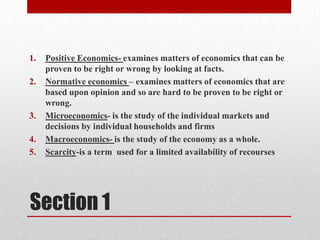
Positive Economics- examines matters of economics that can be proven to be right or wrong by looking at facts.Normative economics – examines matters of economics that are based upon opinion and so are hard to be proven to be right or wrong. Microeconomics- is the study of the individual markets and decisions by individual households and firmsMacroeconomics- is the study of the economy as a whole.Scarcity-is a term  used for a limited availability of recoursesSection 1
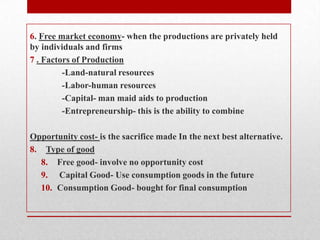
6. Free market economy- when the productions are privately held by individuals and firms7. Factors of Production	-Land-natural resources	-Labor-human resources	-Capital- man maid aids to production-Entrepreneurship- this is the ability to combineOpportunity cost- is the sacrifice made In the next best alternative.Type of goodFree good- involve no opportunity cost Capital Good- Use consumption goods in the futureConsumption Good- bought for final consumption
11. Production possibility Curve (PPC)- shows the maximum combination of goods and services which can be produced given the existing levels of resources.-Actual output- the production of goods and services in the economy achieved in a certain period of time-Potential output- the possible production that would be achieved if the available factors were employed.-Actual Growth- when unemployed factors of production are brought into use-Potentialgrown-when the quantity or quality of factors of production within an economy increases-Economic Growth- growth of real output in an economy  12. Economic development- concept involving improvement in standards of living, reduction in poverty, improved health, and improved education- Sustainable development- is the economic development that meets its needs of the present without compromising the ability of the future generation to meet their needs.
Section 21. Market- where consumers and producers come together to establish a price where each are happy with for a good or service.2.Demand is the willingness and ability to purchase a quantity of a good or service at a certain price over a given time of periodLaw of demand-states as the price of good or service rises, the actual quantity demanded decrease.Demand curve is a representation of the law of demand.3. Supply- is the willingness and ability of a producer to produce a quantity of a good or service at a certain price over a certain period of timeLaw of supply – states that as a price of a good rises, the quantity supplied will increase as well.
Supply Curve-is the curve of representation between the price and quantity supplied4. Equilibrium price- is the market clearing price; demand is equal to supply5. Maximum price- aka ‘ceiling price’ is the set price by the government, in which sellers are not allowed to rise the price above. 6. Minimum price- aka ‘floor price’ is set by the government, in which the price is not allowed to be bellow a certain price. 7. Buffer stock scheme- sets a maximum and minimum price in the market to stabilize prices.
ELASTICIES 8.Price elasticity of demand (PED) is the measure of the responsiveness of the quantity demanded of a good or service to a change in its priceA. -Elastic demand- means that the change in the price of the good or service will cause a larger change in the quantity demandedB. -Inelastic demand-means that a change in the price of the good or service will cause a small change in the quantity demanded.9. Cross elasticity of demand (XED) measure of the responsiveness of the demand for a good or service to a change in the price of a related goodA. Substitute goods- is goods that can be used instead of another such as coke and Pepsi. Substitute good has positive cross elasticity of demandB. Complement goods- goods which are used together, such as calculator and batteries. Complement goods have negative cross elasticity of demand.
10. Income Elasticity of demand (YED) is a measure of the responsiveness of demand for a good to a change in income.A Normal good- Has a positive income elasticity of demand. As income rises, demand increasesB. Inferior goods- have a negative income elasticity of demand. As income rises, demand decreases. 11. Price elasticity of supply (PES)- is a measure of the responsiveness of the quantity supplied of a good or service to a change in its priceA. Indirect tax- Is an expenditure tax on a good or serviceB. Incidence (burden)- tax refers to the amount of tax paid by the producer or the consumer.
THEORY OF THE FIRM12. Fixed cost- are costs of production that do not change with the level of the output. A. Variable costs- are costs of production that vary with the level of  outputB Total cots- are the total costs of producing a certain level of output fixed costs plus the variable cotsC Average cots is the average total costs of production per unit. D. Marginal costs- is the additional costs of producing an additional unit of output13. Short run- period of time in which at least one factor of production is fixedA. Law of diminishing average return-  as extra units of a variable factor are applied to a fixed factor, the output per unit of the variable factor will eventually diminishB. Law of diminishing marginal returns- As extra units of a variable factor are applied to a fixed factor, the output from each additional unit of variable factor will eventually diminish
14.The long run- is the period of time in which all factors of production are variableA. Economies of scale- are any fall in long run unit costs that come about as a result of a firm increasing its scale of productionB Diseconomies of scale- are any increase in long run unit costs that come about as a result of a firm increasing its scale of production.15. Total revenue- Is the aggregated revenue gained by a firm from the scale of a particular quantity of output.A. Average revenue- is the total revenue received divided by the number of units sold. Usually the price is equal to average revenue. B. Marginal revenue-is the extra revenue gained from selling an additional unit of a good or service
16. Normal profit-  s are the amount of revenue needed to cover the total costs of production, including the opportunity costs.A. Abnormal profits- are any level of profit that is greater than the required to ensure that a firm will continue to supply its existing good or service. B. Profit maximizing level of output –the level of output where marginal revenue is equal to marginal costs.17. Shut down price-  is the price where the average revenue is equal to average variable costs. Below this price, the firm or company will shut down in the short run.18. The break even price is the price where average revenue is equal to the average total cost.

Vocab

  • 1.
  • 2.
    Positive Economics- examinesmatters of economics that can be proven to be right or wrong by looking at facts.Normative economics – examines matters of economics that are based upon opinion and so are hard to be proven to be right or wrong. Microeconomics- is the study of the individual markets and decisions by individual households and firmsMacroeconomics- is the study of the economy as a whole.Scarcity-is a term used for a limited availability of recoursesSection 1
  • 3.
    6. Free marketeconomy- when the productions are privately held by individuals and firms7. Factors of Production -Land-natural resources -Labor-human resources -Capital- man maid aids to production-Entrepreneurship- this is the ability to combineOpportunity cost- is the sacrifice made In the next best alternative.Type of goodFree good- involve no opportunity cost Capital Good- Use consumption goods in the futureConsumption Good- bought for final consumption
  • 4.
    11. Production possibilityCurve (PPC)- shows the maximum combination of goods and services which can be produced given the existing levels of resources.-Actual output- the production of goods and services in the economy achieved in a certain period of time-Potential output- the possible production that would be achieved if the available factors were employed.-Actual Growth- when unemployed factors of production are brought into use-Potentialgrown-when the quantity or quality of factors of production within an economy increases-Economic Growth- growth of real output in an economy 12. Economic development- concept involving improvement in standards of living, reduction in poverty, improved health, and improved education- Sustainable development- is the economic development that meets its needs of the present without compromising the ability of the future generation to meet their needs.
  • 5.
    Section 21. Market-where consumers and producers come together to establish a price where each are happy with for a good or service.2.Demand is the willingness and ability to purchase a quantity of a good or service at a certain price over a given time of periodLaw of demand-states as the price of good or service rises, the actual quantity demanded decrease.Demand curve is a representation of the law of demand.3. Supply- is the willingness and ability of a producer to produce a quantity of a good or service at a certain price over a certain period of timeLaw of supply – states that as a price of a good rises, the quantity supplied will increase as well.
  • 6.
    Supply Curve-is thecurve of representation between the price and quantity supplied4. Equilibrium price- is the market clearing price; demand is equal to supply5. Maximum price- aka ‘ceiling price’ is the set price by the government, in which sellers are not allowed to rise the price above. 6. Minimum price- aka ‘floor price’ is set by the government, in which the price is not allowed to be bellow a certain price. 7. Buffer stock scheme- sets a maximum and minimum price in the market to stabilize prices.
  • 7.
    ELASTICIES 8.Price elasticityof demand (PED) is the measure of the responsiveness of the quantity demanded of a good or service to a change in its priceA. -Elastic demand- means that the change in the price of the good or service will cause a larger change in the quantity demandedB. -Inelastic demand-means that a change in the price of the good or service will cause a small change in the quantity demanded.9. Cross elasticity of demand (XED) measure of the responsiveness of the demand for a good or service to a change in the price of a related goodA. Substitute goods- is goods that can be used instead of another such as coke and Pepsi. Substitute good has positive cross elasticity of demandB. Complement goods- goods which are used together, such as calculator and batteries. Complement goods have negative cross elasticity of demand.
  • 8.
    10. Income Elasticityof demand (YED) is a measure of the responsiveness of demand for a good to a change in income.A Normal good- Has a positive income elasticity of demand. As income rises, demand increasesB. Inferior goods- have a negative income elasticity of demand. As income rises, demand decreases. 11. Price elasticity of supply (PES)- is a measure of the responsiveness of the quantity supplied of a good or service to a change in its priceA. Indirect tax- Is an expenditure tax on a good or serviceB. Incidence (burden)- tax refers to the amount of tax paid by the producer or the consumer.
  • 9.
    THEORY OF THEFIRM12. Fixed cost- are costs of production that do not change with the level of the output. A. Variable costs- are costs of production that vary with the level of outputB Total cots- are the total costs of producing a certain level of output fixed costs plus the variable cotsC Average cots is the average total costs of production per unit. D. Marginal costs- is the additional costs of producing an additional unit of output13. Short run- period of time in which at least one factor of production is fixedA. Law of diminishing average return- as extra units of a variable factor are applied to a fixed factor, the output per unit of the variable factor will eventually diminishB. Law of diminishing marginal returns- As extra units of a variable factor are applied to a fixed factor, the output from each additional unit of variable factor will eventually diminish
  • 10.
    14.The long run-is the period of time in which all factors of production are variableA. Economies of scale- are any fall in long run unit costs that come about as a result of a firm increasing its scale of productionB Diseconomies of scale- are any increase in long run unit costs that come about as a result of a firm increasing its scale of production.15. Total revenue- Is the aggregated revenue gained by a firm from the scale of a particular quantity of output.A. Average revenue- is the total revenue received divided by the number of units sold. Usually the price is equal to average revenue. B. Marginal revenue-is the extra revenue gained from selling an additional unit of a good or service
  • 11.
    16. Normal profit- s are the amount of revenue needed to cover the total costs of production, including the opportunity costs.A. Abnormal profits- are any level of profit that is greater than the required to ensure that a firm will continue to supply its existing good or service. B. Profit maximizing level of output –the level of output where marginal revenue is equal to marginal costs.17. Shut down price- is the price where the average revenue is equal to average variable costs. Below this price, the firm or company will shut down in the short run.18. The break even price is the price where average revenue is equal to the average total cost.