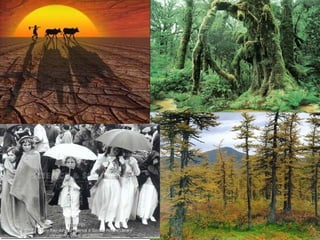
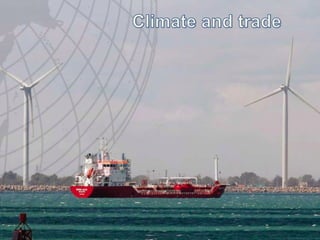
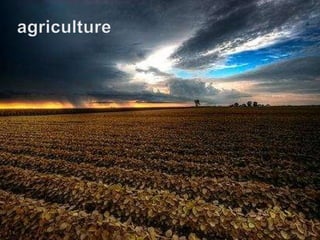
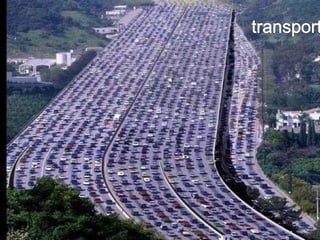
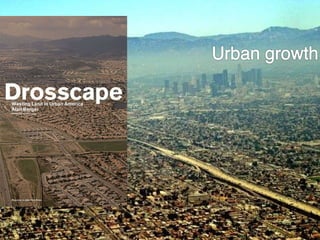
How to think about climate change? Vladimir Jankovic Center for the History of Science, Technology and Medicine University of Manchester
 
 
Climate in a narrow sense is usually defined as the “average weather”, or more rigorously, as the statistical description in terms of the mean and variability of relevant quantities over a period of time ranging from months to thousands or millions of years. The classical period is 30 years, as defined by the World Meteorological Organization ’ (IPCC).
 
‘…  it necessarily follows that there must be one which is the best of all […] Now this principle upon which depends our whole system, being once well established, it will be easy to ascertain which one of these degrees of heat and of the temperature of the air is best adapted to evoke abundantly from the earth – and  without much labour or expense   – everything essential to life.’
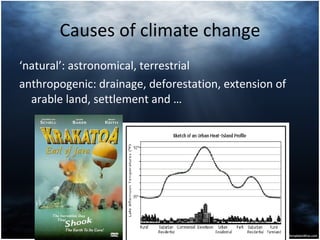
Causes of climate change ‘ natural’: astronomical, terrestrial anthropogenic: drainage, deforestation, extension of arable land, settlement and …
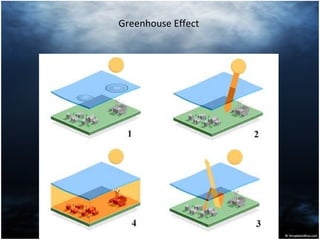
Greenhouse Effect
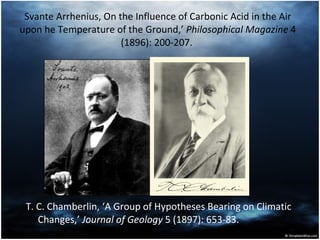
Svante Arrhenius, On the Influence of Carbonic Acid in the Air upon he Temperature of the Ground,’  Philosophical Magazine  4 (1896): 200-207.  T. C. Chamberlin, ‘A Group of Hypotheses Bearing on Climatic Changes,’  Journal of Geology  5 (1897): 653-83.
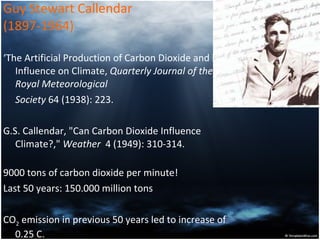
Guy Stewart Callendar  (1897-1964) ‘ The Artificial Production of Carbon Dioxide and its Influence on Climate,  Quarterly Journal of the Royal Meteorological  Society  64 (1938): 223. G.S. Callendar, "Can Carbon Dioxide Influence Climate?,"  Weather   4 (1949): 310-314. 9000 tons of carbon dioxide per minute! Last 50 years: 150.000 million tons CO 2  emission in previous 50 years led to increase of 0.25 C.
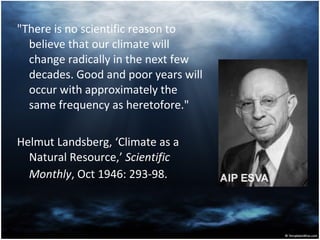
"There is no scientific reason to believe that our climate will change radically in the next few decades. Good and poor years will occur with approximately the same frequency as heretofore."  Helmut Landsberg, ‘Climate as a Natural Resource,’  Scientific Monthly , Oct 1946: 293-98.
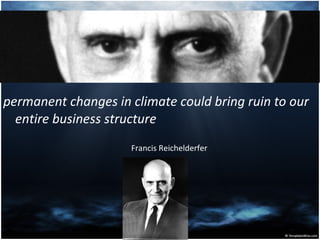
permanent changes in climate could bring ruin to our entire business structure  Francis Reichelderfer
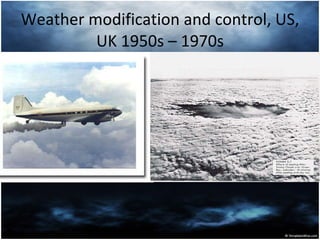
Weather modification and control, US, UK 1950s – 1970s
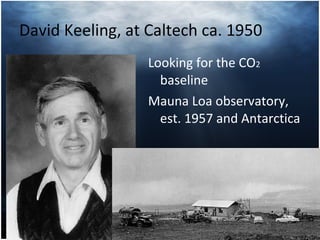
David Keeling, at Caltech ca. 1950 Looking for the CO 2  baseline Mauna Loa observatory, est. 1957 and Antarctica
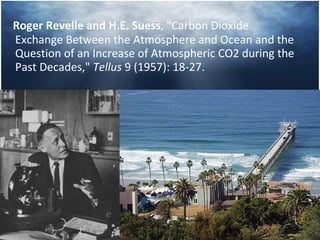
Roger Revelle and H.E. Suess , "Carbon Dioxide Exchange Between the Atmosphere and Ocean and the Question of an Increase of Atmospheric CO2 during the Past Decades,"  Tellus  9 (1957): 18-27.
‘ Human beings are now carrying out a large scale geophysical experiment of a kind that could not have happened in the past nor be reproduced in the future. Within a few centuries we are returning to the atmosphere and oceans the concentrated organic carbon stored in sedimentary rocks over hundreds millions of years.’ Revelle, Suess, 1957
 
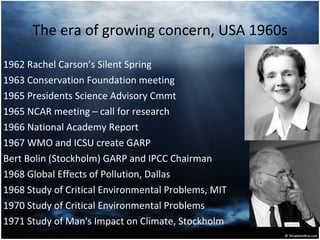
The era of growing concern, USA 1960s 1962 Rachel Carson’s Silent Spring 1963 Conservation Foundation meeting 1965 Presidents Science Advisory Cmmt 1965 NCAR meeting – call for research  1966 National Academy Report 1967 WMO and ICSU create GARP  Bert Bolin (Stockholm) GARP and IPCC Chairman 1968 Global Effects of Pollution, Dallas   1968   Study of Critical Environmental Problems, MIT 1970 Study of Critical Environmental Problems 1971 Study of Man's Impact on Climate , Stockholm
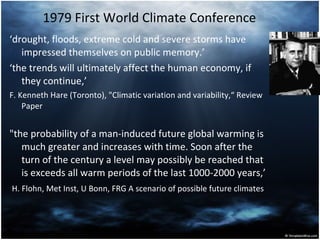
1979 First World Climate Conference ‘ drought, floods, extreme cold and severe storms have impressed themselves on public memory.’  ‘ the trends will ultimately affect the human economy, if they continue,’ F. Kenneth Hare (Toronto), "Climatic variation and variability,“ Review Paper "the probability of a man-induced future global warming is much greater and increases with time. Soon after the turn of the century a level may possibly be reached that is exceeds all warm periods of the last 1000-2000 years,’ H. Flohn, Met Inst, U Bonn, FRG A scenario of possible future climates
Declaration it is now necessary for the nations of the world :  to take full advantage of man's present knowledge of climate;  to take steps to improve significantly that knowledge;  to foresee and to prevent potential man-made changes in climate that might be adverse to the well-being of humanity.  ‘ there is serious concern that the continued expansion of man’s activities […] may cause significant extended regional and even global changes of climate.’
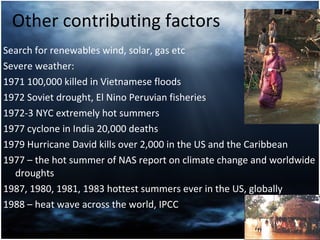
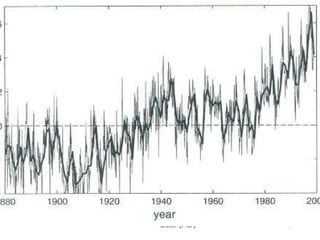
Other contributing factors Search for renewables wind, solar, gas etc Severe weather:  1971 100,000 killed in Vietnamese floods  1972 Soviet drought, El Nino Peruvian fisheries 1972-3 NYC extremely hot summers 1977 cyclone in India 20,000 deaths 1979 Hurricane David kills over 2,000 in the US and the Caribbean  1977 – the hot summer of NAS report on climate change and  worldwide droughts 1987, 1980, 1981, 1983 hottest summers ever in the US, globally 1988 – heat wave across the world, IPCC
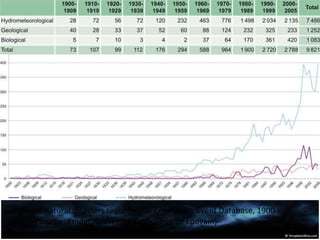
Number of natural disasters registered in Emergency Event Database, 1900 – 2005 (Source: Emdat, Universite Catholique de Louvain)  
 
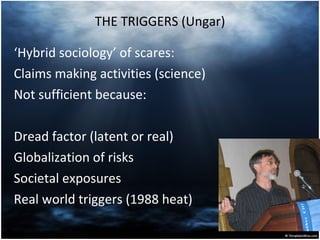
THE TRIGGERS (Ungar) ‘ Hybrid sociology’ of scares: Claims making activities (science) Not sufficient because: Dread factor (latent or real) Globalization of risks Societal exposures Real world triggers (1988 heat)
 
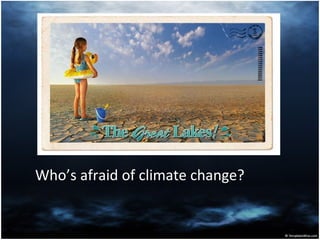
Who’s afraid of climate change?


Insurance and financial sector
 
 
‘ The ideal situation for system control is a closed system that does not feel the environment.’  Thomas Hughes  Thomas Hughes

Course 7/7 Vladimir jankovic

  • 1.
    How to thinkabout climate change? Vladimir Jankovic Center for the History of Science, Technology and Medicine University of Manchester
  • 2.
  • 3.
  • 4.
    Climate in anarrow sense is usually defined as the “average weather”, or more rigorously, as the statistical description in terms of the mean and variability of relevant quantities over a period of time ranging from months to thousands or millions of years. The classical period is 30 years, as defined by the World Meteorological Organization ’ (IPCC).
  • 5.
  • 6.
    ‘… itnecessarily follows that there must be one which is the best of all […] Now this principle upon which depends our whole system, being once well established, it will be easy to ascertain which one of these degrees of heat and of the temperature of the air is best adapted to evoke abundantly from the earth – and without much labour or expense – everything essential to life.’
  • 7.
    Causes of climatechange ‘ natural’: astronomical, terrestrial anthropogenic: drainage, deforestation, extension of arable land, settlement and …
  • 8.
  • 9.
    Svante Arrhenius, Onthe Influence of Carbonic Acid in the Air upon he Temperature of the Ground,’ Philosophical Magazine 4 (1896): 200-207. T. C. Chamberlin, ‘A Group of Hypotheses Bearing on Climatic Changes,’ Journal of Geology 5 (1897): 653-83.
  • 10.
    Guy Stewart Callendar (1897-1964) ‘ The Artificial Production of Carbon Dioxide and its Influence on Climate, Quarterly Journal of the Royal Meteorological Society 64 (1938): 223. G.S. Callendar, "Can Carbon Dioxide Influence Climate?," Weather 4 (1949): 310-314. 9000 tons of carbon dioxide per minute! Last 50 years: 150.000 million tons CO 2 emission in previous 50 years led to increase of 0.25 C.
  • 11.
    "There is noscientific reason to believe that our climate will change radically in the next few decades. Good and poor years will occur with approximately the same frequency as heretofore." Helmut Landsberg, ‘Climate as a Natural Resource,’ Scientific Monthly , Oct 1946: 293-98.
  • 12.
    permanent changes inclimate could bring ruin to our entire business structure Francis Reichelderfer
  • 13.
    Weather modification andcontrol, US, UK 1950s – 1970s
  • 14.
    David Keeling, atCaltech ca. 1950 Looking for the CO 2 baseline Mauna Loa observatory, est. 1957 and Antarctica
  • 15.
    Roger Revelle andH.E. Suess , "Carbon Dioxide Exchange Between the Atmosphere and Ocean and the Question of an Increase of Atmospheric CO2 during the Past Decades," Tellus 9 (1957): 18-27.
  • 16.
    ‘ Human beingsare now carrying out a large scale geophysical experiment of a kind that could not have happened in the past nor be reproduced in the future. Within a few centuries we are returning to the atmosphere and oceans the concentrated organic carbon stored in sedimentary rocks over hundreds millions of years.’ Revelle, Suess, 1957
  • 17.
  • 18.
    The era ofgrowing concern, USA 1960s 1962 Rachel Carson’s Silent Spring 1963 Conservation Foundation meeting 1965 Presidents Science Advisory Cmmt 1965 NCAR meeting – call for research 1966 National Academy Report 1967 WMO and ICSU create GARP Bert Bolin (Stockholm) GARP and IPCC Chairman 1968 Global Effects of Pollution, Dallas 1968 Study of Critical Environmental Problems, MIT 1970 Study of Critical Environmental Problems 1971 Study of Man's Impact on Climate , Stockholm
  • 19.
    1979 First WorldClimate Conference ‘ drought, floods, extreme cold and severe storms have impressed themselves on public memory.’ ‘ the trends will ultimately affect the human economy, if they continue,’ F. Kenneth Hare (Toronto), "Climatic variation and variability,“ Review Paper "the probability of a man-induced future global warming is much greater and increases with time. Soon after the turn of the century a level may possibly be reached that is exceeds all warm periods of the last 1000-2000 years,’ H. Flohn, Met Inst, U Bonn, FRG A scenario of possible future climates
  • 20.
    Declaration it isnow necessary for the nations of the world : to take full advantage of man's present knowledge of climate; to take steps to improve significantly that knowledge; to foresee and to prevent potential man-made changes in climate that might be adverse to the well-being of humanity. ‘ there is serious concern that the continued expansion of man’s activities […] may cause significant extended regional and even global changes of climate.’
  • 21.
    Other contributing factorsSearch for renewables wind, solar, gas etc Severe weather: 1971 100,000 killed in Vietnamese floods 1972 Soviet drought, El Nino Peruvian fisheries 1972-3 NYC extremely hot summers 1977 cyclone in India 20,000 deaths 1979 Hurricane David kills over 2,000 in the US and the Caribbean 1977 – the hot summer of NAS report on climate change and worldwide droughts 1987, 1980, 1981, 1983 hottest summers ever in the US, globally 1988 – heat wave across the world, IPCC
  • 22.
    Number of naturaldisasters registered in Emergency Event Database, 1900 – 2005 (Source: Emdat, Universite Catholique de Louvain)  
  • 23.
  • 24.
    THE TRIGGERS (Ungar)‘ Hybrid sociology’ of scares: Claims making activities (science) Not sufficient because: Dread factor (latent or real) Globalization of risks Societal exposures Real world triggers (1988 heat)
  • 25.
  • 26.
    Who’s afraid ofclimate change?
  • 27.
  • 28.
  • 29.
  • 30.
  • 31.
  • 32.
  • 33.
  • 34.
  • 35.
  • 36.
  • 37.
    ‘ The idealsituation for system control is a closed system that does not feel the environment.’ Thomas Hughes Thomas Hughes